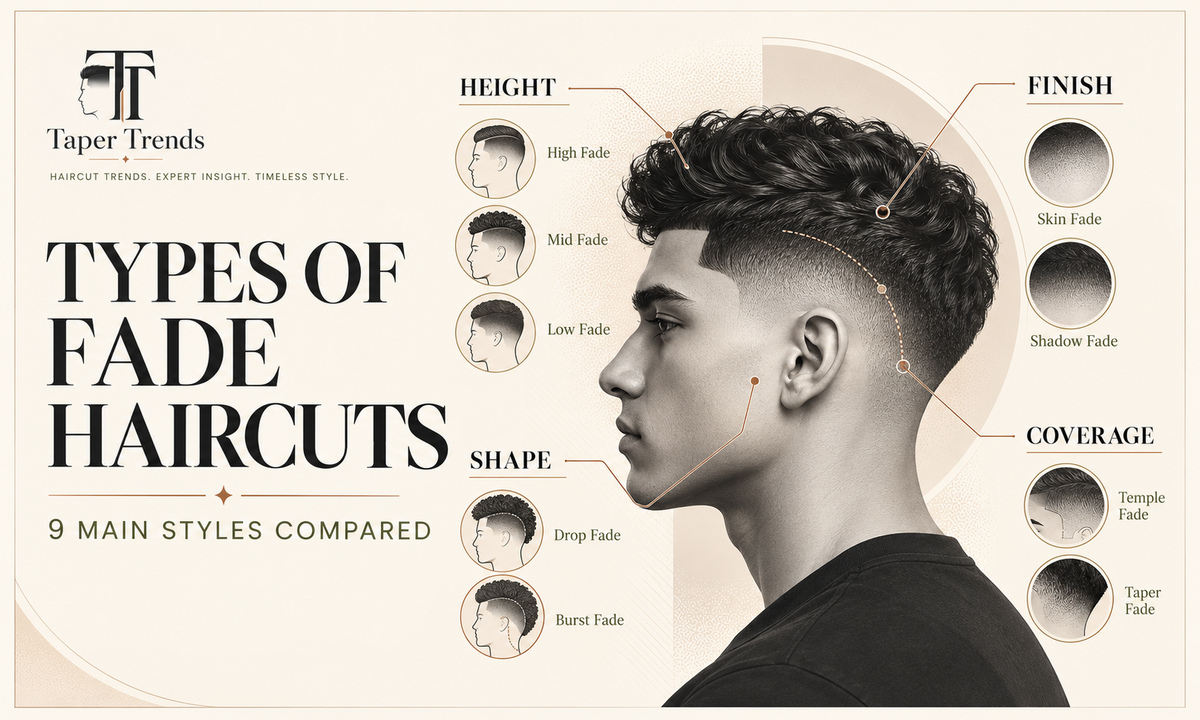
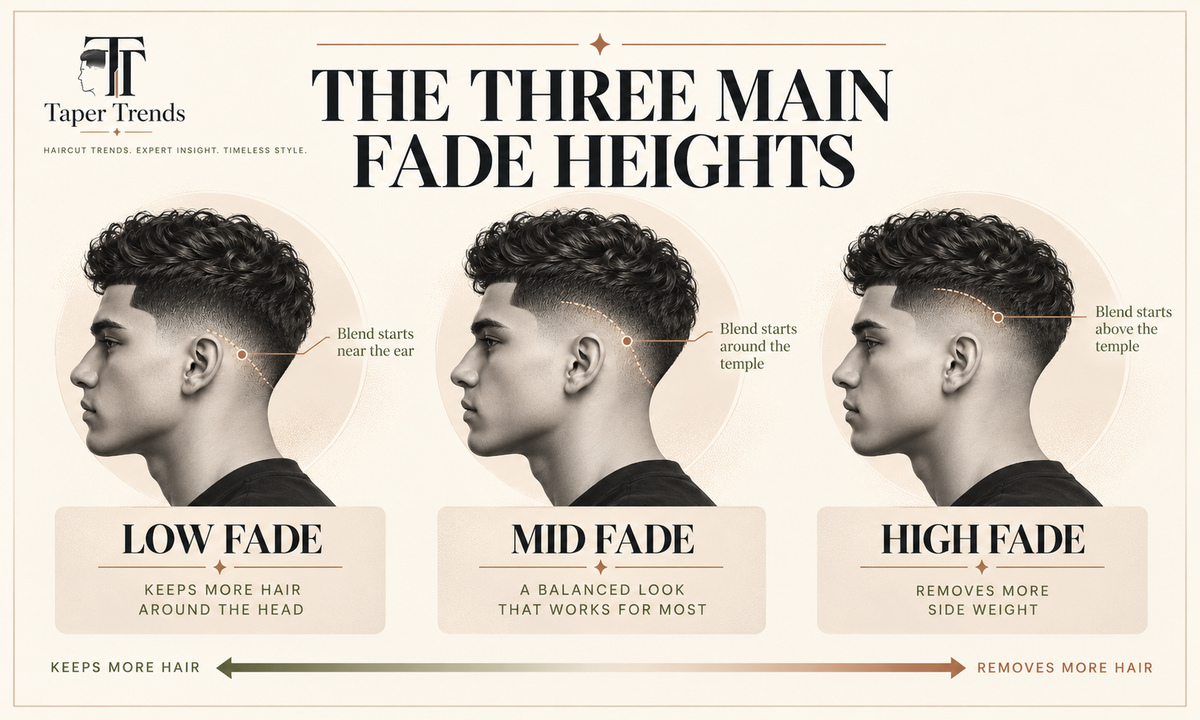
Most fade names answer one of four questions: how high the blend climbs, how short it finishes, what shape it follows, and how much of the head it covers. Low, mid, and high fades set the height. Skin and shadow fades set the finish. Drop and burst fades change the shape around the ear, while temple fades and tapers limit how much of the side gets shortened. Because those are separate choices, one haircut can carry three labels at once.
Want the same ground covered as a straight tour of every name? Our different kinds of fades overview takes that route, and the complete low taper fade haircuts guide goes deepest on the most popular starting point.
What is a fade haircut, and how do the types differ?
A fade haircut is a cut where the hair on the sides and back gets gradually shorter from top to bottom, sometimes all the way to bare skin. The different types exist because each name describes one part of that gradient: where it starts, how short it ends, what line it follows, and how much of the head it covers.
The fade only concerns the sides and back; the style on top is a separate decision. A good fade has no visible step between lengths, which barbers call blending. Wahl's fade tutorial builds one by moving from a longer guide comb to a shorter one and blending each section into the next, and it separates low, mid, and high fades by where the line starts on the side of the head. If you want to see the finished shape before you book, our guide to what a low taper fade looks like walks through it from every angle.
One caution before the details: barbers don't all use these words the same way. Treat the names as shorthand that starts the conversation, and use a photo to finish it, as our guide on how to ask for a fade explains. The barber brief generator turns your choices into a card you can show in the chair.
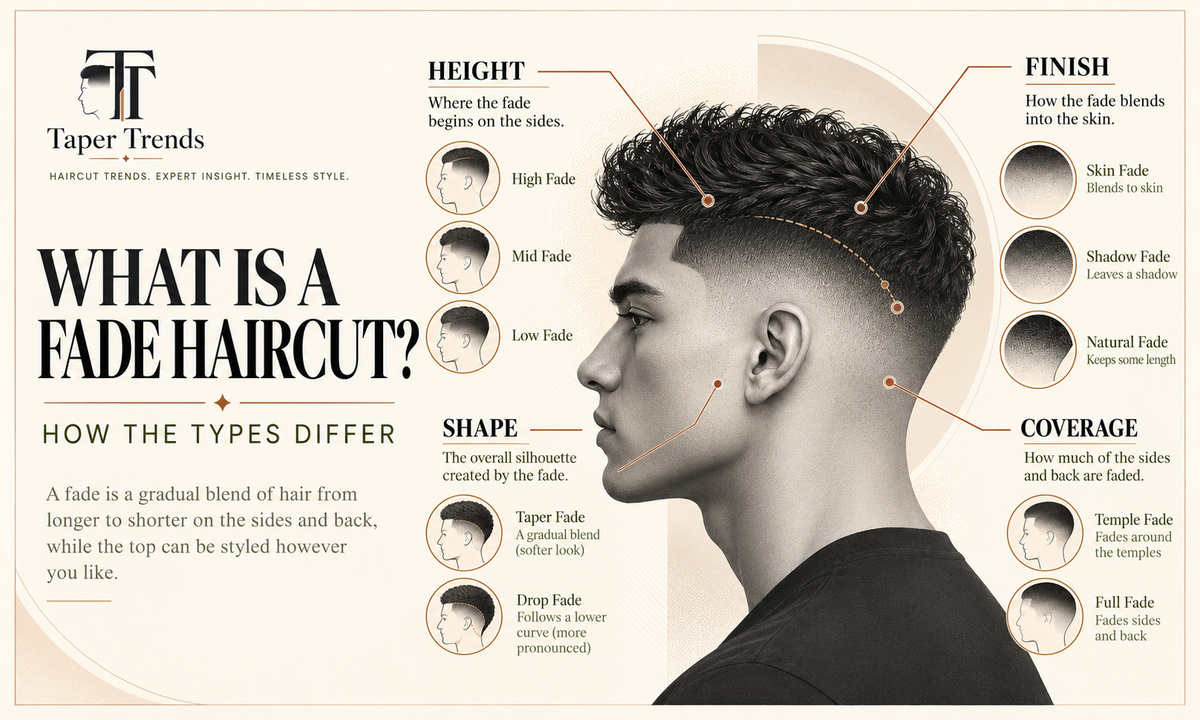
Types of fade haircuts at a glance
Nine labels cover most fade requests. They fall into four groups, height, finish, shape, and coverage, plus the taper, which is a closely related technique. You'll often stack them. A “mid skin drop fade” names a height, a finish, and a shape in one request, so there's no need to pick just one.
| Fade type | Defining feature | Group |
|---|---|---|
| Low | Blend starts near the ear and nape | Height |
| Mid | Blend starts around the temple | Height |
| High | Blend starts above the temple | Height |
| Skin / bald | Shortest point is bare scalp | Finish |
| Shadow | Short visible hair at the bottom | Finish |
| Drop | Blend line dips behind the ear | Shape |
| Burst | Blend arcs around the ear | Shape |
| Temple | Blending kept to the temples and sideburns | Coverage |
| Taper | Shortening mostly at the sideburns and nape | Related technique |
Each name in the table links to its own full guide. For head-to-head comparisons, see taper vs fade, skin fade vs taper fade, drop fade vs burst fade, and burst fade vs taper fade.
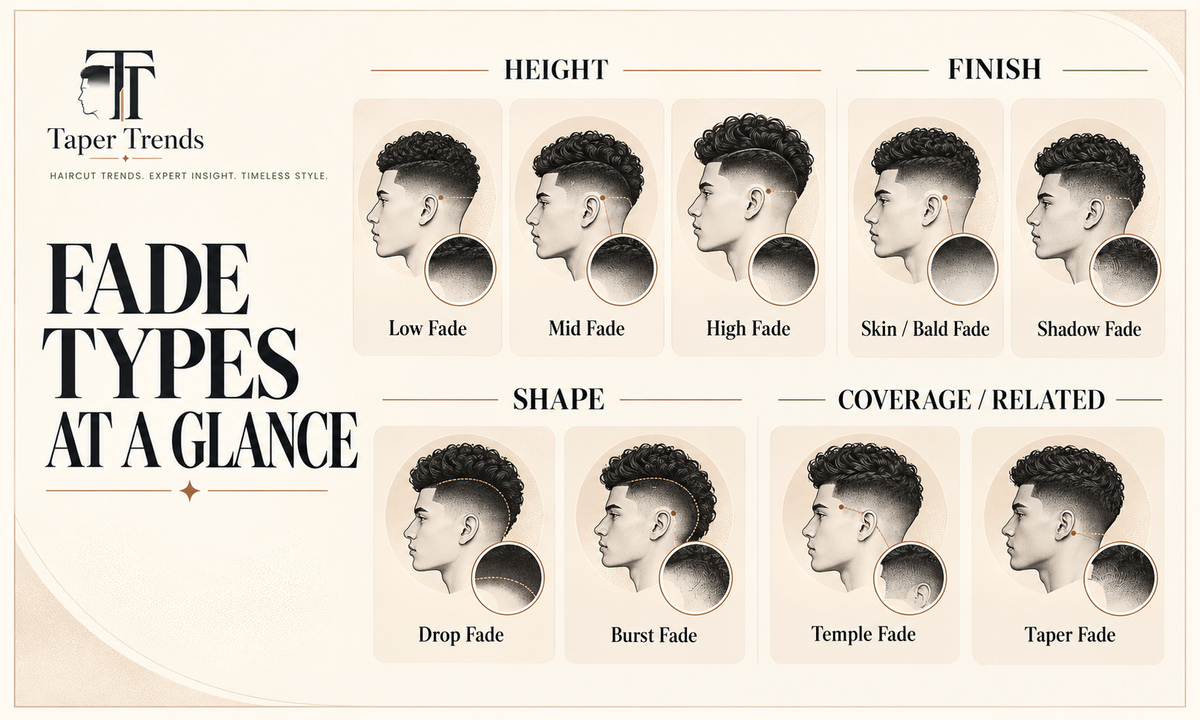
What are the three main fade heights?
Low, mid, and high describe where the blend starts on the side of the head, not how short the hair gets at the bottom. The higher a fade starts, the more weight comes off the sides and the more the top stands out. Lower fades keep more hair around the head and look quieter, as our low vs mid vs high fade comparison shows side by side.
Low fade haircut
A low fade starts the blend close to the ear and the nape, so most of the side keeps its length. Wahl describes it as the less dramatic option, which is a big part of why it's such a common first fade.
Because so much side weight stays, a low fade sits comfortably under longer tops, side parts, and textured crops, and it grows out gently. The bottom can finish at skin or at short visible hair. A clear request sounds like this: “Low fade starting just above the ear, shadow finish, leave the length on top.” Our low taper fade guide is the pillar for this height, and low drop fade and low taper vs low fade cover two common variations.
Mid fade haircut
A mid fade starts the blend around the temple, between the low and high positions. Wahl treats it as the middle ground. It removes noticeably more side weight than a low fade while keeping enough hair that the sides don't read as shaved.
That balance suits short and medium tops alike. Its weakness is the word itself, since one barber's “mid” can sit noticeably higher than another's. Name a landmark instead: “starting at the temple” is clearer than “medium.” The mid taper fade guide and mid drop fade go deeper, and low taper vs mid taper fade and low mid taper fade help you pick the step between them.
High fade haircut
A high fade starts above the temple, so the short section wraps well up the side and the top becomes the focus. Wahl notes that the higher starting point is what draws attention to the hair on top. It gives the strongest contrast of the three heights.
There are trade-offs. A high fade shows more of your head's shape, including flat spots or old scars. Growth also shows sooner: Zürich barbershop The Good Barbers estimates a high fade stays crisp for about two to three weeks, against three to four for a low fade. How much scalp shows is still a separate choice, set by the finish. See the high taper fade guide, high drop fade, and high burst fade, and compare heights in mid taper vs high taper fade and low taper vs high taper fade.
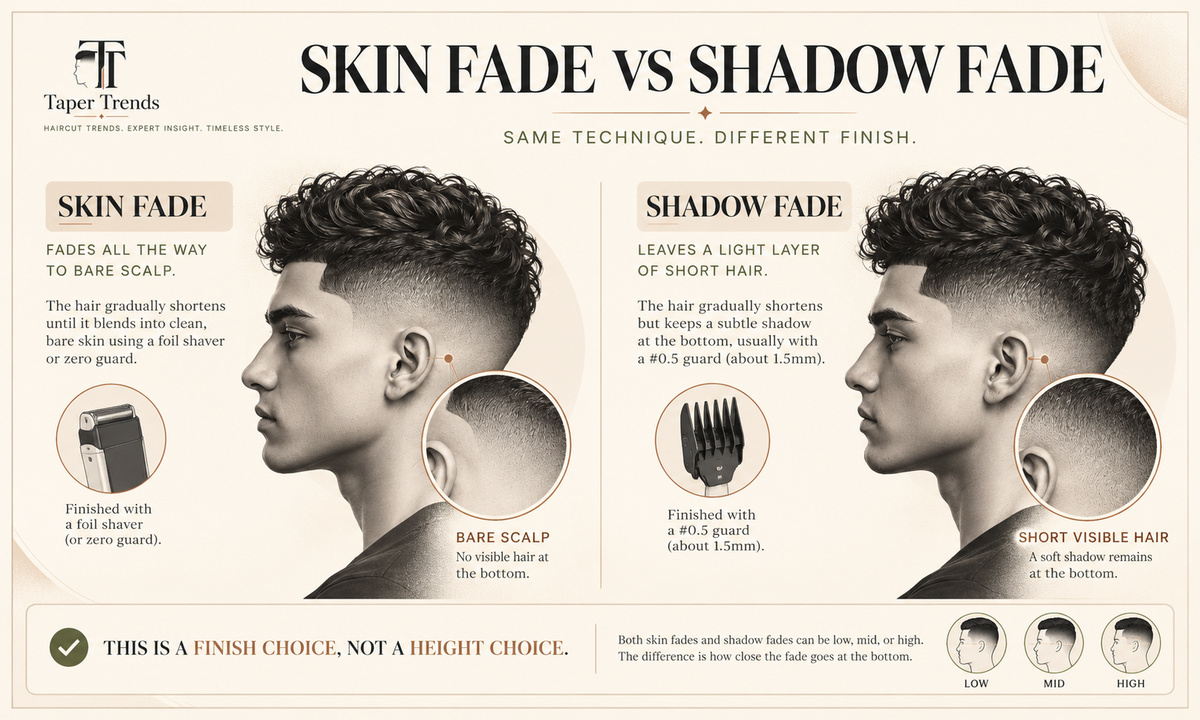
What is the difference between a skin fade and a shadow fade?
A skin fade, also called a bald fade, blends down to bare scalp at its shortest point. A shadow fade stops at short visible hair. Both describe the finish, not the height, so either one can be low, mid, or high. The practical difference is how much skin shows and how quickly regrowth becomes noticeable. Our low vs mid vs high skin fade comparison shows how height changes the picture.
Skin fade or bald fade
A skin fade takes the bottom of the blend to bare skin, often with a foil shaver or razor. Barber Fern Andong told Behind the Chair that a foil shaver can create a bald fade without a straight razor. Close shaving can irritate skin, and the American Academy of Dermatology warns that untreated razor bumps can leave permanent grooves and raised scars. The skin fade guide covers bump-safe care in full, and the fade pairs with other contexts in skin fade curly hair and skin fade with a beard.
Shadow fade or guarded fade
A shadow fade, sometimes called a guarded fade, leaves a thin layer of hair at the bottom instead of bare scalp. It looks softer, grows out more gradually, and skips the closest shave, which many people with irritation-prone skin prefer. Shops define “shadow” differently, so name the shortest guard you want rather than relying on the label. The full shadow fade guide explains which guard makes it.
How do drop, burst, temple, and taper fades differ?
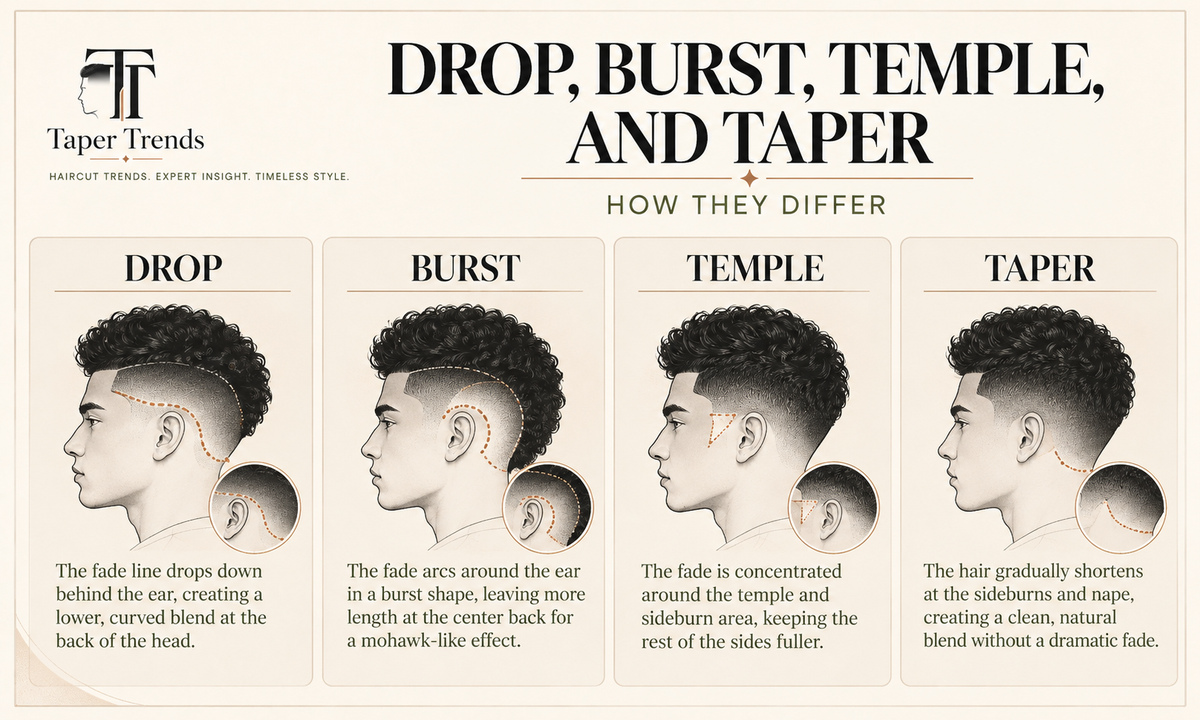
These four names describe the path of the blend, not its starting height. A drop fade dips behind the ear, a burst fade curves around it, a temple fade stays near the temples and sideburns, and a taper shortens mostly the edges. Any of them can still be cut low, mid, or high.
Drop fade
A drop fade runs at one height across the front of the side, then curves down behind the ear toward the neckline instead of continuing straight around the head, as The Good Barbers describes it. Because the line descends at the back, more weight stays above it, which suits textured and curly tops. Height and finish are still separate, so “low skin drop fade” is a normal request. Start with the drop fade guide, then see low taper drop fade, drop fade curly hair, drop fade straight hair, drop fade for Black men, and drop fade textured fringe.
Burst fade
A burst fade arcs in a half circle around the ear and leaves the back of the head longer. The Good Barbers calls it the standard partner for a mohawk or mullet, since it shortens the sides without touching the length at the nape. The real difference from a drop fade is what happens behind the ear: a burst releases the back, while a drop carries the fade down into it. Our drop fade vs burst fade comparison shows the two side by side.
The burst fade haircut guide is the place to start, with mid burst fade for the middle height. It also has dedicated guides for curly hair, straight hair, Black men, the Edgar cut, boys, and a textured fringe.
Temple fade or temp fade
A temple fade concentrates the blend at the temples and sideburns, often with a cleaned-up neckline, while the rest of the side stays longer. It gives a sharp front edge without a full fade around the head. Some barbers say “taper” or “temp” for very similar cuts, so bring a photo and ask what will stay long. The temp fade guide covers where it starts and stops.
Taper fade
A taper usually shortens only the sideburns and neckline and leaves most of the side near its natural length. The Good Barbers points out that shops use “taper” and “fade” differently and suggests a photo over the name alone. A taper tends to grow out softly. If you want the whole side blended instead, say “fade” and give a height. Our taper haircut guide and taper fade guide cover the classic, low, mid, and high versions, and taper vs fade settles the difference. If you want a visible break between the sides and top instead of any blend, undercut vs fade covers that choice.
Which fade works with your hair texture and top style?
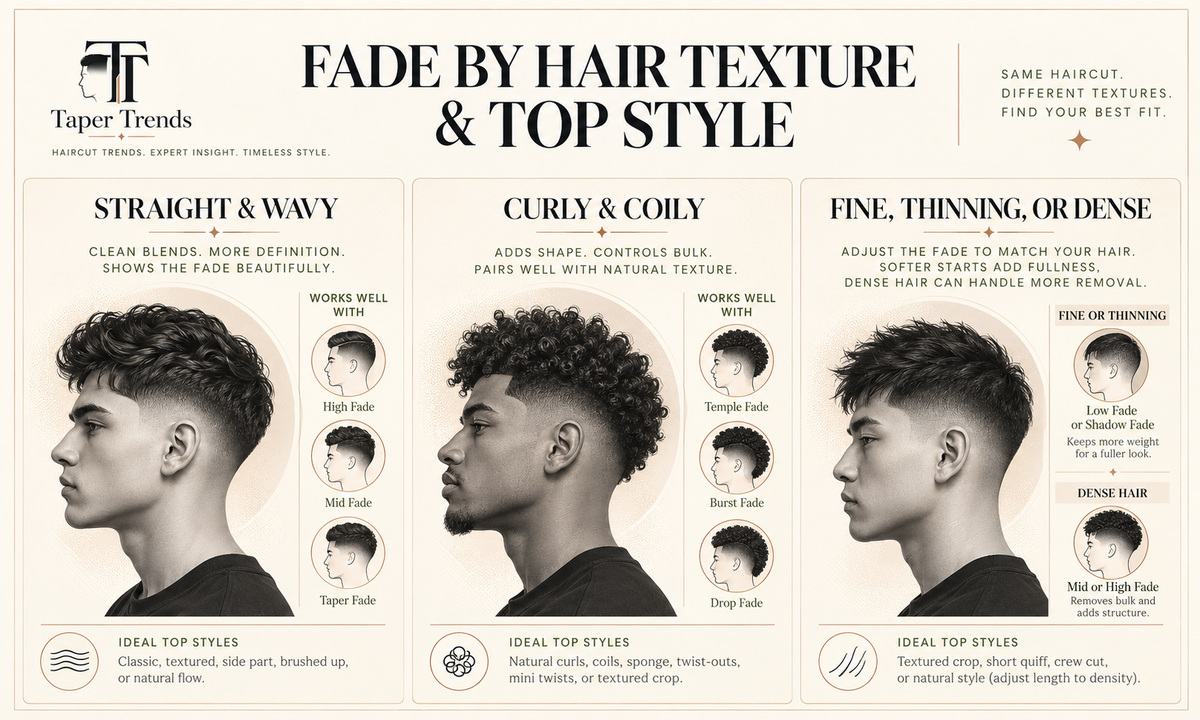
No fade is automatically right for one hair texture. Start with the top: how long it is, how it sits, and how much support it needs from the sides. Then choose the height, shape, and finish that protect that silhouette. The same mid fade can look neat on straight hair and boxy on dense curls.
Straight and wavy hair
Straight and wavy hair show the transition clearly, so blend quality matters more. Low and mid fades work well with crops, fringes, side parts, and longer swept tops, because the sides stay tidy without losing the weight that holds the top in place. Ask your barber to check how the top falls over the blend line before finishing. See low taper fade wavy hair, low taper fade for straight hair, mid taper fade wavy hair, and mid taper fade straight hair, plus top styles like the side part, French crop, textured fringe, and slick back.
Curly and coily hair
Temple, burst, drop, and full fades can all sit under curls, coils, twists, or a shaped top. Ask how much the top will shrink as it dries, since curls spring up shorter. The AAD explains that coarse, curly hairs cut very short can curve back into the skin, so if you get razor bumps, a shadow finish is the gentler choice. Our guides to the curly low taper fade, mid taper fade curly hair, high taper fade curly hair, low taper fade Afro, high taper fade Afro, and low taper fade with dreads cover each case.
Fine, thinning, or very dense hair
A fade changes how full the sides look, but it can't add hair. On fine or thinning hair, a skin finish or high blend can expose more scalp at the temples, while a shadow finish or lower start keeps the edge softer. Very dense hair often looks better with more bulk taken off the sides. The guide to thin and thick hair shows how the cut shifts for each.
Which fade complements your head shape and preferred contrast?
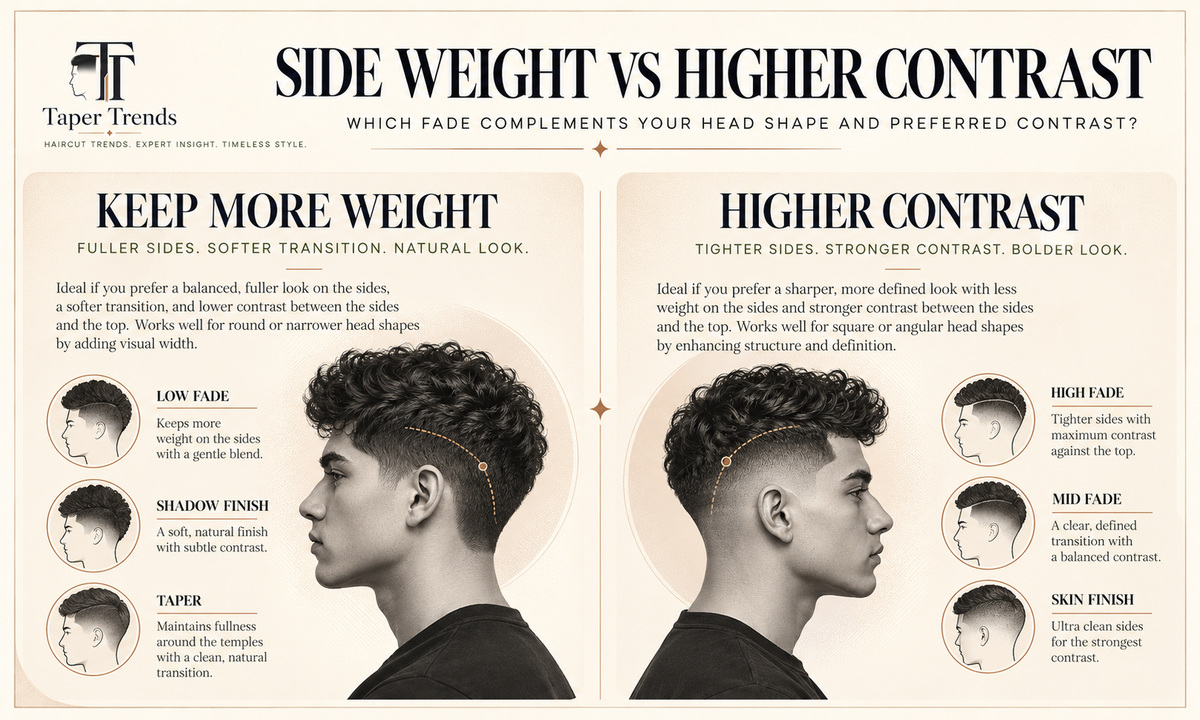
Choose by what you see in the mirror, not by a face-shape chart. Side width, top height, ear position, and hairline decide how a fade reads, and higher contrast makes the sides look smaller next to the top. Treat any shape-based advice as a starting point to test with your barber, not a rule. If you want a second opinion, the face shape detector can give you a starting point to bring along, and our best fade for your face shape guide compares the heights shape by shape.
When should you keep more weight on the sides?
Keep more side weight if you want a subtle change, wear a longer top, or like natural fullness around the ears. A low fade, a shadow finish, or a taper leaves hair through the sides, so the transition looks soft and less scalp shows. It's also the forgiving choice if you can't get back to the barber often. The low taper fade for medium length hair and low taper fade comb over guides show it in practice.
When should you choose a higher-contrast fade?
Go higher if you want the top to dominate, prefer very short sides, or have side hair that puffs out. A mid or high fade, especially with a skin finish, removes more weight and sharpens the line between the sides and the top. The cost is upkeep and exposure: more of your head shows, and regrowth shows sooner. Confirm height and finish separately before cutting starts. The blowout taper fade guide shows how a lifted top works with this kind of contrast.
What fade works with a beard or longer hair at the back?
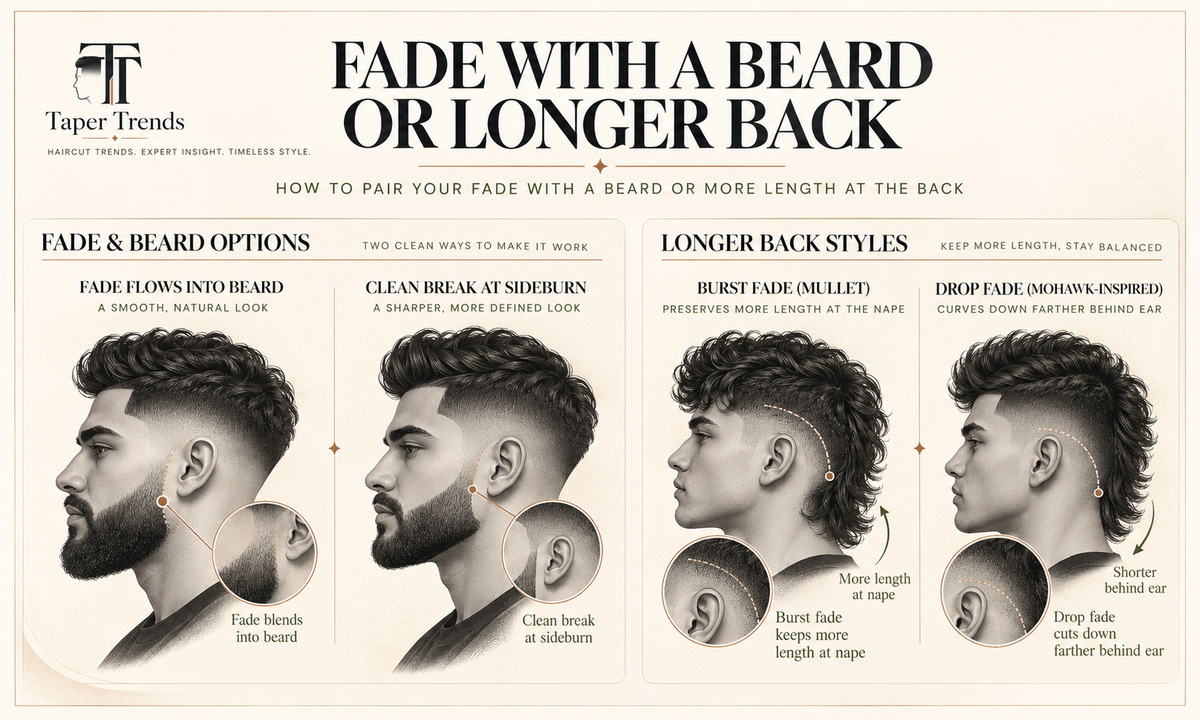
Decide what you want to keep before choosing the fade. With a beard, the question is whether the sideburn blends into the facial hair or breaks cleanly. With longer hair at the back, the contour decides how much length survives at the nape. Settle those first, then pick a height and finish.
Fade haircut with a beard
The sideburn is the bridge. A blended connection carries the fade down into the beard as one continuous gradient, while a separated look leaves a visible break where the sideburn ends. Beard density and where the beard starts on the cheek affect which looks cleaner. Tell your barber the sideburn length, whether the beard should blend into the cut, and where you want any line. Detailed versions live in low taper fade with beard, mid taper fade with beard, high taper fade with beard, skin fade with beard, drop fade with beard, and burst fade with beard.
Burst or drop fade with a mullet or mohawk
Both contours work with longer styles, but they leave different amounts of hair at the back. A burst can leave the nape untouched, which is why it's the usual mullet partner. A drop shortens more toward the neckline. If rear length matters, say exactly how much should stay. See burst fade mullet, drop fade mullet, low taper fade mullet, burst fade mohawk, low taper fade mohawk, and long hair low taper fade.
How do you ask your barber for the exact fade you want?
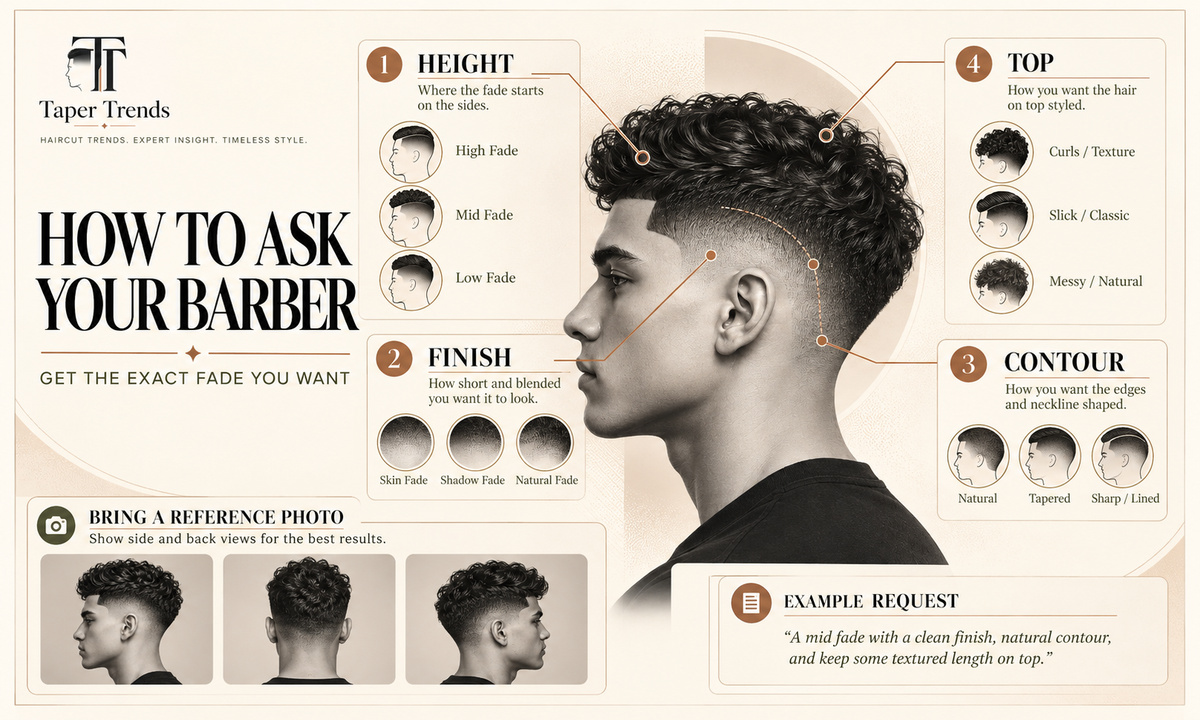
Describe the fade in four parts, height, finish, contour, and top, and back it up with photos. A single label like “skin fade” leaves half the haircut undecided. Cover all four before any cutting starts.
Describe the height, finish, contour, and top
- Height:low, mid, or high, tied to a landmark such as “just above the ear” or “at the temple.”
- Finish: bare skin, or a specific short guard.
- Contour, if you want one: drop, burst, or temple.
- Top: the style and how much length stays.
Put together, it sounds like this:
“Mid drop fade starting at the temple, down to a #1, keep about two inches on top, blend the sideburns.”
Show reference photos and confirm the side and back
Bring photos of the side and the back. The front view says the least about a fade, and The Good Barbers notes that the back and neckline are where most misunderstandings happen. Before cutting begins, confirm:
- What happens at the sideburns and nape
- How long the top stays
- Whether the hair in the photo matches yours in texture and density
If you won't be back for six weeks, say so; a barber can shape the fade to grow out more gracefully. The barber brief generator builds the whole request into one card, and the low taper fade with design guide covers what to say when you also want a line or pattern.
How short should the fade be, and what do clipper guards mean?
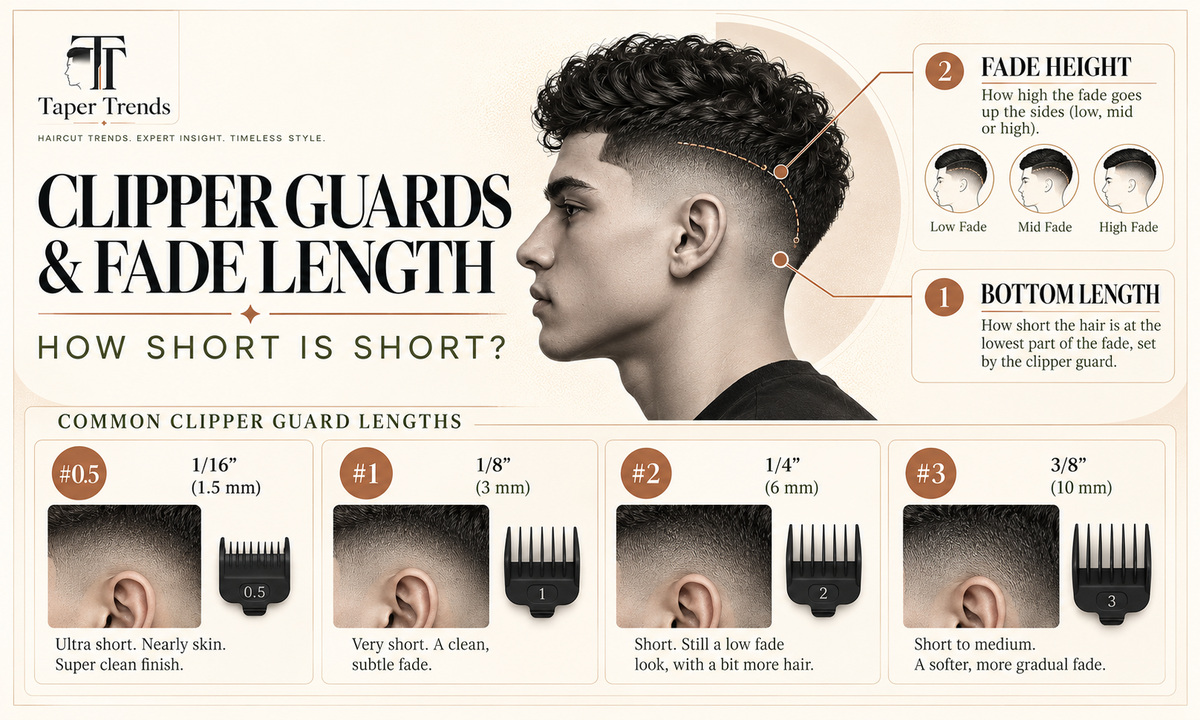
Clipper guard numbers (our haircut numbers guidecovers them in full) control how much hair is left behind, and higher numbers leave more. Guards don't set fade height, which is where the blend starts, and a no-guard clipper pass isn't the same as a shaved skin finish. Ask your barber which guard, or which tool, will sit at the very bottom of the blend.
What lengths do common clipper guards leave?
Wahl's clipper guard size chart lists these nominal lengths:
| Guard | Length |
|---|---|
| #1/2 | 1/16 in (about 1.6 mm) |
| #1 | 1/8 in (about 3 mm) |
| #2 | 1/4 in (about 6 mm) |
| #3 | 3/8 in (about 10 mm) |
| #4 | 1/2 in (about 13 mm) |
Treat these as reference points, not a fading recipe. Other brands can differ, and Wahl explains that the taper lever on many clippers adjusts closeness between guard sizes, which our how to cut a fade guide puts to work step by step and our best clippers for fades guide compares model by model. Bare skin takes a separate step, such as a foil shaver. The clipper guard sizes tool lists every size and converts it to millimeters, and the low taper fade buzz cut guide shows how guards map to real cuts.
How often should you maintain a fade haircut?
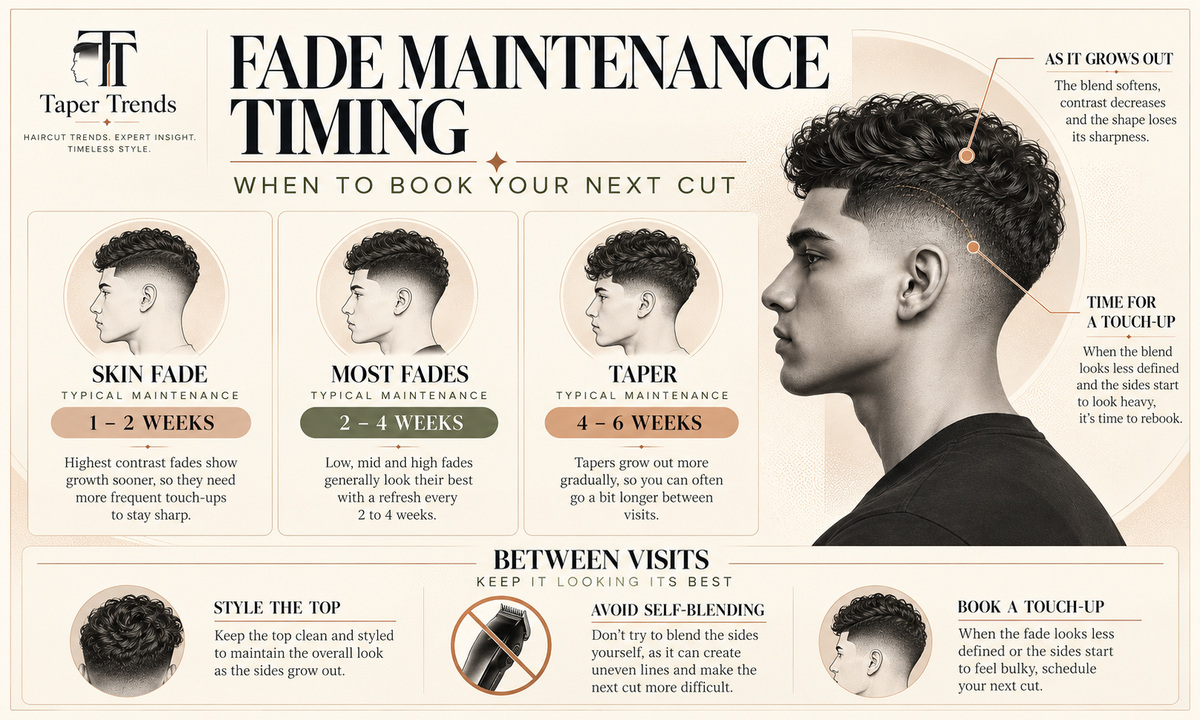
Most fades stay sharp for roughly two to four weeks, but the right interval depends on the finish, the height, and how crisp you like the blend. The Good Barbers estimates one to two weeks for a skin fade and four to six for a taper. Treat those as estimates, and rebook when the blend stops looking clean.
What changes as a fade grows out?
As hair grows, the shortest sections catch up with the rest, so the gradient softens and the edges at the sideburns and neckline fill in. Skin finishes change soonest, because a few millimeters of regrowth is obvious against bare scalp. High fades show growth faster than low ones for the same reason. For a plan to let it all grow out, see how to grow out a fade.
What should you do between barber visits?
- Style the top as usual; it carries the look while the sides soften.
- Leave the blend to your barber, since clipping a gradient you can't see is an easy way to ruin it.
- If you shave any area, follow the AAD's advice to shave softened hair in the direction it grows.
- Book a touch-up when the blend loses its edge; our guide to how often you should get a haircut gives a starting window for each fade.
Our step-by-step guide to styling a low taper fade walks through the top-side routine for every texture.
What mistakes should you avoid when choosing a fade?
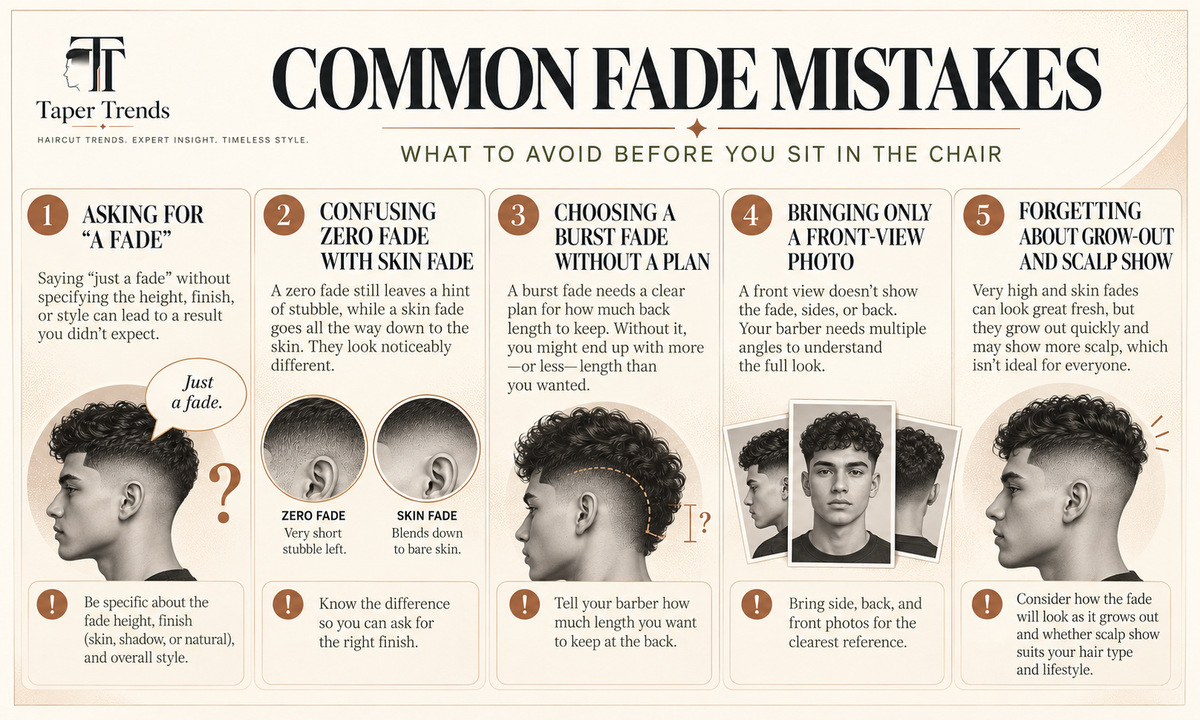
Most fade disappointments come from details nobody specified, and when one happens, how to fix a bad fade shows what is still possible. Avoid these:
- Asking for “a fade” with no height, finish, or contour
- Assuming a zero fade and a skin fade are the same thing
- Requesting a burst without saying how much length stays at the back
- Bringing only a front-view photo
- Forgetting about grow-out and how much scalp will show in two weeks
If you're torn between a fade and something softer, read skin fade vs taper fade and low taper vs low fade before you book.
FAQs about types of fade haircuts
Is a zero fade always the same as a skin fade?
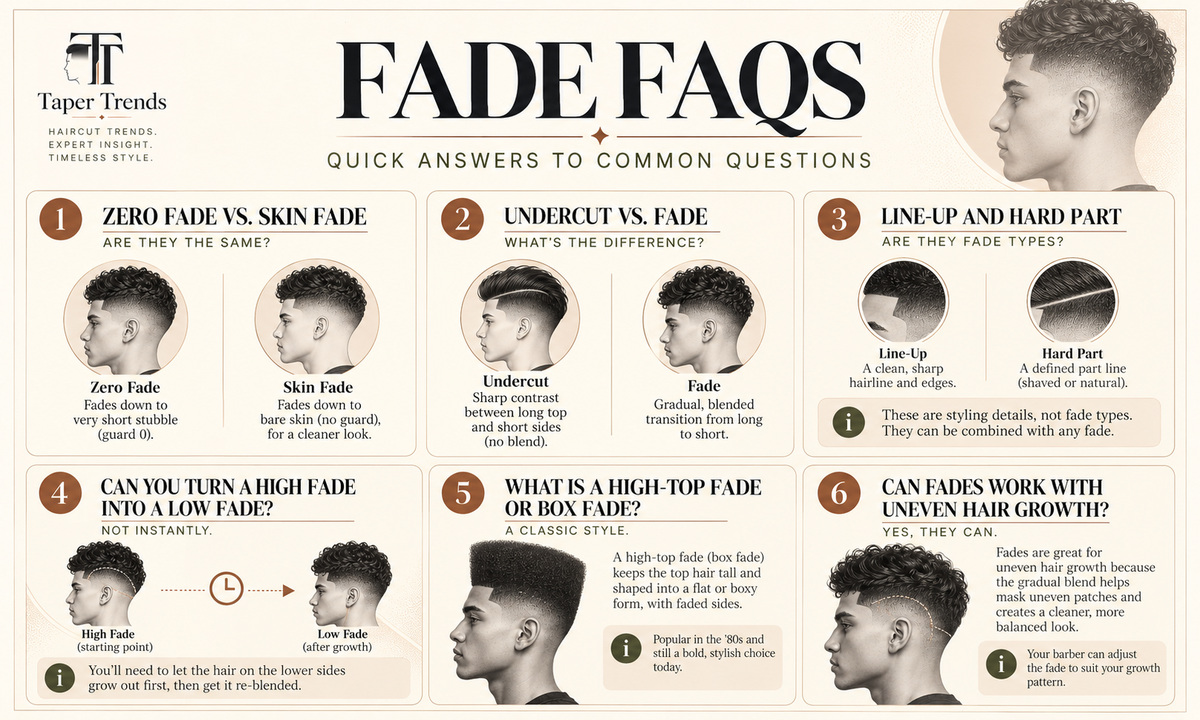
Not always. “Zero” usually means a clipper with no guard at its closest setting, which can leave a faint shadow depending on the blade. A skin fade reaches bare scalp, often finished with a foil shaver. Some shops use the two words interchangeably, so confirm the tool and how close you expect the finish to be.
Is an undercut the same thing as a fade?
No. A fade blends gradually from short to long. A classic undercut keeps the sides at one short length and leaves a visible disconnection beneath a longer top. The two can be combined in a faded undercut, so tell your barber whether you want the change between sides and top blended or deliberately visible.
Are a line-up and hard part types of fades?
No. A line-up, also called an edge-up, sharpens the edges of the hairline, and a hard part is a defined line cut into the hair on top. Both are add-on details that can accompany any fade height or finish, so mention them separately from the fade itself.
Can a high fade be changed to a low fade immediately?
No. A barber can't put back hair that's already been cut short high on the head, so moving to a low fade means letting the sides grow first. In the meantime, a barber can usually soften the transition. Ask for an honest assessment before anything more comes off.
What is a high-top fade or box fade?
A high-top, sometimes called a box fade, names the top: tall, dense, usually coily hair shaped into a flat-topped block. The fade underneath forms the sides and back and can be any height or finish, so bring a photo and specify it separately.
Can a fade work if your hair grows unevenly around the head?
Usually, yes. A barber can move the blend line to work around cowlicks, uneven hairlines, or patches that grow in different directions, though perfect symmetry may not be realistic. Point out the areas that behave differently before cutting begins.
Which fade should you try first?
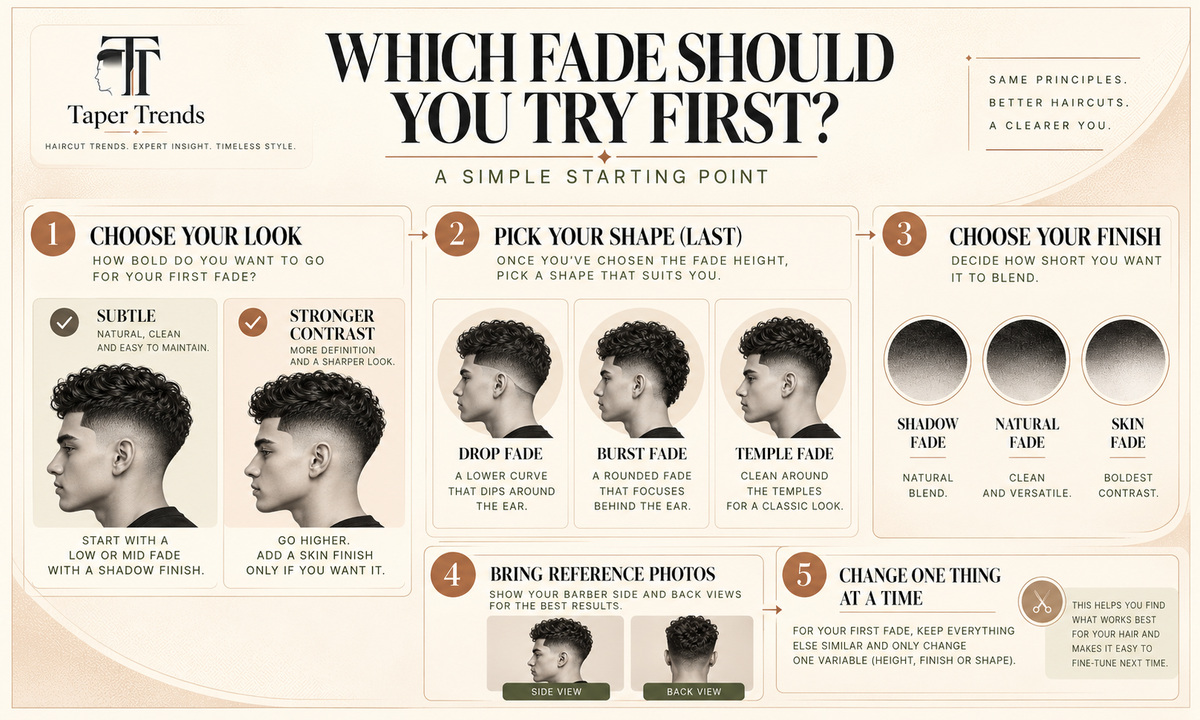
Decide how much side weight you want to keep and how much scalp you're comfortable showing. For a subtle change, start with a low or mid fade and a shadow finish. For strong contrast, go higher, adding skin only if you want it. Choose a drop, burst, or temple shape last, bring side and back photos, and change one variable per visit.
From here, the low taper fade haircuts guide is the easiest next step, and the different kinds of fades overview gives a second route through the same names.
The bottom line
The types of fade haircuts are not nine separate cuts. They are answers to four questions: how high, how short, what shape, and how much of the head. Change one answer and you change the haircut.
Name the height with a landmark, the finish with a guard, the contour if you want one, and the top you're keeping. Bring side and back photos, and the fade you picture is the fade you get.
Want more fade guides?
Browse clean, barber-ready breakdowns for every hair type.