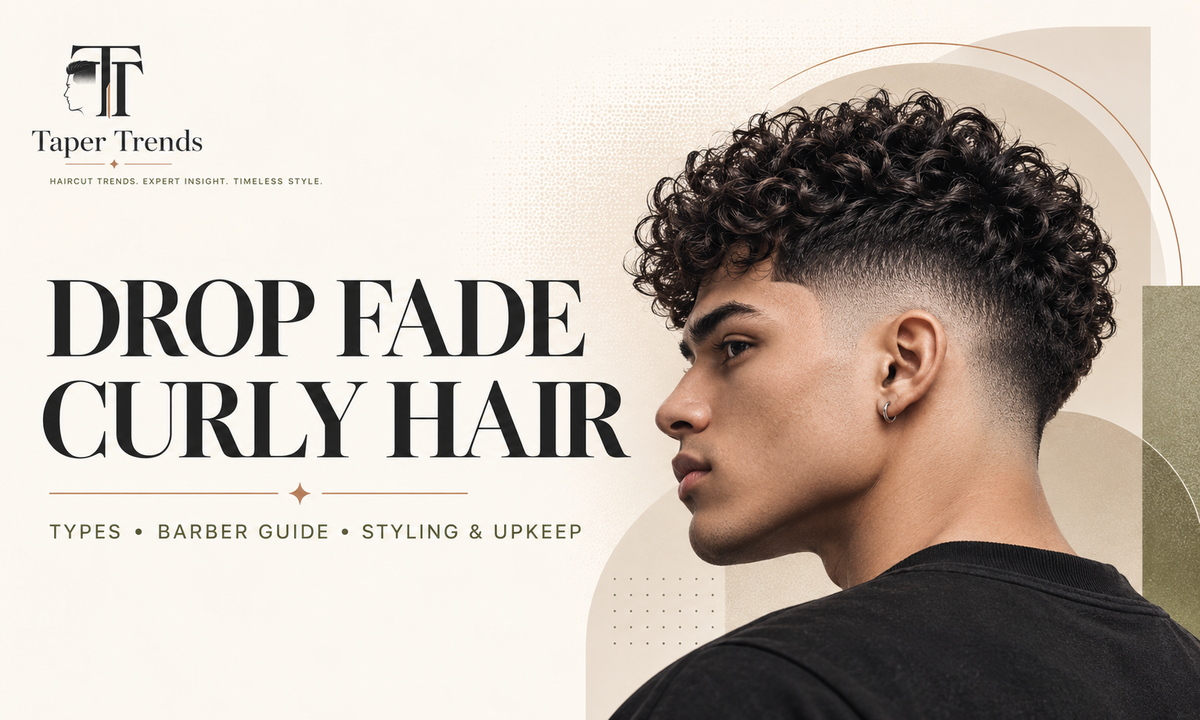
A drop fade on curly hair is a fade whose line curves down behind the ear and continues toward the nape, instead of running level around the head, while the curls on top stay long enough to hold their shape. The drop can start low, mid or high, and it can finish at skin or at a guard length. What makes it a drop is the curve. If you want the broader picture first, our complete drop fade guide covers every hair type in one place, and the low taper fade haircuts guide is the hub for every taper and fade style on the site.
That curve is also why the cut suits curls so well, and why it goes wrong so often. Curly hair shrinks as it dries, carries more bulk at the sides, and hides mistakes until the next morning. This guide covers how a drop differs from a taper or a burst, how to pick your height, base and top shape, what to say in the chair, and how to keep the cut looking deliberate between visits.
What is a drop fade on curly hair?
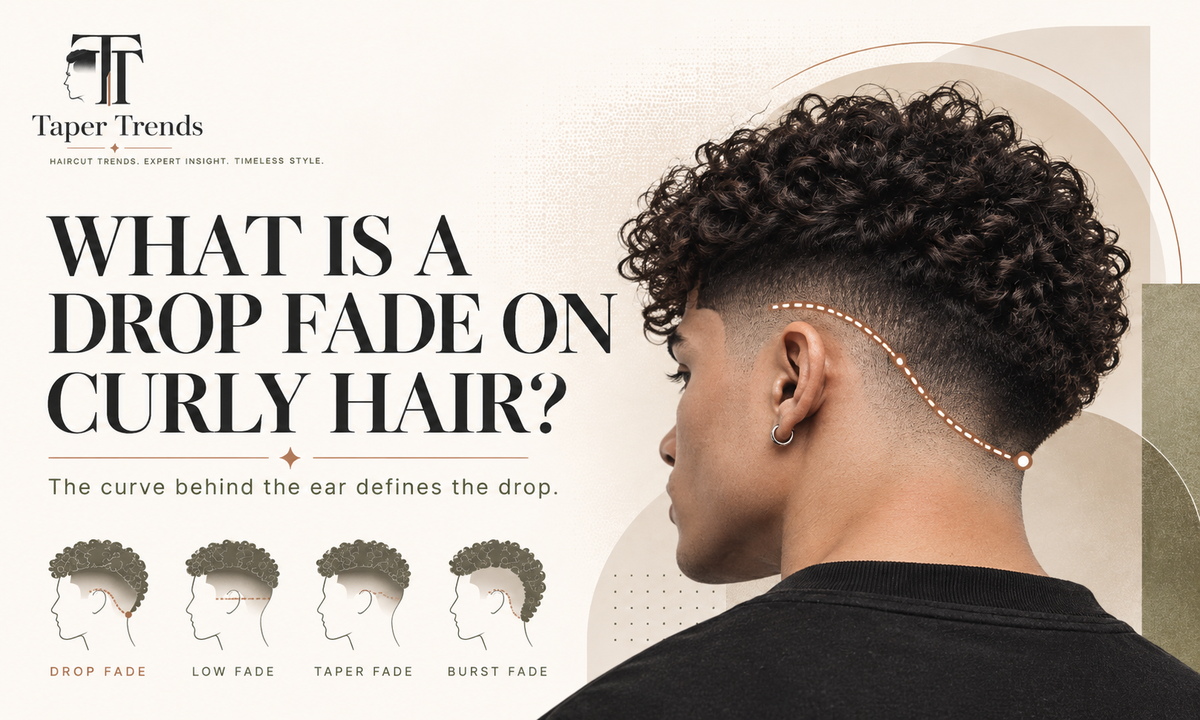
A drop fade on curly hair is a fade that dips lower as it travels from the temple around the back of the ear, then follows the neckline toward the nape, with a fuller curly top above it. Height, base length and top shape are separate choices. Only the curved path defines the drop.
On straight hair, the curve is mostly a styling detail, as our drop fade for straight hair guide shows. On curly hair it does real work. Curls pack volume above and behind the ears, and a level fade line can leave a hard step under a rounded top. Dropping the line behind the ear takes weight out of that area and lets the outline follow the shape of the head rather than cut across it.
One practical consequence: the drop is hard to see from the front. A front-facing photo of a curly fade can look the same whether the line drops or runs straight. The side and back are where this haircut reveals itself, which matters later when you choose reference photos.
Drop fade vs low fade, taper fade and burst fade
These names describe different properties, which is why they get mixed up. Low, mid and high describe where a fade starts, so a mid fade begins around the temple. Drop and burst describe the shape of the line. A taper describes how much of the head gets shortened. Shops don't all use these terms identically, so pair any name with a photo.
| Term | What it describes | Behind the ear | Back and nape |
|---|---|---|---|
| Drop fade | Shape of the fade line | Curves downward | Continues around to the nape |
| Low, mid or high fade | Starting height | Not specified by the name | Not specified by the name |
| Taper | Where the shortening happens | Short mainly at the edges | Short mainly at the neckline |
| Burst fade | Shape of the fade line | Half-moon around the ear | Usually left longer |
Because height and shape are different labels, they stack. A low drop fade and a high drop fade are both drops; they just start at different heights. Skin isn't a shape either. A drop fade can finish at bare skin or at a guard.
The taper is where curly-haired clients most often end up choosing between two things they thought were the same. A taper concentrates the shortening at the sideburns and neckline and leaves more length through the sides, so it reads softer and grows out gently. Some tapers go to skin right at the edge. The difference is how little of the head they cover.
The burst is the closer lookalike. From the front, a burst fade and a drop fade can look identical. From behind, a burst stops arcing once it clears the ear and leaves more hair at the nape, while a drop keeps curving along the back. If you want the back tight, you want the drop; our drop fade vs burst fade guide covers the rear-photo test in full. If you want the curve with a long back, ask for a drop fade mullet, which stops the drop behind the ear. If your hair leans curly and you're still weighing the two shapes, our burst fade curly hair guide covers that arc in the same amount of detail.
Why does a drop fade behave differently on curly and coily hair?
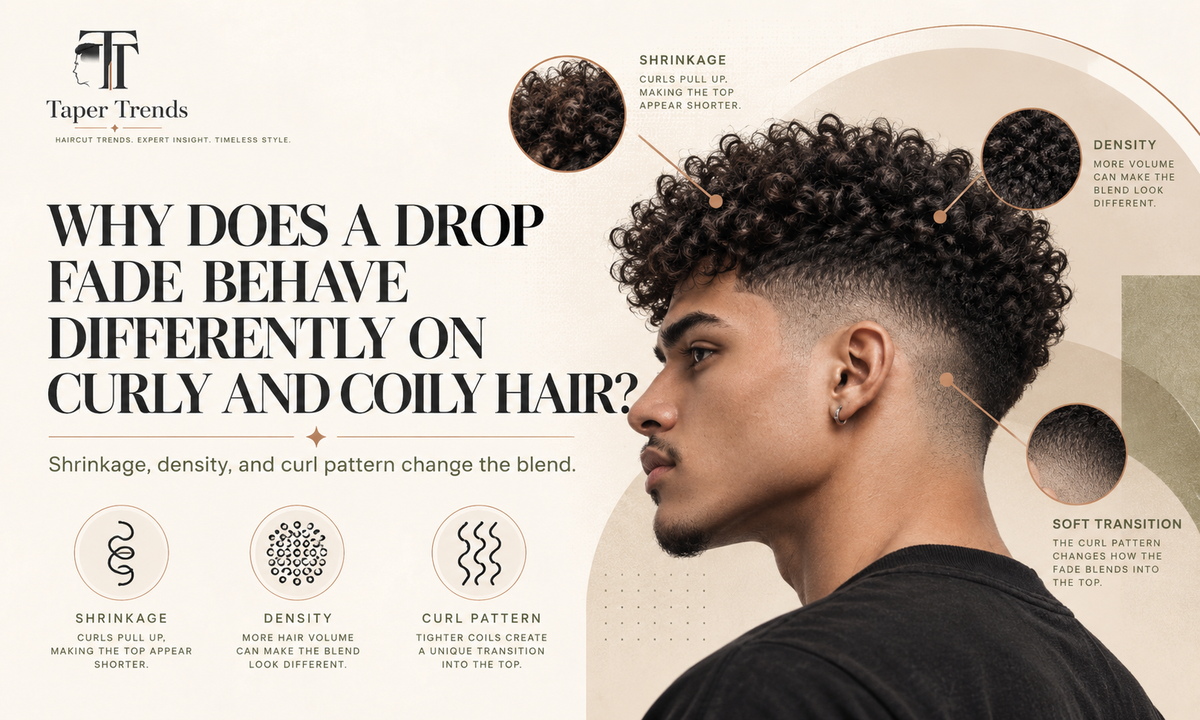
Curly and coily hair doesn't show its length the way straight hair does. It springs up and contracts as it dries, and dense curls add visible bulk at the sides. A length that looks right on damp hair can finish noticeably shorter, so a curly drop fade has to be judged by how the curls actually sit once dry.
Shrinkage drives most of this. A men's curly-cutting guide from the barber school Invictus Career College says loose waves shrink very little, defined spiral curls shrink noticeably, and tight coils can shrink by half or more. It also tells barbers to cut conservatively and never judge length while the hair is stretched, because once length is gone there's no way to reassess.
The fade creates the second problem. The sides are shorter and denser than the top, so a clean fade can end in a hard line against soft curls. The same guide recommends keeping the transition zone longer on curly hair than on straight hair, and softening the point where fade meets curl with shears so it doesn't read as a shelf. For a drop fade, that means two things: leave enough weight above the curve for the top to hold its shape dry, and set the depth of the drop by how much side bulk your density actually creates, not by a guard number borrowed from a straight-hair cut. If your hair sits closer to a low, gradual blend than a hard drop, our curly low taper fade guide covers that softer transition in full. For the cleanest finish, our skin fade with curly hair guide compares fade heights and curl length.
Curl pattern, density, shrinkage and top length
Curl-type labels such as 3B or 4C are handy for describing texture, but they don't tell a barber how much your hair shrinks, how dense it is, or how it looks dry. For planning a drop fade, those three facts, plus how much top length you want, matter more than the label.
Even dermatologists treat the familiar scale cautiously. A 2022 editorial in the International Journal of Women's Dermatology points out that dermatology has no widely accepted objective measure of hair texture, while the public relies heavily on curl-pattern labels to communicate and to market products. The authors encourage dermatologists to learn the labels so they can talk with patients, and call for more work before the scale could be treated as validated.
Use it the same way in the barber chair: as shorthand. Two people with “3C” hair can need different drop fades if one has much denser hair or far more shrinkage. Many heads also carry more than one pattern, often looser at the crown and tighter at the nape, which is exactly the zone a drop fade runs through. Before your appointment, look at your hair completely dry and note how tightly the curls sit, how much volume the sides carry, which way the nape grows, and what top shape you actually like.
Which curly drop fade should you choose?
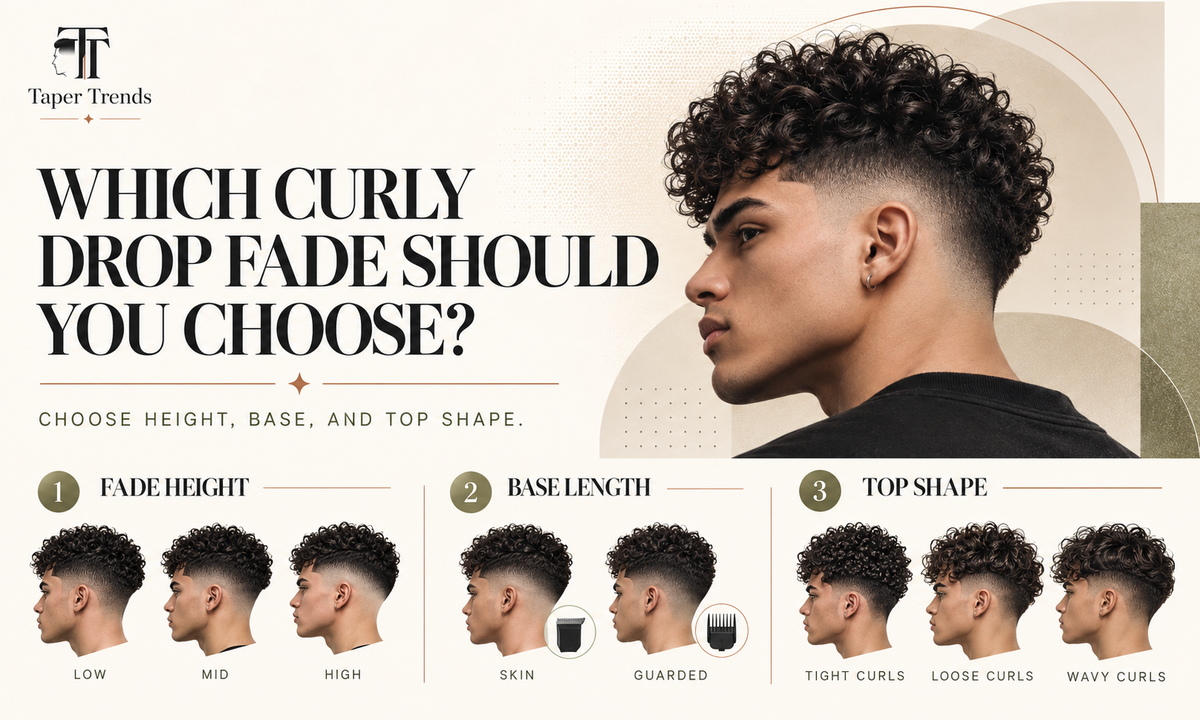
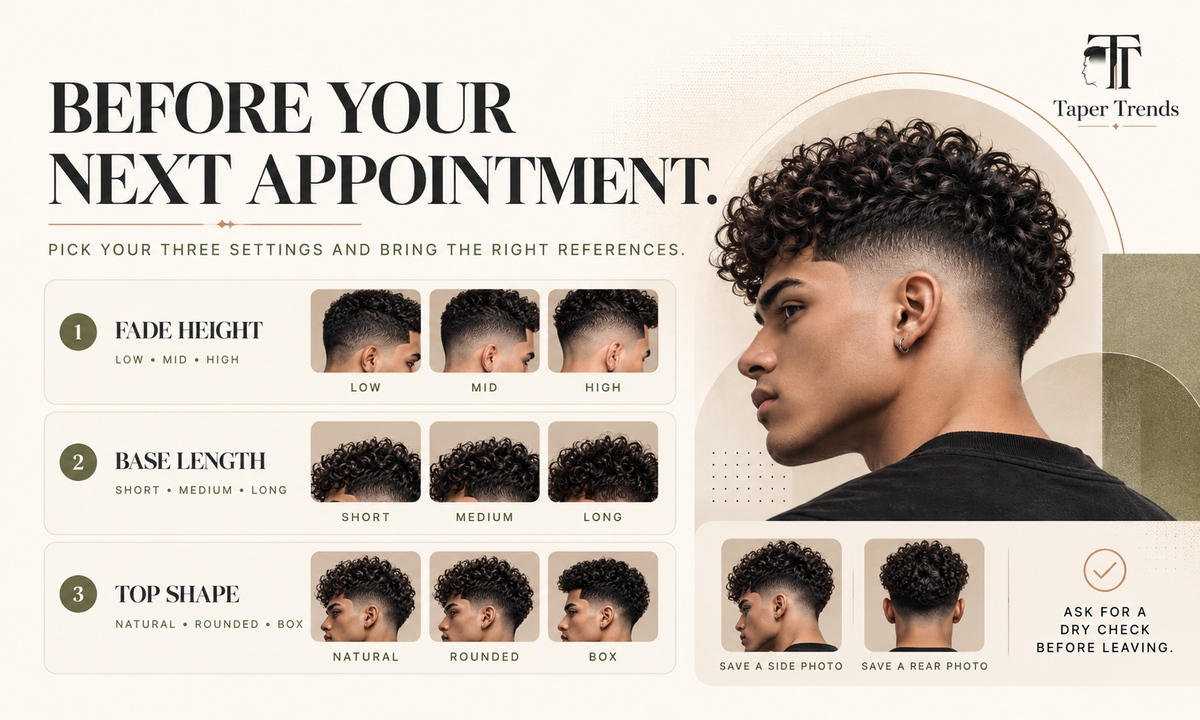
The right curly drop fade isn't a named style. It comes from three separate choices: how high the fade starts, how short the base gets, and what shape the top holds when dry. Decide each one, then describe all three together instead of pointing at a single gallery photo.
Height controls how much side weight stays. Base length controls contrast and how quickly regrowth shows. Top shape controls the silhouette. When you're unsure, start conservative. A barber can always take more off at the next visit, but nobody can put curls back.
Low vs mid vs high drop fade
A low drop fade keeps the most side weight and gives the softest transition. A mid drop fade removes more bulk and makes the curve obvious. A high drop fade exposes the most scalp and produces the strongest contrast, so it needs enough curl mass on top to balance it.
| Height | Roughly where it starts | Side weight kept | Contrast | Good fit when |
|---|---|---|---|---|
| Low drop | Just above the ear | Most | Soft | You're new to fades, want side fullness, or want an easier grow-out |
| Mid drop | Around the temple, midway up the side | Moderate | Clear | You want a visible curve without stripping the sides |
| High drop | Near the top of the sides, where the head starts to round | Least | Strong | You have dense curls and plenty of top length to carry it |
Low is the safe first step for most curly heads, and it's the same starting point our low taper drop fade guide builds on for a softer, more gradual side. The curve reads as a subtle shape, and mistakes are easier to correct. Mid is the common middle ground, and it's where most photos labeled “curly drop fade” land — the mid taper fade curly hair guide covers that height in its taper form. High works best on dense hair, and pairs with the same reasoning behind our high taper fade curly hair guide. On fine or sparse curls, taking the fade that far up can leave the top looking thin against a lot of exposed scalp.
Skin vs #1/2, #1 and longer bases
The base is the shortest length at the bottom of the fade, and it's independent of height and shape. Skin shows the most scalp and gives the most contrast. Guard lengths leave a faint shadow of hair. Pick based on how sharp you want the fade and how soon you're willing to go back.
| Base | Approximate length | Look | How fast regrowth shows |
|---|---|---|---|
| Skin | No guard; blade or shaver to the scalp | Maximum contrast | Within days |
| #1/2 | About 1.5 mm | Near-skin shadow | Fast |
| #1 | About 3 mm | Soft shadow, still high contrast | Moderate |
| #1 1/2 to #2 | About 4.5 mm to 6 mm | Soft, no exposed scalp | Most forgiving |
Those lengths follow a standard clipper attachment guard set; other brands and some shops number guards differently, so quote the millimeter length if your barber uses unfamiliar equipment. The numbers also explain why skin fadesblur so quickly. Scalp hair grows at a fairly steady daily rate, so a fresh skin fade catches up to a guarded length within days, while a guarded base keeps looking finished for far longer.
Top shapes for loose curls, tight curls and coils
Choose the top by the dry silhouette you want rather than by your curl label. Short tops put the attention on the fade. Medium tops balance texture with contrast. A fringe adds forward movement, as our drop fade textured fringe guide shows. A rounded top suits dense coils that build volume outward instead of falling — our drop fade guide for Black men covers that Afro shape alongside waves, sponge twists and locs.
- Short defined curly topCurls sit close to the head with individual clumps still visible, and the fade does most of the visual work. It's the lowest-effort option day to day — leave enough length for each curl to complete its turn rather than cutting it off mid-spiral.
- Medium curly topEnough length for curls to stack and layer, adding height and movement without much styling. It pairs with any fade height and is the most forgiving choice if you're not sure what you want yet.
- Curly fringeThe front curls are left longer and directed forward over the forehead. It usually sits better on a low or mid drop, where the sides keep some weight and don't compete with the front.
- Rounded coily topLength stays fairly even across the top so dense coils build into a sculpted round shape above the fade. It needs more retained length and benefits most from a barber who shapes it dry.
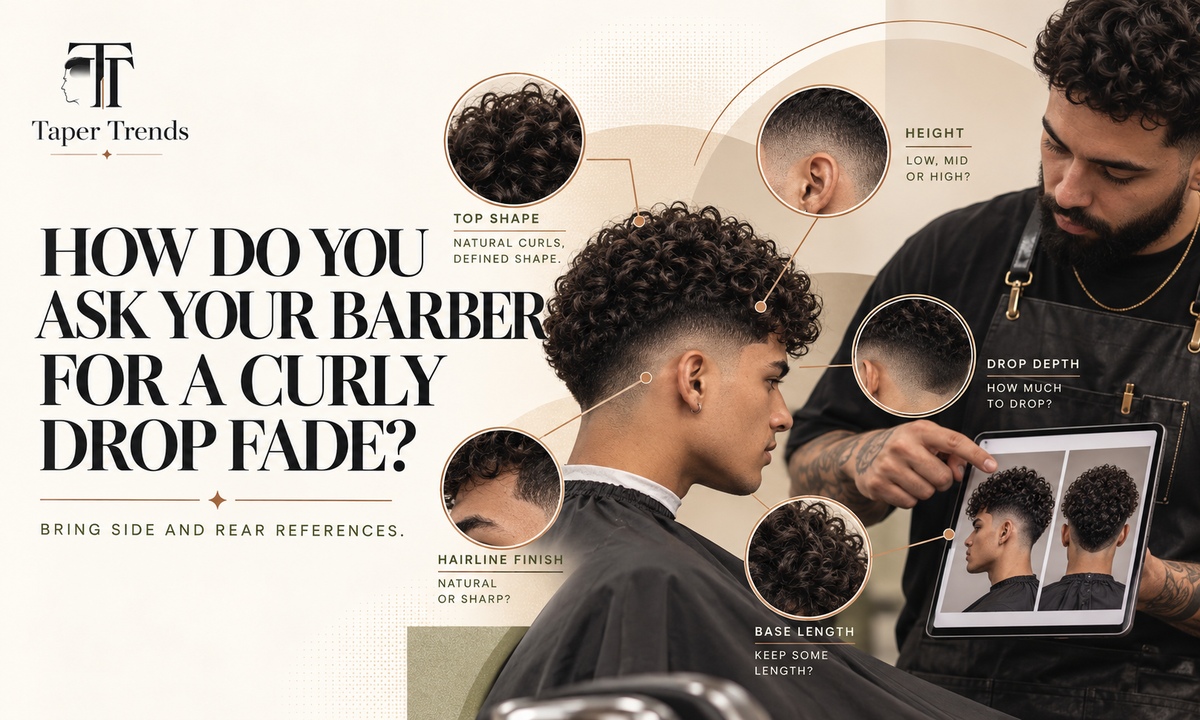
How do you ask your barber for a curly drop fade?
Give your barber five specifics rather than one style name: fade height, base length, how deep the drop should curve, your dry top length or shape, and the hairline finish you want. Then show a side and rear reference photo. The name on its own leaves too much open to interpretation.
- 1. Fade heightLow, mid or high.
- 2. Base lengthSkin, #1/2, #1 or a longer guard.
- 3. Drop depthHow far the curve dips behind the ear.
- 4. Top shape and dry lengthShort, medium, fringe or rounded, described as it should look dry.
- 5. Hairline finishNatural edges or a sharp line-up.
It's worth asking one question back: does the barber shape curly tops dry, or check them dry before finishing? You're not challenging their method. You're finding out whether the shape will be judged the way you'll actually wear it.
Reference photos that show the drop
A front-facing photo can't show whether a fade drops, and it's one of the most common reasons a curly drop fade comes out as something else. Bring at least a side view and a rear or three-quarter-rear view, ideally of hair similar to yours. A useful reference photo:
- Shows the drop's curve clearly from the side
- Shows the nape and back blend from behind or at a three-quarter angle
- Features curl texture and density close to yours, not just the same haircut name
- Shows the top dry, unfiltered and in its natural shape
A barber script
Fill in your three decisions, read it out, then show the photo:
“[Low / mid / high] drop fade, base at [skin / #1/2 / #1 / longer guard], curving down behind the ear to the nape. Keep the top at [dry length or goal] in a [short / medium / fringe / rounded] shape, and [keep my natural hairline / give me a sharp line-up].”
Treat it as a starting point. If the barber suggests an adjustment based on your density or growth pattern, it's usually worth hearing. The script's job is to make sure the conversation starts from specifics. If you wear a beard, add the sideburn connection to it; our drop fade with beard guide covers a curly or coily top with a shaped beard and the exact wording, and our skin fade with beard guide covers the same join with a skin finish. Our low vs mid vs high skin fade breakdown shows how the same three heights behave once the finish reaches skin.
How do you style a drop fade with curly hair at home?
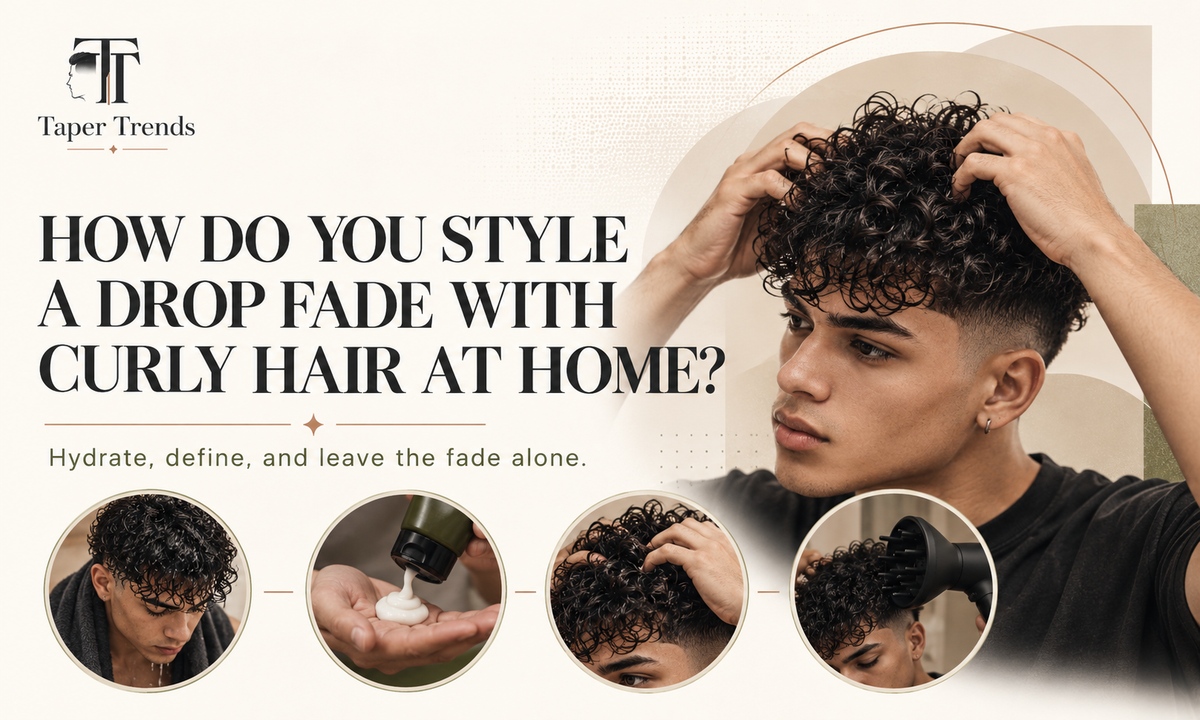
Styling a curly drop fade is mostly about not undoing the cut. Keep the curls hydrated, detangle only when wet, put product on the top rather than the short sides, and leave the curls alone while they dry. The American Academy of Dermatology warns against brushing curly hair while it's dry because it causes breakage and frizz. If you want the fuller, rounded version of this routine, our blowout low taper fade curly hair guide walks through building volume on top of a low blend.
A simple routine:
- 1.Wet or mist the top until the curls are damp, not dripping.
- 2.Work a leave-in conditioner or curl cream mainly through the top. The faded sides need little or none.
- 3.If you need to detangle, use your fingers or a wide-tooth comb while the hair is wet, the approach dermatologists recommend for curly and coily hair.
- 4.Scrunch or finger-coil the curls into clumps, then air-dry or diffuse on low heat without touching.
- 5.Once fully dry, gently separate the clumps if you want more volume, and check the edges.
How much product you need depends on density and dryness, so expect some trial and error for the first few weeks. The AAD's dermatologists say the same about building any curly routine.
How often should you get a curly drop fade touched up?
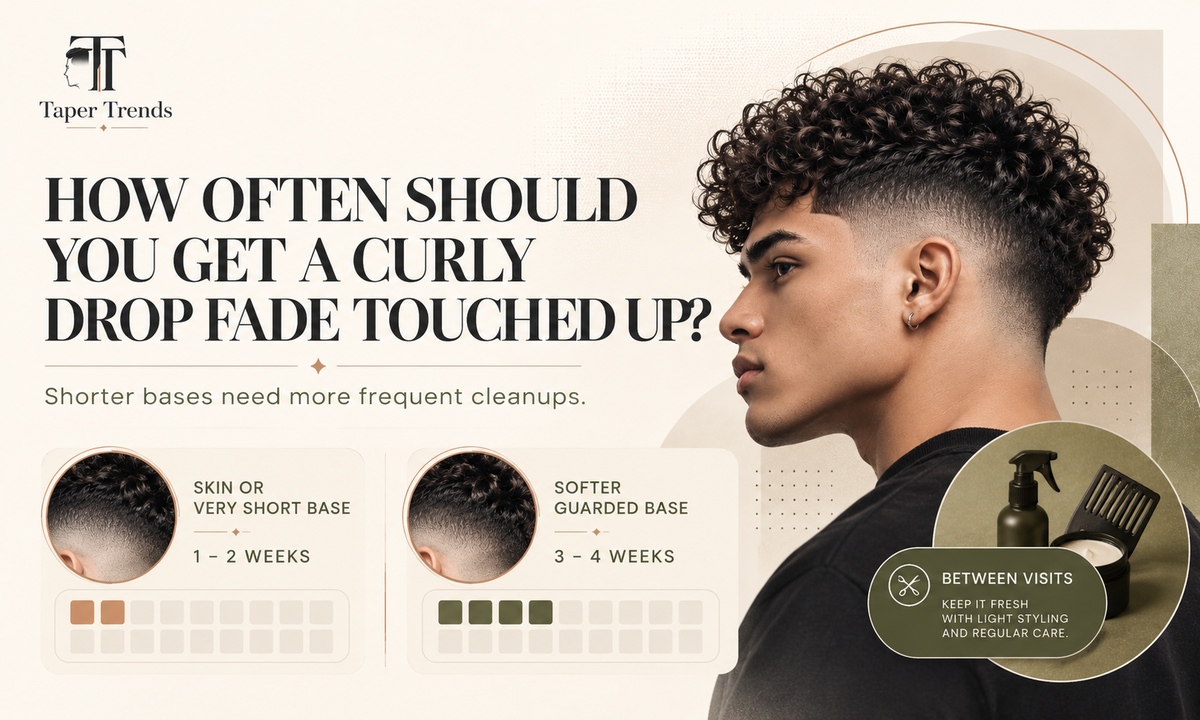
No single interval fits everyone. A skin or #1/2 base loses its sharp contrast within one to two weeks, so people who want it crisp commonly return every couple of weeks. Softer guard bases can often stretch out longer. The curly top needs reshaping less often than the fade does.
That split is worth using. Curly cuts commonly hold their shape for well beyond a single fade cycle because the curl pattern hides new growth. So a practical rhythm is quick fade cleanups on the short cycle and a full top reshape every second or third visit. Ask your barber whether they offer a shorter sides-only appointment.
What to do between barber visits
Between visits, your job is protecting curl definition, not re-cutting the fade. Most of what makes the cut look fresh day to day comes from the top.
- Keep the top moisturized and detangle wet, never dry.
- Leave the fade alone unless you know the exact guards and height used. Chasing it with clippers usually pushes the line higher.
- Tidy obvious neckline growth only if that's already part of your routine.
- Reduce friction overnight with a satin or silk pillowcase or bonnet, which can help preserve curls and cut down on frizz and breakage.
- Keep heavy product off the short sides, where it builds up and dulls the blend.
Common curly drop fade mistakes and how to fix them
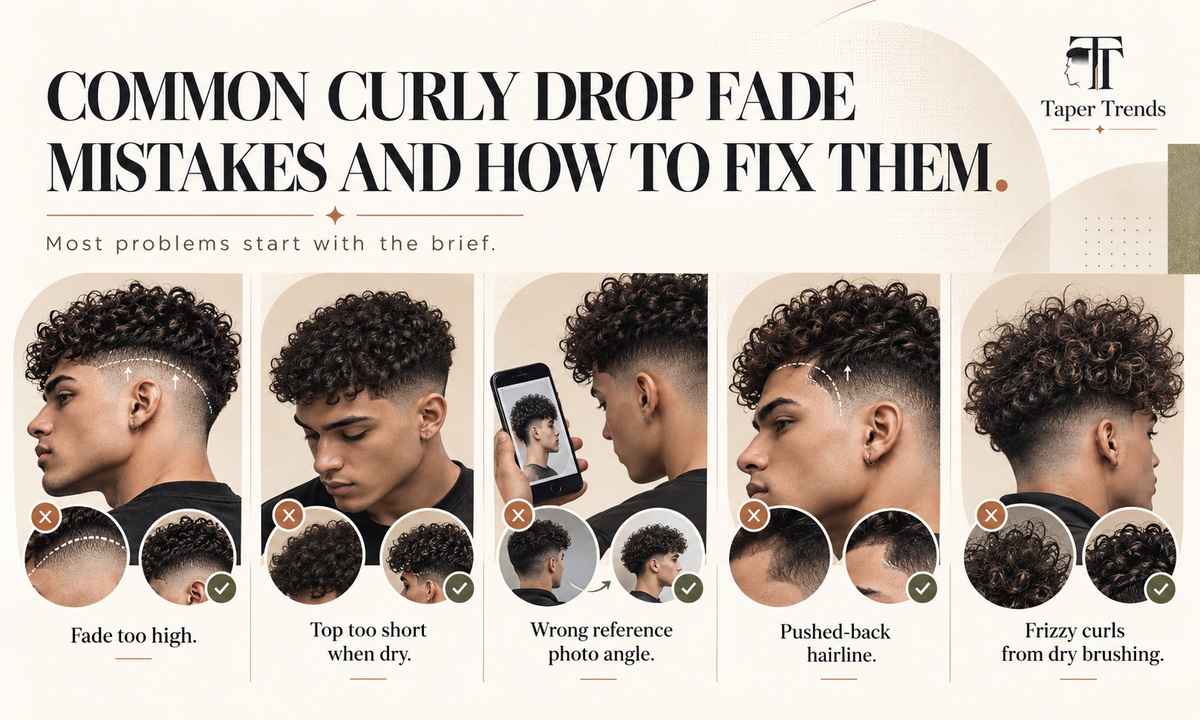
Most disappointing curly drop fades trace back to the brief rather than the barber's skill: a fade taken too high, a top cut to its wet length, a front-only photo, a hairline pushed back, or curls handled dry afterward.
| Mistake | Why it happens | Fix or prevention |
|---|---|---|
| Fade taken too high | More side hair removed than the top's density can balance | Ask for a lower start next time and let the sides grow in; lost weight takes weeks to return |
| Top too short once dry | Length judged on wet, stretched curls | State a dry-length goal and ask for a dry check before finishing |
| Cut came out as a regular fade or burst | Reference photo showed only the front | Bring side and rear photos |
| Hairline creeping back | Line-ups taken slightly further each visit | Ask for your natural hairline to be followed, and point to it at the start |
| Curls frizzy and shapeless days later | Dry brushing or constant touching | Detangle wet only and let curls dry undisturbed |
The hairline problem is slow and easy to miss. Hair at the front hairline and the nape often grows in a different direction from the rest of the head, especially on coily hair, and barbers are generally advised to follow that growth rather than force a straight line. If you like your natural edge, say so at every visit. And if the fade itself ever reads as the wrong shape rather than the wrong height, it's worth double-checking against our guide to the different kinds of fade haircuts before your next visit, so the words you use match what you actually want.
Frequently asked questions
Does a drop fade have to go down to skin?
No. “Drop” describes the curved path of the fade line, not how short it finishes. A drop fade can end at bare skin, a #1/2 guard, a #1 guard or something longer. The curve behind the ear toward the nape is what makes it a drop.
How long should curly hair be on top for a drop fade?
There's no fixed number, because the same cut length looks different depending on curl tightness and shrinkage, and tight coils can finish at a fraction of their stretched length. Describe the dry shape you want — short, medium, fringed or rounded — and let your barber translate that into a cutting length for your hair.
Can you wear a curly fringe with a drop fade?
Yes. A curly fringe usually sits best on a low or mid drop fade, where the sides keep some weight and don't compete with the longer front. It still works with a high drop, but the fringe then carries more of the overall look, so keep enough length at the front for the curls to fall forward.
Does a drop fade work with 3C or 4C hair?
Yes. Curl type doesn't rule out a drop fade. What matters is leaving enough top length for curls or coils to hold their shape after shrinkage, and choosing a fade height that suits your density rather than your curl label. Tighter coils generally need more length retained on top.
Should curly hair be cut wet or dry for a drop fade?
Either can work. The sides are clipper work and are less affected by the choice. For the top, cutting dry lets the barber see where each curl falls, while cutting wet means leaving extra length for shrinkage. Whichever method your barber uses, ask them to check the top's shape dry before you leave.
How do you grow out a curly drop fade?
Stop asking for the sides to go back to the original height and base. Have your barber move up a guard size at each visit, lower the starting point and soften the curve, so side weight rebuilds while the cut still looks intentional. Expect the transition to take several appointments.
Before your next appointment
Pick your three settings: fade height, base length and top shape. Save one side photo and one rear photo of a curly drop fade on hair like yours, fill in the script, and ask for the top to be checked dry before you leave. Between visits, look after the curls and leave the fade to your barber. A skin base will want a cleanup sooner; a guarded base gives you longer.
The bottom line
A drop fade on curly hair works because the curve behind the ear takes weight out of the exact spot where curls build the most bulk. Height, base and top shape are three separate calls, not one style name.
Decide those three, describe them together with side and rear photos, and ask for the top to be checked dry before you leave. Look after the curls between visits and let the fade grow in on its own schedule.
Want more taper fade guides?
Browse clean, barber-ready breakdowns for every hair type.