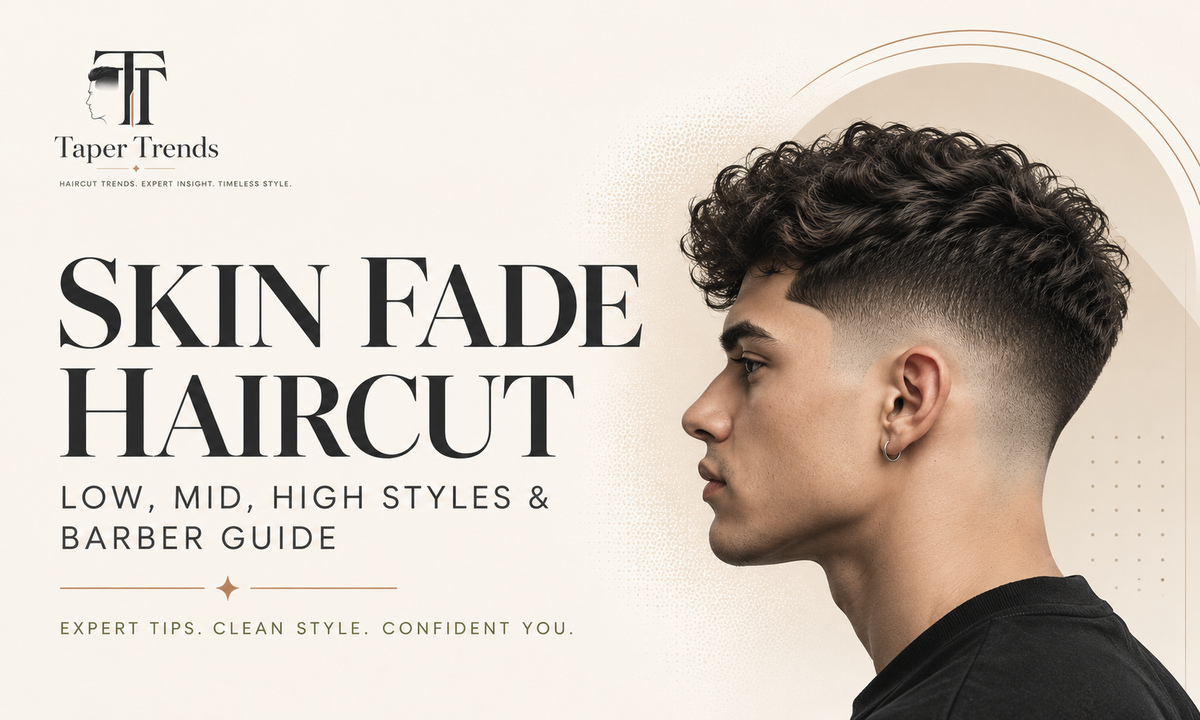
A skin fadeis a haircut that blends the sides and back down to bare scalp, then grows gradually longer until it meets the hair on top. The word “skin” tells your barber how short the bottom goes. It says nothing about how high the blend climbs, which is why a skin fade can be low, mid or high (our low vs mid vs high fade guide compares the three heights).
Mixing up those two settings is the most common way to leave with the wrong cut. Below, you'll find how the heights compare, how the overlapping names differ, and exactly what to say in the chair. If you want every fade word decoded side by side first, our guide to the different kinds of fade haircuts breaks the vocabulary into its five variables, and the complete low taper fade haircuts guide covers the softer end of the same family. For choosing between them, the types of fade haircuts guide compares height, finish, and shape.
What is a skin fade haircut?
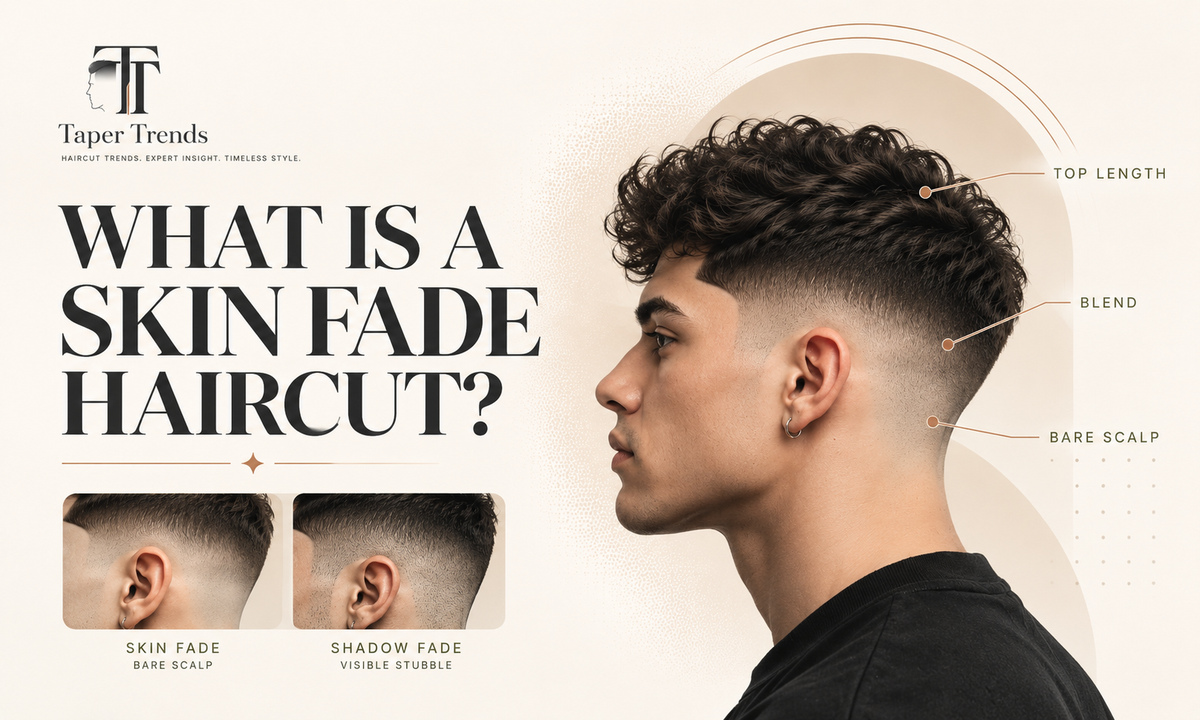
A skin fade is a fade whose shortest section reaches exposed scalp instead of stopping at a clipper guard length. Above that bare zone, the hair lengthens step by step into whatever you keep on top. The finish, the height of the blend and the top style are separate choices, and you can combine them freely, the same way our taper vs fade breakdown separates scope from finish. A skin fade under a long top left unblended becomes a faded undercut, which our undercut vs fade guide explains.
To get the bottom truly bare, barbers go past the shortest guard with a zero-gapped clipper blade, a trimmer or a foil shaver, according to fadepedia's skin fade guide. Bootlegged Barber Co., a Utah barbershop, adds a straight razor because clippers alone leave a faint shadow.
Shape is an optional extra. A drop fade dips lower behind the ear toward the nape, while a burst fade curves in a semicircle around the ear and leaves the nape longer. Either can be taken to skin, and our drop fade vs burst fade comparison shows how to tell the two shapes apart in a photo.
How is a skin fade different from a zero or shadow fade?
A skin fade reaches visibly bare scalp, while a shadow fade deliberately stops just short and leaves a film of very short hair that reads gray rather than bare. “Zero fade” is the loosest term. Many shops use it for the same finish as a skin fade, but a clipper with no guard can still leave a faint shadow, so ask whether any should remain.
The numbers explain why. Wahl's guard chart lists its shortest attachment, the #1/2, at 1/16 inch and a #1 at 1/8 inch. Every guard leaves some hair, so a true skin finish needs a tool that cuts closer than a guard allows. Our clipper guard size chart converts every guard number to inches and millimeters if you want to see the gap, and our haircut numbers guide explains how the labels differ between brands.
What are the low, mid, and high skin fade types?
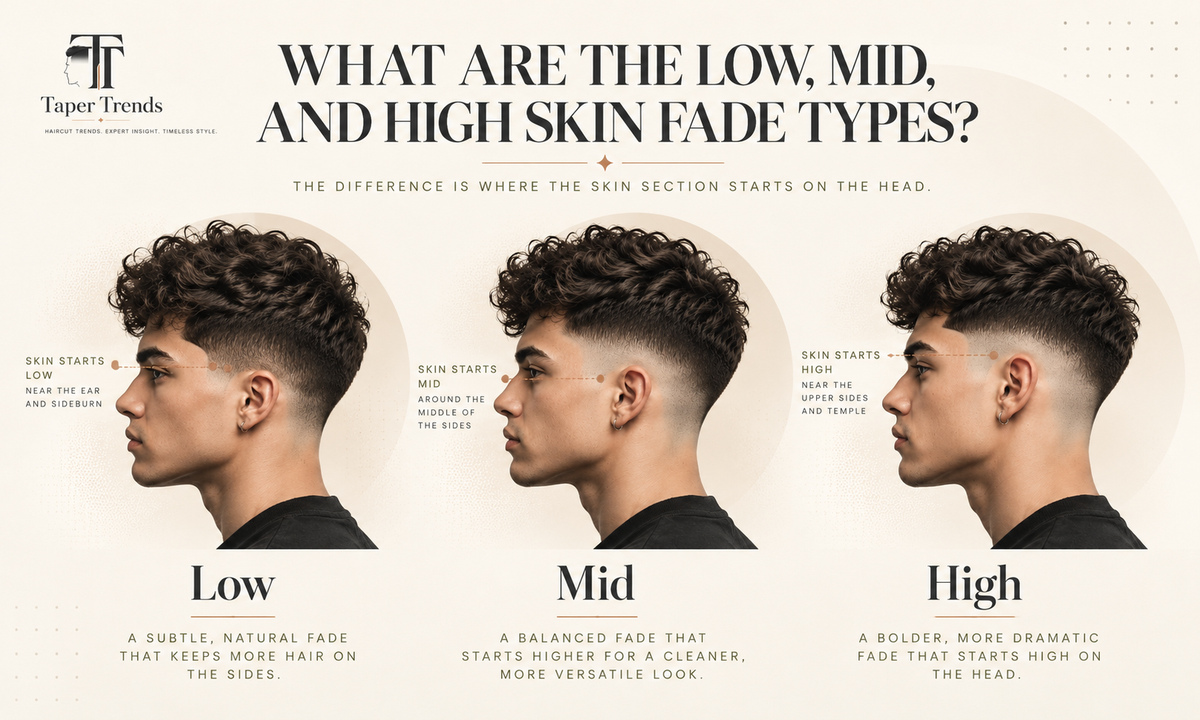
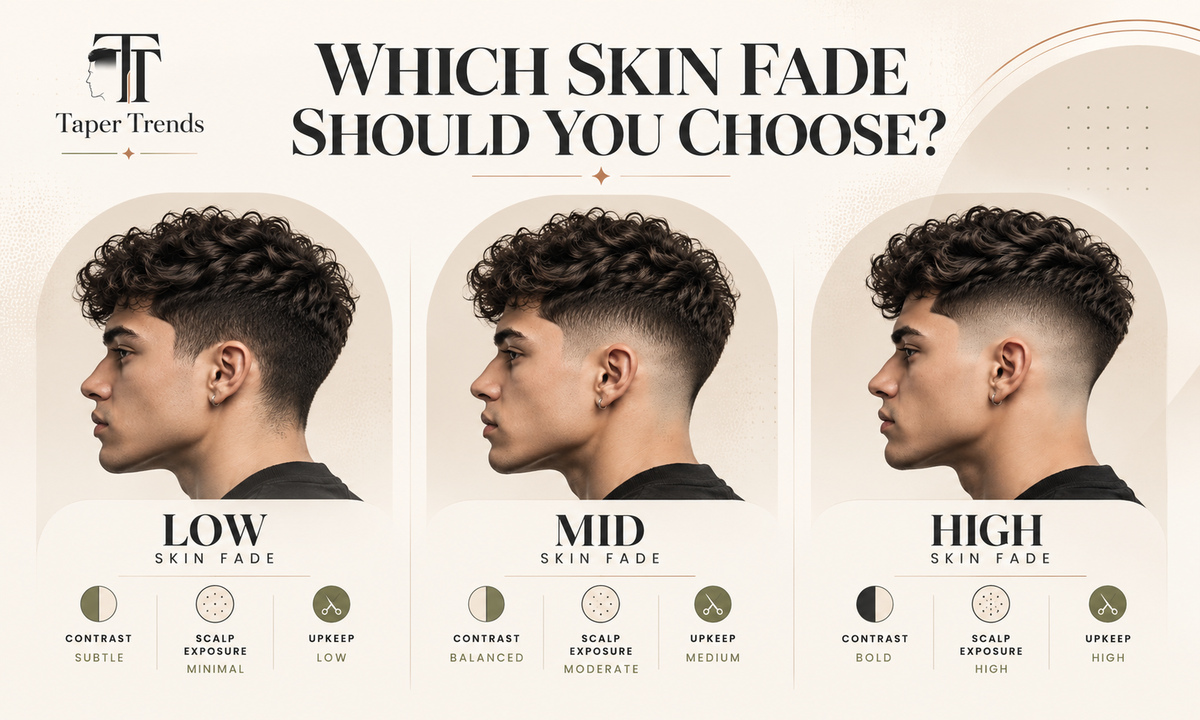
Low, mid and high skin fades all finish at bare scalp. What changes is how far up the head the short section climbs, which sets the contrast between the sides and the top. Barbers judge height from the shape of your skull rather than a tape measure, so the same label can sit slightly differently on two people.
What is a low skin fade?
A low skin fade starts just above the ear and follows the hairline around the back of the head, as Bootlegged Barber Co.describes it. The bare band stays narrow, so most side hair survives and contrast is the softest of the three. That makes it a sensible first skin fade. Say “skin” out loud, though, because a low fade on its own often stops at a guard length. Our low taper vs low fade guide covers the guarded alternative, and the low drop fade guide shows the same height curved down behind the ear.
What is a mid skin fade?
A mid skin fade begins around temple level, roughly halfway up the side of the head. It shows clearly more contrast than a low fade without the drama of a high one, and it suits short and longer tops alike. “Mid fade” alone names only the height, so without the word “skin” you can get one that stops at a #1 and never shows scalp. The mid drop fade and mid burst fade guides cover the shaped versions at this height, and the mid taper fade is the softer option if you want temple height without bare sides.
What is a high skin fade?
A high skin fade carries the bare section up to the parietal ridge, where the side of your head curves into the top. It exposes the most scalp and creates the strongest contrast with the hair above. It also shows regrowth fastest and puts any scar, dent or uneven contour on display, so mention anything you'd rather keep covered before cutting starts. Our high drop fade and high burst fade guides show the curved versions, while the high taper fade keeps the height but confines the shortening to the temples and nape.
Skin fade vs taper fade vs bald fade: what's different?
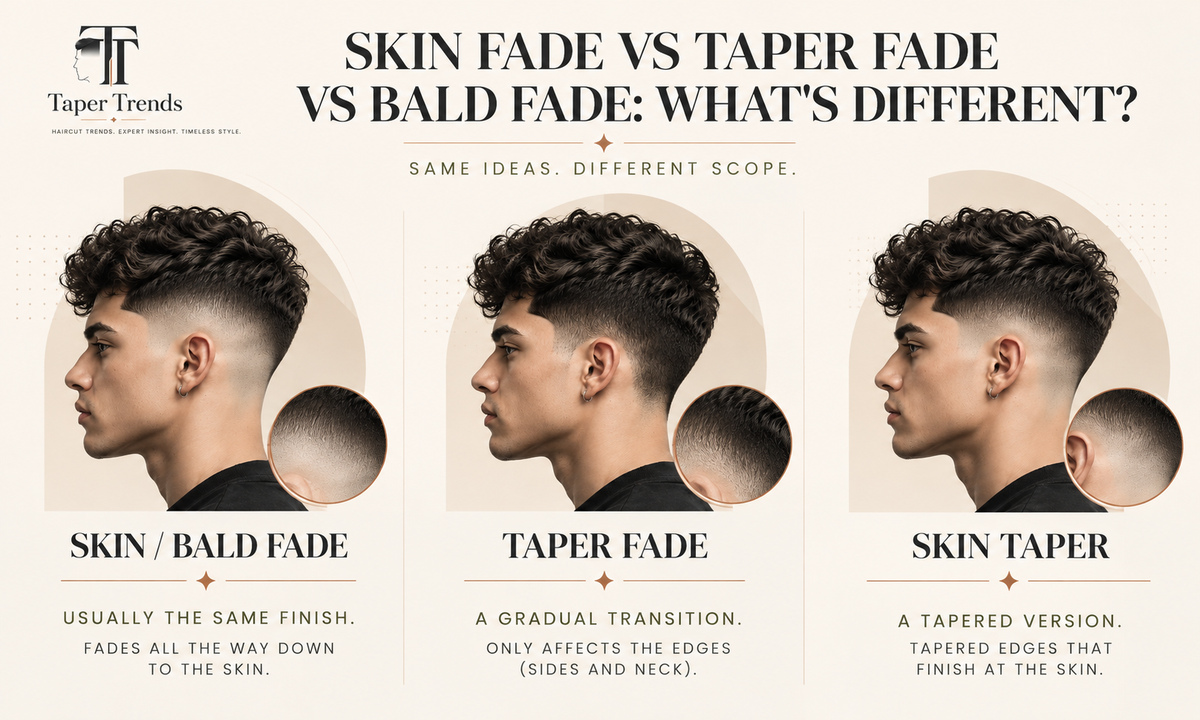
Skin fade and bald fade usually name the same finish: hair taken all the way to bare scalp. A taper answers a different question. It describes scope, meaning the shortening stays at the edges (sideburns, around the ears and the nape) while the rest of the sides keep more length. Because shops use these words differently, describe the result you want rather than relying on one label. Our taper fade guide covers the edge-only version in depth.
| Term | What it describes | What you usually get |
|---|---|---|
| Skin fade | Finish | Bare scalp at the bottom, blended upward |
| Bald fade | Finish | The same as a skin fade in most shops |
| Zero fade | Finish, loosely used | Bare or near-bare; confirm with your barber |
| Shadow fade | Finish | A film of very short hair at the bottom |
| Taper | Scope | Shortening at the edges only |
Can a taper fade also reach skin?
Yes, in many shops. A skin taper takes the sideburns and neckline down to bare skin while leaving the bulk of the sides longer, according to fadepedia. Not every barber shares that vocabulary: Bootlegged Barber Co. defines a taper as a cut that never reaches bare skin. If you want only the edges taken to skin, describe exactly that before the clippers start. The burst fade vs taper fade comparison shows where that edge-only shortening sits next to a shaped fade, and our skin fade vs taper fade guide puts a skin taper and a full skin fade side by side.
Which skin fade should you choose?
Choose a skin fade height by how much contrast, scalp exposure and upkeep you're willing to live with. If you're unsure, start low or at temple height. You can go higher at the next appointment, but you can't put hair back. Our low vs mid taper fade, low vs high taper fade and mid vs high taper fade comparisons walk through the same height trade-off angle by angle.
| Height | Where the blend starts | Contrast | How quickly regrowth shows |
|---|---|---|---|
| Low | Just above the ear | Subtle | Least noticeable |
| Mid | Around the temple | Medium | Moderate |
| High | Near the parietal ridge | Strongest | Most noticeable |
How do hair type, face shape, and head shape affect the choice?
Fade height changes how wide your head looks and how full the top appears, but no hair texture or face shape automatically dictates the right skin fade. A good barber adjusts the blend around your head's contours, cowlicks and scars, and those details matter more than any face-shape chart. If you still want a starting point, our face shape detector gives you one to bring to that conversation.
Texture changes the result more than most people expect. Curly and coily hair gives strong contrast against a bare bottom and hides small inconsistencies, while fine hair shows less contrast, so the bottom has to genuinely reach scalp for the fade to read, fadepedia notes. Our drop fade for curly hair and burst fade for curly hair guides show that contrast on curls, while the drop fade for straight hair, burst fade for straight hair and thin and thick hair guides cover textures that show every step of the blend. Some barbers start the fade higher on round faces and lower on long or narrow ones. Treat that as an opening for the conversation, not a rule.
Choosing a first fade for a child follows the same logic: start low, and keep the finish guarded if the scalp is sensitive. Our burst fade for boys and high taper fade for boys guides cover school-friendly versions.
Which hairstyles work with a skin fade?
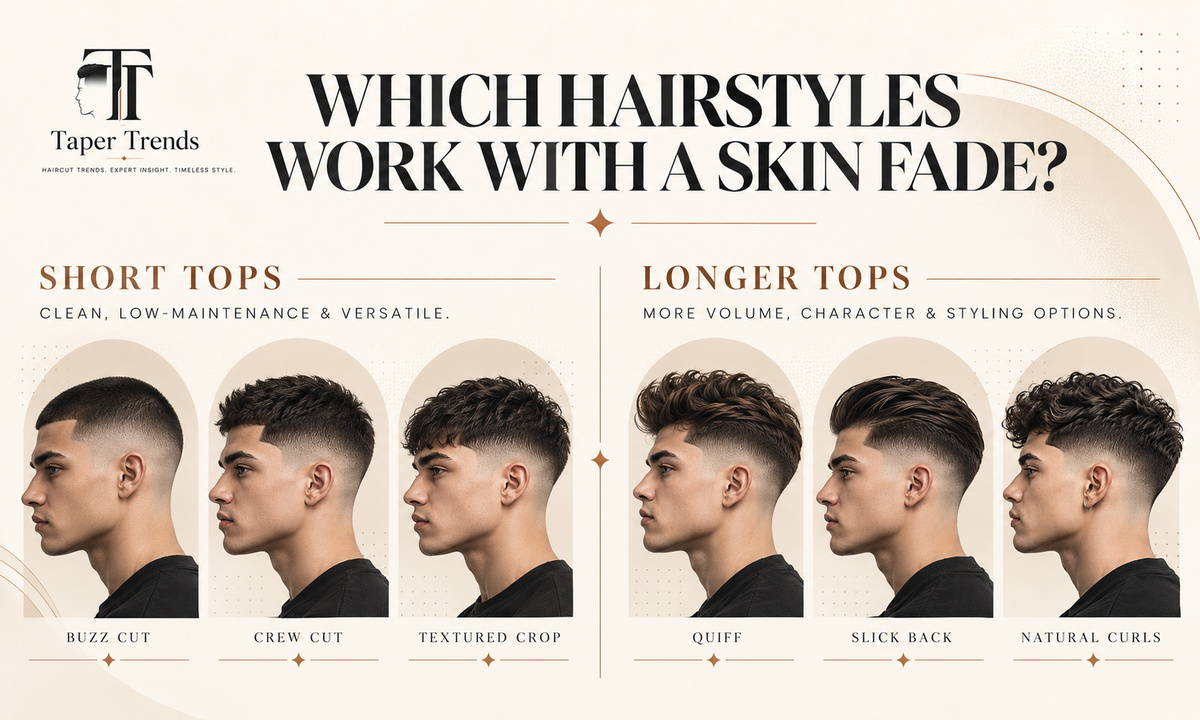
Almost any top works with a skin fade, from a buzz cut to natural curls, because the top is chosen independently of the fade. What changes is contrast and effort. Short tops need little styling but give the fade less to frame, while longer tops make the fade stand out and take more time each morning.
Short tops: buzz cut, crew cut, and textured crop
A traditional buzz cut sits at a #2 guard, or 1/4 inch, on Wahl's chart, and fadepedia points out that it leaves the fade little room to show. Our low taper fade buzz cut, mid taper buzz cut and high taper buzz cut guides compare guard lengths and finishes for buzzed tops. A crew cut keeps slightly more length, around a #4, which Wahl places in crew cut or brush cut territory, so the front can be pushed up a little; the low taper fade for short hair and mid taper fade for short hair guides cover crew cuts and crops in detail. A textured crop adds choppy movement, and Bootlegged Barber Co. names it as a natural partner for a mid skin fade. Our French crop, drop fade textured fringe and burst fade textured fringe guides show the cropped, forward versions.
Longer tops: quiff, slick back, and natural curls
Longer tops are where a skin fade's contrast pays off; fadepedia calls that the point of the contrast. A quiff builds volume at the front, a slick back sweeps hair away from the face, and natural curls or coils let texture do the work. Each needs more daily styling. Our blowout and slick back guides cover the volume and the swept-back looks, and the high taper fade for curly hair and curly low taper fade guides show natural curls over a short perimeter. Ask your barber to blend the top into the sides so the length doesn't look disconnected, and say so if you want your curl pattern left intact.
The same contrast works under statement shapes too. The drop fade mullet, burst fade mullet and burst fade mohawk guides cover tops that keep length at the back or center over a bare perimeter.
How does a barber cut a skin fade?
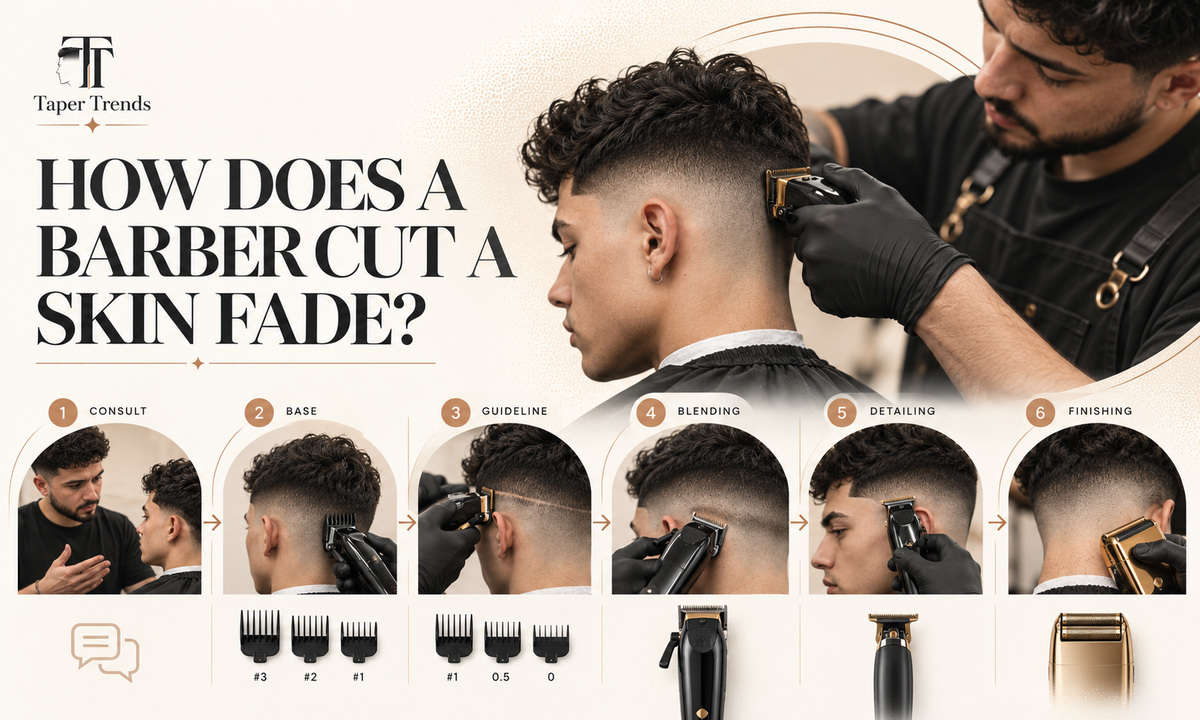
Techniques vary, but fadepedia and Wahl's taper-lever guide describe a common sequence: agree on finish and height, take the bottom to scalp, set a guideline, blend upward through longer lengths, then detail the edges.
- 1Consultation. You and the barber agree on finish, height and top length.
- 2The base. The lowest section goes down to scalp.
- 3The guideline. The first line goes in at your chosen height and gets checked on both sides.
- 4Blending. Progressively longer lengths soften each step up the head.
- 5Detailing. A trimmer sharpens the sideburns, ears and neckline.
- 6Finishing (optional). A foil shaver or razor pass gives the closest result.
Speak up at the guideline stage. Every later pass is measured against that line, so moving it before blending is easy, while moving it afterward usually means going higher.
What do clipper guards, trimmers, and finishing shavers do?
Clippers with guards set and blend the lengths, trimmers define the edges, and foil shavers or razors produce the closest finish. Each tool handles one job, which is why a skin fade usually involves three or four of them.
| Tool | Main job | Limitation |
|---|---|---|
| Clipper with guards | Sets and blends lengths | Every guard leaves some hair |
| Taper lever | Fine-tunes length between guards | Takes a steady hand |
| Trimmer | Outlines hairline, ears and neckline | Not built for blending |
| Foil shaver or razor | Closest finish | Can irritate sensitive skin |
Clippers, guards, and the taper lever
The taper lever is the small handle on the side of a clipper that shifts the blade. According to Wahl, moving it between positions changes cutting length by 1/16 inch, which lets a barber soften the step where one guard length meets the next, the same move our home fade-cutting guide uses on a guarded fade. Lever range and blade closeness vary by model, which our best clippers for fades roundup compares.
Trimmers, foil shavers, and razor finishes
A trimmer draws the outline but doesn't blend. A foil shaver pass over the very bottom removes the gray cast a clipper leaves, according to fadepedia, and a straight razor goes closer still. If your scalp irritates easily, skip both and ask for a shadow finish.
How do you ask your barber for a skin fade?
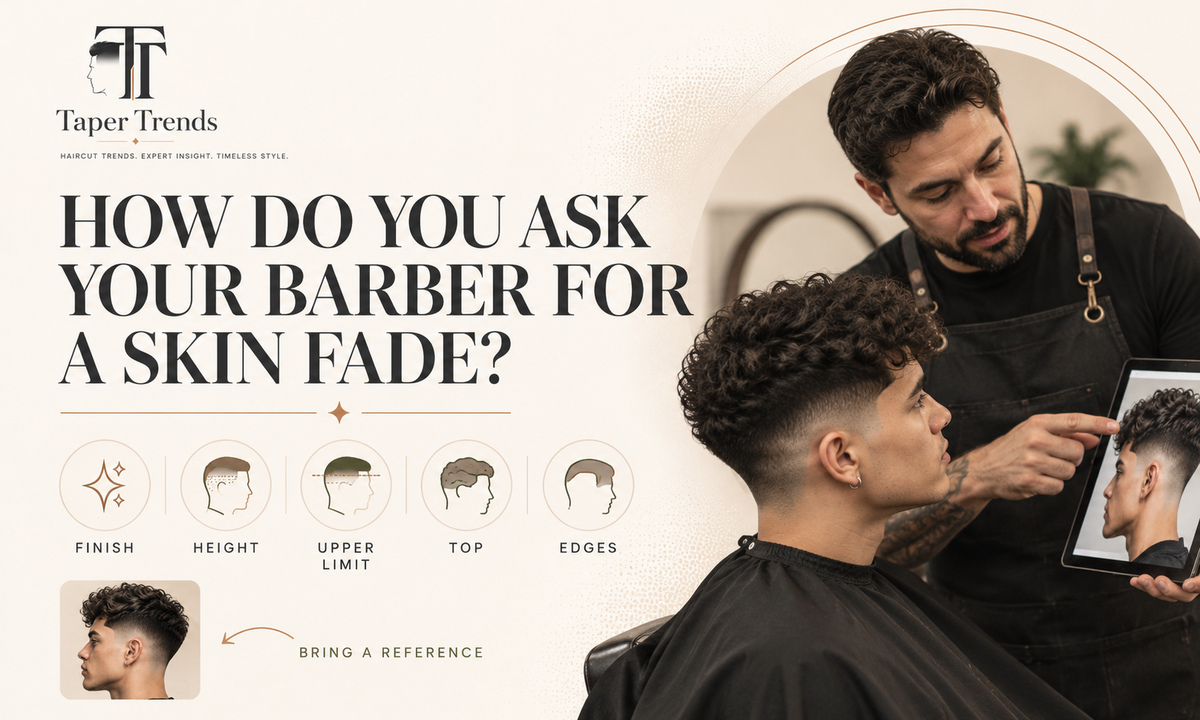
To ask for a skin fade, name four things: the finish (skin or shadow), the height, where the blend should stop, and how much length stays on top. Then show a photo, the same routine our guide on how to ask for a fade applies to every finish. “Skin fade” alone leaves the height open and “mid fade” alone leaves the finish open, which is how most mismatched cuts happen.
- 1Finish:“down to skin” or “keep a shadow.”
- 2Height: low, mid or high, or point to the spot on your head.
- 3Upper limit:where the blend should end, such as “below the temples.”
- 4Top: keep the length, take an inch off, or add texture.
- 5Edges: the neckline shape, and whether the sideburns connect to your beard.
Put together, a request might sound like this:
“I’d like a low skin fade, down to skin at the bottom, with the blend kept below the temples. Keep the length on top and blend it naturally into the sides. Here’s a side and back photo of what I’m after.”
Our barber brief generator turns those five answers into a request you can show on your phone. If the sideburns will meet a beard, our skin fade with beard guide covers that join on this exact cut, and the drop fade with beard, burst fade with beard, high taper fade with beard and low taper fade with beard guides cover the connected blend and the clean break. For the three skin heights side by side, our low vs mid vs high skin fade comparison shows where each bare section stops.
What reference photos and measurements should you bring?
Bring side and back photos that show the height and finish you want, because a front view hides most of a fade. A photo of a past cut you liked works too. Skip inch measurements and point to landmarks such as the top of the ear or the temple, which barbers use anyway. Useful photos show:
- The fade from the side and the back
- Hair with a texture close to yours
- Roughly the top length you want
- Anything to protect, such as a scar or a thin spot
How can you spot and avoid a bad skin fade?
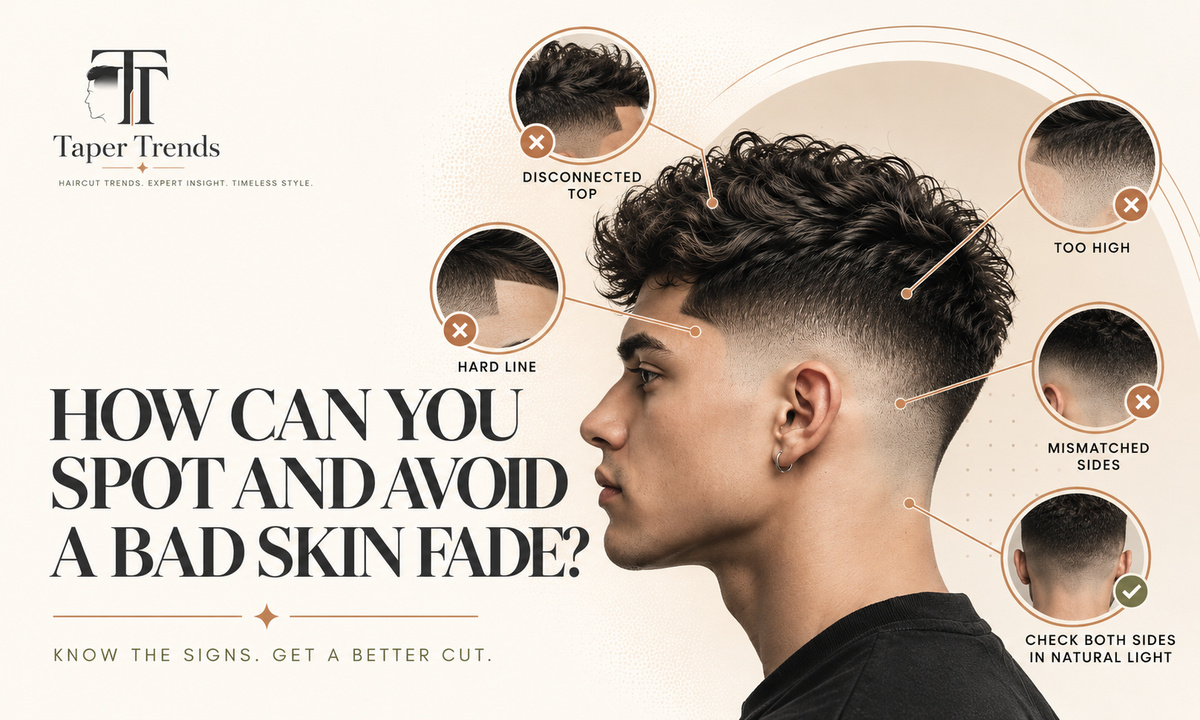
A bad skin fade shows visible lines, mismatched sides or bare scalp higher than you asked for. Fadepedia notes that faults usually sit at the bottom of the blend, especially just above the sideburn, so check both sides in daylight. Most of these problems are easier to prevent with a clear request than to fix afterward, though our guide on how to fix a bad fade covers what a barber can still correct.
| Problem | What it looks like | Prevention or fix |
|---|---|---|
| Hard line above the sideburn | A visible step where the blend stops | Ask for a softer blend there |
| Mismatched sides | One side sits higher | Ask the barber to compare both guidelines |
| Higher than requested | More scalp than agreed | State the upper limit before cutting |
| Disconnected top | Length drops abruptly into the fade | Ask for the top to be blended into the sides |
| Bare skin in a tight space | No room for a transition between beard and sideburn | Request a shadow there, or a higher fade |
What should you check before leaving the barber chair?
Check both sides, the back and the area above your ears in normal light, and confirm the top length before you stand up. A line is far easier to fix while you're still in the chair than to live with until the next appointment.
- 1Compare both sides for matching height.
- 2Look for steps or hard lines above the sideburns and ears.
- 3Check the back with a hand mirror.
- 4Step into natural light if you can.
- 5Confirm the top length, neckline and any beard connection.
How long does a skin fade last, and how do you maintain it?
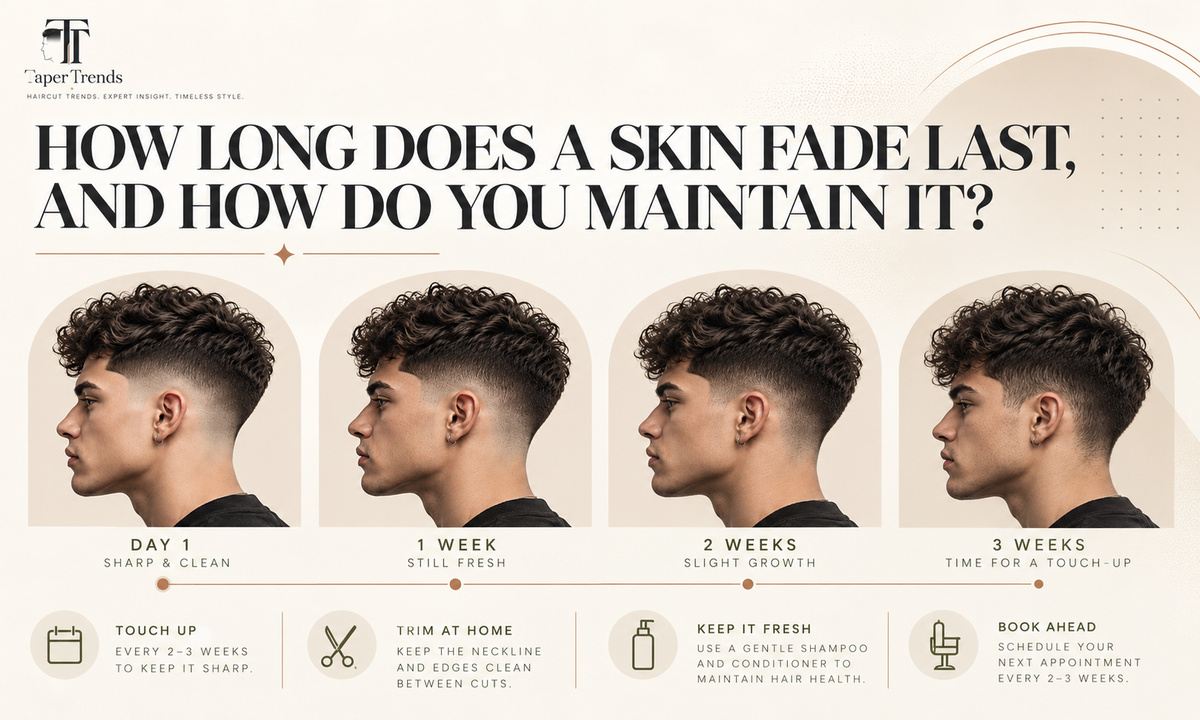
A skin fade looks its sharpest for about a week, because the bare section grows in first and softens the contrast. Both Bootlegged Barber Co. and fadepedia describe that one-week peak. How long it stays presentable afterward depends on how crisp you want it, how fast your hair grows and how high the fade sits.
How often should you book a skin fade touch-up?
Every two to three weeks is a common starting point, and our guide to how often you should get a haircut compares it with every other cut. Bootlegged Barber Co. recommends that window, while fadepedia suggests one to two weeks if you want the bottom to stay truly bare, noting that a shadow finish stretches to two or three. Choose the interval that matches your tolerance for stubble, and book the next visit before you leave. If a two-week cycle sounds like too much, our guide to what a low taper fade looks like shows a cut that grows out far more gradually.
How can you maintain the fade while it grows out?
If you would rather let it go entirely, our guide on how to grow out a fade sets out the timeline and what to tell your barber. Keep home upkeep to the edges. A trimmer on the neckline and sideburns can keep a fade tidy for roughly another week, according to fadepedia, but re-blending the sides yourself usually pushes the line higher. Clean the trimmer afterward and put your effort into styling the top; our step-by-step styling guide covers products and routines by texture. A fade that has softened into even stubble is a normal stage of the cut, not a mistake.
How do you care for exposed scalp and prevent razor bumps?
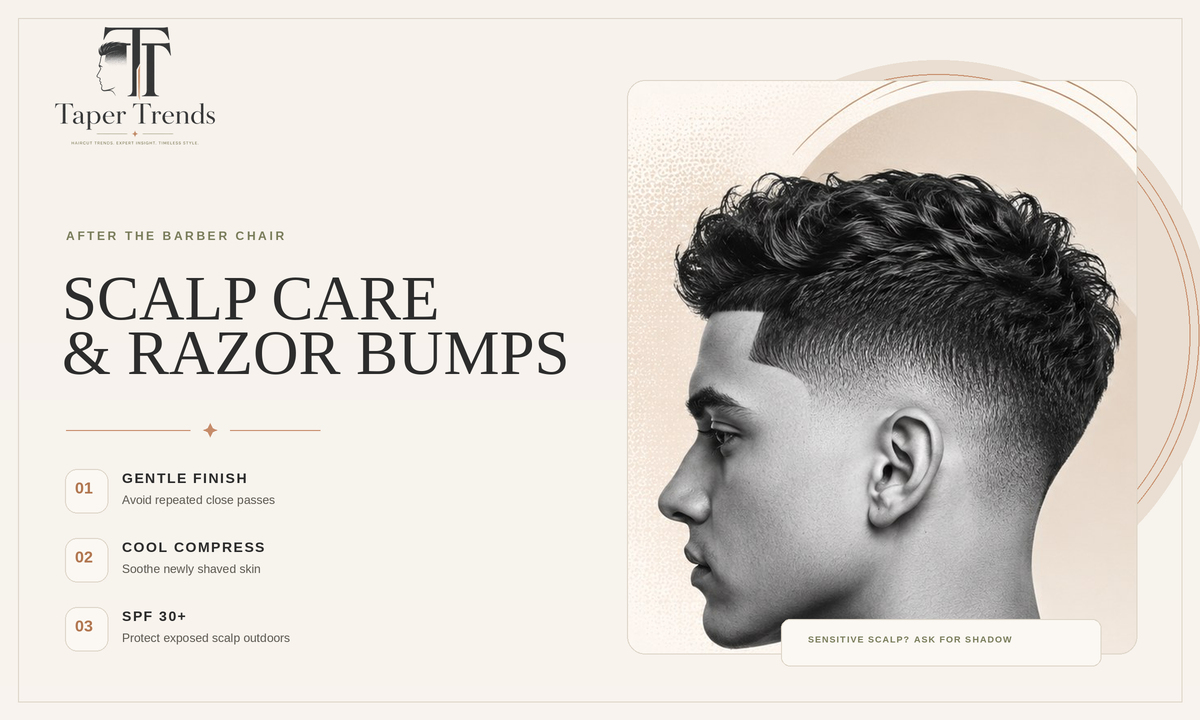
Treat freshly shaved scalp gently: avoid heavy pressure and repeated passes, calm the skin afterward and protect it from the sun. One caveat applies throughout. Most dermatology advice on razor bumps is written for shaving the face, so applying it to the scalp is sensible caution rather than a proven scalp protocol.
For shaving technique, the American Academy of Dermatology (AAD) recommends a sharp blade, short strokes, light pressure, no more than two passes over any area, and a cool compress for about five minutes afterward. It warns against pulling or stretching the skin and says to stop any aftershave that burns or stings. Your barber controls most of this, so it's fair to ask how they finish.
Bare scalp also burns. For uncovered scalp, the AAD recommends sunscreen that is SPF 30 or higher, broad-spectrum and water-resistant, reapplied every two hours and after sweating or getting wet. That advice was written for scalp exposed by hair loss, but skin uncovered by a fade is just as exposed. A hat is the simpler option.
Who should avoid an ultra-close skin fade finish?
People who regularly get razor bumps or ingrown hairs, or who have active scalp irritation, may do better with a guarded or shadow finish than a razor-close skin fade. The AAD says razor bumps are common in people who shave, especially men with darker skin tones, though not everyone gets them. Repeated bumps can leave lasting scars, so persistent ones warrant a dermatologist visit. Our drop fade for Black men, burst fade for Black men and high taper fade for Black men guides each cover bump-safe finishes for coily hair.
Bumps on the back of the neck deserve particular attention, because that is exactly where a skin fade sits. The AAD says acne keloidalis nuchae is often mistaken for razor bumps on the nape and scalp, is most common in Black men, and without treatment can cause raised scars and permanent hair loss. If bumps keep appearing there, see a board-certified dermatologist and ask your barber to finish with a guard or trimmer. Our low taper fade for Black men guide covers a gentler cut that stops above the skin.
Skin fade FAQs
Will a skin fade expose scars, birthmarks, or scalp tattoos?
Yes, it can. Cutting the sides and back close removes the cover hair provides, so scars, birthmarks and tattoos there become more visible, and a high skin fade exposes the most. Mention them before cutting starts and ask whether a lower height or a shadow finish would keep them less noticeable.
Can you combine a skin fade with a beard?
Yes. The sideburn can blend gradually into the beard for a connected look, or your barber can leave a clean break. Fadepedia advises blending the join rather than leaving a hard edge, and avoiding bare skin in the narrow gap between beard and sideburn. Beard density decides which option looks better, so ask your barber.
Does a skin fade make hair grow back thicker?
No. Cutting or shaving removes only the visible hair shaft and leaves the follicle unchanged. A 1970 clinical trial in the Journal of Investigative Dermatology found no significant change in growth rate or hair width after shaving. Regrowth feels coarser because shaved hair has a blunt tip.
Is a skin fade appropriate for a professional workplace?
Usually, though your employer's grooming policy and overall styling matter more than the haircut's name. A low skin fade with a conventional top sits at the conservative end, and Bootlegged Barber Co. describes the low version as a classic, professional cut. High fades read bolder. Check any written dress code, and ask HR when it's unclear.
Does a skin fade cost more than a regular haircut?
Often a little, but prices vary by shop, city and what's included, so there's no reliable national average. As one example checked on October 12, 2026, Bootlegged Barber Co. in Herriman and Sandy, Utah, listed its haircut with skin fade at $52 and its traditional haircut at $46. Ask whether a razor finish and beard work are included.
Can you cut a skin fade yourself at home?
You can, but seeing the back of your head and blending evenly take practice. Wahl outlines a home method that starts at the neckline with no guard, works up about an inch at a time through longer guards, and uses the taper lever to blend each join. Start conservatively. For a razor-bare finish, a barber is the safer choice.
The shaving-and-regrowth answer draws on the 1970 Journal of Investigative Dermatology trial, as Which? explains it; the pricing example comes from Bootlegged Barber Co., and the home method from Wahl.
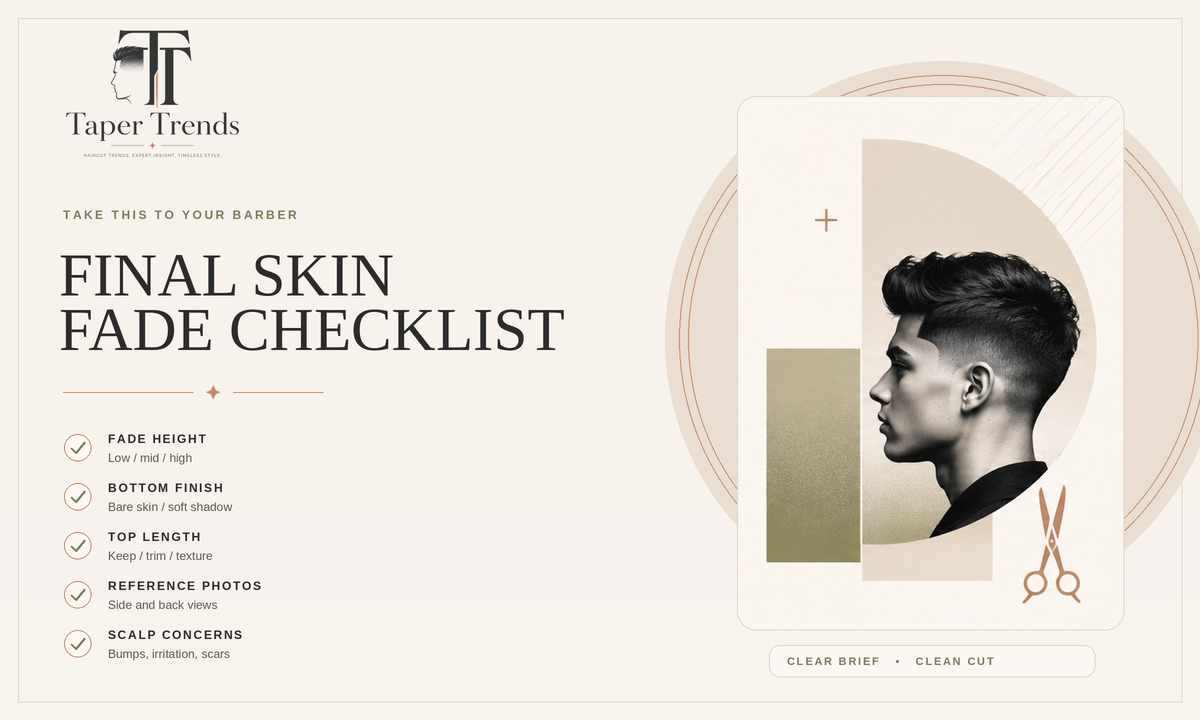
Final skin fade checklist
Before you book, settle five things:
- 1Height: low, mid or high.
- 2Finish: bare skin or a shadow.
- 3Top length: what stays and what comes off.
- 4Reference photos: side and back views, ideally of hair like yours.
- 5Skin concerns: razor bumps, irritation or scars your barber should know about.
Book the next visit before you leave, keep home touch-ups to the edges, and cover bare scalp outdoors. With those answers settled, your barber has everything needed to cut the fade you pictured.
The bottom line
A skin fade is two decisions wearing one name: a bare-scalp finish and a height. Say both out loud, point to where the blend should stop, and bring side and back photos, and the cut you get will match the one you pictured.
Start low if you're unsure, ask for a shadow if your skin bumps easily, and plan on a touch-up every two to three weeks. Everything else, from a buzz cut to natural curls on top, is yours to choose.
Want more fade guides?
Browse clean, barber-ready breakdowns for every height, shape and hair type.