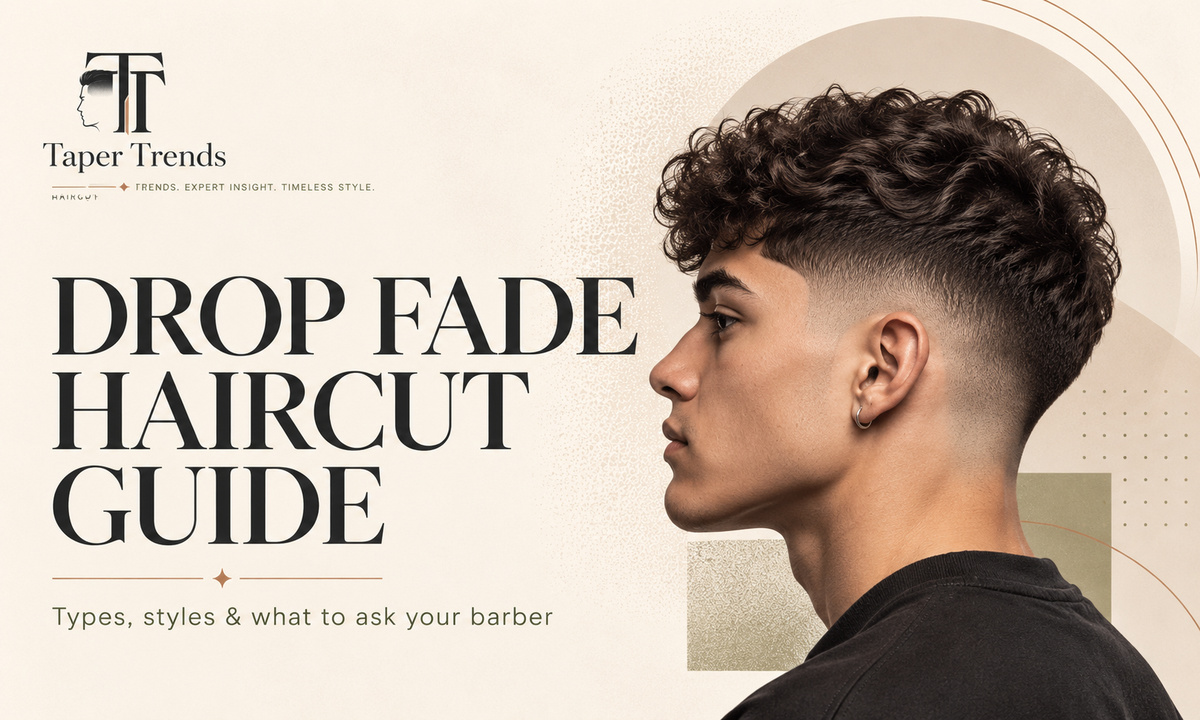
A drop fadeis a fade haircut whose fade line curves down behind the ear instead of running level around the head. The “drop” names that curve and nothing else — it doesn't tell your barber how high the fade starts, how short it finishes, or what happens on top. Four separate choices hide inside the name: the shape of the line, its height, the shortest length at the base, and the style on top.
This guide takes them one at a time, then turns them into a request you can read out in the chair. For how the drop sits next to every other fade shape, our guide to every kind of fade haircut sets it beside low, mid, high, skin, and burst, our types of fade haircuts comparison helps you choose among them, and our complete low taper fade haircuts guide is the hub for every fade on the site.
What is a drop fade?
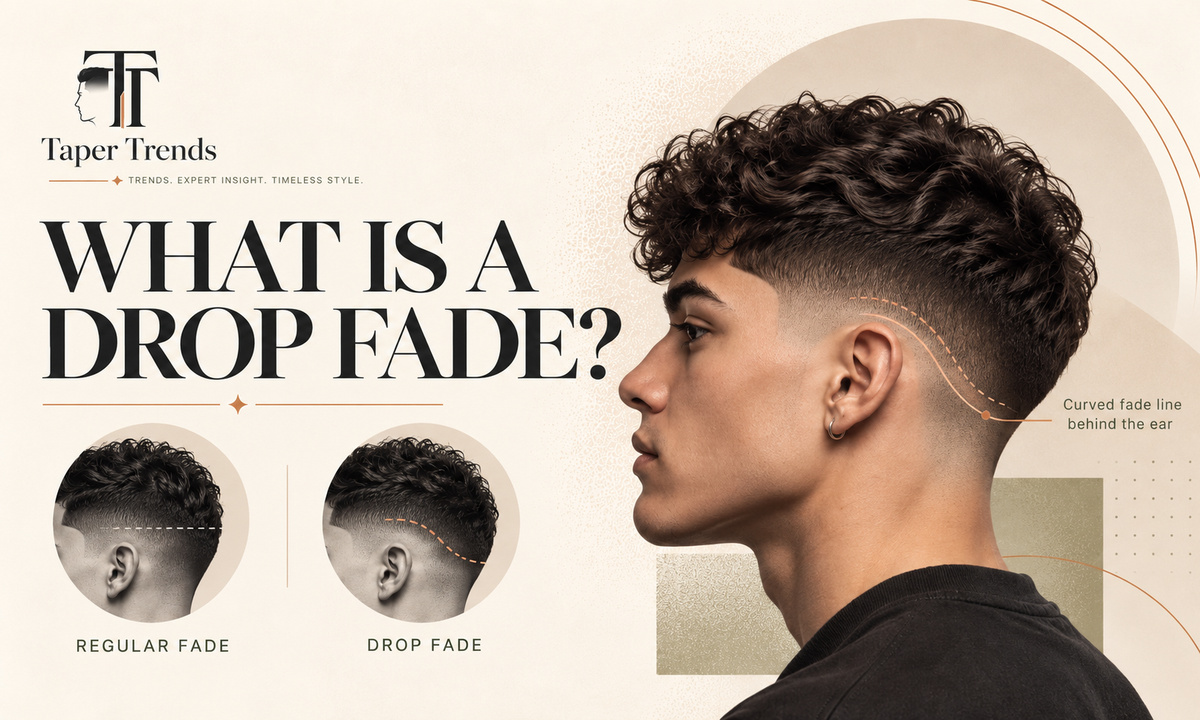
A drop fade is a fade in which the graduation line starts at a chosen height near the temple, dips as it passes behind the ear, and finishes lower toward the nape. Barber-education material from CADMEN Barber Academy defines the cut by that downward arc and doesn't tie it to a particular height or clipper length.
What does the “drop” in drop fade mean?
The drop is the dip in the fade line behind the ear. Seen from the side, the line forms an arc: higher above the ear, lower behind it, then continuing around to the neckline. The drop is a shape, not a separate clipper length, so no guard number creates it on its own (our how to cut a fade guide covers the straight version). Because the arc has to match on both sides of the head, check the back with a hand mirror before you leave the chair.
How is a drop fade different from a regular fade?
A regular fade holds its line at roughly the same height around the sides and back. A drop fade bends that line down behind the ear, so more hair stays above the lower back line — the crown and upper sides look fuller than they would under a regular fade started at the same height. Think of the choice as one of silhouette: a drop follows the round of the head and supports a rounded top, while a regular fade gives a straighter, more uniform transition.
Low, mid, high and skin drop fades: what changes?
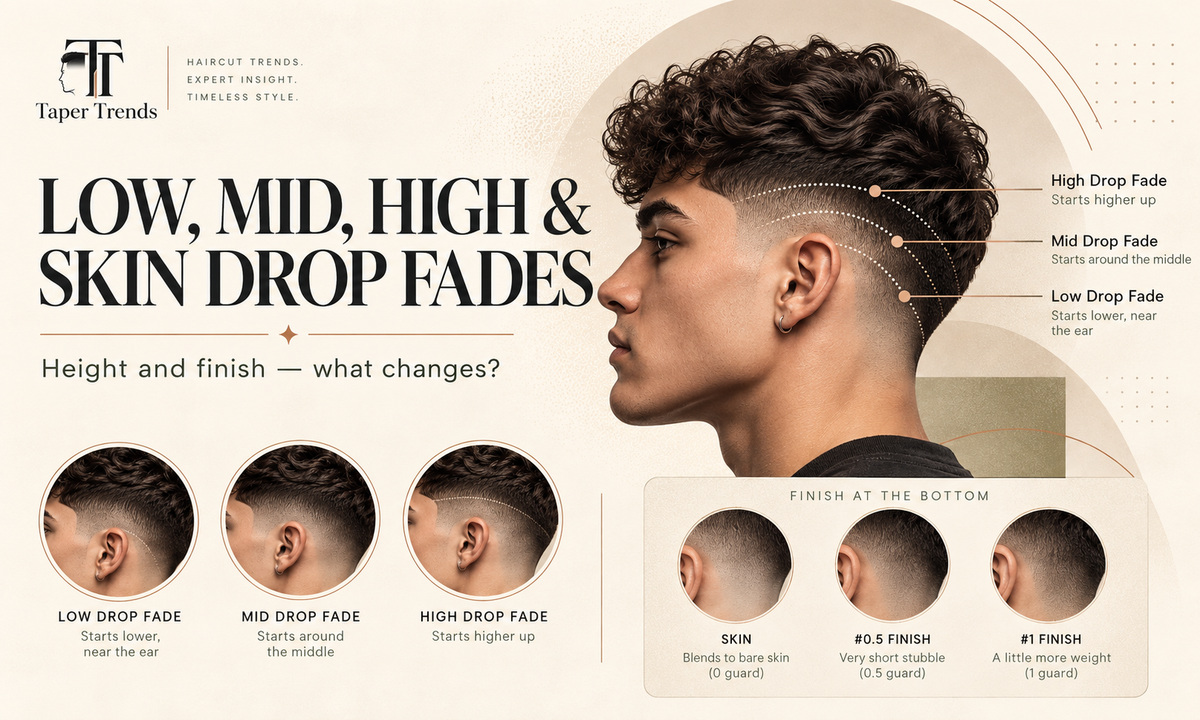
Once the drop is settled, two more settings decide the cut: height and finish. Height (low, mid or high) sets where on the side the blend begins. Finish (skin, #0.5, #1 and so on) sets how short the hair gets at the base. The two are independent, so any height can pair with any finish, and neither one changes whether the line drops. Our low vs mid vs high fade guide explains the height choice on its own, and our mid fade haircut guide shows the level version of the middle setting.
| Decision | What it controls | Typical options |
|---|---|---|
| Shape | Path of the fade line | Drop, regular (level), burst |
| Height | Where the blend starts on the side | Low, mid, high |
| Finish | Shortest length at the base | Skin, #0.5, #1 or longer |
| Top | Hair above the fade | Buzz, crop, curls, quiff, slick back |
Shops don't all draw these boundaries in the same place, so read the heights below as typical positions rather than fixed measurements.
Low drop fade
A low drop fade starts just above the natural hairline near the ear, so only the lower quarter to third of the side falls inside the fade and most of the side length stays. The curve at this height is subtle and close to the ear, and it keeps the most weight of the three heights. Our low drop fade guide covers this height on its own, from base length to the five specs to give your barber.
Mid drop fade
A mid drop fade starts around the midpoint of the side, near the temple, so roughly the lower half of the side is faded. The curve is easier to see and the contrast runs through the middle of the side. “Mid” drifts a little from shop to shop, so point to where you want the line to start. Our mid taper fade guide covers this starting height in more detail across straight, wavy, and curly hair.
High drop fade
A high drop fade starts near the top of the sides, just below the crown, so almost the whole side sits inside the fade. It gives the strongest contrast with the top and exposes the most scalp, while the line still dips behind the ear. A curve taken too high can't be restored in the same visit, so if you're moving to a high drop from a regular fade, ask for a conservative guideline first — the barber can always go higher. Our high drop fade guide covers guard sizes, six tops and the four-part barber brief for this height, and our high taper fade guide covers this height in full, including who it flatters.
Skin drop fade vs #0.5 or #1 finish
A skin (or bald) drop fade takes the base down to bare-looking skin. A #0.5 or #1 finish leaves a thin layer of visible hair. The curve is identical either way, because the guard number only controls the shortest length. On Wahl's guard chart, #1/2 cuts to about 1.6 mm and #1 to about 3 mm, though other brands can differ slightly (our best clippers for fades guide shows how much guard sets vary by kit). Closer finishes show regrowth sooner, so name the guard you want instead of relying on “skin” or “taper,” words shops use differently.
Which drop fade suits your hair and head shape?
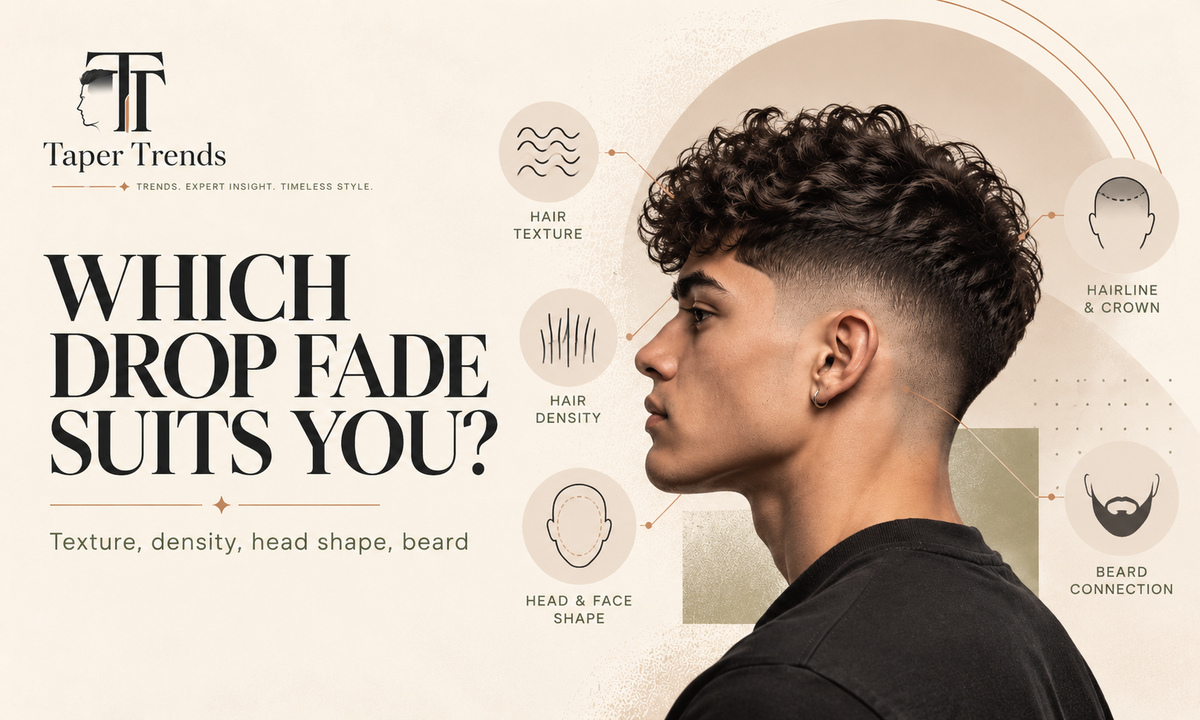
No face shape is universally right or wrong for a drop fade, and published advice on this often contradicts itself. Weigh five things together instead: hair density and texture, the shape of the back of your head, side width, fade height, and the top style. A barber who can see your hair can judge all five at once.
By hair texture and density
The drop's geometry works on straight, wavy, curly and coily hair (our drop fade for straight hair guide covers the flattest, least forgiving texture). What changes is how the barber transitions into the top and how much weight stays, and density matters as much as curl pattern. A piecey drop fade textured fringe needs real density; on fine or thin hair the same shape tends to fall flat, and a tightly coiled top needs enough volume for the fade to read.
- Thick, straight or wavyHow much bulk to take off the sides
- Fine or thinWhether a textured top will hold, or a shorter top suits better
- Curly or coilyKeeping enough weight on top for the curve to frame it
By head and face proportions
Face-shape advice for this cut is inconsistent, even between different guides. Some sources say a drop suits round or square faces and can exaggerate length on long or oval faces; others say the same drop flatters round and square faces while recommending a fringe-heavy version for long or oval faces. When sources disagree this much, the fade probably isn't the deciding factor — the shape of the top does more for face balance than the fade type, and a drop can help a flatter crown, because it leaves volume above the occipital bone. Instead of a face-shape label, look at:
- Fade height and how much of the side it exposes
- Top height and volume
- Width at the sides
- The profile of the back of your head, since the drop follows that contour
Hairline, crown and beard considerations
Hairline, crown and beard connection are separate decisions from the fade, and any of them can make a reference photo unrealistic for you. Point out your hairline, any cowlick at the crown, and how you wear your beard before the clippers start.
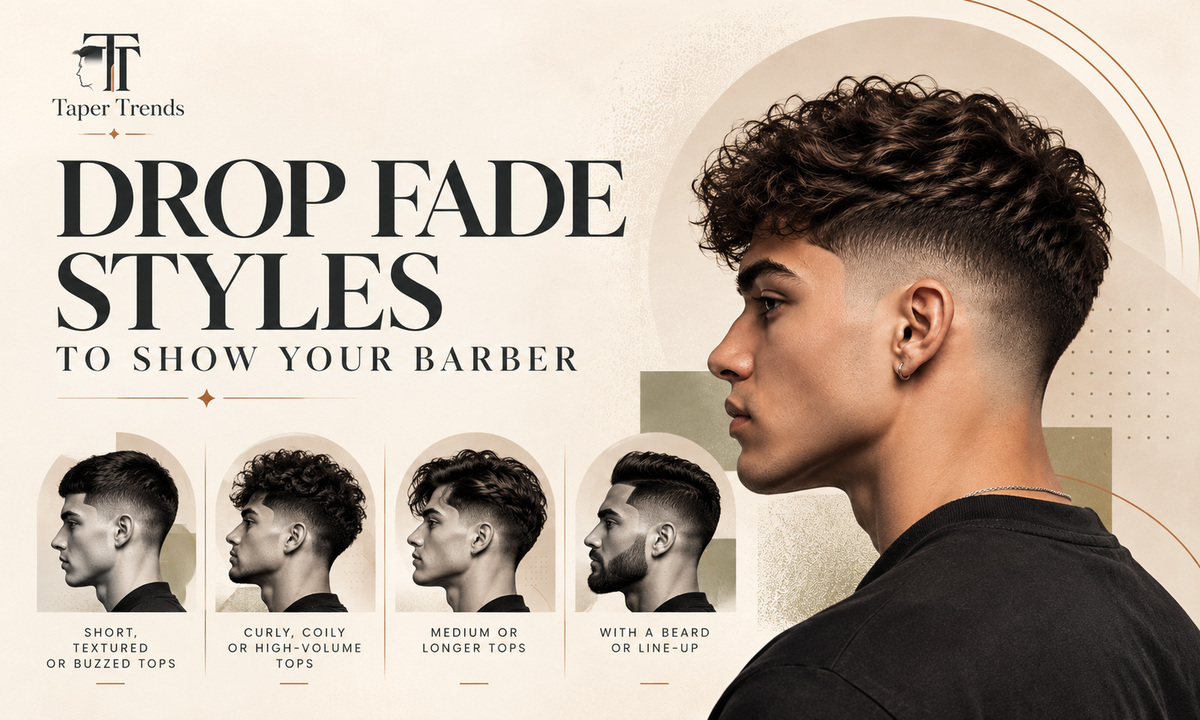
Drop fade styles to show your barber
Choose reference photos that match your own hair on three specs: top length and texture, fade height, and base finish. Two or three well-matched photos tell a barber more than a fifty-image gallery, and they should show the side and back, because that's where the drop is.
Short, textured and buzzed tops
The drop is most visible when the top is short. Under a very short buzz cut the curve is fully exposed, so its balance matters more. A bald drop fade can be worn as a buzz cut, with a side part, or blended into a longer top. A textured or French crop pairs clippered sides with a point-cut or razor-cut top, and a Caesar needs very little styling. For waves, patterned styles look best with clean sides and back.
Curly, coily and high-volume tops
Fuller textured tops are where the drop fade makes the most sense. Afro-textured styles and frohawks are natural fits, because the lower line accommodates a fuller top without the contrast feeling abrupt — a skin drop is one of the most common combinations for textured and natural styles. Keep enough weight above the fade for the curve to frame the shape; take too much and the contrast disappears. A short flat top needs daily styling and an afro is slightly high-maintenance, so ask your barber what each will cost you in the mornings. Curly and coily hair also shrinks as it dries, which changes how this fade should be judged and cut — our drop fade curly hair guide covers heights, base lengths, and top shapes for that texture specifically, and our drop fade guide for Black men pairs the curve with waves, an Afro, sponge twists and locs.
Medium and longer tops
The fade frames a longer top without dictating how you style it, and a drop fade works well if you're growing out length on top while keeping the sides sharp. A quiff or pompadour usually means a daily comb and blow-dry, roughly 10 to 15 minutes. For a slick back or side part, ask for the fade to blend into full length on top so the hair lies down when brushed back.
Drop fade with a beard or line-up
You can connect the fade to your beard or keep the two separate. A beard fade is typically a short blend, half an inch to an inch, at the sideburn junction and sometimes the cheek line, with the rest of the beard keeping its length. Once the top of the beard is blended to zero, the graduation can run from the cheekbones up through the sideburn into the hairline. The alternative is a disconnected sideburn with a crisp line-up. Mention the beard before the cut starts — our low taper fade with beard guide covers the sideburn-to-beard blend and a dozen combinations in detail, and our drop fade with beard guide covers the same join on this exact curve, with fade height matched to beard density, while our skin fade with beard guide covers a skin finish with a connected or disconnected sideburn.
Drop fade vs low fade, taper fade and burst fade
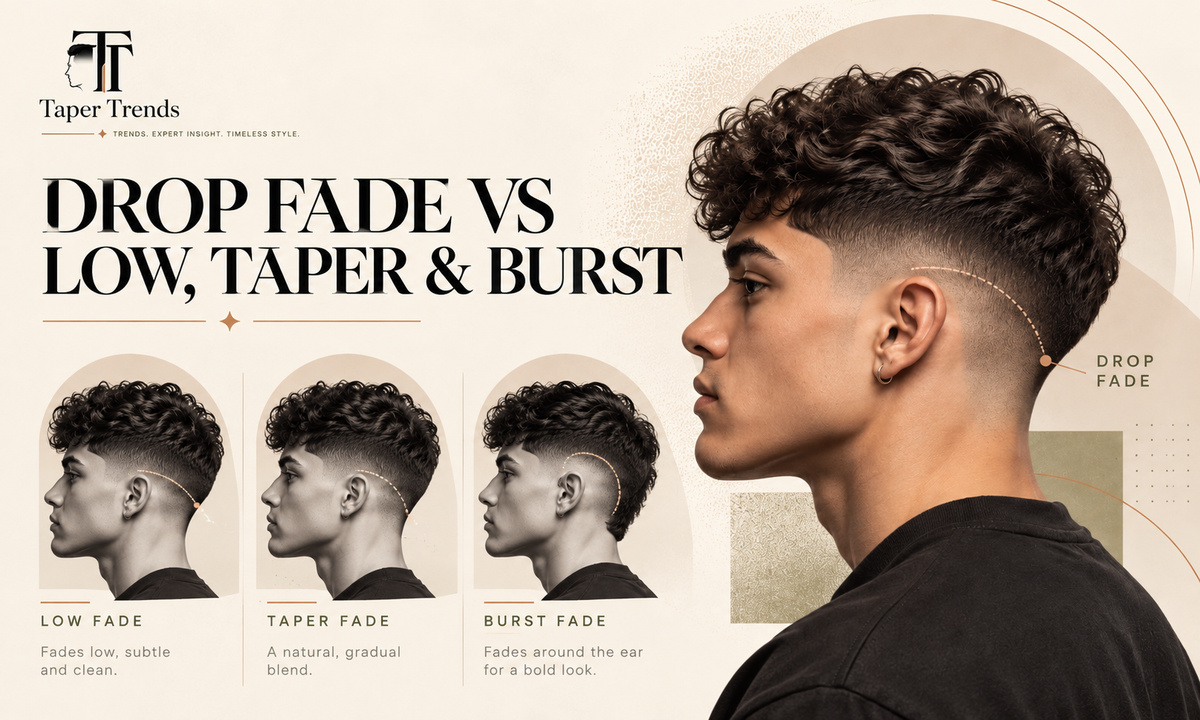
These terms get confused because they describe different things. Drop and burst name the shape of the line, low names a height, and taper, depending on the shop, names either a less-than-skin finish or a smaller cutting area.
| Term | What it describes | Line path | What usually stays longer |
|---|---|---|---|
| Drop fade | Shape | Arcs down behind the ear toward the nape | Crown and upper sides |
| Low fade | Height | Starts just above the hairline; can be level or dropped | Most of the side |
| Taper | Depth or area, depending on the shop | Often limited to sideburns and neckline | Visible hair at the base, or most of the sides |
| Burst fade | Shape | Semicircle around the ear | The back and neckline |
Drop fade vs low fade
A low fade describes height and a drop fade describes shape, so one haircut can be both: a low drop fade. Not every source uses the words that way, and some treat a drop fade as one held low around the ears while a low fade starts higher, which runs against most height definitions. If there's any doubt, state the starting height and the curve separately. Our low taper vs low fade breakdown untangles the contrast difference between those two in full.
Drop fade vs taper fade
“Taper” has no single definition. Some shops use it for a fade that stops at short visible stubble instead of skin, others use it for a cut that keeps visible length on the sides and shortens only the sideburns and neckline. So don't choose between the words: say whether you want the curve to run through the sides and back, and name the shortest guard. Our taper vs fade guide breaks the difference down term by term.
Drop fade vs burst fade
A drop fade keeps travelling behind the ear and down toward the nape. A burst fade radiates in a semicircle around the ear, like a sunburst centered on it, and it leaves the back longer. Some shops blur the two, so bring side and rear photos; our drop fade vs burst fade guide shows how to tell them apart from behind and which to choose. Our burst fade vs taper fade comparison covers the shape difference in more detail. If you want the back long rather than tight, our drop fade mullet guide explains how to stop the drop behind the ear.
What should you ask your barber for a drop fade?
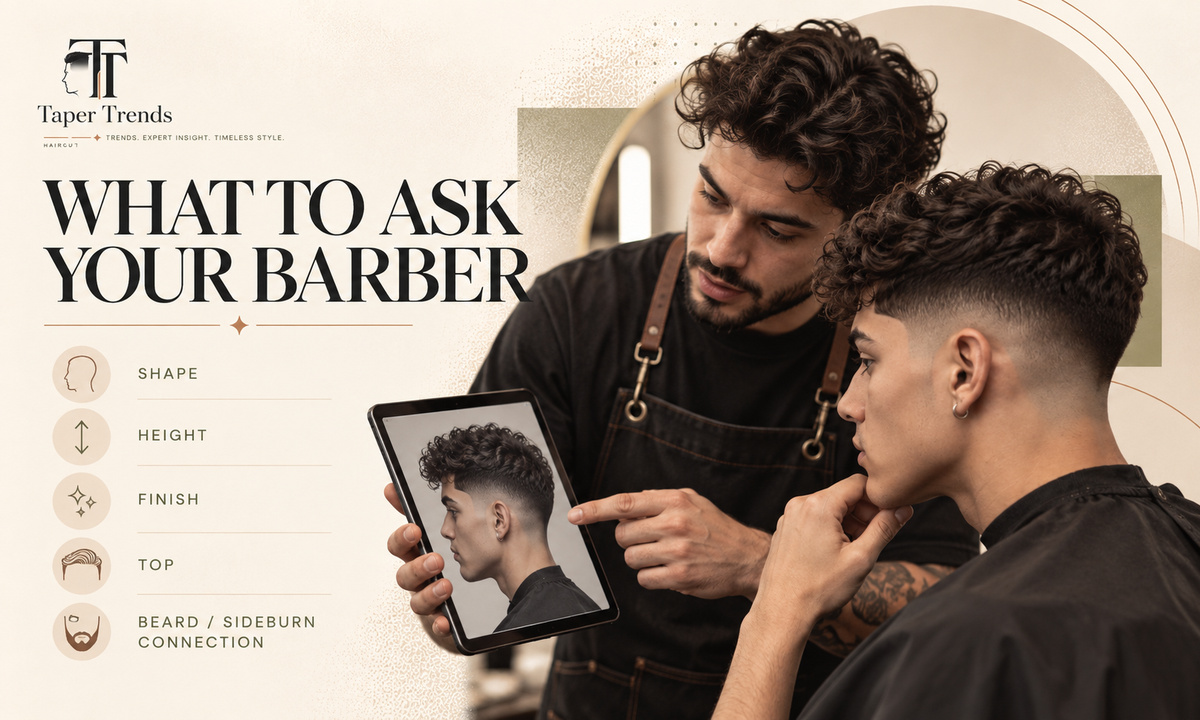
Give your barber five details: fade height, how far the line drops behind the ear, the shortest length, the top, and the edges. A front-facing photo can't show the drop, so bring side and rear views of a real haircut on hair like yours, as our guide on how to ask for a fade recommends for every fade.
Use this five-part barber brief
- 1Height: low, mid or high, and point to where the blend should start.
- 2Curve: a subtle drop or a pronounced one — some clients want a very slight drop and others a pronounced arc, and a photo settles it.
- 3Shortest length: skin, #0.5, #1 or longer.
- 4Top: length, texture, and whether it blends into the fade or meets it at a hard, disconnected line.
- 5Edges: neckline shape (natural, rounded or squared), line-up, and beard connection.
A sample request that covers all five in one breath:
“Mid drop fade with a #1 at the bottom. Let the line drop behind my ear toward the nape, like in this photo. Keep about two inches on top, textured and blended into the fade. Natural neckline, no line-up, no beard blend.”
What kind of reference photo should you bring?
Bring at least one side view and one rear view of a real haircut on a real person, not an AI-generated image, and treat it as a starting point rather than a demand. That warning matters: some published “drop fade gallery” images circulating online are AI-generated, and a render can show a blend no real head of hair will produce. Pick a photo whose hair matches yours in texture, density and top length.
Common drop fade request mistakes
| Avoid | Do instead |
|---|---|
| “Give me a drop fade.” | Name height, drop depth, shortest guard and top |
| Bringing only a front-facing photo | Bring side and rear photos |
| Asking for “a number one” and expecting a fade | A #1 all over is a buzz cut; ask for a fade up from your shortest guard |
| Pushing the height up mid-cut on impulse | Settle it first; a line taken too high can't come back that visit |
| Staying quiet when something looks off | Speak up during the cut, when a fix takes minutes |
How do you maintain a drop fade?
How short the base is and how crisp you want the gradient decide the upkeep, more than the word “drop.” There is one shape-specific wrinkle: because the cut sits lower at the back, you may notice it growing out a bit quicker than usual there.
How often should you refresh a drop fade?
Most people rebook every two to four weeks, skin finishes at the shorter end, the same range our guide to how often you should get a haircut gives most fades. Note the day your cut starts to look grown out to you, then book just before that point.
| If you want | Consider |
|---|---|
| A skin base that always looks fresh | Every 1 to 2 weeks |
| A skin base with some softening | Every 2 to 4 weeks |
| A low or mid drop with a guarded base | Every 2 to 4 weeks |
| A taper at the neckline only | Every 4 to 6 weeks |
Styling and grow-out between barber visits
- TopSalt spray with matte clay for a longer textured look, or pomade for a slick finish.
- NecklineA weekly trimmer pass along the natural neckline, with a detail trimmer and a two-mirror setup.
- The fade itselfLeave it to your barber. Home re-fading typically comes out uneven and takes longer to fix than waiting.
What if a skin fade irritates your scalp?
A bare-skin base, the finish that defines a skin fade, is optional. The American Academy of Dermatology explains that razor bumps form when a razor cuts hairs short and coarse, curly hairs curve back into the skin, and its advice includes avoiding a very close shave. If you're prone to bumps, ask what tool creates the base and whether a #0.5 or #1 gives you the look you want. Bumps that keep returning on the back of the neck or scalp can be acne keloidalis nuchae, a condition that can scar without treatment, so the AAD advises seeing a board-certified dermatologist about it. For the three skin heights side by side, our low vs mid vs high skin fade comparison shows where each bare section stops.
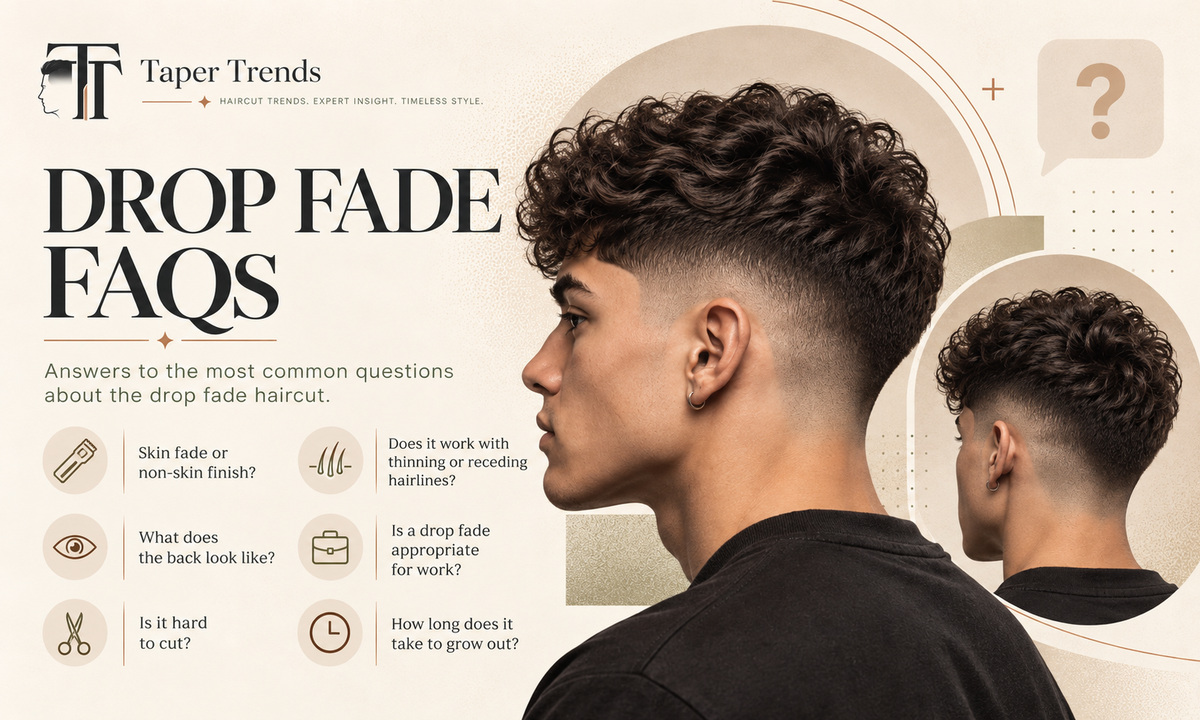
Drop fade FAQs
Does a drop fade have to go down to skin?
No. The drop describes the path of the fade line, not its shortest length. The base can be skin, a #0.5, a #1, or longer, and the curve behind the ear stays the same either way. A guarded base softens the contrast, hides regrowth for longer, and avoids a razor or foil pass on the skin.
What does a drop fade look like from the back?
From behind, the fade line slopes down from each side toward the nape and forms a rounded arc instead of a flat band, with fuller hair left at the crown above it. The two sides should mirror each other, so if one sits noticeably higher, ask your barber to even it out before you leave the chair.
Is a drop fade harder to cut than a regular fade?
It takes more planning, since the barber is drawing a curve rather than a straight or evenly angled line, and that arc has to balance on both sides of your head. Experienced barbers handle it routinely, but when choosing one, look for a portfolio that shows side and rear views of their drop fades, not only front shots.
Can you get a drop fade with a receding hairline or thinning hair?
Usually, yes. The drop shapes the sides and back, so it doesn't change your front hairline; the top style and remaining density matter more. Where you're thinning is the real question. A skin finish on thinning sides exposes more scalp, while contrast below a thinning top can draw the eye downward, so tell your barber where you're losing density before you pick the finish.
Is a drop fade appropriate for a conservative workplace?
A low drop fade with a guarded base is about as understated as a fade gets, and it pairs naturally with a side part or a classic pompadour. Higher starting points, skin finishes, disconnected tops, and shaved designs all raise the contrast, so scale up only as far as your workplace is comfortable with.
How long does a drop fade take to grow out?
Healthy hair grows roughly half an inch a month, so for a skin finish the base typically looks fuzzy by around day 14 and loses most of its contrast by day 21. A guarded base shows the same growth less, so it keeps its shape for longer between visits.
Your next step
Before your next appointment, write down the height, the drop, the shortest guard and what you want on top, plus the neckline and beard if they matter. Save a side and a rear photo of a real cut on hair like yours, then let your barber tell you what your head shape, density and hairline will change. If close finishes irritate your skin, choose a guarded base.
The bottom line
A drop fade is a shape, not a height or a finish. Once you separate those three choices, the name stops being confusing and starts being a tool you can use in the chair.
Settle the height, the depth of the drop, the shortest length, and the top before the clippers start, bring side and rear photos, and let your barber weigh in on your head shape and hairline. That's the whole formula.
Want more fade guides?
Browse clean, barber-ready breakdowns for every fade shape and hair type.