How often should you get a haircut? Most stylists start with “every 4 to 8 weeks,” but that range hides big differences. A skin fade can look grown out within two weeks, while healthy long hair can go three months or more between trims. Your haircut's design and the condition of your ends set the real schedule. Find your style in the table below, then adjust once you see how your cut actually grows.
If you aren't sure what your current cut is called, our types of fade haircuts guide sorts fades by height and finish, and the taper vs fade explainer shows why those two age so differently. For the low-maintenance end of the range, the low taper fade guide is the place to start.
How often should you get a haircut?
A common starting point is every 4 to 8 weeks, the range Hair Cuttery gives in its 2026 guide. Short, sharply defined cuts such as fades need attention sooner, while medium and long styles can stretch to two or three months. The right time is when the shape or the ends no longer match what you want.
Professionals don't agree on a single number, and that's useful to know. Hair Cuttery recommends a maintenance visit about every three weeks for clipper cuts like fades and tapers (scissor cut vs clipper cut covers how the two techniques grow out). In a medically reviewed Healthline guide, salon owner Michael Fuzailov put the average gap between cuts at three to four months, much longer than the six-to-eight-week rule many people grew up with. Both are judgments about appearance, not medical rules. They describe different haircuts.
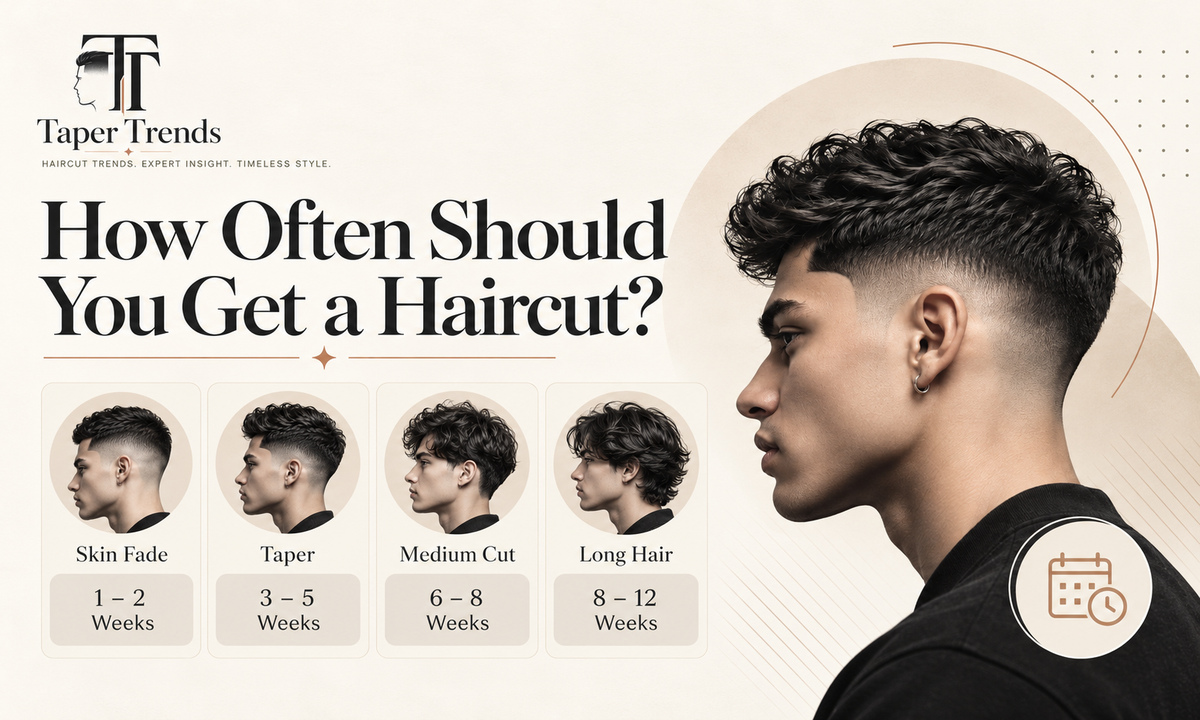
| Haircut or style | Starting window |
|---|---|
| Skin or bald fade | 1–2 weeks |
| Mid or high fade | 2–3 weeks |
| Low fade | 3–4 weeks |
| Taper or classic short cut | 3–5 weeks |
| Buzz or crew cut | 2–4 weeks |
| Bangs or a precise fringe | 2–4 weeks |
| Medium-length or layered cut | 6–8 weeks |
| Long hair | 8–12 weeks, longer if healthy and unprocessed |
Planning ranges drawn from Hair Cuttery, Healthline, and master barber Adrian Carranza's guidance, reviewed October 2026. They are practical estimates for keeping a look, not clinical intervals.
How often should you get a haircut by hairstyle?
Scalp hair grows about half an inch a month, the American Academy of Dermatology figure that Healthline cites, though genetics, age, and health move that number around. On long hair, half an inch barely registers. On a fade, where a fraction of an inch separates crisp from fuzzy, it changes the whole look. That's why the shortest styles sit at the top of the table.
How often should you refresh a skin fade or regular fade?
A skin or bald fade needs a refresh every one to two weeks to stay sharp. Mid and high fades usually hold two to three weeks, and low fades three to four. The shorter the shortest section and the stronger the contrast, the faster regrowth blurs the blend.
“Low,” “mid,” and “high” describe where the fade starts on the head. “Skin” or “bald” describes how short it goes. Our low vs mid vs high fade guide and the low vs mid vs high skin fade breakdown show both decisions side by side. Adrian Carranza, a master barber in Goodyear, Arizona, writes that a skin fade has only about a quarter inch of contrast to lose and looks its best for roughly six days. His point is worth sitting with: on a four-week cycle, you spend most of the month wearing the grown-out version. If you won't book every week or two, a softer fade will look better for more of the month, such as a shadow fade that stops short of bare skin or a low taper instead of a low fade.
Height matters as much as finish. The low vs high taper fade and mid vs high taper fade comparisons show how a higher start line exposes more skin, which is why a high taper fade sits nearer the short end of its window than a mid taper fade. Curved fades follow the same rule: a drop fade or burst fade loses its arc around the ear as soon as the short hair fills in.
How often should you trim a taper or classic short haircut?
A taper or classic short haircut typically holds three to five weeks. A taper leaves more length at the sideburns and nape than a skin fade, so regrowth reads as gentle softening rather than a lost line. Book near three weeks if you want a clean neckline, and closer to five if a relaxed outline doesn't bother you.
Carranza puts tapers at three to four weeks and says they stay presentable at five. Hair Cuttery places short styles in general at three to five weeks. Where you land depends on how much contrast your particular taper has, so ask your barber what interval suits the cut they gave you. Our taper fade guide covers the blend itself, and the skin fade vs taper fade and burst fade vs taper fade comparisons spell out how much longer a taper stays tidy. If you only want the temples kept sharp, a temp fade is the narrowest version to maintain.
How often should you maintain a buzz cut or crew cut?
Maintain a buzz cut or crew cut every two to four weeks. Uniform short hair shows regrowth everywhere at once, and the outline around the ears and neck blurs first. Two to three weeks keeps the edges crisp; four works if a slightly fuller look is fine with you.
Carranza suggests every two to three weeks for a buzz cut and says you can clip it yourself between shop visits. If you do, our haircut numbers guide, the how to cut a fade walkthrough, and the clipper guard sizes tool show what each guard leaves. A crew cut keeps more length on top, so its shape depends on that section as well as the sides, and it usually tolerates the longer end of the range. Pairing a buzz with a fade shortens the window again, as the low taper buzz cut, mid taper buzz cut, and high taper buzz cut guides show.
How often should you cut medium-length hair?
Medium-length cuts usually hold six to eight weeks if you want to keep the same length, the range both Hair Cuttery and Healthline give. Fine or chemically treated hair may need closer to four to six weeks, and choppy layers about six, before the shape starts to look uneven. If it already has, see how to fix a bad fade.
Healthline notes that sharper shapes tend to grow out more gracefully, so a crisp, blunt cut can sometimes wait longer than a soft, heavily layered one. If you're adding length rather than holding it, Healthline suggests stretching to 8 to 12 weeks. With short sides under a medium top, the sides set the pace, as our low taper fade for medium-length hair guide explains.
How often should you trim long hair?
Healthy long hair can often wait 8 to 12 weeks between trims, and hairstylist Lisa Huff told Healthline it can go three to six months if you don't color it or use heat. That only holds while the ends stay intact. Split ends, tangling, or visible breakage mean it's time sooner.
Hair Cuttery warns that waiting too long leads to breakage, which costs length later. Healthline adds that long hair can look thinner and break more easily. With long hair, judge by the ends, not the calendar. A long top over faded sides runs on two clocks at once; see long hair with a low taper fade and mid taper fade long hair for how to split the visits.
What affects how often you need a haircut?
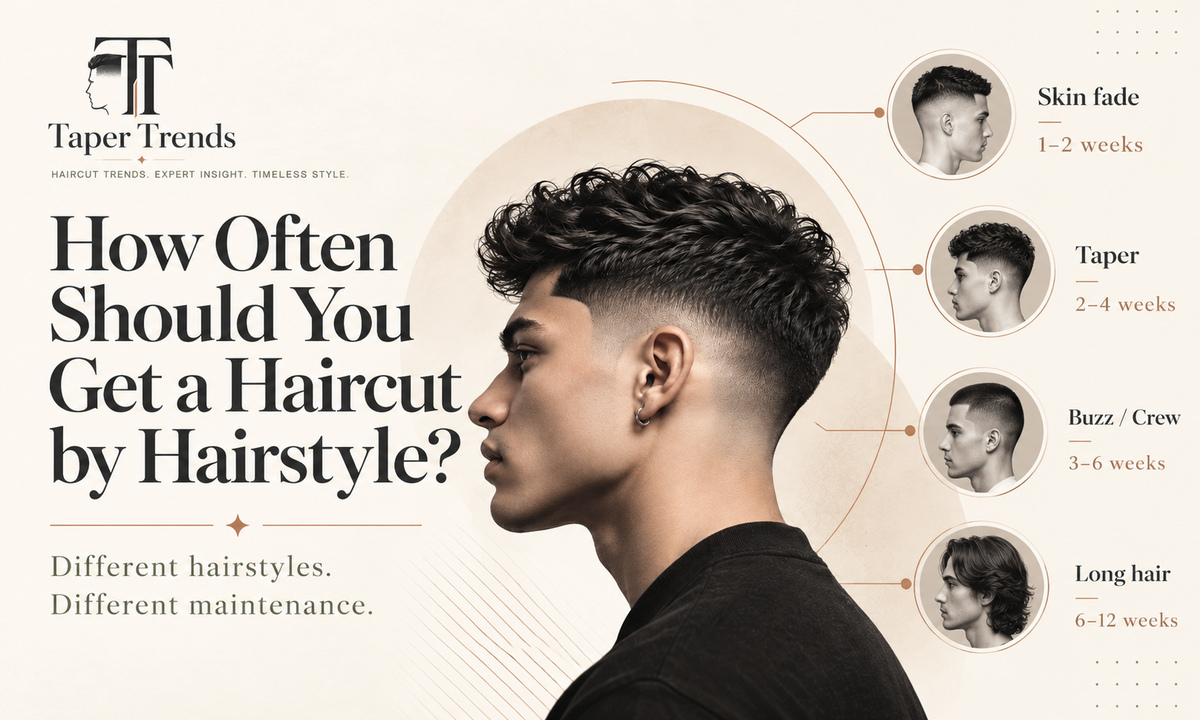
Two people with the same haircut can need different schedules. Texture, density, damage, and how polished you want to look all push your interval earlier or later. Use your style's window from the table as the baseline, then adjust it with the factors below.
Does hair texture or thickness change your haircut schedule?
Yes, but as an adjustment rather than a separate schedule. Texture changes how quickly regrowth shows and how easily hair breaks. Curly hair tends to hide uneven growth but dries out and breaks more readily, while fine strands fray sooner. Nudge your style's window instead of replacing it.
The AAD says thick, curly hair is more prone to breakage and dryness than other hair types. Professional advice on timing differs: Hair Cuttery suggests every 6 to 10 weeks for curls, while Healthline says curly hair can often wait longer because growth changes its look less. Fine hair sits at the other end. Huff told Healthline that ultra-fine hair breaks more easily and may need a trim as often as every six weeks.
Our texture guides show how this plays out under a fade: curly low taper fade, mid taper fade for curly hair, skin fade for curly hair, low taper fade afro, low taper fade for wavy hair, and low taper fade for straight hair, where every uneven patch shows first.
One distinction helps here. “Fine” describes the width of each strand, while “thin” usually means low overall density. Hair Cuttery recommends frequent, light trims for low-density hair to protect fullness, and regular reshaping for dense hair, which gets heavy and loses its balance sooner. The low taper fade for thin or thick hair guide covers both ends.
Should damaged, bleached, or heat-styled hair be trimmed more often?
Often, yes. Damaged hair is fragile and tends to break, so heat-styled, bleached, or chemically processed hair benefits from earlier checks. A trim removes damaged ends, but it can't repair the rest of the strand. Pair more frequent trims with gentler habits so you aren't cutting off the same damage every visit.
Heat and mechanical damage
The AAD recommends the lowest heat setting and using hot tools about once a week or less. For hair that's heat-styled constantly, Fuzailov told Healthline that cuts every few weeks help over time. He means small trims, not inches. Blow-dried styles like the low taper fade blowout and blowout taper fade are where this matters most.
Bleaching and chemical processing
Fuzailov also notes that color makes ends more fragile, so colored hair needs trims more often. Hair Cuttery suggests every four to six weeks for chemically treated hair. The AAD's advice targets the cause: stretch the time between color or relaxer touch-ups, aiming for 8 to 10 weeks or longer in winter. If you bleach or perm, our low taper fade with blonde hair and low taper fade perm guides cover the extra care.
What is the difference between a trim and a full haircut?
A trim removes a small amount of length while keeping your current shape. A full haircut rebuilds the shape, length, or layering. Service names vary between shops, so describe the result you want rather than relying on a label.
| Service | What it changes | Best when |
|---|---|---|
| Trim | Removes damaged ends or a little length | The shape still works but the ends look worn |
| Fringe trim | Shortens bangs only | Bangs are reaching your eyes |
| Edge-up or neckline cleanup | Sharpens the outline at the forehead, temples, sideburns, and nape | The outline looks fuzzy but the shape is fine |
| Full haircut | Reshapes length, layers, and sides | The overall silhouette has lost its balance |
How often should you trim your hair when growing it out?
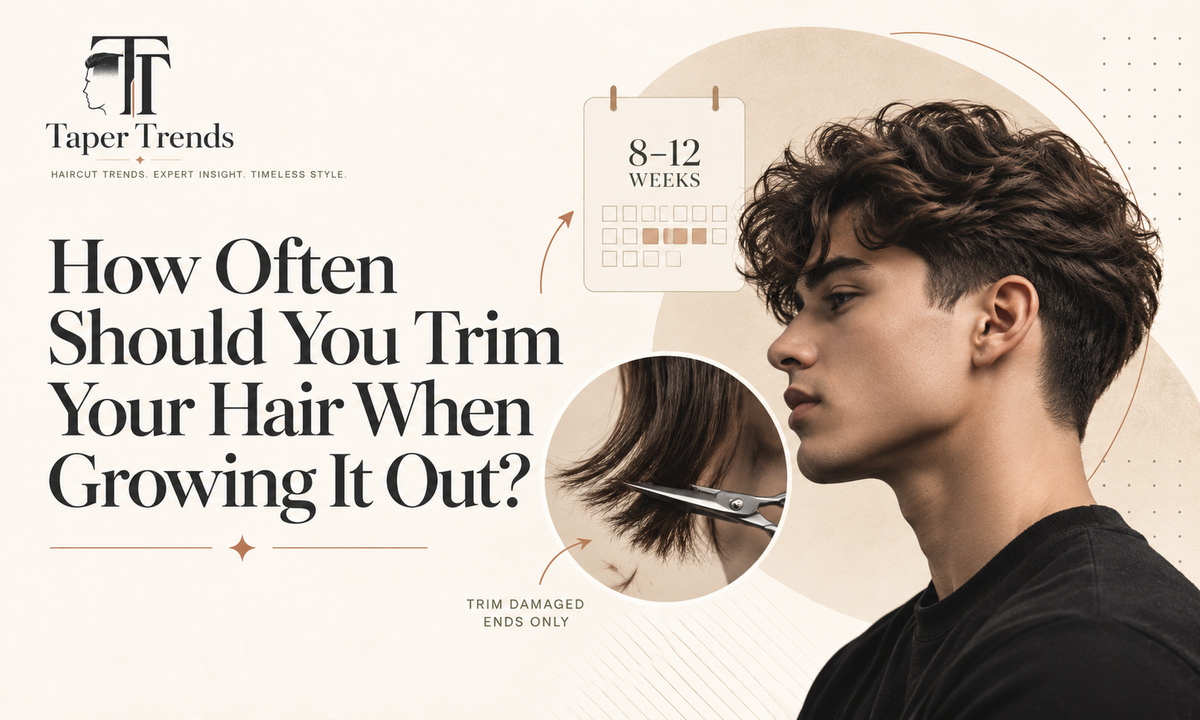
Trim about every 8 to 12 weeks while growing hair out, and remove only damaged ends. Hair Cuttery recommends that spacing. A trim won't speed up growth, but it removes split ends before they break off higher up and cost you length you've already gained. Growing out a fade is a different job, because the sides need shaping rather than trimming; see how to grow out a fade.
How do you remove split ends without losing unnecessary length?
Let the condition of your ends decide the amount, not a fixed measurement. Huff told Healthline she suggests removing a quarter to half an inch about every 12 weeks while growing hair out, and more only if breakage has traveled further up the strand.
- Check your ends in good light. Dry, brittle tips or hair that won't comb through cleanly are the early signs. Visible splits mean you've waited a little long.
- Tell your stylist the goal plainly, using the line below.
- Agree on a maximum before the cutting starts.
“I'm growing this out. Please take off only the damaged ends and keep as much length as you can.”
How should you maintain a fade, taper, or buzz cut while growing it out?
Stop restoring the original short sides and protect the length on top. Use short visits to tidy only the neckline and sideburns, so the outline stays clean while the rest fills in. Then ask your barber to blend the grown-in sides into the next shape instead of re-cutting the fade.
A practical sequence looks like this. Decide the length you're aiming for on top and tell your barber at the first visit. Keep the next few appointments to edges only. Once the sides have real length, have them shaped into a taper or an even medium cut that suits your destination style. Clean edges make the awkward middle stage look deliberate, which is most of the battle.
Common destinations each have their own guide: a low taper mullet, a middle part, fluffy hair, or locs over a low taper. Each lists the length the top needs before the shape works.
How can you tell when it's time for another haircut?
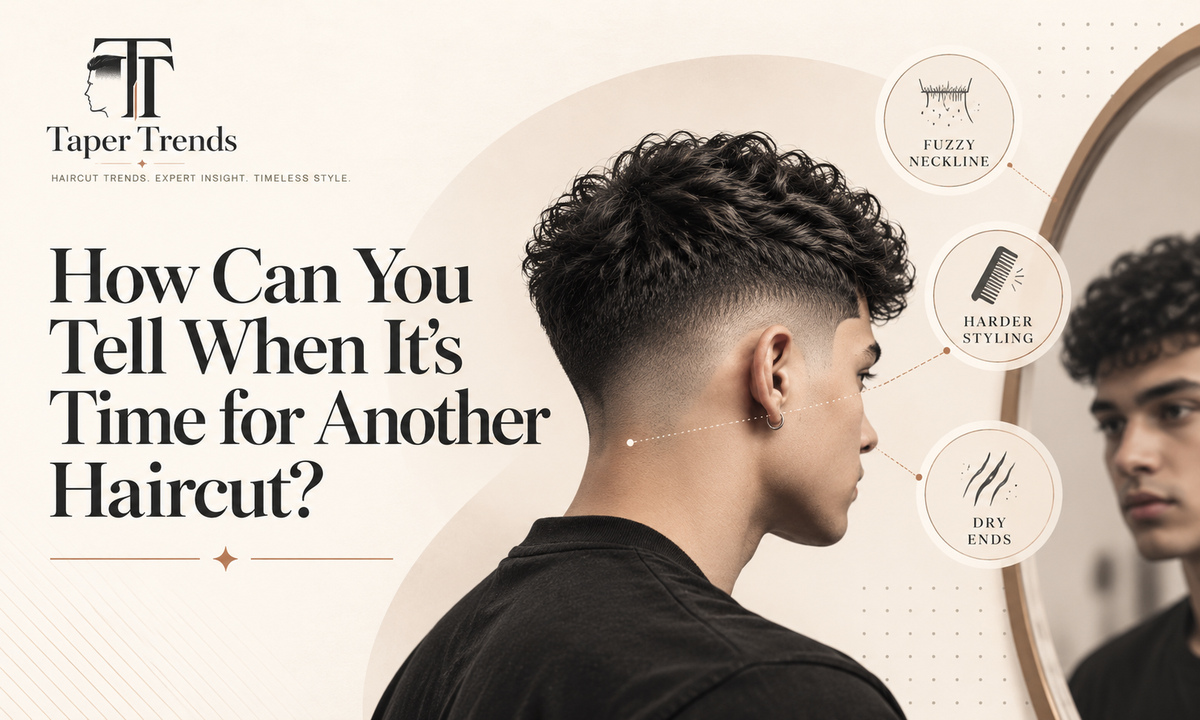
It's time when your haircut no longer looks or behaves the way you want, whatever the calendar says. Check three things in a mirror: your outline, how the style sits, and the condition of your ends. Any one of them can tell you to book.
- Outline: your neckline looks fuzzy or the hair touches your collar, the sides grow outward instead of down, or a fade's blend has gone soft. Carranza lists these as the clearest signs in his guide.
- Styling: it takes longer than it used to, or you now need product to control hair that used to behave on its own.
- Ends: they feel dry or brittle, or your hair is hard to comb through. By the time ends visibly split, Healthline says, you've waited too long.
These signs don't always arrive together. A cut can stop looking sharp well before it becomes hard to style, and tidy-looking hair can still have ends that need attention. To judge a fade, compare it with a fresh one: our what a low taper fade looks like guide shows the crisp version. Normal grow-out isn't a medical issue, but if you notice thinning or hair loss, the AAD recommends seeing a board-certified dermatologist rather than waiting it out.
How do you choose your next haircut date?
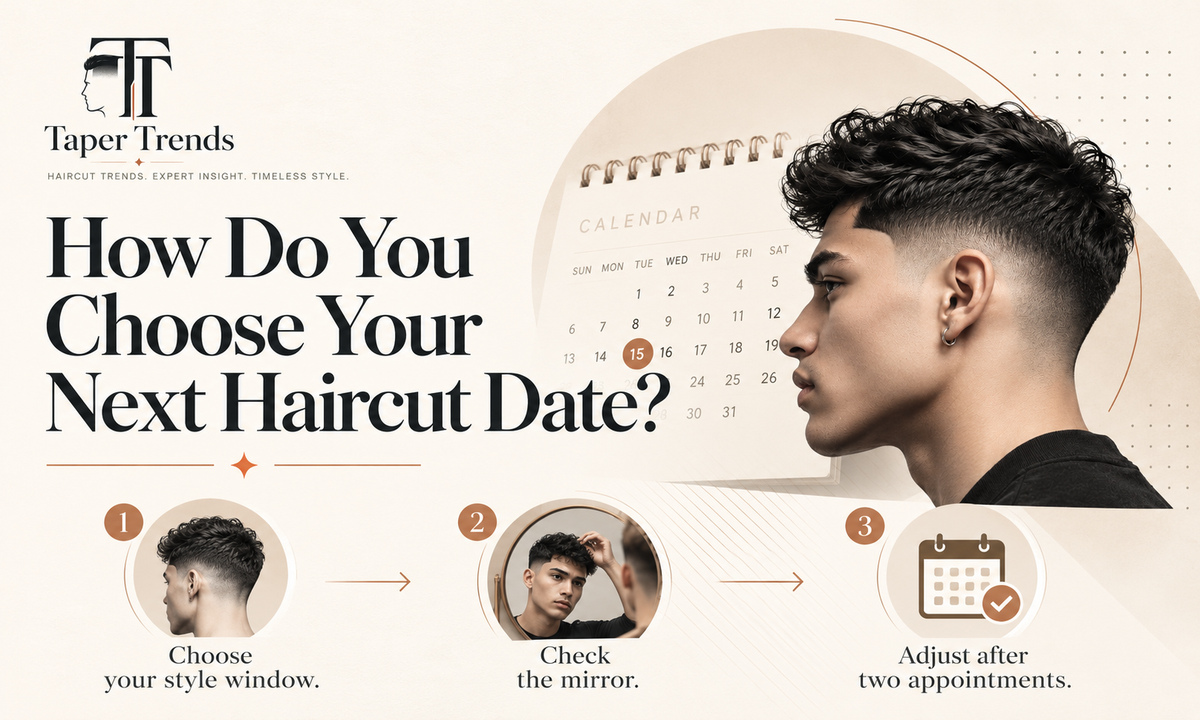
Pick your style's starting window, book toward the short or long end depending on how sharp you want to look, then fine-tune after two appointments. Real habits vary widely. In a May 2023 YouGov survey of 1,000 US adult citizens, 25% said they pay for a haircut every two to three months and 18% every four to six weeks. Those figures describe habits, not advice. Whatever your schedule, build how much to tip your barber into the cost of each visit.
Start with your hairstyle's maintenance window
Choose a date inside your style's range from the table. Book near the short end for a crisp finish and near the long end if a softer look is fine. All you need is your last haircut date and an honest sense of how polished you want to look day to day.
Adjust your schedule after two appointments
After two haircuts, note the week your shape first stopped looking right and how your ends looked at that point. If the cut slipped before your appointment, book earlier next time. If it still looked good, push the next one back slightly.
- A taper booked for week five that looked messy by week four points to a four-week interval.
- A medium cut that still looked tidy, with healthy ends, at eight weeks can try nine or ten.
Keep the same request between visits so you are comparing like with like. Our how to ask for a fade guide covers the details worth repeating, and the barber brief generator saves them on one card.
How can you make a haircut last longer?
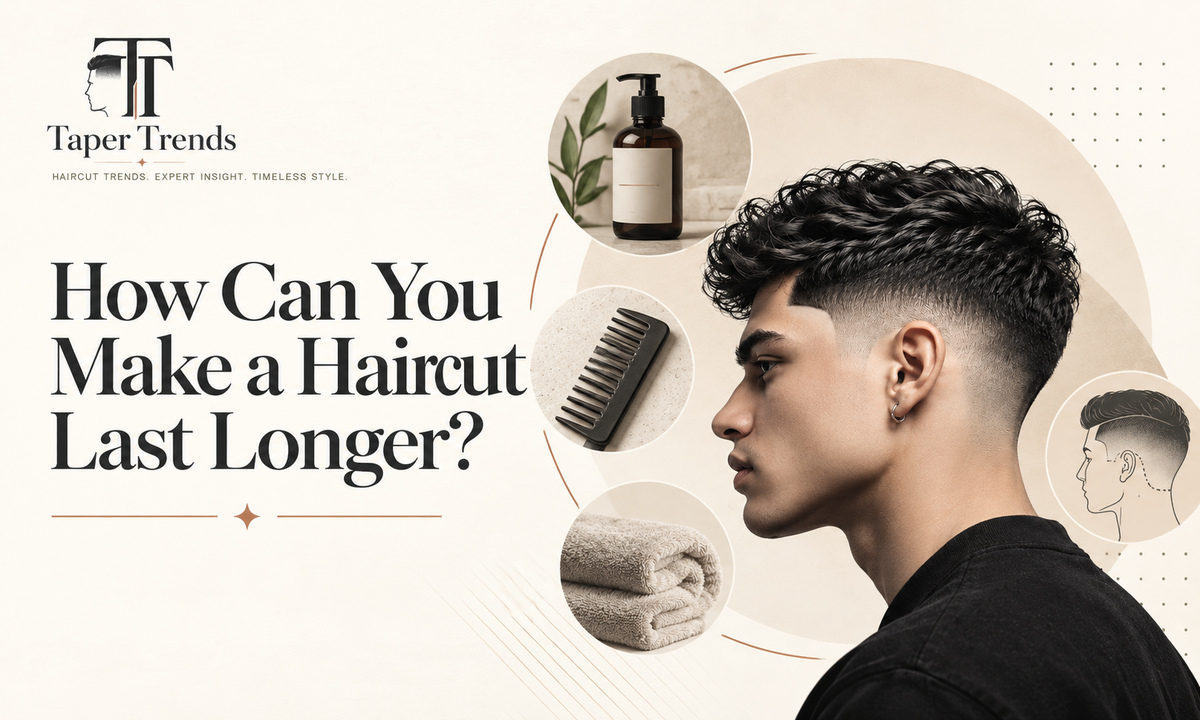
Handle your hair gently, keep it conditioned, and match your upkeep to your cut. These habits keep a style tidy and slow avoidable damage, but nothing stops hair from growing out of its shape. The realistic goal is getting the full life out of each haircut.
How do you maintain the shape between visits?
Style only as much as you need to, detangle carefully, and protect fragile ends. Small daily habits decide whether a cut looks deliberate or frayed by the time your next appointment comes around.
Daily shape and styling
Dermatologists say to brush or comb hair only to style it; the old 100-strokes-a-day rule is a myth. Wrap wet hair in a towel instead of rubbing it, and let it air dry when you can. Our guide to styling a low taper fade keeps the routine short, and textured tops like a textured fringe or French crop hide a little regrowth better than slick, polished shapes like a slick back or side part.
Protecting the hair from avoidable breakage
Use conditioner after every shampoo. If your hair is straight, let it dry a bit before combing it gently with a wide-tooth comb. If it's textured or tightly curled, detangle while it's damp, also with a wide-tooth comb. Skip tight ponytails, buns, and other styles that pull on the strands. If you wear waves, the low taper fade with waves guide covers the durag and brushing routine that keeps the pattern between cuts.
Is a neckline cleanup or edge-up enough between full haircuts?
Often, yes, if the overall shape is still sound. An edge-up or neckline cleanup restores definition at the hairline, temples, sideburns, and nape without reshaping everything else. It can't bring back a blurred fade, rebuild lost side proportions, or fix a top that has outgrown its style.
Hair Cuttery says an edge-up looks sharpest for one to two weeks and may lose definition before the rest of the haircut needs work, which is exactly why it's useful between full cuts. Carranza makes the same case for booking aline-uphalfway through a monthly cycle. Hair Cuttery also advises against trimming your own hairline unless you're confident with clippers, and our best clippers for fades guide covers which home kits suit that kind of touch-up. Ask your barber to follow your natural hairline rather than create a new one.
Line-up-heavy cuts like the burst fade Edgar and mid taper Edgar depend on these quick visits most, and so do beard blends. See low taper fade with a beard and skin fade with a beard for keeping the sideburn connection clean, and low taper fade designs for shaved lines that fade faster than the cut around them.
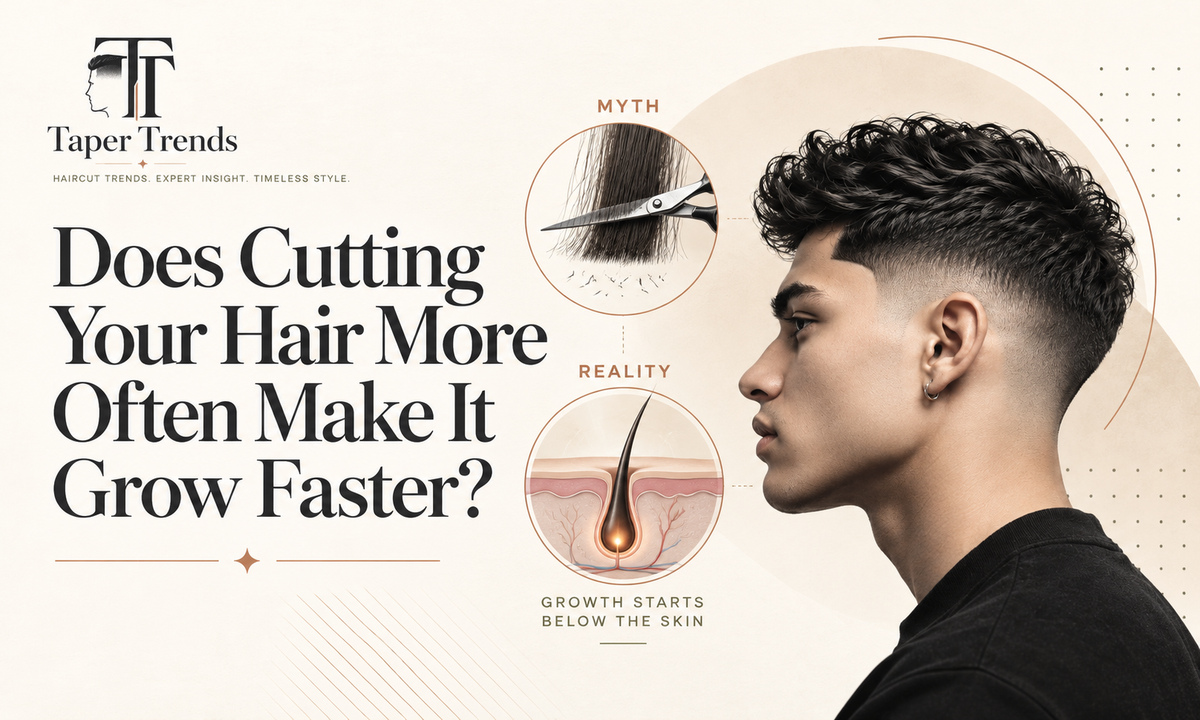
Does cutting your hair more often make it grow faster?
No. Hair grows from follicles beneath the skin, and cutting the visible shaft doesn't change that process. Regular trims can make it seem like hair grows faster only because they remove damaged ends before those ends break off and take length with them.
An American Academy of Dermatology release calls the faster-growth idea a false myth. Rochelle Torgerson, MD, PhD, a board-certified dermatologist at Mayo Clinic, explained that regular cuts keep hair healthier by removing hair that would split, but growth “occurs below the level of the skin and is not affected by cutting.”
| Belief | What holds up |
|---|---|
| More cutting speeds growth | Growth happens below the skin and isn't affected by cutting |
| Skipping trims keeps more length | Only while ends stay intact; split hair breaks and shortens the strand |
Treat a trim as maintenance for the hair you already have, not a way to change how much you grow.
Frequently asked questions about haircut frequency
These cover the edge cases the sections above don't: unusual intervals, special occasions, and how to talk to your barber.
Is getting a haircut every two weeks too often?
No. Regular cutting doesn't harm hair or change how it grows, so a two-week schedule is a choice about cost and polish rather than a health risk. It suits very precise styles, especially skin fades. If closely clipped skin ever feels irritated, tell your barber so they can adjust their technique or tools.
Is a haircut every six to eight weeks enough?
For medium-length and longer scissor cuts with healthy ends, usually yes. For fades, tapers, and buzz cuts, it's generally too long, because those styles depend on short, crisp sides. Check the mirror at week six. If the cut already looks grown out, shorten your interval next time.
Can you go six months without getting a haircut?
Yes, if your hair is healthy, your ends are intact, and the shape doesn't matter much to you. The gap itself isn't harmful. Hair Cuttery notes that damage often starts at the ends and travels upward, though, so expect a bigger trim afterward if you color or heat-style your hair.
How often should you trim bangs or a fringe?
Bangs change fastest because they sit at eye level. Hairstylist Lisa Huff told Healthline that people who want bangs to look just right may trim them as often as every two weeks, while most book every three to four. With curly bangs, ask your stylist to account for shrinkage, since curls spring up shorter once dry.
How many days before an important event should you get a haircut?
There's no fixed rule. A day or two of buffer is sensible for a precise style, because it leaves time to fix anything you don't like while the cut is still near its sharpest. Softer, longer styles often look best a week or so in. If your main cut is a little older, an edge-up a day or two before can sharpen it.
What should you ask your barber for if you want fewer haircuts?
Say it directly: "I want a cut that still looks good as it grows. How long can I realistically go?" Then ask for softer blending, a natural outline, and less exposed skin instead of hard contrast. A taper or a longer textured cut will usually look intentional for weeks longer than a skin fade.
For the fringe question, see the low taper fade fringe and mid taper textured fringe guides. For fewer visits overall, the low-mid taper fade is a common middle ground between a soft taper and a sharper fade, and different kinds of fades lists which ones age most gracefully.
What haircut schedule should you follow next?
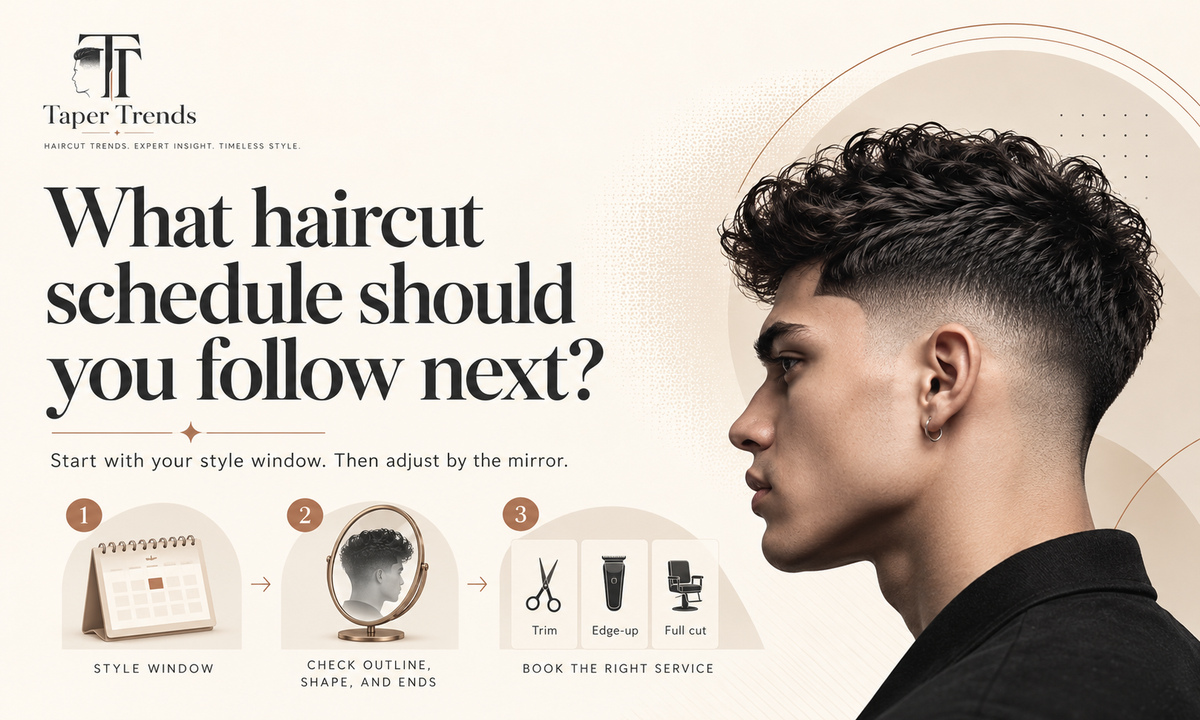
Start with your style's window, book toward the end that fits how sharp you want to look, and let the mirror overrule the calendar. Watch your outline, your shape, and your ends. After two haircuts, move your interval earlier or later based on when the cut actually slipped.
Match the service to the problem: a trim for worn ends, an edge-up for a fuzzy outline, and a full haircut when the silhouette has lost its balance. Then write down today's date, set a reminder at the short end of your window, and book before you start looking overgrown. If your current cut needs more visits than you want to make, our low vs mid taper fade comparison shows how much a lower start line buys you.
Keep going: guides that set your schedule
How often you need a cut depends on which cut you have. These guides cover the styles themselves, so you can pick one that matches how often you want to book.
- Low taper fade guideThe pillar guide to the taper that holds its shape longest between cuts
- Types of fade haircutsEvery fade by height and finish, so you know which window applies
- Different kinds of fadesThe fade overview, with the sentence to say in the chair
- Skin fadeThe highest-maintenance finish, and how to keep it sharp
- Skin fade: low, mid, highHow the start line changes how fast a skin fade grows out
- Mid fade haircutHow often a mid fade needs a touch-up, by finish
- Shadow fadeA softer bottom that forgives a longer gap between visits
- Taper fadeThe broad guide to the blend, with barber wording
- Taper haircutKeeping the sides and cleaning only the sideburns and neckline
- Taper vs fadeWhy a taper grows out gently and a fade loses its line
- Undercut vs fadeWhy an undercut's sides can go longer between visits than a fade
- Skin fade vs taper fadeContrast, upkeep, and which suits your booking habits
- Low taper vs low fadeThe same height, two very different amounts of short hair
- Low vs mid taper fadeHow much height and contrast each start line gives
- Low vs high taper fadeThe low-maintenance end against the high-contrast end
- Mid vs high taper fadeChoosing between a temple start and a high start
- Burst fade vs taper fadeTwo fades with very different grow-out stages
- Temp fadeA blend at the temples only, easy to refresh between cuts
- Haircut numbersWhat each clipper guard leaves, for buzz cuts and fades
- How to cut a fadeTouching up the neckline yourself without raising the blend
- How to ask for a fadeThe four details to give your barber at every visit
- How to style a low taper fadeThe at-home routine that keeps a cut looking fresh
- Low taper fade for thin or thick hairHow density changes the cut and its upkeep
The bottom line
There is no single right interval. Short, high-contrast cuts need a barber every one to four weeks, tapers and classic short cuts about three to five, and medium or long hair six weeks to three months or more.
Start with your style's window, watch your outline and your ends, and adjust after two cuts. If you want fewer visits, ask for softer contrast rather than stretching a skin fade.
Want more haircut guides?
Browse clean, barber-ready breakdowns for every hair type.