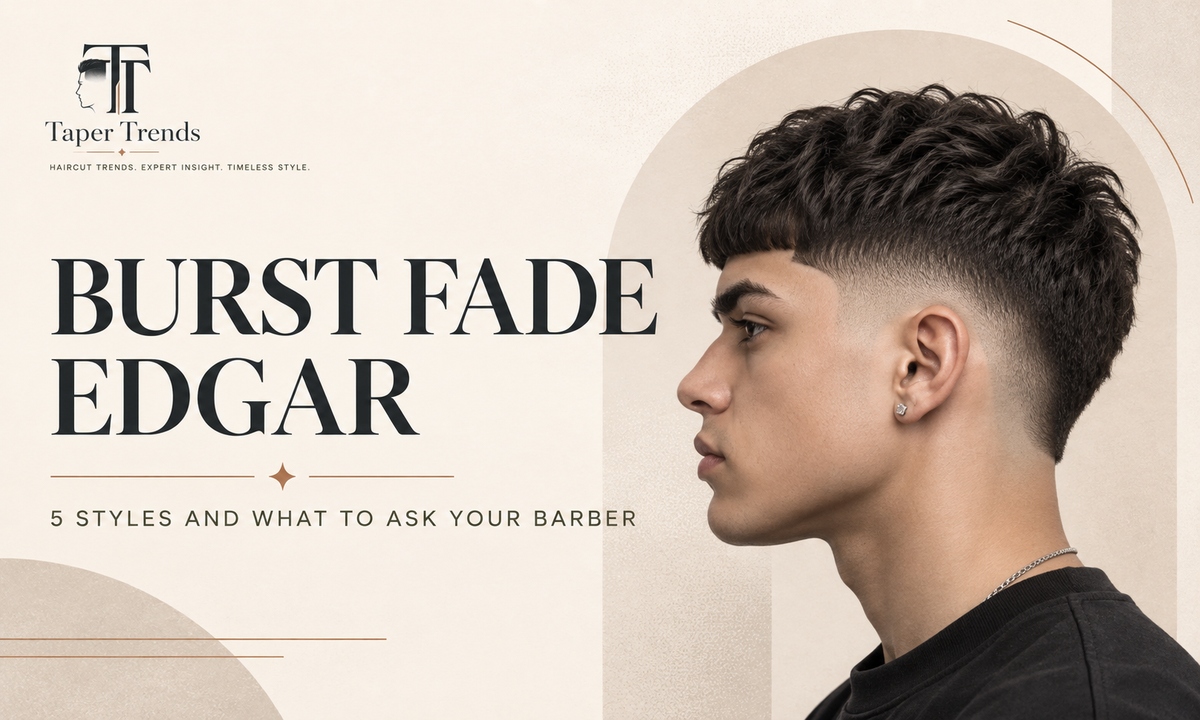
You found a photo of a burst fade Edgar and want that exact cut. The name alone rarely gets you there, because two barbers can read it two different ways. This guide splits the haircut into its parts, shows five variations, and compares it with taper and drop fade versions. It ends with a request you can save and hand over at your next appointment.
If you want either half of the name explained on its own first, our complete burst fade haircut guide covers the arc around the ear, the high burst fade guide covers how high it can climb, and the mid taper fade Edgar covers the same blunt fringe over a straight-line taper. The complete low taper fade haircuts guide is the hub for every quieter variation, and the rundown of every kind of fade haircut sets the burst beside its relatives.
What is a burst fade Edgar?
A burst fade Edgar is a haircut built from two separate features: an Edgar's blunt, cropped fringe (bangs) at the front, and a burst fade that curves in a semicircle around each ear. The fringe sets the front view, while the burst sets the sides. Confirming one from a photo takes front, side, and back angles.
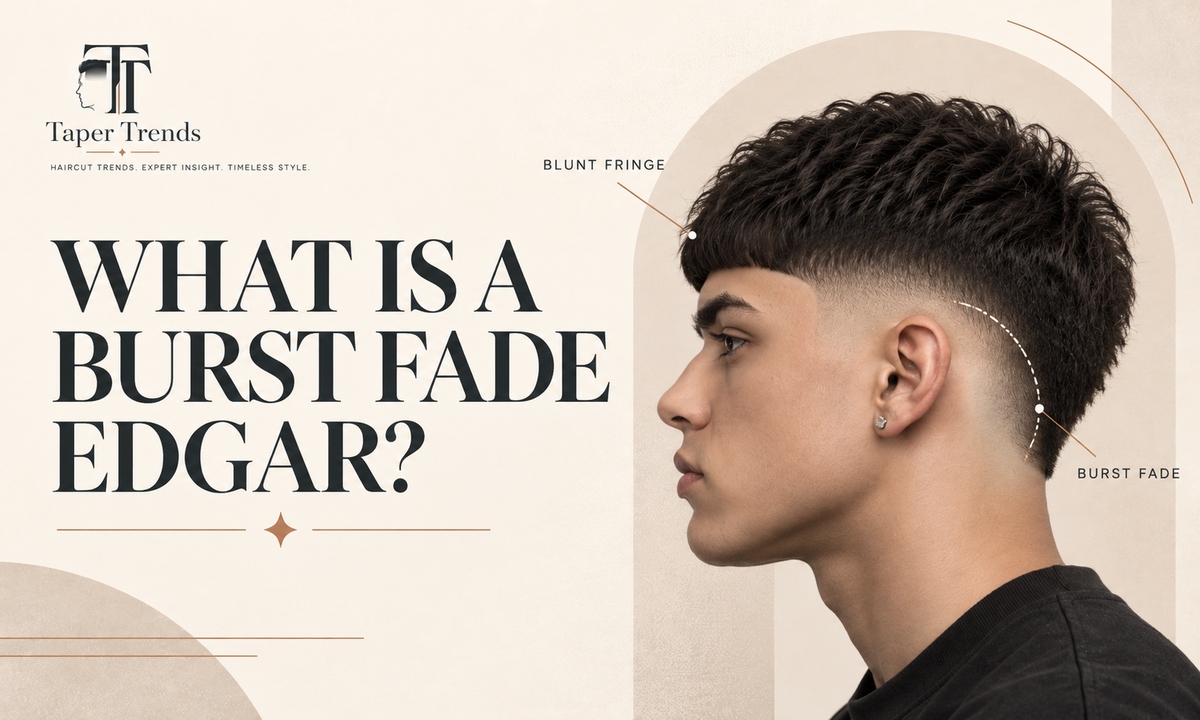
The Edgar half belongs to the French crop family. Luke Hartley of House of Barbers told Modern Barber that the Edgar is one of many modern varieties of the French crop, typically pairing a high taper fade with a blunt cropped fringe. Darren Fowler of Fowler35 adds that the fade can even be a drop fade, as long as a bowl-cut line creates “absolute contrast between the sides and top.” Jim Shaw of TONI&GUY Billericay notes the cut can drift toward a bowl cut when the top has no texture or is left a little long.
That family connection is worth following. Our French crop with a low taper fade covers the forward-textured parent shape, the textured fringe with a low taper fade shows what happens when the fringe is broken up instead of blunt, the burst fade textured fringe keeps that broken fringe over this same arc, and the low taper fade fringe guide walks through where a fringe should land on the forehead.
The burst half concerns only the sides. Cutters Yard, a London barbershop, describes a burst fade as one that curves around the ear in a semicircle. Cadmen Barber Academy's technique guide explains the geometry. The shortest point sits behind the ear and the fade graduates outward from it, so hair at the neckline and in front of the ear can keep more length. A burst says nothing about the fringe, which is why a side-only photo can't confirm the whole haircut.
If the arc itself is the part you're still deciding on, the taper low burst fade is the quietest version of it, and the low taper vs high taper comparison shows what raising the starting height does to the contrast.
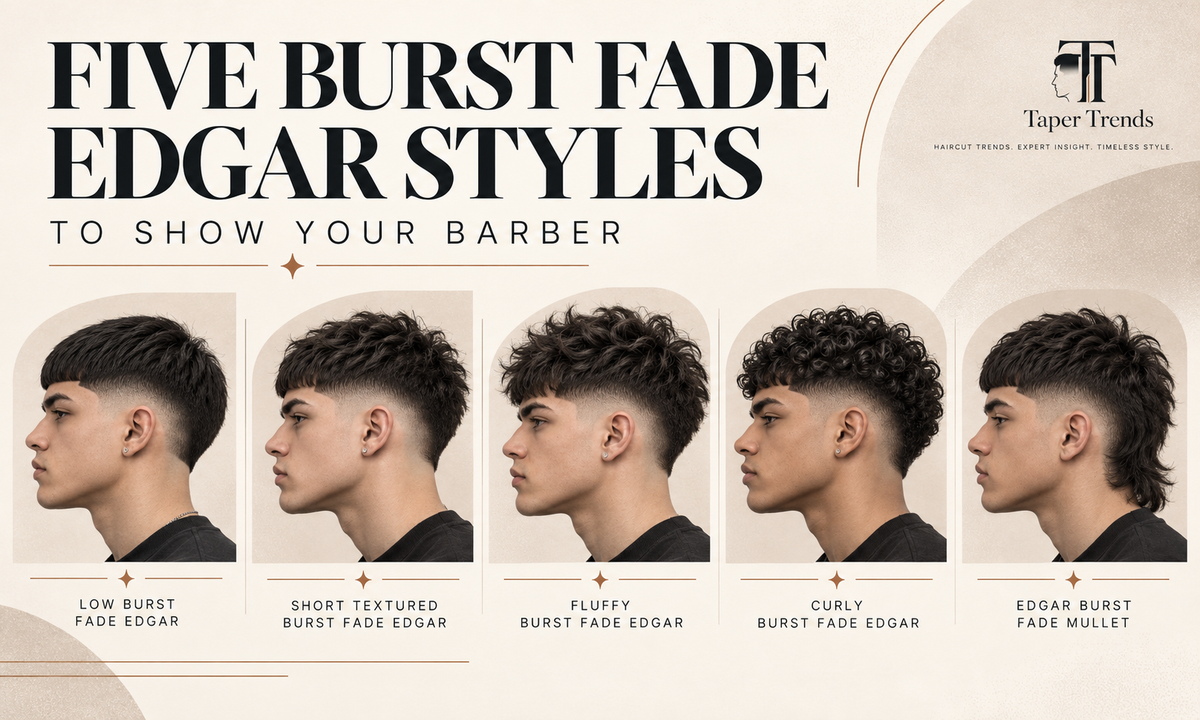
Five burst fade Edgar styles to show your barber
These five looks overlap, so treat them as reference points rather than fixed categories. Words like “low” and “fluffy” describe appearance, not standard measurements. Each entry names the one detail worth pointing at in your photo.
Low burst fade Edgar
According to Cutters Yard, a low burst fade starts just above the ear and makes a subtle curve around the hairline. That leaves more side hair than the high fade Hartley describes as typical for an Edgar, so the contrast is softer. Point to where the fade begins in your photo and how much side hair should stay above it. If you like that softer step, our low taper vs low fade comparison explains how contrast and upkeep move together.
Short textured burst fade Edgar
This version pairs a shorter, choppier top with the burst. Texture is what stops it from reading as a bowl cut, which is Shaw's warning in practice. Ask how the barber plans to cut texture into the top and where the fringe will land once your hair is dry. The low taper fade for short hair and mid taper fade with a textured fringe cover the same cropped territory from two different fade heights.
Fluffy burst fade Edgar
“Fluffy” describes a finish: a fuller, softer-looking top. Ben Brazzo of Jack & The Wolfe describes the classic Edgar top as slightly rounded and worn forward, which gives you a starting silhouette. Fowler points out that the same cut looks very different depending on texture and density. Bring a photo of the finish you want and ask how much volume your own hair can realistically produce. Our guides to the low taper fade on fluffy hair and the mid taper fade on fluffy hair break down what actually creates that lift.
Curly burst fade Edgar
The burst shape is a common pick for curls. Cutters Yard says it suits hair from tight curls to straight and lets the top and back keep length. Cadmen notes it's popular on curly and coily textures. To count as an Edgar, though, the front still needs a defined fringe line, so check a dry front view of any curly reference before saving it. For more on the arc over texture, read the burst fade for curly hair, the burst fade for Black men, or the mid taper fade on curly hair.
Edgar burst fade mullet
Cutters Yard describes the burst fade mullet as a burst paired with longer length at the back. A burst already leaves some length near the neckline, so not every grown-out back is a mullet. Bring side and back photos that show the length you mean, and agree where the outline should end at the nape. The burst fade mullet guide covers that back length in detail, and the mid taper fade mullet shows the same silhouette over a straight taper, while the drop fade mullet curves the line down behind the ear. If you want a strip rather than a fringe, the burst fade mohawk is the neighboring shape.
Burst fade Edgar vs. taper Edgar vs. drop fade Edgar: what changes?
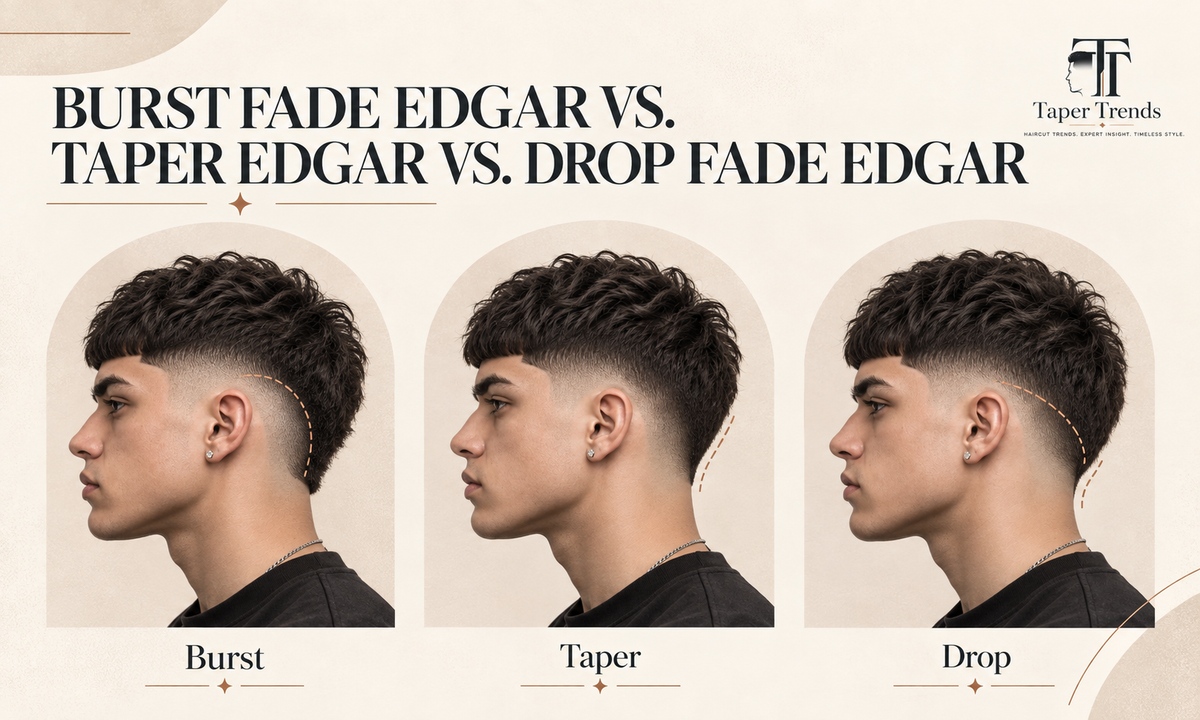
Only the sides and back change. A burst fade Edgar curves the fade around the ear, a taper Edgar shortens hair more gradually and keeps more length, and a drop fade Edgar dips lower behind the ear to follow the head. The fringe and cropped top can stay identical across all three, so the side photo decides it. Our drop fade vs burst fade comparison adds the rear check that separates a burst from a drop. Break that fringe into separated pieces over the drop and you have a drop fade textured fringe.
| Option | Side shape | Back and neckline | What to ask |
|---|---|---|---|
| Burst fade Edgar | Fade arcs in a semicircle around the ear | Neckline and back can keep length | Where does the arc start, and how long does the back stay? |
| Taper Edgar | Length shortens gradually, with the hairline shortest | Tapers toward the neckline, less dramatic than a fade | Should the shortest point be skin or just short? |
| Drop fade Edgar | Fade curves down behind the ear | Dips lower at the back, following the head's curve | How far should it drop behind the ear? |
Sources: Cutters Yard, Cadmen Barber Academy, StyleSeat. Checked September 2026.
Terminology isn't standardized. StyleSeat notes that many people, barbers included, use “taper” and “fade” interchangeably. It also says “taper fade” isn't a specific cut, just a term that grew out of the mix-up. That's the strongest argument for bringing photos: the barber confirms what they see, not what a label implies.
Each of those neighbors is covered here. Our taper vs fade explainer untangles the two words, the low taper drop fade carries the curve down toward the neckline, and the full taper fade guide places low, mid, and high side by side. For fade height specifically, compare the mid taper fade and the high taper fade — Hartley's “typical” Edgar sits at the higher end.
Will a burst fade Edgar work with your hair?
A burst fade Edgar can work on most hair types, but suitability is a consultation, not a yes-or-no rule. A barber weighs the result you want, your current hair, and how much daily styling you'll accept. Four traits drive that call: curl pattern, strand thickness, density, and growth direction. Together they decide whether your hair can hold the fringe.
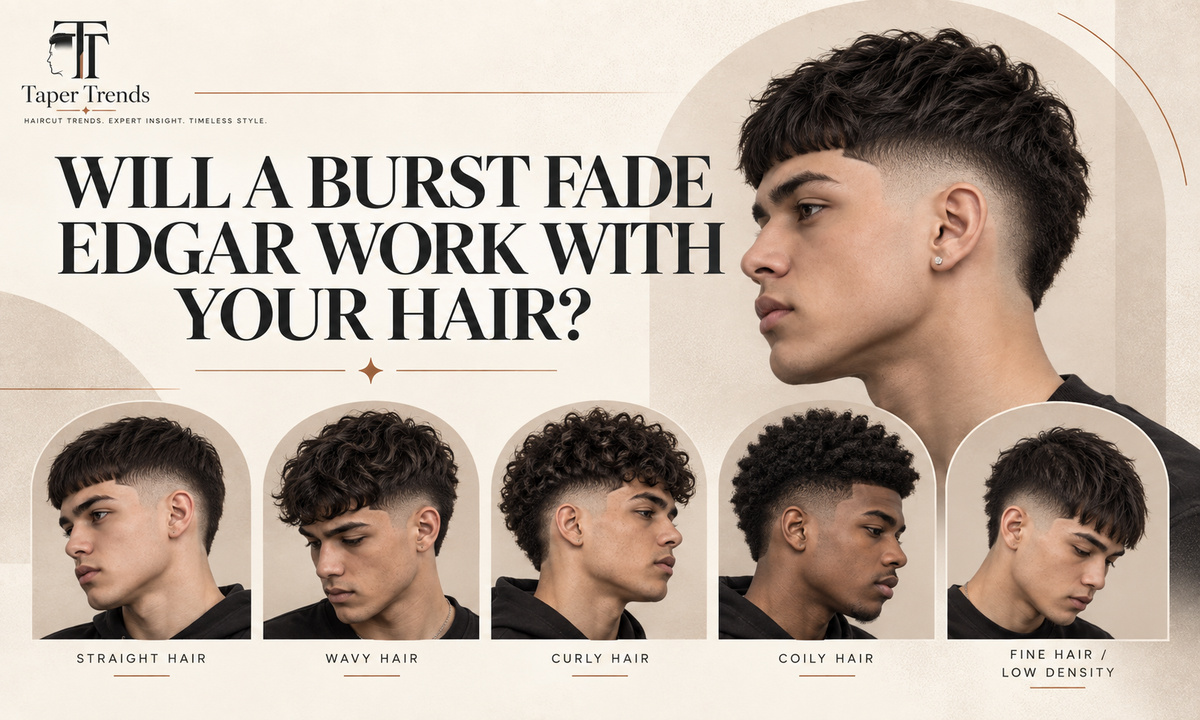
Straight and wavy hair
Growth direction matters most here. Cadmen's cowlick guide says a cowlick at the front hairline changes how the fringe lies, and that wet hair can temporarily hide one. Show your barber your hair dry and unstyled. For wavy hair, Uppercut Deluxe warns that forcing natural movement flat usually ends up looking puffy or over-styled. That matters if your reference fringe sits dead straight. Ask whether your movement will fight the fringe line, and whether the photo shows the cut styled or simply as it falls. Our low taper fade on wavy hair and low taper fade on straight hair guides go deeper on both, and the burst fade for straight hair covers the arc itself on hair that shows every transition. Our drop fade for straight hair compares the Edgar's blunt line with a softer, point-cut fringe.
Curly and coily hair
Dry length is the main risk. Curly and coily hair can sit noticeably shorter once dry than it looks wet, so describe the fringe and top as they should look dry, and ask whether your barber checks the shape dry. The sides are less of a gamble: Cadmen says the burst technique on tightly coiled hair follows the same method, with the barber working around natural growth patterns. Faders Barber Studio recommends picking a reference from someone with similar texture, since a cut on straight hair can look different on curls. If you're booking someone new, ask whether they regularly cut your curl type. The curly low taper fade walks through that conversation curl type by curl type.
Fine hair, low density, and growth patterns
Fine strands and low density are different problems. In an IPSY interview, trichologist Kimberlee Blakley defines density as the number of strands per square inch of scalp and thickness as the width of each strand. Hairstylist Naomi Vera says visible scalp from above suggests lower density. She adds that lower density needs more hair left at the perimeter to avoid holes, so ask how your fringe will fill in. Our guide to the low taper fade on thin and thick hair works through that distinction in detail.
Cowlicks at the crown, hairline, or nape come from follicle angle and, per Cadmen, can't be cut away. If thinning is new, the American Academy of Dermatology recommends seeing a board-certified dermatologist for an accurate diagnosis.
How should you adapt it to your face and head shape?
Face and head shape are preferences to discuss, not rules about who can wear a burst fade Edgar. Three choices change the look most: how much forehead the fringe covers, how much of the sides shows, and how much height sits on top. Bring your reference and ask which adjustments suit your proportions.
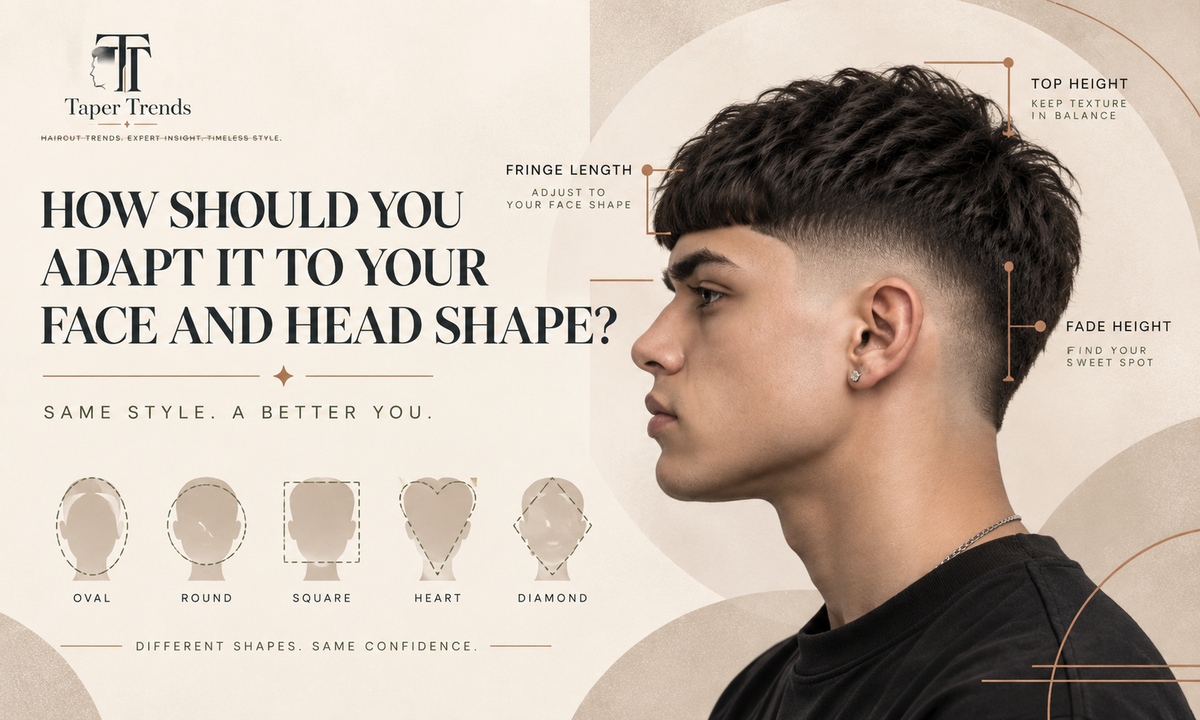
Most guidance on this comes from individual barbers, not research. The barber behind a Classic Barber Shop NYC post begins each cut by feeling the client's head shape and recommends a high or drop fade for a round head. He also warns that a straight skin fade over a prominent ridge at the back can look patchy, where a shadow fade smooths it out. Treat that as one practitioner's method, then use these starting points:
- For softer contrast, place the burst lower and finish at a shadow length rather than skin.
- For sharper contrast, raise the burst and take it to skin, which the same barber calls the most aggressive, high-contrast finish.
- To change forehead balance, adjust the fringe length or top height instead of the fade.
- Before cutting starts, ask the barber to show where the burst will begin and where the fringe will sit.
If you want to see how a blend reads from every angle before committing, our look at what a low taper fade actually looks like is a useful reference point, and the low taper vs mid taper comparison shows what moving the starting height does to your proportions.
How do you ask your barber for a burst fade Edgar?
Ask for a burst fade Edgar with front, side, and back photos rather than the name alone. Say what you like in each photo, agree six details before cutting starts, and describe the look you want instead of dictating clipper guards. Then ask the barber to repeat the plan back to you.
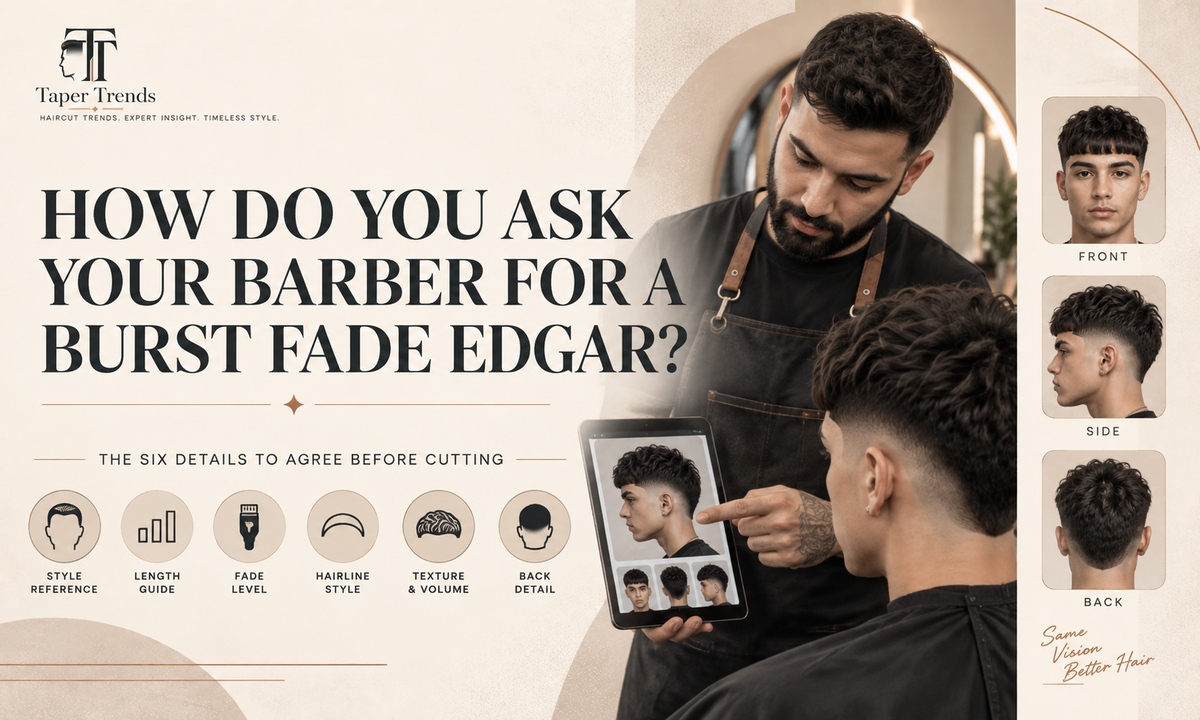
The six details to agree before cutting
Faders Barber Studio points out that a single front-facing photo may not show fade height, neckline, or blend clearly. It adds that saying what you like about a photo matters more than handing it over. Arrive with dry, unstyled hair and point to each detail below.
Front and top
- Fringe: blunt or textured, and where it should sit on your forehead when dry.
- Top: its length once dry, and whether texture is cut in or left natural.
- Front and temples: a crisp line-up or a softer edge. If a front cowlick pushes your hair sideways, say where and which way.
Sides and back
- Burst: where the arc starts above the ear and how far back it reaches. Cadmen notes that a temple cowlick can change how the sides lie after a fade.
- Shortest length: skin, shadow, or something longer. Classic Barber Shop treats this as a separate choice from fade height (low, mid, or high). Our mid burst fade guide covers the middle setting.
- Back and nape: how much length stays, and whether the outline is rounded, tapered, or squared. According to Cadmen, a nape cowlick can make a squared neckline hard to keep.
Finish by naming anything you don't want removed. If you wear a beard, agree the sideburn connection at the same time — our burst fade with beard, low taper fade with a beard and mid taper fade with a beard guides cover that handover. If you want a line or pattern shaved into the burst, settle it before the cut using our low taper fade design ideas.
A saveable barber request
Copy this, fill in the brackets, and save it with your photos. It's a template, not a universal specification. Your hair may not manage every detail, and your barber's job is to tell you so.
- Fringe: [blunt or textured], sitting at [point on forehead] when dry
- Top: [length when dry], texture [cut in or natural]
- Front and temples: [crisp line-up or soft edge]
- Burst: starting [low, mid, or high], reaching [distance behind ear], finishing at [skin, shadow, or length]
- Back and nape: keep [length], outline [rounded, tapered, or squared]
- Non-negotiable: [one or two details]
- Do not remove: [what to keep]
If something in your photos won't work with your hair, ask for the closest workable version before the clippers start.
How do you style a burst fade Edgar at home?
Styling a burst fade Edgar takes a few short steps. Start with clean, damp hair, dry the fringe forward on low or medium heat, and finish with as little product as the look needs. Begin with one product and add a second only if the top falls flat. Wavy and curly hair usually do better with a diffuser.
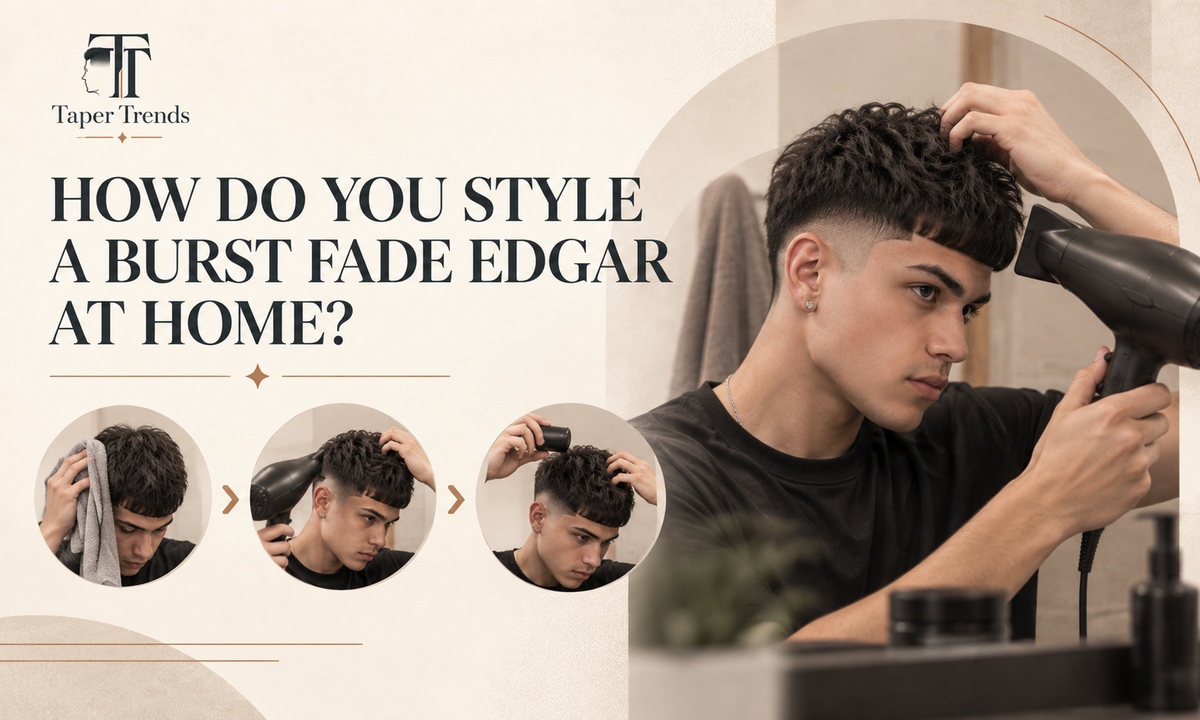
- Towel-dry gently. The American Academy of Dermatology says rubbing hair roughly can damage it. Wrapping it in a towel to absorb moisture is gentler.
- Add a base if you need one. In Uppercut Deluxe's textured-crop tutorial, barber George Coady's routine works a fingertip of light-hold product into damp hair. Follow your own product's label.
- Dry into shape.Brazzo dries the Edgar forward. The AAD recommends low or medium heat with a heat protectant. Uppercut's wavy-hair guide suggests a diffuser on low heat and low airflow for definition.
- Finish once fully dry. The textured-crop routine taps a small amount of styling powder into the roots for lift, then builds gradually. Uppercut lists applying powder to wet hair as a common mistake.
Done well, the fringe stays where you set it and the top holds texture without stiffness. If it doesn't, ask your barber to demonstrate on your hair at the next visit. Our full at-home styling routine for a low taper fade covers products and drying technique step by step, and if you're weighing a chemical route to more curl, the low taper fade perm guide lays out the trade-offs.
How often does a burst fade Edgar need maintenance?
Most burst fade Edgars need a fade cleanup every two to four weeks, while the fringe and top can often go longer. Barbershops quote windows from one to four weeks, depending on how short the fade goes. Book the service that matches what has grown out, and let your tolerance for softness set the schedule.
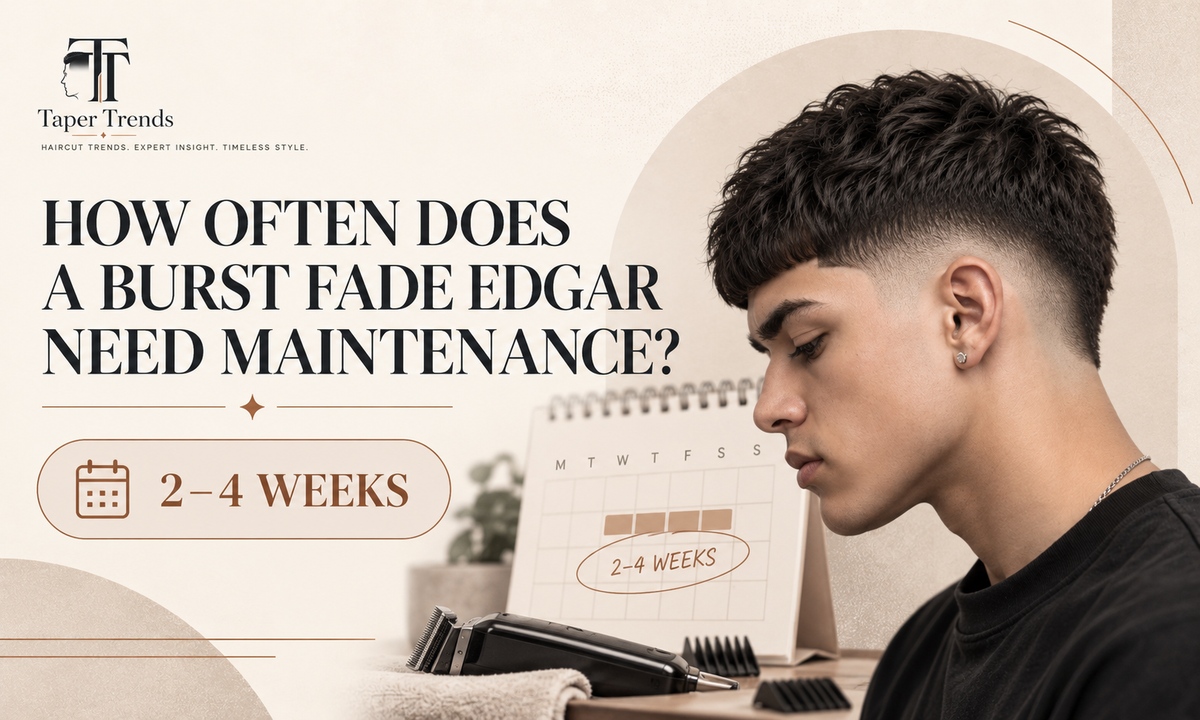
Cadmen Barber Academy gives a burst fade two to three weeks before regrowth shows at its tightest point, and clients who want it sharpest rebook every two weeks. Cadmen adds that the arc, not the top, drives the rebooking cadence. Cutters Yard suggests trims every two to four weeks for burst and drop fades. Outlaw Barber Company in South Carolina puts a skin fade at one to two weeks and a low fade or taper at three to four. It also suggests a lower fade or longer transition if you want something that grows out better — which is the argument for the taper low burst fade if you'd rather stretch your visits.
- Fade cleanup: the area around your ears and neckline looks fuzzy, or the blend has lost its smooth transition.
- Fringe adjustment: the fringe no longer sits at the length or line you agreed.
- Full reshape: the sides and top have both drifted, or you want a change.
What should you do if the cut doesn't look right?
If your burst fade Edgar doesn't match the reference, compare it with what you agreed before asking for more cutting. Judge it dry, after washing and styling it yourself, then decide whether the problem is styling, shape, or length. Cutting can't restore removed length, so ask for an assessment before any fix.
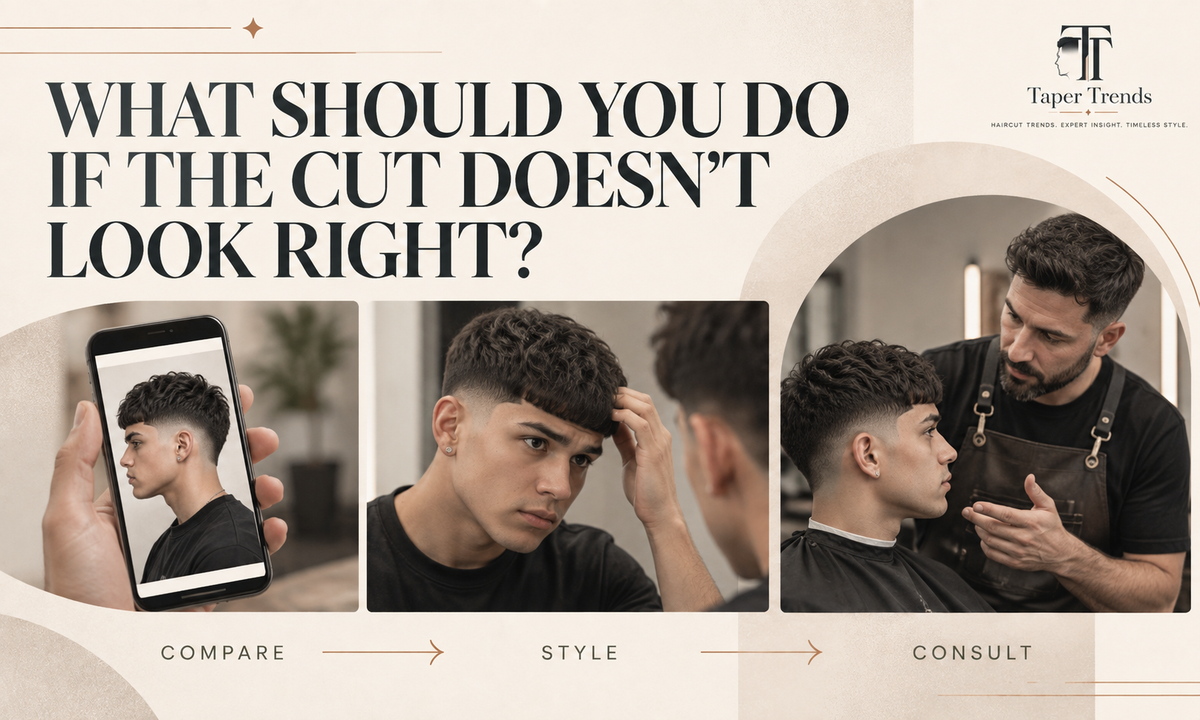
- Compare. Put your saved request and photos next to the dry result and note which of the six details differs.
- Give it a few days. A Hair.com etiquette piece notes that a new cut can take a few days to get used to. It suggests washing and styling it before reaching for scissors.
- Go back with specifics. Matrix artistic educator Selina McManus suggests asking for a consultation to see whether styling can solve the problem before a full correction. Name the exact difference, and leave any fade work to the barber.
Burst fade Edgar FAQs
Can I keep a beard with a burst fade Edgar?
Yes, as long as the barber plans the beard and haircut together. Cadmen Barber Academy explains that fading the beard at the sideburns connects it to the haircut so both read as one element. Ask for the sideburns and cheeklines to be shaped with the burst. Also check whether beard work is booked separately: Outlaw Barber Company distinguishes a standard trim from a full service for reshaping and line work.
Do I need a perm for a fluffy burst fade Edgar?
No. A fluffy top usually starts with the cut and a styling routine suited to your natural hair, so first ask your barber how much volume your texture can give. A perm chemically changes your curl pattern, and the American Academy of Dermatology cautions that treatments like perming can leave hair dry and brittle. If you're still considering one, discuss the risks with a qualified stylist.
Can I grow a burst fade Edgar into another haircut?
Yes, with a plan agreed with your barber. Name the target style, then ask which areas to keep growing, which to tidy, and which to shorten at each visit. Moving through a softer taper can help, since StyleSeat notes that tapers leave room to try different styles as hair grows out. Your current length, not a fixed calendar, sets the timeline.
How much does a burst fade Edgar cost?
There's no standard price for this exact cut. Shops price by service, such as a haircut, a skin fade, or add-ons like beard work, and prices vary by city and barber. Check your shop's current online menu or call ahead. Confirm that fringe work and any line-up are included in the quoted price before you book, so the total doesn't surprise you.
Can I cut a burst fade Edgar myself?
You can style it yourself, but reproducing the full cut at home is hard. Cadmen says a burst fade takes more three-dimensional thinking than a straight fade because the guide follows a curve, and that curve sits behind your ear where you can't see it clearly. Outlaw Barber Company warns that DIY neckline work often ends in an emergency appointment. Maintain the style between visits and leave the cutting to a barber.
Should I book a fade, a restyle, or a regular haircut?
Book a service that covers the whole head, not a fade-only cleanup, because a burst fade Edgar needs work on the fringe and top as well as the sides. Menu names differ between shops, so send reference photos, say what will change, and ask whether line-up and beard work are included. Faders Barber Studio invites customers to call if they need help choosing the right service.
Three of those answers point elsewhere on the site. For the beard question, read the high taper fade with a beard on connecting a higher blend to facial hair, or the drop fade with beard guide if your fade curves down behind the ear, or the skin fade with beard guide if the sides go to bare skin. For growing it out, the low taper fade on medium length hair and long hair low taper fade are useful landing points. And if you're booking this for a school-age child, the low taper fade for boys and mid taper fade for boys guides cover school-friendly versions of the same shape. Our skin fade height comparison sets low, mid and high skin fades side by side when the finish is bare scalp.
Before you book
Settle three things first:
- Pick a reference that shows every angle and matches your texture.
- Agree the six details before any cutting.
- Decide how sharp you want the fade to stay, since that sets your upkeep.
Then arrive with dry hair and ask the barber to repeat the plan. Keep the saved request, so every touch-up starts from the same brief.
Still comparing shapes? The burst fade haircut guide covers the arc on its own, the full rundown of fade types places it beside everything else on the menu, and the low taper fade haircuts guide is the hub for every quieter variation. For the nearest neighbors to this cut, read the mid taper fade Edgar, the French crop low taper fade, the high taper fade with a textured fringe, or the burst fade mullet. For the arc versus a straight-line taper specifically, our burst fade vs taper fade comparison puts the geometry, hair-type fit, and upkeep of each side by side.
The bottom line
“Burst fade Edgar” names two things and settles neither. The fringe line, the height of the arc, the length at the back, and whether the finish is skin or guarded are all still yours to decide.
Bring photos from three angles, arrive with dry hair, and agree the six details out loud. You can always go shorter next visit.
Want more fade guides?
Browse clean, barber-ready breakdowns for every fade shape and hair type.