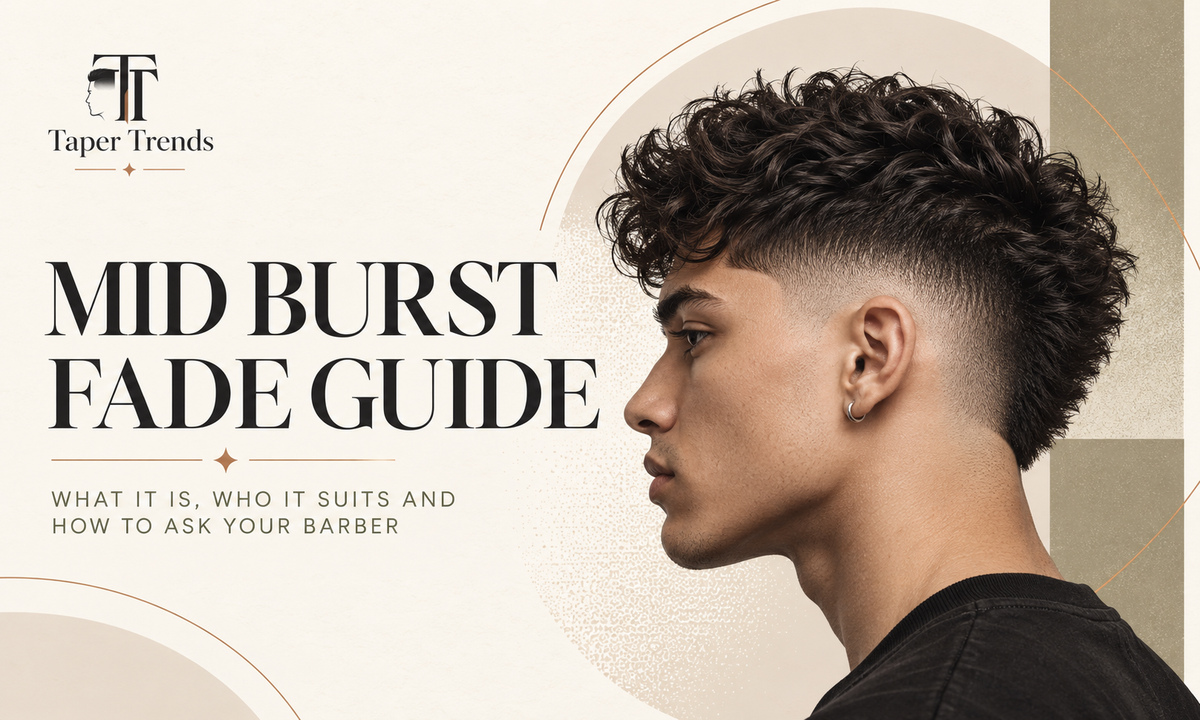
A mid burst fadeis a haircut in which the hair around the ear fades in a rounded arc that climbs roughly halfway up the side of the head, while the top and back keep their length. “Mid” is the height. “Burst” is the curved shape. The shortest point can be bare skin or a light shadow, so the contrast is adjustable.
Below, you will find how it compares with other fades, who it suits and what to tell your barber. If you want the arc on its own first, the complete burst fade haircut guide covers low, mid and high side by side, and the low taper fade haircuts guide is the hub for every fade on the site. Prefer a straight-line blend at the same height? That is the mid taper fade.
What is a mid burst fade?
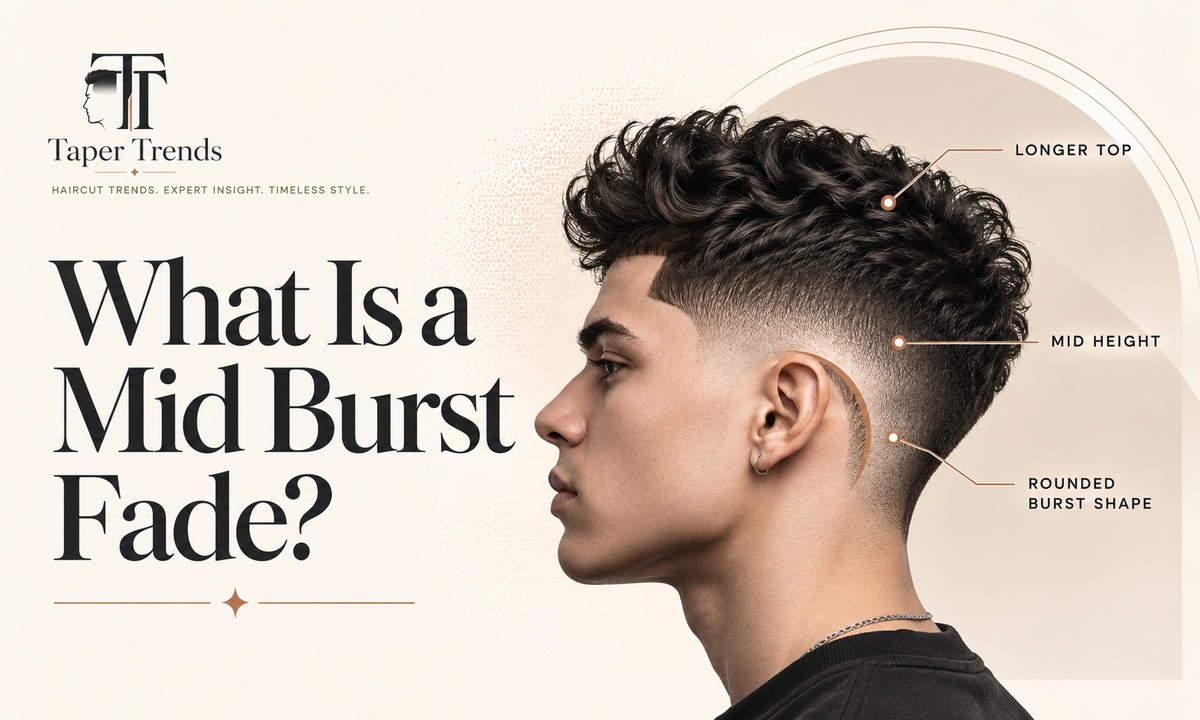
A mid burst fade combines two separate choices: a burst shape, where the fade curves in a semicircle around the ear, and a mid height, where that curve reaches roughly the middle of the side of the head. Longer hair stays on top and usually at the back. The name says nothing fixed about how the top is styled.
Viewed side-on, the shortest hair sits directly behind the ear, and length builds as the fade moves up and outwards. CADMEN Barber Academy describes the result as a burst or sunburst pattern. A standard fade works differently, running in a roughly level band around the sides and back, which is the basic idea behind any taper fade.
Working professionals describe it the same way. Celebrity hairstylist Dean Banowetz told GQ Middle East that the burst creates “a clean, circular fade around the ear” while leaving length through the top and back. Elvis Amezquita, a barber manager at Famous Fadez in Illinois, described it to Business Insider as short or bald hair near the ear that fades into longer hair towards the top and back.
What makes it “mid”?
“Mid” refers to how high the burst climbs, not how long the hair on top is. A mid burst sits between a low burst, which hugs the ear, and a high burst, which reaches towards the top of the side. Heads and hairlines vary, so treat mid as a relative position rather than a fixed measurement.
CADMEN places a standard mid fade at the temple midpoint, about halfway up the side, and says it gives clear contrast without the aggressive look of a high fade, the trade-off our low vs mid vs high fade guide lays out. Our low mid taper fade guide and the low vs mid taper fade comparison show how that height reads with a straight-line blend.
What does “burst” change?
“Burst” changes the shape of the fade line. Instead of running level around the head, the fade radiates in a semicircle from behind the ear, which leaves more length behind and above it. Burst describes geometry only. It does not imply a skin finish, a mullet or any particular top.
CADMEN splits every fade into three independent choices: level (low, mid or high), depth (taper or skin) and shape (standard, drop or burst). “Mid burst” names two of them. Depth, meaning how short the shortest point goes, is still open. The gentlest version of the shape is the taper low burst fade, and the different kinds of fades guide lays out every level and depth side by side.
How does a mid burst fade compare with low, high, drop and taper fades?
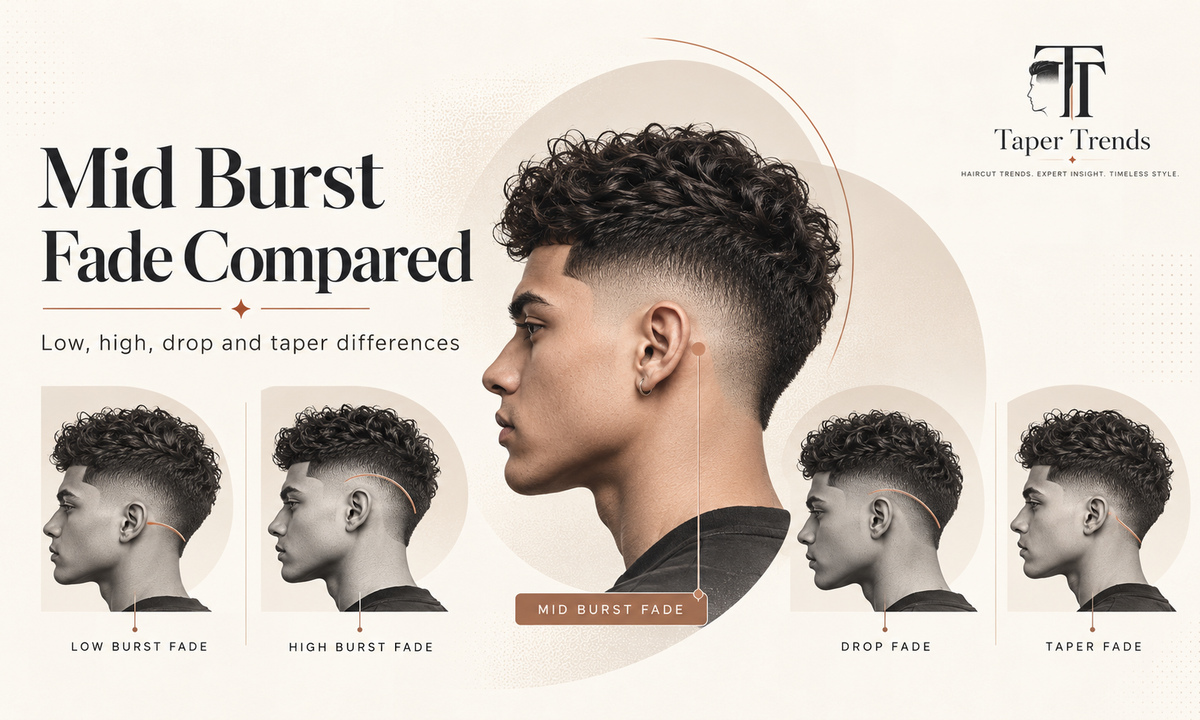
A mid burst fade sits between low and high burst fades in height and shares their curved line around the ear. A regular mid fade matches its height but runs level. A mid drop fade curves down towards the nape (a high drop fade runs that curve from higher up), and a burst taper tightens only the ear area. Barbers use these labels loosely, so a photo is the safest way to confirm which one you mean.
| Style | Where the fade sits | Shape of the fade line | Back | Contrast |
|---|---|---|---|---|
| Low burst fade | Close to the ear | Semicircle around the ear | Can stay long | Subtle |
| Mid burst fade | About halfway up the side | Semicircle around the ear | Can stay long | Moderate |
| High burst fade | Towards the top of the side | Semicircle around the ear | Can stay long | Strong |
| Regular mid fade | About halfway up the side | Level band | Faded | Moderate |
| Drop fade | Any level | Dips behind the ear towards the nape | Faded along the neckline | Depends on finish |
| Burst taper | Ear and sideburn only | Small arc around the ear | Can stay long | Gentle |
Contrast ratings assume the same finish. Taking any of these styles down to skin makes it look sharper.
Mid burst fade vs low burst fade
Both use the same arc around the ear, and the difference is height. A low burst stays close to the ear and leaves most of the side untouched, so the curve reads as a detail. A mid burst exposes more of it.
Beard Beasts calls the low version the safest burst fade for most men and the place to start for a first attempt. That is a judgement, not a rule. Choose mid when you want the curve to be obvious from across a room. The taper low burst fade and the low taper vs low fade breakdown cover the quieter end of the range.
Mid burst fade vs high burst fade
A high burst pushes the faded area further up the side and creates stronger separation from the top. A mid burst leaves more hair above the arc, so the side keeps some support.
Beard Beasts warns that once a burst climbs too high, the side can start to look hollow, especially when the top is not strong enough to balance it. For that reason the same guide calls the mid version “probably the best all-rounder”. Treat that as an experienced opinion, not a measurement. A high burst makes most sense on thick hair with a full top. For the same height decision on straight-line fades, see mid taper vs high taper, low taper vs high taper and the high taper fade guide.
Mid burst fade vs regular mid fade
A regular mid fade and a mid burst fade can start at the same height, but the lines are different. A regular fade runs as a roughly level band around the sides and back, while a burst curves around the ear and can leave the back long. Ask only for “a mid fade” and you may well get the level version. Our taper vs fade explainer untangles the rest of the vocabulary. Curious how the same three heights look at skin? Our low vs mid vs high skin fade guide puts low, mid and high side by side.
CADMEN notes that most requests name only one or two of level, depth and shape, and the barber fills in the rest based on trends and judgement. That gap is where most disappointing haircuts come from.
Mid burst fade vs drop fade and burst taper
Drop fades and burst fades get confused more than any other pair. According to CADMEN, a drop fade follows the natural hairline down behind the ear towards the neckline, while a burst radiates in a fuller semicircle from behind the ear without necessarily dropping. CADMEN also acknowledges that some barbers use the two terms interchangeably, which is exactly why a reference photo matters; our drop fade vs burst fade comparison shows how to read one. The low taper drop fade guide shows the dropped line on its own.
A burst taper is the quieter relative. Beard Beasts describes it as tightening the sideburn and ear area without fading the whole side, giving a softer finish that grows out more easily. If a mid burst feels like too much, this is the version to look at next.
Who does a mid burst fade suit?
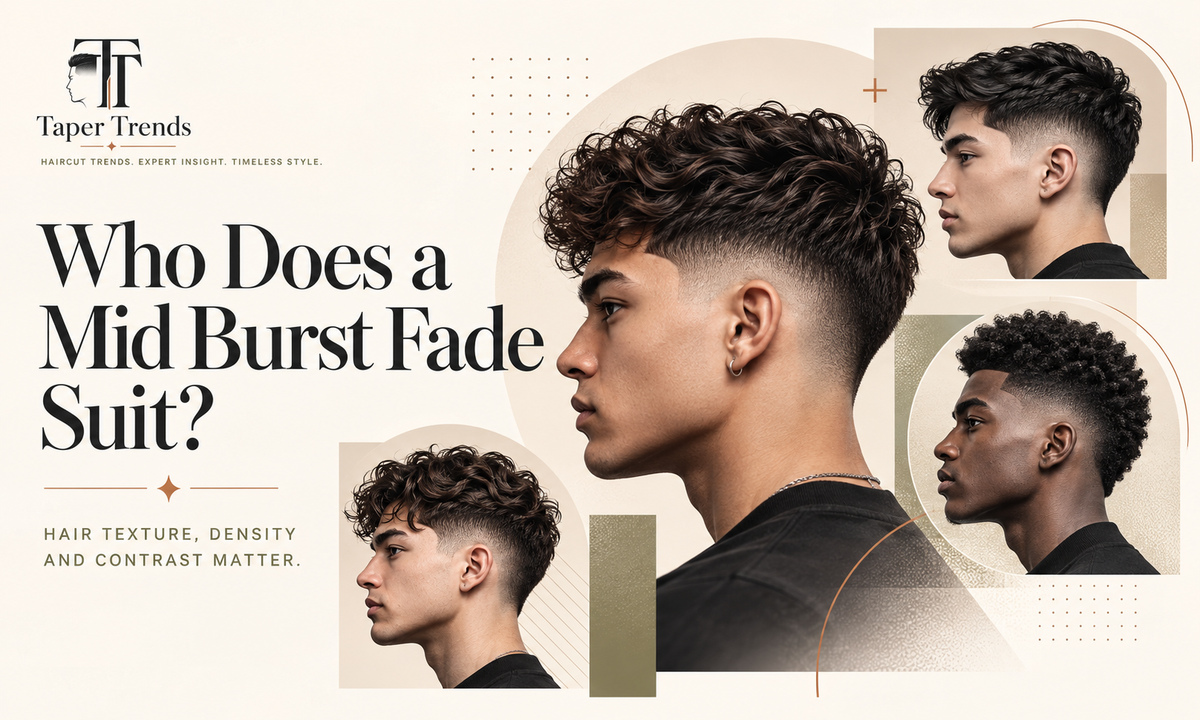
A mid burst fade can suit most hair textures, but a single reference photo will not look the same on every head. Curl pattern, density, growth direction and top length all change the result. Choose by how your hair behaves and how much contrast you want, and treat face-shape charts as a secondary guide rather than a rule.
CADMEN does offer face-shape suggestions for fades, but it says hair texture, head shape, lifestyle and personal preference are equally important factors.
Straight hair
Straight hair can carry a mid burst fade, but it hides nothing. Without curl or wave to soften the transition, a dark patch or heavy line above the ear shows immediately, a point Beard Beasts makes about straight-hair burst fades. Choose a barber whose fades you have seen up close. Our drop fade for straight hair guide covers the same problem for a line that curves behind the ear instead.
Give the top some direction or texture as well. Straight hair lying flat above a tight curve can look stiff. CADMEN adds that the top style, more than the texture itself, decides whether the burst looks balanced. Our burst fade for straight hair guide ranks nine tops by effort, and the mid taper fade for straight hair covers the level-band version.
Wavy and curly hair
This is the most natural pairing. Curls and waves build width beside the ear, and the burst removes bulk in exactly that spot while the top keeps its shape and volume. Banowetz told GQ Middle East that the burst works especially well for curly or textured hair.
The risk is overdoing it. Cut the top so short that the curl pattern disappears, and the haircut loses the thing that made it work. With waves, a loose, forward or textured finish shows the movement far better than pressing it flat. The burst fade for curly hair guide goes deeper on silhouettes, while the mid taper fade for curly hair, mid taper fade for wavy hair and mid taper fade with waves cover the same height on each pattern.
Coily and Afro-textured hair
Coily and Afro-textured hair gives a mid burst fade strong contrast. The arc clears the ear area while the top keeps its height and fullness. The curve has to stay connected to the top, though, and Beard Beasts warns that a burst pushed too far can leave the top looking separate from the sides.
Two practical points matter here. Coily hair can shrink significantly from its stretched length, so check the shape at your hair's natural resting length, not just when it is combed out. CADMEN also says straight-hair technique applied to dense coils gives uneven results, so pick a barber who cuts coily textures regularly. Our burst fade for Black men, mid taper fade for an Afro and mid taper fade for Black men guides go deeper on coils, twists and waves, and the mid taper fade with locs guide covers locs kept full length.
Fine or low-density hair vs thick or dense hair
Fine or low-density hair usually looks better with more weight left above the burst, while thick hair can carry stronger contrast. A skin finish or high placement strips away support, and Beard Beasts notes it can make a fine top look weaker than it really is. Dense hair gives the barber more bulk to shape, although the area above the fade still needs thinning so it does not balloon outwards.
| Fine or low-density | Thick or dense | |
|---|---|---|
| Finish | Shadow or short guard | Skin or shadow |
| Height | Low to mid, or a burst taper | Mid or higher |
| Above the arc | Keep more weight | Remove bulk |
These are Beard Beasts' styling judgements, so use them to start the conversation with your barber rather than to end it. If you are unsure which column fits, ask how much hair should stay above the ear before settling on a height. The low taper fade on thin and thick hair guide explains how barbers keep or remove weight, and the mid taper fade for white guys and mid taper fade for Asian hair guides cover finer and coarser straight textures at the same height.
Best mid burst fade styles to show your barber
The curve stays the same, and the top and back change the look. When you save reference photos, match more than the haircut's name. Look for similar texture, density and top length, and check the back as well as the side, because a photo of very different hair can promise a result yours cannot produce.
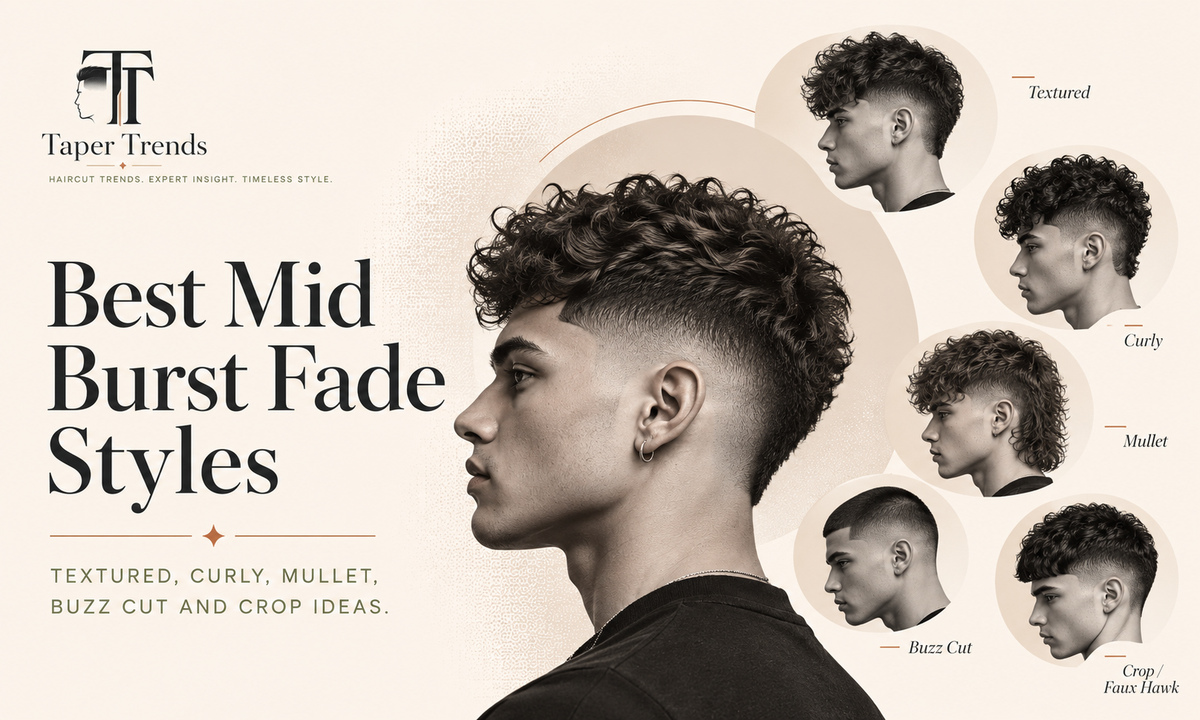
Textured top or fringe
Slightly choppy length pushed forward sits well above curved sides and gives the cut movement without much styling. Beard Beasts calls the textured burst one of the easiest to recommend, particularly on thick, wavy or slightly coarse hair, and notes that it does not need to look perfect to work. Tell your barber how far forward the fringe should fall and whether you want it blunt or broken up. The burst fade textured fringe and drop fade textured fringe guides break that choice down, and the mid taper fade with a textured fringe and low taper fade fringe show where the front should land.
Curly top
Here the curls lead and the burst tightens the sides. Top length sets the contrast. CADMEN notes that the shorter the top, the more the burst reads as subtle, while a fuller top turns the arc into a statement. For a softer, lifted version, the mid taper fade with fluffy hair shows how much volume the sides can support.
The finish matters as well. Beard Beasts rates a skin finish best on thick hair, curls and strong waves. A shadow finish is gentler if you want the curls to do most of the work.
Burst fade mullet
In a burst fade mullet, the burst shapes the sides and the mullet is a separate decision about how long the back stays. CADMEN says the curved fade moves between short sides and a longer back more naturally than a straight fade would.
Beard Beasts cautions that the back must look intentional and stay connected to the top, or the whole thing reads as a haircut that was never finished. Bring a rear-view photo and say exactly how long the back should be. The full burst fade mullet guide covers the settings, and the mid taper mullet and low taper mullet show the same idea with a straight-line fade, and the drop fade mullet with a curve that dips behind the ear.
Buzz cut
A burst fade buzz keeps the top short and even, while the curve around the ear adds a detail a plain buzz lacks. Beard Beasts suggests a number 2 or 3 guard on top and advises keeping the burst low or mid. Short hair, bare sides and a high burst together can make the whole cut look thinner than it needs to. The mid taper fade buzz cut and low taper fade buzz cut guides cover the guard choices.
French crop or faux hawk
Both suit a mid burst but push the top in different directions. A French crop keeps the front short and forward with little height. A faux hawk keeps height through the middle, and the tight sides pull the shape inward.
CADMEN says the arc leads the eye towards the top section on faux hawks. Beard Beasts adds that a crop needs enough density at the fringe to hold its shape, and that a faux hawk looks better with texture than with stiff spikes. See the French crop low taper fade and burst fade mohawk for each shape in full, or the burst fade Edgar and mid taper fade Edgar if you want a blunt, cropped fringe instead.
How to ask your barber for a mid burst fade
Ask for a mid burst fade by name, then fill in what the name leaves open: how high the arc sits, how short the shortest point goes, how much length stays on top and at the back, and how the edges and any beard are finished. Bring a side photo and a rear photo, ideally of hair similar to yours.
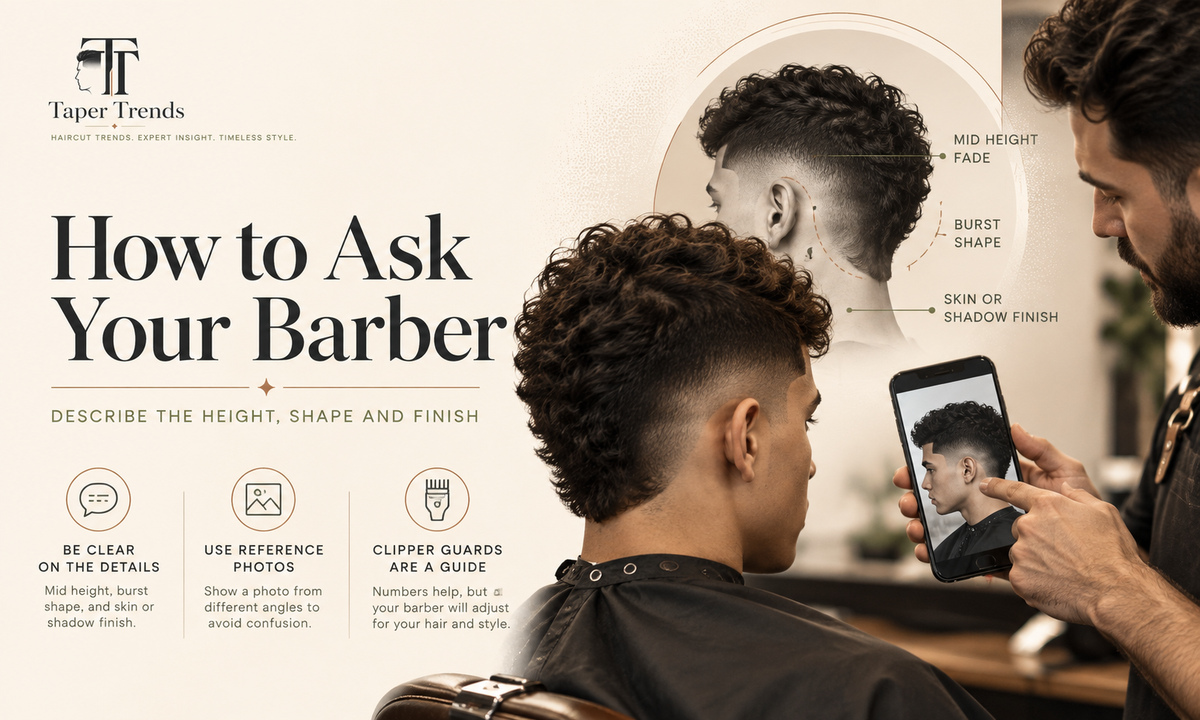
What to specify in your barber brief
Five details turn a label into an instruction.
- 1. Height and arcPoint to where the curve should top out and keep it centred on the ear. Beard Beasts suggests asking for a burst that stays tight around the ear rather than stretching towards the back. Ask to see it in a hand mirror before it goes any higher.
- 2. Shortest finishChoose bare skin or a short shadow. Skin gives the sharpest contrast, while CADMEN says a taper finish with visible stubble grows out more gracefully because there is no bare skin to show regrowth.
- 3. Top lengthSay where the top section starts and how long it should be, as CADMEN advises.
- 4. Back and necklineDecide whether the back stays long, gets tidied or becomes a mullet, and whether you want a sharp line or a softer natural finish at the nape.
- 5. Sideburns and beardIf you wear a beard, ask for the fade to blend into it. Beard Beasts says the connection matters more than the beard's length. Our burst fade with beard, mid taper fade with beard and low taper fade with beard guides walk through the sideburn-to-beard blend, and the drop fade with beard guide covers it when the curve runs behind the ear, and the skin fade with beard guide when the sides go to bare skin.
A short script covers most of it:
“I’d like a mid burst fade, curved around the ear. Take it to [skin / a light shadow] at the shortest point, keep weight on top and at the back, and use this photo for the height of the arc and the neckline.”
Why reference photos matter
Photos settle what words cannot: the height of the arc, how deep the fade goes and what happens behind the ear. CADMEN says burst fades vary enough in arc height and fade depth that a photo is the surest way to make sure you and your barber are describing the same cut.
A front-facing celebrity photo tells the barber almost nothing about the arc. Beard Beasts puts the principle simply: match the burst fade to your hair, not to the photo. If you want to see what a finished fade looks like from every angle before you book, the guide on what a low taper fade looks like is a good model for the photos to save.
Do you need to know clipper guard numbers?
No. The finished look matters more than the tools, and a guard only sets a length. It does not decide where the fade starts or how it curves.
For reference, Wahl lists a #1/2 guard at 1/16 inch, a #1 at 1/8 inch and a #2 at 1/4 inch, roughly 1.5 mm, 3 mm and 6 mm. Wahl also explains that a clipper's taper lever adjusts the closeness of the cut between guard lengths, the blending move our how to cut a fade guide walks through. Even then, numbers can mislead. CADMEN notes that a #1 on dense coily hair can look like a 1.5 or 2 on straight hair.
How to style and maintain a mid burst fade
Daily effort comes from the hair left on top and at the back, not from the fade itself. How often you book depends on how crisp you want the curve to stay.
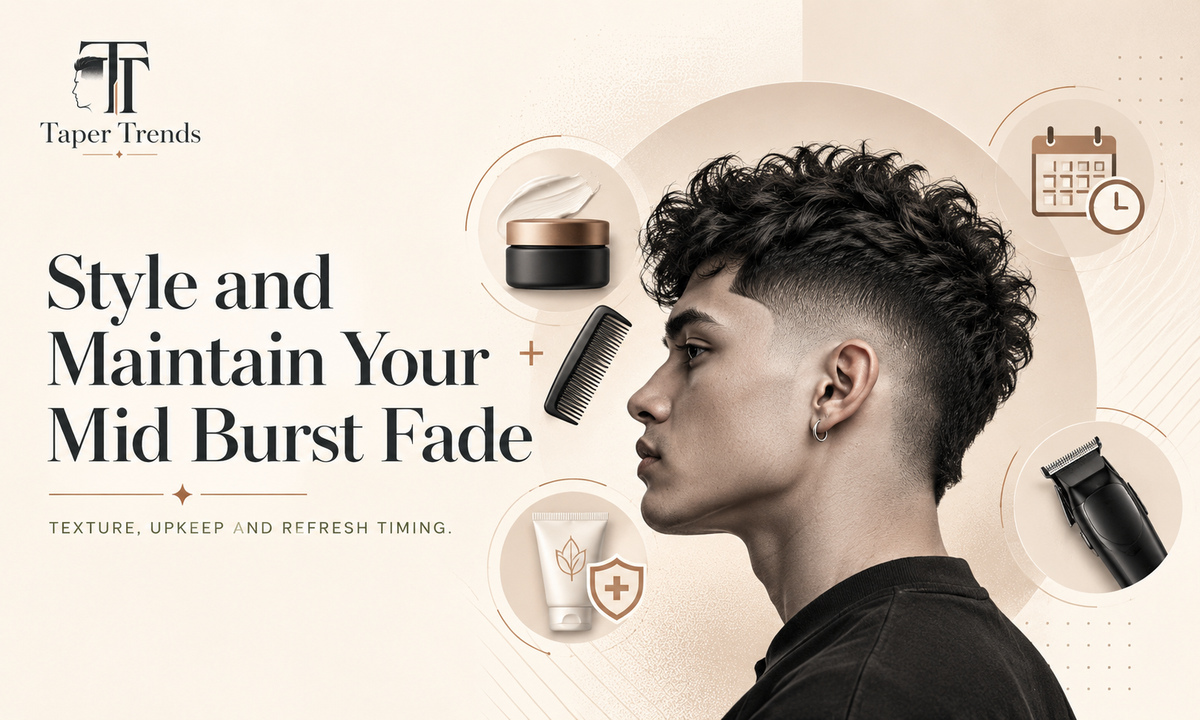
Styling by hair texture
Pick the product for your texture and keep it off the fade. Beard Beasts recommends a small amount of matte clay for thick or coarse hair, a lighter texture powder for fine hair, and a lightweight curl cream or light-hold gel for curly or textured hair.
Work it into the top only. Product dragged down into the sides makes the blend look patchy. Our step-by-step guide to styling a low taper fade walks the same routine through, and the mid taper fade blowout shows how to add lift with a dryer.
How often does a mid burst fade need refreshing?
There is no fixed interval, but two to three weeks is a realistic range for most people. CADMEN says regrowth usually shows behind the ear at about the two-week mark, the arc blurs noticeably by weeks three to four, and a touch-up about every three weeks keeps it defined.
Beard Beasts gives similar timing and adds two useful extremes. A skin burst typically needs a touch-up every 10 to 14 days, while a low burst can hold its shape for four to five weeks. Between appointments, CADMEN notes, the burst softens gradually rather than looking suddenly overgrown.
What if a skin finish irritates your skin?
A mid burst fade does not need to go to skin, so ask for a short shadow instead. Mayo Clinic explains that razor bumps develop when shaved hairs curve back into the skin, mainly in people with curly hair who shave too close, and are most noticeable on the face and neck. Its prevention advice includes avoiding shaving too close.
If bumps or irritation persist for more than a week or two, keep coming back or start to spread, see a doctor or dermatologist. The burst fade for Black men guide also covers bump-safe finishes.
Mid burst fade FAQs
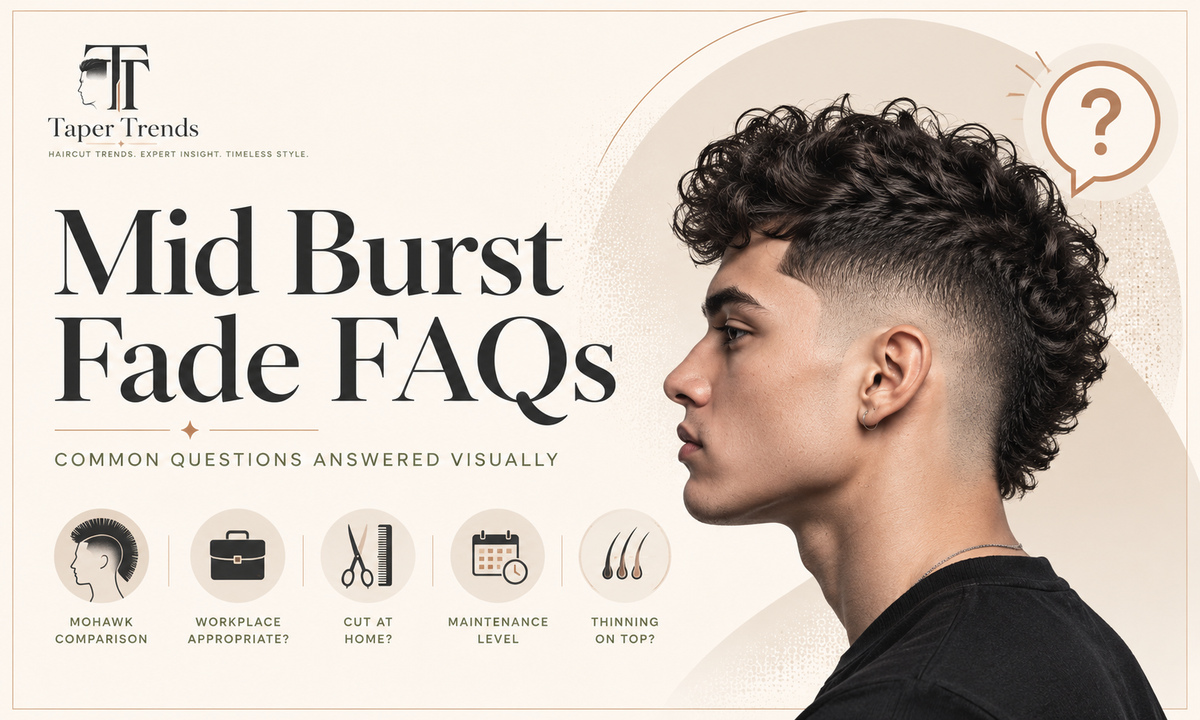
Is a mid burst fade the same as a mohawk?
No. A mid burst fade describes the sides, while a mohawk or faux hawk describes the top. The two are often worn together, and CADMEN says burst fades are most commonly paired with mohawks and faux hawks. A mid burst works just as well with a crop, curls, a buzz cut or a mullet.
Can you wear a mid burst fade to a conservative workplace?
Usually, if you keep the finish restrained. A shadow rather than bare skin, a low or mid placement and a tidy top read as polished. CADMEN describes taper finishes as cleaner and more conservative than skin fades, and Beard Beasts rates low and mid bursts as easier to live with than skin, high or design-heavy versions. Check any written dress code if you are unsure.
Can you cut a mid burst fade at home?
You can, but it is harder than a standard fade. CADMEN says the burst requires more technique because the barber has to work in a curved arc rather than a straight horizontal band, and guard lengths alone will not create that shape. For a first mid burst, a barber is the safer choice.
Is a mid burst fade high maintenance?
It is moderate. Elvis Amezquita told Business Insider that the burst fade is normally less maintenance than longer hairstyles. The trade-off is regular barber visits to keep the arc sharp. A skin finish needs the most frequent touch-ups, while a shadow finish is more forgiving.
Does a mid burst fade work if your hair is thinning on top?
It can, but keep the contrast soft. A thinner top has less density to balance bare sides, so Beard Beasts suggests a low burst, mid burst or burst taper rather than a skin finish for fine hair. It also warns that a burst fade will not disguise thinning. Keep more weight above the arc and ask your barber what the top can realistically support.
Want the top to lead? The burst fade mohawk keeps the same arc under a center strip. For younger clients and school dress codes, our burst fade for boys guide covers the same curved arc sized for a kid, the mid taper fade for boys covers a straight-line alternative, and the mid taper fade for short hair is a useful next read if your top is on the shorter side.
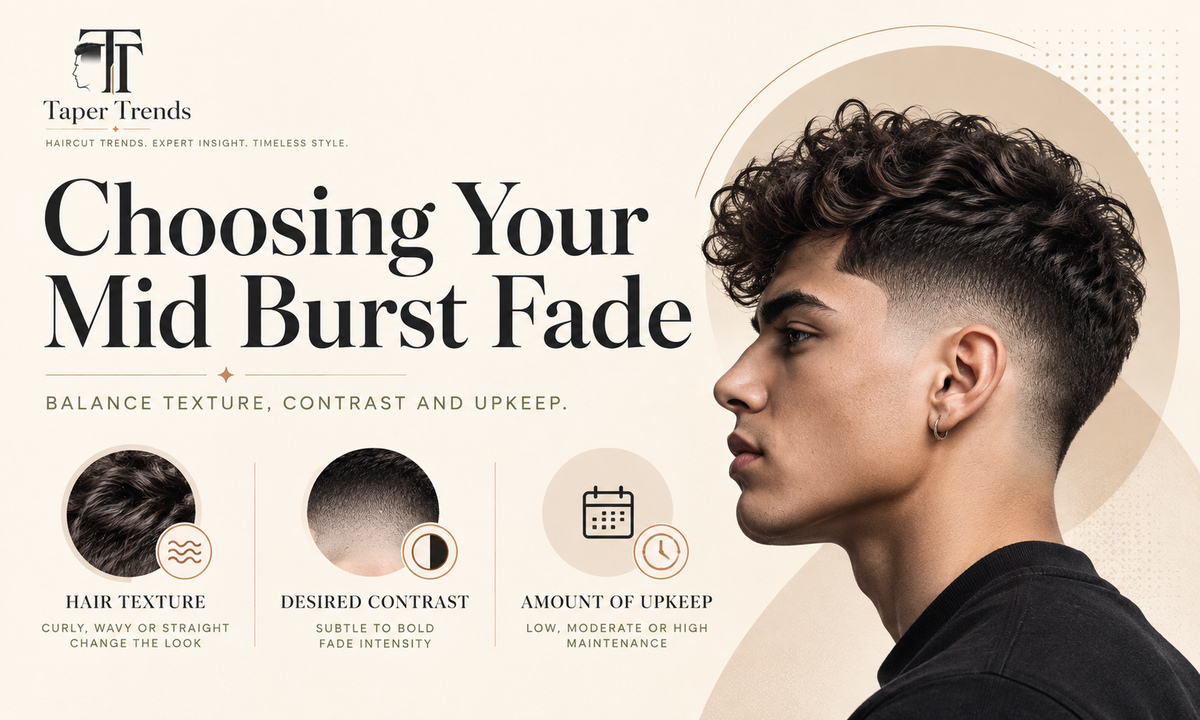
Choosing your mid burst fade
Start with three decisions. Pick your contrast: low for a quiet curve, mid for a clear one, and high only with a full top. Pick skin or shadow at the shortest point based on how often you are willing to rebook. Then be honest about which top and back you will actually style on a busy morning.
Save a side photo and a rear photo on hair like yours, run through the five-point brief, and ask to see the arc in the mirror before it climbs any higher. Rebook when the curve behind your ear softens more than you would like, which for most people falls somewhere between two and four weeks.
Still comparing? The burst fade haircut guide covers the arc on its own, the full taper fade guide places low, mid and high side by side, and the low taper fade haircuts guide is the hub for every variation. For the closest burst neighbors, read the burst fade curly hair, burst fade straight hair, burst fade for Black men, burst fade mullet and burst fade textured fringe guides, or the taper low burst fade for the gentlest version. Weighing the arc against a straight-line taper specifically? The burst fade vs taper fade comparison puts the geometry, hair-type fit, and upkeep of each side by side.
The bottom line
“Mid burst fade” settles height and shape and leaves the rest open. How short the shortest point goes, how much stays on top and at the back, and how the edges finish are still yours to decide.
Bring a side photo and a rear photo, ask to see the arc in the mirror, and match the cut to your hair rather than to the picture.
Want more fade guides?
Browse clean, barber-ready breakdowns for every fade shape and hair type.