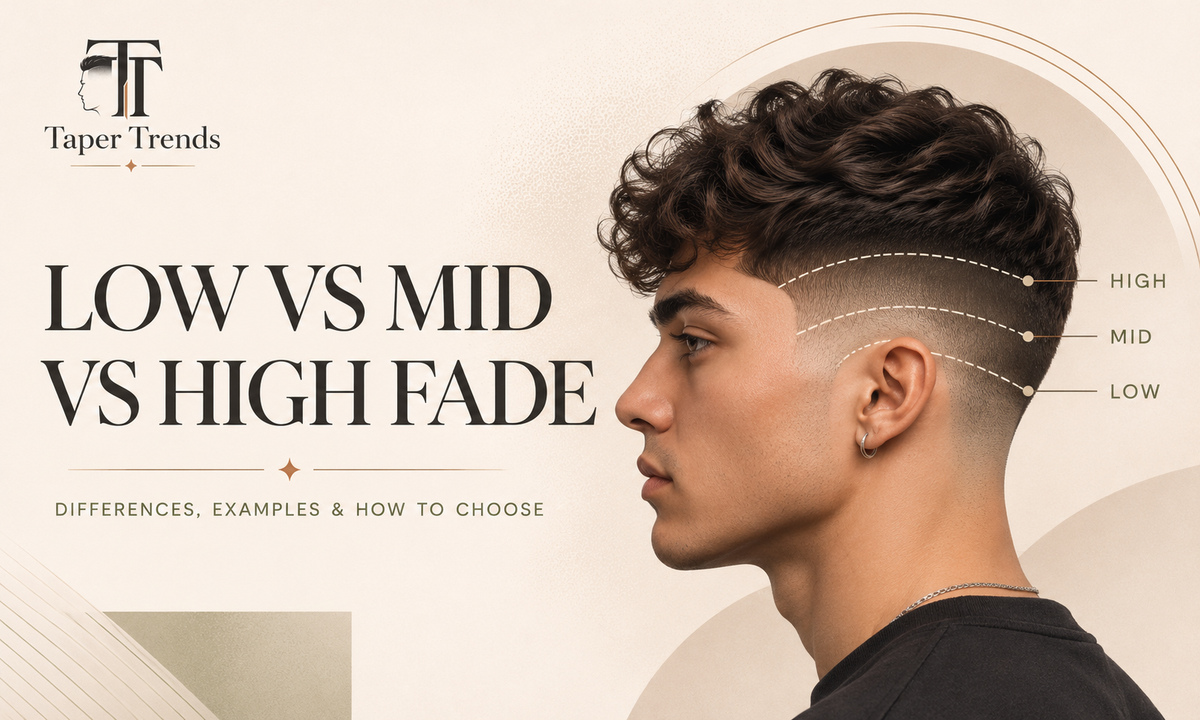
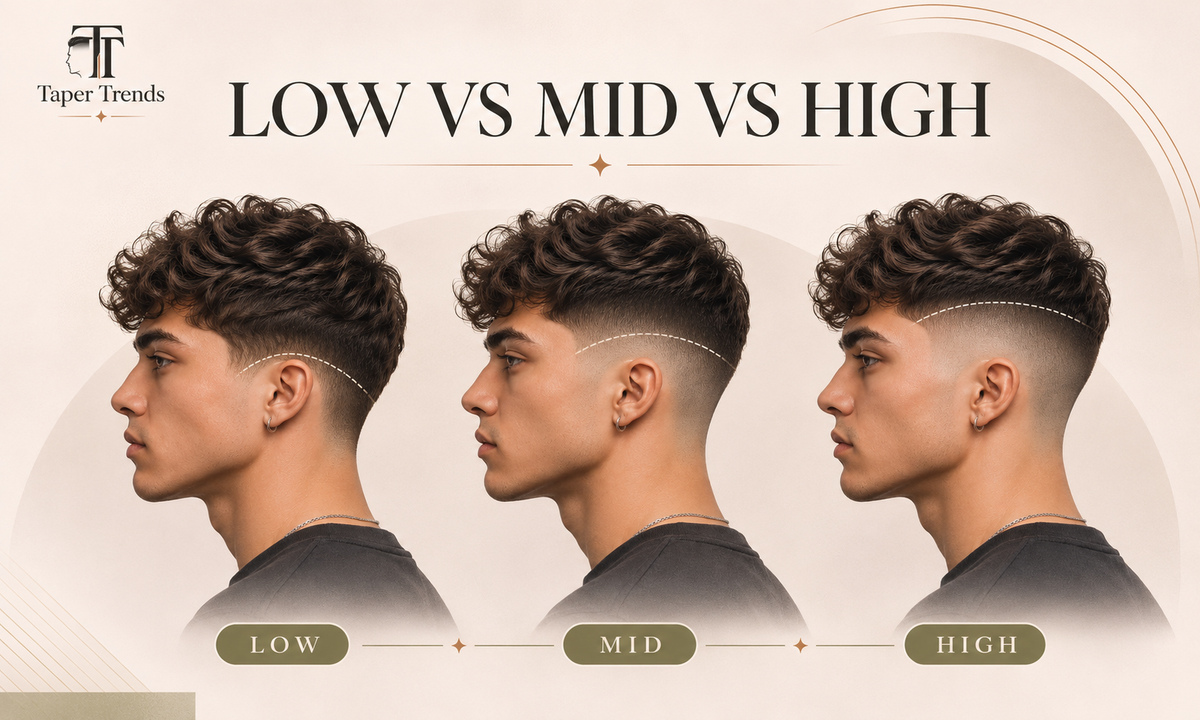
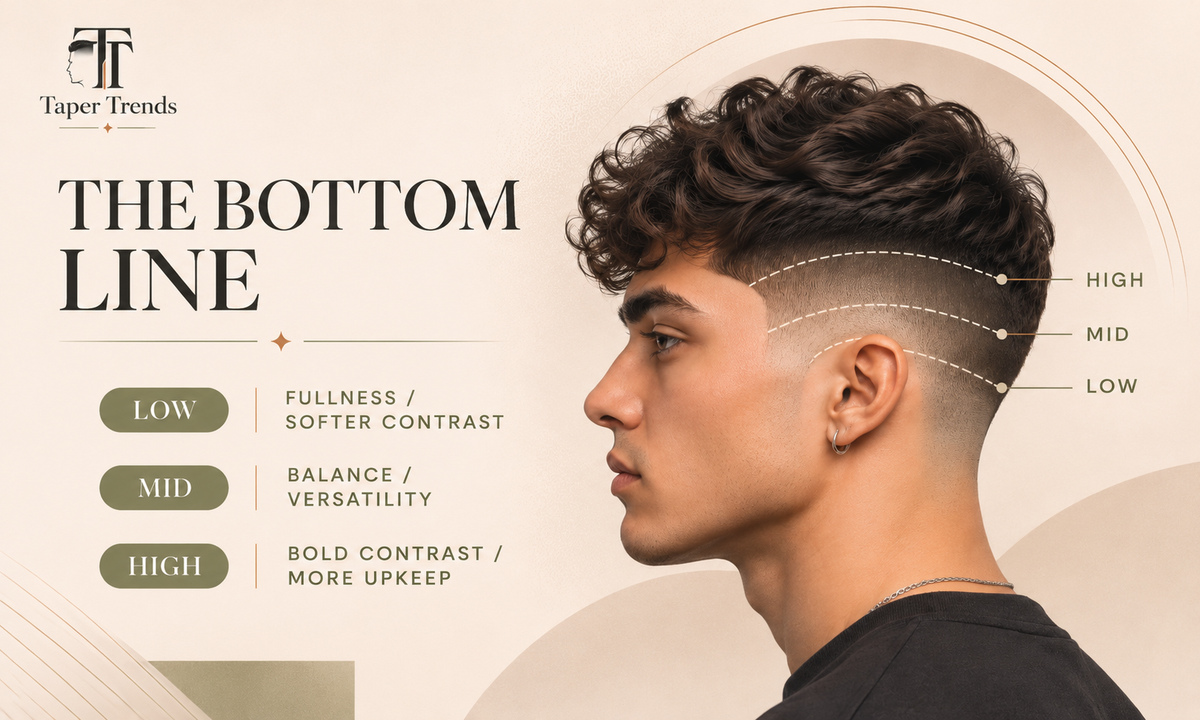
Low vs mid vs high fade comes down to where the blend from short to longer hair begins on the side of your head. A low fade starts just above the ear. A mid fade starts around temple level. A high fade starts above the temple, near where the side of the head curves into the top. The higher the fade, the more side hair comes off and the sharper the contrast with the top.
Height is only one of three decisions, though. The other two are how short the hair gets at the bottom and how much length stays on top. Mixing those up is the most common reason people leave the chair with a cut they didn't ask for. If you want the full map of fade styles first, start with types of fade haircuts; if a taper is on your shortlist too, taper vs fade explains how the two differ, and the low taper fade guide covers the softest version of the low cut.
What is the difference between a low, mid, and high fade?
The difference between a low, mid, and high fade is placement: how far up the side of the head the shortest hair travels before it blends into longer hair. A low fade keeps the transition near the ear, a mid fade lifts it to about temple level, and a high fade carries it above the temple, removing the most side hair.
Wahl's fade guide frames it the same way. The low fade starts close to the ear, the high fade starts higher to put the focus on the hair on top, and the mid fade sits between the two. The same three heights apply to tapers, which is why the low taper vs mid taper and mid taper vs high taper comparisons read so much like this one.
Don't expect every shop to draw the lines in exactly the same place. America's Beauty Show's barbering guide divides the side of the head into thirds, while Man of Many's barber-written guide places the mid fade's blend roughly level with the top of the ears. Treat the three names as zones, then confirm the exact line on your own head.
Where does each fade start?
Each fade starts in a different zone between the ear and the top of the head, and exact positions shift with head shape. Three landmarks make the zones easy to check in a mirror:
- The top of the ear, the usual reference for a low fade.
- The temple, the usual reference for a mid fade.
- The upper side of the head, where it turns toward the top. Barbers sometimes call this the parietal ridge, and a high fade reaches toward it.
Before the clippers start, ask your barber to touch the spot where your fade will begin. The free taper height diagram shows the same three zones on a head, and barber terms explained covers words like parietal ridge and occipital bone if your barber uses them.
Does fade height determine how short it gets?
No. Fade height controls where the blend starts, while the base length controls how short the hair is at the bottom. A low, mid, or high fade can finish at bare skin, at a shadow of stubble, or at a longer guard length. America's Beauty Show lists starting point and shortest length as separate variables that define a fade.
Three requests show how the two combine:
Low skin fade
The blend starts low and finishes at bare skin. See skin fade for how the bottom is taken to the scalp.
Mid fade at a #2 guard
The blend starts at temple level and stops at the quarter inch Wahl lists for its #2 guide comb. Guard lengths can differ between brands, so confirm the length with your barber; haircut numbers and the clipper guard sizes tool list every guard.
High shadow fade
The blend starts high and ends in very short visible stubble rather than skin, the finish explained in shadow fade.
That's why “high fade” and “skin fade” are different requests. Pall Mall Barbers' 2026 fade guide makes the same point: skin describes how short the fade goes, and a skin fade can be low, mid, or high. If you already know you want skin at the bottom, our low vs mid vs high skin fade guide narrows the choice further, and skin fade vs taper fade compares the two finishes.
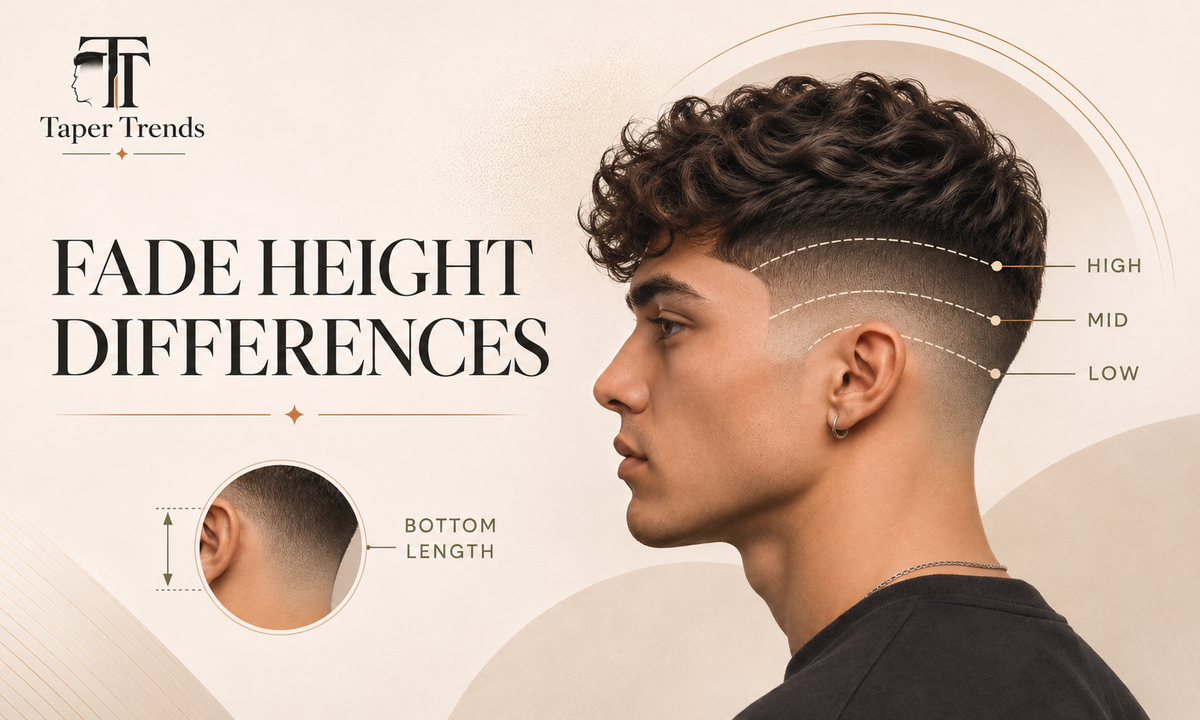
What is a low fade?
A low fade is a gradual blend that begins just above the ears and wraps around the lower back of the head, leaving more hair on the upper sides. It is the most restrained of the three heights. The contrast with the top stays soft, and the overall silhouette stays fuller than with a mid or high fade.
From the front, a low fade changes very little. The work shows from the side and back, where the blend hugs the ear and the nape. Pall Mall Barbers describes the transition as gradual and understated, and DIDA NYC Hair Studio notes that low fades grow out more gracefully than higher ones. A textured crop, side part, or crew cut all sit comfortably above it. If you want the low line to curve behind the ear, look at the low drop fade; if you want it even softer, a low taper instead of a low fade keeps more hair around the ears.
The tradeoff is subtlety. If you want an obvious change, a low fade may feel too quiet, and on very thick hair it can leave the upper sides bulky unless the barber removes weight above the blend. Our thin and thick hair guide covers how barbers handle that bulk.
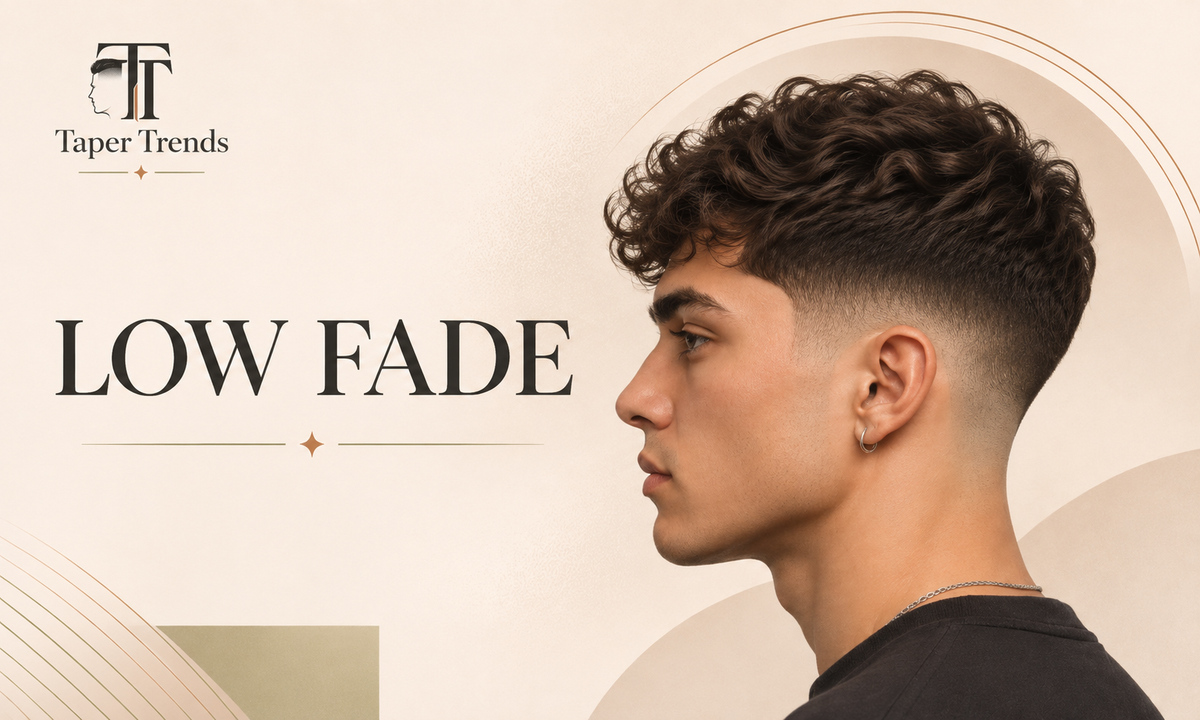
What is a mid fade?
A mid fade starts the blend around temple level, roughly halfway between the ear and the top of the head. It removes more side hair than a low fade and less than a high fade, giving clear definition without the strongest contrast. Many barbers treat the mid fade as the default when a client can't decide.
A professional-tools retailer's fade guide calls it arguably the most versatile of the three, and DIDA NYC Hair Studio calls it the shop's most popular fade. That's one barbershop's experience, not national data. For a first fade, France Khamees, director of BY FRANCE and the 2018–19 Barber Brands International Barber of the Year, told Man of Many that “it's safest to consider a mid to low fade position.” The low mid taper fade sits right in that in-between zone.
A mid fade pairs naturally with textured crops, side parts, curly tops, and quiffs. Antonio Centeno, founder of Real Men Real Style, writes that he personally thinks a mid fade looks best under a quiff, which is one experienced opinion rather than a rule. The mid taper fade, the mid drop fade, and the mid burst fade show the same height with different shapes.
The tradeoff is exposure. A mid fade shows more of your head's contour, so if you have dents or ridges on the sides you'd rather keep covered, ask whether a slightly lower line would work.
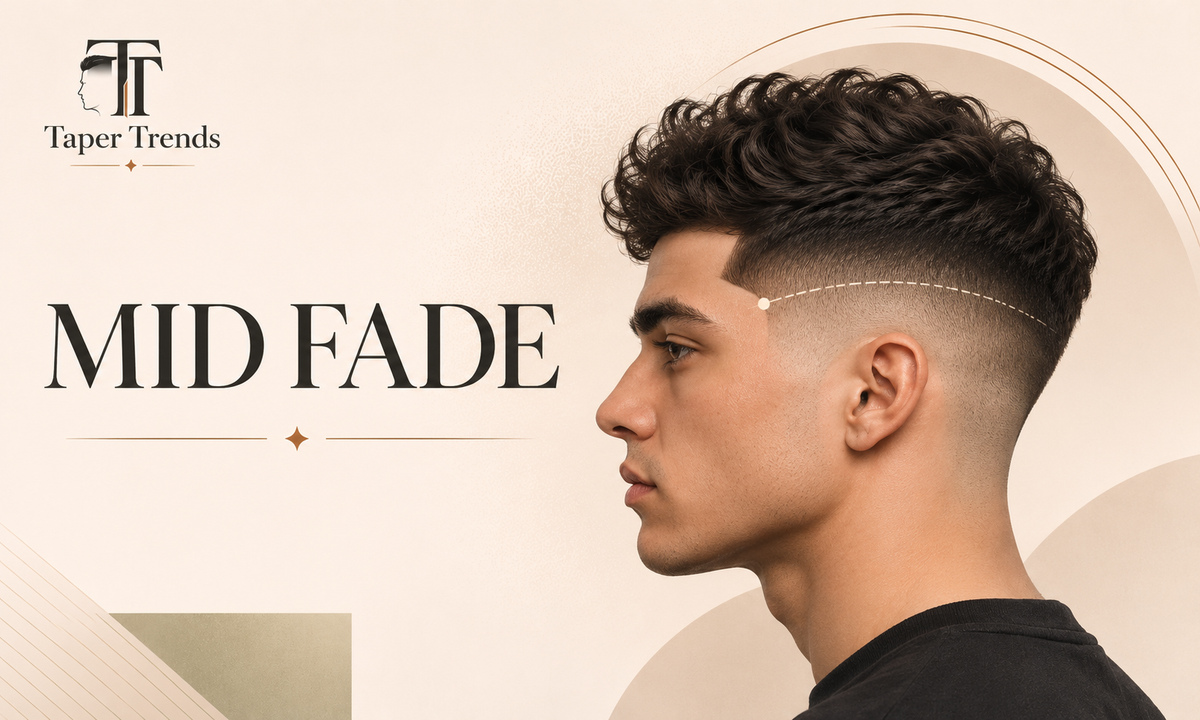
What is a high fade?
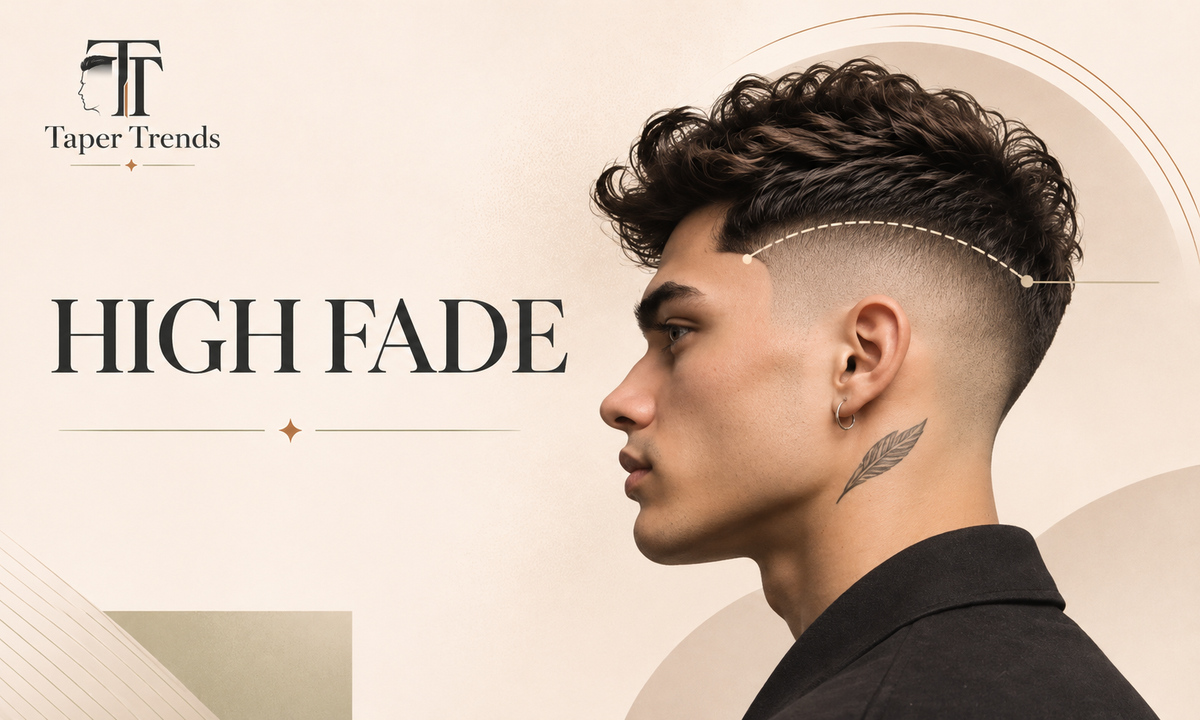
A high fade carries the shortest hair above the temple, toward the upper curve of the head, so very little side hair remains and the top stands clearly apart from the sides. It is the boldest of the three heights and puts the most attention on the length, shape, and texture of the hair on top.
The benefits are strong contrast, clean sides, and a structured silhouette. A high fade suits pompadours, quiffs, short crops, and buzz cuts, and Wahl mentions the high-and-tight as one familiar version of the idea. For high versions with a softer or more shaped outline, compare the high taper fade, the high drop fade, and the high burst fade.
The drawbacks are coverage and upkeep. Nick Hall, Man of Many's editor-in-chief and a qualified barber, writes that a high fade taken down to skin will likely be due for another cut within one to two weeks.
If you're torn, start one step lower. Raising a fade later is easy; lowering one means waiting for hair to grow back, which how to grow out a fade walks through week by week.
Low vs mid vs high fade: side-by-side comparison
Low, mid, and high fades differ mainly in how much side hair they keep and how sharply the sides separate from the top. A low fade keeps the most hair and looks softest, a mid fade balances fullness and definition, and a high fade removes the most hair and looks boldest. Base length, density, and top length still change the final result.
| Feature | Low fade | Mid fade | High fade |
|---|---|---|---|
| Where the blend starts | Just above the ear | Around temple level | Above the temple |
| Side fullness kept | Most | Moderate | Least |
| Contrast with the top | Subtle | Moderate | Strong |
| Overall look | Soft, understated | Balanced, defined | Bold, structured |
| Grow-out | Usually softest | Moderate | Usually most noticeable |
| Touch-up frequency | Can often stretch longest | In between | Usually most frequent |
| Can finish at skin? | Yes | Yes | Yes |
| Good choice if you want | To keep fullness | Balanced definition | Maximum contrast |
Read the contrast row as a default, not a guarantee. A high fade that finishes at a #2 guard can look softer than a low skin fade, and dark, dense hair shows more contrast than fine or light hair at the same height. The same trade-offs show up in the low taper vs high taper comparison, and different kinds of fades lines these heights up against drop, burst, and temple shapes.
Which fade suits your face shape?
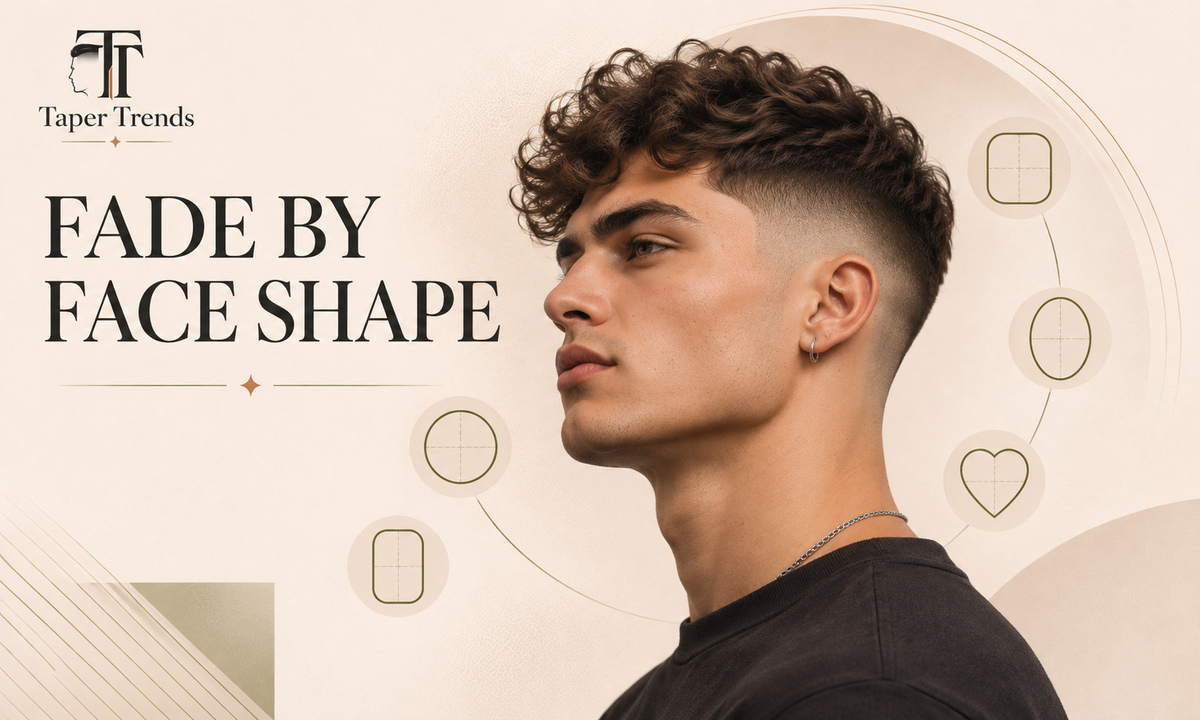
Fade height changes how much hair sits beside your face, which shifts how wide or long your head appears. Higher fades slim the sides and draw the eye upward, while lower fades keep width. Published barber advice conflicts often enough that face shape should start the conversation with your barber, not settle it. Not sure of your shape? The face shape detector gives you a starting point, and the best fade for your face shape guide goes shape by shape.
Head shape matters too. Man of Many's Nick Hall advises avoiding a high fade if your head is widest at the temples, since it tends to make the face look wider.
Which fade works for round or square faces?
A mid or high fade usually suits a round face, because slimmer sides and some height on top make the face look longer. Pall Mall Barbers and DIDA both recommend a high fade for round faces. Square faces get split advice: a low or mid fade softens a strong jaw, while a higher fade sharpens it.
Even one barbershop can split: Pall Mall Barbers' 2024 guide uses a high fade to sharpen a square face, while its 2026 guide uses a low fade to soften one. Man of Many, meanwhile, lists round faces among the best matches for a low fade. Decide what you want the cut to do:
Round face
Mid or high fade with some height on top to add length.
Square face
Low or mid to soften the jaw, or higher for a sharper, more angular look.
Which fade works for oval, long, or heart-shaped faces?
Oval faces can wear almost any fade height, so style and upkeep should decide. Long faces usually do better with a low or mid fade and controlled height on top, because a high fade can make the face look longer. Heart-shaped faces often suit a low or mid fade that keeps some width beside a narrower chin.
Pall Mall's 2024 guide says a low fade keeps the side fullness that balances oval faces and offsets a narrower chin on heart-shaped ones. DIDA suggests a low fade for long faces when you don't want to emphasize height. Man of Many disagrees on that last point and lists oblong faces among good matches for a high fade.
Oval
Most heights work, so choose by style and maintenance.
Long
Low or mid, with restrained height on top.
Heart-shaped
Low or mid, to keep softness at the sides.
When sources split like this, ask your barber to hold the comb at two different heights and look at both in the mirror before cutting. If a beard is part of the picture, the blend through the sideburn changes the face shape too; see skin fade with beard and drop fade with beard.
Which fade works with your hair type and density?
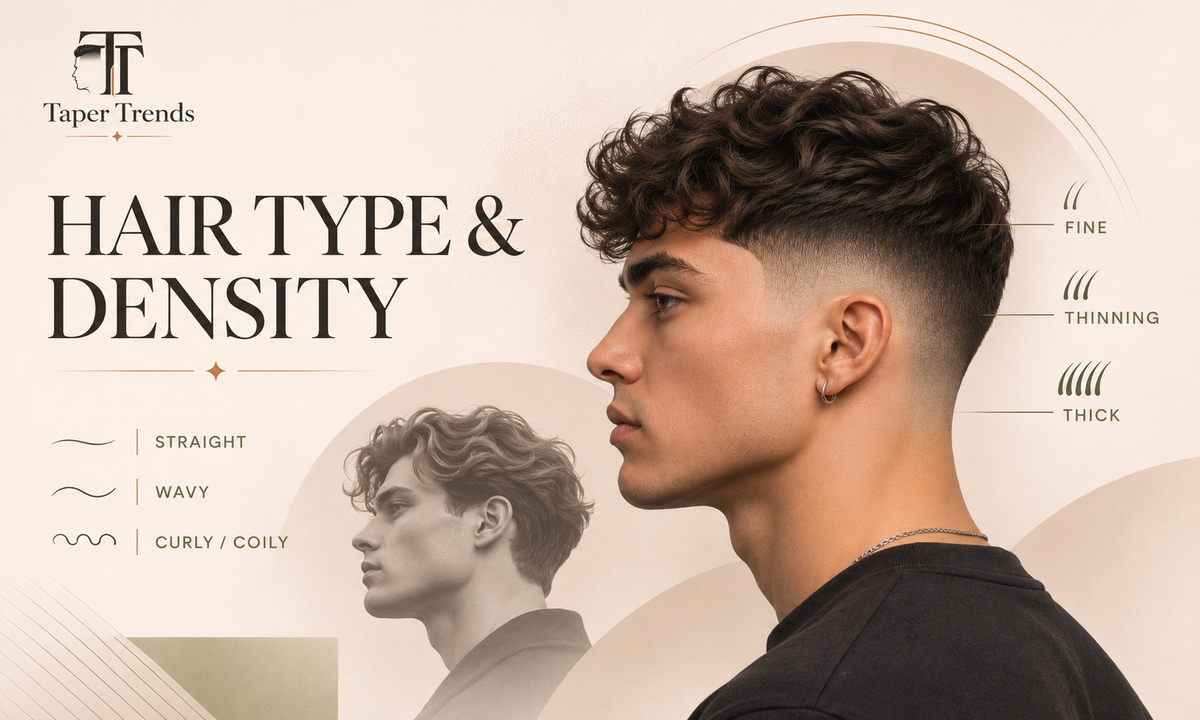
All three fade heights can work on any hair texture. What changes is how visible the blend looks, how much side bulk remains, and how the cut grows out. Density, curl pattern, growth direction, and top styling all shape the result, so a barber experienced with your hair type matters as much as the height you pick. The hair type quizhelps if you're not sure where your texture falls.
Which fade works for straight or wavy hair?
All three heights work on straight and wavy hair, so choose by side volume, growth direction, and how much contrast you want. DIDA calls straight hair the easiest to fade because the blend shows clearly, and notes that waves can disguise grow-out. If thick, straight sides tend to stick outward, a mid or high fade removes more of that bulk than a low fade does, and Pall Mall Barbers notes that thicker hair handles the stronger contrast of a high fade well. For worked examples by height, see the low taper on straight hair, the mid taper on straight hair, the high taper on straight hair, and for waves, the low taper fade for wavy hair and mid taper fade for wavy hair.
Which fade works for curly or coily hair?
Any height can complement curls or coils when the barber adapts the blend to your density and the shape you want. The main decision is side volume. Lower fades keep more curl at the sides, while higher fades concentrate volume on top.
DIDA says low to mid fades often suit curly hair better than high ones, while Man of Many's Nick Hall finds that thick, dense hair, including tight curls, shows off a high fade's contrast best. For coily hair, DIDA notes that skin fades and tapers are both popular and that clean edge work and lineups make a big difference. Look for a barber who regularly cuts textured hair. Compare the curly low taper fade, the mid taper on curly hair, the high taper on curly hair, and the skin fade on curly hair; for coils, the low taper afro, mid taper afro, and high taper afro show all three heights.
Which fade works for fine, thinning, or thick hair?
Fine or thinning hair usually looks fuller with a low or mid fade and a softer blend, while thick hair handles bolder contrast but needs more blending to remove bulk. A fade shapes the sides of the head; it does not treat or prevent thinning.
Fine hair
Pall Mall Barbers says a low fade's softer transition can make fine hair look fuller, and DIDA advises against cutting the top too short.
Thinning on top
Man of Many warns that a harsh high fade meeting a sparse top can make the whole head look bald.
Receding temples
A DIDA barber recommends keeping the fade low and the blend subtle. More options are in haircuts for a receding hairline.
Thick hair
Any height works, but DIDA notes you should expect a longer appointment. See the thin and thick hair guide for how weight comes out.
If you're concerned about hair loss itself, a board-certified dermatologist is the right person to see.
Which fade works with your top hairstyle?
Fade height should follow the top you want to keep. Tall, styled tops such as pompadours usually pair with mid to high fades, while classic or softer tops such as side parts pair with low to mid fades. Textured crops and buzz cuts work with any height. These pairings are starting points, not rules.
| Top hairstyle | Suggested fade heights | Why it works |
|---|---|---|
| Textured crop | Any | A textured top contrasts with clean sides |
| Buzz cut | Any | The fade adds shape to a simple cut |
| Side part | Low to mid | The fade modernizes a classic shape |
| Pompadour | Mid to high | Clean sides emphasize height on top |
| Curly or coily top | Low to mid | Sides stay tidy while texture shows |
| Fringe | Mid | Keeps a fringe looking current |
These pairings follow DIDA's fade combinations, and other barbers weigh them differently, as the curly-hair advice above shows. Bring a photo of the top you want and let your barber set the height around it. More top-first examples: the textured fringe with a low taper, the high taper textured fringe, the low taper comb over, and buzz cuts at low and mid heights. The best hair products for fades match a finish to each top.
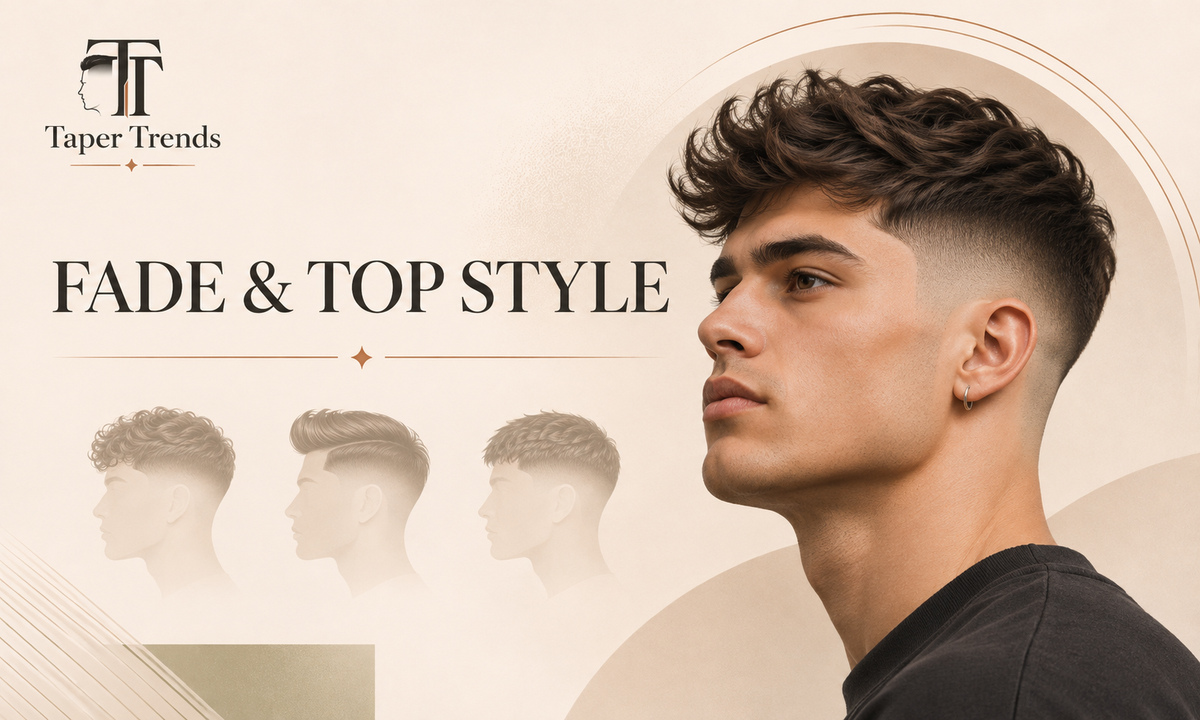
How do you ask your barber for the right fade?
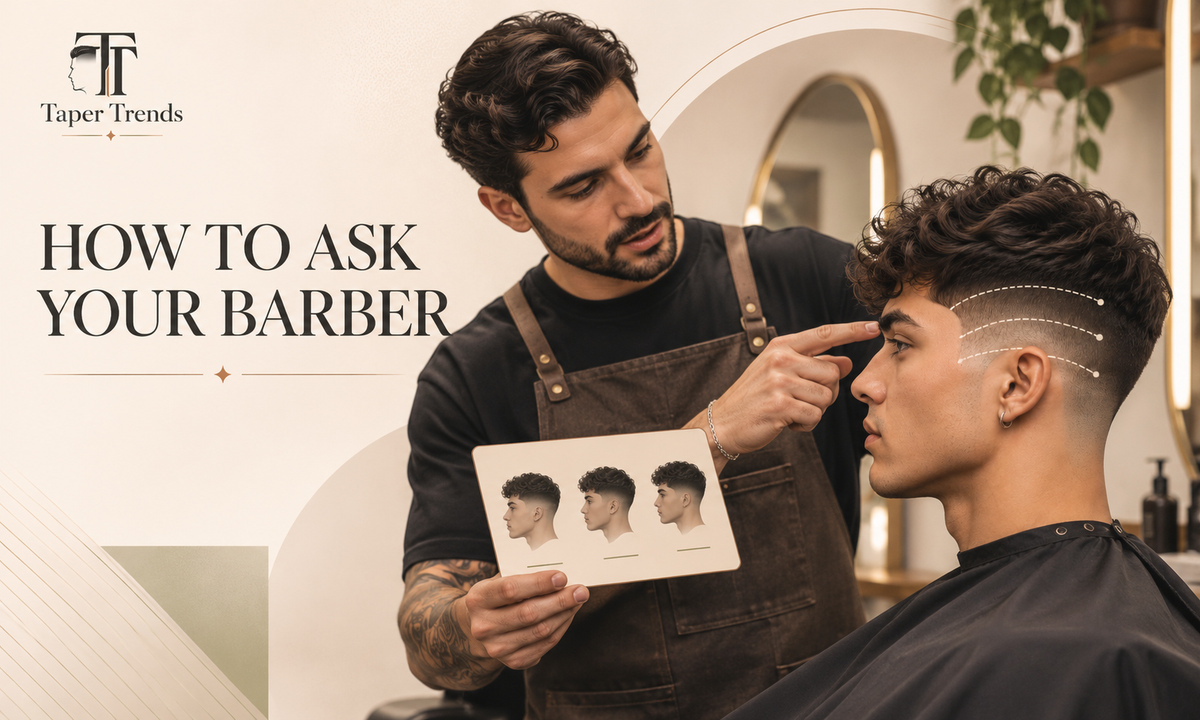
Tell your barber four things: the fade height, the shortest length at the bottom, how much to leave on top, and how the sideburns, neckline, and back should be shaped. Then confirm the starting line on your own head before cutting begins. DIDA suggests pointing to exact landmarks, such as temple level or the top of the ear, and bringing two or three photos from different angles. Name the guard number and the height separately, because a guard number describes cutting length, not where the fade starts. For a longer script library, see how to ask for a fade.
What should you specify before the cut?
Specify the fade height, the base finish, the top length, and the shape of your edges, then ask the barber to repeat the height back to you.
- Height: low, mid, or high, shown on your own head.
- Base finish: skin, shadow, or a specific guard number.
- Top: the length you want and how you usually style it.
- Edges: sideburn shape, neckline, and whether the back outline is rounded or squared.
- References: front, side, and back photos of hair like yours.
The barber brief generator turns those five answers into one request you can show at the chair.
What can you say for a low, mid, or high fade?
Name the height, the base length, and the top in one or two sentences. Here are three requests you can adapt:
Low
“I'd like a low skin fade starting just above the ear, with enough length on top for a side part.”
Mid
“I'd like a mid fade with the shortest section at a number one guard rather than skin. Please leave enough length on top for a textured style.”
High
“I'd like a high fade with a shadow finish and a short crop on top.”
How often do low, mid, and high fades need maintenance?
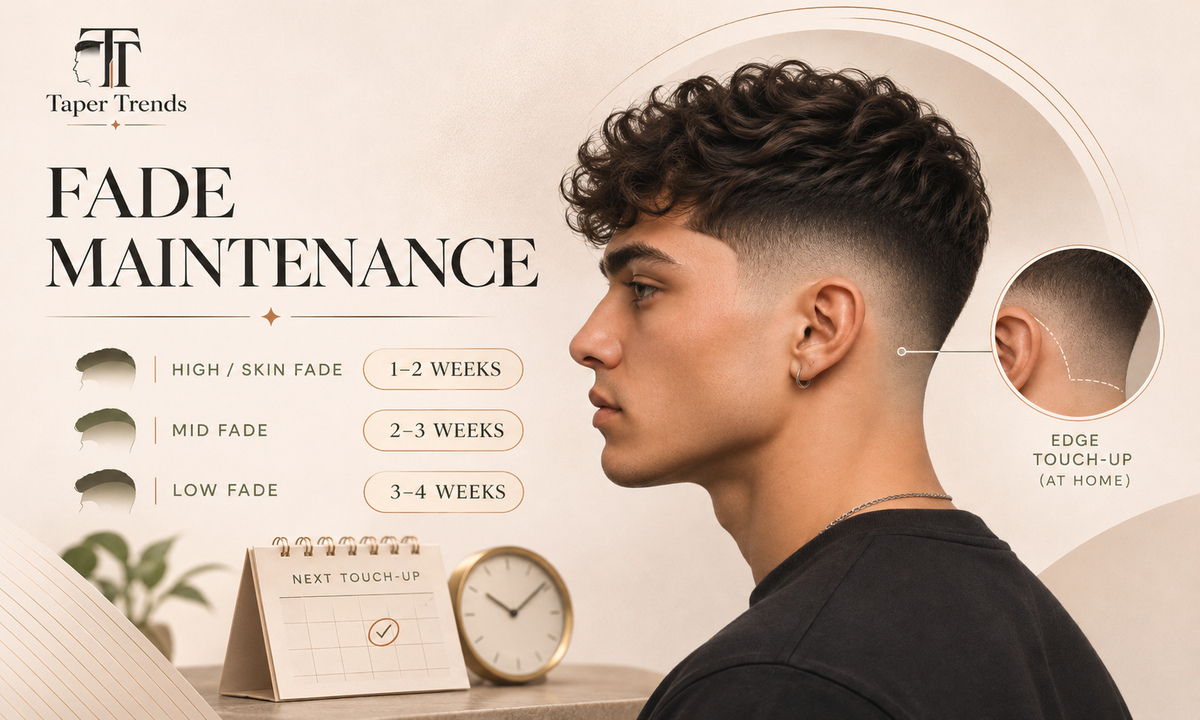
Most barbers suggest a touch-up every two to four weeks, with skin fades and high fades at the shorter end, often every one to two weeks. Fade height alone doesn't set the schedule. Base length, how fast your hair grows, and how sharp you want the blend matter just as much, so treat published intervals as approximate.
| Fade | Suggested touch-up interval | Source |
|---|---|---|
| Skin fade, any height | Every 1–2 weeks | Pall Mall Barbers, DIDA |
| High fade | Every 1–2 weeks (DIDA) to 2–3 weeks (Pall Mall) | DIDA, Pall Mall Barbers 2024 |
| Mid fade | Every 2–3 weeks, up to 4 if you're relaxed about sharpness | DIDA |
| Low fade | Every 2–3 weeks (DIDA) to 3–4 weeks (Pall Mall) | DIDA, Pall Mall Barbers 2024 |
Pall Mall Barbers also reports that its clients visit every two to four weeks on average. Our guide on how often to get a haircut breaks this down by style, and the haircut frequency calculator sets a date for you.
Softer isn't slower
A low fade can look fresh longer because regrowth blends into the hair above it, but your hair grows at the same rate whatever the fade height.
Keep home trims to the edges
Tidy the neckline and around the ears only. One clipper pass into the blend can change the fade's height. If you do cut at home, start with how to cut a fade and the best clippers for fades.
What mistakes should you avoid when choosing a fade?
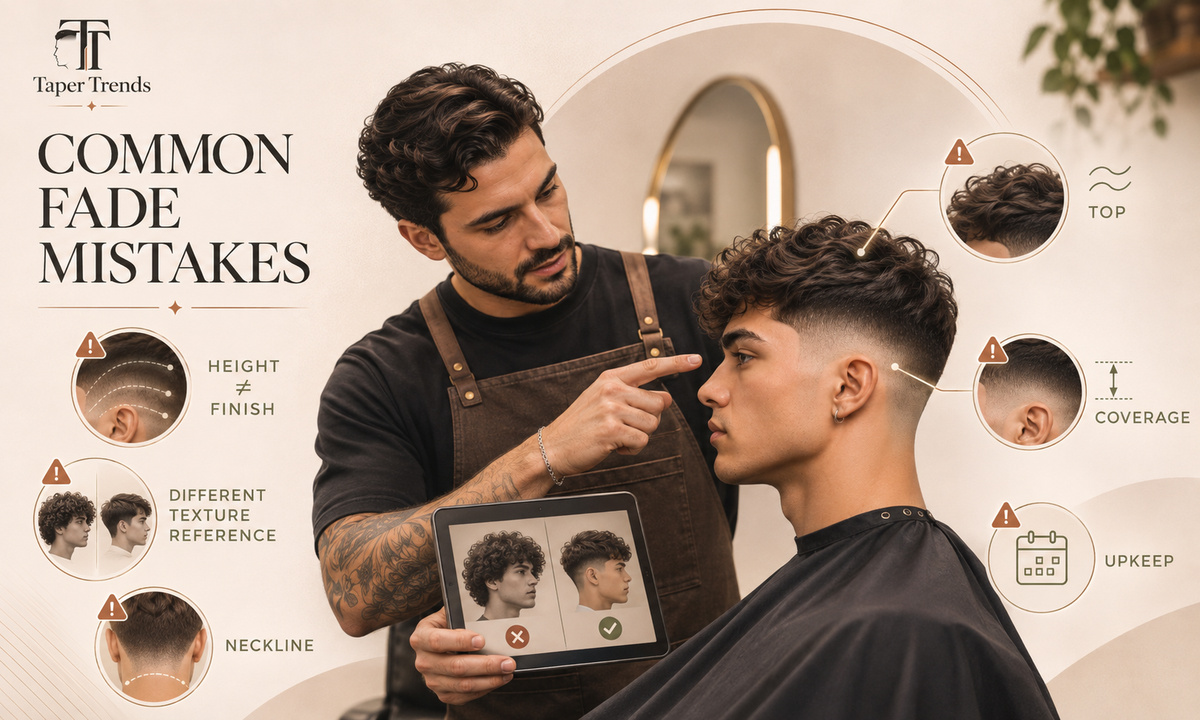
Most fade mistakes come from unclear requests rather than poor clipper skills, so naming the height, base finish, and top length before the cut prevents nearly all of them.
- Treating high and skin as the same thing. Say the height and the finish separately.
- Asking for a fade without discussing the top. Give a length and a style.
- Copying a photo of very different hair. Pick references with similar texture and density.
- Losing too much side coverage. Ask the barber to pause and check the sides with you before going shorter.
- Skipping the back and neckline. Say whether you want the outline rounded or squared.
- Ignoring upkeep.Choose a height you'll actually book appointments for.
If one of these has already happened, how to fix a bad fade covers what a barber can correct on the spot and what needs regrowth.
Low vs mid vs high fade FAQs
Can you change a high fade into a low fade immediately?
Not usually. A true low fade needs hair on the upper sides, so after a high fade you have to let that hair grow back first. Use interim visits to clean up the neckline and outline without cutting any higher, and expect the change to take several weeks.
Related: How to grow out a fade · Haircuts that grow out well · Low taper fade vs high taper fade
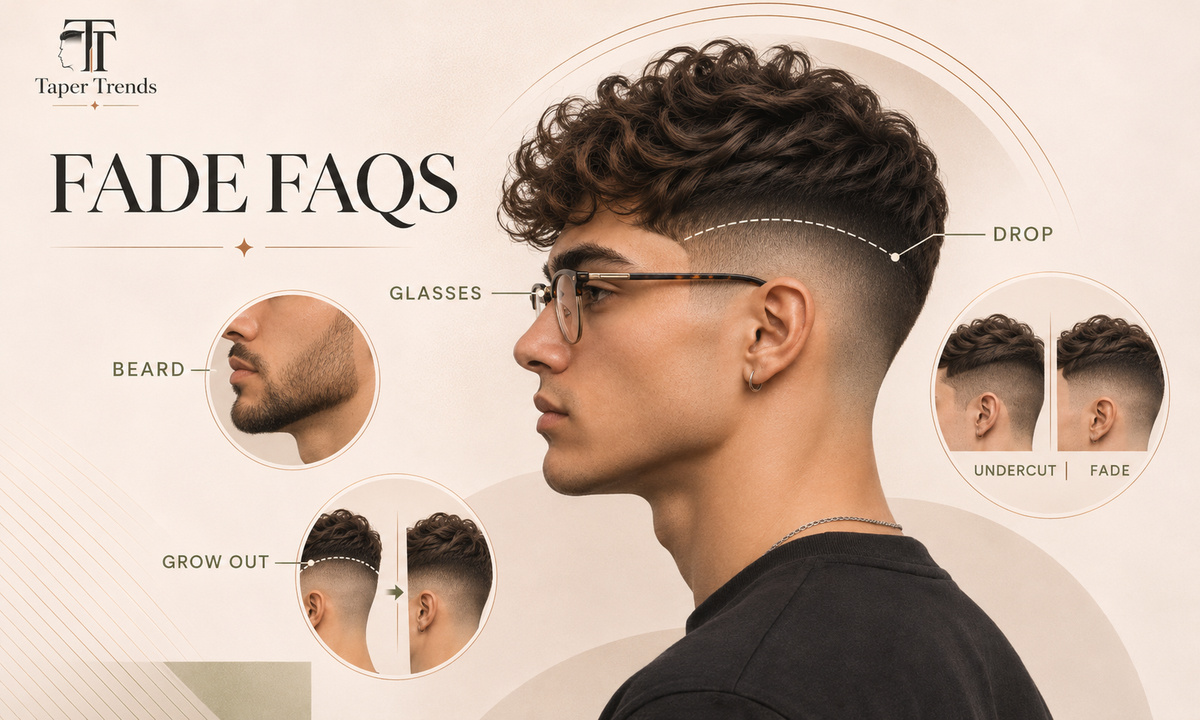
Can a fade be blended into a beard?
Yes. A barber can carry the blend from the temple through the sideburn into the beard, so the haircut and facial hair read as one shape. DIDA's low fade guide flags the temple and sideburn connection as the part to get right if you wear a beard.
Related: Skin fade with beard · Low taper fade with beard · Mid taper fade with beard · High taper fade with beard
Is a drop fade a different fade height?
No. A drop fade describes the path of the blend, which curves lower as it passes behind the ear and forms an arc around the back of the head. Ready Sleek's fade comparison explains that this has nothing to do with starting height, so a drop fade usually starts at low or mid height.
Related: Drop fade · Low drop fade · Mid drop fade · Drop fade vs burst fade
What is the difference between a fade and an undercut?
A fade blends the sides gradually into the top, while an undercut leaves a visible line between short sides and much longer hair on top. Man of Many describes the undercut as a disconnected style, meaning the top is deliberately not blended into the sides. Say which one you want.
Related: Undercut vs fade · Barber terms explained · Taper vs fade · Different kinds of fades
Does a fade haircut work with glasses?
Yes. Tell your barber you wear glasses, and ask them to shape the area around the temples and ears with the frame arms in mind. Bringing your glasses helps the barber check that the outline sits evenly beneath the frames.
Related: How to ask for a fade · Best fade for your face shape
What should you do if your fade is cut too high?
Ask the barber to even out the shape now and let the upper sides grow back, rather than cutting the rest of the hair higher to match. At your next visit, show the barber where you want the fade to start before any clipper work begins.
Related: How to fix a bad fade · How to grow out a fade · Barber brief generator
Sources named in these answers: DIDA's low fade guide, Ready Sleek's fade comparison and Man of Many.
The bottom line
The bottom line
Choose by what you want from the sides: a low fade for fullness and quiet contrast, a mid fade for balanced definition, a high fade for the boldest separation from the top.
Before your next cut, decide the height, base finish, and top length, bring photos from several angles, and agree on where the blend starts. Put it together with the Taper Trends barber brief generator and the low taper fade guide. If you're torn between two heights, choose the lower one. You can always go higher next time.
Keep reading
Fade heights and finishes
Taper heights compared
Drop and burst fades by height
By hair type
- Low taper fade, straight hair
- Mid taper fade, straight hair
- High taper fade, straight hair
- Low taper fade, wavy hair
- Mid taper fade, wavy hair
- Curly low taper fade
- Mid taper fade, curly hair
- High taper fade, curly hair
- Skin fade, curly hair
- Low taper fade, afro
- Mid taper fade, afro
- High taper fade, afro
- Low taper fade, thin and thick hair
- Low taper fade for Black men
Top styles over a fade
Face shape and hairline
Asking, cutting and upkeep
Want more fade guides?
Browse clean, barber-ready breakdowns for every hair type.