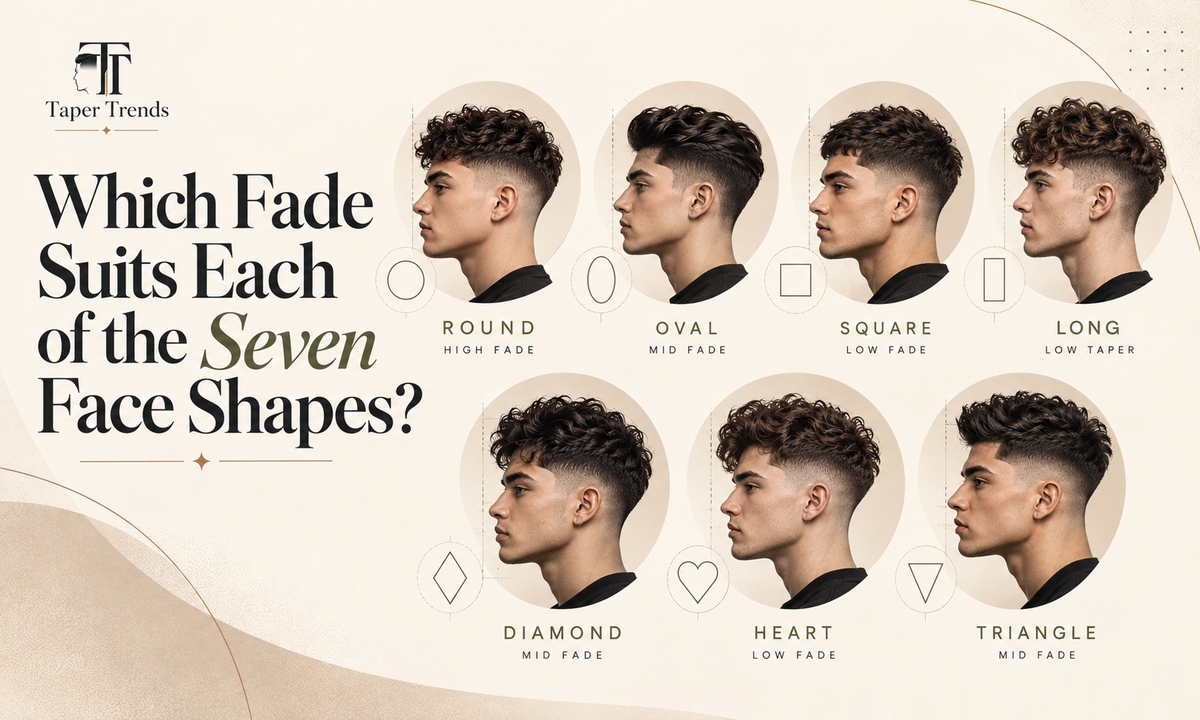
The best fade for your face shape is the one that keeps weight where your face needs it. Round faces usually suit a mid fade or high fade with some height on top. Long faces do better with a low fade or taper that holds width at the sides. Oval and square faces can carry most heights.
Treat that as a first filter, though, because hair texture, head shape, hairline and upkeep all change the final call. If you are still learning the vocabulary, our guides to the types of fade haircuts and the taper fade are the best place to start, and the face shape detector can check your proportions while you read.
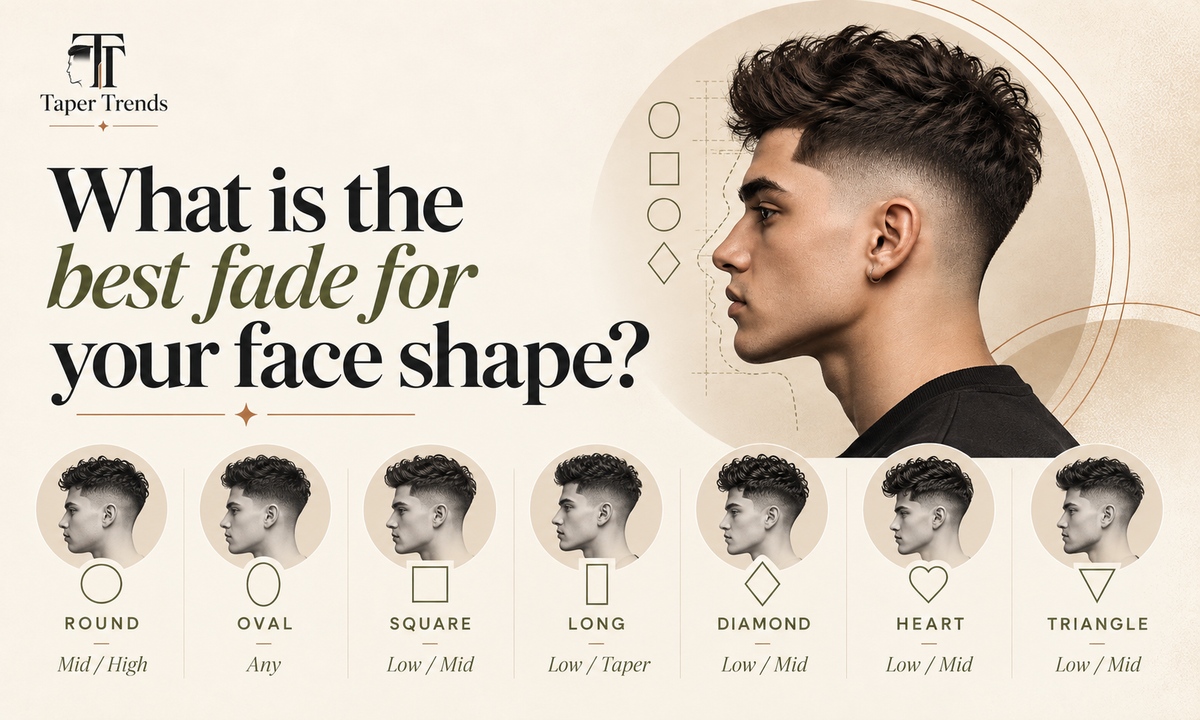
What is the best fade for your face shape?
A mid or high fade is the usual starting point for a round face, a low fade or taper for a long face, and a low or mid fade for square, diamond, heart and triangle faces. Oval faces can wear almost any height. How much weight you keep at the sides, and what you wear on top, matters as much as the fade itself.
| Face shape | Starting fade | Top style | What to watch |
|---|---|---|---|
| Round | Mid or high | Textured quiff or crop with lift | Keep the sides controlled |
| Oval | Low, mid or high | Textured crop | Mostly personal preference |
| Square | Low or mid | Side part or textured top | Soften or sharpen the jaw |
| Long / oblong | Low fade or taper | Short crop or fringe | Keep side width, limit top height |
| Diamond | Low or mid | Textured, side-swept top | Keep some width at the temples |
| Heart | Low or mid | Soft textured fringe | Avoid a tall top |
| Triangle / pear | Low or mid, keeping upper-side weight | Fuller textured top | Balance a wider jaw |
The table draws on the BCcampus Barbering Techniques for Hairstylists textbook and guidance published by working barbers, including Montreal barber Youssef Ouda. Sources don't always agree; the sections below explain where they split. For the top styles in the table, our guides to the textured fringe, French crop and side part over a low taper cover each one in detail.
How can you identify your face shape?
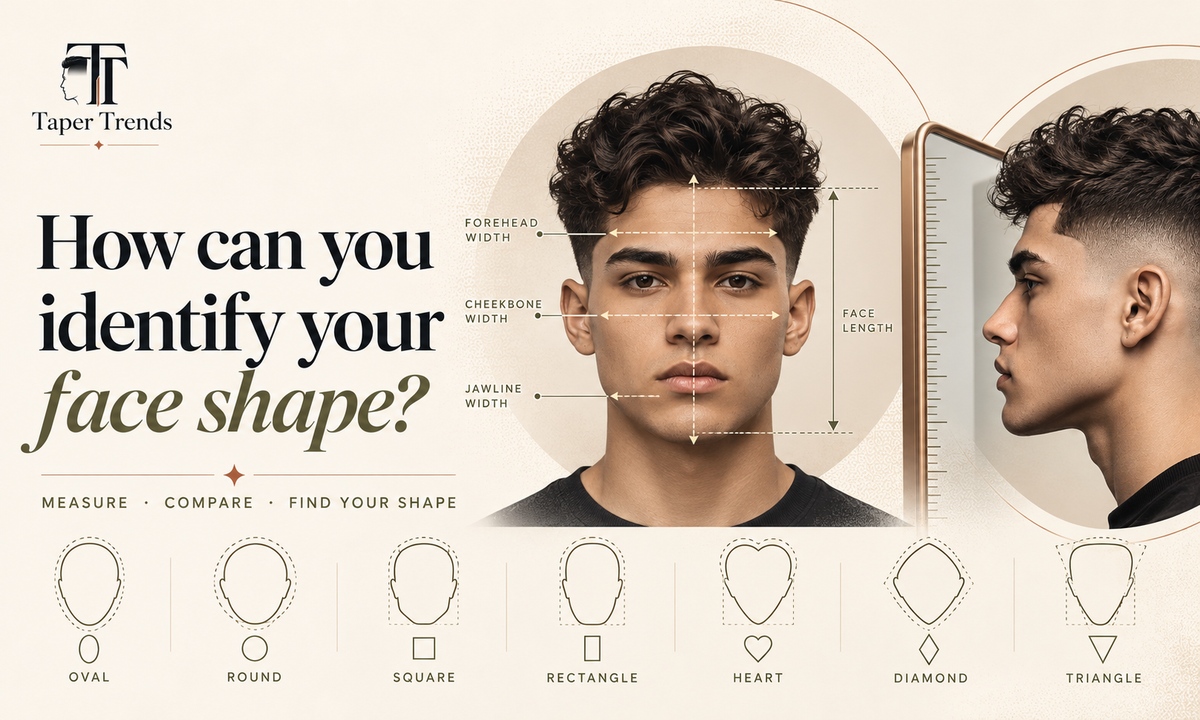
You can estimate your face shape by comparing the width of your forehead, cheekbones and jaw with the length of your face. Where your face is widest, and how your jaw finishes, points to the closest shape. It's an estimate, not a diagnosis, and mixed features are normal.
Compare your face length, forehead, cheekbones and jaw
BCcampus lists face shape, head shape and growth patterns as the three things a barber should assess before suggesting a style. You can get close with a phone camera:
- 1.Pull your hair back off your forehead and away from your face.
- 2.Take a photo straight-on, in even daylight, with the camera at eye level.
- 3.Compare the widths of your forehead, cheekbones and jaw.
- 4.Compare the overall length of your face with its width.
- 5.Note whether your jaw is rounded, angular or narrow at the chin.
Prefer a second opinion? Upload the same photo to our face shape detector, which runs in your browser, then preview a few cuts with the haircut try-on tool.
Match your proportions to the seven main face shapes
Pick the shape whose widest point and jawline best match your photo:
- RoundLength and width roughly equal, soft jaw, shorter chin
- OvalA little longer than wide, balanced, no feature dominates
- SquareSimilar length and width, strong angles at the jaw and hairline
- Long or oblongClearly longer than wide, often a strong jaw and higher hairline
- DiamondCheekbones widest, narrower forehead and chin
- HeartWider forehead, narrowing to a pointed chin
- Triangle or pearNarrower forehead, wider jaw
Naming varies between references. BCcampus uses “triangular” for prominent cheekbones with a narrow, pointed chin and “pear” for a wide jaw, while Cadmen Barber Academy groups “triangle/heart” as a wider forehead. In this guide, heart always means wide on top, and triangle or pear always means wide at the jaw.
What is the difference between low, mid, high and taper fades?
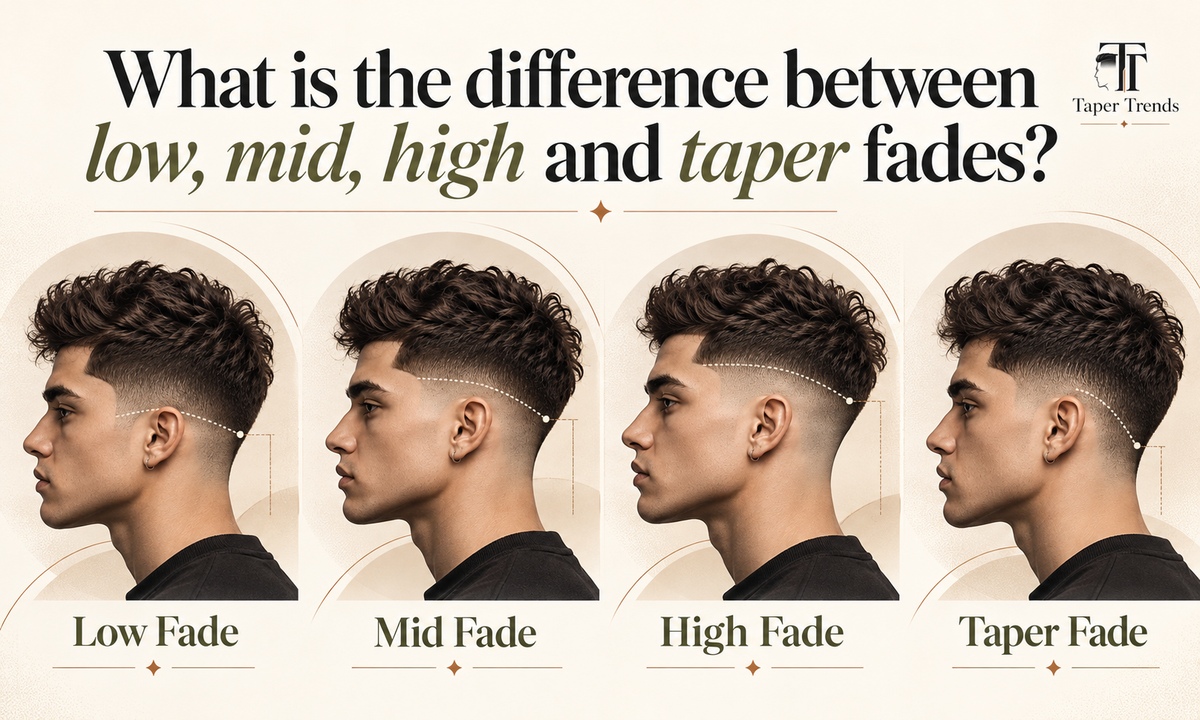
A fade blends short sides into longer hair on top. Low, mid and high describe where that blend starts on the side of the head. Taper, skin, drop and burst describe something else: how short the fade finishes or what shape its outline follows. Those properties combine with any height, so a “mid skin fade” is a normal request. Our guide to every kind of fade and the taper vs fade and undercut vs fade explainers unpack the vocabulary further.
Low vs. mid vs. high fade: where does the blend begin?
The core difference is where the line starts. Wahl describes the low fade as starting close to the ear, the high fade as starting much higher to focus attention on the hair on top, and the mid fade as the middle ground. Shops differ: Kozmic Barbershop puts a mid fade about two inches above the ear, and FadeByFame starts a high fade at or above the temples. Point to the spot rather than relying on the label. Our low vs mid vs high fade guide shows each starting line in profile.
| Low fade | Mid fade | High fade | |
|---|---|---|---|
| Blend starts | Just above the ear | Around the temple | At or above the temples |
| Contrast | Subtle | Moderate | Strongest |
| Side weight kept | Most | Some | Least |
For a closer look at each pairing, see low vs mid taper fade, low vs high taper fade and mid vs high taper fade, or the low mid taper fade if you want something in between. The taper height diagram shows the three heights on a head outline.
How are taper, skin, drop and burst fades different?
These aren't alternatives to low, mid and high. Each describes a separate property you can add to any height:
- TaperShortens mainly at the sideburns and neckline, leaving visible hair at the bottom.
- Skin or bald fadeThe shortest point goes down to bare skin.
- Shadow fadeStops just short of skin, leaving a faint layer of stubble.
- Drop fadeThe line curves down behind the ear toward the nape.
- Burst fadeThe blend radiates in a semicircle around the ear.
How does fade height change your overall silhouette?
Fade height changes where the sides keep their weight. A low fade holds width near the temples and ears, while a higher fade removes it and pulls the eye upward. The top works separately: extra height lengthens the face, which helps a round face and works against a long one. Ouda makes the same point, which is why he argues one fade shouldn't be copied onto every head.
Which fade suits each of the seven face shapes?
Each section below gives a starting fade, an alternative and one thing to watch for, so you can jump straight to your shape. Where barbers disagree, it says so.
What is the best fade for a round face?
A mid fade or high fade with controlled sides and some height on top is the usual starting point for a round face. Taking weight off the sides trims width at the cheeks, and lift on top adds vertical length. A low-to-mid fade can still work if the top carries enough structure.
Cadmen favors a high or skin fade with volume on top, while Ouda warns against going higher than your density and head shape can support.
- Start withA mid fade, or a high fade if your hair is dense
- AlternativeA low-to-mid fade with a structured top
- Top styleA textured quiff or crop with lift at the front, like the fluffy low taper or a blowout
- Watch forA flat, rounded top over a low fade, which Cadmen says emphasizes width
What is the best fade for an oval face?
An oval face can wear low, mid and high fades, so hair texture, profile and upkeep are better deciding factors than correction. BCcampus describes the oval as the shape that wears most styles easily. If you want one pick, Cadmen suggests a mid fade with a textured top.
- VersatileA mid fade with a textured crop
- QuieterA low fade or taper with a side part, which grows out gently
- Watch forA very high fade, which Kozmic says can over-lengthen an already balanced face
What is the best fade for a square face?
A low or mid fade usually suits a square face because it keeps some weight at the sides next to a strong jaw. From there, the choice is about the look you want: texture on top softens the angles, while cleaner, sharper lines make the jaw stand out.
- To softenA mid fade with a textured crop and rounded edges toward the temples, which BCcampus says softens a square face’s strong corners
- To emphasizeA low fade with a comb over or side part and a crisp finish. Ouda notes that a clean fade can reinforce the jaw.
- Watch forA very high skin fade. Cadmen says removing all side weight can make a strong jaw look like it's floating, and Kozmic says a skin fade can look boxy.
Both warnings are styling judgments, not rules.
What is the best fade for a long or oblong face?
A low fade or taper is the best starting point for a long or oblong face. Keeping weight at the sides adds horizontal balance, and a fairly short top avoids stretching the face further. A fringe or side-swept top also shortens the face visually. Some guides call this shape rectangular.
- Start withA low fade or taper with a short crop or textured fringe
- AlternativeA mid fade with a side-swept top, since BCcampus says styles that move across the temples make the face look shorter
- Watch forA high fade under a tall quiff. Cadmen warns that very high fades with height on top add length.
What is the best fade for a diamond face?
For a diamond face, a low or mid fade with a fuller, textured top keeps some width at the temples so the cheekbones aren't the only wide point. A higher fade is a reasonable alternative if you'd rather lean into the angles and make the cheekbones the focus.
Advice splits here. Cadmen and Kozmic recommend low to mid placements, and BCcampus suggests textured styles that add width at the temples. The Spot Barbershop instead suggests a mid to high taper to draw attention upward and highlight the cheekbones.
- For balanceA low or mid fade with a textured, side-swept top
- For definitionA mid-to-high fade, provided the top still has volume
- Watch forVery tight sides, which Kozmic says expose the widest point
What is the best fade for a heart-shaped face?
A low or mid fade with moderate volume on top and a soft fringe suits a heart-shaped face. The forehead is already the widest area, so the aim is to avoid adding weight up there while keeping the lower face in proportion.
- Start withA low or mid fade, which The Spot says keeps attention off a wider forehead
- Top styleA soft textured fringe, kept moderate rather than tall
- Beard optionA beard fuller at the chin, which BCcampus suggests to balance prominent cheekbones
- Watch forVery tight sides with no fringe, which The Spot flags, and too much crown height
What is the best fade for a triangle or pear-shaped face?
For a triangle or pear-shaped face, with a narrower forehead and wider jaw, keep weight at the upper sides and temples and add fullness on top. A low or mid fade usually does this. The volume you keep matters more than the height label.
BCcampus recommends fullness at the sides, temples and top, and FadeByFame suggests a low or shadow fadeso the jaw doesn't look out of proportion. Kozmic disagrees, recommending a high fade to draw weight upward, with a clean neckline to avoid a heavy base.
- Start withA low or mid fade with a fuller textured top
- AlternativeA higher fade, only if the top has enough volume to offset the jaw
- Watch forRemoving too much temple weight, which works against the fullness BCcampus recommends and can make the jaw look wider
How do hair texture, hairline and head shape affect your fade?
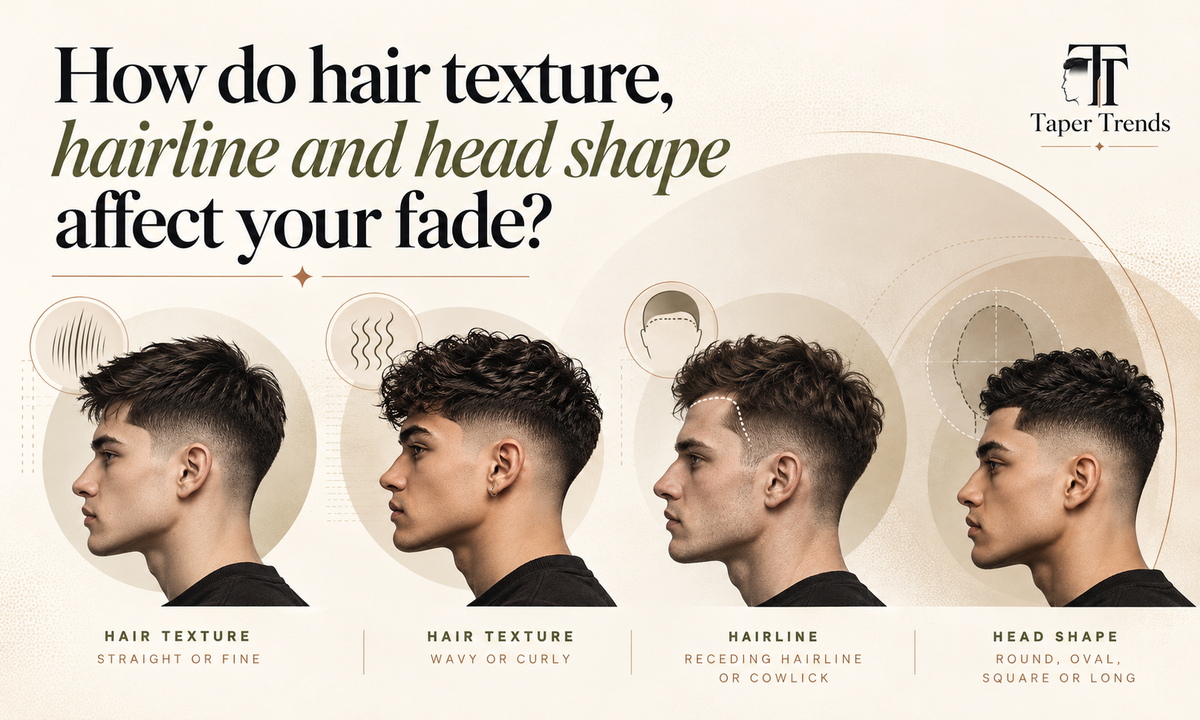
Two people with the same face shape can need different fades, because density, texture, hairline and skull shape all change how a blend reads. None of these traits rules out a fade; they change the height, finish or amount of hair your barber leaves.
Which fades work with fine, straight or thick hair?
Fine hair usually looks fuller with a lower, softer blend, because a high fade can expose lighter patches of scalp. Thick, straight hair handles more contrast but needs enough length or weight removal above the fade so the sides don't form a shelf. Ouda describes both problems. Our low taper fade for thin or thick hair and straight hair guides go deeper on each.
- Fine or straightA low fade, taper, shadow fade or scissor fade, which FadeByFame says keep the scalp from showing too much
- ThickAny height, with selective thinning where the sides meet the top
How should you choose a fade for wavy, curly or coily hair?
With wavy, curly or coily hair, keep controlled volume above the fade so the natural texture sets the silhouette. Ouda recommends a low fade or taper for Afro and curly hair for this reason. Higher contrast remains an option: FadeByFame says coarse, curly and Afro-textured hair holds skin and burst fades well.
- WavyA mid fade with length on top; see low taper fade wavy hair and mid taper fade wavy hair
- CurlyA low or mid fade with a rounded top, as in the curly low taper fade and skin fade for curly hair. Kozmic warns that a high fade on tight curls can leave a mushroom shape.
- CoilyA gradual transition, with a defined lineup if you like crisp edges; the low taper fade afro and high taper fade afro guides compare the heights
What if you have a receding hairline, cowlick or uneven head shape?
Mention these before the clippers start. They usually call for leaving hair a little longer in places rather than cutting tighter.
- Receding or thinning hairFadeByFame says short sides reduce contrast between thinning and fuller areas, and a shadow fade avoids stark scalp exposure. Ouda adds that temple recession can change a recommendation. Our haircuts for a receding hairline guide goes further.
- Cowlicks and whorlsBCcampus treats these as growth patterns to check first, because they affect how hair responds to cutting.
- A prominent occipital boneBCcampus advises leaving hair above and below the ridge slightly longer, and avoiding tight fades if you want to hide it.
What should you ask your barber for?
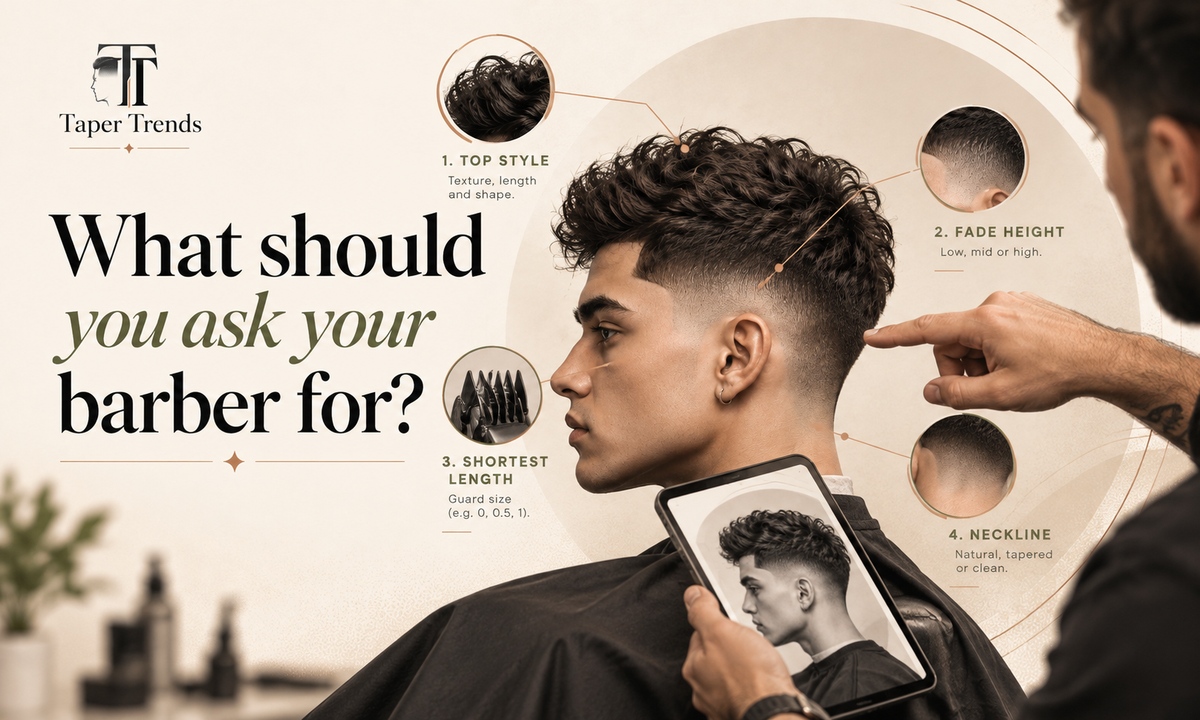
Ask for specifications, not just a fade name. Say where the fade should start, how short the sides should finish, what you want on top and how the neckline should end. Then let your barber adjust the plan for your head shape. Our how to ask for a fade guide has the full script, and the barber brief generator builds one for you.
Specify the fade height, shortest length, top style and neckline
Clipper guard numbers describe length, not height. Wahl lists a #2 guard at a quarter inch and a #4 at half an inch, so “a 2 on the sides” says how short to go, not where to start. Our haircut numbers chart and the clipper guard sizes tool convert the labels.
- 1.Height: low, mid or high, and point to where it starts.
- 2.Shortest length: skin, shadow or a guard number.
- 3.Top: length in inches and how much texture.
- 4.Neckline: rounded, squared or tapered.
Ask to see the front and both sides before the barber finishes. If you're torn between two heights, go lower first; The Spot suggests telling your barber to start low and go higher if needed, since hair can't be put back. If a cut does go wrong, our guide on how to fix a bad fade covers the repair.
How can you use reference photos and a simple barber script?
Bring a front and a side photo of someone whose hair is similar to yours, then ask what the barber would change for your head shape. A photo of a different texture can show a result your hair won't reproduce.
Example request: mid fade with a textured top
“I’d like a mid fade starting at the temple, down to a #1 at the bottom, with about two inches on top, textured, with a bit of lift at the front.”
Example request: low fade with a short fringe
“I want a low fade with the sides left fuller, finishing at a #2, and a short textured fringe without extra height.”
How often should you maintain your fade?
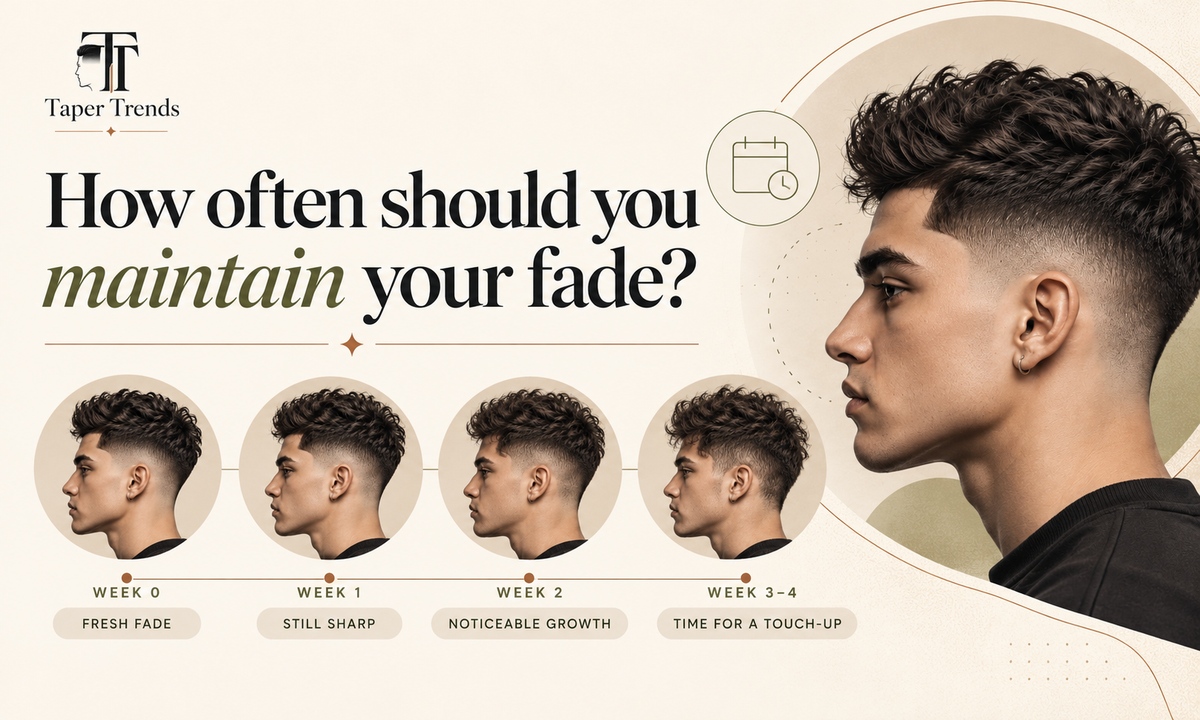
Plan on a refresh every two to three weeks for a crisp skin or high fade, and every three to four weeks for a low fade or taper. The sharper the contrast, the sooner regrowth shows. Published schedules vary: Ouda suggests one to two weeks for high-contrast fades, while FadeByFame allows up to five weeks for low fades and tapers. For longer gaps, Ouda suggests a softer blend that keeps more shadow at the sides.
Our how often to get a haircut guide breaks the timing down by style and hair type, and the haircut frequency calculator gives a personal estimate. Between visits, the right hair product keeps the top in shape, and a good set of clippers helps with neckline cleanups; our styling guide covers the daily routine.
Frequently asked questions
What if your face shape falls between two categories?
Go by your dominant proportions and the effect you want. Ouda points out that face-shape labels simplify a three-dimensional face, and two men in the same category can have different foreheads, jaws and profiles. Decide where you want to add or keep weight, then let your barber confirm the height.
The face shape detector gives a second opinion on your proportions, and our complete low taper fade guide shows how the same cut shifts across heads.
Can every face shape wear a skin fade?
Most can, because “skin” describes how short the fade finishes, not a fixed height, and a low skin fade looks very different from a high one. It isn’t automatically the best choice, though. Ouda notes that strong contrast exposes more head shape and loses its crispness sooner than a taper.
Our skin fade guide, the low, mid and high skin fade comparison and the skin fade vs taper fade breakdown cover the trade-offs in full.
Does your beard change which fade looks best?
Yes. A fuller beard adds length or width to the lower face, so Ouda recommends judging the fade with the beard visible. Ask your barber to blend the sideburns into the fade; The Spot Barbershop says this makes the haircut and beard read as one connected shape.
See the low taper fade with beard, mid taper fade with beard, high taper fade with beard and skin fade with beard guides for the join.
Do glasses or prominent ears affect fade selection?
They can, but no established rule exists. A fade shortens hair around the temples and ears, so more of both shows, and that’s where glasses frames sit. Wear your glasses to the consultation and check the front and both profiles before the barber finishes.
The haircut try-on tool is a quick way to preview a shape against your own photo before you book.
Can you change fade height without shortening the hair on top?
Yes. Fade height and top length are separate decisions, so you can move from a low fade to a mid fade and keep the same length above it. State each one separately, and ask your barber to keep a smooth connection between the sides and the top.
Our low vs mid taper fade and mid vs high taper fade comparisons show what changes when only the height moves.
What fade should you choose if you don’t want your scalp to show?
Choose a taper or a shadow fade. A shadow fade stops just short of bare skin, and a taper leaves visible hair at its lowest point. If your hair is fine, also ask for a lower placement, since a high fade can expose lighter areas of scalp.
Read the shadow fade guide and our low taper fade for thin or thick hair guide, or see haircuts for a receding hairline if thinning is the concern.
Choosing your fade: where to start
Find your closest face shape, take the starting fade from the table, then adjust for your hair texture and how often you'll visit the barber. Save a front and a side photo of a cut you like on hair similar to yours, bring both to your next appointment with the four specifications, and let your barber fine-tune the height to your head shape.
Once you have your height, the full guides take over: low taper fade, mid taper fade, high taper fade, skin fade and every other type of fade.
The bottom line
The best fade for your face shape keeps weight where your face needs it: height and lift for round faces, a low fade or taper for long faces, and a low or mid fade for most of the shapes in between.
Treat the table as a starting filter, then adjust for texture, hairline and upkeep. Bring photos, state the four specifications, and start lower if you are unsure.
Want more taper fade guides?
Browse clean, barber-ready breakdowns for every hair type.