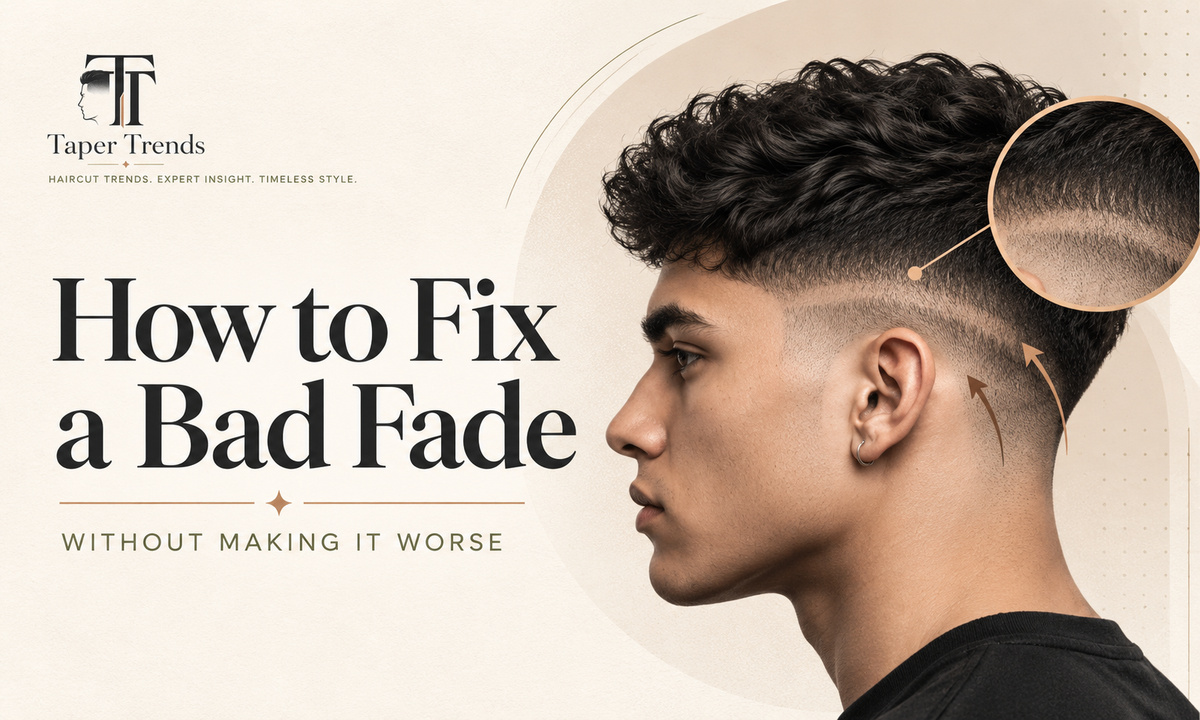
To fix a bad fade, first work out whether the problem is the blend or missing length. A barber can often soften a hard line, even out the sides or take down bulk, because there is still hair to work with. A fade cut too high, or a patch cut too short, needs time to grow. That distinction shapes every decision below.
If you are not sure what a well-made version should look like, our what a low taper fade looks like guide shows the target, and the low taper fade guide covers the gentlest version of the cut from every angle. If the bad fade came from a home attempt, our how to cut a fade guide explains where the blend usually breaks down.
What should you do first after a bad fade?
Put the clippers down and look at the fade properly before anything else gets cut. Clippers remove length for good, so every extra pass narrows your options. Wahl's home fade guidestates the rule plainly: “You can always go shorter, but you can't add more hair.”
Then work through five checks:
- Wash and dry your hair the way you normally would. Fresh cuts tend to look harshest on day one, and the barbers at Markcutit suggest giving a cut two or three days before you decide it is ruined. Settling is not regrowth, though. Hair that was cut too short will still be too short on day three.
- Look at it in daylight. Check the front, then turn to see both sides and the back. Straight 8 Barbers warns that mirror angles and overhead lighting can exaggerate shadows.
- Compare left and right from the same angle and distance.
- Photograph the problem in steady light, close enough to show the flaw and wide enough to show where it sits on your head.
- Set a limit. Decide how much more length you would give up for a cleaner blend.
That photo does double duty. It is the first thing to show a barber, and our how to ask for a fade guide explains what else to bring. If you want the plan written down, the barber brief generator puts it on one card.

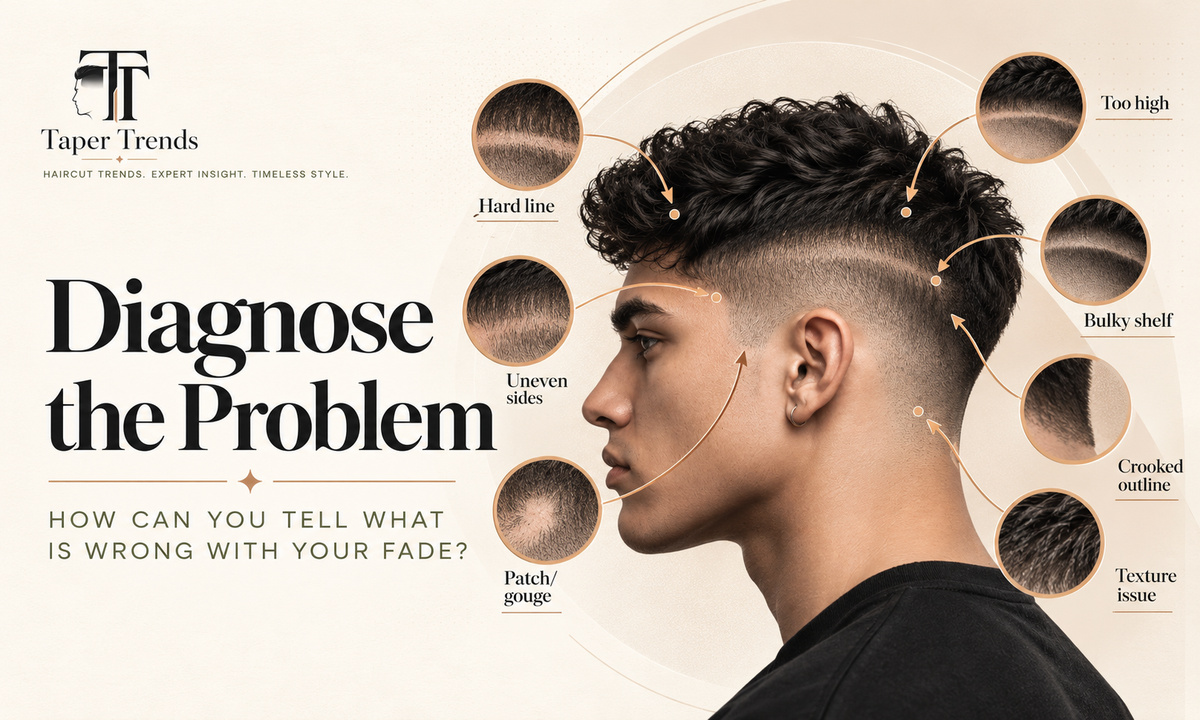
How can you tell what is wrong with your fade?
Most bad fades come down to one of seven problems: a hard line, uneven sides, a patch or gouge, a fade cut too high, a bulky shelf, a crooked outline, or unevenness caused by texture and growth direction. Naming the right one matters, because each points to a different fix, and a few point to no cut at all.
A fade is a gradual change from shorter hair low on the sides and back to longer hair above. A flaw in one spot often comes from the hair just above or below it. If thebarber vocabulary is unfamiliar, types of fade haircuts and different kinds of fades name every height and finish, and taper vs fade explains why two cuts that look similar leave very different amounts of hair.
| Visible problem | What you notice | Likely direction |
|---|---|---|
| Hard line | A distinct horizontal band | Reassess and reblend the transition |
| Uneven sides | One side appears higher | Check symmetry and how much length you can spare |
| Patch or gouge | An isolated, noticeably shorter area | Assess the surrounding length, or wait |
| Fade too high | More scalp shows than you asked for | Wait, or accept a different style |
| Bulky shelf | A heavy ridge where the sides meet the top | Remove weight and reconnect it to the top |
| Crooked outline | Uneven temple, sideburn or neckline | Reshape only where hair remains |
| Texture-related unevenness | A dark spot or a distorted transition | Check growth direction, density and cutting method |
Read the right-hand column as a starting point, not a verdict. Growth direction, curl pattern and density can make one area look darker even when the lengths match, so judge your hair as it lies at rest. Be specific when you describe what you see. “A band above my left ear” gives a barber far more to work with than “it looks off.”
Height is the other thing to pin down. Our low vs mid taper fade and low vs high taper fade comparisons show where each start line sits, and skin fade low, mid and high shows how the same heights read on a bare finish. If the fade landed higher than you asked for, that is a different problem from a line.
Which bad fade problems can a barber actually fix?
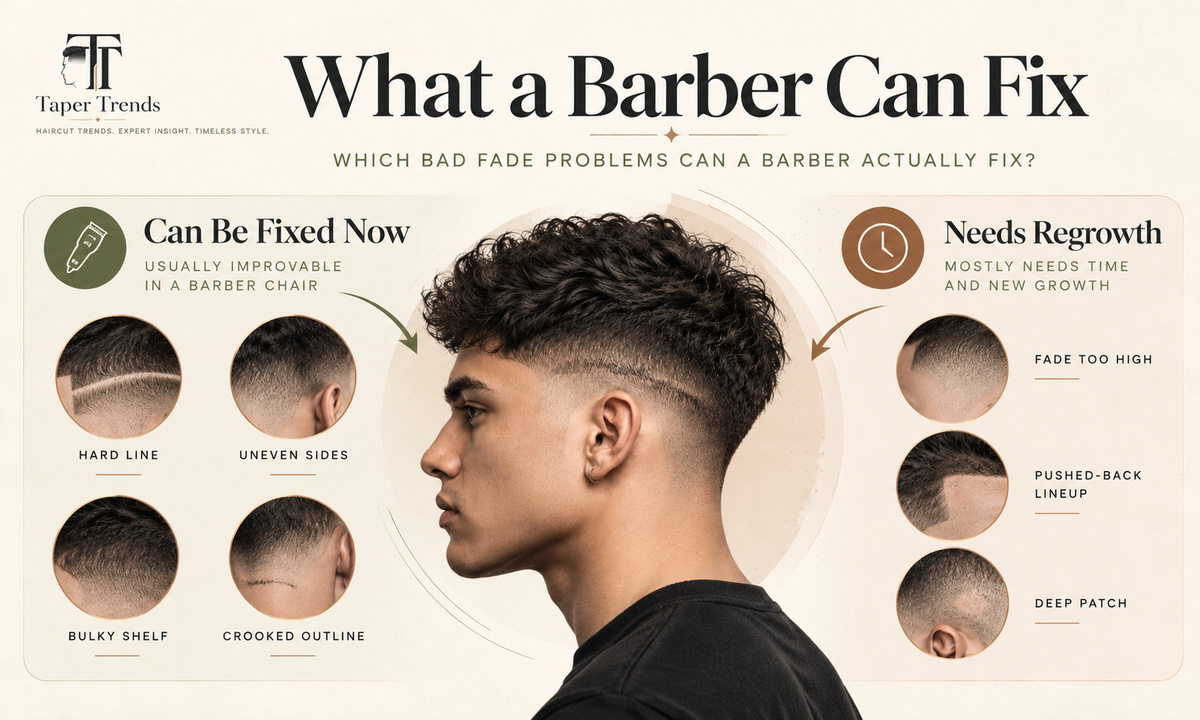
A barber can usually improve a bad fade wherever enough length remains, which covers most hard lines, uneven sides, bulky transitions and crooked outlines. A barber cannot put hair back, so a fade cut too high or an outline pushed back needs regrowth. The length that remains, and where it sits, sets the limit of any correction.
| Problem | Possible correction | Trade-off |
|---|---|---|
| Hard line | Reblend the lengths on both sides of it | The fade may sit slightly higher or tighter |
| Uneven sides | Bring the longer side down to match | Both sides may end up shorter |
| Bulky shelf | Remove weight and reconnect it to the top | Some length comes off the sides |
| Pushed-back lineup | Soften the outline within the hair that is left | The original edge does not come back |
| Fade too high | Clean up the blend at its current height | It cannot be lowered until hair regrows |
Markcutit's barbers describe re-blending a visible line by taking the fade slightly higher or tighter, which is often the right call but still costs something. That cost is steepest on a bare-skin finish, which is why skin fade and skin fade height guides stress choosing the height carefully, while a shadow fade hides small blending flaws better.
It helps to think in three outcomes: correct it now, improve it without restoring the original shape, or let the area grow. John Delgado, an Andis educator, told American Salon that a barber fixing a bad fade should correct what can be corrected while taking off as little hair as possible. Use that as the test for any correction a barber proposes.
Should you fix a bad fade yourself or go to a barber?
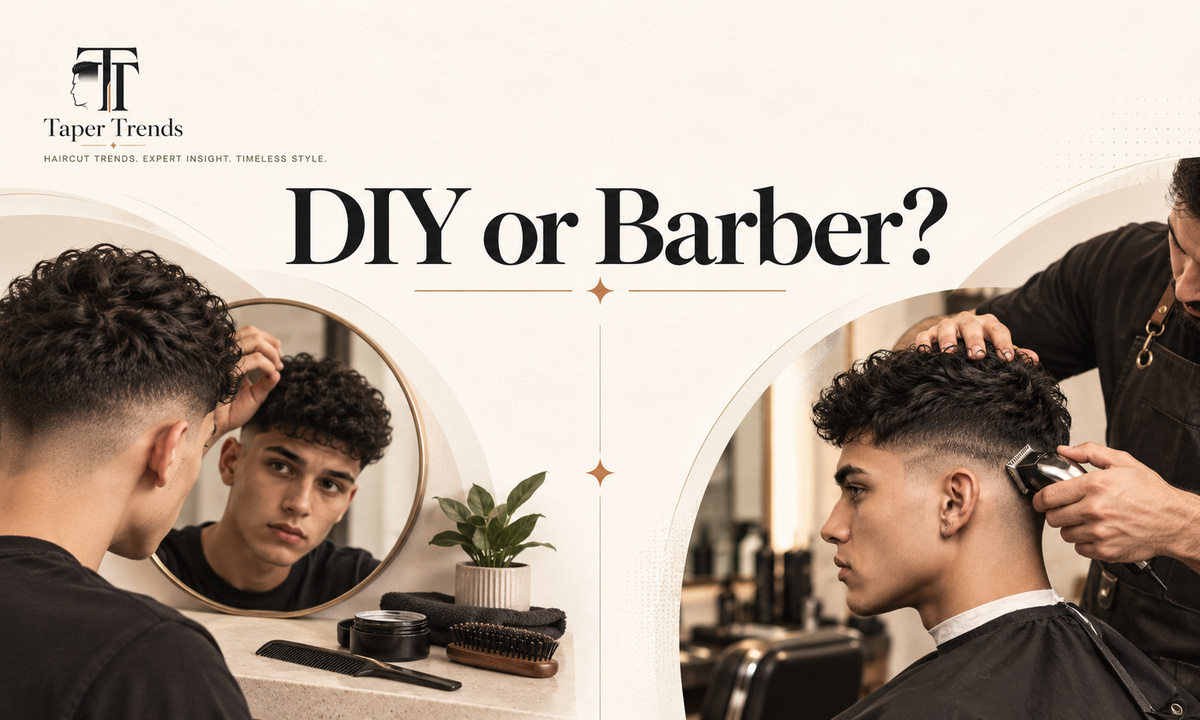
Handle the styling yourself and leave clipper work to a barber. Restyling carries almost no risk because it changes how hair lies, not how long it is. Blending a fade takes technique, the back and crown are hard to see on your own, and one wrong pass leaves less hair for anyone to correct later.
| Task | Better handled by | Why |
|---|---|---|
| Styling longer hair | You | It changes direction, not length |
| Blending a line or shelf | A barber | It takes technique and can raise the fade |
| Fixing the back or crown | A barber | You cannot see it clearly on your own |
| Evening up the sides | A barber | A single pass can take off too much |
Stop and book a barber if you catch yourself about to:
- Put a shorter guard on to chase a visible line.
- Trim one side to match the other.
- Cut an area you can only see in a second mirror.
A professional correction removes hair too, so say how much you will accept before the first cut. Styling can soften how a line looks, but it will not even out the lengths underneath. If you do want to learn the technique for next time, how to cut a fade teaches it with the guards and lever in the right order, and haircut numbers and the clipper guard sizes tool show what each guard leaves, and our best clippers for fades roundup covers the levers and blades that make blending easier.
How does a barber fix each type of bad fade?
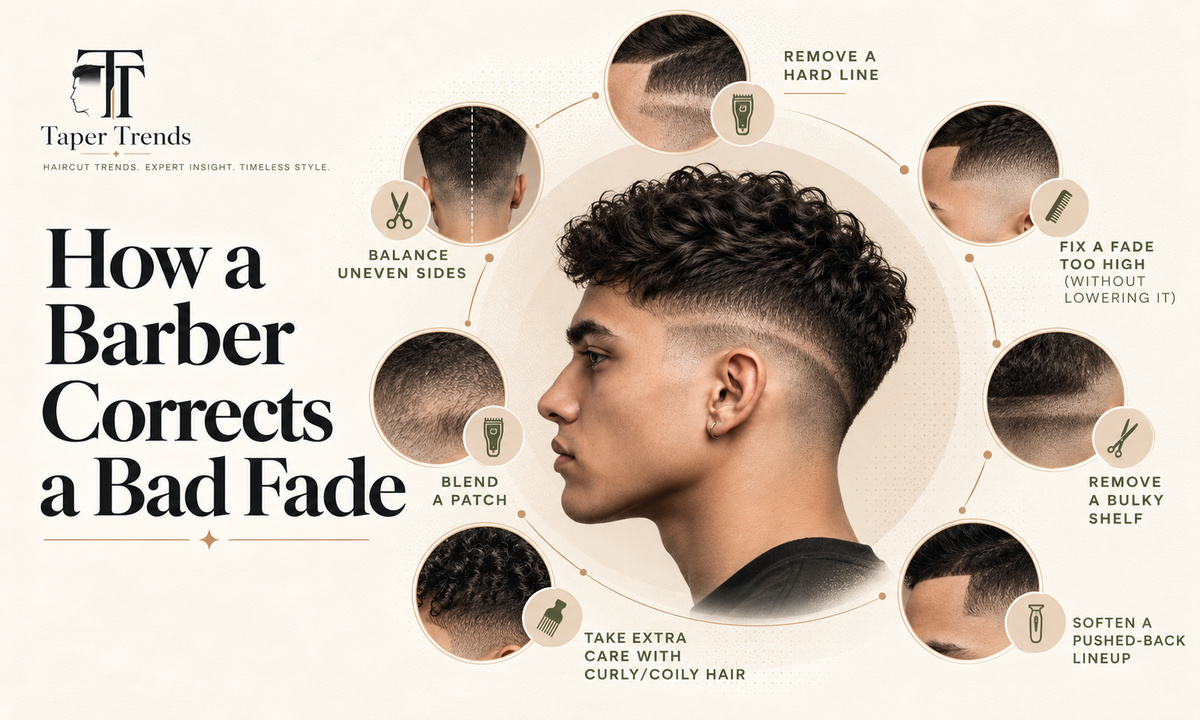
A barber starts by checking how much hair remains, then matches the correction to the defect: blend a line, balance a side, remove weight or leave an area to grow. The sections below explain that logic. They are not a home procedure. Guard numbers and taper lever positions vary between clippers, so any setting named here comes from one specific tutorial.
How does a barber remove a hard line from a fade?
A barber removes a hard line by blending the lengths on both sides of it, not by cutting a new line just above it. The usual tools are intermediate guard sizes, the taper lever, which shortens or lengthens the cut within one guard, and an outward stroke that lifts the clipper away from the head at the top of each pass.
The first job is diagnosis. The barber finds which two lengths meet at the band and how much hair sits above it. If there is very little hair above the line, there is very little room to blend without raising the whole fade.
Then comes the softening. In Wahl UK's fade tutorial, the barber works up to the transition with a #1 guard and the taper lever open, repeats it with the lever closed, then uses a #0.5 guard to take out the line. In a Modern Barber step-by-step sponsored by BaByliss PRO, ambassador Tariq Howes refines imperfections with a 0.5 guard using only the corner of the blade, so he does not create fresh hard lines. The same lever logic is laid out for beginners in how to cut a fade.
What fixes a fade that is uneven from side to side?
A barber fixes an uneven fade by comparing both sides at matching angles, picking one side as the reference, and blending the other to match. Perfect symmetry can cost length, because the higher or shorter side usually sets the limit. Heads are rarely symmetrical either, so the realistic goal is balance, not identical measurements.
- Compare equivalent angles to find which side actually sits higher.
- Choose the reference. Markcutit's barbers describe balancing uneven sides by shortening the longer side to match.
- Account for head shape, since a bump or flat spot can make an even cut look lopsided.
Ask how much length the match will cost before you agree to it. The same applies to curved shapes such as the drop fade and burst fade, where an arc that is off on one side is harder to see and harder to match.
Can a patchy fade or clipper gouge be blended?
A patchy fade can usually be blended when the hair around the patch is only slightly longer than the patch itself. When an area was cut much shorter, blending means bringing everything around it down, or waiting. Cutting into the patch again only deepens the contrast.
That leaves three realistic outcomes:
- Blend: the barber evens out the nearby hair so the patch disappears into it.
- Shorter reset: the surrounding hair comes all the way down to the patch, and the whole fade ends up shorter.
- Grow out: the patch is too short to match without sacrificing most of the fade.
First confirm the patch is a real cutting mark, since density and lighting can make a spot look lighter than it is. If it is a genuine gouge, Markcutit notes that one made by a clipper with no guard needs a few weeks just to blend in. A patch at the temple is the most common version, and our temp fade guide explains how that small area is blended in the first place.
What if the fade was cut too high?
No cut can lower a fade that was cut too high, because the hair that would form a lower transition is gone. A barber can clean up the blend at its current height so it looks deliberate, or you can wait for regrowth. Waiting keeps the most length, while rebalancing now may change your overall style.
- Rebalance now: the barber tidies the blend where it sits and may adjust the top so the proportions work. The result will still sit higher than you asked for. Pat Regan, a BaBylissPro global platform artist, described a similar fix to American Salon for an undercut taken too high: keep length around the parietal ridge and fade down to work around bumps or indentations in the head.
- Wait: you keep every bit of length, and the next barber starts a new, lower transition once hair has grown in below the current one. The stage in between can look unfinished.
A fade that is too high usually means the start line was misunderstood. The mid taper fade and high taper fade guides show how much higher those lines sit than a low taper fade, and low taper vs low fadeexplains why even the word “low” can mean two different amounts of short hair.
How can a barber correct a bulky shelf into the top?
A barber reduces a bulky shelf by removing weight from the heavy area and reconnecting it to the top, often with clipper-over-comb. The goal is a smooth connection that keeps as much top length as possible.
The heavy area usually sits around the parietal ridge, the widest part of the upper head where the sides turn into the top. In a low-medium fade demonstration for American Salon, Wahl educator Miguel Rosas runs a #1½ attachment up toward that ridge to remove bulk, then lifts the hair out at a 90-degree angle with a comb and cuts it so it blends into the longer hair on top. For how that connection is built, see low mid taper fade.
What if the neckline or lineup was pushed back?
A barber can straighten a crooked outline only where hair remains. If the neckline, temples or lineup were cut too far back, trimming more to match makes the problem bigger. A softer outline and time work better. Markcutit's barbers recommend finishing a correction with a conservative lineup that follows the natural hairline rather than pushing it.
- Do follow the natural edge and let the removed hair grow back in.
- Don't chase symmetry by taking more off, or sharpen a border that has already moved.
Irritated or nicked skin is a separate issue from shape. Mention it to your barber, and see a doctor if it does not heal normally. A neckline-only cleanup is what a taper haircut is built around, and it is often a gentler reset than redoing the whole fade. If a beard is involved, the sideburn blend in low taper fade with a beard and skin fade with a beard shows where lines tend to break.
What changes when fixing a fade on curly or coily hair?
Curly and coily hair changes how a fade should be judged, because curl pattern, density and growth direction can create shadows that look like missed sections. A barber should assess the hair in its natural, dry shape before deciding anything is uneven.
Wahl UK's Afro skin fade tutorial by Michael Damiano shows the order of operations. The line between the #0 and #1 is faded out by working the taper lever from open to closed, bulk comes off the side with a #4 comb, the side is tapered with clipper-over-comb, and only then is the hair combed out to its natural state before freehand shaping. For texture-specific guidance, see curly low taper fade, low taper fade for afro hair, skin fade on curly hair, mid taper fade for curly hair and high taper fade for curly hair. For waves, see low taper fade for wavy hair and mid taper fade for wavy hair.
What can you safely do at home while you wait?
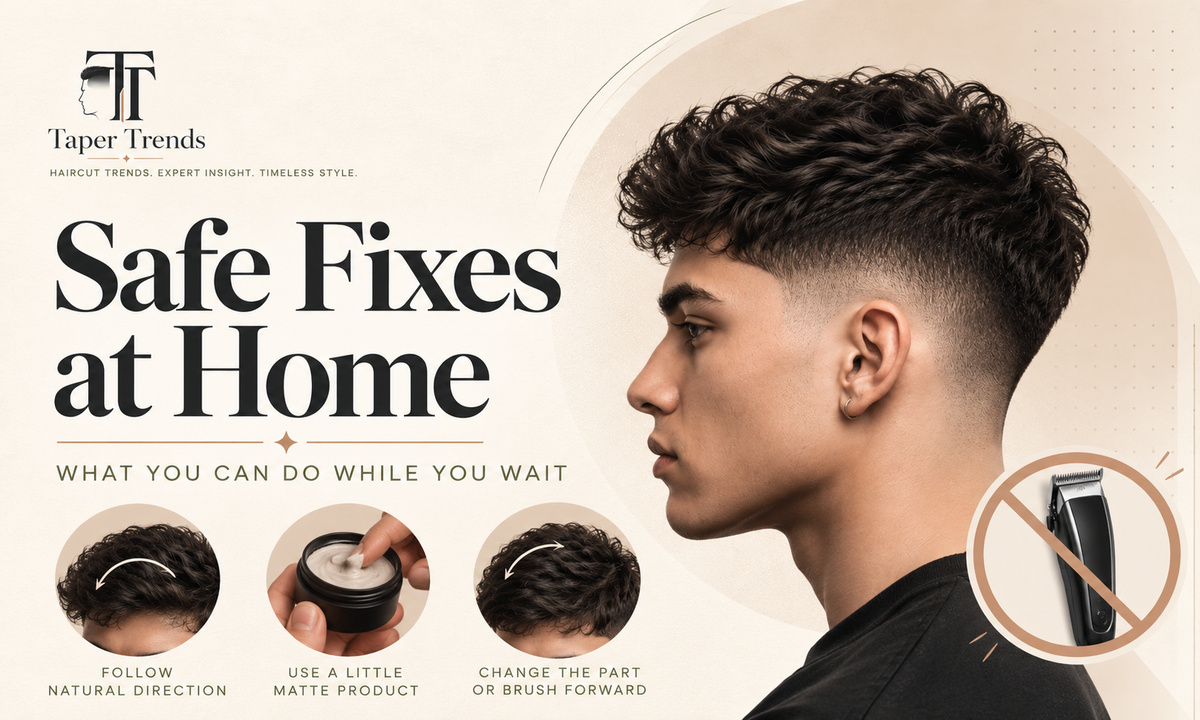
Style the longer hair naturally, use a little of a product you already own, and leave the clippers in the drawer. Everything you do at home changes appearance, not length.
- Style with the grain. Let longer hair fall in its natural direction.
- Try a matte product, sparingly. Markcutit suggests a matte clay or texture powder to break up choppy lines, and a heavier pomade to lay down a patch that sticks out.
- Change your part or brush the front forward to move attention elsewhere.
- Skip the all-day hat. The same Markcutit guide warns that wearing one all day can flatten a fade and irritate the neck.
Whatever you do, do not chase a visible band with a shorter guard. Camouflage buys time. It does not correct the cut. Our how to style a low taper fade routine covers products and technique by hair type, and low taper fade for thin or thick hair explains how density changes what a blend shows.
Should you wait, reblend the fade, or get a shorter haircut?
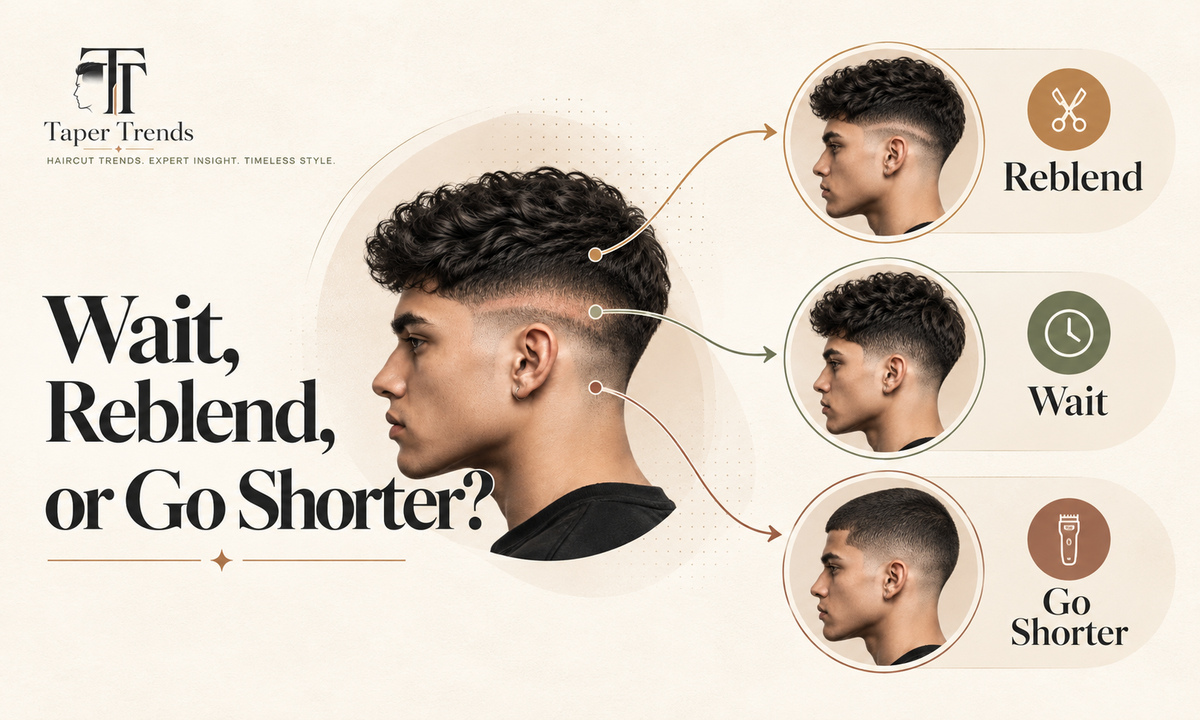
Choose based on what went wrong and how much length you can spare. Reblend when a line or side imbalance still has hair to work with, wait when the fade sits too high or a patch went too short, and go shorter only if you would genuinely enjoy that style anyway.
| Option | Choose it when | Limitation |
|---|---|---|
| Reblend | A line, shelf or small imbalance remains and you accept some length loss | The fade may end up shorter or higher |
| Restyle | You want a short-term improvement with no more cutting | The lengths underneath stay the same |
| Recut shorter | You already like a shorter style | Removed length cannot be returned |
| Grow out | The fade sits too high or an area was cut too short | The in-between stage can look unfinished |
Markcutit's advice on the shorter option is blunt and sensible: only buzz it all off if you like the idea of a buzz cut anyway. A buzz cut resets everything but takes the length you would otherwise keep. If that sounds appealing, see the low taper fade buzz cut, mid taper fade buzz cut and high taper fade buzz cut guides for versions that keep a little blend.
If you would rather keep the length and change the shape, the what a low taper fade looks like guide and the low taper vs low fade comparison are quick ways to picture a lower or softer direction before the next appointment.
How long does a bad fade take to grow out?
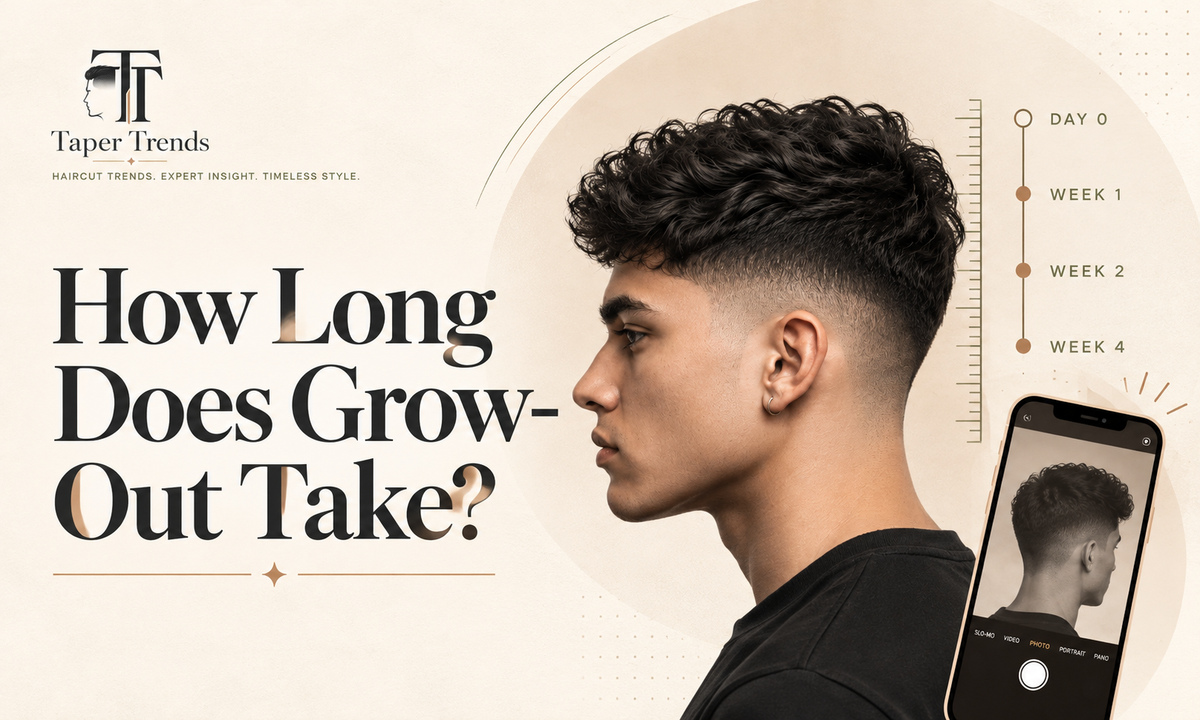
There is no reliable timeline for a bad fade to grow out. Scalp hair grows about 1 centimeter per month during its growth phase, according to Cleveland Clinic, but getting the shape back depends on how much was removed, the length that remains, your hair texture and the style you choose next.
Growth and recovery are separate questions. Recovery happens when a barber has enough length to rebuild the transition you want, and a low fade usually needs less regrowth for that than one cut far higher than requested. If you decide to wait it out rather than re-cut, our guide on how to grow out a fade covers the plan.
Photograph the same angles in the same light on day 0, then at week 1, week 2 and week 4. Treat those as checkpoints for comparison, not promised milestones. Book a reassessment once the shorter area has visibly caught up with the hair around it. Our how often should you get a haircut guide covers grow-out pace by style, and taper haircut shows how a softer cut stretches the time between visits.
What should you tell your barber to fix a bad fade?
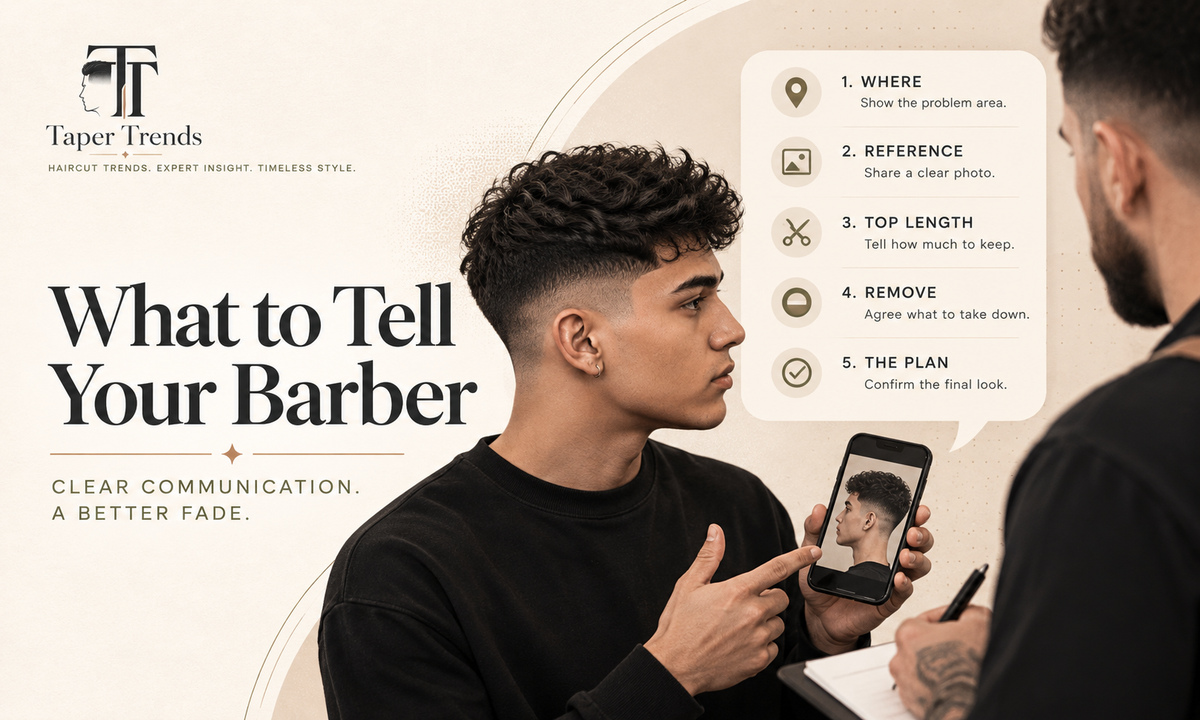
Tell your barber where the problem is, what you want to keep, and how much length you would give up. Plain language works better than technical terms, and the plan should be agreed before any hair comes off. For example:
“The left side of my fade sits higher than the right, and there's a visible line above my ear. I want to keep as much length as I can. What would a correction take off, and what would you suggest if I waited instead?”
Before you sit down, make sure you have covered five things:
- Where the problem is.
- A reference photo of the shape you wanted.
- The length you want to preserve, especially on top.
- What the correction would remove.
- A plan you both agree on.
Keep expectations realistic about that reference photo. Straight 8 Barbers points out that a photo shows the general shape you like, but your texture, growth and existing cut mean it cannot guarantee an identical result. For wording that works at the chair, how to ask for a fade breaks down height, finish and top length, haircut numbers translates guide sizes, and the barber brief generator turns it all into a card you can show. If the result still falls short, see how much to tip your barber when you are unhappy with a cut.
How can you avoid getting another bad fade?
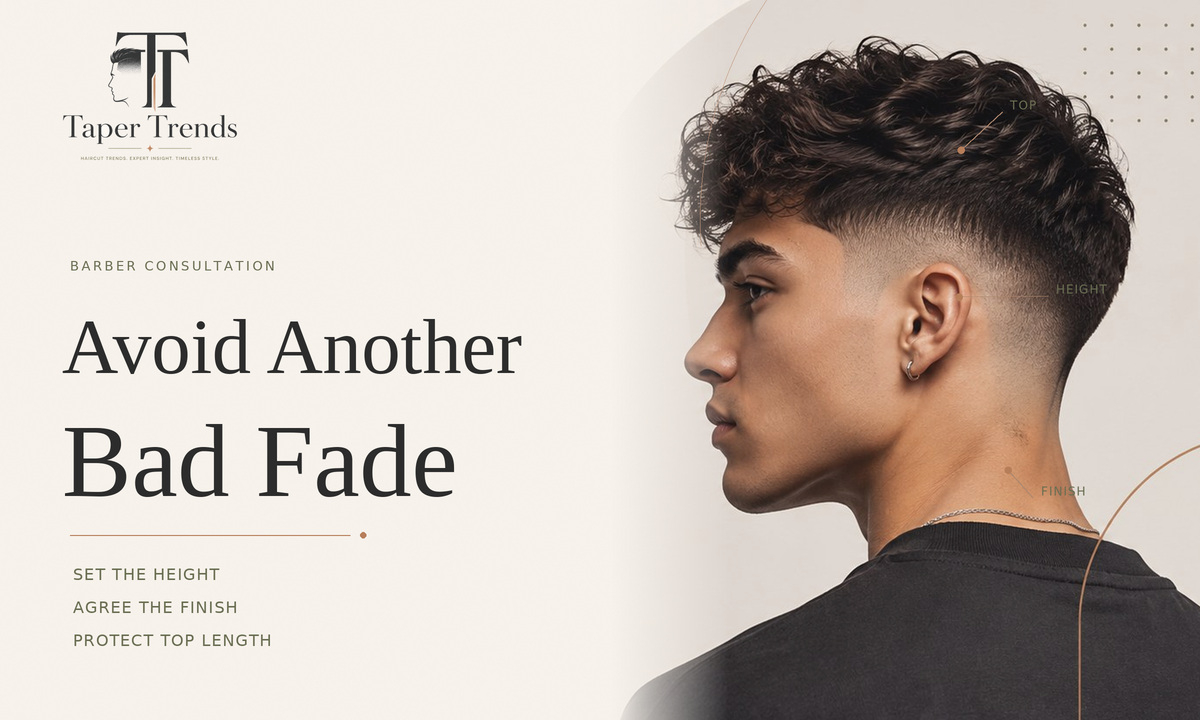
Avoid a repeat by specifying the fade's height, its shortest length and the areas that must stay full, then checking the cut before the barber finishes. Wahl explains that low, mid and high fades differ in where the line starts on the sides: a low fade starts close to the ear, a high fade starts much higher, and a mid fade sits between them. Our low vs mid vs high fade guide shows each line on the head.
- Bring reference photos that show the sides and back.
- Name the height, then point to where it should start on your own head.
- Say whether you want a skin finish or a softer shadow at the bottom.
- Name any area that must stay full, such as the top or the temples.
- Look in the mirror before the barber calls it done.
If you are unsure which height to ask for, start with the low taper fade guide, compare the skin fade vs taper fade finishes, and read low vs mid taper fade to settle on a height. Keeping the result sharp is a schedule question, which is where how often to get a haircut helps.
Frequently asked questions about fixing a bad fade
Can styling products hide a harsh fade line?
Partly, and only for a while. A product can change how the longer hair above a harsh fade line lies and make the line less eye-catching, but it cannot restore length or smooth the blend underneath. If you need heavy product every day to hide it, book a barber.
Can you turn a bad fade into a buzz cut or crew cut?
Yes, if you would like a buzz cut or crew cut anyway. Either style evens out a bad fade by removing more hair, so it works as a voluntary reset rather than an automatic fix. Once that length is gone, it only comes back with time.
Why does a fade look uneven in photographs but not in the mirror?
Lighting, camera angle and lens distance can deepen shadows in a fade, so a photo may show unevenness the mirror hides, and the reverse also happens. Compare both sides from equivalent angles in the same light before deciding the fade needs more cutting.
Does every light patch in a fade mean the barber made a bald spot?
No. Natural density, scalp visibility and lighting can make one area of a fade look lighter even when the lengths are even. Check the spot from several angles in daylight, then ask a barber to look at it before assuming it is a cutting mistake.
Can a barber fix the fade without cutting the top?
Sometimes. When the problem sits on the sides or back and enough length remains, a barber can keep the correction there and leave the top alone. A bulky shelf may need slight shortening where it meets the top, so say early that top length matters to you.
What should you do if you need a bad fade fixed before an important event?
Book a professional assessment as early as you can, and skip any rushed DIY fix. Tell the barber the event date and the most length you are willing to lose. Markcutit says a patchy blend or an obviously lopsided side can usually be fixed the same week.
For more on the styles mentioned above, the low taper fade buzz cut guide covers the reset option, and how to cut a fade explains the lever and guide work behind every blend.
Final takeaway: correct the problem without creating another one
The right fix depends on what hair remains, and every extra pass removes options. Decide how much length you would trade for a cleaner blend, then take plain-language notes and clear photos to a barber before any more hair comes off. Your next step today is simple: photograph the problem in daylight and book an assessment.
Keep going: fade guides worth reading next
A bad fade is easier to avoid, and easier to fix, once you know how each cut is built. These guides cover the cuts themselves, the textures they work on, and what to ask for.
- How to cut a fadeThe guarded step-by-step method, and what it looks like when each blend goes right
- How to ask for a fadeThe details to give a barber so the next cut matches what you pictured
- Low taper fade guideThe pillar guide to the gentlest fade, and the one with the most room to recover
- Types of fade haircutsEvery fade by height and finish, so you can name exactly what you wanted
- Different kinds of fadesThe fade overview, with the terms barbers use
- Haircut numbersWhat each clipper guard leaves, so you can talk lengths with your barber
- How often to get a haircutGrow-out pace by style, and when a visit is worth booking
- Taper vs fadeA taper keeps more hair, which makes it the more forgiving reset
- Taper fadeThe broad guide to the blend itself
- Taper haircutA cleanup that only touches the sideburns and neckline
- Low taper vs low fadeThe same height, two very different amounts of short hair
- Low vs mid taper fadeHow much height each start line takes on
- Low vs high taper fadeWhy a higher start line leaves less room to correct
- Mid taper fadeThe in-between height, and how it blends
- High taper fadeThe start line with the least room for error
- Skin fadeBare-skin finishes, and why they show every flaw
- Skin fade: low, mid, highWhere a skin fade starts, and what each height exposes
- Shadow fadeA softer bottom that hides small blending flaws better than skin
- Skin fade vs taper fadeContrast, upkeep, and which finish forgives mistakes
- Temp fadeA blend at the temples only, a smaller area to get wrong
- Drop fadeA fade that curves down behind the ear
- Burst fadeThe curved fade around the ear, and why it is a barber job
- What a low taper fade looks likeA clear picture of the target before you ask for a correction
- How to style a low taper fadeStyling that works with the hair you have while a fade settles
- Low taper fade buzz cutIf a reset to short suits you anyway
- Curly low taper fadeHow curl pattern changes the way a fade reads
- Low taper fade for afro hairJudging a fade on coily texture
- Skin fade on curly hairWhere a tight finish and curls need extra care
- Low taper fade with a beardThe sideburn-to-beard blend, and where it goes wrong
- Low taper fade for thin or thick hairHow density changes what a blend looks like
The bottom line
Put the clippers down, name the problem, and find out how much hair is left to work with. A barber can blend a line, balance a side or take down bulk. Nobody can add hair back.
Agree what the correction will cost before the first cut, and let the rest grow.
Want more haircut guides?
Browse clean, barber-ready breakdowns for every hair type.