Barber termsare the words barbers and clients use to describe how much hair stays, where it blends, how the edges are shaped, and how the finished cut is styled. You don't need all of them. You need enough to say what you want and catch a misunderstanding before the clippers start. “A number 2 on the sides, blended into an inch on top” leaves far less to chance than “short, but not too short.”
The terms below are grouped the way they come up in the chair: fades and guards, techniques, style names, edges, beards, and products, followed by a simple way to turn them into one clear request. If you only want the request part, jump to our guides on how to ask for a fade and haircut numbers, or build a script with the free barber brief generator.
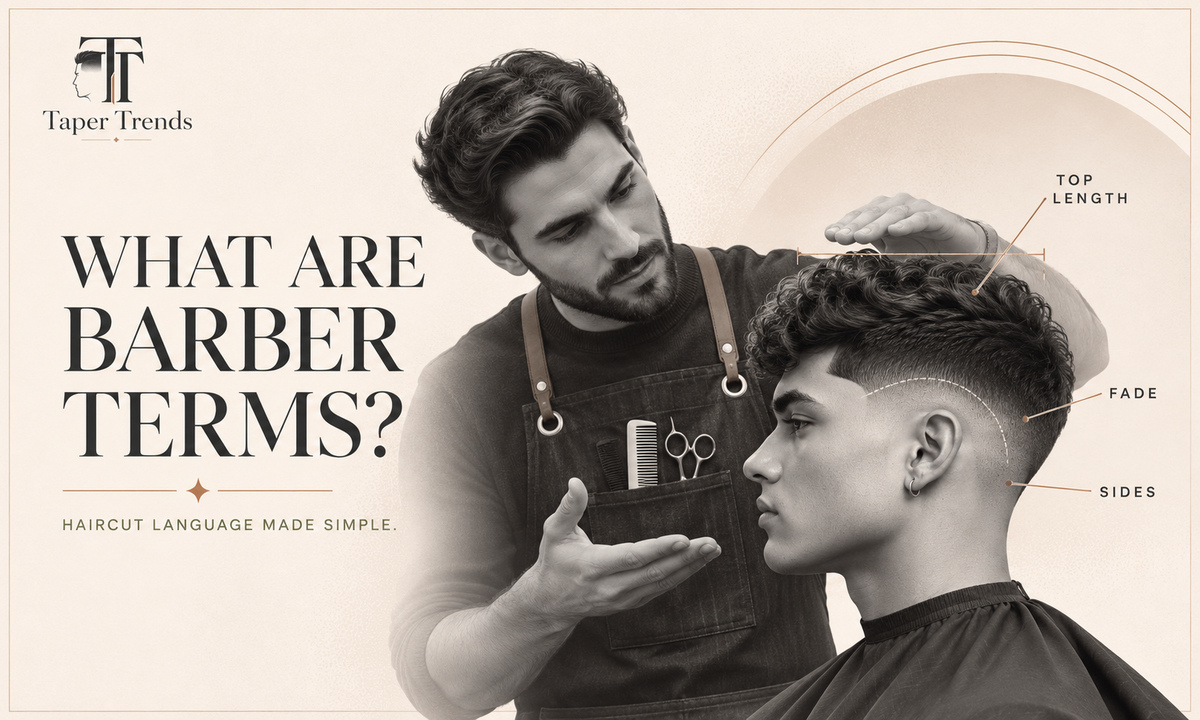
What are barber terms?
Barber terms are the technical and everyday words used to describe haircut length, style, tools, cutting methods, and grooming details. Some come from formal barber training, some are shop slang, and a few mean slightly different things from one shop to the next. Learning the core set helps you explain the cut you want and understand what your barber recommends. Our types of fade haircuts guide and the complete low taper fade guide show how these words turn into real cuts.
Barber terminology vs. barber slang
Terminology is the established language barbers learn in training, such as graduation, scissor-over-comb, and parietal ridge. Slang is shop talk, like “fresh cut” or “clean-up,” and its meaning drifts between shops.
Even standard names travel badly. Barber Waverly Willis told StyleSeat that cuts which look almost identical can carry completely different names locally, regionally, and internationally. When a word could mean two things, describe the result instead of relying on the name. The low taper fade meme is a good example of a haircut name that went well beyond the barbershop.
Fade and taper terms
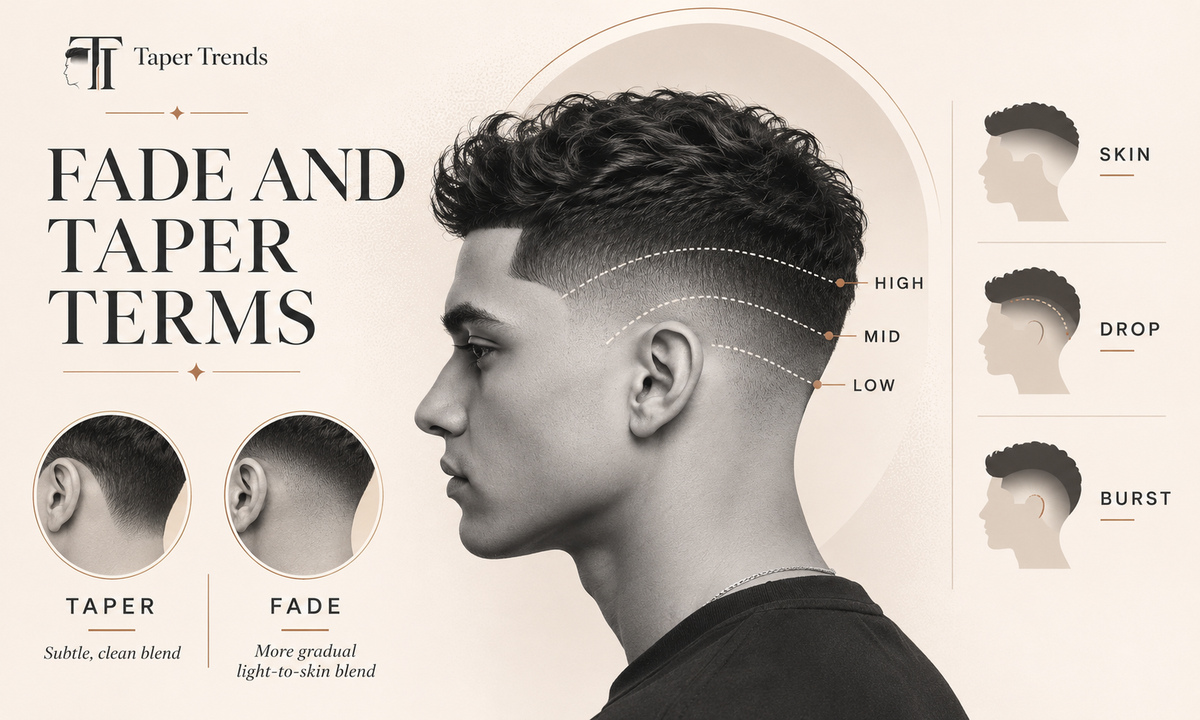
Fades and tapers both shorten hair gradually toward the hairline. Most barbershop mix-ups start here, usually because two separate questions get blended together: where the transition sits, and how short it finishes. For the full breakdown, read taper vs fade, the taper fade guide and different kinds of fades.
Fade vs. taper: what's the difference?
A taper shortens hair gradually toward the hairline and usually stops at a short but visible length, while a fade carries the sides and back down to skin or very close to it. The Art of Manliness puts it neatly: every fade is a taper, but not every taper is a fade.
StyleSeatcalls the taper the more gradual, less dramatic option and notes that many people, barbers included, use the two words interchangeably. That's why it pays to describe the result along with the name. For a side-by-side on the most common pairing, see low taper vs low fade.
| Taper | Fade | |
|---|---|---|
| Shortest point | Short, visible hair | Bare skin or close to it |
| Area affected | Mostly sideburns and neckline | Often more of the sides and back |
| Contrast | Soft | Sharp |
Low, mid, and high fades
Low, mid, and high describe where a fade starts on the side of the head, not how short it gets. Barber school CADMEN Academy places a low fade just above the natural hairline near the ear, a mid fade at about mid-ear height, and a high fade at temple level or above. A high fade can still finish at skin or at a short guard, so name both. Our low vs mid vs high fade guide shows all three side by side. Compare the heights in low vs mid taper fade and low vs high taper fade, or see each on its own in the mid taper fade and high taper fade guides. The taper height diagram shows the three positions on a head.
Skin, drop, burst, and temple fades
“Skin” describes how short a fade finishes. “Drop,” “burst,” and “temple” describe its shape or where it sits.
- Skin fade:the shortest area goes to bare skin. StyleSeat notes it's also called a bald fade. See skin fade and low vs mid vs high skin fade.
- Drop fade: the fade line curves down behind the ear instead of running level. See drop fade and low drop fade.
- Burst fade: the fade arcs around the ear in a half circle, leaving more length at the back of the neck. See burst fade and drop fade vs burst fade.
- Temple fade:the blending sits at the temples and sideburns, often paired with a line-up. Some shops say “temp fade.” See temp fade.
One more word you will hear is the shadow fade, a softer finish that stops short of bare skin. Compare it with the skin version in skin fade vs taper fade.
Clipper and guard terms
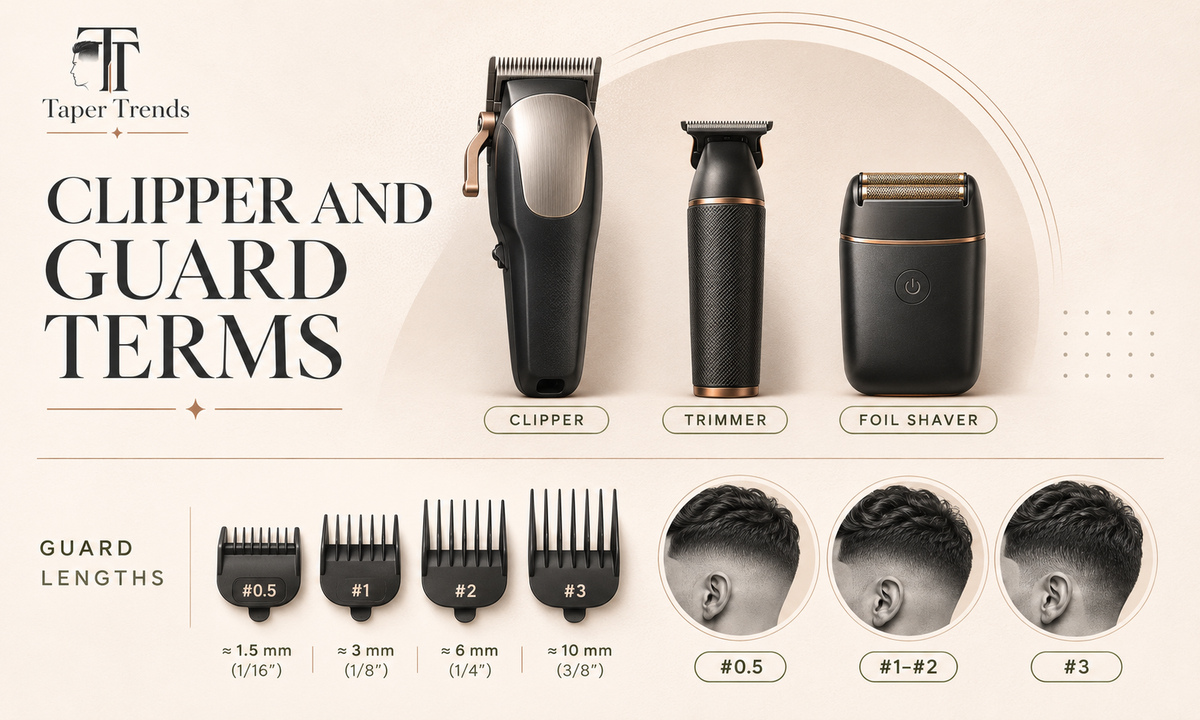
Three things decide how short clipper work ends up: the guard, the blade setting, and the tool. A clipper does the bulk cutting, a trimmer (or edger) handles outlines and line-ups, and a foil shaver gets close enough to finish skin fades. If you are shopping, our best clippers for fades comparison covers blades, taper levers and guards.
A guard, also called an attachment comb, clips onto the clipper blade and holds it away from the scalp so it leaves a set length. Some barbers call the number a “grade,” as in “a grade one.”
What do clipper guard numbers mean?
Clipper guard numbers stand for preset lengths, and higher numbers leave more hair. On standard seven-piece sets such as Andis's snap-on attachment combs, each step from #1 to #4 adds 1/8 inch, and the gaps widen after that. Other brands can label differently, so confirm inches if you switch barbers. Our haircut numbers guide and the clipper guard sizes tool cover the brand differences.
| Guard | Labeled length |
|---|---|
| #0 | 1/16 inch (about 1.5 mm) |
| #1 | 1/8 inch (3.2 mm) |
| #2 | 1/4 inch (6.4 mm) |
| #3 | 3/8 inch (9.5 mm) |
| #4 | 1/2 inch (12.7 mm) |
| #6 | 3/4 inch (19.1 mm) |
| #8 | 1 inch (25.4 mm) |
Treat these as labels, not guarantees. Andis's clipper instructions call the lengths approximate and say blade angle, hair thickness, and texture all change the actual cut. The same guard can look different from one head to the next.
Open, closed, and zero
Zero usually means a very short clipper setting, not a shave. Depending on the shop, it can mean the 1/16-inch #0 guard or the bare blade with no guard. Andis sells its #0 comb at 1/16 inch, while The Modest Man describes #0 as fully exposing the blade, so one word can produce two results.
Many clippers also have a lever: closed is the shortest blade setting and open the longest, and Andis's chart shows each guard leaving slightly more hair with the blade open. If you want bare skin, skip the numbers and say “down to skin.” The same lever is how a barber blends one guard into the next, which how to cut a fade walks through step by step.
Head and hair anatomy terms
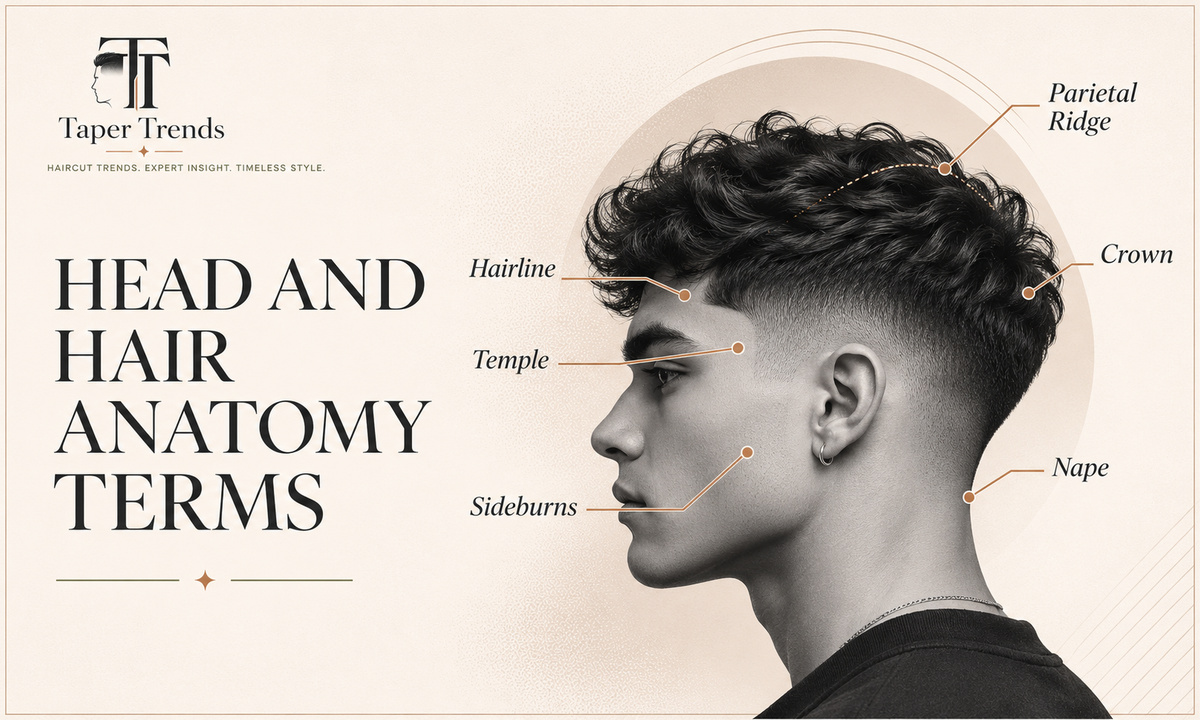
Barbers use landmarks on the head to decide where to cut, blend, and leave weight. Knowing a few lets you point to exactly where you want a change, which helps most when you are asking for a particular low taper or mid taper height.
Crown, nape, temple, and parietal ridge
The crown is the upper back of the head, where hair often grows in a swirl. The nape is the back of the neck, below the bump at the base of the skull. The temples are the flat areas beside the forehead, in front of and above the ears. The parietal ridge is the widest part of the head, where the top curves into the sides, and many blends finish around this line. Head shape changes which fade looks best, so see the best fade for your face shape and try the face shape detector.
Hairline, sideburns, cowlick, and growth pattern
Your hairline is the edge where hair meets the forehead, temples, ears, and neck, and sideburns grow in front of each ear. A cowlick is a patch that grows in a different direction from the hair around it, while your growth patternis the overall direction your hair grows. Mention a cowlick before the cut starts, since it changes how a section lies once it's short. A changing hairline calls for its own approach, covered in haircuts for a receding hairline, and hair type matters too, so check the hair type chart or take the hair type quiz.
Cutting and blending techniques
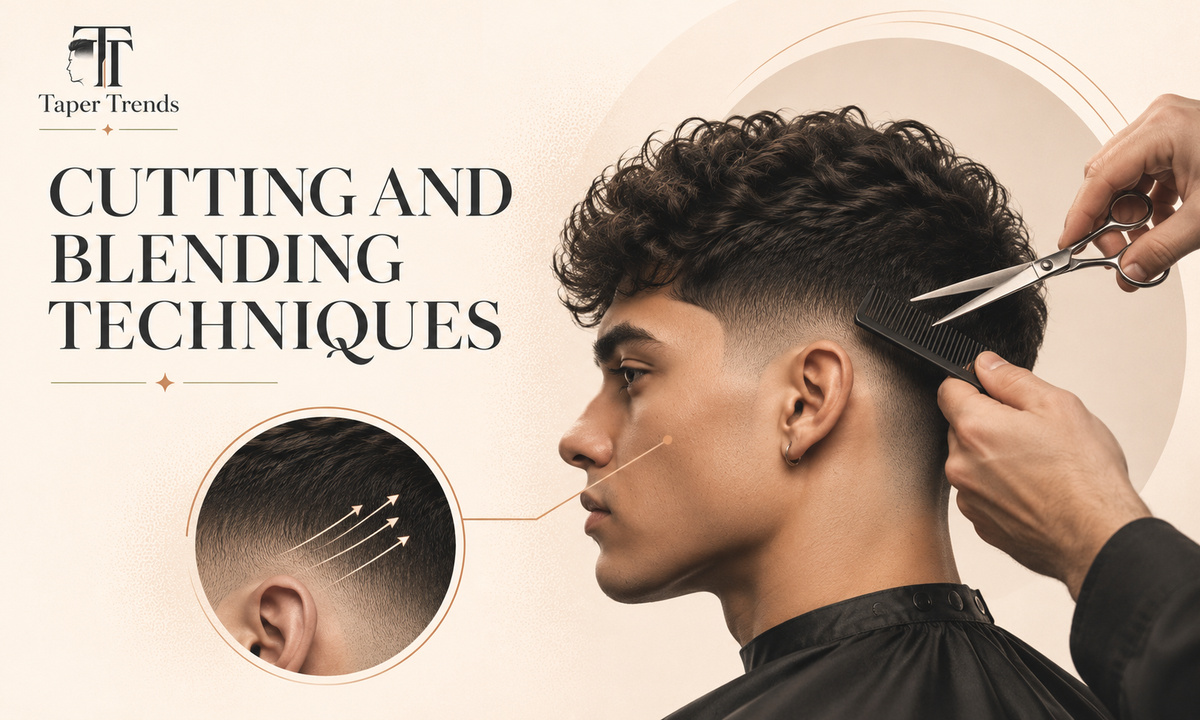
Barbers make two kinds of decisions as they work: which tool controls the length, and how the different lengths connect. When the connection goes wrong, our how to fix a bad fade guide explains what a barber can correct.
Scissor-over-comb vs. clipper-over-comb
Both lift hair with a comb and cut what sits above it. Scissor-over-comb uses shears, which StyleSeatsays gives a softer look, while clipper-over-comb helps hair look even as it grows out. A “clipper cut” means most of the work is done with clippers and guards (the full scissor cut vs clipper cutcomparison breaks down which suits which hair). If you want short sides that don't look buzzed, ask about shears. It is also the technique behind a gentle, scissor-shaped low taper on short hair.
Blending, graduation, layering, and disconnection
| Term | What it means |
|---|---|
| Blending | Smoothing the transition between lengths so no hard line shows |
| Graduation | Building length gradually, shorter below and longer above, to create weight |
| Layering | Cutting sections at different lengths for volume and movement |
| Disconnection | Leaving a deliberate, visible break between short and long hair |
A blended cut is what most people mean by a fade. A disconnected cut is what you get with an undercut or a low taper fade mohawk, where the contrast is the point.
Point cutting, texturizing, and thinning
Point cutting means snipping into the ends with the tips of the shears to soften a blunt line. Texturizing is the broader goal of cutting at varied lengths for dimension, and thinning uses thinning shears to remove bulk so hair lies flatter. StyleSeat warns that point cutting can turn dramatic if a lot of hair comes out, so say how much movement you want. These are the tools behind a textured fringe and the answer to heavy hair in low taper fade for thin and thick hair.
Common men's haircut names
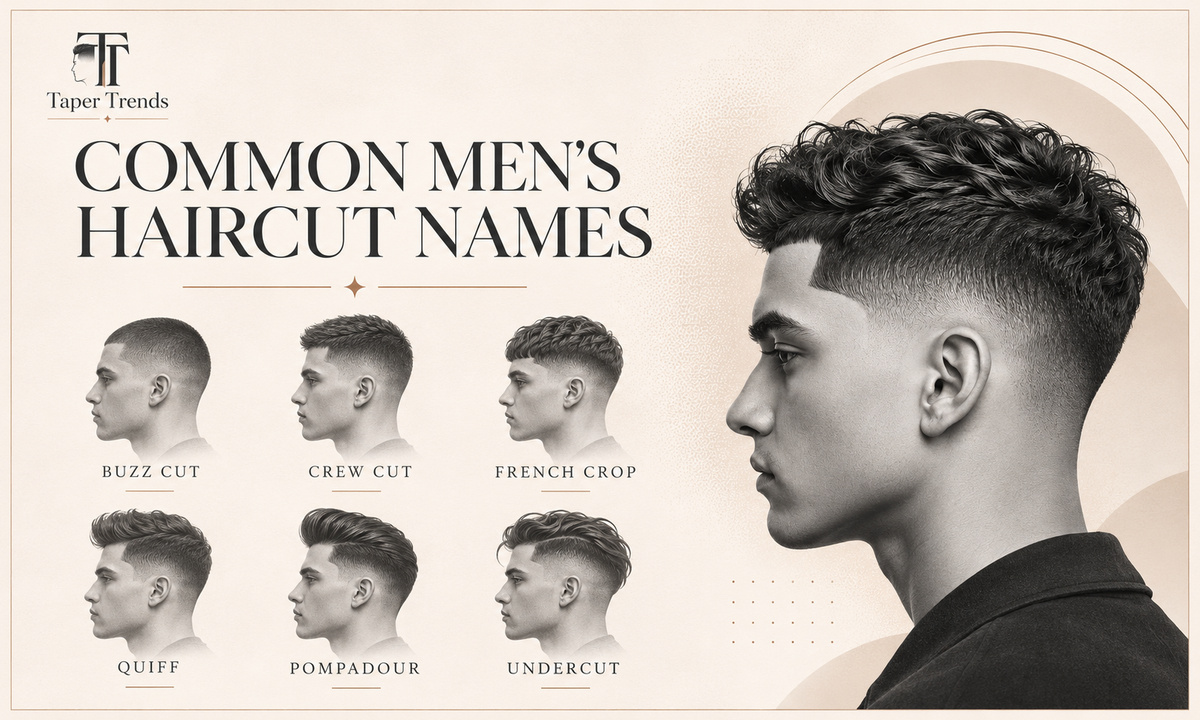
A haircut name describes the finished look; a technique describes how it's made. Most cuts below pair faded or tapered sides with a different amount of hair on top, and exact lengths vary by shop, so confirm the top length in inches.
Buzz cut, crew cut, Ivy League, and high and tight
A buzz cut is clipped close all over, often at one length, and pairs well with a fade; see low taper fade buzz cut and high taper fade buzz cut. A crew cut has tapered sides and about an inch on top. An Ivy League leaves enough length to comb into a side part and, per StyleSeat, also goes by Princeton or Harvard clip; the side part low taper fade is the modern take. A high and tight keeps a couple of inches on top with sides usually faded to skin, close to a high taper fade.
French crop, Caesar cut, and undercut
The French crop pairs short sides with a textured top pushed forward into a fringe; see the French crop low taper fade and low taper fade with a fringe. A Caesar cut is shorter and more uniform on top, with a short, straight fringe. An undercut is defined by contrast: short sides and back, usually disconnected from a longer top. Our undercut vs fade guide shows where the two differ.
Quiff, pompadour, and other top styles
A quiff is brushed up and back, while a pompadour has more length and volume combed back and, StyleSeat notes, needs more product. A slick back is combed straight back close to the head; see low taper fade slick back. A comb-over leaves enough length to comb to one side, often with a fade or hard part; see low taper fade comb over and the middle part version. A faux hawk keeps roughly three inches on top to push up into a ridge, and a flat top stands up in a level, usually square shape. Longer, lifted tops are covered in blowout taper fade and the low taper fade mullet.
Hairline, neckline, and edge-up terms
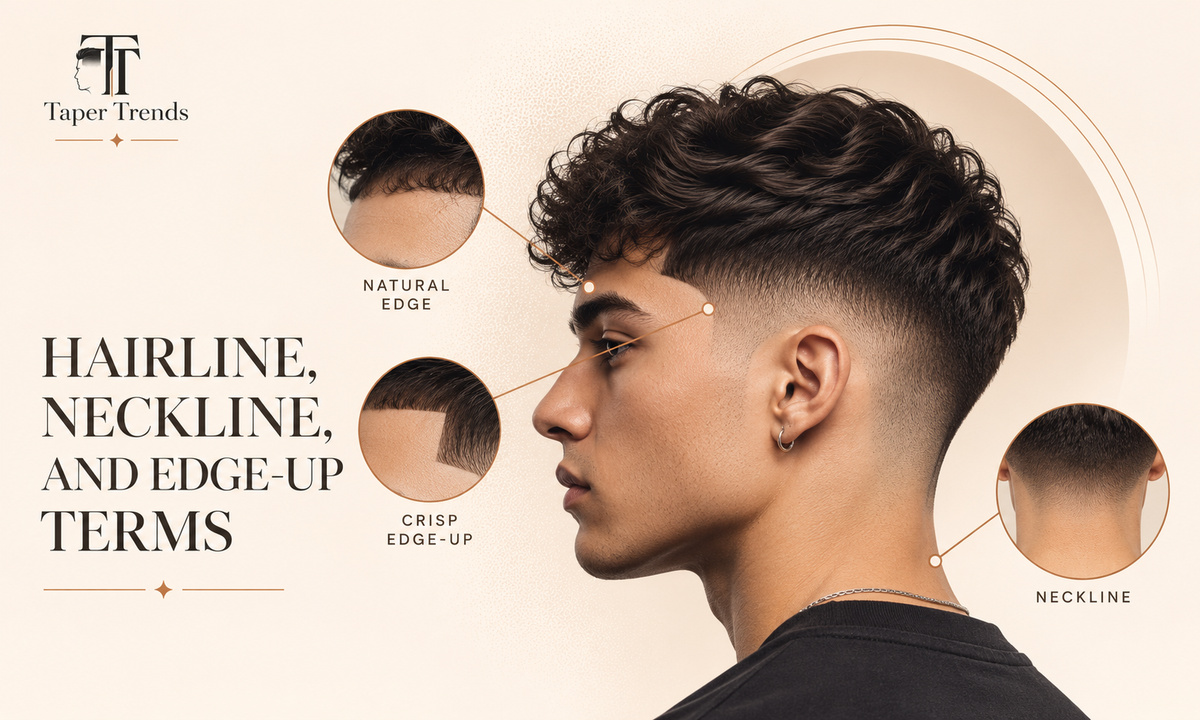
Edge work is the finishing detail around the hairline and neckline. It decides how sharp a cut looks on day one and how soon it looks grown out, which is why it drives how often you need a haircut.
Line-up, shape-up, edge-up, and hard part
A line-up straightens the natural hairline into crisp edges at the forehead, temples, and sideburns, and most shops treat shape-up and edge-up as other names for it. A hard part is a part line shaved in with a razor or clippers; StyleSeat notes it grows back quickly. You can also choose the arch, the space between ear and hairline, which can follow your natural line or sit slightly higher. Fancier edge work, such as a shaved line or pattern, is covered in low taper fade design and low taper fade with design.
Tapered, rounded, and blocked necklines
The neckline is the shape hair forms at the nape. A tapered neckline fades into the skin and grows out most naturally. A rounded neckline curves the corners, and a blocked (squared) neckline creates a straight border. Both StyleSeat and The Modest Man say rounded and blocked necklines need more frequent touch-ups. If you plan to let a cut grow, a tapered neckline is the friendliest, as how to grow out a fade explains.
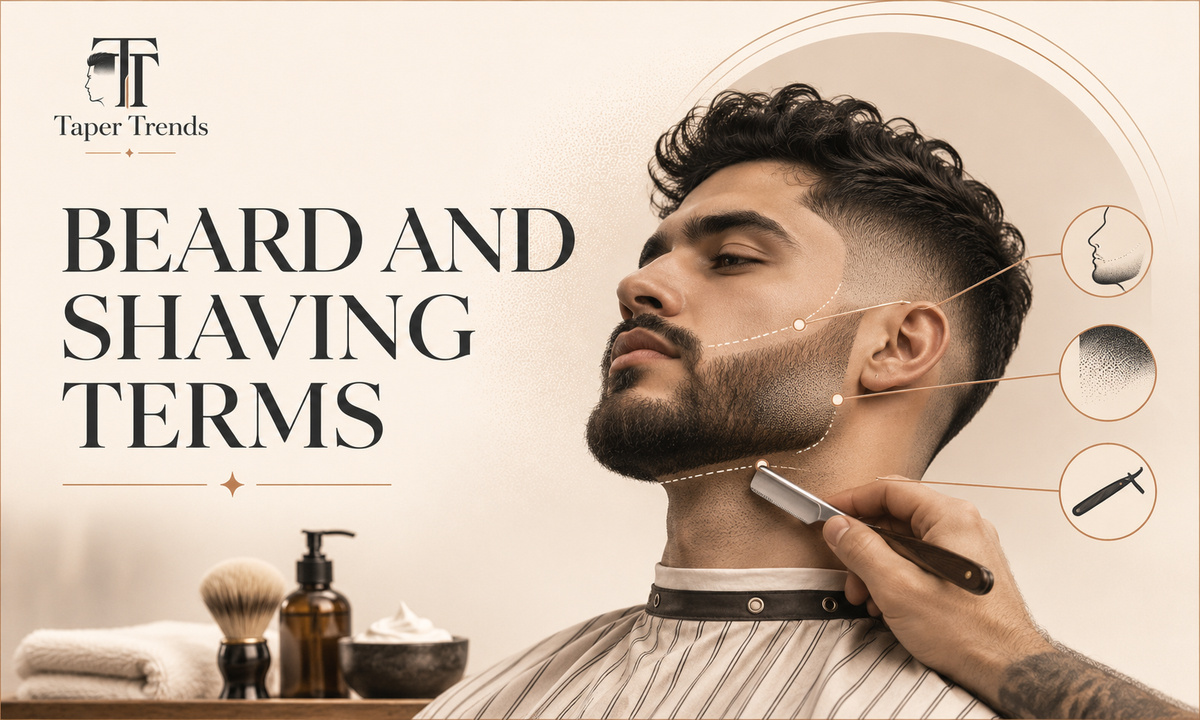
Beard and shaving terms
Facial hair terms cover how a beard is shaped and how skin is shaved. Service menus vary, so ask what each service includes. For beard pairings with specific fades, see low taper fade with a beard, mid taper fade with a beard, high taper fade with a beard, skin fade with a beard and drop fade with a beard.
Beard fade, beard line-up, and cheek line
A beard fade shortens the beard gradually where it meets the sideburns. A beard line-up sharpens its edges: the cheek line on top and the beard neckline under the jaw. Say whether you want those lines natural or crisp.
Straight razor, shavette, hot towel shave, and neck shave
A straight razor is an open blade for close shaving, and a shavette is the same shape with a disposable blade. In a hot towel shave, the barber wraps a hot towel around the beard, for about a minute according to StyleSeat, to soften the hair first. A neck shave removes stray hair below the neckline.
Sanitation rules differ by state. California's Board of Barbering and Cosmetology rules require clippers to be disinfected before each use and any tool that touches a client but can't be disinfected to be thrown away after that client. Asking for a fresh shavette blade is reasonable anywhere.
Styling and product terms
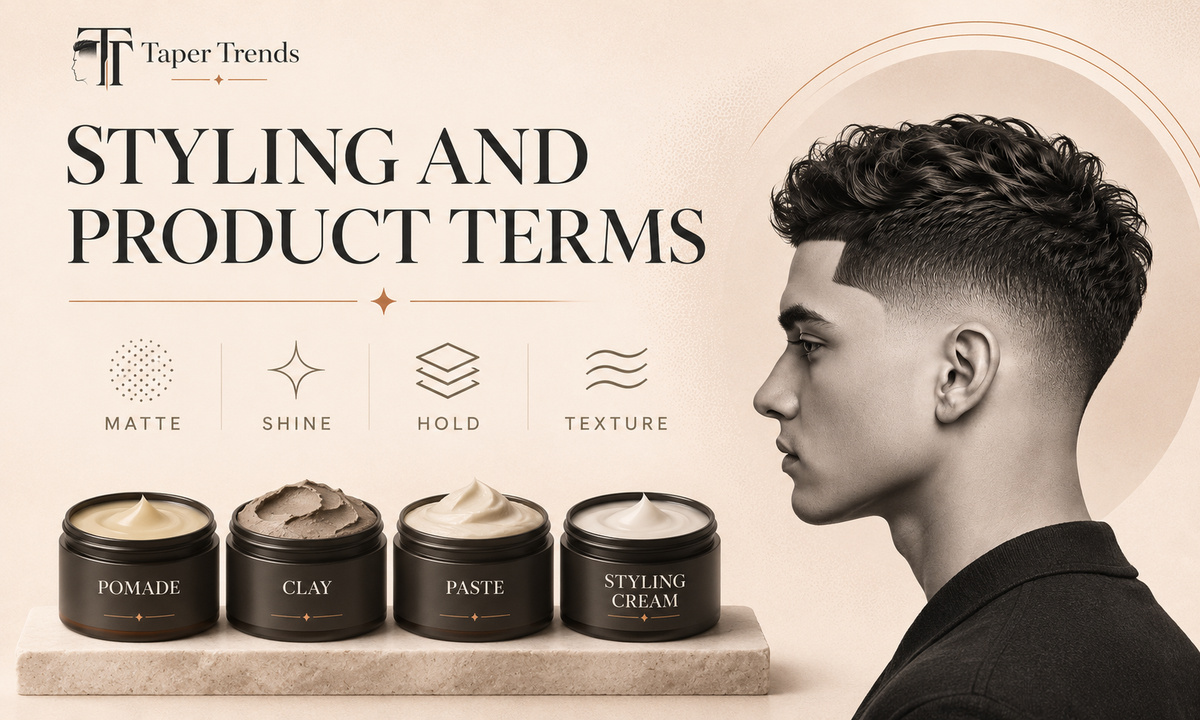
Styling terms let you ask for a result instead of a brand. For product picks by hair type, see best hair products for fades and how to style a low taper fade.
Matte, shine, hold, and texture
Matte and shine describe finish, hold describes how firmly a product keeps hair in place, and texture describes visible separation and grip. Hold and shine are separate dials: Suavecito, for example, sells a clay with strong hold and low shine.
Pomade, clay, paste, and styling cream
These are broad categories, and formulas vary. In a Daily Hive piece sponsored by American Crew, barber Pete Goupil describes clay as giving a natural, messy look, pomade as sleek and shiny, and paste as thicker than pomade with a matte finish that usually washes out easily. Suavecito adds that shine varies among pomades.
| Category | Usually chosen for |
|---|---|
| Pomade | Sleek, defined styles with shine |
| Clay | Textured, natural looks with a matte finish |
| Paste | Natural looks with a low-shine finish |
| Styling cream | Light, flexible control |
Wavy and curly hair usually wants a different product mix; see low taper fade for wavy hair, curly low taper fade and low taper fade afro.
Commonly confused barber terms
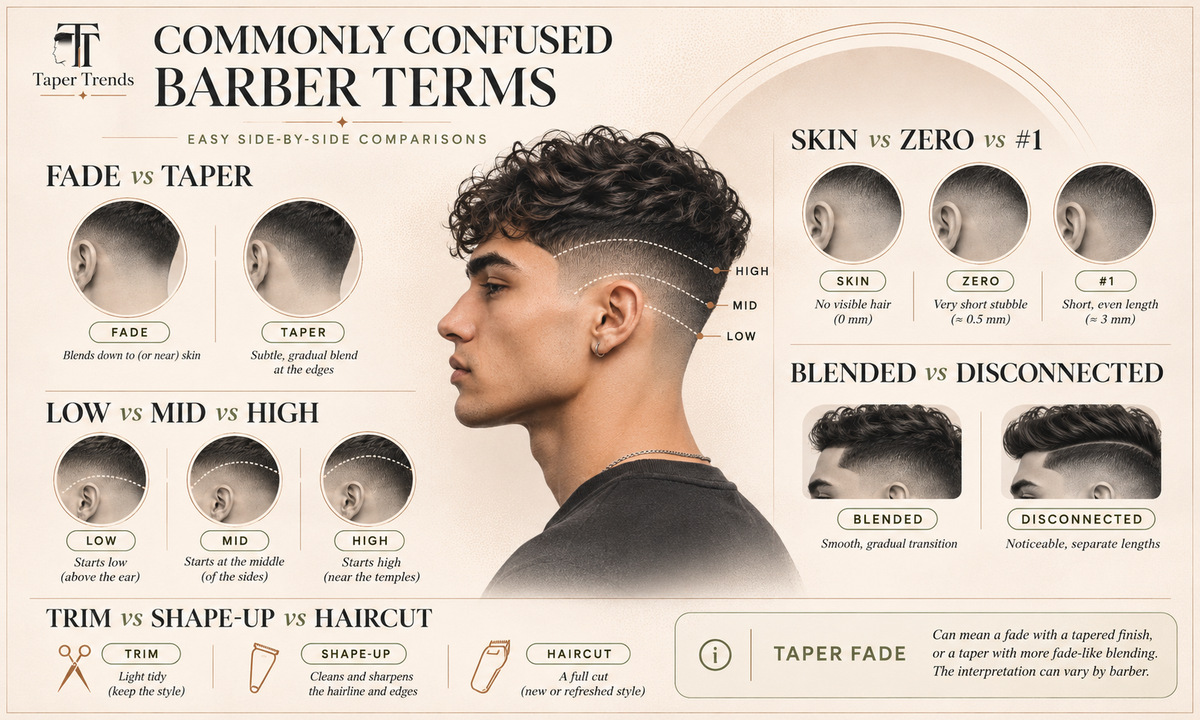
Most mix-ups happen because similar-sounding terms answer different questions.
| Term | Question it answers |
|---|---|
| Fade, taper | How do the lengths transition? |
| Skin, zero, #1 | How short is the shortest point? |
| Low, mid, high | Where does the transition start? |
| Blended, disconnected | Is the transition smooth or deliberate? |
| Trim, shape-up, haircut | Which service am I booking? |
“Taper fade”: a term sources disagree on
“Taper fade” has no single agreed meaning. The Art of Manliness argues there's no such haircut, StyleSeat says it isn't a specific style and you'll likely get a taper, and CADMEN's glossary uses it both for a fade that stops just short of skin and for one that ends at skin. Whenever you say it, add the shortest point: “taper fade, down to skin” or “taper fade, stop just short of skin.” Our taper fade and what a low taper fade looks like pages show the usual result, and burst fade vs taper fade shows how a third name fits in.
Trim vs. shape-up vs. full haircut
A trim removes some length while keeping the shape. A shape-up only cleans the edges, which CADMEN describes as sharpening the hairline without significantly shortening the hair. A full haircut reshapes the top, sides, and back. CADMEN puts a full cut at 30 to 45 minutes and a shape-up at 10 to 20, and some shops include the shape-up while others sell it separately. Tip on the combined price of whatever is on the ticket, as our guide to how much to tip your barber explains. Use the haircut frequency calculator to plan how often each one fits your style.
How to tell your barber exactly what you want
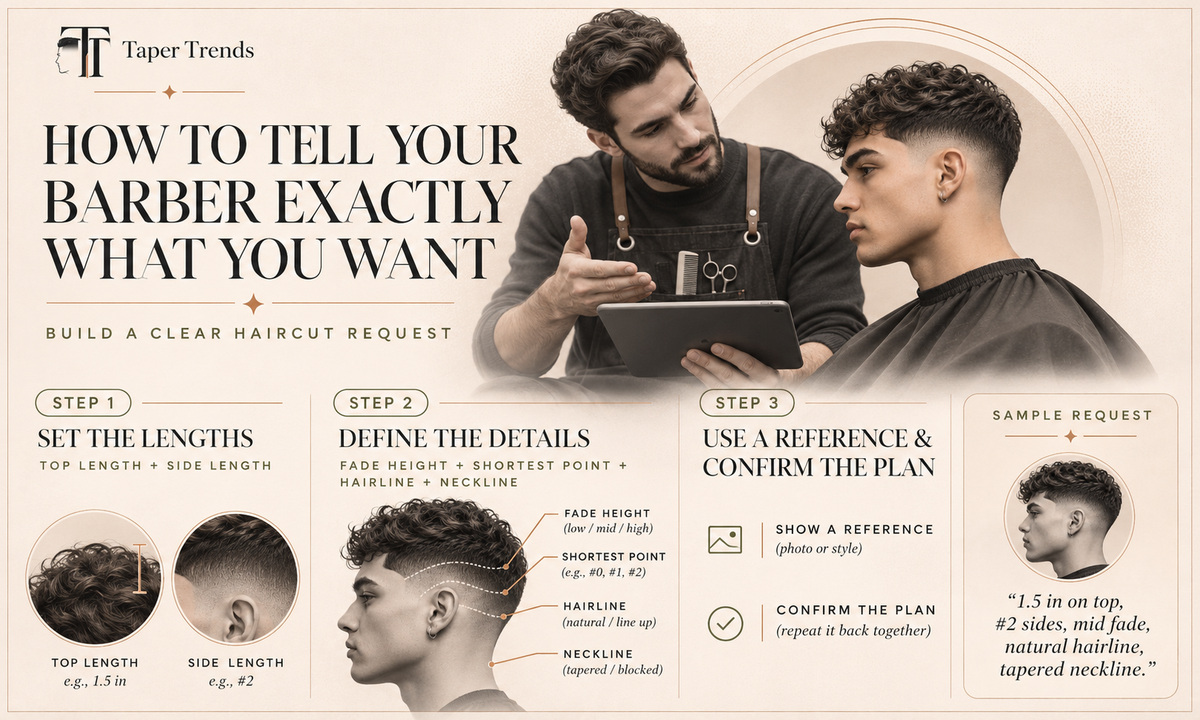
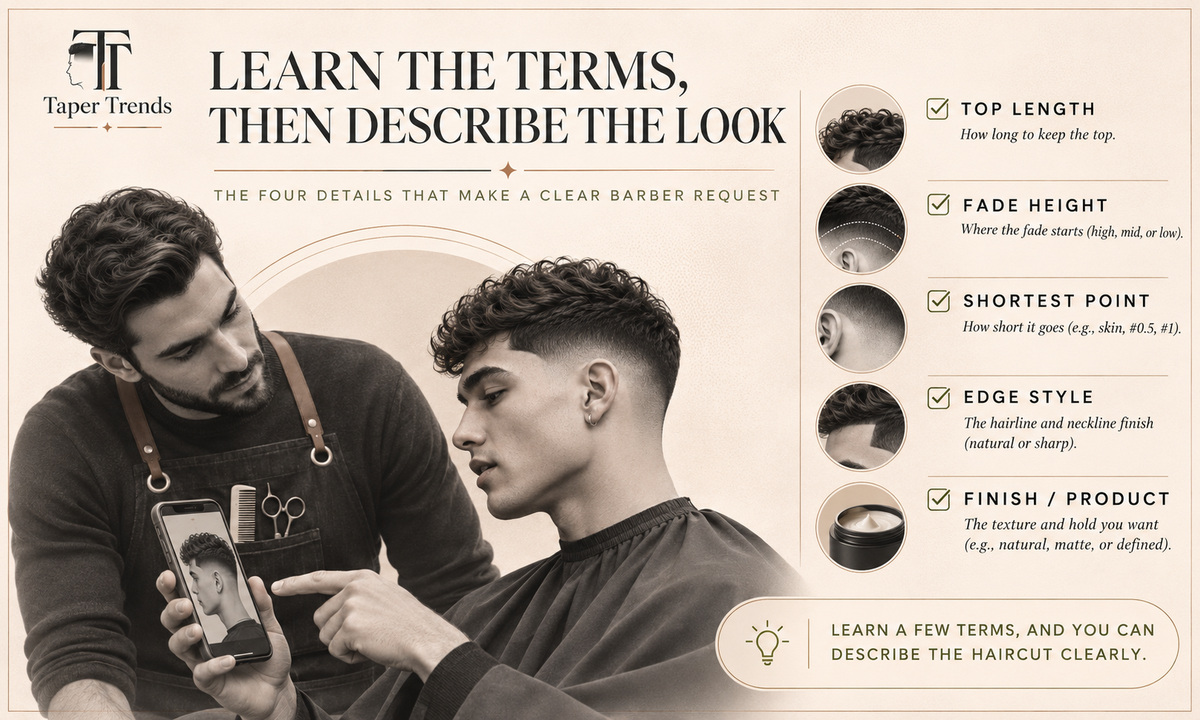
The clearest haircut requests cover four things: top length, how the sides are cut, how the edges are finished, and how you'll style it. Add a reference photo, then ask your barber to repeat the plan back before the first pass. The how to ask for a fade guide has word-for-word scripts, and the barber brief generator builds one for you.
Step 1: Describe the top and side lengths
Give measurements, not adjectives. The Modest Man suggests describing length in inches, saying how you want the hair to feel, and using a guard number for the sides. Pall Mall Barbers adds that telling your barber how long it's been since your last cut helps them work efficiently. Check the numbers in haircut numbers first.
Sample request: “About an inch and a half on top, with a #2 on the sides.”
Step 2: Specify the fade, hairline, and neckline
State the fade height, then whether the shortest area should reach skin or stop just short. Finish with a natural or sharp hairline and your neckline shape. Not sure which height suits you? Take the taper quiz.
Sample request: “Mid fade down to skin, natural hairline, tapered neckline.”
Step 3: Use a reference photo and confirm the plan
Choose photos of someone whose hair is close to yours. Pall Mall Barbers warns that a cut shown on very different hair, curly versus straight for example, won't look the same on you. A photo of yourself on a good hair day works too, though The Modest Man notes results still depend on your hair type, hairline, and product. Ask what will look different on your hair. Photos on matching hair are easy to find in straight hair, wavy hair and curly hair guides.
Common barber terminology mistakes to avoid
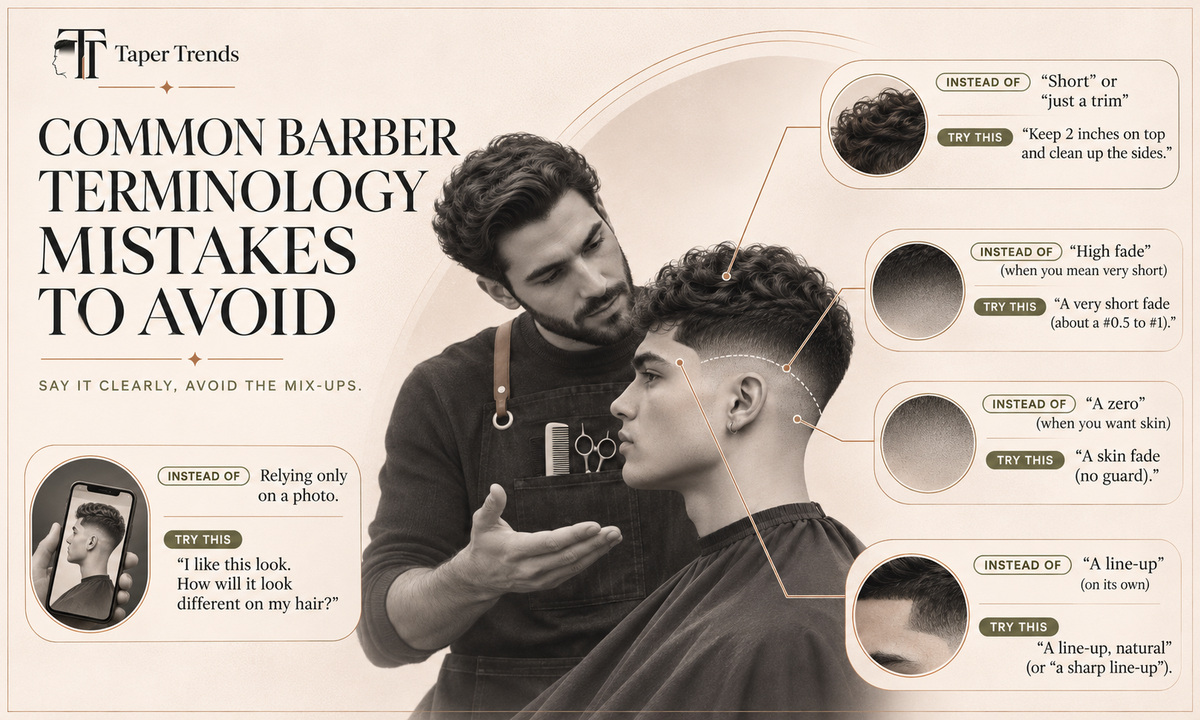
Most terminology mistakes come from using a short word that hides a decision. Swap vague phrases for specifics, and you avoid the haircut you did not ask for. If one slips through anyway, see how to fix a bad fade.
| Instead of saying | Try saying |
|---|---|
| "Just a trim" or "short" | Inches for the top, a guard number for the sides |
| "High fade" when you mean very short | "High fade, stop just short of skin" |
| "A zero" when you want bare skin | "Down to skin" |
| "A line-up" | "A natural line-up" or "a sharp line-up" |
| "Make it look like this photo" | "What will look different on my hair?" |
Frequently asked questions about barber terms
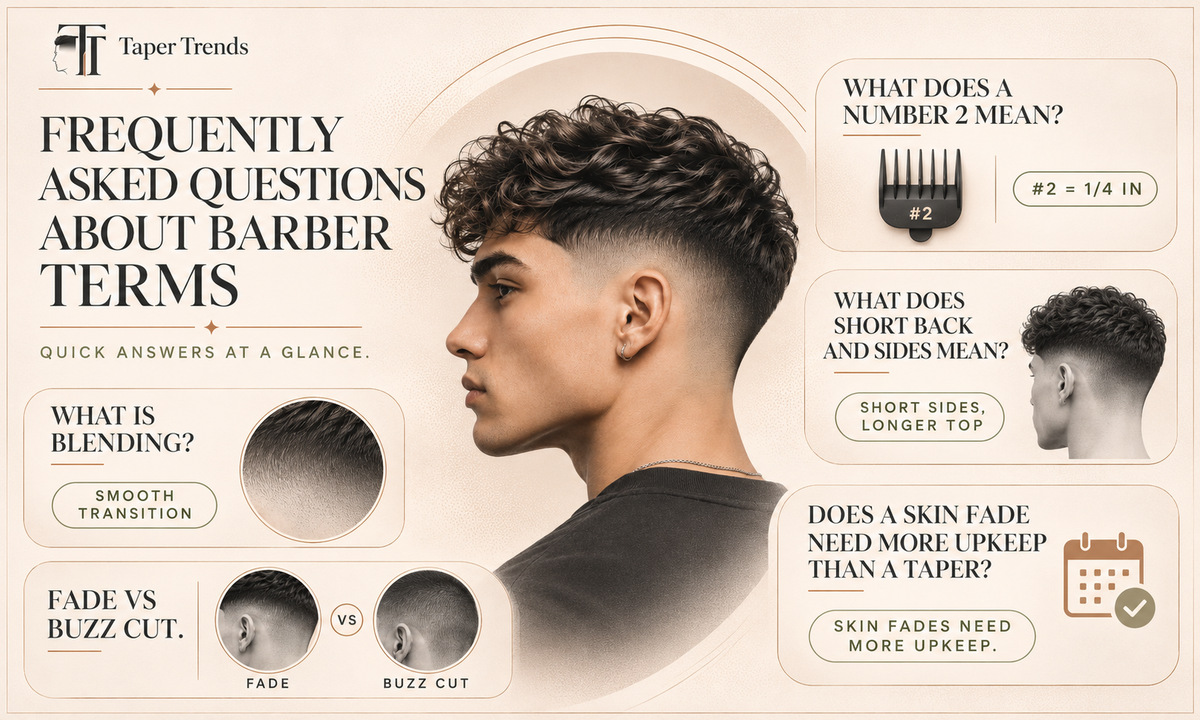
What does a number 2 mean at the barber?
A number 2 is a clipper guard that leaves about 1/4 inch (6.4 mm) of hair on standard American guard sets. The actual length shifts slightly with the brand, the blade setting, and your hair's thickness and texture.
Related: Haircut numbers and guard sizes · Clipper guard sizes tool
What does "short back and sides" mean?
"Short back and sides" means the back and sides are cut short while the top stays longer. StyleSeat calls it a common starting point for many cuts, from crew cuts to quiffs, so follow it with a guard number or fade height and a top length.
Related: How to ask for a fade · Taper haircut basics
What does blending mean in a haircut?
Blending means smoothing the boundary between two lengths so no visible line or step remains. If you notice a hard line after a cut, ask your barber to blend it further. A disconnected cut keeps that contrast on purpose.
Related: How to fix a bad fade · How to cut a fade
What is the difference between a fade and a buzz cut?
A fade is a technique that shortens hair gradually, while a buzz cut is a complete haircut clipped short all over, usually at one length. The two combine easily, so "buzz cut with a low fade" names both the style and the technique.
Related: Low taper fade buzz cut · High taper fade buzz cut · Types of fade haircuts
Does a skin fade need more upkeep than a taper?
A skin fade usually needs touch-ups sooner than a taper, because bare skin next to longer hair shows regrowth quickly. The Art of Manliness notes that fades need regular maintenance to stay sharp, while StyleSeat says a taper leaves more room to grow out.
Related: Skin fade vs taper fade · How often to get a haircut · How to grow out a fade
Learn the terms, then describe the look
The bottom line
You don't need every term here. Pick the handful that describe your cut: top length, fade height and shortest point, edge style, and finish. Shops use some words differently, so when a term could mean two things, ask your barber what they'll actually do.
Before your next appointment, jot down those four details so the conversation takes thirty seconds instead of five minutes.
Keep reading
Fade and taper vocabulary
- Types of fade haircuts
- Different kinds of fades
- Taper vs fade
- Taper fade
- Taper haircut
- Skin fade
- Low, mid and high skin fade
- Skin fade vs taper fade
- Shadow fade
- Temp fade
- Drop fade
- Burst fade
- Burst fade vs taper fade
- Drop fade vs burst fade
- Low taper vs low fade
- Low vs mid taper fade
- Low vs high taper fade
- Low taper fade haircuts guide
- Mid taper fade
- High taper fade
Haircut names and top styles
- Low taper fade buzz cut
- High taper fade buzz cut
- French crop low taper fade
- Low taper fade slick back
- Low taper fade comb over
- Low taper fade mohawk
- Low taper fade mullet
- Low taper fade with a fringe
- Textured fringe with a low taper
- Side part low taper fade
- Middle part low taper fade
- Blowout taper fade
- Low taper fade design
- Low taper fade with a beard
- Skin fade with a beard
Talking to your barber and upkeep
- How to ask for a fade
- Haircut numbers and guard sizes
- How to cut a fade
- How to fix a bad fade
- How to grow out a fade
- How often to get a haircut
- How to style a low taper fade
- Best hair products for fades
- Best clippers for fades
- Best fade for your face shape
- Haircuts for a receding hairline
- What a low taper fade looks like
Want more taper fade guides?
Browse clean, barber-ready breakdowns for every hair type.