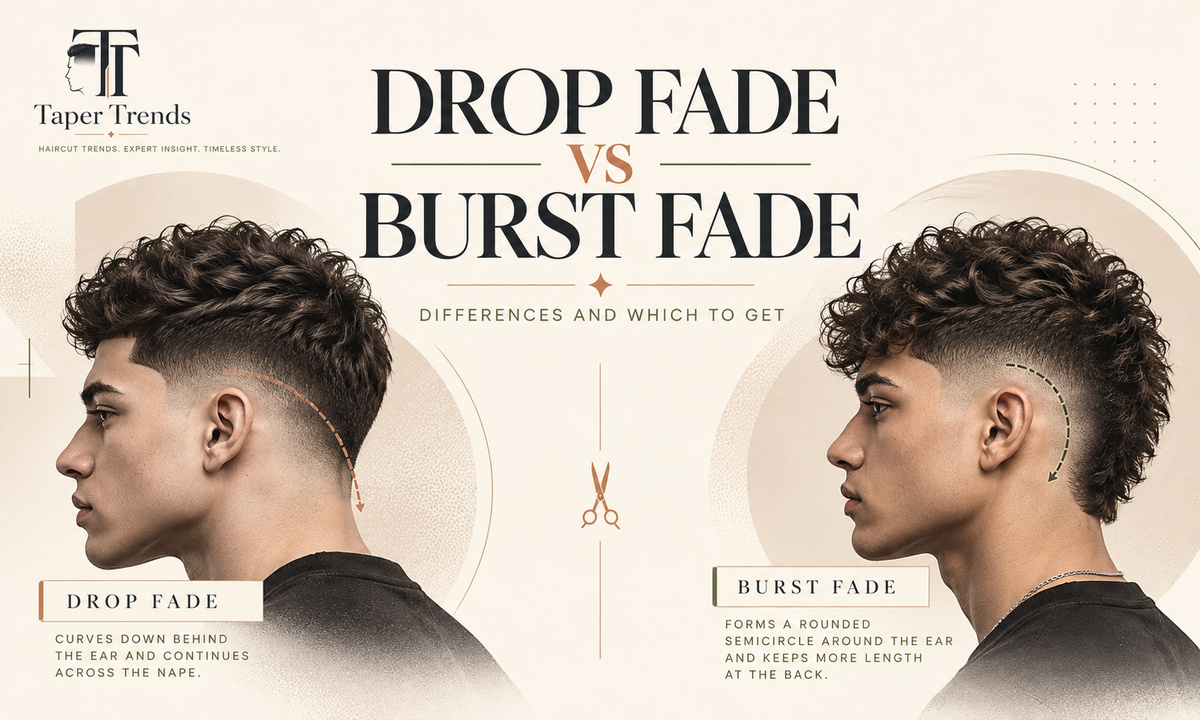
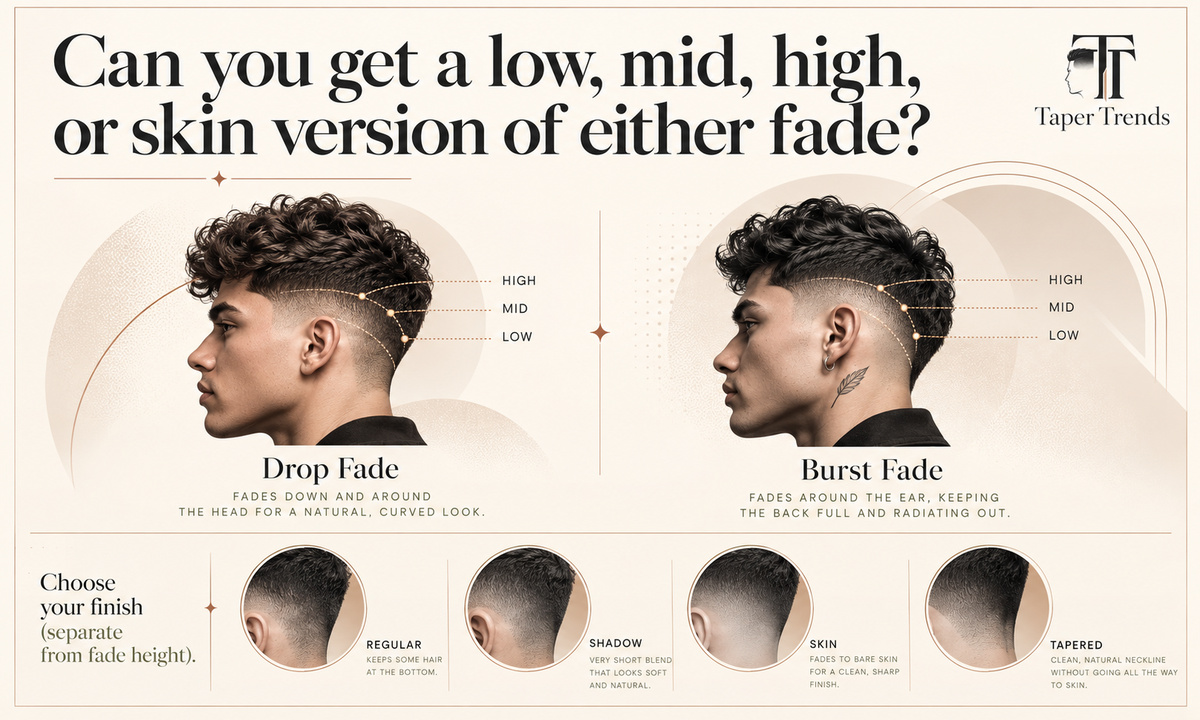
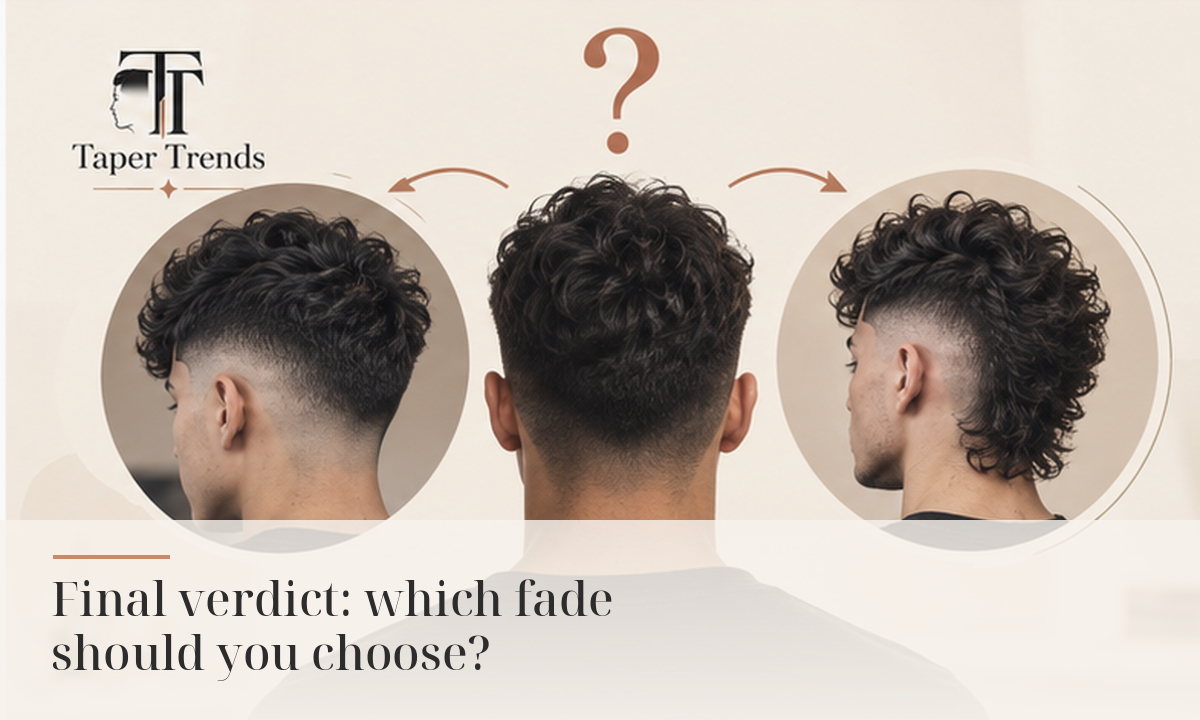
In drop fade vs burst fade, the back of the head decides. A drop fade curves down behind the ear and keeps going around the back of the head, so the nape ends up faded. A burst fade makes a rounded arc around the ear and stops there, which leaves the hair at the back long.
How high the fade starts and whether it reaches bare skin are separate decisions, and keeping those three choices apart (shape, height, finish) is how you get the cut you pictured.
For each shape on its own, see our complete drop fade guide and burst fade haircut guide. Our guide to every type of fade haircut lines both up against the rest, and the low taper fade haircuts guide is the hub for every taper and fade on the site.
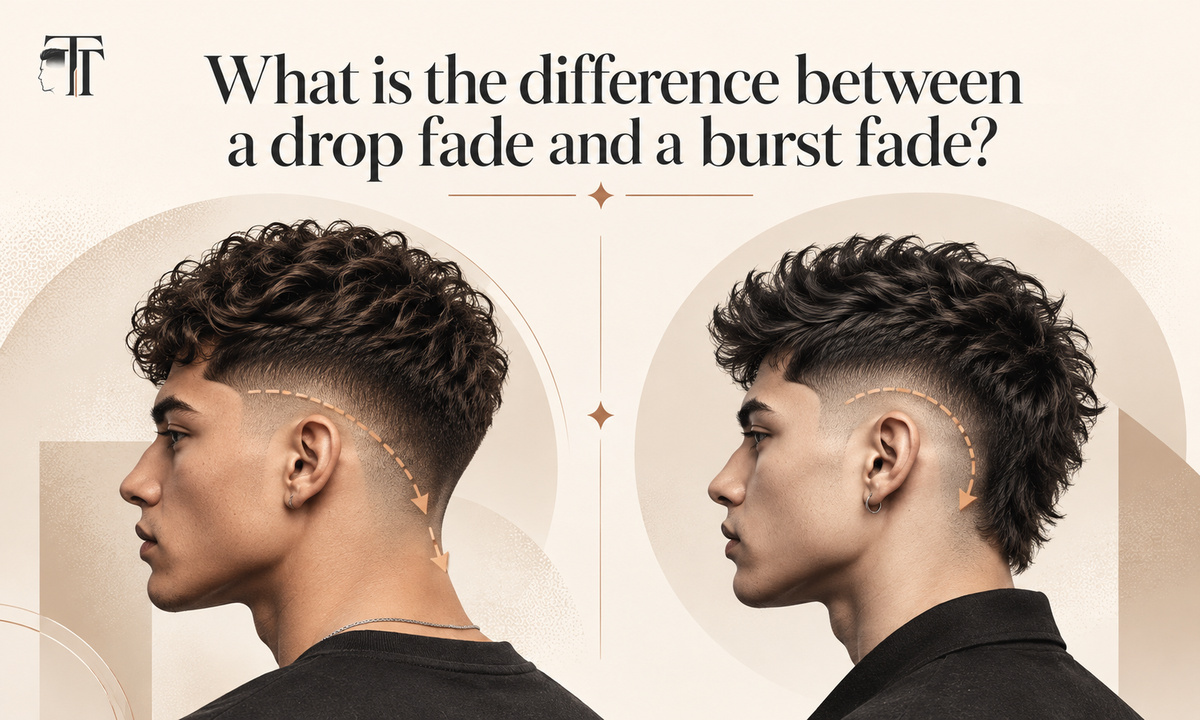
What is the difference between a drop fade and a burst fade?
The difference between a drop fade and a burst fade is where the fade travels after it reaches the ear. A drop fade follows one continuous curve that dips behind the ear and wraps across the nape. A burst fade stays in a semicircle around the ear, and the back of the head usually keeps its length.
The team at Markcutit, a barbershop in Mississauga, Ontario, says you can tell the two apart instantly from behind, and Republic of Barbers in Adelaide draws the same line: the drop tidies the entire back, the burst does not.
| Drop fade | Burst fade | |
|---|---|---|
| Shape | Curve that dips behind the ear | Semicircle centered on the ear |
| Fade path | Continuous from the sides through the back | Stops just behind the ear |
| Nape | Faded low across the neckline | Usually left long, often an inch or more |
| Visual focus | The whole side-and-back outline | The ear area and side profile |
| Common pairings | Crops, quiffs, side parts, waves, curly tops | Mullets, mohawks, faux hawks, longer curls |
| Shortest finish | Skin, zero, or a guard | Skin, zero, or a guard |
| Grow-out | The whole band softens evenly | The curve tends to blur first |
Fade direction and shape
A drop fade starts near the temple and arcs downward, so its guideline slopes toward the neck instead of running level around the head like a ruler. A burst fade behaves more like a sunburst. The shortest hair sits right beside the ear, and the blend radiates outward into the longer hair surrounding it.
That level-versus-curved distinction is also what separates a drop from a standard fade; our low taper vs low fade comparison and taper vs fade explainer cover the straight-line cuts both shapes are measured against.
The back and nape
From behind, a drop fade shows a blend running low across the neckline from one ear to the other. A burst fade shows a block of longer hair running from the occipital bone (the bump at the back of your skull) down to the neck. Markcutit notes that the back of a burst is often left at about 2.5 cm, roughly an inch, or longer. If the back matters to you, say how long you want it.
A taper treats the back differently again, shortening only the neckline and sideburns; our burst fade vs taper fade guide walks through that third option, and the taper fade haircut guide shows it at every height.
Contrast, coverage, and overall look
A burst puts its contrast around the ear, so it reads as a deliberate feature. A drop fade spreads the blend across the sides and back for a cleaner all-round outline. Neither is better in the abstract; the question is how much of your head you want faded.
What is a drop fade?
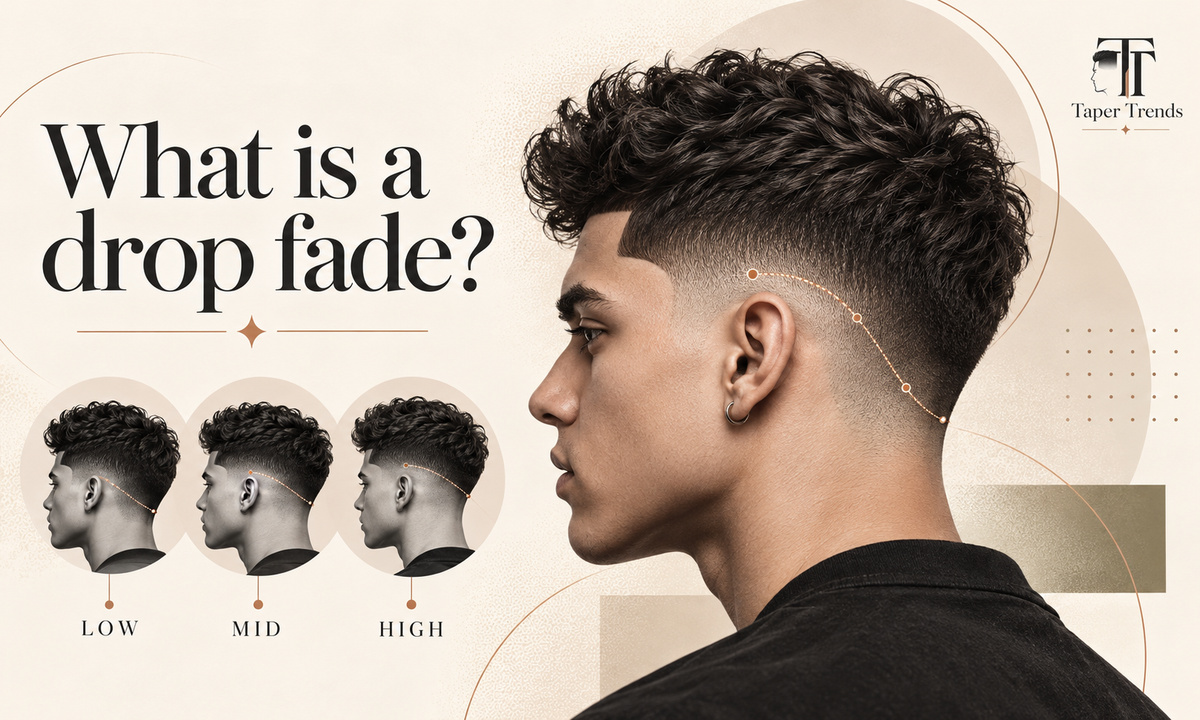
A drop fade is a fade whose guideline curves downward behind the ear rather than running level around the head, then continues across the back toward the nape. It can start low, mid, or high, and it can finish at bare skin or at a longer guard if you want to keep some coverage.
The guideline is only a cutting boundary. On a finished drop fade you should see a smooth gradient, not a stripe. One practical warning from Luxe Digital's men's haircut guide: ask for the drop by name, because a barber who hears plain “mid fade” will likely cut it straight.
Our drop fade haircut guide covers the shape in full, and if you like the curve but want a gentler finish, the low taper drop fade keeps the downward path with a softer, taper-style blend.
Low, mid, and high drop fades
Low, mid, and high describe where the fade begins. “Drop” describes the direction it travels. Republic of Barbers places a low fade around the ear, a mid fade at the temple, and a high fade up near the parietal ridge, where the top of the head starts to round off. Start higher and you get more contrast on the sides, but the downward curve behind the ear stays the same.
Each height has its own guide: the low drop fade for the subtlest version, the mid drop fade for the temple start, and the high drop fade for the most side contrast.
What is a burst fade?
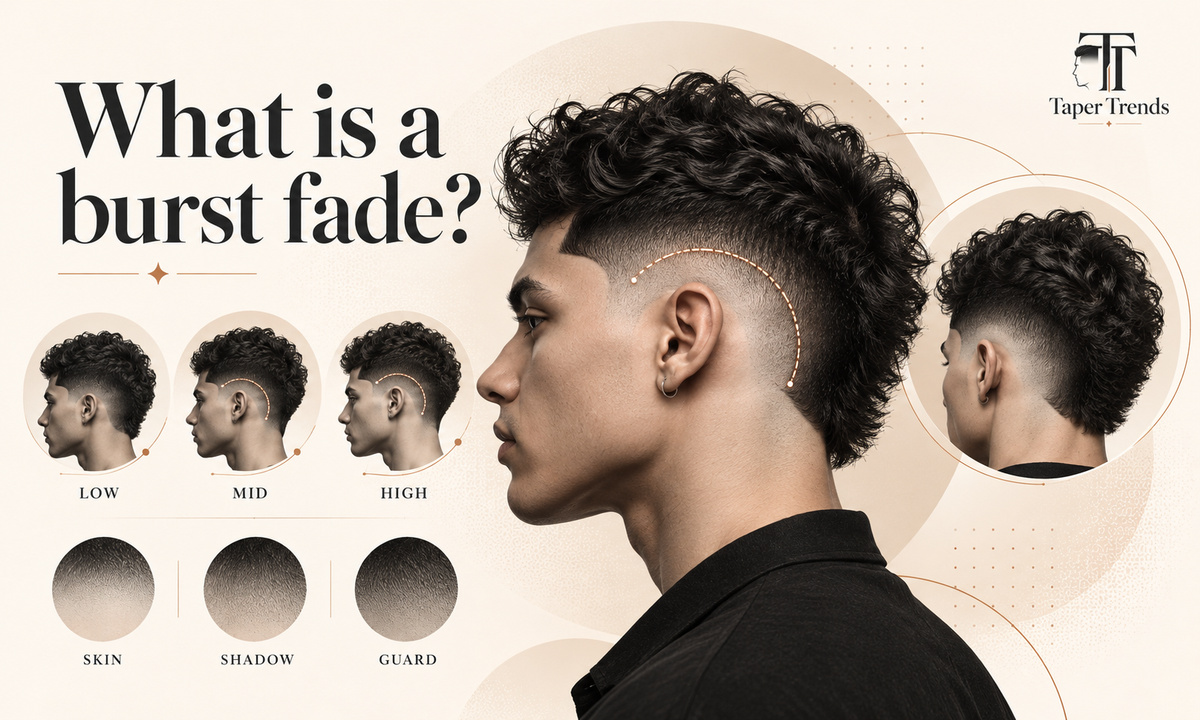
A burst fade is a rounded fade that radiates in a half circle around the ear and then stops. The hair behind it, down the back of the head and at the nape, keeps its length. That is why the burst shows up so often under mullets, mohawks, faux hawks, and curly tops that are grown longer at the back. Think of it as a shape for the sides rather than a complete haircut: the same burst can sit under a textured crop or a full mullet.
Our burst fade haircut guide shows the shape on its own, and the burst fade with a textured fringe and burst fade Edgar guides put it under shorter, cropped tops.
Burst heights and finishes
A burst can sit low, mid, or high, and it can end at skin, a clipper with no guard, or a softer shadow where some hair still shows. Burst & Taper points out that bare skin is optional. Words like “skin,” “bald,” and “zero” are not used identically from shop to shop, so bring a photo or say plainly whether you want skin showing, as our guide on how to ask for a fade explains.
See the low burst fade with taper, the mid burst fade and the high burst fade for each height in detail.
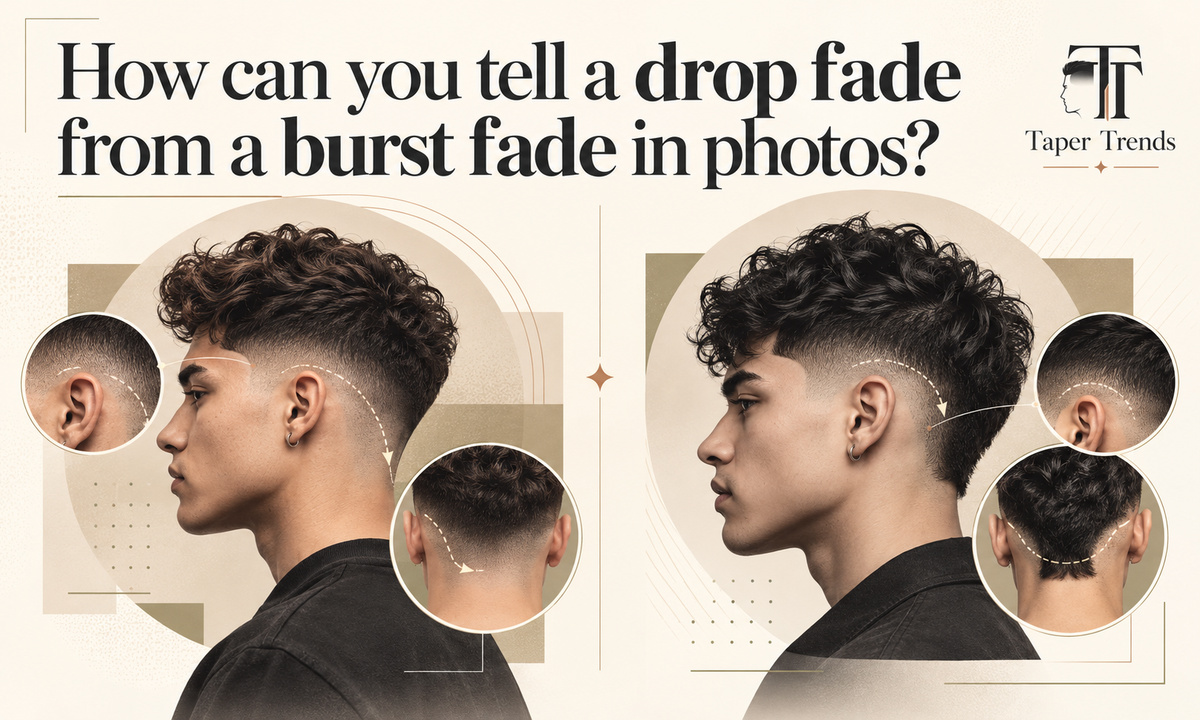
How can you tell a drop fade from a burst fade in photos?
To tell a drop fade from a burst fade in a photo, check two angles. From the side, see whether the shortest hair forms a tight arc around the ear or a band sloping down toward the back. From behind, check the nape. If the fade crosses the neckline, it is a drop. If the nape keeps its length, it is a burst.
Check the side and three-quarter view
A single side-on photo can fool you, because both fades curve around the ear instead of running straight. Markcutit says clients regularly bring in a side photo of a burst and ask for a drop, or the reverse. Look at where the shortest hair sits: tight around the ear suggests a burst, a band descending toward the neck suggests a drop.
Check the back of the head and neckline
Burst & Taper calls this the ear-and-nape test. Find the area directly behind the ear, then look at the nape. A focused semicircle with real length below it is almost always a burst. A fade that stays connected across the back is a drop. Hybrids exist, so show an ambiguous photo to your barber and ask what they see.
For practice, compare the side and rear shots in our drop fade styles for Black men with those in the burst fade styles for Black men, or browse the Taper Trends gallery.
Which fade works better for your hair type?
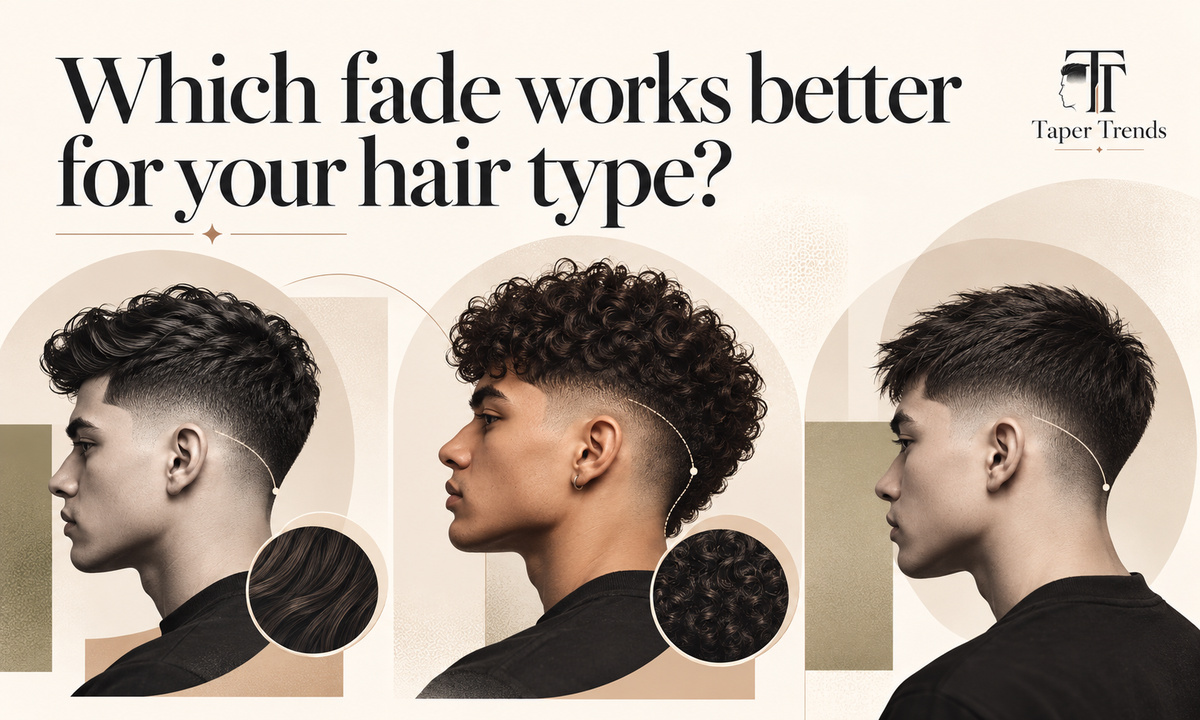
Both fades work on straight, wavy, curly, and coily hair, so texture rarely settles the question alone. What texture changes is how the back behaves once you leave length there. Choose by silhouette and daily styling, then let hair density break the tie.
Straight and wavy hair
Straight hair shows the back most plainly, so the decision comes down to length and how you style the top. Markcutit recommends a drop fade for straight hair worn slicked back, because a long back can look unkempt against a slick top. Wavy hair has more room to go either way. Bring a rear photo of waves at a similar length so your barber can judge how the back will fall.
Our drop fade for straight hair and burst fade for straight hair guides go deeper on each shape, and the low taper fade for wavy hair and mid taper fade for wavy hair show how a wave pattern sits over a faded side.
Curly and coily hair
Either fade can keep a curly or coily top full. Markcutit notes that dense hair holds a sharp curve, which suits both shapes, and Republic of Barbers says curly hair takes especially well to a burst because the contrast between the tight arc and the volume above it does most of the styling. A drop gives a crisp perimeter. A burst suits curls you want to keep long at the back.
Longer curls bring care needs. The American Academy of Dermatology says curly hair is drier than other hair types and advises conditioning all of it, not just the ends.
Our drop fade for curly hair and burst fade for curly hair guides break each shape down by curl type, and the low taper fade for curly hair and low taper fade afro show the softer taper alternative for a full curly or coily top.
Fine, thinning, or low-density hair
With fine or low-density hair, the drop fade is usually the safer starting point. Markcutit cautions that very fine, straight hair can make a burst look patchy at the back, where the length lies flat against the neck, and Republic of Barbers steers straight or fine hair toward the drop. Be wary of anyone who promises a fade will hide hair loss. Our taper fade guide for thin and thick hair explains how density changes any fade.
Which fade matches your preferred hairstyle?
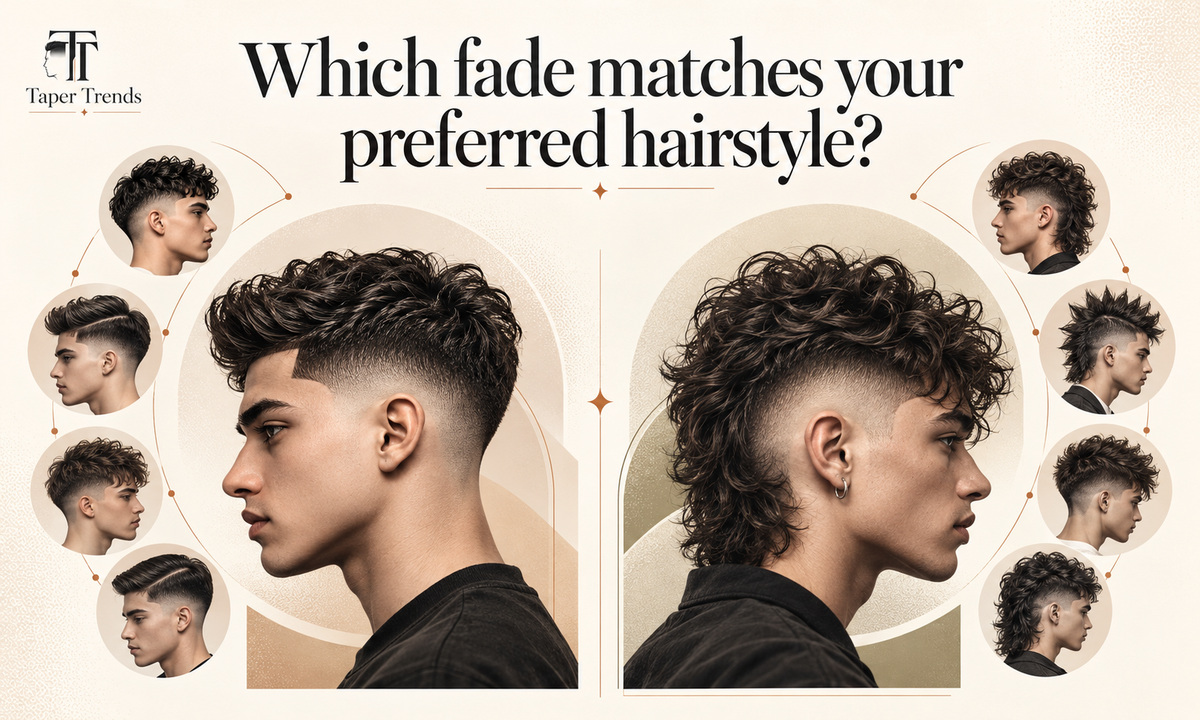
Let the top decide. A drop fade frames most short-to-medium tops, such as crops and side parts, without asking anything special of the back. A burst fade earns its place when the style depends on length at the nape, as a mullet, mohawk, or faux hawk does.
Crops, quiffs, side parts, and short tops
Markcutit pairs textured crops, French crops, quiffs, and side parts with a drop fade because the low nape keeps the outline tidy from every angle. A burst is still possible if you like the contrast around the ear. Just confirm how long the back stays, since Markcutit's barbers also warn that a burst without length behind it looks like an unfinished fade.
For a forward, choppy top on either shape, compare the drop fade textured fringe with the burst fade textured fringe. A blunt crop works the same way: see the burst fade Edgar and the mid taper Edgar.
Mullets, mohawks, and faux hawks
These styles need length through the center or back, which makes the burst the natural fit. Markcutit calls it the right choice for a modern mullet “almost always.” In a burst fade mullet, Burst & Taper explains, the curve cleans up the side profile without cutting away the tail. A drop fade would remove that tail and change the whole silhouette.
Our burst fade mullet and drop fade mullet guides show exactly how each shape treats the tail, and the low taper mullet, mid taper mullet and high taper mullet cover the taper versions. For a strip on top, see the burst fade mohawk and the low taper fade mohawk.
Waves, beards, and connected sideburns
Markcutit pairs 360 waves with a drop fade for a crisp perimeter. With beards and connected sideburns, neither fade wins on its own merits, because the blend has to be planned either way. Tell your barber whether the sideburn should flow into the beard and where the neckline should end.
For waves, our low taper fade with waves, mid taper fade waves and high taper fade waves guides cover keeping the pattern intact. For beards, the drop fade with beard and burst fade with beard guides plan the sideburn join for each shape, and our skin fade with a beard guide covers it when either is taken to bare skin. For the three skin heights side by side, our low vs mid vs high skin fade comparison shows where each bare section stops.
Which fade suits your face and head shape?
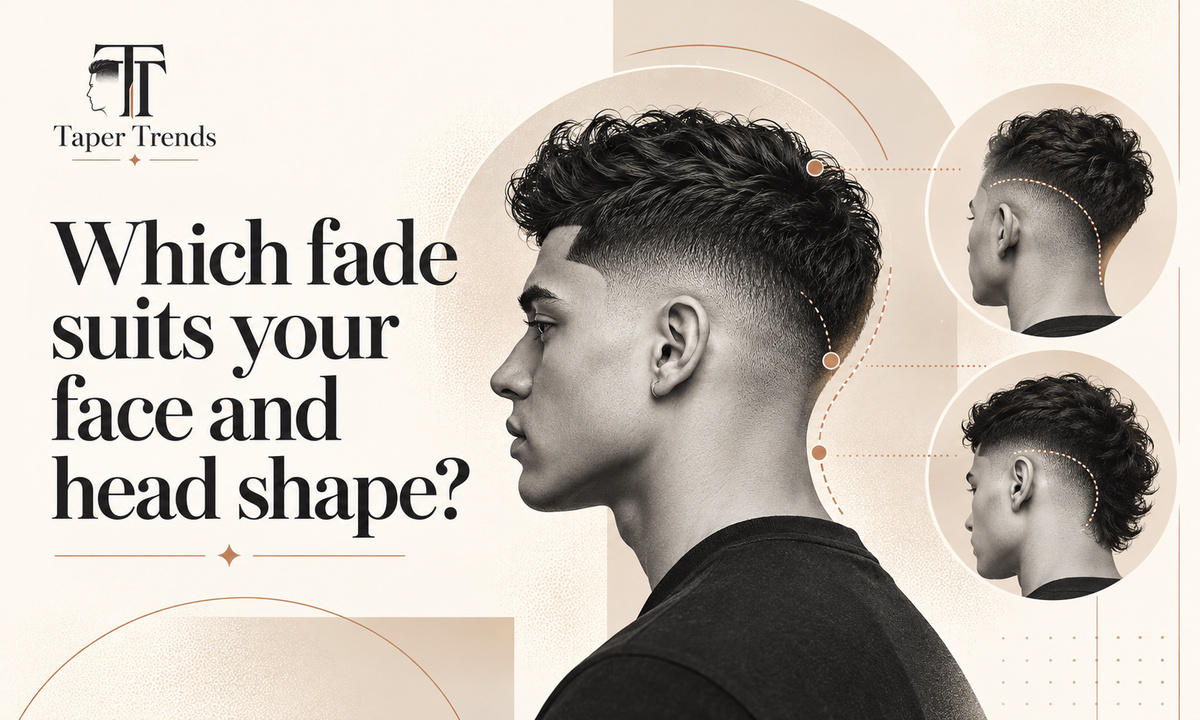
No fade belongs to a particular face shape. Head shape, top volume, and back length matter more, and published guides disagree anyway: Luxe Digital's burst fade guide relays one source matching the burst to round faces and another listing it for round, oval, and square faces alike.
Occipital bone, crown, and back-of-head shape
Markcutit calls a drop fade the kinder choice for a flat back or a prominent occipital bone, because the curve behind the ear shapes the silhouette, and Republic of Barbers agrees that a drop adds depth to flatter head shapes. Man Cave Barbershop, quoted in Luxe Digital's guide, argues that a burst helps a flat back because the length it keeps adds volume there. Decide whether you want the fade or the length to shape that area, then check rear photos.
Facial proportions and personal style
Three settings change the overall balance: fade height, top length, and nape length. A higher start increases side contrast, while a fuller top or a longer back adds weight. Change one setting per visit rather than all three at once, so you can tell which adjustment you actually like.
If you want a starting point for the top, our face shape detector reads your proportions in a few seconds, and the low taper fade long hair guide shows how top length shifts the balance by face shape.
Can you get a low, mid, high, or skin version of either fade?
Yes. Drop and burst describe the fade's path, low, mid, and high describe where it starts, and the finish describes how short it ends. Those are three independent choices, so a low drop fade, a high burst, or a skin finish on either is an ordinary request.
Fade height vs fade path
A low drop fade and a high drop fade follow the same downward path from different starting points. The same logic applies to bursts: a low burst hugs the ear, a mid burst reaches halfway up the side, and a high burst climbs toward the crown with the strongest contrast. When you order, say the shape first and the height second.
Height works the same way on tapers, which our low vs mid taper fade and low vs high taper fade comparisons lay out side by side.
Skin, shadow, and clipper-guard finishes
A guard number sets the shortest remaining length, not the fade's shape. Wahl's guard chart lists the sizes most often used at the bottom of a fade:
| Wahl guard | Length | Approx. metric |
|---|---|---|
| #1/2 | 1/16 inch | 1.6 mm |
| #1 | 1/8 inch | 3.2 mm |
| #2 | 1/4 inch | 6.4 mm |
Wahl describes the #1/2 as about as short as you can go outside of bald, and gives an example of fading from a #1/2 at the bottom up to a #3. It also notes that the taper lever on a clipper adjusts closeness between guard lengths. These are Wahl's figures, and other brands and lever settings vary. If you want bare skin, say so, because skin sits below every guard. Our clipper guard size chart converts every number to inches and millimeters.
How do you ask a barber for the right fade?
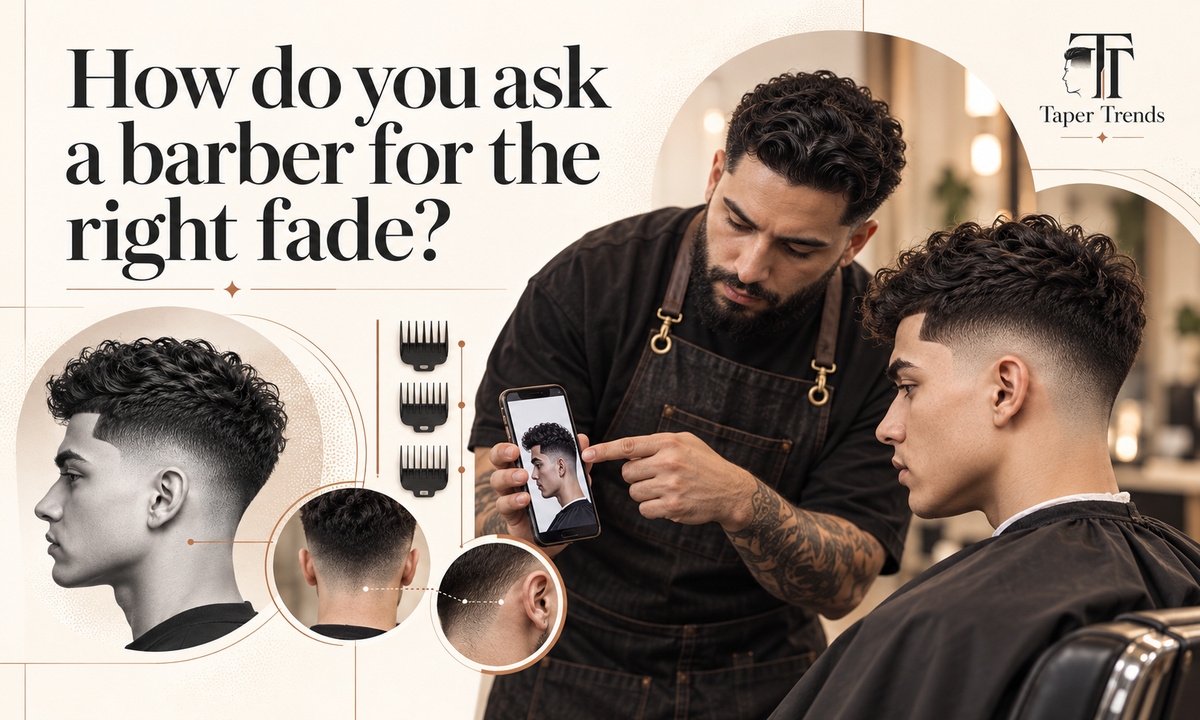
Describe the fade in the order a barber builds it: shape, height, shortest finish, then the lengths you want to keep on top and at the back. Back it up with photos from more than one angle, and ask the barber to repeat the plan before any real length comes off.
Five details to confirm before the cut
- 1. Show side and rear reference photosNot just a front shot.
- 2. Name the shapeSay “drop” or “burst” and point to where the fade should travel.
- 3. Give the height and finishSay low, mid, or high, and whether the shortest point goes to skin.
- 4. Agree on lengthsGive the top in inches and say how long the nape should stay.
- 5. Ask for a read-backSo the barber describes the plan before the first pass.
Example requests for each fade
Adjust the details, then read it out:
Drop fade“Mid drop fade starting near the temple, curving down behind the ear and running low across the nape to skin. Leave about three inches on top.”
Burst fade“Low burst fade around the ear with a shadow finish. Keep the back about two inches long and blend it into the top.”
To turn those five details into a note you can show on your phone, use our barber brief generator. Our guide to what a low taper fade looks like from every angle shows the kind of side and rear reference shots worth saving.
Which is easier to maintain and grow out?
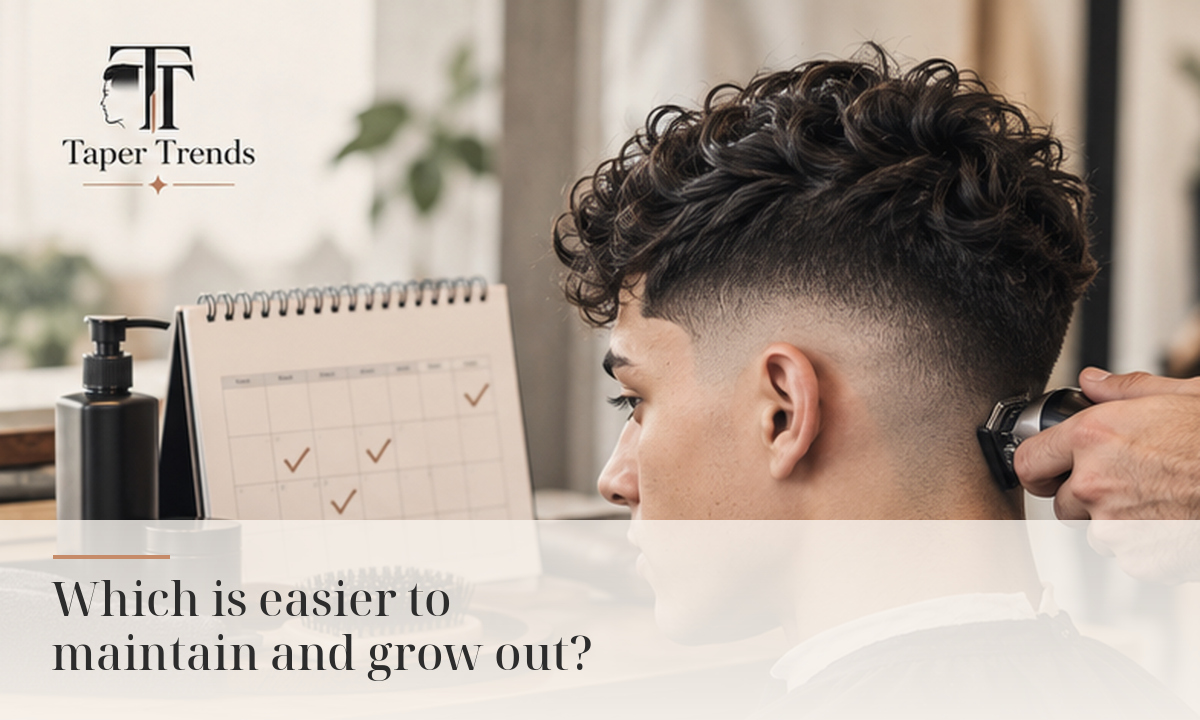
A drop fade is usually the easier one to live with between appointments, because it grows out evenly. Both Markcutit and Republic of Barbers say the curve of a burst blurs sooner. Still, the finish you pick matters as much as the shape: a skin finish shows regrowth faster than a softer taper or guard on either cut.
Typical refresh schedules and what changes them
Estimates vary by shop. Markcutit suggests rebooking a burst every two to three weeks to keep the curve crisp. Republic of Barbers estimates three to four weeks for a drop fade before the guideline softens, and two to three weeks for a burst. Our guide to how often you should get a haircut compares those windows with every other cut.
Treat those numbers as planning ranges, not rules. Scalp hair grows about half an inch a month on average, according to dermatologist Hadley King and the American Academy of Dermatology as reported by USA Today. That is roughly a quarter inch in two weeks, plenty to soften a skin fade. On a two- or three-week cycle, our barber tip calculator works out what to leave at the chair.
At-home styling and care by texture
Between visits, daily styling is about the top. Leave the edges to your barber, because one stray clipper pass at home can remove the nape length a burst depends on. Our five-step guide to styling a faded cut covers products and technique by hair type.
For curly or coily tops, the American Academy of Dermatology advises washing only when needed, but at least every two to three weeks. It also recommends detangling hair while it is wet, using fingers or a wide-toothed comb, and avoiding brushing it dry.
What mistakes should you avoid when choosing?
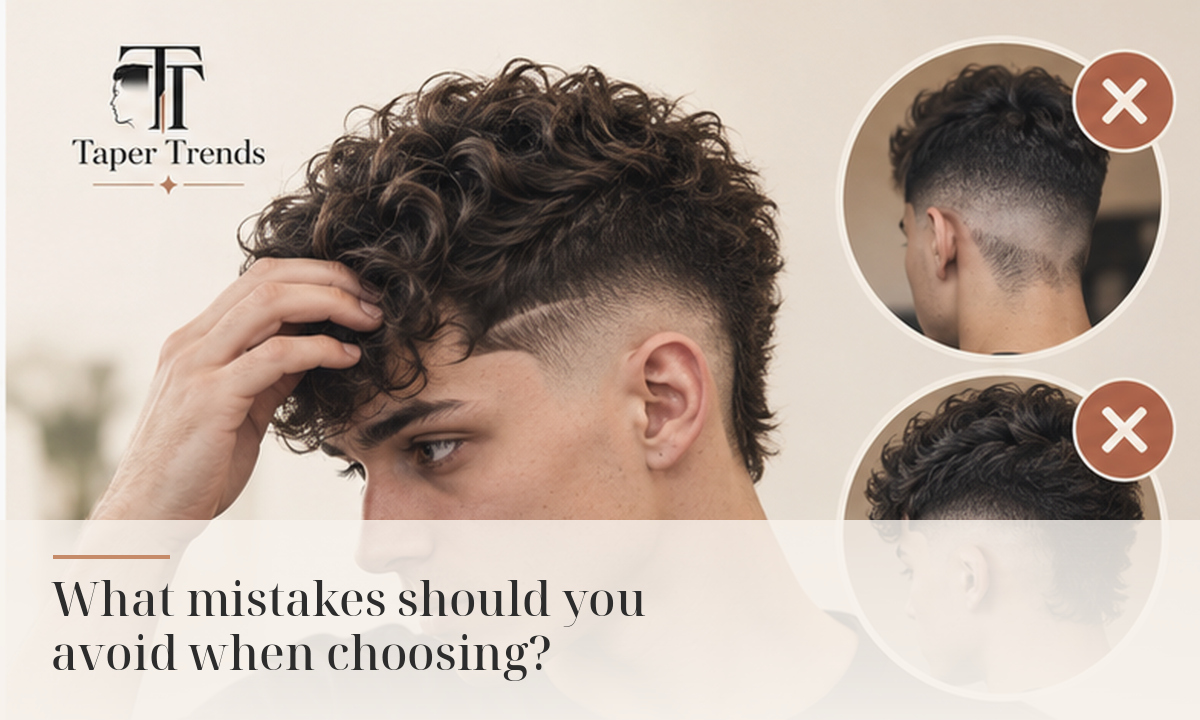
Most disappointing fades come from vague requests rather than bad barbering. These five mistakes cause the bulk of them:
- Bringing only front photos.A burst is easy to see from the side and easy to miss from the front, so bring side and rear shots.
- Mixing up low and drop.Ask whether the line should run level or curve down behind the ear.
- Leaving the nape unspoken.Confirm the neckline so nobody tidies away the length you came in to keep.
- Assuming skin is required.A guard or shadow finish is a legitimate choice and shows regrowth less abruptly.
- Skipping the top length.The fade has to suit what sits above it, so give a number in inches.
The low-versus-drop mix-up is the most common one; our low taper drop fade guide shows how a curved line differs from a level one at the same height.
Drop fade vs burst fade FAQs
Can you combine a drop fade and a burst fade?
Yes, to a degree. Barbers customize both, and you will hear names like “burst taper” for a burst cut with a softer blend. Names vary between shops, so describe the path of the fade and what should happen at the nape: kept long, faded low, or somewhere in between.
Is a burst fade the same as a mohawk?
No. A burst fade is the curved shape around the ear, and a mohawk is the strip of hair left on top. Markcutit notes the two are often worn together, which is where the confusion comes from.
Which fade is better for work or school dress codes?
A low drop fade is the safer pick for strict dress codes. Markcutit points out that the back looks tidy above a collar, while a burst with a long back can read as a statement style. Republic of Barbers agrees that a burst’s suitability for work depends on how long you keep the back.
Can you switch from a burst fade to a drop fade in one appointment?
Usually, yes. Turning a burst into a drop means cutting the back shorter, which a barber can do in a single visit. The reverse takes patience. At about half an inch of growth a month, rebuilding the nape length a burst needs can take a couple of months or more.
Can either fade work with a receding hairline?
Either fade can work with a receding hairline, depending on your top length, density, and how much contrast you like. No fade can hide hair loss, so be skeptical of any cut sold that way. If the hair loss itself worries you, a dermatologist, a doctor who treats skin, hair, and nails, can evaluate it.
Should you get a burst fade if your ears stick out?
A burst can still work if your ears stick out, but it frames the ear, so placement matters. Markcutit suggests keeping the burst low with a tight curve, or choosing a drop fade with a shadow finish, if you want your ears to look smaller.
For the softer burst blend, see our low burst fade with taper. For school-friendly versions of either shape, the burst fade for boys, low taper fade for boys and mid taper fade for boys guides keep the contrast dress-code-friendly.
Final verdict: which fade should you choose?
Choose a drop fade if you want one continuous fade through the sides and back that suits most tops, grows out evenly, and passes a strict dress code. Choose a burst fade if the contrast around the ear is the point and you want to keep length at the nape. If you are still torn, let the back decide: faded, or kept long.
Then settle height and finish separately, bring side and rear photos, and have your barber repeat the plan before the first pass. Most good fades get dialed in over two or three cuts, not one.
The bottom line
Drop or burst comes down to one question: should the nape be faded, or kept long?
Name the shape first, then the height and finish, and bring side and rear photos so your barber cuts the fade you pictured.
Want more fade comparisons?
Browse clean, barber-ready breakdowns for every fade and hair type.