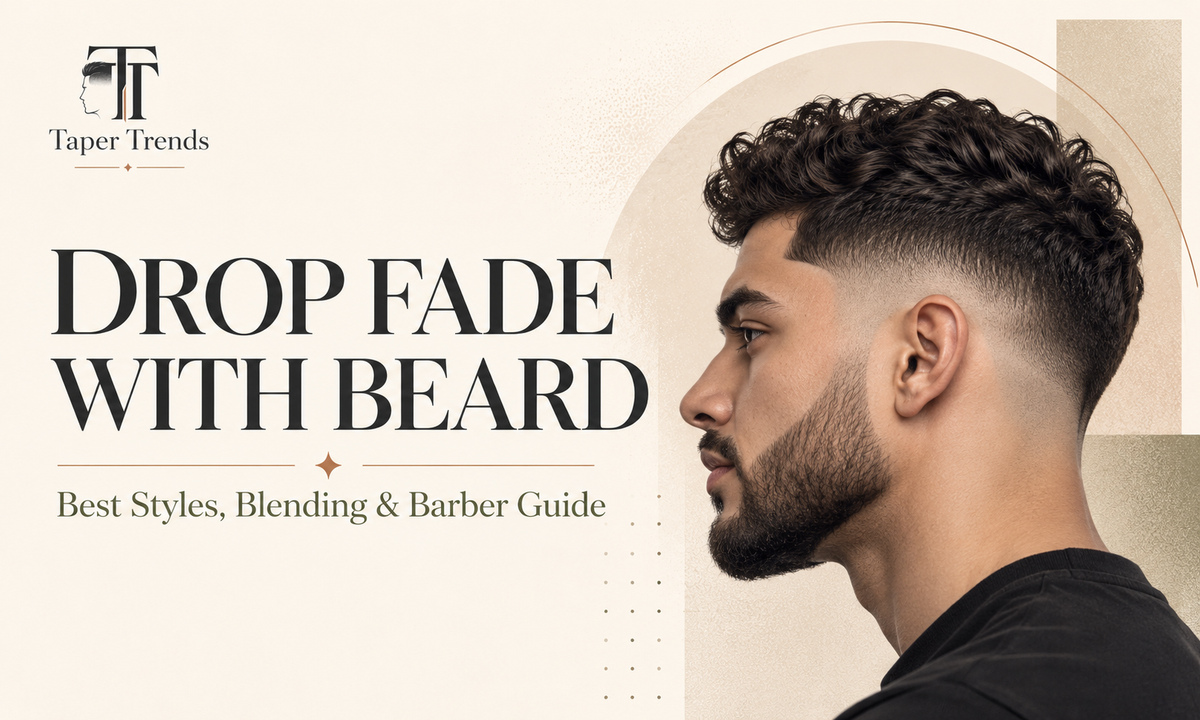
A drop fade with beardis two cuts planned as one. The fade curves down behind your ear, the beard is shaped on your face, and the sideburn is where the two either melt together or meet at a deliberate break. When that meeting point is right, the whole look holds together. When it's wrong, you see a step beside your ear every time you catch a mirror.
This guide covers fade heights, six combinations worth showing a barber, how the blend is actually cut, and the exact words to use once you're in the chair.
For the drop shape under every other top, see our complete drop fade guide, and for every taper, fade and beard pairing on the site, start at the low taper fade haircuts guide.
What is a drop fade with a beard?
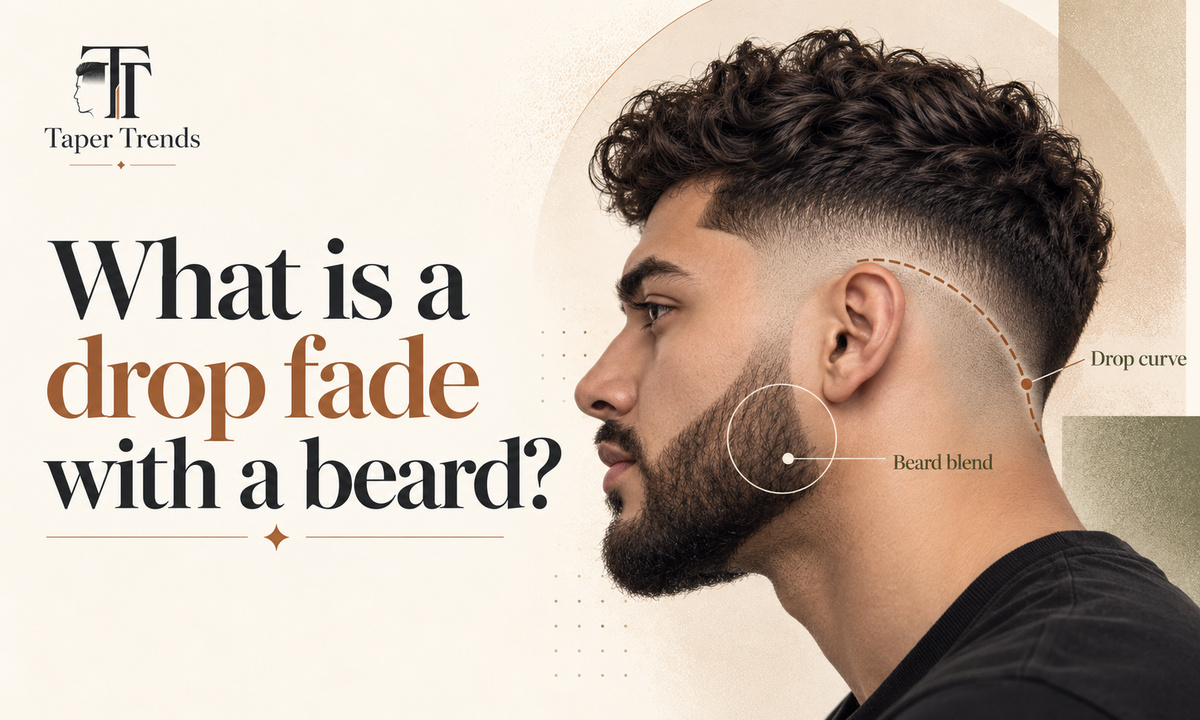
A drop fade with a beard is a men's haircut that pairs a fade whose line curves downward behind the ear with facial hair that is either blended in through the sideburn or kept visibly separate. The top can be any length or texture. The beard is shaped on its own terms, and the sideburn decides whether hair and beard read as one design.
The same idea runs through every beard pairing on the site; what changes is the side shape. Our low taper fade with beard keeps the sides soft and level, the burst fade with beard curves the line around the ear instead of behind it, the skin fade with beard takes the sides all the way to bare skin, and the guide to the different kinds of fade haircuts lays out every shape, height and finish side by side.
Where does the drop curve behind the ear?
A drop fade dips lower behind the ear instead of running level around the head. Forte Seriesdescribes the line as curving downward behind the ears to follow the head's natural shape, and notes that it works as a low, mid, or high fade. So “drop” names the path the line takes, while low, mid, and high name where it starts, as in a mid fade at temple height. If you want that same curve with a softer, taper-depth finish, our low taper drop fade guide shows how the arc works without bare skin.
How does the fade meet the beard?
The fade meets the beard at the sideburn, not the jawline. The barbers at Markcutit, a shop in Mississauga, Ontario, point out that the sideburn is the only place the haircut and beard physically touch. A skin fade at the temple beside a full-length beard leaves a hard step in front of the ear, so a beard fade turns that strip into a gradual climb in length. Our low vs mid vs high skin fade breakdown shows how the same three heights behave once the finish reaches skin.
Which drop fade height works best with a beard?
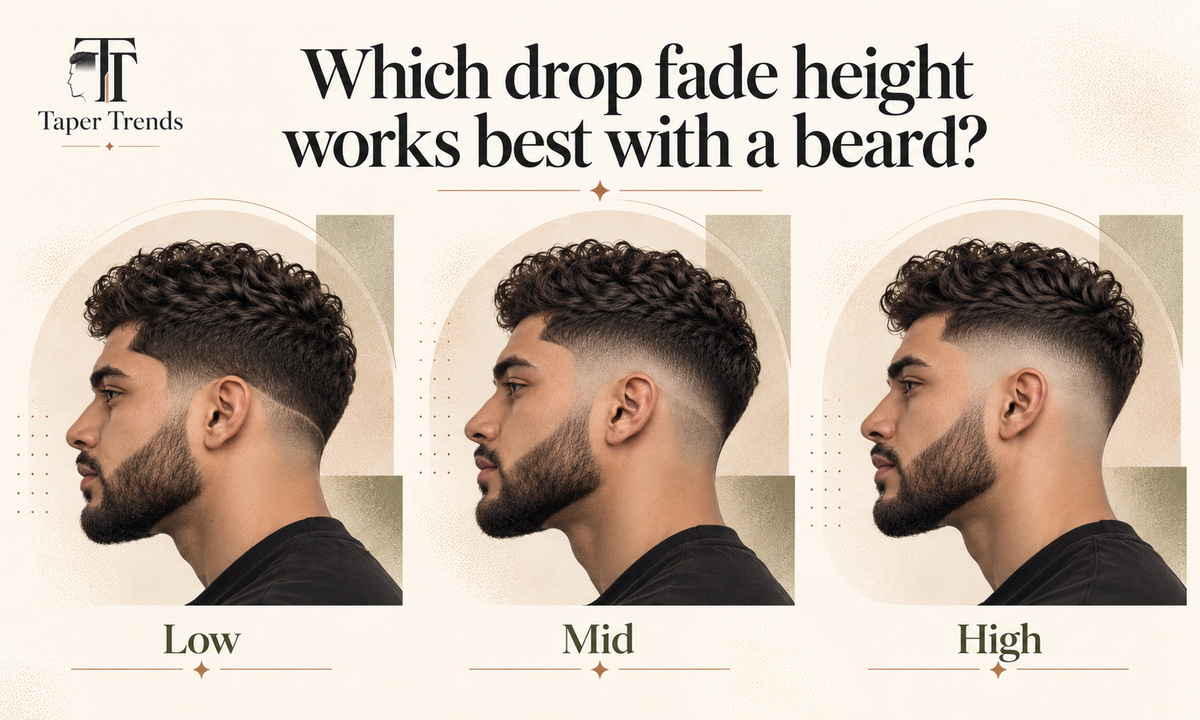
No single drop fade height works best with every beard. A low drop keeps the most hair on the sides and gives the softest contrast next to facial hair. A mid drop shows the curve clearly without exposing much scalp. A high drop exposes the most skin, which makes the beard the heaviest part of the silhouette. Choose by how much contrast you want and how full your beard grows.
Low drop fade with a beard
A low drop fade starts down near the ears and neckline, so the sides keep more weight. Forte Series pairs it with volume on top. Next to a beard, the transition zone is short and soft, which suits anyone who wants the beard to carry the look. Our low drop fade guide covers this height under every top, skin versus #1 base included.
Mid drop fade with a beard
A mid drop fade starts at a moderate height, high enough that the curve behind the ear is easy to see. In Markcutit's breakdown of fade-and-beard pairings, the blend on a mid drop follows that curve behind the ear down to the jaw. It's the most even split between haircut contrast and beard presence. The mid drop fade guide shows where the line starts and the guard numbers behind it, and our mid taper fade with beard guide is the softer, level version of the same height.
High drop fade with a beard
A high drop fade starts high on the sides and sweeps around the back, giving the strongest contrast and the most visible scalp. Beside a full beard, the face can start to look bottom-heavy. Beside stubble, the haircut does most of the work. Barbers place “high” differently, so confirm the starting point on a photo. Our high drop fade guide compares skin, #0.5 and #1 finishes, and the high taper fade with beard guide shows the same contrast with a taper-depth base.
6 drop fade with beard styles worth showing your barber
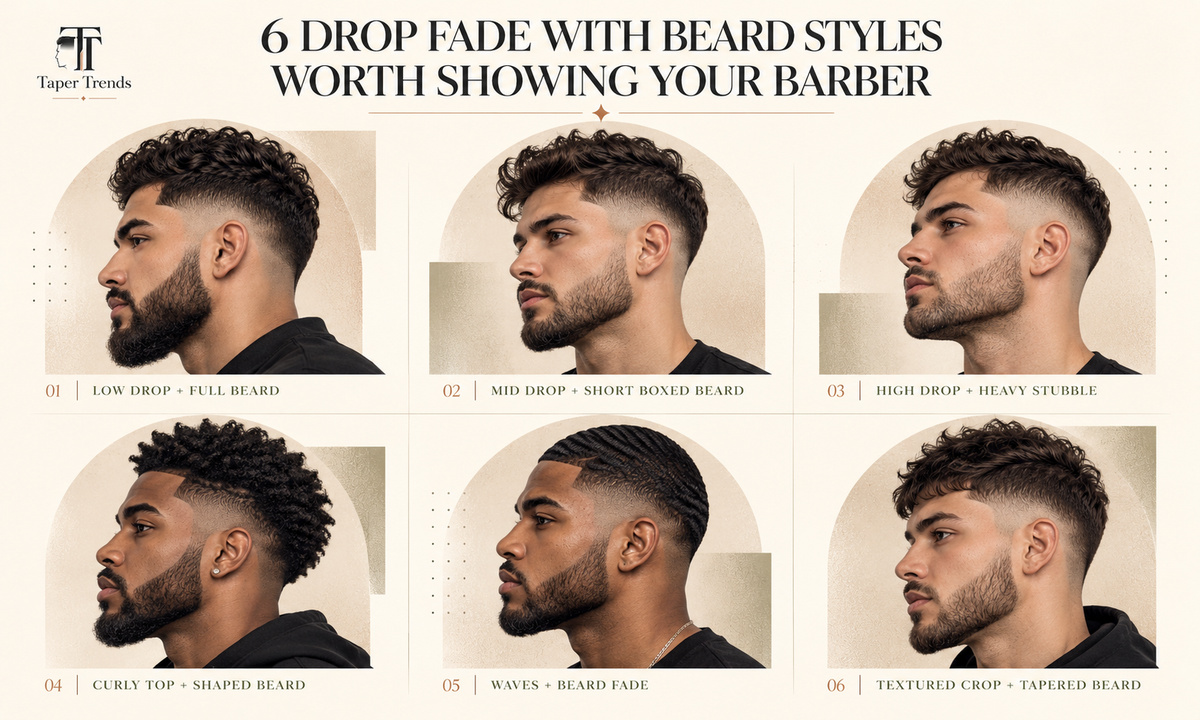
These six combinations each change something meaningful: fade height, top texture, beard length, or how the sideburn connects. They aren't a popularity ranking. Pick the one closest to what you want, then bring side and rear photos so your barber can see the curve and the blend, not just the front.
1. Low drop fade with a full beard
This pairing keeps the haircut quiet and suits dense, even growth along the jaw. Wahl's guide comb chart gives a full-beard example of a #2 at the sideburns, #3 on the cheeks, and #4 at the chin, which is 1/4 inch to 1/2 inch on Wahl combs. A low drop that stops short of skin keeps the gap between shortest and longest lengths manageable. Our clipper guard size chart converts each of those numbers to inches and millimeters.
2. Mid drop fade with a short boxed beard
A short boxed beard keeps the beard close and even with crisp edges, and a mid drop gives the haircut enough contrast to match. Markcutit describes a skin fade into a 6 to 10 mm boxed beard as a quick, tight blend. Philips describes a clean cheekline as a straight or slightly rounded line from the bottom of the sideburn to the tip of the moustache.
3. High drop fade with heavy stubble
Stubble adds almost no bulk, so the exposed scalp of a high drop does most of the visual work. Wahl's stubble example uses a #1/2 on the sideburns and cheeks and a #1 at the chin. The tradeoff is upkeep, because a high fade shows regrowth quickly. For an even shorter, lower-effort top over the same idea, see our high taper fade buzz cut guide.
4. Curly or coily drop fade with a shaped beard
Texture doesn't change where the drop begins, so curls, coils, or an afro can sit over any fade height. Forte Series includes both curly and afro drop fades. Shape the beard with the top in mind, since a large crown over a very thin beard can look top-heavy. Our drop fade for curly hair and drop fade for Black men guides cover the base lengths and top shapes for curls, coils and an afro, and the low taper fade afro guide shows how a rounded crown balances against facial hair.
5. Drop fade with waves and a beard fade
Waves put a defined pattern on top, and Forte Series describes the drop fade around a wave cut as adding contrast around the sides and back. Ask for the beard fade to follow the haircut's lines so the sideburn, cheek line, and fade all point the same way. Our low taper fade with waves, mid taper fade waves and high taper fade waves guides cover brushing and durag routines that keep the pattern sharp.
6. Textured crop drop fade with a tapered beard
A textured crop is a short, low-effort top, which makes this the most practical option on the list. The drop shapes the sides while the beard lengthens gradually from sideburn to chin. Wahl's beard-fade example starts with a #1/2 at the sideburns, then moves to a #1 and a #1-1/2 on the way down toward the chin. Our drop fade textured fringe and French crop low taper fade guides show how to size and style that forward top.
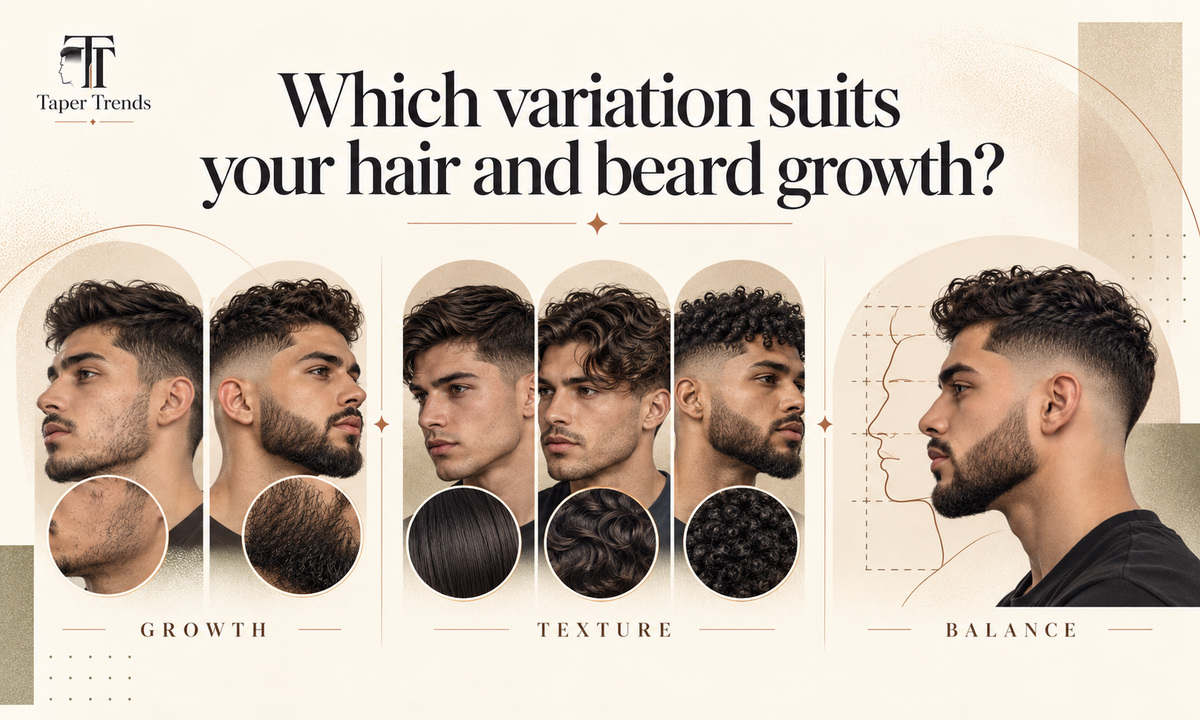
Which variation suits your hair and beard growth?
Match the variation to your beard growth first, your hair texture second, and face shape last. Dense, even sideburns support a connected blend. Thin or patchy sideburns usually look better with a tighter blend or a deliberate break. Top texture rarely limits the choice because it sits above the fade, and face-shape advice is styling judgment rather than a fixed rule.
Beard density and patchy sideburns
A blend needs hair to blend, so sparse sideburn growth limits how smooth the gradient can look. Markcutit's advice for a patchy sideburn is a tighter blend that keeps the sideburn shorter, which tends to hide thin growth better than leaving it at full beard length. No barber can add density where none grows. Our taper fade guide for thin and thick hair applies the same density logic to the top.
Straight, wavy, curly, and coily hair
Top texture and fade path are separate choices, so every texture can wear the same drop. Forte Series says the cut works on straight, wavy, and curly hair, and suggests defined edges for coily hair. Straight hair shows the arc most sharply, while curls and coils add height that a beard has to balance. For each texture under a close fade, see our drop fade for straight hair, low taper fade for straight hair, low taper fade for wavy hair, curly low taper fade and low taper fade for Black men guides.
Face proportions and beard silhouette
Beard bulk and top volume change how wide or long a face looks, but no face-shape rule is absolute. Wahl suggests that a rounder face suits a longer, tapered beard with shorter sides, while a longer face suits fuller sides and a shorter chin. That's a manufacturer's styling guidance, so test it against photos of yourself from the front and side. If you want a quick starting point, our face shape detector gives you one in a few seconds.
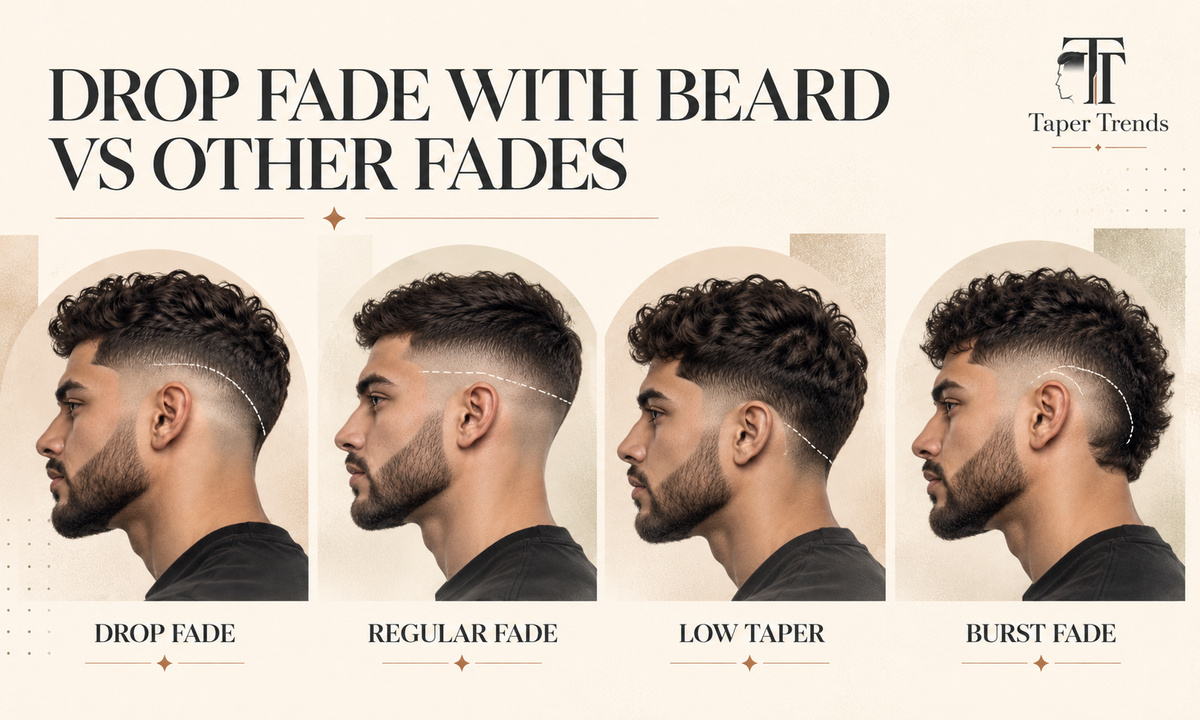
Drop fade with beard vs other fades
A drop fade is defined by its path: the line curves downward behind the ear. A regular fade holds a more even line, a taper keeps a soft, light finish around the neck and temples, and a burst fade flares in a rounded arc around the ear. These terms aren't used identically everywhere. Taper Empire notes that plenty of people, including some barbers, treat drop and taper as the same thing, so compare photos before you book.
Side-by-side cut comparison
The distinctions below follow Forte Series and are visual guides, not universal shop definitions.
| Haircut | Fade path | With a beard | Main limitation |
|---|---|---|---|
| Drop fade | Curves down behind the ear | Sideburn blend is chosen separately | Height terms vary by barber |
| Regular fade | Even line across the sides | Sideburn may blend or break | No shape behind the ear |
| Low taper | Soft finish at neck and temples | Keeps more weight at the sideburn | Little contrast |
| Burst fade | Rounded arc around the ear | Distinct side silhouette | Concentrated at the ear, not behind it |
Our taper vs fade explainer and low taper vs low fade comparison cover the taper side of that table in more depth.
When to choose a taper, burst, or regular fade instead
Choose a taper if you want to keep hair near the temples and neck and prefer a soft finish. Choose a burst fade for a rounded silhouette around the ear, especially under a tall or curly top. Choose a regular fade if you want an even line with no curve. Keep the drop if the arc behind the ear is the point. None is better overall, and our drop fade vs burst fade comparison breaks down the closest of those choices. Our taper fade guide, the burst fade haircut guide and the burst fade vs taper fade breakdown show each alternative up close.
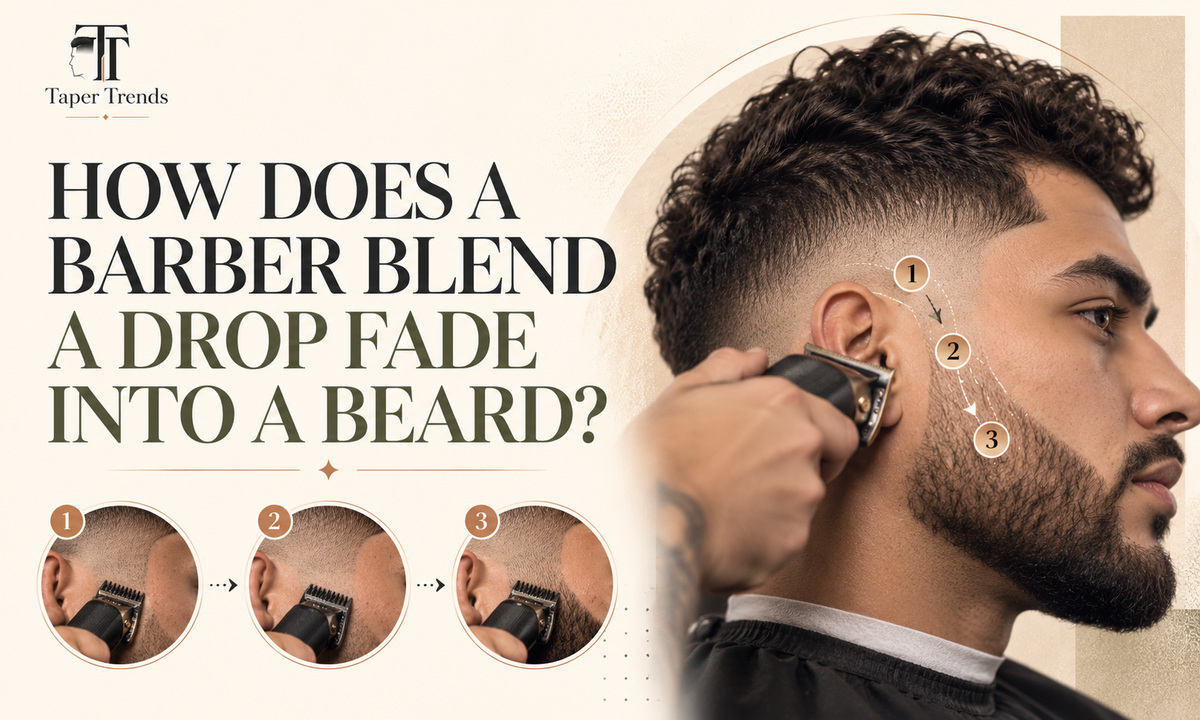
How does a barber blend a drop fade into a beard?
A barber blends a drop fade into a beard by planning both lengths together, then bridging them through the sideburn with progressively longer cuts. Fade height, beard length, and cheek line are chosen before the clippers come out. The result is either a continuous gradient or a deliberate break, depending on your growth and what you prefer.
Connected sideburn blend
A connected blend lengthens hair gradually from the short sideburn into the beard, so no step shows beside the ear. Markcutit's staged method cuts the haircut first and the beard second:
- Finish the fade. Set the lowest length on the side, often skin or a #0.5 at the bottom of the sideburn.
- Take the beard to its working length. Use a guard. Markcutit gives 10 to 13 mm on the cheeks and jaw as an example.
- Climb the sideburn. Run intermediate guards up the sideburn from the beard length, each one stopping a little higher than the last.
- Soften any band. Use half guards, the clipper lever, and clipper-over-comb or scissor-over-comb where the sideburn meets the cheek.
- Set the lines last. The cheek line and neckline go in after the blend is finished.
Markcutit also recommends having one barber cut both halves. Split the job, or trim the beard at home, and the step tends to come back.
Intentional disconnected beard
A disconnected beard leaves a clean, visible gap between the haircut and the beard instead of forcing a gradient. It suits sparse sideburns, or anyone who wants the beard to read as its own shape. Taper Empire frames this as a choice between a hard line and a soft blend, and says to tell the barber which one you want before the cut starts. Ask for the gap to sit at the same height on both sides. Our burst fade for Black men guide shows how a crisp line-up and a disconnected beard read together.
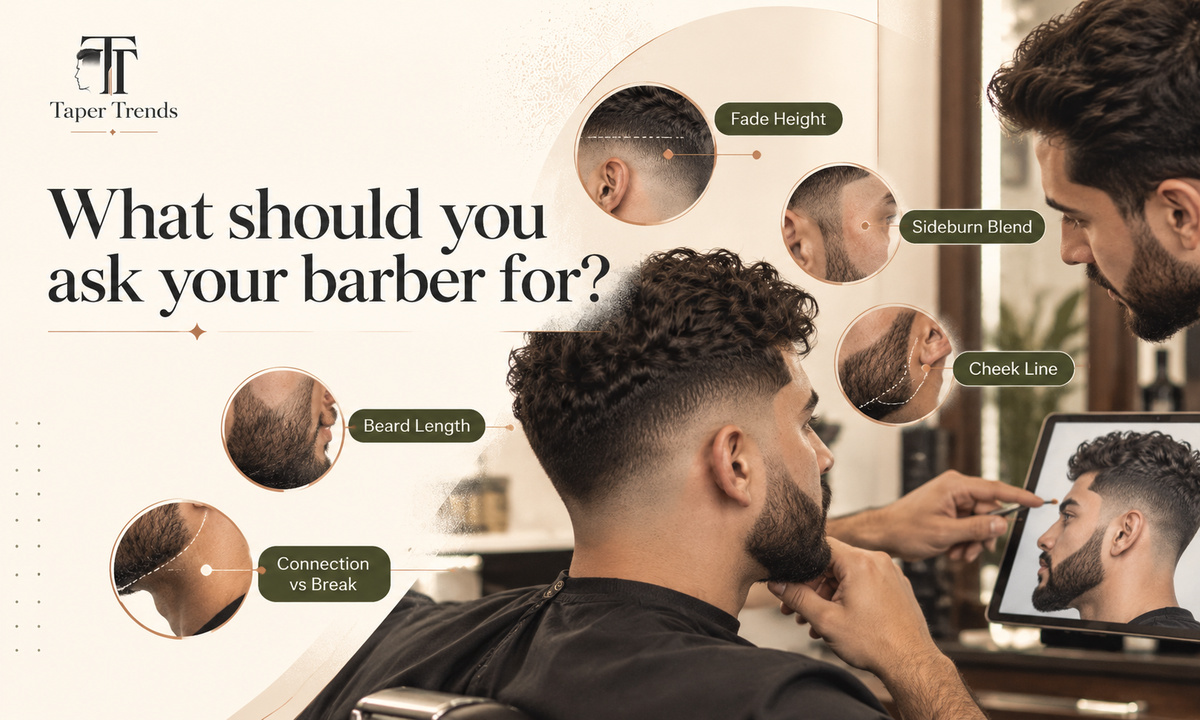
What should you ask your barber for?
Describe the cut in parts instead of naming a style. A clear drop fade with beard request covers six details: fade height, drop path, shortest finish, top length, sideburn connection, and beard outline. Specifics plus photos keep you and your barber picturing the same haircut.
Six details to specify before the cut
- 1. Fade height and drop pathName low, mid, or high, and say you want the line to curve down behind the ear. A rear photo shows how far the drop travels toward the nape.
- 2. Shortest finish and top lengthChoose skin, near skin, or a visible shadow for the shortest point, then give the top length and how you style it. If you mention guard numbers, ask which system the barber uses. On Wahl’s combs, a #1 is 1/8 inch, but attachments differ between brands.
- 3. Sideburn connection and beard outlineSay whether the beard blends into the sideburn or breaks on purpose, how much cheek and jaw bulk to keep, and whether you want a sharp or natural cheek line and neckline.
A request that covers all six might sound like this:
“Mid drop fade that curves behind the ear, finished at a visible shadow, textured top about two inches, sideburns blended into a short boxed beard, natural cheek line.”
If you'd rather build the script step by step, our barber brief generator turns the same decisions into a note you can show on your phone.
Reference photos and a final mirror check
Bring three images: a side view, a rear view, and a close-up of the sideburn blend. Before you leave the chair, check both sides in a hand mirror. The curves should match, no step should show beside the ear, and the cheek lines and neckline should sit at the same height. Our guide to what a low taper fade looks like from every angle shows the kind of side and rear shots worth saving.
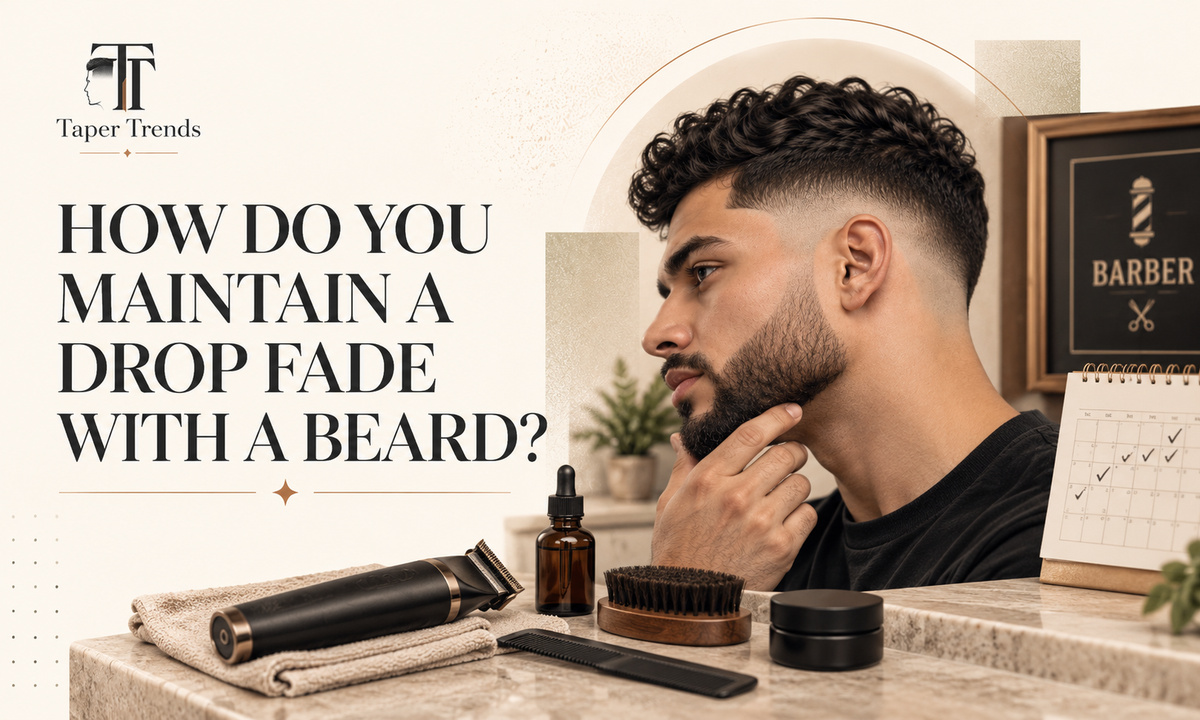
How do you maintain a drop fade with a beard?
Maintain the haircut, the beard, and your skin as three separate jobs. Your barber looks after the drop curve and sideburn blend, which Forte Series suggests refreshing every two to three weeks. You handle washing, styling the top, and light beard grooming between visits. Trying to rebuild the fade at home is the fastest way to lose it, since the drop curve is far harder than the straight, guarded fade in our beginner fade-cutting guide.
At-home hair and beard routine
- Daily low-risk grooming. Wash and condition as needed, comb or brush the beard, and style the top with a light product. Philips washes, dries, and brushes the beard before any trimming, which makes stray hairs easier to spot.
- Beard outline touch-ups. Remove only obvious strays above the cheek line and below the neckline. Wahl notes that trimming against the direction of growth removes more hair, so work with the grain and take small passes. Leave the sideburn itself to your barber.
Our guide to styling a taper fade covers the blow-dry and product basics for the top in more depth.
When to book the next barber visit
Book when a step reappears at the sideburn, the curve behind the ear loses definition, or the neckline turns fuzzy. Markcutit says the sideburn blend softens first, because the shortest hair doubles in length quickly, and that the step starts creeping back after about two weeks. Treat two to three weeks as a typical range. Higher fades and skin finishes show regrowth sooner, which our low vs mid taper fade comparison illustrates. On a short rebooking cycle, the barber tip calculator works out what to leave at the chair.
What mistakes can ruin the fade or irritate your skin?
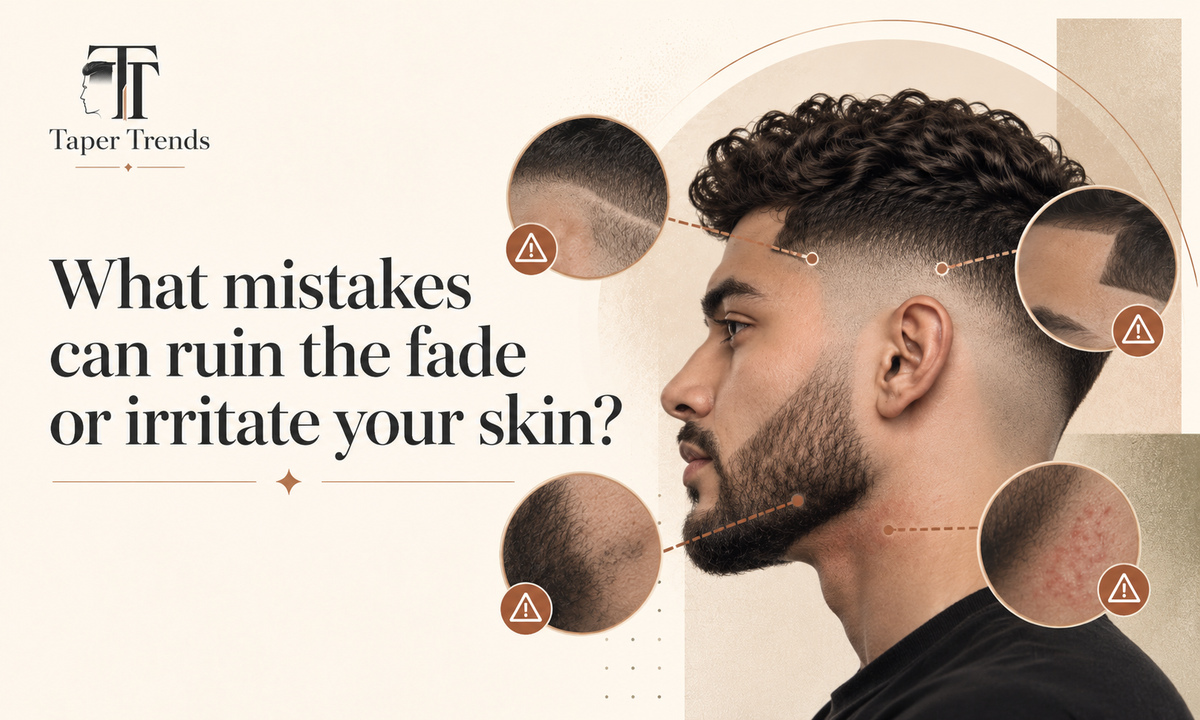
The costliest mistakes are cutting too much too fast, losing the drop curve, and pushing your skin past what it tolerates. Skin irritation is never fixed by shaving closer.
Common shape and blending errors
| Mistake | What you see | Fix |
|---|---|---|
| Sideburn cut too short | Hard step beside the ear | Soften with clipper-over-comb, or let it grow |
| Drop curve flattened | Looks like a regular fade | Show a rear photo before the cut starts |
| Beard thinned too far | Weak jaw outline | Stop trimming and let length return |
| Cheek line set too low | Smaller beard, wider-looking face | Wait for regrowth, then reset both sides |
| Uneven cheek lines | Lopsided beard | Compare both sides in a hand mirror |
Markcutit's cheek line guide explains why the fourth row matters. A line cut too low can take about two to eight weeks to grow back, depending on beard length.
Razor bumps and sensitive skin
If close shaving irritates your skin, ask for a near-skin or shadow finish instead of bare skin. The American Academy of Dermatologyexplains that razor bumps develop when shaved hairs curl back into the skin, and recommends shaving in the direction of growth while the hair is soft. For people with acne keloidalis nuchae, the AAD's self-care guidance advises haircuts that avoid shaving the back of the neck and head where possible. Bumps that keep coming back are worth showing a board-certified dermatologist. Our high taper fade for Black men and mid taper fade for Black men guides cover bump-safe finishes for tightly curled hair in more detail.
FAQs about the drop fade with beard
Can you get a drop fade with patchy cheek growth?
Yes. The drop fade shapes your scalp, so it doesn’t depend on your beard at all. What patchy cheeks limit is a smooth, connected beard fade. Ask your barber for a shorter, even beard, a goatee, or a deliberate break at the sideburn, and keep the cheek line conservative so the gaps don’t become the focus.
Does a drop fade with a beard need to be a skin fade?
No. The drop describes the curved path of the fade line, while skin, near skin, or a visible shadow describes how short the shortest section gets. You choose them separately. A skin finish gives the sharpest contrast, and a shadow finish looks softer next to a beard and is gentler on skin that reacts to close shaving.
Can a goatee work with a drop fade?
Usually, yes. With no hair on the cheeks, there’s no sideburn-to-beard blend to manage, so the sideburn can simply be cut to match the fade. The goatee then reads as its own shape. Ask for clean outlines so both shapes look planned together.
How long should your beard be before blending the sideburn?
There’s no universal minimum. Philips starts by getting the beard to your preferred length and notes that more length gives a more dramatic fade. Markcutit adds that a bigger jump between the shortest and longest lengths needs a taller transition. If unsure, grow it a little longer and let your barber decide.
Can a drop fade work with a receding hairline?
Yes. A drop fade shapes the sides and back, so it doesn’t rely on your front hairline. Top length and forehead coverage are separate decisions, so ask your barber what top style suits where your hairline sits now. A fade changes how the haircut looks. It doesn’t change how your hair grows.
Can you keep a natural cheek line instead of a sharp lineup?
Yes. Cheek line sharpness and the sideburn connection are independent choices. Markcutit lists natural, sharp, and lowered cheek lines as the three broad options, and Philips suggests that if you prefer natural cheeks, you leave the line and clean up only the stray hairs above it. You can still ask for the sideburn blend to connect.
Want the drop curve with a longer back instead? Our drop fade mullet keeps the crown and back long, and pairs just as easily with a beard.
Final checklist before you book
- Fade height: low, mid, or high.
- Drop path: the curve behind the ear, shown in a rear photo.
- Shortest point: skin, near skin, or a visible shadow.
- Top: the length you want and how you plan to style it.
- Beard: overall length, cheek line, and neckline.
- Sideburn: connected blend or deliberate break.
- Photos: side, rear, and a sideburn close-up.
The bottom line
A drop fade with beard works when the fade and the beard are planned together and the sideburn is treated as the bridge between them, not an afterthought.
Bring the list and the photos, and let your barber tell you what your growth can realistically support. Booking the next visit before you leave keeps the blend from drifting too far between cuts.
Want more fade and beard guides?
Browse clean, barber-ready breakdowns for every hair type.