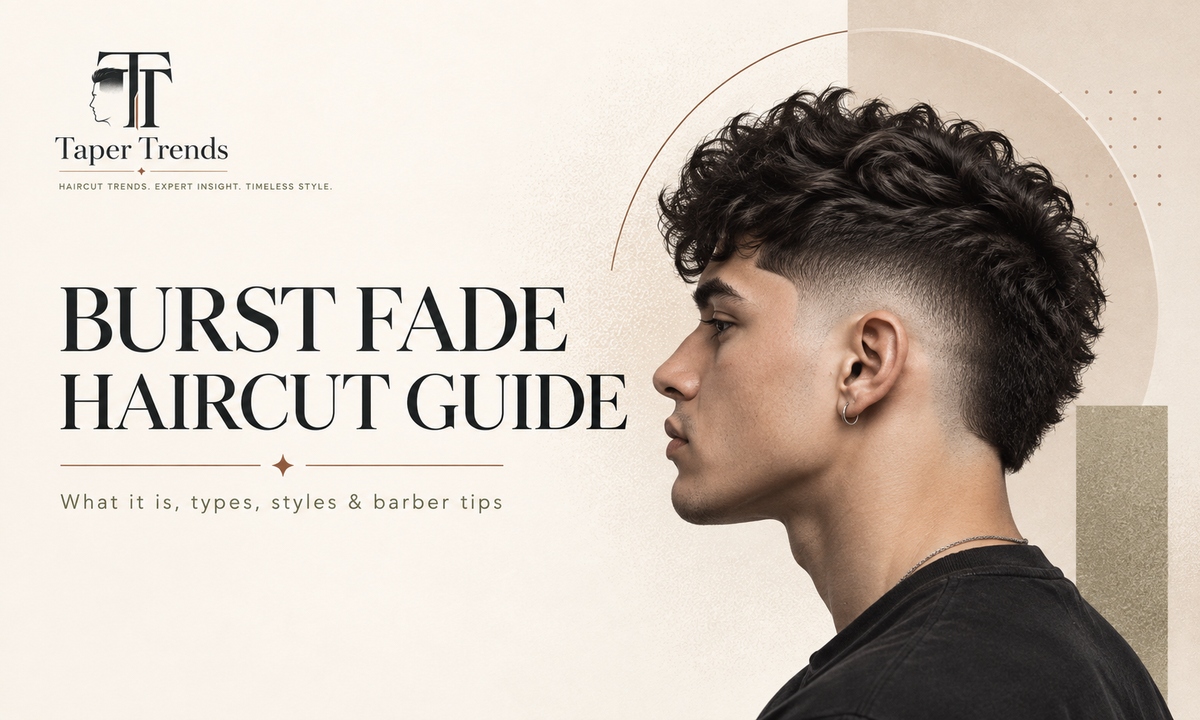
A burst fade is a fade haircut whose shortest point sits directly behind the ear, with the hair getting longer as the fade moves outward in a curved sweep. From the side it reads as a semicircle radiating around the ear rather than a flat band across the head. It works under a mullet, a mohawk, a textured crop or a long top.
This guide covers what makes a fade a burst, who it suits, how the low, mid and high versions differ, and what to say in the chair. The term is no longer shop shorthand: GQ put it on its list of the seven best short haircuts for men in 2026, alongside the soft mullet and the bowl cut. If you want the wider family first, our guide to every kind of fade haircut sets the burst next to the other ten, our types of fade haircuts comparison helps you pick one, and our complete low taper fade haircuts guide covers the quieter end of the same spectrum.
What is a burst fade?
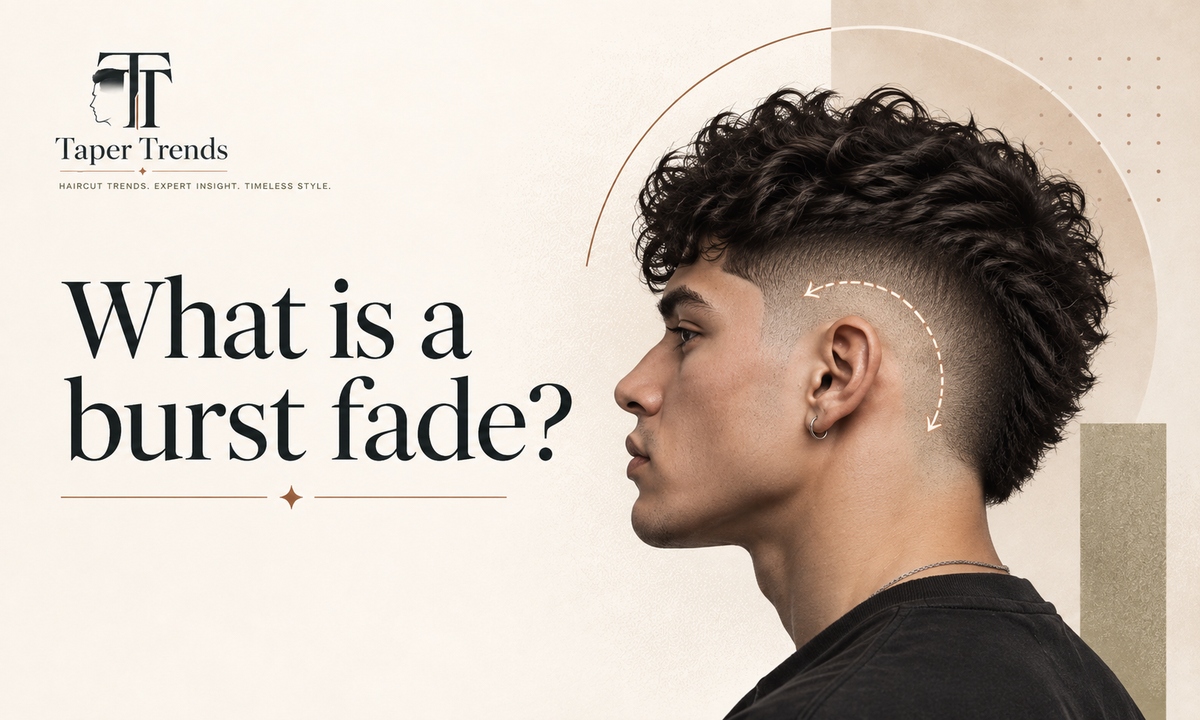
A burst fade is defined by the shape of its fade line, not by the hair on top. The shortest point sits directly behind the ear, and the length increases as the fade moves outward and upward in a curved arc. CADMEN Barber Academy describes the result as a semicircular pattern radiating from behind the ear rather than a horizontal band around the sides and back.
That makes “burst fade” an incomplete request on its own. CADMEN's breakdown of fade types treats every fade as a combination of three variables: level, meaning where the graduation starts on the side; depth, meaning how short the shortest zone goes; and shape, meaning whether the line runs straight, drops behind the ear (as in a low drop fade, mid drop fade or high drop fade), or bursts around it. The same three-variable logic runs through our taper vs fade explainer, which is the fastest way to stop the words fighting each other.
Burst is a shape. Say only that word and your barber has to guess at level and depth, usually from habit or from whatever the shop has been cutting that month. Most burst fade disappointment traces back to that gap.
How does the burst shape work around the ear?
The point behind the ear is the anchor, and everything else graduates away from it. A barber establishes the arc first, usually with an outliner or T-blade, takes that point down to its shortest setting, then blends outward along the curve through the guard sizes. The hair gets longer in every direction as it moves away: up toward the top, forward toward the temple, down toward the neckline.
It is harder to cut than a straight fade. CADMEN's technique material notes that the guide follows a curve rather than a horizontal line, which asks for more three-dimensional thinking. When it goes wrong it goes wrong at the arc, and an uneven arc reads as patchy rather than radiating (see how to fix a bad fade for what a barber can correct). A level blend is more forgiving, which is part of why a standard taper fade remains the safer first booking at an unfamiliar shop.
What hair stays longer in a burst fade?
A burst fade defines the sides only, so the top and back are separate decisions you still have to make. Plenty of versions keep enough length above and behind the arc for a mullet, a mohawk or a textured crop, but nothing about the cut requires it. CADMEN notes that with a short top the burst shape is still there but reads as a quiet detail rather than the point of the haircut. That is a legitimate choice, not a compromise — the same reasoning behind our low taper fade for short hair guide.
Who does a burst fade suit?
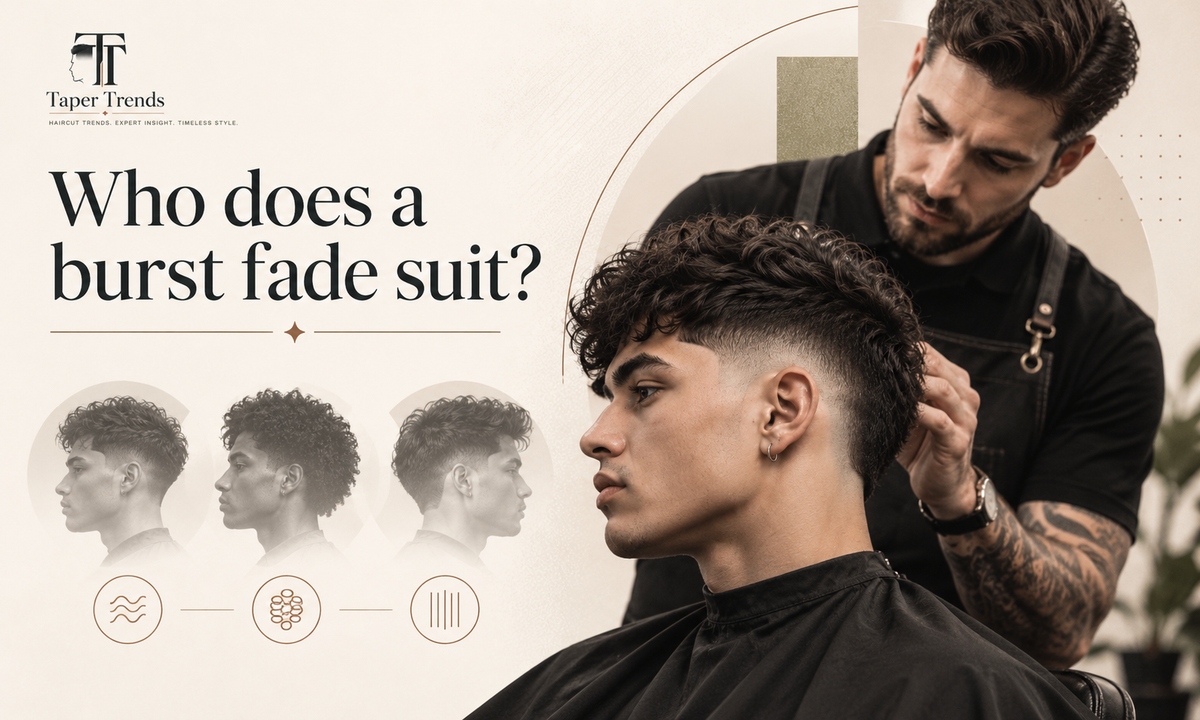
Suitability comes down to texture, density, growth pattern, how much contrast you want and how often you are willing to sit in the chair. There is no single correct face shape. Because the fade wraps around the ear rather than sitting at a fixed height, it adapts to most heads, and the right version comes out of a two-minute conversation rather than a chart.
Which hair textures work with a burst fade?
Every texture works. Straight, wavy, curly and coily hair all pair with a burst fade, because the burst is a side technique and the texture lives on top. What changes is how sharp the arc looks and how much length the top needs to balance it. CADMEN makes the same point from the barber's side: the top style, not the texture, decides whether the finished shape reads as balanced.
Straight and wavy hair shows the curved geometry most clearly, since there is less volume competing with the fade line. The trade-off is that a flat top looks flat against a sharp side. Most straight-haired versions need enough length for movement, a defined part, or a light product that creates separation — the ground our low taper fade for straight hair and drop fade for straight hair guides cover in detail — and our burst fade for straight hair guide works the same problem through on the curved arc. Wavy hair does some of that work for you, and our wavy hair guide shows how much length the movement needs.
Curl shrinkage means the hair is longer than it looks, often by a lot, so barbers typically leave more length on curly and coily tops rather than reaching for the guard they would use on straight hair. The fade itself is the same technique. CADMEN's guidance for tightly coiled hair is to work with the natural growth pattern when establishing the arc, since the curve has to sit on the head it is actually on. Ask your barber to check the top dry rather than stretched, so the shape is settled before the fade line is locked in. Our curly low taper fade and afro low taper fade guides go further on shrinkage and guard choice, and if you train a 360 pattern, our low taper fade with waves guide explains where the blend has to stop.
How do head shape, density and lifestyle affect the choice?
Density, growth pattern and your realistic rebooking habits matter more than face-shape formulas. CADMEN's own face-shape answer puts hair texture, head shape and lifestyle on equal footing with fade level, which is a more honest starting point than a chart. Four things genuinely change the recommendation:
- Fine or thinning hair holds less contrast, and an uneven arc shows up faster on a sparse side.
- Dense hair keeps a sharp edge longer between appointments.
- A conservative dress code points toward a lower arc finished with a guard rather than skin.
- If you cannot get back in the chair inside three weeks, ask for the version that softens gracefully rather than the one that looks best on day one.
If the first point is the one that applies to you, our guide to low taper fades on thin and thick hair covers how much contrast each density can actually hold.
Low vs mid vs high burst fade: which should you choose?
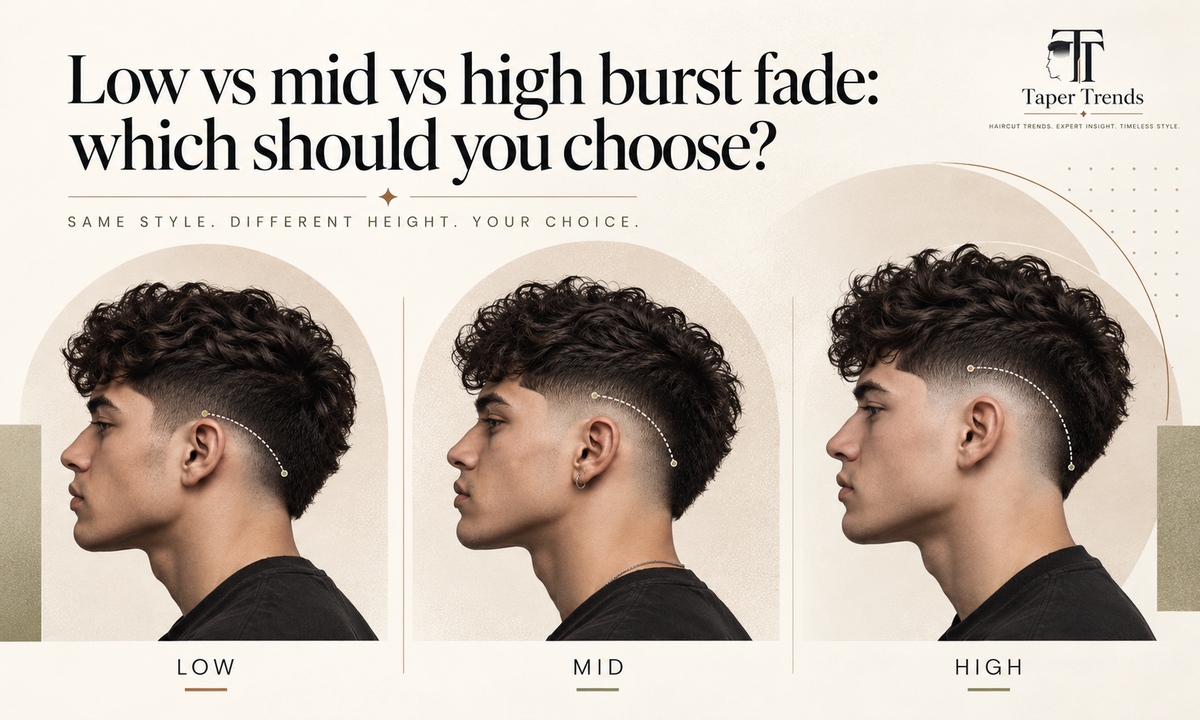
Low, mid and high describe how far up the side the arc climbs. They do not change the curved shape, and they do not decide how short the shortest point goes. CADMEN defines the levels the same way for any fade: a low fade begins just above the natural hairline, a mid fade at the temple midpoint, a high fade near the crown. Applied to a burst, the level sets how much of the side the arc covers and how strong the contrast reads. The same height ladder is laid out angle by angle in our low vs mid vs high fade, low vs mid taper fade and low vs high taper fade comparisons.
Shop vocabulary for this is not standardized, which is the recurring theme of the haircut. A photo settles in five seconds what a label argues about for five minutes, and our guide on how to ask your barber for a fade covers the words to pair with it.
What is a low burst fade?
A low burst fade keeps the arc close to the ear and the natural hairline, so the shortest area sits low and most of the side length stays. Contrast is subtle, the curve is still clearly visible from the side, and it is the easiest version to grow out. Our taper low burst fade guide covers that version on its own, from styles to barber wording.
What is a mid burst fade?
A mid burst fade raises the arc to roughly the midpoint of the side, which is where most people picture the cut when they ask for it. CADMEN notes the mid level is the most commonly requested fade level in most barbershops, and the logic carries over: visible enough to read clearly as a burst, without the exposure of a high placement. Our mid taper fade guide covers what that temple-midpoint height does to a level blend, and it applies to a curved one too. The dedicated mid burst fade guide compares that height with low, high, drop and taper fades.
What is a high burst fade?
A high burst fade takes the arc up near the temple and crown, producing the strongest contrast between the faded side and the top. It is also the least forgiving, because there is nothing above the arc to soften it. Agree on exactly where the curve should stop before the first pass, and expect to rebook sooner. The dedicated high burst fade guide covers its styles, the barber brief and upkeep, while our high taper fade guide and the mid vs high comparison both walk through the scalp-exposure trade-off in more detail.
| Version | Where the arc sits | Contrast & length kept | Best for |
|---|---|---|---|
| Low burst fade | Just above the natural hairline, close to the ear | Subtle contrast, most side length kept | First-timers, dress codes, longer gaps between cuts |
| Mid burst fade | Around the temple midpoint | Balanced contrast, moderate side length kept | The default request for most people |
| High burst fade | Near the temple and crown | Strong contrast, least side length kept | Bold, high-contrast looks with a shorter rebooking window |
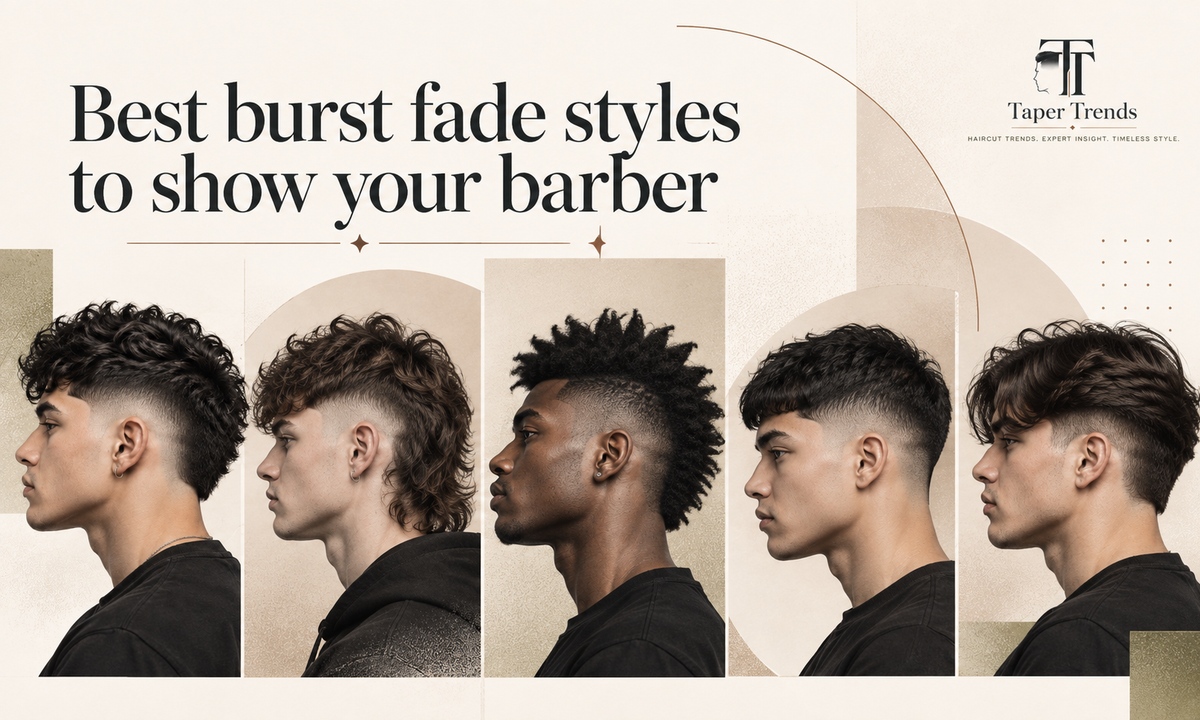
Best burst fade styles to show your barber
The arc looks completely different depending on what sits above it. These five change the top and back silhouette rather than the guard number, which makes them genuinely separate requests instead of near-duplicates from a gallery of thirty.
1. Burst fade mullet
The burst fade mullet keeps the arc tight around the ear while length runs through the crown and down the nape. CADMEN describes the burst as making a cleaner transition between short sides and a long back than a straight fade manages, which is why the pairing caught on. Ask for the burst to stay tight around the ear rather than blending upward into the back length, because blurring that boundary costs you the contrast that makes the cut work. Our full burst fade mullet guide walks through the four settings that separate every version of it, and for the level-blend versions of the same silhouette, see our low taper fade mullet, mid taper fade mullet and high taper fade mullet guides. If you want the curve to dip behind the ear instead of circling it, the drop fade mullet is the closest relative.
2. Burst fade mohawk or faux hawk
This is the pairing CADMEN calls the most common one, and the reasoning is visual: the curved sides pull the eye toward the strip of length running down the center. A faux hawk gets the same effect with less commitment, since the sides are faded rather than shaved out and the top is styled up rather than cut into a strip. Our low taper fade mohawk guide compares the burst, skin and faux hawk versions side by side, and our dedicated burst fade mohawk guide takes the strip-over-arc pairing apart decision by decision.
3. Curly or coily burst fade
Curls on top against a clean arc below is the strongest contrast this haircut offers, and it is a long-standing pairing on textured hair rather than a recent one. Leave more length than feels necessary, because shrinkage takes some of it back. A twist-out or a defined afro shape holds the contrast well as the fade softens. Our burst fade for curly hair guide takes this pairing apart variable by variable, our high taper fade on curly hair guide covers the same balance at the boldest height, and our guide for Black men covers waves, coils, twists and locs at taper heights, while our burst fade guide for Black men runs through 15 versions of this exact arc. If you wear locs, the dreads and locs guide is the better starting point.
4. Short or textured-top burst fade
A burst fade does not need a long top. Kept short and textured, as a crop or a light fringe, the arc becomes a detail rather than a statement. That makes it the easiest entry point if you are unsure about a bolder silhouette, and the easiest version to explain at work on Monday. Our French crop and textured fringe guides cover the two most common short tops to put above it, the burst fade textured fringe pairs that piecey fringe with this exact arc, the drop fade textured fringe pairs it with a curve that dips toward the nape instead, and the burst fade Edgar covers the blunt-fringe version of that same short top.
5. Straight or wavy burst fade
Straight and wavy hair shows the fade's geometry most clearly, so this version lives or dies on the top. Directional styling does the work: a defined part, hair pushed to one side, or enough length for the wave to show movement. Without it, a sharp arc under a flat top looks unfinished. A side part or a middle part both give the top the direction it needs.
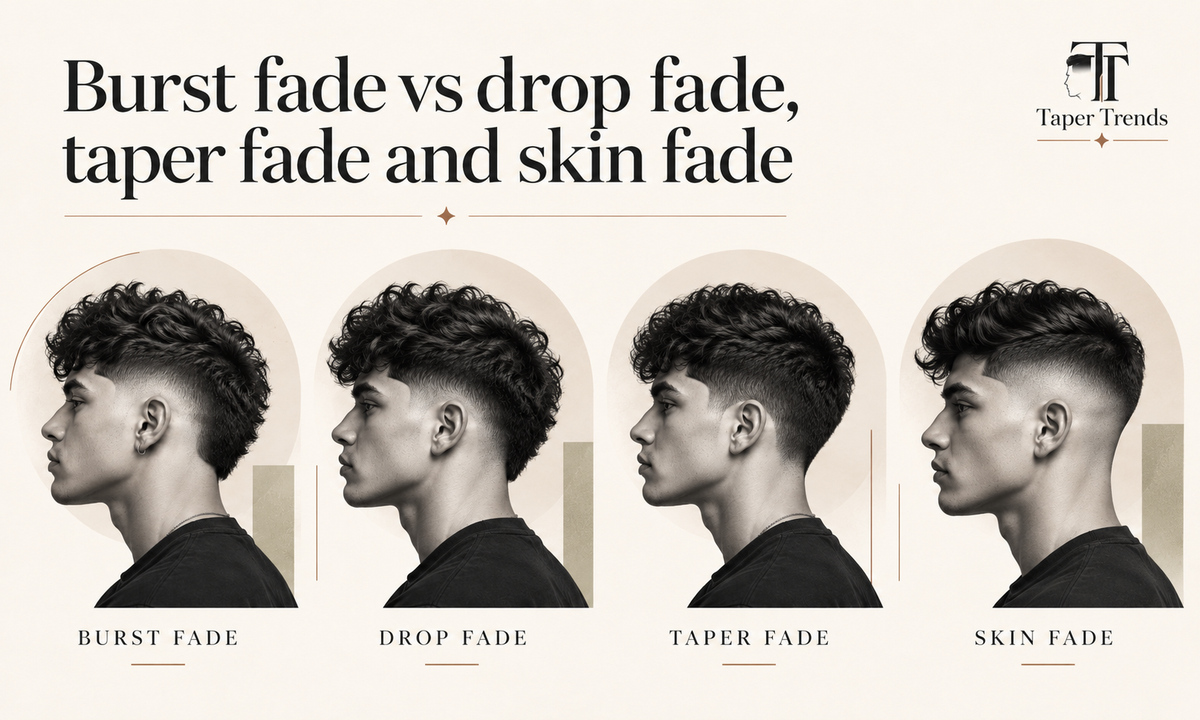
Burst fade vs drop fade, taper fade and skin fade
These four terms get used loosely and shops do not apply them identically. Two of them describe a shape and two describe a depth, which is where most of the confusion starts.
| Cut | What it describes | Where the fade line goes | Best when |
|---|---|---|---|
| Burst fade | Shape | Radiates in a semicircle from behind the ear | You want a rounded, ear-framing shape |
| Drop fade | Shape | Curves downward behind the ear toward the neckline | You want a rounder silhouette with more fullness above the fade line |
| Taper fade | Depth | Usually level, stopping at short stubble rather than skin | You want a subtler cut that grows out gracefully |
| Skin fade | Depth | Whatever shape it is paired with, taken to bare skin | You want maximum contrast at the shortest point |
Burst fade vs drop fade
Both curve behind the ear, which is where the confusion lives. The difference is what the line does next. A drop fade curves downward behind the ear toward the neckline, following the contour of the back of the head, which leaves more hair above the dropped line and gives the crown a fuller, rounder profile. A burst radiates outward from behind the ear in a fuller semicircle and does not necessarily drop to the neckline at all. CADMEN is blunt about the consequence: some barbers use the two terms interchangeably, which is a reason to bring a photo rather than to study the terminology harder. Our drop fade vs burst fade comparison explains what to check from the side and back, our low taper drop fade guide shows exactly where that downward curve lands, and our drop fade guide for Black men compares the two shapes on coils, waves and locs.
Burst fade vs taper fade
These two are not alternatives, because they describe different variables. A taper is a depth (our skin fade vs taper fade guide shows where each finish stops): the graduation stops at a short, visible stubble length instead of reaching bare skin. A burst is a shape. You can have a burst cut to taper depth, and plenty of people do without knowing that is what they asked for. What taper depth buys you, per CADMEN, is a gentler grow-out, because there is no bare skin to mark where the regrowth starts — the argument our low taper vs low fade comparison works through in full. For the full side-by-side, including which hair types suit each and how the two grow out, see our dedicated burst fade vs taper fade comparison.
Burst fade vs skin fade
Same logic, opposite end. Skin fade describes how close the shortest point is cut, all the way to bare skin. Burst fade describes the shape of the line around the ear. The two combine, and the combination is usually just called a skin burst fade.
This is the one place the source material disagrees. CADMEN's technique guide treats a zeroed point behind the ear as the standard anchor for the cut, while its client-facing guide tells clients to specify skin or a guard number as a separate decision. In practice the assumption varies by barber, so state it either way.
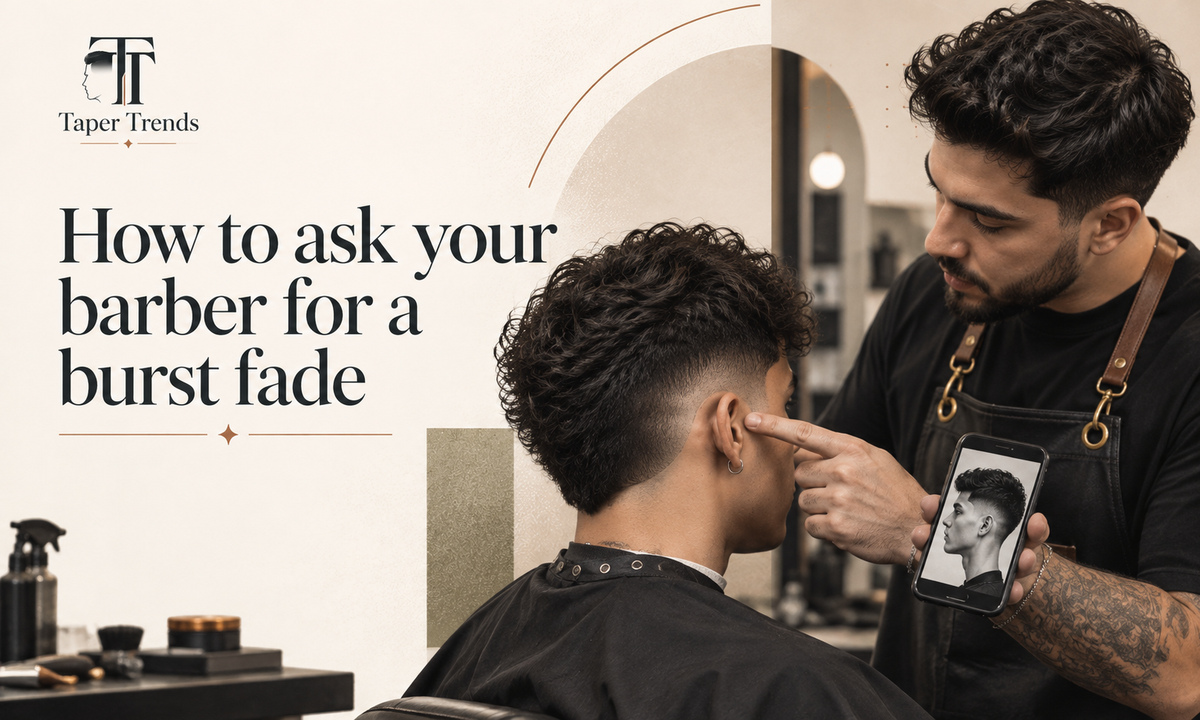
How to ask your barber for a burst fade
Name five things and you have described the haircut completely: arc placement, shortest finish, back treatment, top length and hairline finishing. CADMEN's consultation advice covers two of them, telling clients to point behind the ear, specify skin or a number, and say where the top section starts. The other three are the ones people forget.
Use a five-point barber brief
- 1Choose the arc placement. Low, mid or high, and point to where you expect the curve to stop. This is the single biggest driver of how bold the result reads.
- 2Specify the shortest finish. Bare skin, or a guard number. Do not assume burst implies skin, because your barber may not assume the same thing.
- 3State what happens at the back and nape. Keep the length, taper it, or blend it into the sides. The word burst describes the sides and says nothing about the back, so if you do not raise it, nobody does.
- 4Specify the top length and silhouette. Mullet, mohawk, textured crop, or simply leave it long. The burst implies no particular top.
- 5Confirm hairline, sideburn and beard treatment. Natural edge, sharp lineup, or a fade into the beard, agreed before the cut starts rather than after.
Said out loud, the whole brief fits in one sentence:
“A mid burst fade, shortest point behind the ear taken to a one rather than skin, keep the length at the back, leave the top long enough to style, and fade the sideburn into the beard.”
On point five, our dedicated burst fade with beard guide covers the curved join step by step, while our low taper fade with a beard and high taper fade with a beard guides both cover the sideburn-to-beard blend in the detail a single sentence cannot. If you want the curve behind the ear instead of around it, our drop fade with beard guide shows that join, and our skin fade with beard guide covers a skin finish meeting the beard. Our low vs mid vs high skin fade breakdown shows how the same three heights behave once the finish reaches skin.
What should your reference photo show?
Bring a photo of the side profile and one of the back, ideally on hair with similar density and texture to yours. CADMEN's reasoning is straightforward: arc height and fade depth vary enough between versions that a photo is the only way to confirm you and your barber are picturing the same haircut. A single front-facing shot shows neither detail. If you are still building a mental picture of how these blends sit from each angle, our guide to what a low taper fade looks like is a useful reference set.
What are the most common miscommunications?
Three keep recurring. Saying burst fade without specifying the back. Naming a placement without confirming the closeness. And treating taper, drop and burst as interchangeable when two describe shape and two describe depth. All three take two minutes to settle beforehand and three weeks to grow out afterward.
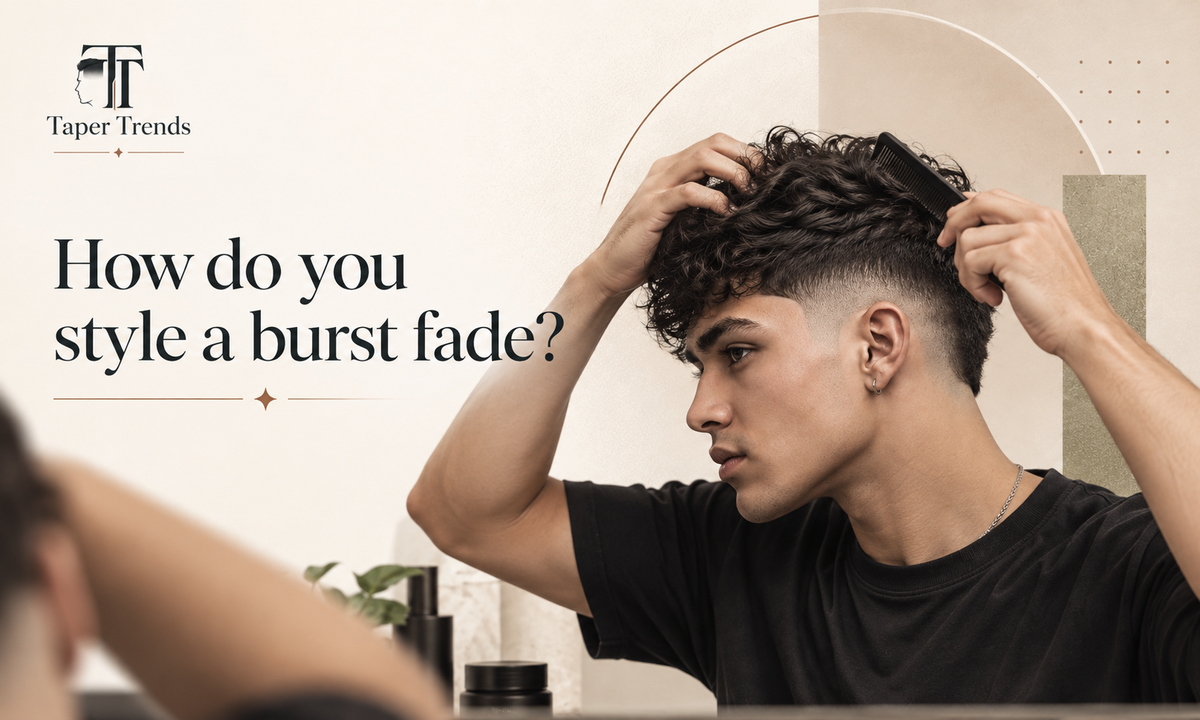
How do you style a burst fade?
Daily styling is about the top. The arc holds its own shape, needs nothing from you, and looks the same whether you spend one minute or ten. A comb, a small amount of product matched to your top length, and a couple of minutes of drying covers most versions. Our styling routine for taper fades breaks the same steps down product by product.
Styling by hair texture and top style
For straight and wavy tops, the goal is separation and direction. A light cream or matte paste adds texture without flattening the top, and a comb defines a part if there is enough length to hold one. Blow-drying in the direction you want the hair to sit does more than any product.
For curly and coily tops, the goal is shape and moisture. A curl cream or light oil on damp hair holds definition and keeps frizz down, and air-drying or diffusing preserves volume in a way brushing curls out does not. No single product suits a whole texture category, so treat this as the category to shop in rather than a recommendation. If you want the rounded, blow-dried version of a curly top, our blowout guide for curly hair covers the drying technique.
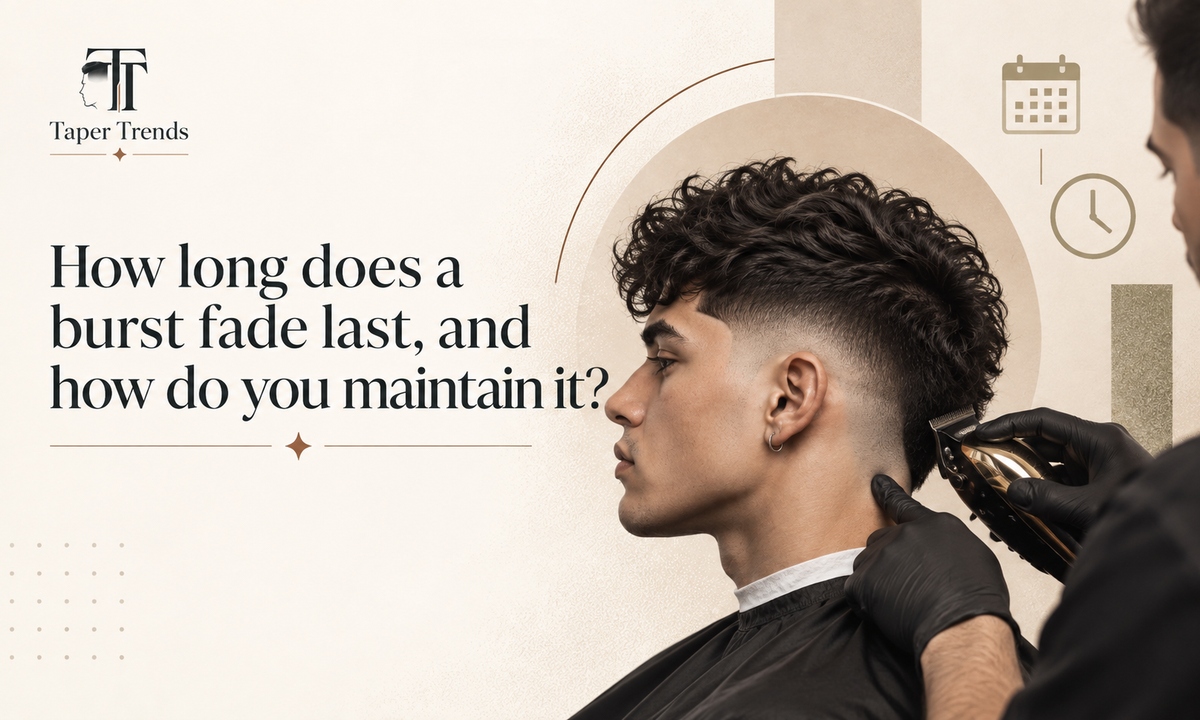
How long does a burst fade last, and how do you maintain it?
The arc softens gradually rather than growing out badly. According to CADMEN, regrowth shows first at the shortest point behind the ear, most men notice it around the two-week mark, and the arc blurs noticeably by week three or four. A touch-up roughly every three weeks holds the defined shape, and clients who want it at its sharpest tend to rebook every two. Our guide to how often you should get a haircut compares that rhythm with every other cut.
Treat those numbers as barbershop practice rather than biology. Your growth rate, how high the arc sits and how close the shortest point was cut all move the interval, and a low guard-finished burst stretches further than a high skin one.
Touch-up timing and grow-out
What changes between appointments is contrast, not shape. The curve blends into the surrounding hair rather than disappearing abruptly, which is why the cut looks progressively softer rather than progressively wrong. Higher and closer versions cross that line sooner because they have more contrast to lose.
Re-establishing the arc yourself is harder than a straight fade cut at home, since you cannot see both sides at once and the curve has to match, and even the closest clipper in our best clippers for fades guide cannot fix that. If you are stretching time between visits, ask your barber to clean up the neckline only and leave the arc alone.
Scalp and skin care for very close or skin bursts
This applies to skin-level finishes only, not to a guarded burst. Shaving hair very close leaves a sharp cut end that can re-enter the skin, which is what causes razor bumps, or pseudofolliculitis barbae. DermNet notes the reaction is most common on the face and neck after shaving but can occur anywhere hair is shaved, and that it is more likely where hair is tightly curled and coarse.
The adjustment is small. DermNet's prevention guidance centers on not shaving as close as possible, leaving roughly a millimetre of stubble rather than going bare. If irritation keeps appearing along your fade line, a short guard instead of skin is the first thing to try, and a clinician is the right call if it persists or scars.
Is a burst fade right for you?
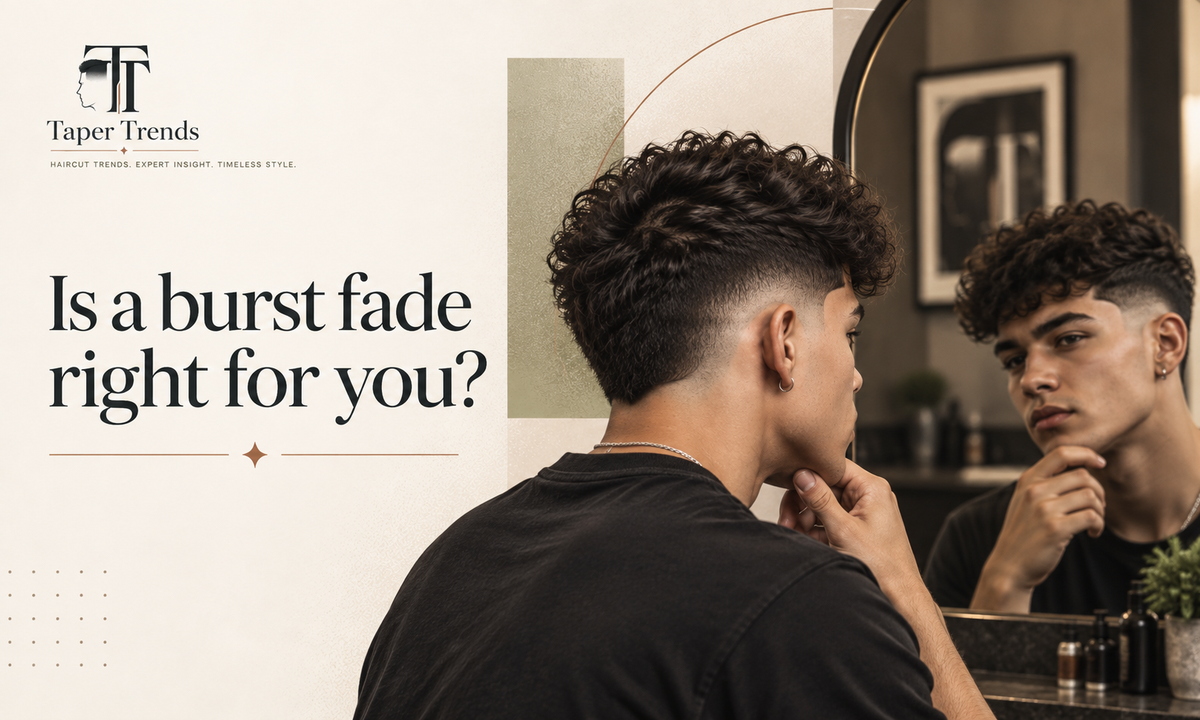
A burst fade suits you if you want a distinctive side profile and are comfortable with a shorter maintenance window than a basic fade needs. It suits you less if you want six weeks between cuts, if your barber does not cut curved fade lines regularly, or if a high-contrast look does not fit where you spend your days.
Main benefits
The curved arc gives you a side profile standard fades do not, and it is the only fade shape built specifically around the ear. It pairs with several top silhouettes, so you can change the haircut substantially without changing the request. It works on every texture. And the low version is genuinely understated, which means one decision separates a loud version from a quiet one.
Trade-offs and edge cases
It leans on barber skill more than a straight fade does, because a curved guide line is harder to execute evenly and an uneven arc is obvious. It needs attention sooner the higher and closer it is cut. Skin-level versions can irritate skin prone to ingrown hairs. And the most common disappointment has nothing to do with the arc: it is a back that came out shorter than expected.
What are the best alternatives to a burst fade?
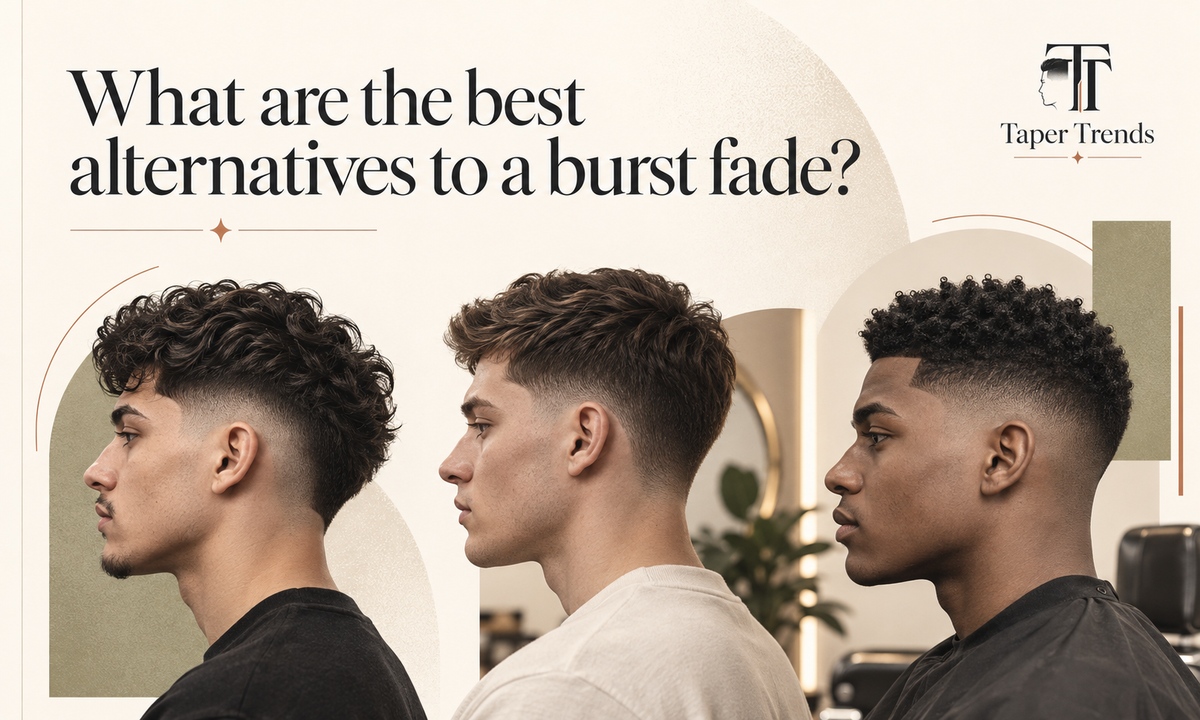
If the curve or the upkeep does not suit you, three cuts cover similar ground. Choose based on what specifically bothers you about the burst.
| Choose this | If you want |
|---|---|
| Drop fade | A curved shape with a fuller, rounder crown, and a fade line that follows the back of the head rather than circling the ear |
| Low taper | The subtlest option, finished at stubble rather than skin, growing out with the least visible line |
| Standard low or mid fade | A level fade line with no curve at all, and the widest range of compatible top styles |
Each has a guide of its own: the low taper drop fade for the curve that follows the back of the head, the low taper fade for the subtlest finish, and the low-mid taper fade if a level line at a middling height is closer to what you pictured. If you would rather see every option in one place before choosing, start from our types of fade haircuts guide.
Burst fade FAQs
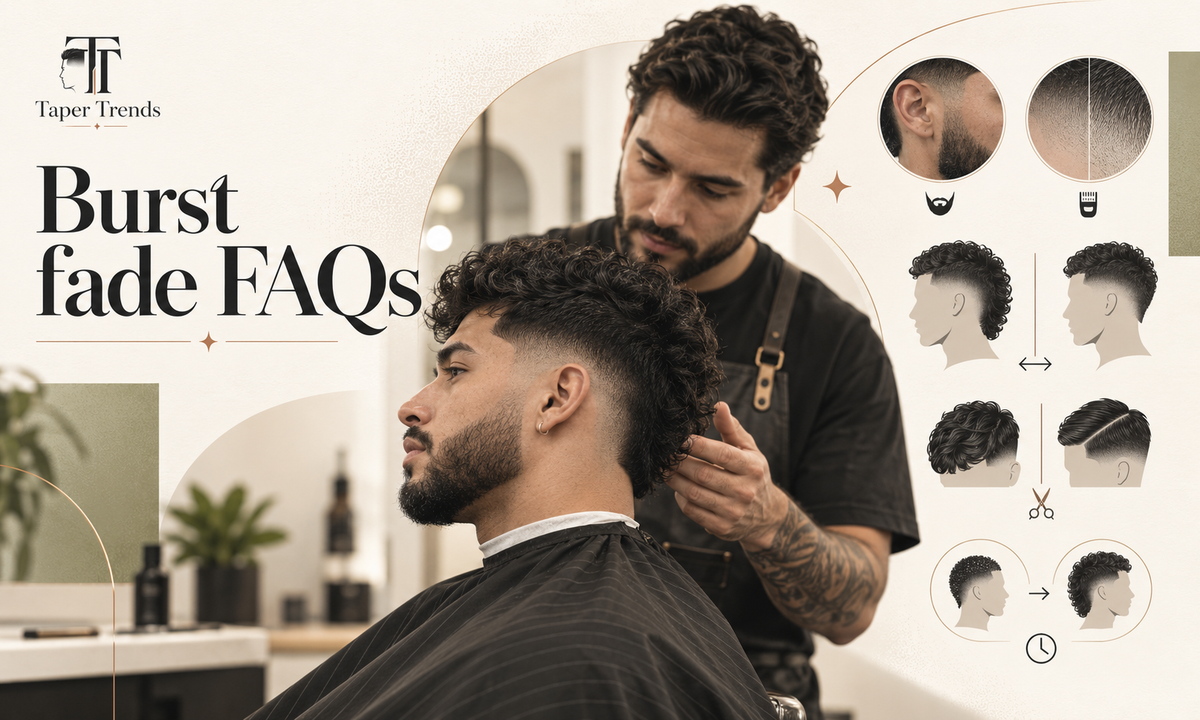
Can a burst fade connect into a beard?
Yes. Ask for the sideburn to fade into the beard rather than stop at a hard line, and raise it during the consultation rather than at the end of the cut. Beard work is sometimes billed separately from the haircut, so ask how your shop prices it when you book.
Can you get a burst fade without going to skin?
Yes. Shape and closeness are separate decisions, so the arc can be finished at a guard number instead of bare skin. Say the number out loud and confirm it before the first pass, because some barbers default to a skin finish on this cut unless told otherwise.
How much hair do you need at the back for a burst fade?
There is no minimum. A burst fade works under a short textured top with no extra length at the back, though the shape reads as a subtle detail rather than a statement at that length. Longer silhouettes like a mullet need real growth first, so plan on a few months if you are starting from short.
Should both sides of a burst fade be exactly identical?
Close, but not identical. Ear position and head shape are rarely symmetrical, so a barber balances the two sides by eye rather than matching them by measurement. Small differences are normal and go unnoticed once the cut is finished and styled.
Can you wear a burst fade with a crop or side part instead of a mullet?
Yes. The mullet and mohawk pairings get the attention, but the burst is only a side treatment. It sits fine under a textured crop, a side part or any short top, with less contrast than the long-top versions produce.
What should you do if a burst fade was cut too high or too short?
Wait rather than fix it immediately. There is little room to correct a too-high arc without removing more hair, so let a few weeks of growth give the barber something to work with, then reset the arc lower at the next appointment. Ask for the edge to be softened in the meantime rather than recut.
Cutting a burst fade for a younger family member instead? Our burst fade for boys guide covers the same curved arc with heights, finishes, and a barber script sized for a kid.
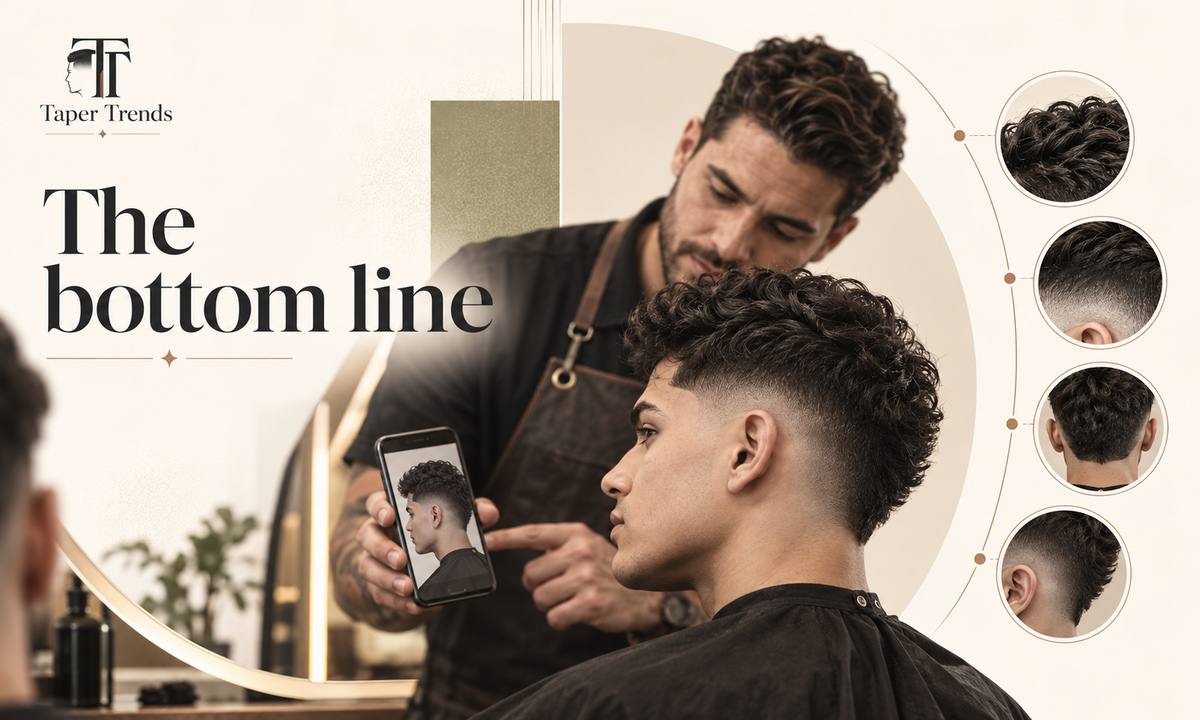
The bottom line
A burst fade comes down to four decisions: how high the arc climbs, how short the shortest point goes, what happens at the back, and what stays on top. None of them require you to know anything about barbering. They just have to be said out loud before the clippers start.
The bottom line
Burst names a shape and nothing else. The arc is the part your barber owns; the level, the depth, the back and the top are the parts you have to name before the first pass.
Bring a side photo and a back photo to your next appointment and walk through the five points: placement, closeness, back treatment, top length, hairline finish. That conversation does more for the result than any label does on its own.
Want more fade guides?
Browse clean, barber-ready breakdowns for every fade shape and hair type.