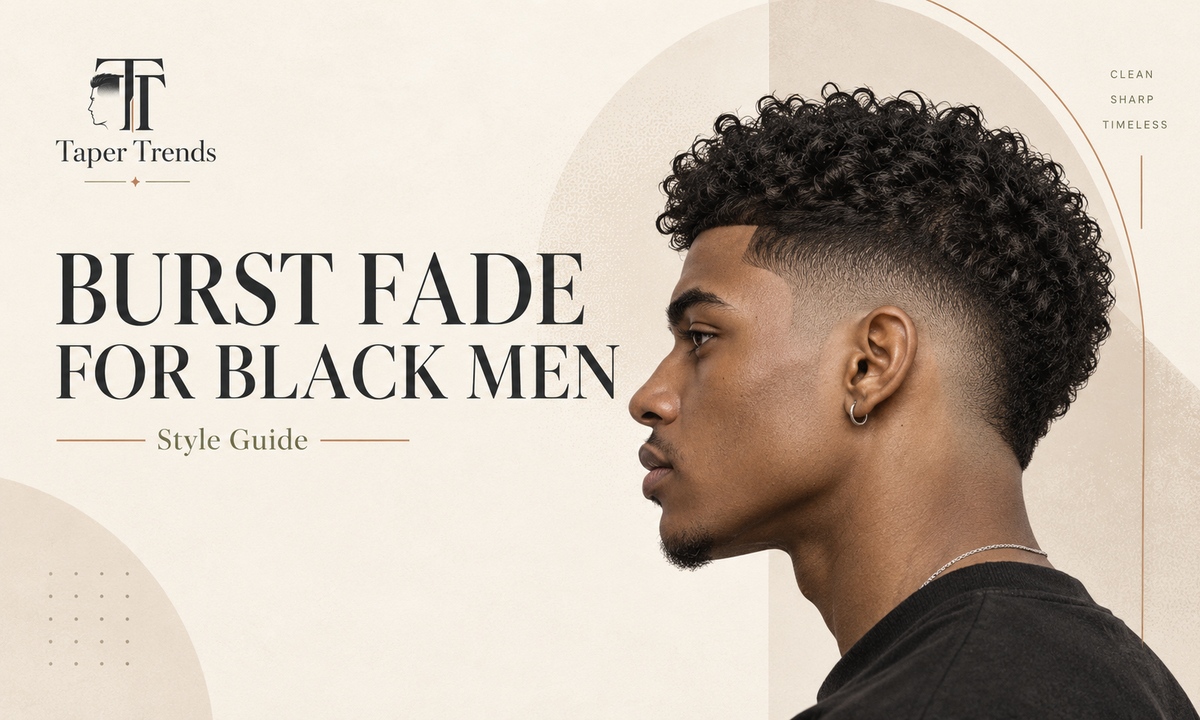
A burst fade for Black men is a fade that curves in a half-circle around each ear and leaves the hair behind it longer. The sides look carved out while the back keeps its weight. On Black men it works with short coils, waves, twists, an Afro, locs, or braids. The right version comes down to how much contrast you want, how often you'll go back to the barber, and how your skin handles close cutting.
If you want the arc explained on its own first, our complete burst fade haircut guide covers the geometry, the rundown of every kind of fade haircut sets the burst beside its relatives, and the complete low taper fade haircuts guide covers the quietest end of the same spectrum. For the taper-height version of this same conversation, see the low taper fade for Black men and the high taper fade for Black men.
What is a burst fade?
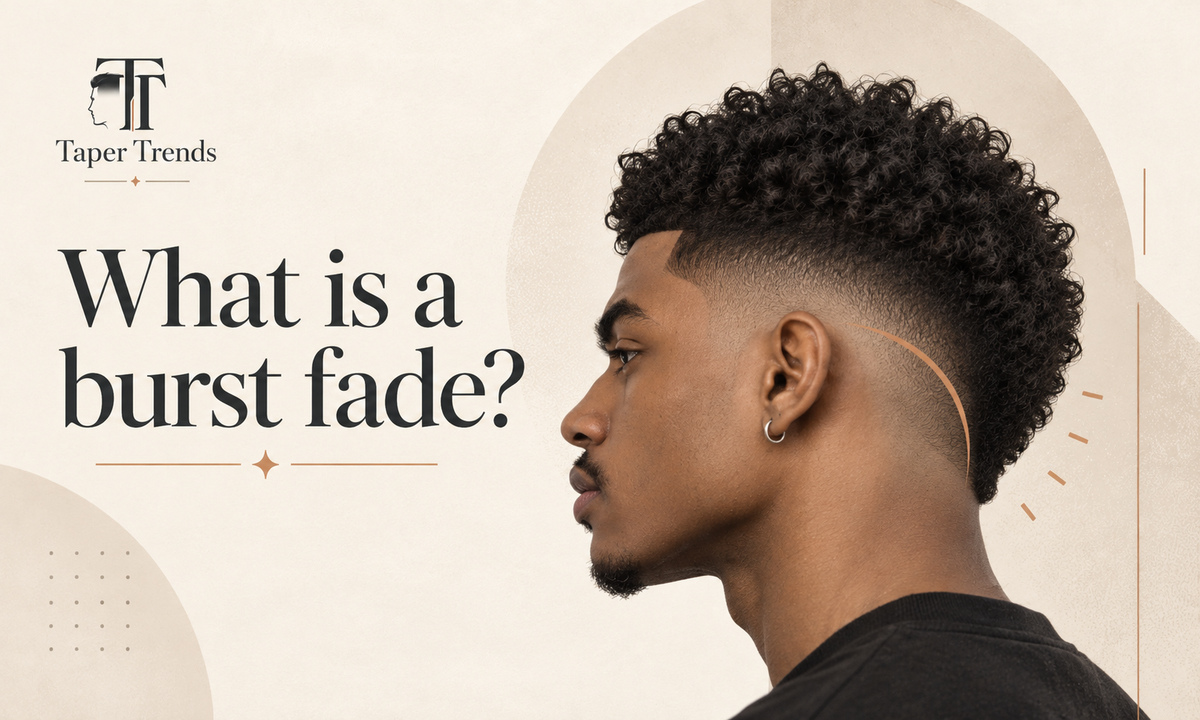
A burst fade is shaped as an arc around the ear rather than a line running level around the head. The hair is shortest close to the ear and lengthens as the curve moves up and back, and the back keeps noticeably more length than a standard fade leaves. “Burst” describes the path of the fade. It says nothing about what happens on top.
That's why the same cut sits under a buzz, 360 waves, twists, or a full frohawk. Modern Barber says the style also goes by the Gentleman's Mohawk or the South of France, and credits Usher and his longtime barber Curtis Smith with making it famous. Other barbers reserve “South of France” for a burst fade paired with a wide mohawk strip, as Barber's Take does. Two shops can mean two different cuts, so a photo settles it faster than a name — and if the strip on top is the part you want, our burst fade mohawk guide covers that pairing on its own.
What makes the fade “burst”?
The fade radiates out from the ear instead of running straight across the side of the head. Wez Jones, owner of Heartbreak Barber Club, told Modern Barber that the shape usually starts at the middle of the ear tip and fades in a circle, “a bit like a sunset.” The arc is cut the same way whatever the texture; what changes is how forgiving the blend above it is, which our burst fade for straight hair guide covers from the other end of the range, as does our drop fade for straight hair for the curve behind the ear.
Three decisions shape the result:
- Height sets the contrast. A low burst reads understated, while mid and high versions give a sharper, more dramatic transition — the same trade-off our low taper vs high taper comparison walks through angle by angle.
- The finish sets how much scalp shows. A skin finish takes the shortest area to bare skin. A shadow finish leaves a little stubble.
- Back weight is the part people forget. Charles Rose, owner of Crate, tells barbers to drop the fade line right behind the ear, because the client still wants hair at the back. That is the whole point of the cut.
Why it suits coily, curly, and Afro-textured hair
Keeping length on top and at the back leaves your texture visible, and the short arc around the ear gives it a clean edge. Modern Barber describes the cut as a long-standing go-to for Afro hair. Wahl ambassador Rhys Whitehouse adds that thicker hair makes the result more striking. The same logic drives a low taper fade afro and a burst fade on curly hair: remove bulk in a defined zone, leave the pattern alone everywhere else.
Density, growth pattern, and shrinkage still decide how it lands. A cowlick behind the ear can pull the arc off its line. Coils also sit shorter than their stretched length, so judge your top length by how your hair looks dry, not wet. If your hair sits closer to the looser end, the notes in our curly low taper fade guide apply here too.
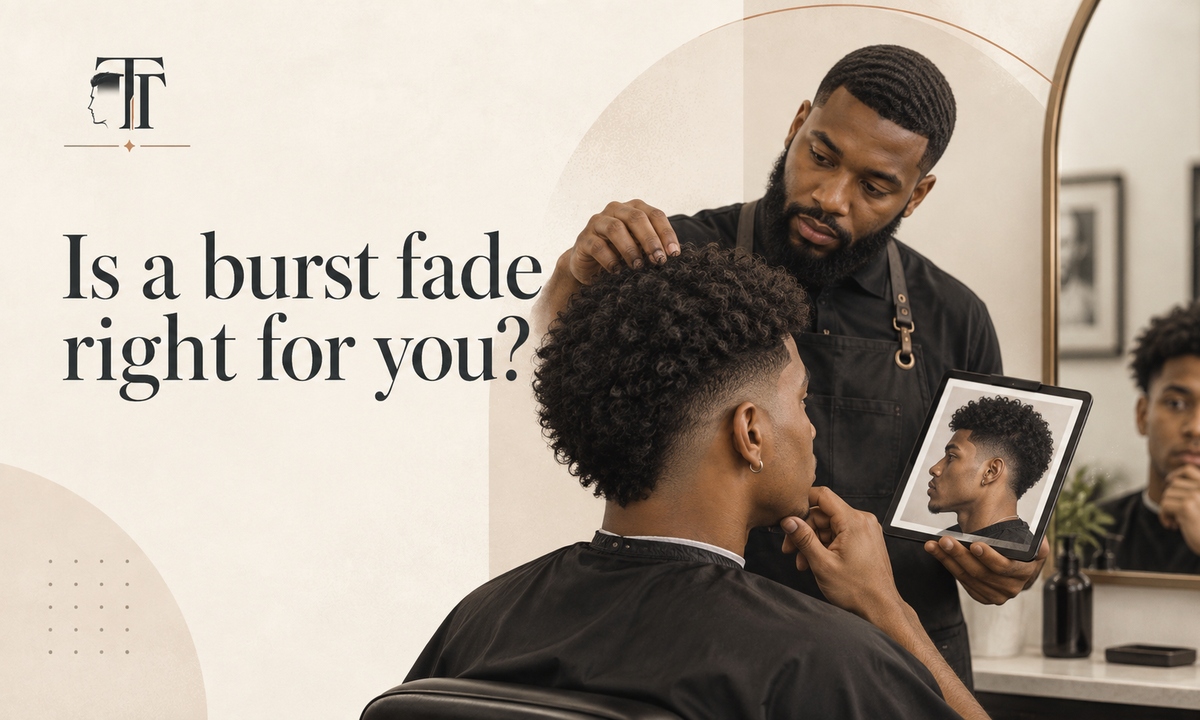
Is a burst fade right for you?
No single burst fade suits everyone. The right version depends on:
- your current length, density, and growth pattern
- the top you want
- how much scalp you're comfortable showing
- how often you'll realistically get the outline cleaned up
Kevin Luchmun, International Artistic Team Lead for Andis, says a good consultation settles the top first and the fade height second.
Which hair lengths and textures work?
A burst fade works on very short hair and on long textured styles. The barber needs enough room on the side to build the arc and enough length left for the top or back you want. It's a strong fit when:
- You have short coils, waves, or a short Afro with some length on the sides to fade — the territory covered by our low taper fade with waves guide.
- Your top is long enough to hold the twists you want.
- You wear locs or braids, and you and your barber agree on which side sections stay.
Five questions to ask yourself first
Plenty of fade guides lean on face-shape charts. A barber can shift the balance of any burst fade through height, top width, back length, and line-up shape, so your preferences and growth pattern count for more than a face-shape label.
- How much contrast do I want?
- How much scalp am I comfortable showing?
- How often will I actually get the outline cleaned up?
- What does my school or workplace expect?
- Have close cuts given me bumps before? If so, read the skin section below before you book.
Burst fade vs. drop fade, taper fade, and temple fade
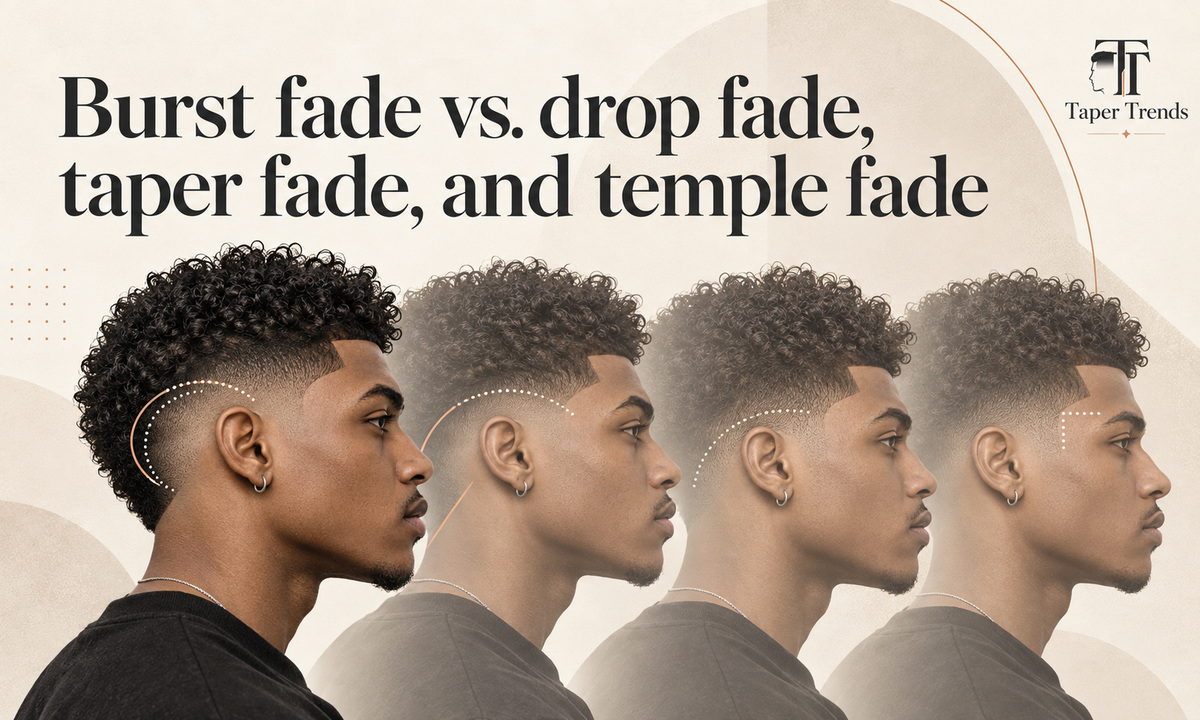
These cuts differ in where the shortest area sits and how far down the back it travels. A burst fade wraps around the ear and leaves the back full. Barber's Take describes the burst as keeping more hair in the back than a drop fade for Black men, with most of the tapering around the ear. Our drop fade vs burst fade comparison explains how to spot the difference from behind.
| Cut | Where the shortest area sits | The back | Choose it when |
|---|---|---|---|
| Burst fade | A rounded arc around the ear | Keeps length | You want a visible curve and back weight |
| Drop fade | Around the ear, then lower toward the nape | Faded down to the neckline | You want a curved outline without keeping the back |
| Taper fade | Sideburns and neckline, often stopping short of skin | Mostly full | You want the subtlest change |
| Temple fade (temp or Brooklyn fade) | Temples and the front of the ear | Less faded | You want a crisp frame around the hairline |
“Taper” is the slipperiest word here. Some barbers use it for a small fade at the sideburns and neckline. Others use it for any fade that doesn't go down to skin — a split our taper vs fade explainer and our low taper vs low fade comparison both untangle. A shadow finish is not a separate cut and can be applied to any of these. If you want the curve to carry on down toward the nape instead of stopping, that is a low taper drop fade; if you want the quietest possible version of the arc, that is a taper low burst fade. Whatever name you use, point to where you want the shortest hair to sit.
15 burst fade styles for Black men
The burst describes the sides. The top, back length, line-up, and finish turn it into a specific look. The styles below run from quietest to boldest. Judge each one from the front, side, and back, not just its most dramatic angle.
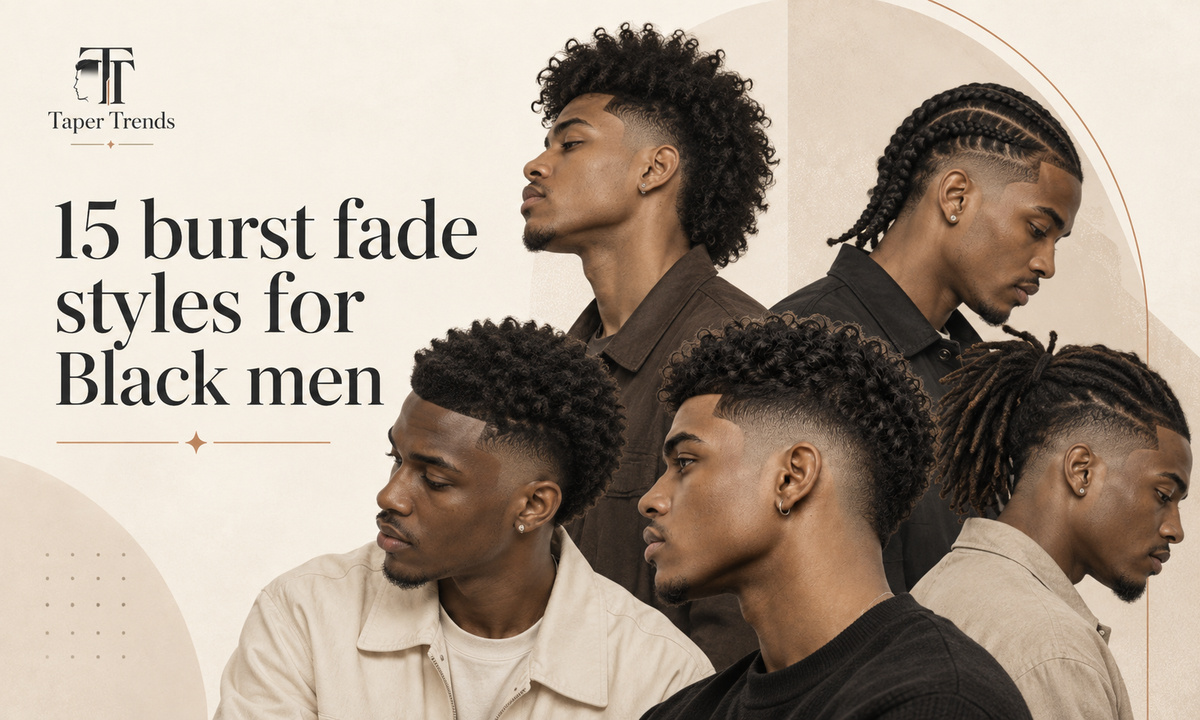
Clean, short, and low-contrast options
These keep the top manageable and soften the cut's intensity, especially when a low arc or shadow finish replaces a skin finish.
1. Low burst fade with short coils
This is the easiest first burst fade. The arc shows without much scalp, and it reads tidy almost anywhere. A shadow finish also grows in more gently, since skin finishes show new growth fastest.
Ask for: a low arc, a shadow finish, and even length on top.
Photos to save: side for the arc, front for the hairline.
2. Mid burst fade with a natural line-up
This gives more contrast than a low burst without a hard frame around the face. A natural hairline also hides regrowth better than a sharp edge-up. It sits at the same height as a mid taper fade for Black men, but curved instead of level. Our mid burst fade guide compares that height with low and high bursts, and the high burst fade guide covers the boldest setting.
Ask for: a mid arc and light cleanup that follows your own hairline.
Photos to save: front for the hairline, side for arc height.
3. Burst taper with 360 waves
This one is for established waves that need a quiet frame. Licensed barber Sebastian Mondragon advises keeping fades low or mid on wave-prone hair, because going higher cuts off the area where the pattern develops. He credits a wave brush, a durag, and steady moisture for the waves themselves — the same routine our high taper fade with waves and mid taper fade with waves guides break down.
Ask for: a low or mid burst taper that stops short of skin.
Photos to save: top-down and back, to show wave direction.
4. Burst fade buzz cut
This is the lowest-effort option day to day. With so little length on top, the arc is the entire design, so regrowth at the sides shows sooner than on longer styles. Guard numbers work the same way as in our low taper fade buzz cut and high taper fade buzz cut guides.
Ask for: one buzz length on top, with the arc defined by a shorter finish.
Photos to save: a side shot, plus one showing your intended top length.
Texture-forward styles
Here the fade frames your texture instead of replacing it. Top length, shrinkage, density, and the weight left behind the ear decide the finished shape. Choose reference photos from someone whose curl pattern looks like yours.
5. Burst fade with a short Afro
This gives natural volume inside a tidy outline. The outline ages before the top does, so the edges set your refresh schedule. For the taper-height equivalents, see the high taper fade afro and the mid taper fade afro.
Ask for: a rounded shape, your chosen arc height, and full weight behind the ear.
Photos to save: front and back, to check the roundness.
6. Burst fade with sponge twists
Short, coily tops are twisted with a twist sponge, and a low or mid arc keeps the sides clean. The twists and the fade will need attention on different schedules.
Ask for: enough length on top to sponge, then a low or mid arc.
Photos to save: top-down and side.
7. Burst fade with two-strand twists
This works when your hair is long enough to hold defined twists. Keep the tension light. The American Academy of Dermatology (AAD) says that if styling hurts, you should ask the stylist to stop and redo it, because pain means damage.
Ask for: the twist section left untouched, with the arc set below it.
Photos to save: front and side, showing twist length.
8. Burst fade with a curly top
Defined curls need room to move, so the arc stays low or mid. AAD recommends conditioning every time you wash and coating the ends, which are the oldest and most fragile part of the hair. Our high taper fade for curly hair and mid taper fade for curly hair guides cover the same top at two other fade heights.
Ask for: enough length for the curls to spring, and a low or mid arc.
Photos to save: front, plus one of your curls dry.
9. Burst fade with a high top
This is a tall, squared top with clear vertical lines. Barber's Take notes that a high skin or temp fade makes a high top look taller, and a higher burst works on the same principle at the sides. The top's outline needs regular re-squaring. If you want that height without the curve, read the high taper fade guide.
Ask for: a squared top and a higher arc.
Photos to save: side profile, for height.
Bold and length-preserving styles
These use the arc to frame more length on top or at the back. The silhouette reads from every angle, so reference photos matter more here. Your barber should confirm top width, back length, and the shortest area before starting.
10. Burst fade frohawk
This is a mohawk shape built from natural Afro texture, with a central strip of height. Keeping the strip's edges clean is most of the upkeep. The strip logic matches our low taper fade mohawk guide.
Ask for: your preferred strip width, with the back length kept.
Photos to save: front and back, to show strip width.
11. Burst fade mohawk (“South of France”)
This is a wide mohawk over burst-faded sides. Barber's Take describes the South of France exactly this way and says it takes regular visits to keep both the fade and the mohawk tight.
Ask for: strip width, top length, and where the arc begins. Names vary by shop, so show all three angles.
Photos to save: front, side, and back.
12. Burst fade mullet
This style grows length at the nape behind tidy sides. Tell your barber you're growing the back, or a routine cleanup can take it off. Our burst fade mullet guide covers the two-schedule upkeep in full, and the low taper fade mullet and mid taper fade mullet show the same back at other fade heights, while the drop fade mullet keeps it under a curve that dips behind the ear. Pair that back with a blunt front line and it becomes the burst fade Edgar; break that front into separated pieces and it becomes a burst fade textured fringe.
Ask for: a rounded burst around each ear, the back length kept, and the top connected to it.
Photos to save: side and rear.
13. Burst fade with locs
Here the locs stay full length above clean sides. Agree on the boundary before any clipper work, so no perimeter hair you plan to loc gets cut. Then repeat the same boundary every visit. Our low taper fade with dreads and locs and mid taper fade with locs guides cover that boundary conversation in detail.
Ask for: locs styled first, then a clearly marked line for the arc.
Photos to save: front, side, and back with the locs styled.
14. Burst fade with braids
This pairs a braided top with clean sides. Ask your braider and barber which of them should go first, and plan separate refresh times for the braids and the fade. The same AAD rule applies to braids: if they hurt, they're too tight.
Ask for: the braid pattern shown in photos, with the parting planned against the arc.
Photos to save: top-down and side.
15. Burst fade with a hair design
A design adds detail at the side or a hard part. Start with a simple line or part and point to its exact placement. Fine lines show regrowth first. Mondragon puts the crisp life of a shape-up at roughly 5 to 10 days, and a design is similar hard linework, so expect it to soften on a similar timeline. Our low taper fade design and low taper fade with a design guides cover placement and upkeep.
Ask for: a single line or part, with its placement confirmed in the mirror.
Photos to save: a close-up of the design, plus a side view.
Which burst fade should you choose?
Choose in this order: contrast first, then top style, back length, finish, and how often you'll refresh the cut. If you're torn between two heights, pick the lower one. Luchmun's advice to barbers is to keep things slightly longer, because you can always go shorter.
| If you want… | Start with |
|---|---|
| Less scalp showing | A low burst or a shadow finish |
| To keep your waves | A burst taper with 360 waves |
| Visible natural texture | A short Afro, coils, or twists |
| A strong central shape | A frohawk or mohawk |
| To keep long top or back hair | The loc, braid, or mullet version |
| Maximum detail | A hair design with a crisp arc |
Skin and scalp risks to know before a close cut
The burst shape itself isn't the risk. Irritation comes from how close the hair is cut at the hairline, sides, and nape, and from your own history with razor bumps or bumps on the back of the neck. This section is general information, not medical advice.
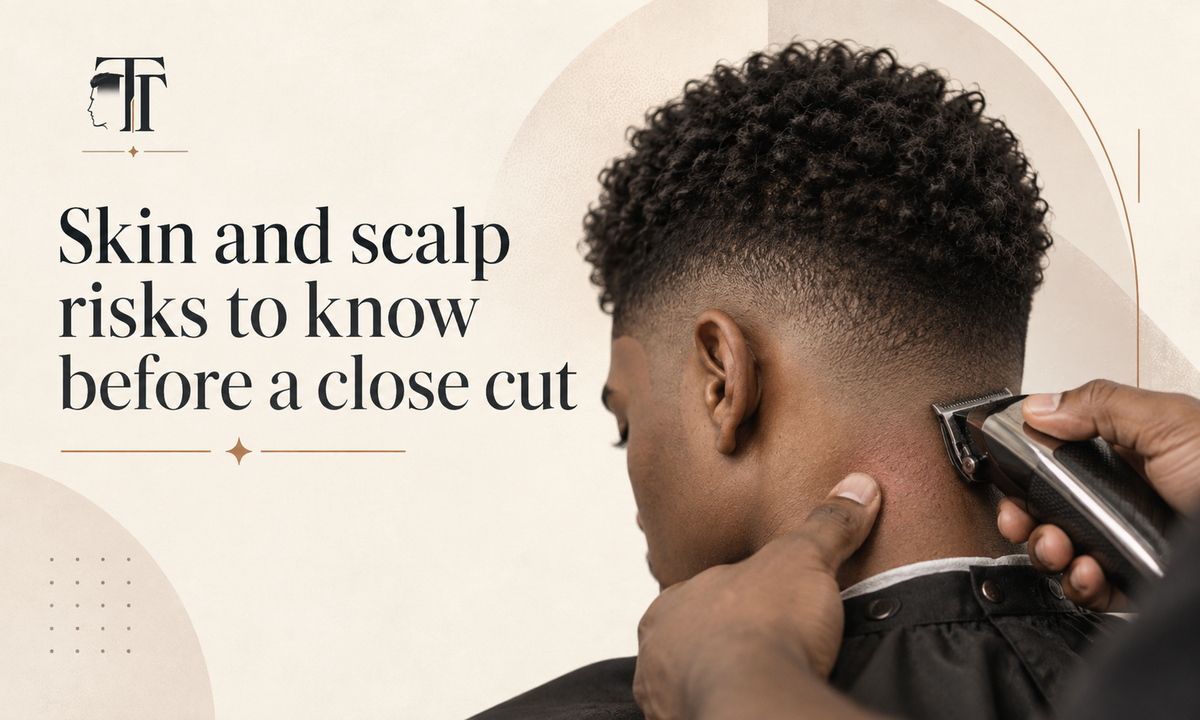
Razor bumps (pseudofolliculitis barbae)
DermNet describes razor bumps as an inflammatory reaction that happens when closely cut, tightly curled hair grows back into the skin. It estimates they affect roughly 45 to 80 percent of men of African ancestry, most often on the face and neck after shaving, and they can leave dark marks or scars once healed.
DermNet's shaving advice includes not going over the same area twice and leaving about 1 mm of stubble. That advice is written for razors, but the logic carries over to haircuts. If you've had bumps before:
- tell your barber before the cut starts
- ask for a shadow or guarded finish instead of bare skin
- ask for no repeated passes over sore skin
Bumps on the back of the neck: AKN
Bumps at the nape or back of the scalp may be acne keloidalis nuchae (AKN). It is often mistaken for razor bumps or acne. AAD says it is most common in Black men and usually begins between ages 14 and 25.
AAD lists the following as things that can irritate that skin:
- frequent close-shave haircuts
- caps, durags, and helmets
- shirt collars
AKN isn't contagious, and AAD calls the belief that you catch it from dirty clippers a myth. Without treatment it tends to worsen and can cause raised scars and permanent hair loss.
When to stop going closer
Stop asking for a closer finish if bumps keep coming back, hurt, or leave dark marks or raised areas, and see a board-certified dermatologist. AAD warns that untreated razor bumps can leave deep grooves and raised scars. Pus or spreading redness can signal infection, which DermNet notes can occur alongside razor bumps. A gentler, guarded outline — the approach our low taper fade guide for Black men recommends for bump-prone skin — is usually the right next booking.
What should you tell your barber?
Give your barber six details:
- fade height
- the shortest finish (skin or shadow)
- how much back length to keep
- your plan for the top
- line-up preference
- whether the beard connects — the join our burst fade with beard guide covers for the arc, and our low taper fade with a beard and high taper fade with a beard guides walk through, with the drop fade with beard guide covering a curve that runs behind the ear and the skin fade with beard guide covering a skin finish
A set of front, side, and back photos communicates all of that better than the name “burst fade” alone. When the sides go all the way to bare scalp, our low vs mid vs high skin fade guide helps you pick the right height. For a level line at the middle height, see the mid fade haircut guide.
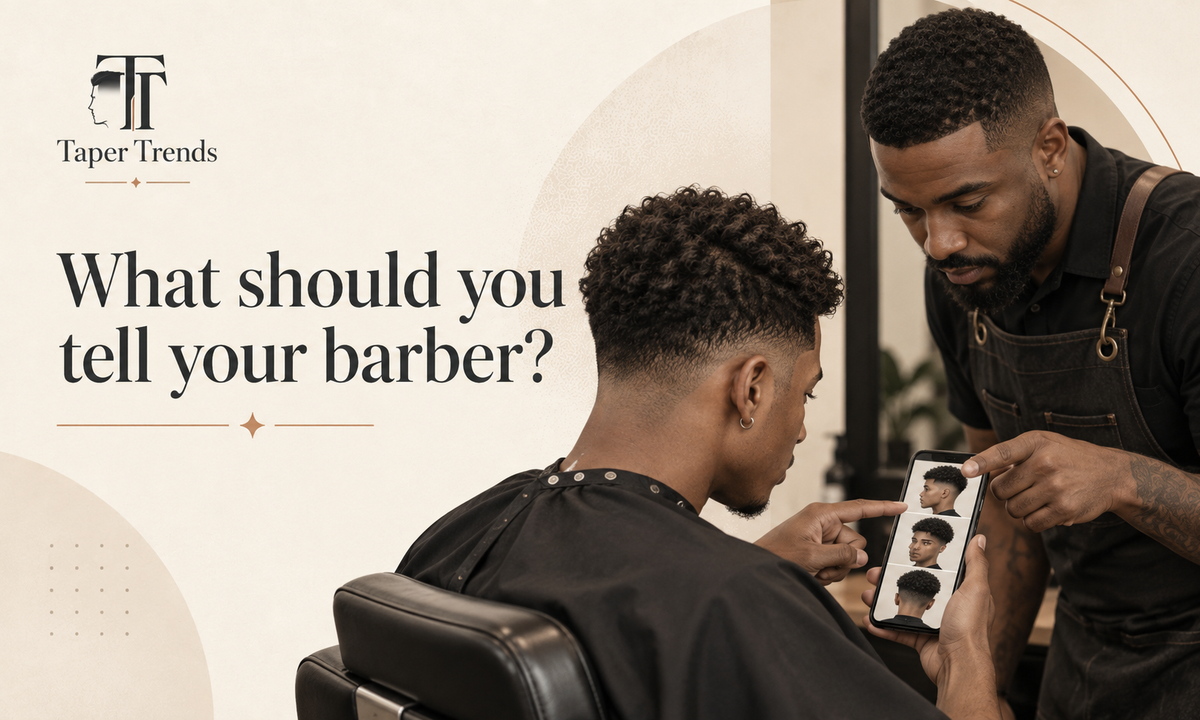
A fill-in-the-blank script
“I'd like a [low / mid / high] burst fade around both ears, finished at [skin / shadow]. Keep [amount] of length at the back. On top I want [style and length]. [Natural / sharp] line-up, [with / without] a beard blend, and [no design / this design].”
Before the first pass, ask the barber to point to where the arc will start and to repeat back the finish and the back length. That takes thirty seconds and catches most misunderstandings.
Bring front, side, and back photos
A single dramatic side shot hides most of the cut:
- The front shows the line-up and top width.
- The side shows the arc.
- The back shows the retained length and the neckline.
Choose photos of hair with a texture similar to yours and a starting length you actually have. Mondragon also suggests asking the barber what would need to change for the look to work on you. If you want to see how a given height reads from every angle before you commit, our what a low taper fade looks like walkthrough does exactly that for the quietest version.
How do you style and maintain a burst fade?
A burst fade is two jobs. The top follows a routine set by its texture. The fade needs a refresh once regrowth softens the arc, and that timing depends on the finish and how sharp you like it.
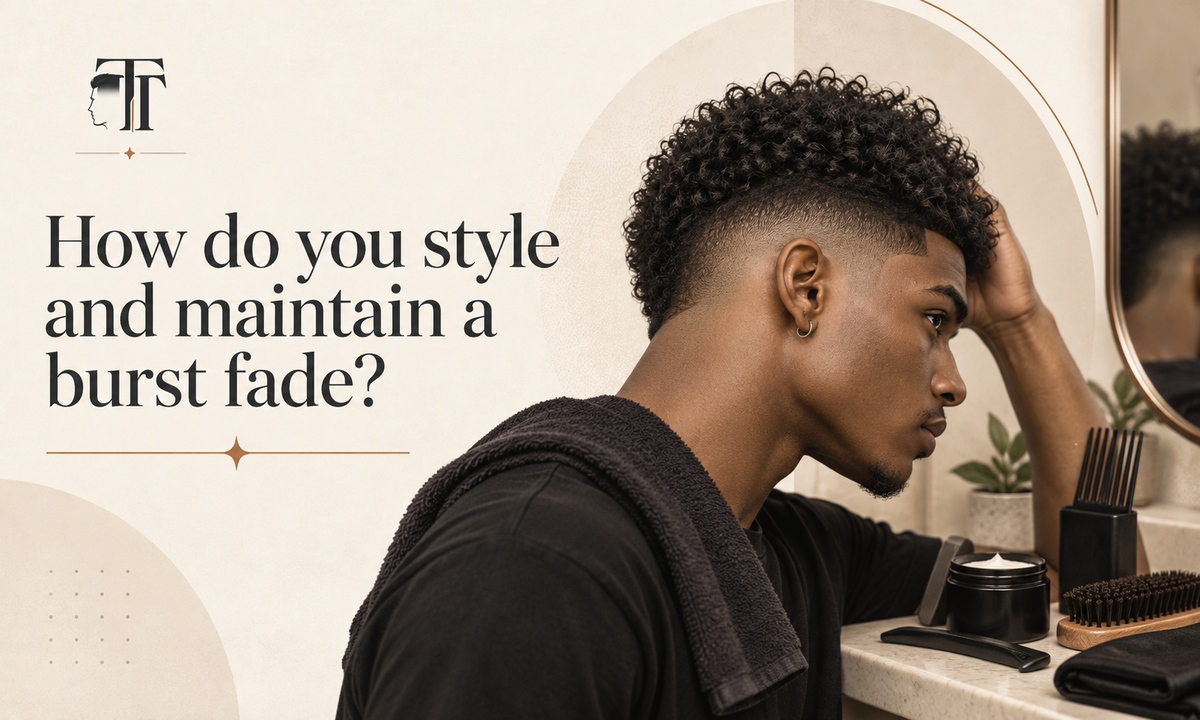
Style the top for its texture
AAD recommends washing Black hair once a week or every other week and conditioning every time. Some barbers, including Mondragon, suggest conditioner-only washes in between. If you do that, keep AAD's regular shampoo as your baseline so product doesn't build up.
- Waves and short coils: light moisture and consistent brushing. A durag helps train waves.
- Afro and curly tops: condition the ends, which break most easily.
- Twists, locs, and braids: keep tension light and loosen anything that hurts.
If you blow the top out for volume rather than brushing it flat, the routine in our low taper fade blowout and blowout low taper fade for curly hair guides transfers directly.
When to refresh the fade and line-up
Go by what you see rather than counting days. Book a refresh when:
- the arc looks blurred
- the sideburns have grown out
- the line-up has softened
- you have an event coming up
For a rough benchmark, Mondragon recommends these intervals for fades generally:
| Fade type | Refresh every |
|---|---|
| Skin fade | 10 to 14 days |
| Low or mid fade with a taper | 2 to 3 weeks |
| Tapered style with no skin work | 3 to 4 weeks |
Between visits:
- Protect the top overnight if your style needs it.
- Photograph the fresh cut so you can show it next time.
- Leave the hairline and the blend to the barber; the curve is much harder than a straight fade cut at home. A line-up pushed back at home takes weeks to grow in.
Frequently asked questions
Is a burst fade the same as a mohawk?
No. Burst describes the fade's curved path around the ear. A mohawk is a longer central strip on top. Barbers often combine the two, and some call that combination the South of France. If that's what you want, show the strip width and the arc in your photos.
What clipper guard should I ask for?
No single guard defines a burst fade. Barbers build the arc with several guards and a trimmer. Wez Jones told Modern Barber he might start around a No. 2, depending on density. Describe the finish, arc height, and back length, and let the barber choose the settings.
Can a burst fade work for school or a conservative workplace?
Often, yes, in a low-contrast version: a low arc, shadow finish, natural line-up, short top, and no design. Workplace and school expectations still vary, so check any written dress or grooming policy before you choose a bolder version.
Is a burst fade a good first fade for a teenager?
A low burst with a shadow finish is a sensible first try, because it's easy to go higher later. Parents should know that acne keloidalis nuchae usually begins between 14 and 25. If bumps appear on the back of the neck, the fix is a dermatologist visit, not a closer cut.
Can a burst fade work with a receding or uneven hairline?
Usually. The burst sits around the ear, so ask the barber to follow your natural edge rather than force a straight line. If you notice new thinning, see a dermatologist. The AAD says the earlier hair loss is diagnosed, the more effectively it can be treated.
What happens when a burst fade grows out?
The arc loses its edge first, then the sides fill in. Barber Sebastian Mondragon says most fades start to blur within about ten days. Because the back already has length, a barber can usually reshape a grown-out burst into a taper or drop fade if you want a change.
Two of those answers point elsewhere on the site: for the teenage first-fade question, our low taper fade for boys and high taper fade for boys guides cover the school-friendly versions, and for a change of shape as the burst grows out, the taper fade guide explains what a barber can reshape it into.
Final checklist before you book

- Pick one preferred style and one backup
- Save front, side, and back photos
- Decide low, mid, or high
- Decide skin or shadow finish
- Decide natural or sharp line-up
- Note any history of bumps, at the hairline or the nape
- Confirm back length and beard connection
Walk in with those answers and your photos, and ask the barber to point to the arc before cutting. If your skin has reacted badly to close cuts before, start with a shadow finish. You can always go closer next visit, but you can't put the hair back.
Your barber-ready next step
Still comparing shapes? The burst fade haircut guide covers the arc on its own, the full rundown of fade types places it beside everything else on the menu, and the low taper fade haircuts guide is the hub for every quieter variation. For more on this texture specifically, read the low taper fade for Black men, the high taper fade for Black men, the mid taper fade for Black men, or the low taper fade for Black women.
The bottom line
Burst names the path of the fade and nothing else. Height sets the contrast, the finish sets how much scalp shows, and the weight left behind the ear is the whole point of the cut — so name all three before the first pass.
Bring front, side, and back photos, say out loud whether close cuts have ever given you bumps, and start lower than you think. You can always go shorter next visit.
Want more fade guides?
Browse clean, barber-ready breakdowns for every fade shape and hair type.