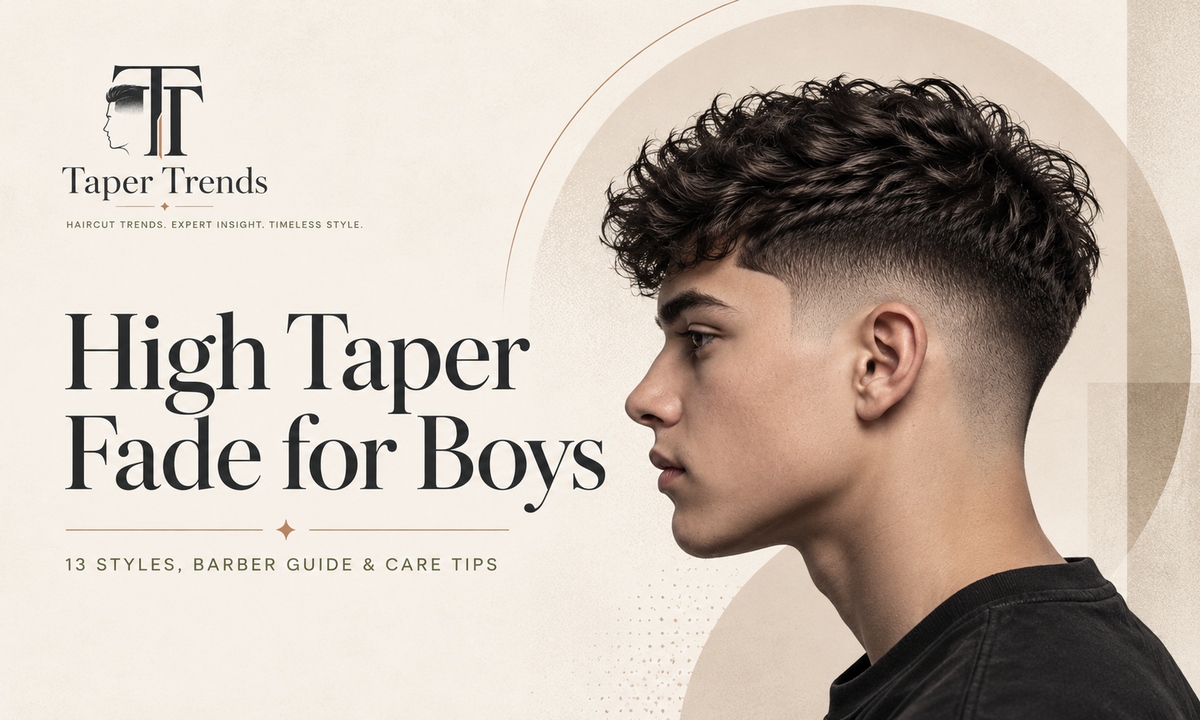
A high taper fade for boys is a haircut where clippers shorten the sides and back gradually, starting the blend at or above the temple and leaving more length on top. The word high describes where that blending starts, not how short the shortest point goes or what style sits above it. Those two decisions are separate, and they are what determine whether a boy leaves the chair with the haircut his family pictured.
Ask ten barbers for the same cut and you can get ten slightly different results, because the label is loose. This guide covers what the term means, 13 versions sorted by texture and styling time, how to describe the cut so a barber can act on it, and how to keep it looking right between visits. If you want the wider family of cuts first, our complete taper fade haircuts guide covers every height and texture in one place, and the main high taper fade guide goes deeper on the adult version of the same cut.
What is a high taper fade for boys?
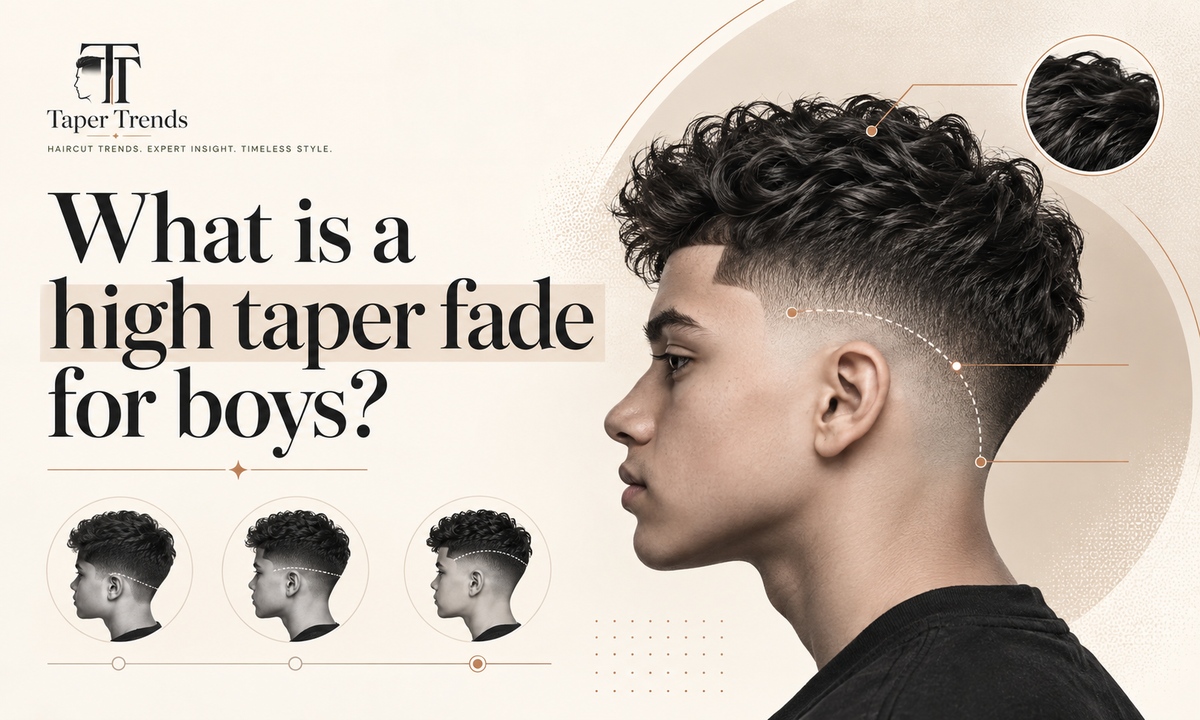
A high taper fade for boys is a haircut where clippers shorten the hair gradually from around or above the temple, down through the sides and back toward the ears and neckline, with more length left on top. “High” refers to where that blending starts. How close the shortest point gets to the scalp is a separate choice.
The tapering stays fairly localized: the temples, above the ears, the sideburns and the neckline. That is what separates it from a fade carrying very short hair around the whole side of the head. The top is left long enough to comb, shape, or leave alone.
Because barbers use the phrase loosely, treat it as the opening line of a conversation rather than a fixed recipe. Two boys can ask for the same thing and walk out looking quite different.
What “high,” “taper” and “fade” mean
Splitting the phrase into parts makes the cut much easier to describe without leaning on the label:
- High is the placement of the blend, generally at or above the temple, rather than at ear level (mid) or close to the neckline (low).
- Taper is the gradual shortening of hair as it moves down toward the ears and neckline. In everyday shop usage a taper does not have to reach bare skin.
- Fade is the blended transition itself, worked so that no hard line shows between lengths.
- The top is an independent decision. The same fade height can sit under a buzz cut, a curly crop, or a longer textured style.
Some of the confusion comes from the tools. Clipper manufacturers sell taper blades for general cutting and shaping and separate fade blades that cut closer to the skin, so the same two words describe equipment as well as technique. Our taper vs fade breakdown untangles the two terms properly.
High taper fade vs mid taper, low taper, high fade and skin fade
A high taper keeps the shortest blending around the temple and upper sides, leaving more hair further down. A full high fade carries short hair much farther around the head. “Skin” or “bald” describes closeness to the scalp, not height, so a cut can start high and still stop well short of bare skin. Our guide to every kind of fade haircut lays out all eleven names against the variables they actually control.
| Cut | Where blending starts | How much gets very short | Can it reach skin? | Contrast | Grow-out |
|---|---|---|---|---|---|
| Low taper | Just above the neckline and ears | A narrow band | Sometimes | Subtle | Softens quietly |
| Mid taper | Around ear level | A moderate band | Sometimes | Moderate | Fairly forgiving |
| High taper | At or above the temple | A moderate band, placed higher | Optional | Medium to strong | Visible line returns sooner |
| High fade | At or above the temple | Most of the side and back | Often | Strong | Regrowth shows quickly |
| Skin or bald fade | Any height | The full band below the start line | Yes, blended to the scalp | Strongest | Needs the most frequent upkeep |
Wahl’s fade guide puts it simply: the difference between a low, mid and high fade is where the line starts on the sides of the head, with a high fade beginning higher up to draw attention to the hair on top. That is the part everyone agrees on. The rest varies by shop, which is why a photo showing the side and back communicates more than the name does. For the two comparisons parents ask about most, see low taper vs high taper fade and the closer call in mid taper vs high taper fade.
Is a high taper fade right for a boy?
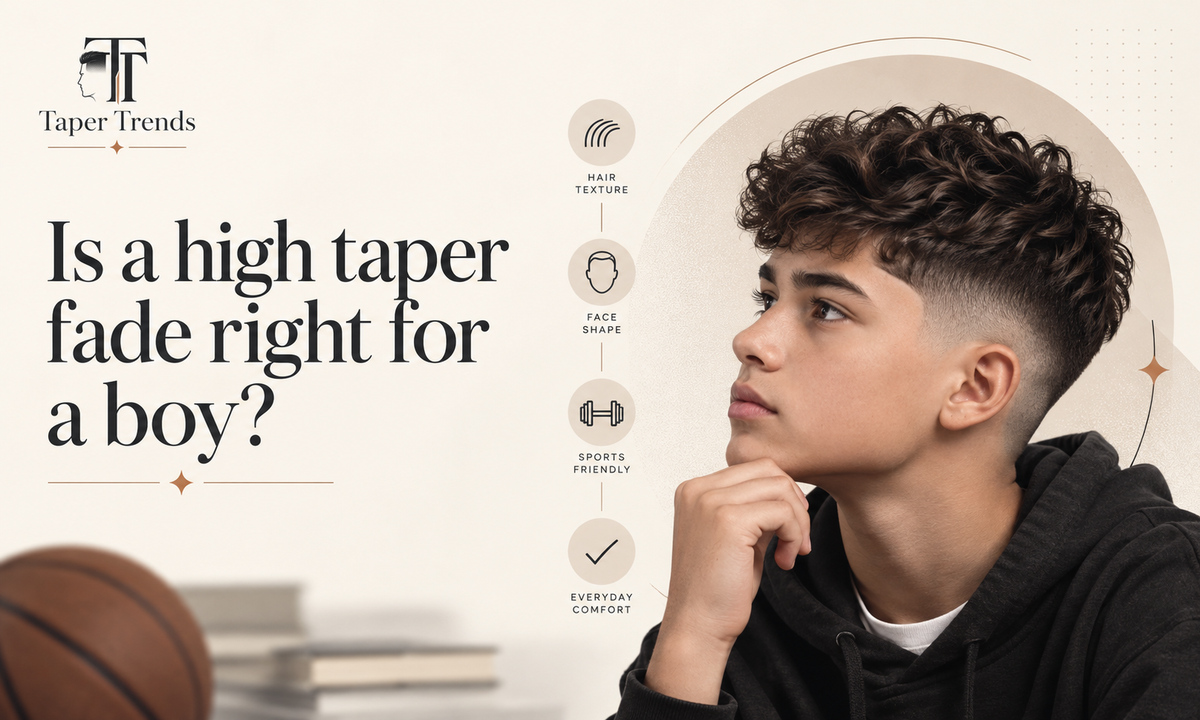
A high taper fade suits most boys, but the right version depends on hair density, the top style he wants, how much contrast feels comfortable, whether a school or team dress code applies, and how often the family can realistically book a touch-up. None of those depend on age.
Worth checking before the appointment:
- Whether he wants a visible, crisp fade line or a softer, shadowed finish
- Whether there is enough length on top for the style he has in mind
- Whether a dress code restricts high-contrast cuts, shaved designs or line-ups
- Whether a trim every few weeks is realistic for your schedule
Hair texture and density
Straight, wavy, curly and coily hair all carry a high taper fade well, and no texture is inherently better suited to it. Most of the visible difference between two boys' cuts comes from the top, not the fade. Fine or thin hair usually looks fuller with a little more length left on top. Dense or coily hair holds curly crops and Afro shapes particularly well, because the volume above the taper is what creates the shape. Our texture-specific guides go further on curls and coils and on straight hair, where flat strands show every line of the blend, a point our drop fade for straight hair guide makes about the curve behind the ear too.
Face shape, head shape and hairline
Face-shape rules are loose visual guidelines, not science, and a poor reason to overrule what a boy wants. A higher fade does expose more of the natural head shape and tends to add apparent height, which some boys like and others soften with a lower placement. Cowlicks and uneven hairlines matter more in practice, since they affect how the front sits and how a line-up looks. If a softer starting point sounds closer to the mark, the low taper fade for boys and the mid taper fade for boys cover the same cut at gentler heights.
Age, school rules, sports and comfort
Fade height on its own does not make a haircut appropriate or inappropriate. The finish, any added line-up or shaved design, and the specific rules in place matter far more. Dress codes are set locally, so the handbook is the only reliable answer. For families who want flexibility, a shadow finish with no hard-edged line-up is usually the easiest version to keep neutral at school and practical for sport. If he has been asking for a shaved design in the fade, check the handbook before booking rather than after.
13 high taper fade styles for boys
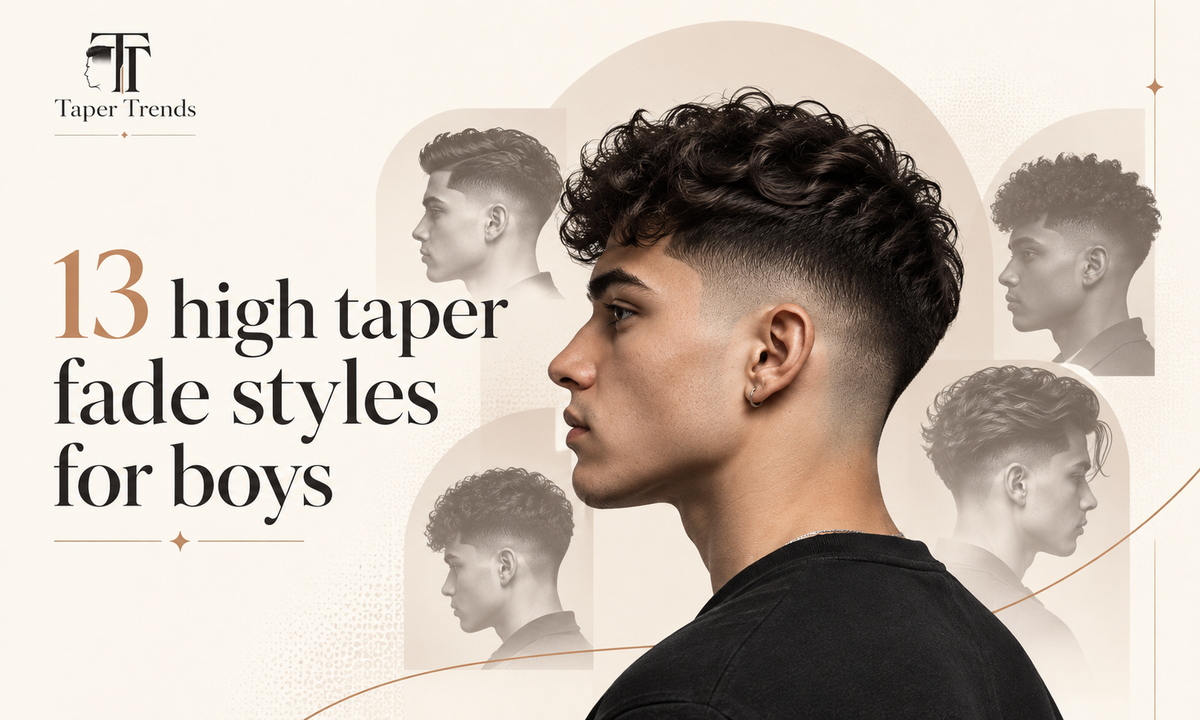
The clearest way to compare versions is by top style, since that is what creates most of the visible difference. Natural texture, the length he already has, and how much morning styling is realistic should drive the choice more than whatever label a photo carries. Every style below can sit on a high taper fade, so ask the barber to match the fade height and finish separately from the top.
Short, low-effort tops
These need little more than a comb or a quick towel dry to look finished, which makes them the practical picks for school mornings. Our guide to the high taper fade on short hair covers this whole group in more detail.
1. Buzz cut with a high taper. A buzz cut keeps the top at one short clipper length, so the taper above the temple reads as a gentle gradient rather than a hard contrast. It needs almost no daily attention, grows out evenly, and stretches the time between barber visits — the high taper fade buzz cut guide walks through the guard lengths.
2. Crew cut with a high taper. A crew cut leaves a little more length on top, cut shorter toward the front hairline, giving a neat shape with some texture to work with. A comb and a small amount of product is enough on most mornings.
3. Textured crop with a high taper. A textured crop keeps the top slightly longer with texturized ends, usually pushed forward or left loosely tousled. It handles fine hair well, since the texturizing creates the impression of more bulk against the clean sides.
Straight and wavy hair
Straight and wavy hair holds a parting or forward texture cleanly, so these versions use direction and length rather than curl to create the difference.
4. Textured fringe. A textured fringe brings the top forward over the forehead in soft, choppy pieces. It suits straight or slightly wavy hair and needs a light product to hold its shape. The high taper keeps the sides quiet so the fringe carries the look; see the high taper fade with a textured fringe for the barber wording.
5. Side part or comb-over. A side part uses a defined line to sweep the top to one side for a neater, more formal finish. It sits best on straight hair, since waves blur the parting without product or a blow dry. The side part version and the comb-over both translate straight up to a higher taper.
6. Middle part. A middle part splits the top down the centre and falls outward on both sides. It needs enough length to hang properly, so expect a few weeks of growing out before it sits the way the photos do — our middle part guide covers that growing-out stretch.
7. Quiff. A quiff lifts the front section up and back to create height. It wants straight or wavy hair with natural body, plus a blow dry or product to hold the lift, so be honest about morning time before choosing it.
Curly and coily hair
These versions keep and shape the natural curl pattern on top instead of styling it flat, which usually looks more deliberate and takes less daily effort.
8. Curly top. A curly top leaves the curls at a moderate length and defines them with a light curl cream rather than flattening them. Ask the barber to allow for shrinkage, since curly hair sits shorter once it dries.
9. Afro. An Afro keeps coily hair at a fuller, rounded length while the sides and back are tapered high. It works best with a barber who cuts textured hair regularly, because shaping the top and blending the taper are two different skills — the high taper fade Afro guide and our guide for Black men and boys both go into the shaping in depth.
10. Waves. Waves are a rippled pattern brushed into short coily hair rather than a separate cut, kept up with regular brushing and a durag overnight. A high taper holds the sides at a closeness that lets the pattern show, which the high taper fade with waves explains in terms of coverage versus contrast.
Longer, more expressive tops
These trade some of the low-maintenance appeal for a bolder shape, and all three want more time in the morning.
11. Messy or fluffy top. A messy top keeps length loose and deliberately untidy, usually with a texturizing product worked through damp hair. It forgives imprecise styling, which helps for boys doing their own hair; the fluffy hair guide covers the products that hold that shape without stiffness.
12. Blowout. A blowout uses a round brush and a dryer to lift the top into a rounded shape, often with a defined edge where it meets the taper. It suits thicker hair that holds volume and needs the most daily styling time here — our blowout guide breaks the drying routine into steps.
13. Faux hawk. A faux hawk gathers the centre section into a raised strip and tapers shorter toward the sides of it, without shaving a true mohawk line. It reads as a deliberate style choice, so check dress codes first; the mohawk and faux hawk guide shows how far the centre strip can go. If he wants length at the back too, the high taper mullet is the same fade under a longer crown.
How to choose the right version
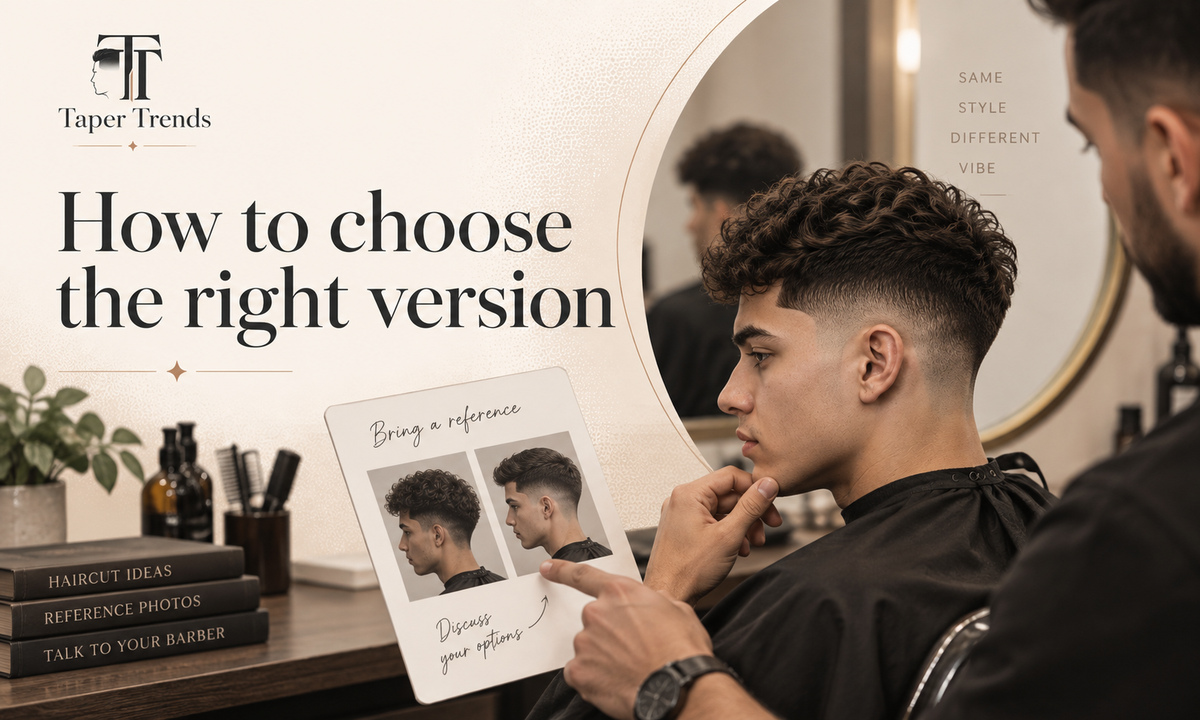
The decision comes down to four questions: how much contrast feels comfortable, how short the shortest point should be, which top style fits his natural texture and current length, and how often a touch-up is realistic. Answering those narrows the field faster than scrolling through more photos.
Contrast versus upkeep
Higher and closer finishes look sharpest in the first days after a cut, and they also show regrowth soonest, because the shortest area grows back into a visible line faster than a softer blend does. A shadow finish stops short of bare skin and blurs as it grows, so it tends to look presentable for longer.
There is no correct answer here, only a trade. A boy who wants a crisp, high-contrast look needs more frequent trims than one who prefers a softer version. Both are still a high taper fade. Seeing the heights side by side in our mid taper fade guide often settles the question faster than another photo search.
Use reference photos, then ask
- 1Pick one or two photos of hair with a similar starting texture and length to his.
- 2Make sure at least one shows the side and the back of the head, not just the front.
- 3Point out the fade height and the shortest finish specifically, since those are the two details barbers read differently from photo to photo.
- 4Ask the barber whether the pictured result is realistic for his current length and texture before any cutting starts.
That last question prevents the most common mismatch in these appointments, where client and barber picture different fade heights from the same words.
How to ask a barber for a high taper fade
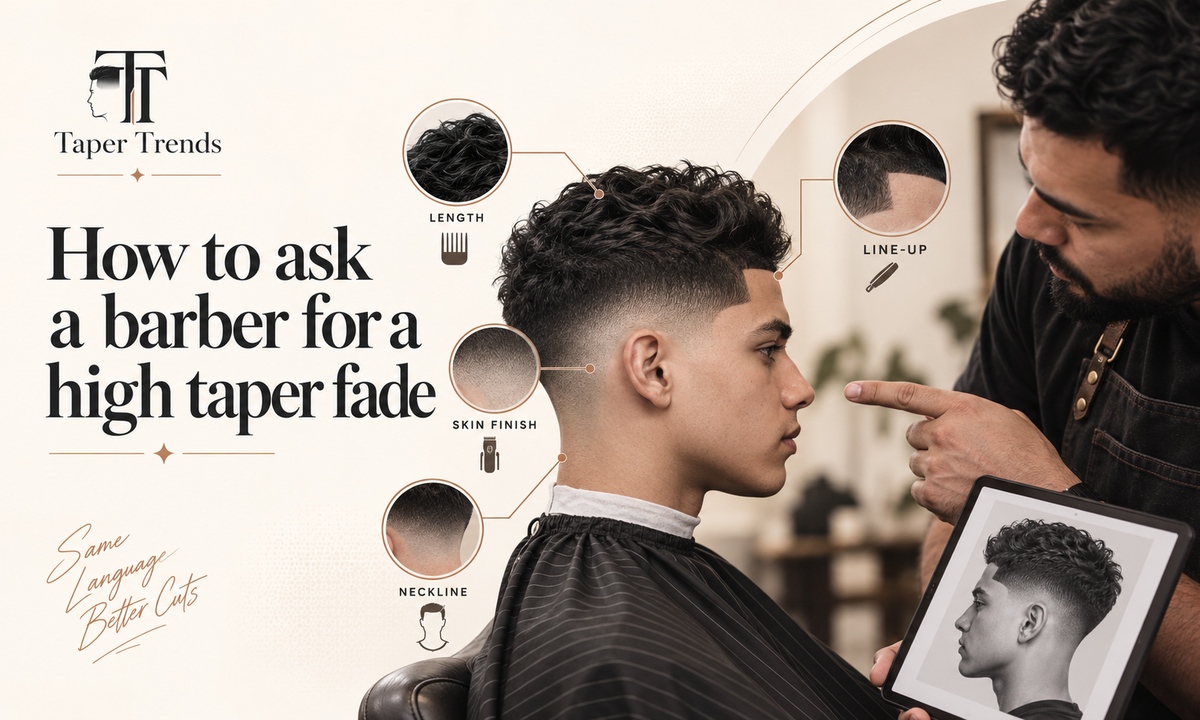
Do not stop at “high taper fade.” Specify five things the barber can act on: where the blending should start, how short the shortest point should go, the length and style on top, the shape of the neckline, and whether you want a line-up. Those five answers describe a haircut. The label alone does not.
Consultation checklist and a simple script
Have these ready before he sits down:
- A reference photo showing the side and back, not just the front
- The top length you want, in inches or finger widths if guard numbers are unfamiliar
- The area to be faded: at the temple, above it, or further around the head
- The finish at the shortest point: shadow, zero or skin
- Whether you want a defined line-up or a softer natural edge
A simple way to open:
“I’d like the fade to start around here, blending down to a shadow finish, with the top left about this long and styled like this photo. Please keep the hairline natural rather than squared off.”
Guard length, skin finish, neckline and line-up
A guard number is shorthand, not a specification. Wahl’s guide explains the basic maths: the smaller the number, the shorter the cut, with a #2 comb leaving around a quarter of an inch and a #4 around half an inch. The finished blend still depends on the blade underneath and how the barber works the transition.
Describing the result is more reliable than a number. A shadow finish leaves a faint, even layer of hair at the shortest point; a zero or skin finish takes it to the scalp. The neckline can be left natural, which grows out softly, or squared off with a trimmer, which looks sharper and needs tidying more often. A line-up adds a crisp edge at the hairline and temples, which some boys want and others would rather skip for a softer edge.
How to style and maintain a boy's high taper fade
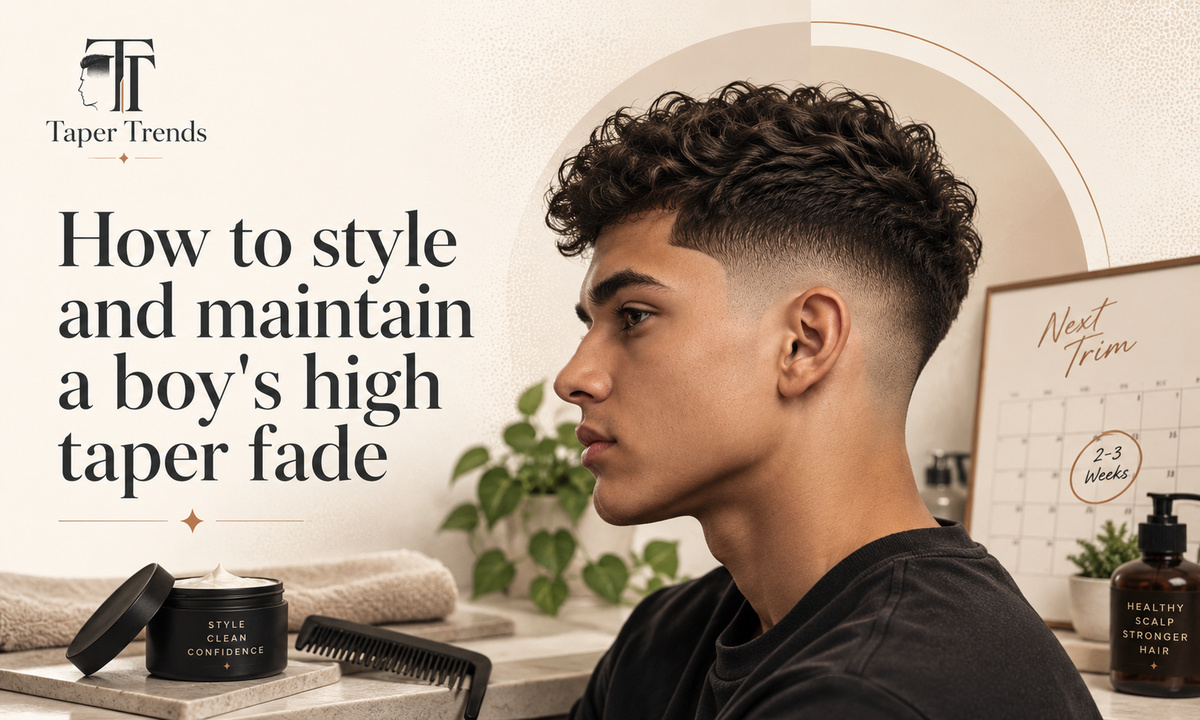
Maintenance splits into two jobs. Day to day, you only style the top. The taper itself is barber work, refreshed every few weeks. Extending a fade at home with clippers is possible, but blending the transition evenly is the hard part (our step-by-step fade guide shows why), and a first attempt shows.
Daily styling by hair texture
Straight and wavy tops need a small amount of light cream or pomade worked through towel-dried hair, then shaped with fingers or a comb. Curly and coily tops do better with a lightweight curl cream or leave-in conditioner on damp hair, with minimal brushing, since brushing dry curls breaks up the pattern the cut is meant to show. Our step-by-step styling routine applies to the top of a high taper exactly the same way.
Hair and scalp care between cuts
Gentle shampooing suited to his hair type, conditioner for dry or curly hair, and careful detangling with a wide-tooth comb cover most of what is needed.
Tension at the hairline is worth watching. The American Academy of Dermatology notes that hairstyles worn tightly and repeatedly, including cornrows, locs and tight braids, can pull on the hair and lead to traction alopecia, and that children develop it too. Their advice is practical: loosen braids around the hairline, keep them thicker and shorter, and change the style if it causes pain, stinging, crusting or tenting of the scalp. If a style hurts, it is too tight.
How often should a high taper fade be refreshed?
There is no universal schedule. Refresh timing depends on how fast his hair grows, how short the shortest point is, and how crisp the family wants the line to stay. A skin finish on fast-growing hair asks for attention much sooner than a shadow finish on slower growth.
The visual signal is easy to read: the transition zone has softened, and the shortest area no longer looks distinct from the length above it. That is the cut asking for a cleanup, whether it happens at two weeks or five.
Problems, risks and better alternatives
A high taper fade is not the right call for every boy or every season. Most regret traces back to one of a few predictable mismatches.
| Problem | Better option |
|---|---|
| Upkeep is more than the family can manage | Mid or low taper with a shadow finish |
| The contrast feels too bold once it is cut | Lower placement, longer shortest length |
| A dress code restricts high-contrast cuts | No line-up, no designs, softer finish |
| The scalp gets irritated by very close work | Leave a guard length instead of going to skin |
| He is unsure and cannot picture it | Start lower, adjust at the next visit |
Common mistakes, and when a mid or low taper is the better call
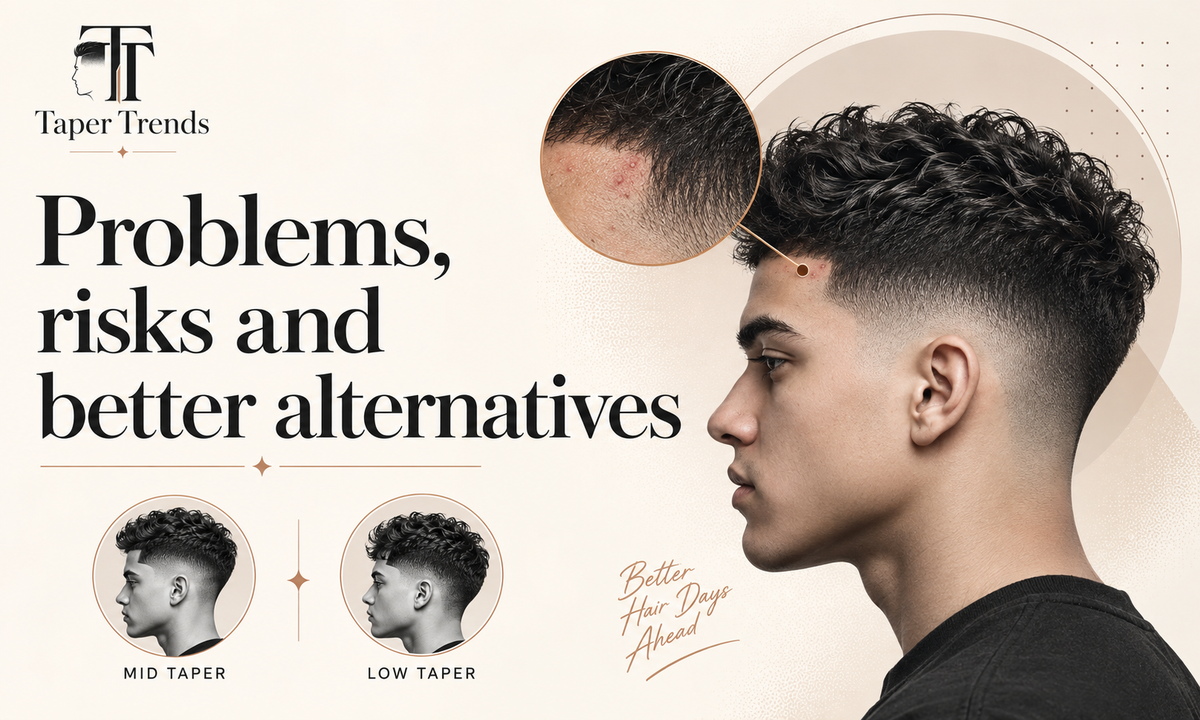
The most frequent mistake is bringing a photo of a high skin fade while asking for a high taper, which removes more hair than expected. Others: a barber cutting higher than planned without checking in partway through, and adding a sharp line-up a boy did not actually want. When the sides go all the way to bare scalp, our low vs mid vs high skin fade guide helps you pick the right height.
When in doubt, start lower. The advice Wahl gives home cutters applies just as well in a barber’s chair: taking more off later is easy, and putting hair back is not. A mid or low taper can be raised at the next appointment — the low taper fade for boys with straight hair is a common softer starting point, and our burst fade for boys guide covers a different, curved-arc shape if height alone was not the issue. Growing a fade back in takes weeks.
Irritation and bumps at the hairline
Very close clipper or razor work at the nape and hairline can irritate the skin, particularly on coarse or tightly curled hair. The American Academy of Dermatology notes that close-shave haircuts, along with helmets and hats, can irritate the back of the neck and trigger acne keloidalis nuchae, a chronic inflammation of the hair follicles that usually begins between 14 and 25 years of age and is most common in males with coarse, curly hair.
The early signs are itching at the back of the neck or scalp, followed by small bumps easily mistaken for razor bumps or acne. Easing off close work at the nape is the sensible first response, and persistent bumps, pain or thinning at the hairline are worth showing to a doctor or dermatologist rather than treating at home. Left alone, this one can scar.
FAQs about high taper fades for boys
Does a high taper fade have to go down to skin?
No, because high refers to where the fade starts rather than how close it gets to the scalp, so a high taper can finish at a shadow, at a longer guard length, or at bare skin.
Can a high taper fade work with a long top?
Yes, since top length and fade height are independent choices, though a longer top needs more daily styling time and a few weeks of growing out before it sits properly.
Can a high taper fade be done without a sharp line-up?
Yes, and skipping that optional step leaves a softer natural edge at the hairline and temples, which many parents prefer for younger boys because it grows out less conspicuously and needs fewer visits to keep tidy.
What if the boy has a cowlick or uneven hairline?
A good barber works around both rather than forcing symmetry, cutting against the direction of growth at a cowlick, and following an uneven hairline's existing shape instead of squaring a straight edge across it.
Can a high taper fade be made school-appropriate?
Often yes, since a shadow finish with no line-up and no shaved design is the most conservative version, though dress codes are set locally and the school or team handbook is the only reliable check.
What should parents bring to the barber appointment?
One or two reference photos of hair with a similar texture and length, including at least one side or back view, plus a maximum top length and a clear answer on whether he wants a sharp line-up.
The bottom line
A high taper fade works for families because it breaks into variables you can control: where the blend starts, how short it gets, what happens on top, the shape of the neckline, and how often you come back. Getting a consistent result has less to do with knowing the right haircut label than with describing those choices clearly, ideally alongside a photo showing the side and back. Barbers read the same three words differently, so the photo does work the name cannot.
Texture and preference fill in the rest: a buzz cut needs nothing, while a blowout or an Afro wants daily attention. Check the school or team handbook first if a dress code is in play, and ease off close work at the nape if the skin there gets sore. If the height turns out to be too bold, a mid or low taper gives a similarly clean look with an easier grow-out. Describe the result you want, not just the name.
What to remember
“High” only tells the barber where to start the blend. The shortest finish, the top style, the neckline and the line-up are four more decisions, and every one of them changes how the cut looks and how long it stays sharp.
Bring a photo showing the side and back, name a shadow or skin finish out loud, and be honest about how often you can get back to the shop. Start lower if you are unsure — raising the fade next visit is easy, and growing one back in is not.
Want more taper fade guides?
Browse clean, barber-ready breakdowns for every hair type.