How to explain a haircut to your barber
Most bad haircuts start with a vague request. “Short on the sides, a bit off the top” can describe a dozen different cuts, and the barber has to guess which one you meant. You need to cover four things, and the generator above walks you through each:
- Where the fade or taper starts. Low, mid, or high. This one choice changes the look more than anything else.
- The shortest length. Skin, no guard with the lever closed, or a guard number. The clipper guard size chart shows what each number leaves.
- The length on top. Say it in inches, not “a little” or “not too much.” If you can't judge inches, show where you want the hair to fall, or pinch the amount you want taken off, and ask the barber to confirm before cutting.
- The edges. Line-up or natural, and how the neckline at the back should finish.
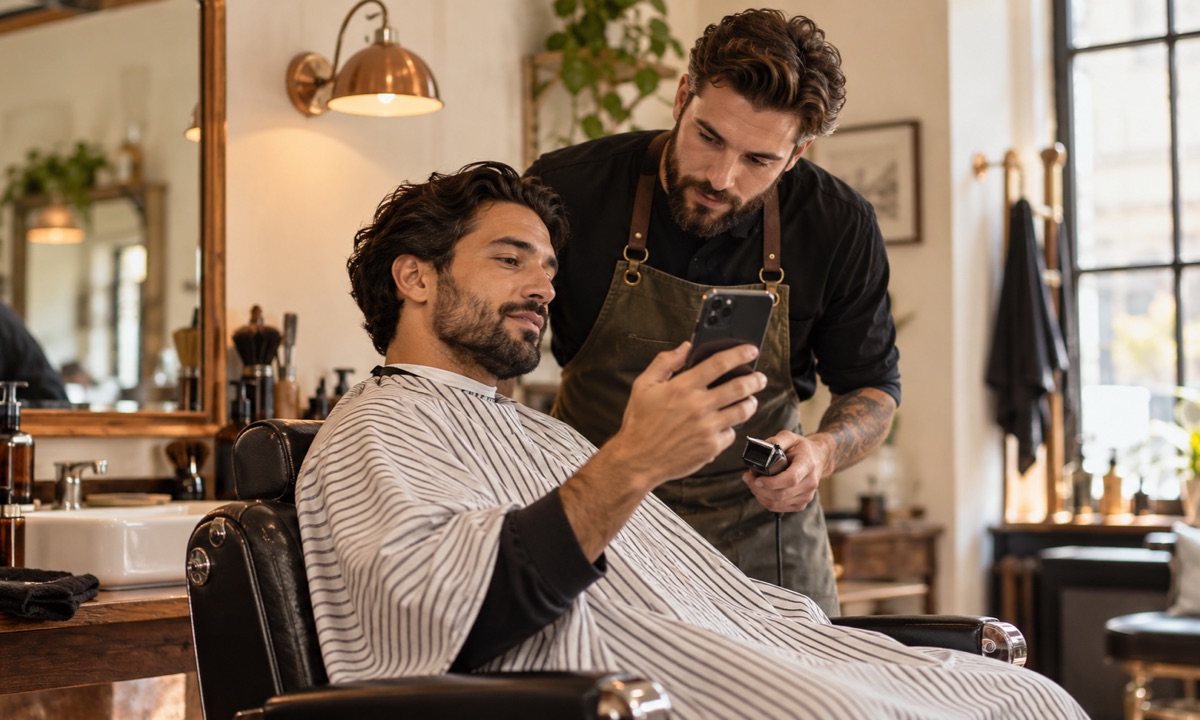
Bring a photo as well. Words and pictures cover each other's gaps: the photo shows the overall look, and the words pin down the lengths the photo can't show. Front, side, and back views help most, because a front shot hides where the fade starts and how the neckline finishes. Point at the parts you want copied.
Barber terms you should know
You don't need all the jargon. A handful of terms covers most of what you'll want to say, and your barber will know exactly what you mean by them.
Taper
The hair gets shorter toward the ears and neckline, but only around the edges. Most of the side keeps some length, so it looks clean without looking freshly shaved. See the taper fade guide.
Fade
The hair blends from longer to very short, often skin, across a wider band on the sides and back. It has more contrast than a taper. The taper vs fade comparison shows the difference.
Drop fade and burst fade
Both change the shape of the fade line. A drop fade curves down behind the ear toward the nape. A burst fade arcs around the ear like a half circle and leaves length at the back of the neck.
Skin and lever closed
“Skin” means taken down to bare skin with a foil shaver or razor. “Lever closed” means no guard, with the clipper blade at its shortest setting. It's very short, but you can still see a shadow of hair.
Line-up and C-cup
A line-up (or edge-up, or shape-up) cuts crisp, straight edges at the forehead, temples, and sideburns. C-cups are the curved corners some barbers cut in at the temples.
Tapered, rounded, and blocked necklines
A tapered neckline fades out with no hard edge and grows out gracefully. A blocked neckline is a straight, squared line across the nape; it looks sharp but shows regrowth within days. Rounded sits between them.
Point cutting
Snipping into the ends of the hair with the tips of the scissors. It takes out weight and adds texture, which is what makes a textured crop look textured.
How to ask for the most popular cuts
Each script below is a starting point you can say word for word. The link under it loads the same cut into the generator so you can adjust it.
Low taper fade
“Low taper fade, please, down to skin at the sideburns and neckline only. Number two on the sides and about two inches on top.” Load this brief or read the low taper fade guide.
Mid taper fade
“Mid taper fade, taking it down to skin at the edges and blending up to about the temples. Number two above that, and leave the top.” Load this brief or read the mid taper fade guide.
High taper fade
“High taper fade, skin at the bottom, blending up to where my head starts to curve. Keep the top longer so there's some contrast.” Load this brief or read the high taper fade guide.
Skin fade
“Mid skin fade, foil shaver at the bottom, blending up to a number three. Sharp line-up.” Load this brief or see the different kinds of fades.
Buzz cut with a taper
“Number two all over, tapered at the neckline and sideburns, with a sharp line-up.” Load this brief or read the high taper fade buzz cut guide.
Textured crop
“Mid skin fade, about two inches on top cut into a textured crop. Point cut it so it has some movement, and push the fringe forward.” Load this brief.
Mistakes that lead to a bad haircut
- Saying “short” without a number. Short to you might be a #3. Short to your barber might be a #1.
- Not saying where the fade starts. It's the difference between a low taper and a high skin fade, and it's the first thing people forget.
- Bringing no photo, or the wrong one. A cut shown on straight hair won't look the same on curls. Pick a reference with hair like yours.
- Not mentioning upkeep. Tell the barber how often you'll come back and whether you style your hair every morning. A skin fade with a sculpted top looks great on day one and needs work by day ten.
- Staying quiet during the cut. If the sides look higher than you expected halfway through, say so then. It's much easier to adjust early.
What to do if the cut isn't right
Speak up before you pay. Be specific about what's off and polite about it: “Could we take the top down a little more?” or “Can you soften the line at the back?” Most barbers are glad to adjust, and it's their reputation walking out of the shop.
If the problem is that too much came off, there's usually nothing to do but wait. Hair grows about half an inch a month, so ask the barber how many weeks until they can even it out, and book that visit before you leave.
Frequently asked questions
What should I tell my barber for a taper fade?
Give three things: the height, the shortest length, and the top. For example: "Low taper fade, down to skin at the sideburns and neckline only, number two on the sides, and leave about two inches on top." Add whether you want a line-up and how the neckline should finish.
How do I ask for a low vs mid vs high taper?
Describe where the short part stops. Low stays around the ears and neckline. Mid rises to about the temples. High goes up to where the side of your head starts to curve toward the top. Pointing to the spot on your head while you say it removes any doubt.
What's the difference between a taper and a fade?
A taper only shortens the hair at the edges, around the sideburns and neckline, so most of the side keeps some length. A fade blends from longer hair to very short, often skin, across a wider band of the sides and back. Our taper vs fade guide shows them side by side.
Should I bring a picture to the barber?
Yes. A photo settles questions words can't, like how much contrast you want or what "textured" means to you. Pick a photo of someone with hair like yours in texture and density. A straight-haired model's cut won't look the same on curly hair, and a good barber will tell you what will change.
What does lever closed mean?
It means cutting with no guard and the clipper's adjustable blade set to its shortest position. It's shorter than a #0.5 guard but not quite bare skin. Barbers use it as the bottom step of many fades when you don't want the skin to show.
What is a blocked vs tapered neckline?
A blocked neckline is cut in a straight, squared-off line across the nape. It looks sharp at first but shows regrowth quickly. A tapered neckline gets shorter until it fades out with no hard edge, so it grows out more naturally. A rounded neckline sits between the two.
How do I ask for a line-up?
Ask for a line-up, edge-up, or shape-up; barbers use all three names. Say whether you want it sharp or soft, and whether to follow your natural hairline or straighten it. If you want curved corners at the temples, ask for C-cups. Ask them not to push the hairline back.
How do I tell my barber I don't like the cut?
Say it before you leave, calmly and specifically: "Could you take the sides a bit shorter?" or "Can we soften the line at the back?" Barbers would rather fix something in the chair than have you walk out unhappy. If it can't be fixed today, ask what to do at the next visit.