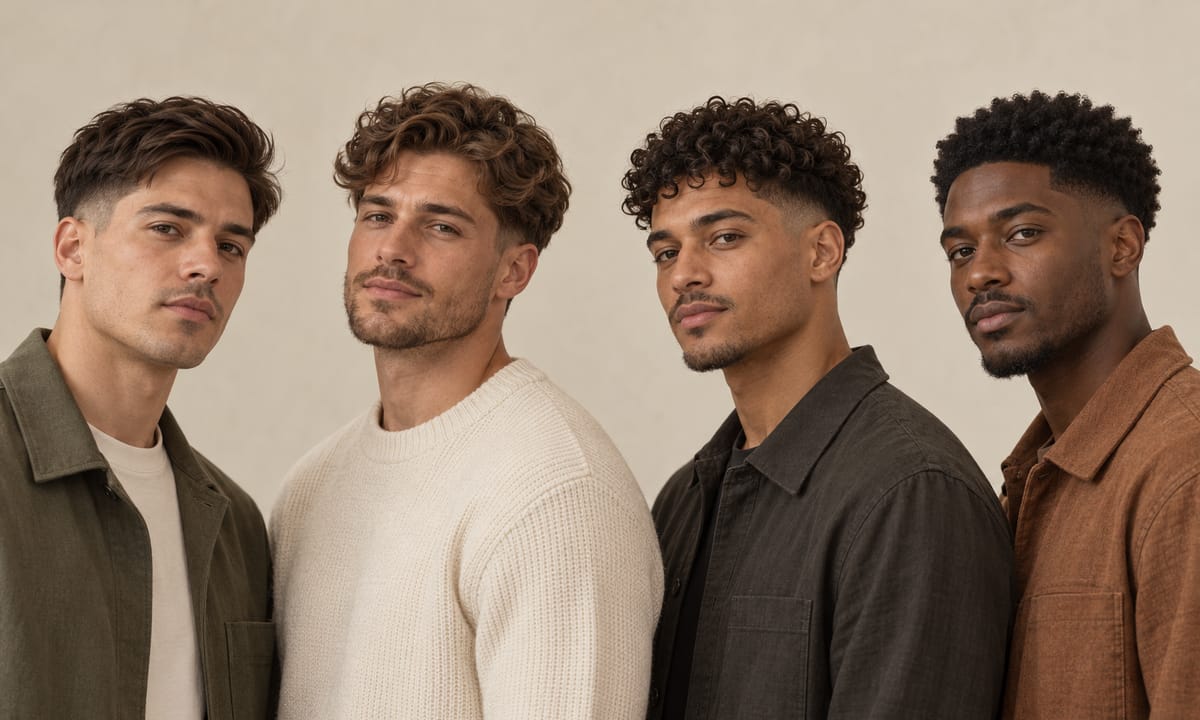
How the 1A–4C hair typing system works
The hair typing chart most people use was popularized in the 1990s by the stylist Andre Walker. It sorts hair by the shape of the strand into four families: Type 1 straight, Type 2 wavy, Type 3 curly, and Type 4 coily. Within each family, the letters A to C go from the loosest pattern to the tightest. Walker's original chart was simpler; the full 12-type version, including 3C, 4C, and the three straight subtypes, grew out of later use, and it's the version this quiz uses.
It's a description, not a ranking. Every type is just a shape, and each one has cuts and routines that suit it. You can browse all 12 side by side on the hair type chart.
Type 1: Straight
Type 1A: Pin-straight, fine, and flat, with a strong natural shine. Type 1B: Straight with more body, and a slight bend toward the ends. Type 1C: Straight but coarse, with a faint S-bend and a little frizz.
Type 2: Wavy
Type 2A: Loose, barely-there S-waves that lie close to the head. Type 2B: Clear S-waves that start near the mid-length, with some frizz. Type 2C: Deep S-waves from the root, some starting to form loose curls.
Type 3: Curly
Type 3A: Large, loose spiral curls with lots of shine. Type 3B: Springy ringlets with clear definition and natural volume. Type 3C: Tight corkscrew curls, densely packed, with lots of volume.
Type 4: Coily
Type 4A: Tight, defined S-shaped coils with visible pattern. Type 4B: Z-shaped bends with sharp angles and a soft, fluffy feel. Type 4C: Very tight zigzags with little visible pattern and the most shrinkage.
How to test your hair type properly
The test only works on hair in its natural state. Styling products, heat, and brushing all change the pattern you see, so:
- Wash your hair with a simple shampoo and conditioner, and skip any leave-in, cream, or gel.
- Let it air-dry completely without touching it, scrunching it, or brushing it.
- Look at a section from the middle of your head, not just the front. The hair around your face is often looser.
- If your hair is very short, a buzzed or faded side won't show a pattern; look at the longest part of the top.
Then compare the shape, not just the look. Straight hair has no bend. Waves form an S that lies flat against the head. Curls form full loops you could put a finger through. Coils are tight spirals or zigzags packed close together, with a lot of shrinkage.
Why you might have more than one type
Few heads are one pattern all over. The crown is often looser, the nape and the area behind the ears tighter, and the hair underneath can curl more than the top layer, which is exposed to more friction and sun. If you're between two types, go with the one that covers most of your head, and add the second one in the quiz. It's useful information for a barber, because it changes how the top sits once the sides are short.
Density, thickness, and porosity
Two people with the same curl pattern can have very different hair. Three other traits explain most of the difference:
- Strand thickness. How wide each hair is. Compare one with a piece of sewing thread: thinner is fine, about the same is medium, thicker is coarse. Fine hair needs lighter products and shows texture less.
- Density. How many hairs grow on your head. If you can see your scalp easily when your hair is dry, it's low density; if you can barely see it, it's high. Density decides how much volume a cut has.
- Porosity. How readily your hair takes in and holds moisture. Hair that dries fast and drinks up conditioner is usually high porosity; hair that dries slowly and lets product sit on top is usually low. The popular “float test,” dropping a hair in a glass of water, is easily thrown off by oil and product residue, so the quiz asks how your hair behaves instead.
Hair type and haircuts
Your type shapes the top of a taper more than the sides. Straight hair shows every line the barber leaves, so soft blends and textured tops look cleanest; see the low taper fade for straight hair. Wavy hair suits cuts that leave a few inches on top, like a mid taper with wavy hair. Curly hair balances well over a mid blend, as in the mid taper fade for curly hair, and coily hair holds a sharp shape over a high taper with an afro or waves.
Frequently asked questions
What are the 4 hair types?
Type 1 is straight, Type 2 is wavy, Type 3 is curly, and Type 4 is coily. Each family is split into A, B, and C, from the loosest pattern to the tightest, which gives the 12 types from 1A to 4C.
How do I know if my hair is 3A or 3B?
Compare the width of the curls once your hair has air-dried without product. 3A curls are large loops about the width of a stick of sidewalk chalk. 3B curls are springier ringlets about the width of a marker, and they bounce back faster when stretched.
Can your hair type change?
Your basic pattern is set by the shape of your hair follicles, but how it shows can change. Hormonal changes, age, some medications, heat or chemical damage, and even the length you wear it can make hair look straighter or curlier. Many people notice their pattern loosening or tightening over the years.
Is 4C hair the same as afro hair?
"Afro hair" is a broad everyday term for coily and kinky textures. On the hair typing chart, that range is split into 4A, 4B, and 4C by the shape of the coil, and 4C is the tightest of them. Many people with afro-textured hair have more than one of those patterns.
Can you have more than one hair type?
Yes, and most people do to some degree. It's common to have a looser pattern at the crown or nape and a tighter one at the sides, or tighter curls underneath. The quiz lets you add a second type, and you can go by whichever pattern covers most of your head.
What is hair porosity?
Porosity is how easily your hair absorbs and holds moisture, which depends on how open the outer cuticle layer is. Low-porosity hair resists water and lets products sit on top; high-porosity hair soaks things up quickly but also dries fast. It affects which products work for you more than your curl pattern does.
Does hair type affect which fade I should get?
It changes how the top looks more than which height works. Curly tops balance well over a mid taper, and coily hair holds a sharp shape over a high taper, while straight hair shows every line, so a softer blend often looks cleaner. The taper quiz uses your hair type as one of its factors.