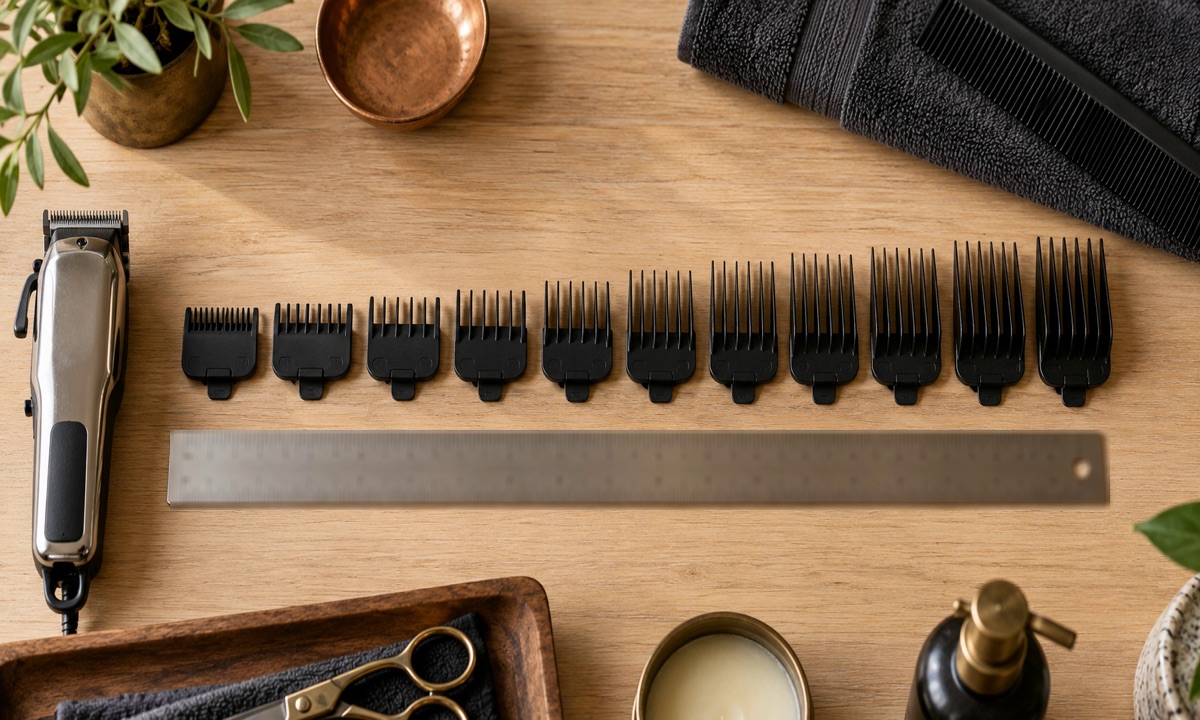
How clipper guard numbers work
The numbering is simpler than it looks. Every whole number is another eighth of an inch. A #1 is 1/8 inch, a #2 is 2/8 (1/4 inch), a #3 is 3/8, and so on up to the #8, which is 8/8, or a full inch. If you remember that, you can work out any guard in your head: divide the number by eight and you have the length in inches.
Half sizes fill the gaps at the short end, where small differences are easiest to see. The #0.5 (1/16 inch) and #1.5 (3/16 inch) exist for fades, where a barber needs more steps between skin and a #2 to hide the lines. Above #2 the steps are big enough that half sizes rarely matter.
Below the #0.5 you're working with no guard at all. Most adjustable clippers have a lever on the side: closed is the shortest cut the blade can do, and open leaves a little more. The lever works with a guard on, too, so a #2 with the lever open cuts a touch longer than a #2 with it closed. How much depends on the clipper, so if you cut at home, it's worth checking the manual for yours. Past that, the only way shorter is a foil shaver or a razor, which is what “skin” means in a skin fade.
Guard sizes by haircut
These are the ranges barbers reach for most often. They're starting points, not rules, and your barber will adjust them to your hair. To see where each guard goes on the head, open the taper height diagram.
| Haircut | Usual guards | Notes |
|---|---|---|
| Buzz cut | #1 to #4 all over | One guard everywhere. A #2 or #3 is the most common. Add a taper to clean up the edges. |
| Crew cut | #2 to #3 sides, #4 to #6 or scissors on top | Short sides with a little more length on top, often styled forward or to the side. |
| Taper | Lever closed or #0.5 at the edges, #2 to #3 sides | The short part stays around the ears and neckline. See our taper fade guide. |
| Fade | #0.5 to #1 at the bottom, stepping up to #2 or #3 | A wider band of short hair than a taper. Taper vs fade explains the difference. |
| Skin fade | Foil or razor, lever closed, #0.5, #1, then up | Bare skin at the bottom. The types of fades guide shows where each one starts. |
Fade height changes where the short guards go, not which guards get used. A low taper fade keeps the #0.5 and #1 in a thin band near the hairline. A mid taper fade carries them up to around the temple, and a high taper fade takes them most of the way up the side.
#1 vs #2 vs #3: what the difference looks like
On paper, each step is only an eighth of an inch. On your head it's the difference between seeing scalp and not seeing it.
- #1 (1/8 in): you can see your scalp clearly, especially under bright light. It reads as very short and very clean.
- #2 (1/4 in): the hair covers the scalp from a distance, but it still shows up close and in photos with flash. This is the length most people picture when they hear “buzz cut.”
- #3 (3/8 in): on most hair the scalp stops showing through. It looks like short hair rather than a shaved head.
Going longer, the steps stop being about scalp and start being about shape. A #4 (1/2 inch) looks like a full, soft buzz. A #6 (3/4 inch) is short hair you could almost comb, and a #8 (1 inch) is about as long as a clipper cut gets. On the longer guards, go over each area a few times, because thick hair tends to fold under the comb instead of being cut.
Your hair changes the picture. Dark, dense hair looks longer and fuller at the same guard because it hides the scalp. Blonde, grey, or fine hair looks shorter, so if your hair is light, go one number longer than you think. Curly and coily hair also sits up off the scalp more, which adds visible length at the same guard.
How to ask your barber for a guard length
Say the number and where it goes. “A two” on its own could mean a two all over or a two on the sides, and those are very different haircuts. Give the sides and the top separately. A clear request sounds like: “Number two on the sides, fading down to a half at the neckline, and leave about two inches on top.” If you want the top clippered too, say so (“a two on the sides blended into a six on top”), or ask whether scissors would suit your hair better up there.
If you don't know the numbers, say the length you want left in inches and let the barber pick the guard. And if you liked a past cut, ask what they used and write it down. Our barber brief generator puts all of this on one card you can show from your phone.
Do guard sizes differ between brands?
For standard snap-on guards, mostly no. Wahl, Andis, BaByliss, and Oster all sell numbered guards for their regular clippers on the same 1/8-inch scale, so a #3 is 3/8 inch whichever logo is on it. What does differ:
- The metric label. A #3 is exactly 9.53 mm, but it's usually printed as 10 mm. A #4 is 12.7 mm and printed as 13 mm. The chart above shows both.
- Half sizes. Some sets include #0.5 and #1.5, and some cheaper ones don't.
- Detachable blades. Clippers like the Oster Classic 76 use swappable blades with their own numbering, and it doesn't match guard numbers. A #1 blade on those leaves roughly 3/32 inch, not 1/8. Blade numbers also run backwards: the higher the blade number, the shorter the cut.
- Fit. The same number can mean the same length across brands and still not clip onto your clipper. Guards are made for specific blade shapes, so match the clipper model before buying replacements.
- Magnetic and metal guards. Premium guards from several brands clip on more firmly and flex less than basic plastic ones. The lengths follow the same scale.
Cutting at home with guards
Start one size longer than the length you want. You can always go shorter on a second pass, and you can't put hair back. Push the clipper against the direction your hair grows, which on most heads means upward on the sides and back and from the crown forward on top.
Before every pass, check that the guard is fully clicked in. A guard that slips loose lets the blade cut much shorter than you meant, and you won't notice until you see the patch. Move slowly, keep the flat of the guard against your head, and go over each area more than once so stray hairs get caught.
For a fade at home, work from the bottom up with the shortest guard first, then use the next size up with a scooping motion to soften the line. The low taper fade styling guide covers keeping it looking sharp between visits.
How fast a guard length grows out
Scalp hair grows about half an inch a month on average, according to the American Academy of Dermatology. That's roughly one guard size every week. A #2 buzz cut is closer to a #4 after two weeks and a #6 after a month, which is why short cuts look “grown out” so fast.
The shorter the cut, the sooner you notice. Skin fades lose their sharpness within a week or two, while a #3 or #4 buzz can go three or four weeks before it looks untidy. If you want less upkeep, pick a longer guard or a lower fade that grows out gradually. The next haircut calculator works out when your cut will need a trim and adds it to your calendar.
Embed this chart on your site
Barbershops, barber schools, and grooming blogs are welcome to use this chart. Paste the code below into your page. It's free; please keep the credit link. You can also use the Download chart button above to save it as an image.
Frequently asked questions
What length is a number 2 guard?
A #2 guard leaves 1/4 inch of hair, which is 6.35 mm. Most guards round that and print 6 mm on the side. It's the classic short buzz length: the hair covers the scalp, but you can still see the shape of your head, especially if your hair is light or fine.
What is the shortest clipper guard?
In a standard set the shortest is the #0.5, at 1/16 inch (about 1.5 mm). Some kits skip it and start at #1. Shorter than a #0.5 means taking the guard off: the bare blade with the lever closed, then a foil shaver or razor if you want skin.
What guard number is used for a fade?
A fade uses several. It starts with the shortest length at the bottom (skin, lever closed, or a #0.5), then steps up through #1 and #1.5 to a #2 or #3 where it meets the top. The fade planner above shows common steps for low, mid, high, and skin fades.
What number is a buzz cut?
Most buzz cuts are between a #1 and a #4. A #1 shows a lot of scalp, a #2 is the classic short buzz, a #3 covers the scalp on most hair, and a #4 reads as short hair rather than a buzz. Dark, thick hair looks longer than fine or light hair on the same guard.
What does lever open and lever closed mean?
Most adjustable clippers have a lever on the side that moves the cutting blade. Closed is the shortest setting and open leaves the hair slightly longer, usually by a millimeter or so. Barbers use the lever to blend between two guard sizes without switching guards.
Are Wahl and Andis guard sizes the same?
For the standard numbered guards that clip onto their regular clippers, yes: both follow the same 1/8-inch steps, so a #2 is 1/4 inch on either. The numbers stop matching when you get into detachable blades or brand-specific comb sets, which use their own scales. Check the length printed on the guard.
Is a higher guard number longer or shorter?
Longer. Each whole number adds about 1/8 inch (3 mm), so a #4 leaves twice as much hair as a #2. Detachable clipper blades are the exception and run the other way, where a higher blade number cuts shorter. That mix-up causes a lot of accidental buzz cuts.
How long does a #1 buzz cut take to grow out?
Hair grows about half an inch a month on average, according to the American Academy of Dermatology. A #1 leaves 1/8 inch, so after a week you're near #2 length and after about three weeks you're at roughly a #4. Most people rebuzz every one to three weeks to keep it looking deliberate.