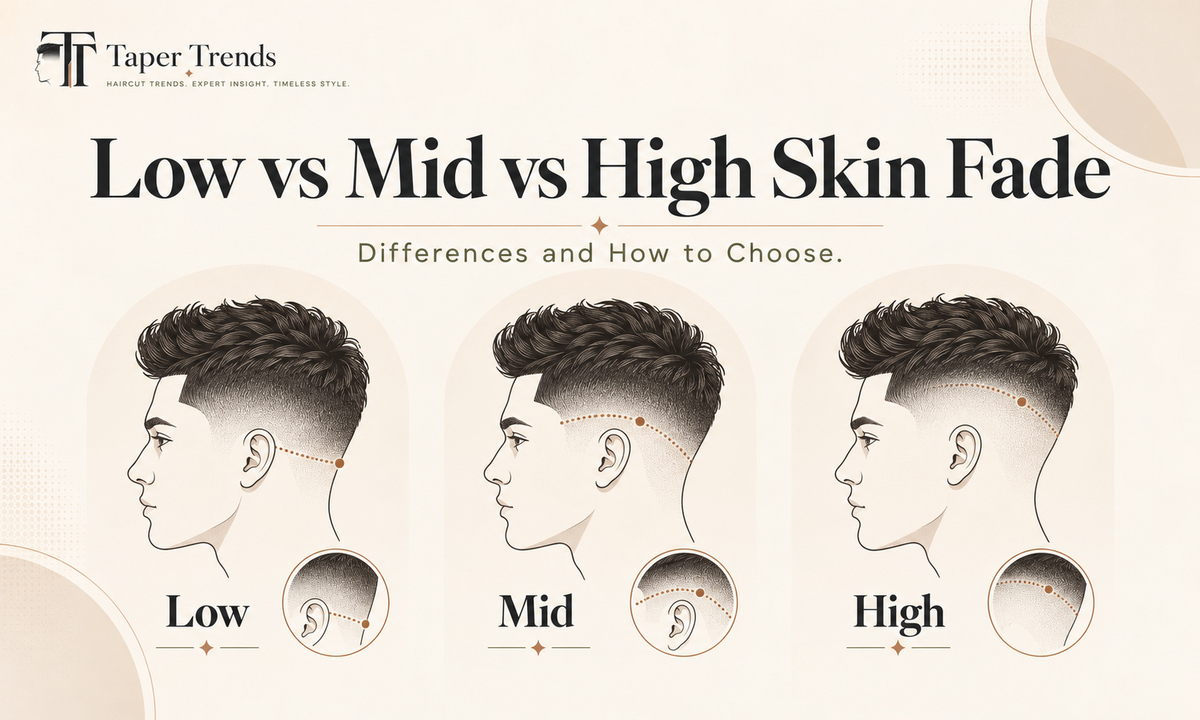
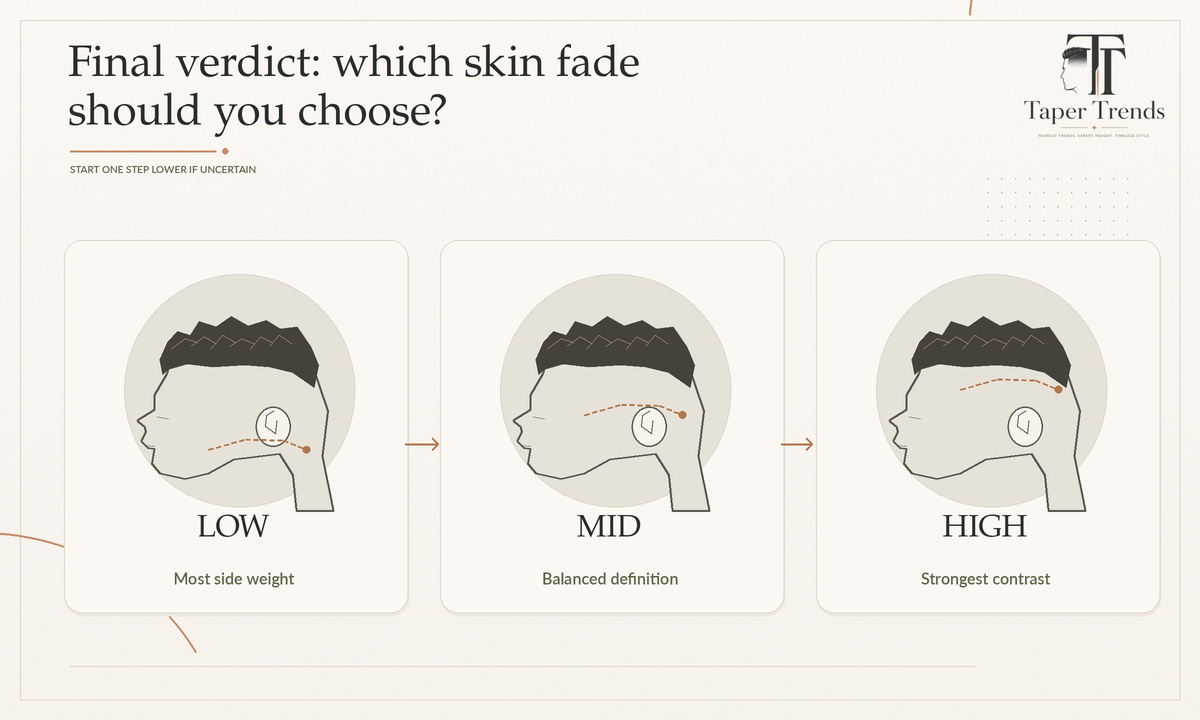
In a low vs mid vs high skin fade comparison, every cut ends at bare scalp, so the only thing that changes is how far up the head the bare section climbs. A low skin fade stays near the ears and neckline and keeps the most side hair. A mid skin fade reaches roughly temple level. A high skin fade runs toward the top of the sides, showing the most scalp and the strongest contrast. The table in the first section puts all three side by side.
For the full cut on its own, start with our complete skin fade guide. If you're still deciding between bare scalp and a longer finish, the skin fade vs taper fade comparison comes first, and the low taper fade haircuts guide is the hub for every taper and fade on the site.
Low vs mid vs high skin fade: what is the difference?
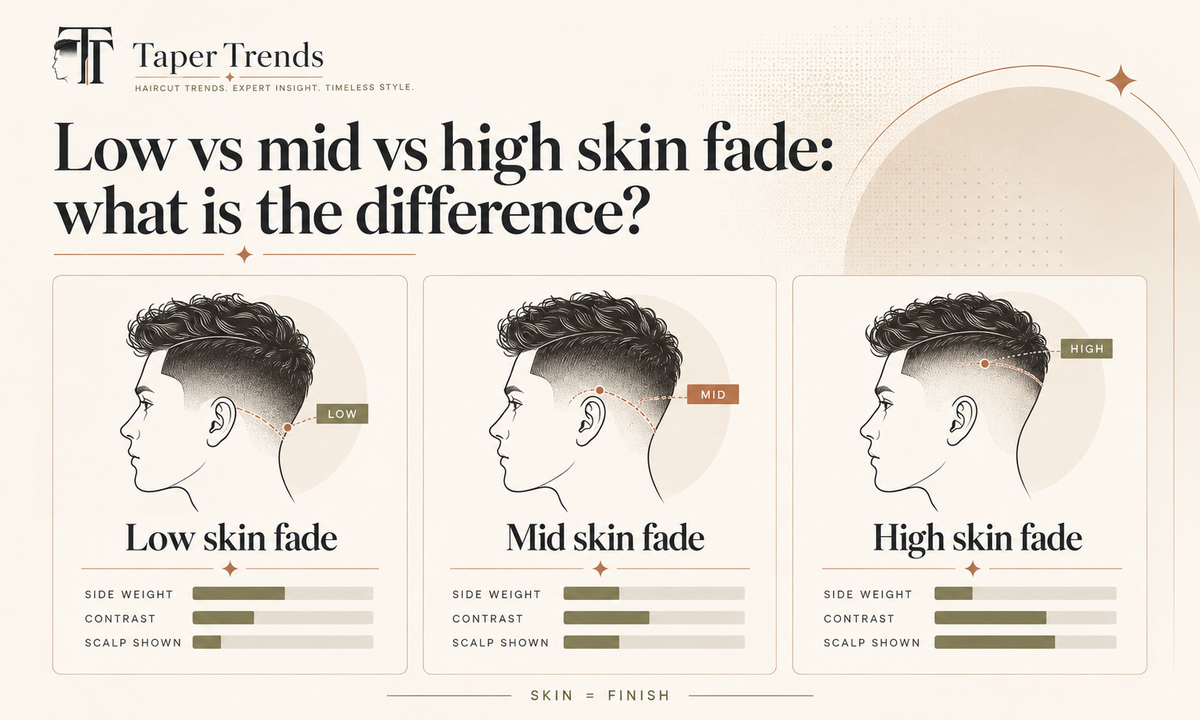
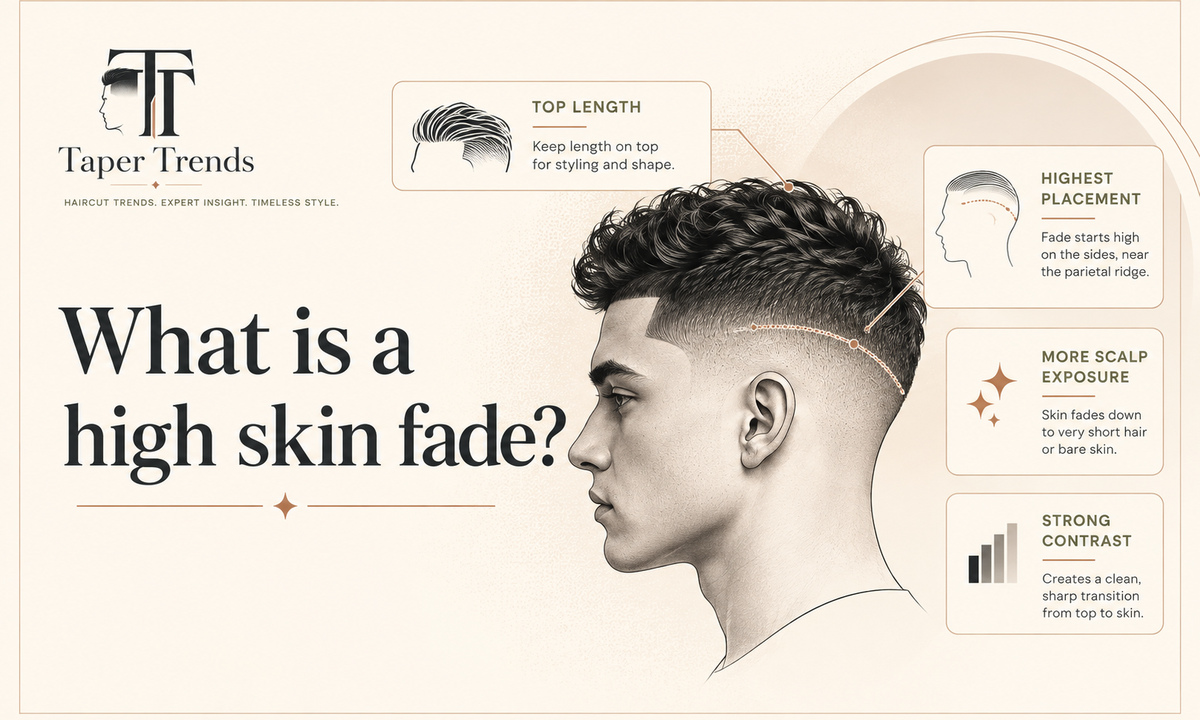
The difference between low, mid, and high skin fades is placement. All three finish at bare skin, and the height label tells your barber where the fade starts on the sides and back. That starting point decides how much hair stays around your head and how hard the contrast looks. Aventura Barber Studioframes height and shortest length as two separate choices, and that split is the key to this whole comparison. If you haven't settled on skin at the bottom yet, our general low vs mid vs high fade guide covers the same heights with shadow and guard finishes.
Barbers place fades by landmarks, not rulers, so the labels drift a little from shop to shop. A Wahl barber guide describes one common method: find the natural hairline at the base of the head behind the ear, then measure up about one finger width for a low fade, two for a mid fade, and three for a high fade.
| Low skin fade | Mid skin fade | High skin fade | |
|---|---|---|---|
| Bare section ends near | Ears and lower nape | Temples | Upper sides, near the parietal ridge |
| Scalp exposed | Least | Moderate | Most |
| Side weight kept | Most | Moderate | Least |
| Contrast | Soft | Balanced | Strong |
| Regrowth shows | Latest | In between | Soonest |
| Main thing to agree on | Saying “skin,” not a guard | Where the temple line sits | The highest point allowed |
The same three heights apply when the fade stops short of skin. Our low taper fade vs mid taper fade, mid taper fade vs high taper fade and low taper fade vs high taper fade comparisons run the same height decision for the taper family, and the guide to every type of fade haircut lines every other fade name up beside these three, and the types of fade haircuts guide sorts them by height, finish, and shape.
What does “skin” mean in a skin fade?
“Skin” means the shortest part of the fade reaches exposed scalp. It describes the finish, not the height. CADMEN Barber Academy notes that most shops use skin fade and bald fade interchangeably.
Any height can also stop at a guard length instead of skin, so name both settings when you sit down: “mid fade, down to skin.” “Zero fade” is the loosest term of all. Some shops mean bare scalp, others mean a faint stubble, so ask which one you'll get (our how to cut a fade guide covers what a zero actually leaves). Our clipper guard size chart converts every guard number to inches and millimeters, which helps when your barber offers a close guard instead of a shave, and our best clippers for fades guide explains why even a zero-gapped blade stops short of bare skin.
What is a low skin fade?
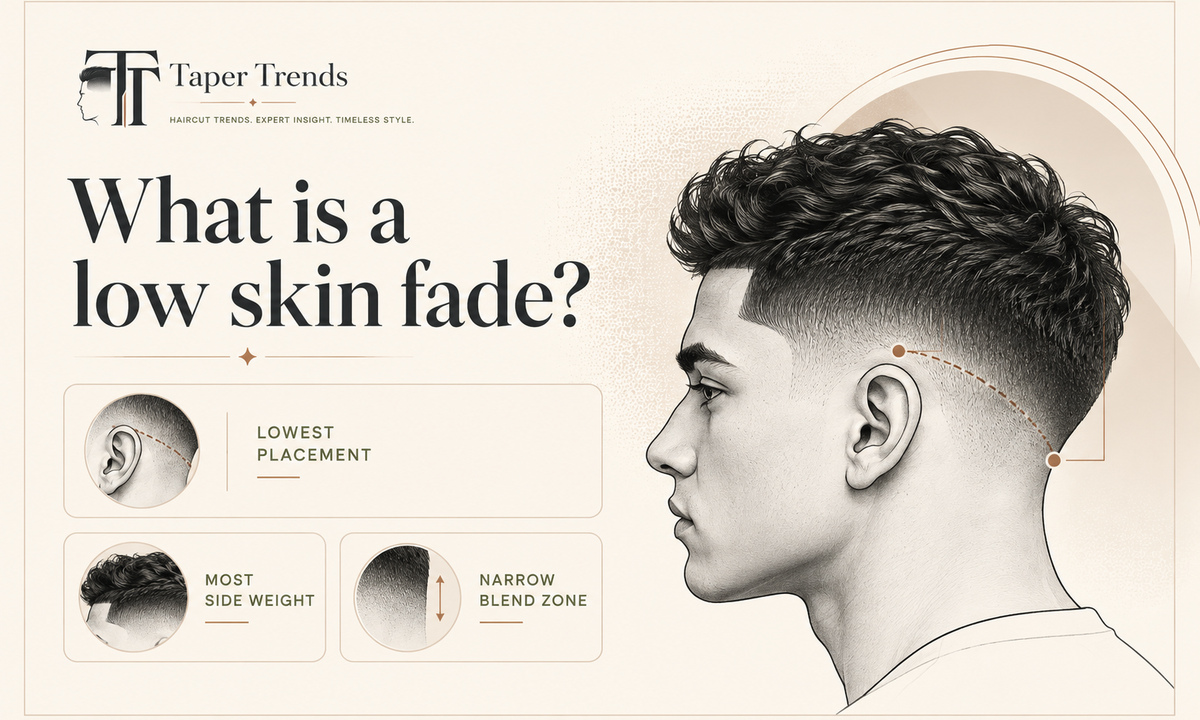
A low skin fade keeps the bare section close to the ears and lower nape, leaving the most hair on the upper sides. It has the softest contrast of the three. That makes it a common first skin fade and a safe choice for workplaces that lean conservative.
CADMEN places the skin about 1 to 2 centimeters (roughly half an inch to three-quarters of an inch) above the ear line. Treat that as one academy's description rather than an industry standard. Most of the side stays covered, so the cut reads clean instead of dramatic, and Aventura recommends this height when you want texture or fullness above the temples.
The trade-off is precision. The whole blend has to fit into a narrow band, which leaves little room to hide an uneven step. Ask for skin by name, too. A low fade on its own often stops at a guard length.
If you like the idea of a low blend but not the bare finish, our low taper fade for short hair, low taper fade for straight hair and low taper vs low fade guides show the same placement with hair left at the edges. For a low blend that curves behind the ear, see the low drop fade and low taper drop fade guides.
What is a mid skin fade?
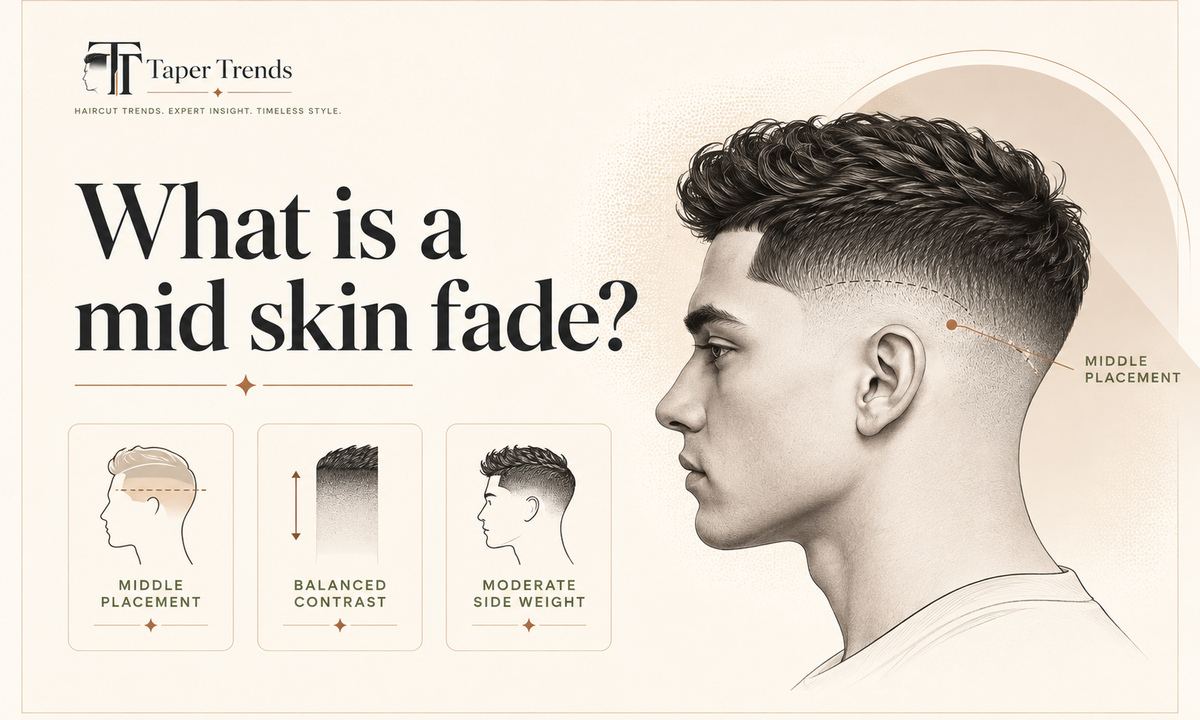
A mid skin fade starts around the temples, roughly halfway up the side of the head. It shows clearly more contrast than a low fade while keeping more side weight than a high one. If you're torn between the other two, mid is the sensible middle.
The wider blend zone gives your barber more room to smooth the transition, which is one reason mid is so forgiving to cut. Aventura pairs mid heights with short crops, side parts, textured tops, and curls. Pick mid if you want visible definition and still want some fullness above the ears.
Our mid taper fade guide covers the same height without the bare finish, and the mid taper fade with a textured fringe and mid taper fade for short hair guides show the tops that sit best on a temple-level blend. For the curved version, the mid drop fade and mid burst fade guides cover the shapes.
What is a high skin fade?
A high skin fade carries the bare section up toward the parietal ridge, the point where the side of the head curves into the top. It exposes the most scalp, removes the most side weight, and creates the strongest contrast with the hair above.
That contrast pulls attention to the top and sharpens the silhouette. It also has costs. Aventura notes that high fades show growth sooner, and the extra exposure puts any scar, dent, or uneven contour on display. Point out anything you'd rather keep covered before cutting starts, along with the other details in our guide on how to ask for a fade.
Top length matters more here than at the other heights. CADMEN warns that a high fade over very short top hair can look severe on some people, so settle the top before the fade line goes in.
Our high taper fade guide shows the same height with hair left at the edges, and the high taper fade with beard, high drop fade and high burst fade guides cover the beard blend and the two curved shapes at this height.
How can you spot each fade in photos?
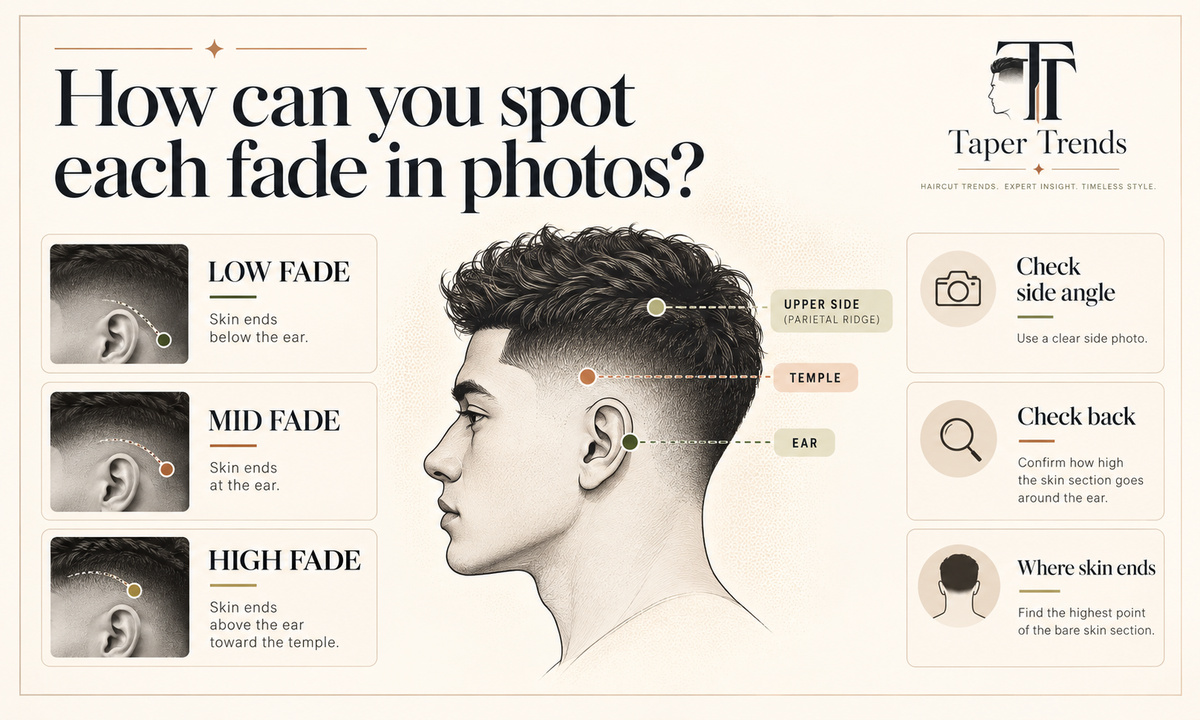
To tell low, mid, and high skin fades apart in a photo, find where the bare scalp ends and the darker hair begins. Low ends around the ear, mid near the temple, and high near the curve where the side meets the top. Use side-angle photos, then check the back, because a fade can sit lower there.
Three details settle most cases:
- Where the bare scalp stops, measured against the ear, the temple, and the side-to-top curve.
- How wide the blend is. Height is where the bare zone ends; blend width is how gradually the hair lengthens above it. Don’t confuse the two.
- What the back does. A drop fade dips behind the ear toward the nape, so judge the sides and back separately.
Skip tight close-ups that hide the temple and upper side. Without those landmarks, you're guessing at height. Our what a low taper fade looks like guide shows the lowest placement from side and back angles, and the drop fade and burst fade guides explain the back shapes that can throw off a photo read.
Which skin fade suits your face and head shape?
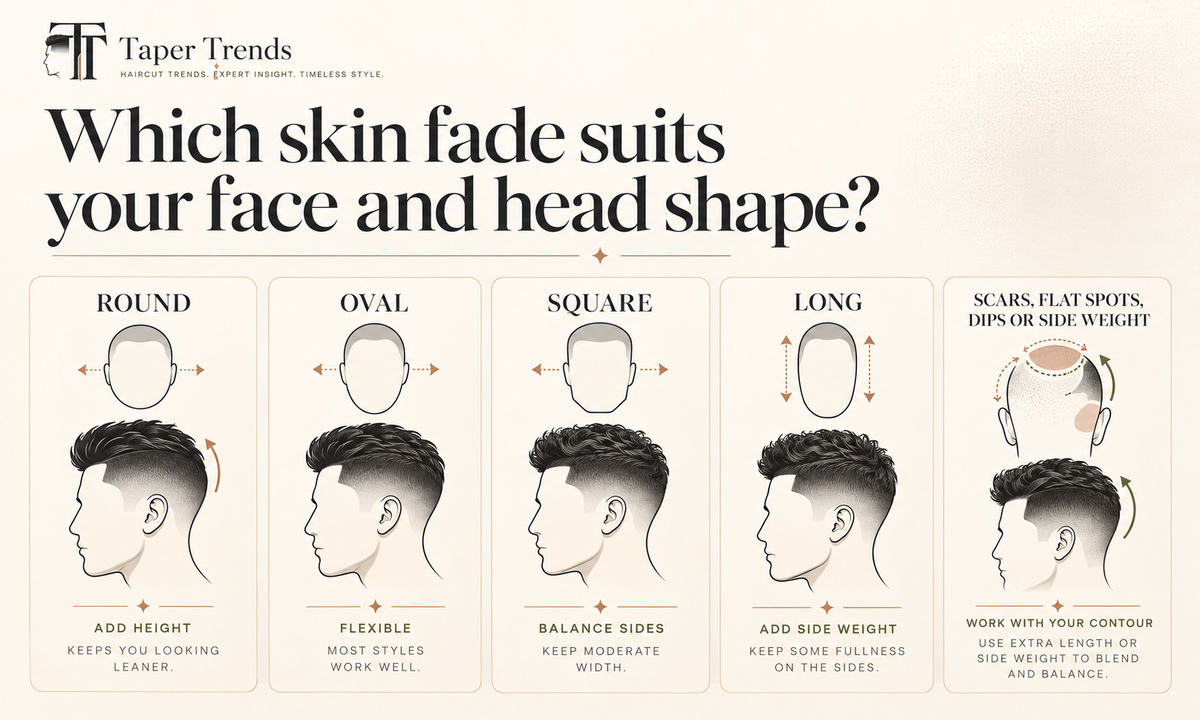
No face shape requires a particular skin fade height. Height changes how wide the head looks and how much the top stands out, so proportion and retained side weight matter more than any chart. Use face-shape advice to open the conversation with your barber, not to close it. Our face shape detector gives you a starting point, and the photo stays on your device; our best fade for your face shape guide goes shape by shape.
How does fade height affect round, oval, square, and long faces?
A higher fade narrows the sides, while a lower one keeps width. Our skin fade guidenotes that some barbers start higher on round faces and lower on long or narrow ones. That's stylistic opinion, not a measured rule.
- Round faces: a higher fade takes width off the sides, which is why some barbers favor it.
- Long or narrow faces: a lower fade keeps width at the sides.
- Oval and square faces: reliable sources don’t favor one height. Decide on exposure, side weight, and upkeep instead.
How do head contours and side weight change the result?
Raising a skin fade reveals more of the skull, while leaving side weight softens the outline. Barber training material tells barbers to read the head first, noting parietal and occipital contours, dips, and scars, before setting the fade line, a habit our guide to every type of fade haircut also stresses. Mention flat spots, asymmetry, or marks you want kept covered before the clippers come out.
Which skin fade works with your hair texture and top style?
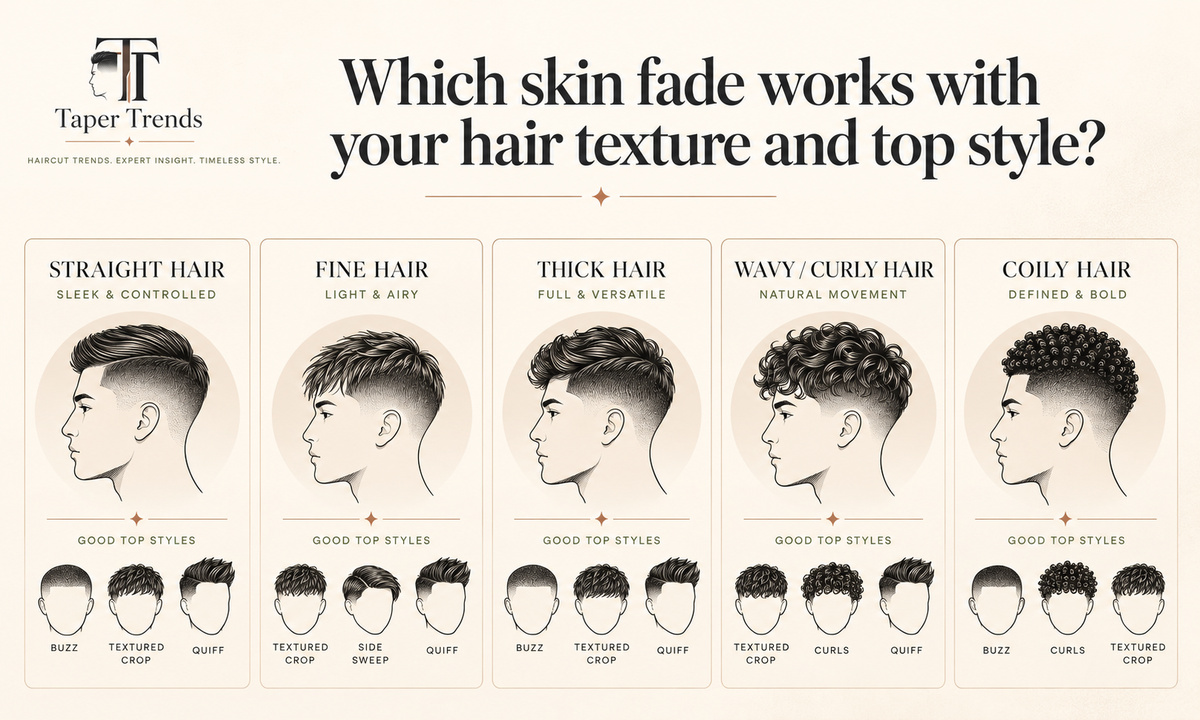
Low, mid, and high skin fades can all work with any hair texture. What changes the result is bulk, density, and how the top connects to the sides. Settle your texture and top style first, then choose the height that gives the contrast you want.
Which fade works for straight, fine, or thick hair?
Choose the height by how much fullness you want left on the upper sides. Thick hair holds a lot of side weight, so a lower fade keeps more of that bulk. Fine hair shows less contrast, which means the bottom has to genuinely reach scalp for the fade to read at all. Our low taper fade for thin and thick hair, mid taper fade for straight hair and high taper fade for straight hair guides go deeper on each density.
A thinning top changes the math. A sharp skin fade beside a sparse top raises the contrast rather than hiding it, according to our fade guide, so a lower, softer blend usually looks more natural.
What works best with wavy, curly, or coily hair?
Any height can work with wavy, curly, or coily hair, but judge the top, curl volume, and side silhouette together. Curly and coily hair gives strong contrast against a bare bottom and tends to hide small inconsistencies in the blend.
A lower fade keeps more volume beside the curls, and a higher one pushes attention to the top. If you want your curl pattern left alone, say so, and ask for the top to blend into the sides. The skin fade curly hair guide covers curls in depth, and the curly low taper fade, mid taper fade curly hair and high taper fade curly hair guides show each height without the bare finish. For waves, see low taper fade wavy hair, mid taper fade wavy hair and high taper fade waves. For coils and Afros, the low, mid and high taper fade Afro guides apply, along with the drop fade for Black men and high taper fade for Black men guides.
Which top hairstyles pair with low, mid, and high skin fades?
Pairings are flexible, not fixed. A buzz cut leaves a skin fade little to frame, while textured crops, quiffs, slick backs, and natural curls make the contrast stand out. A textured crop over a mid skin fade is a common combination. As a loose rule, stronger separation suits higher fades and connected tops suit lower ones.
For top ideas, browse the French crop, slick back, comb over, side part, blowout and textured fringe guides, or the low taper fade buzz cut and mid taper fade buzz cut guides for the shortest tops. Longer tops are covered in low taper fade for long hair and mid taper fade for long hair, and our how to style a low taper fade guide covers the daily routine.
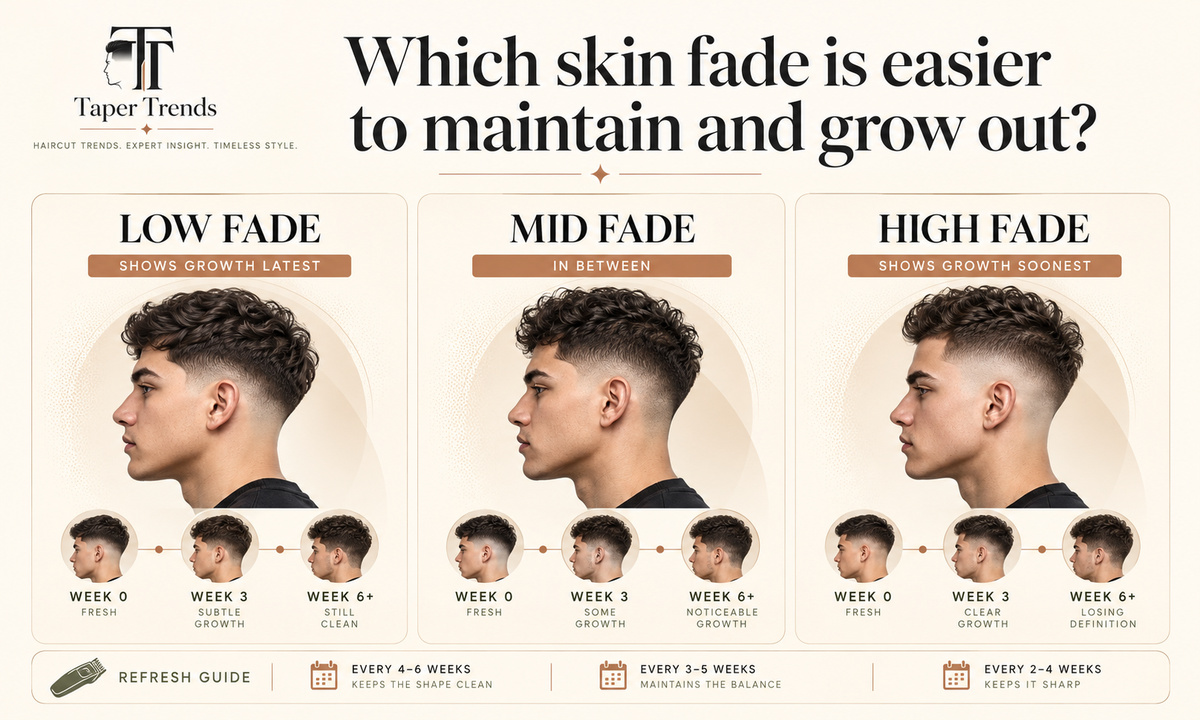
Which skin fade is easier to maintain and grow out?
Fade height doesn't change how fast hair grows. It changes how soon the regrowth shows. Cleveland Clinic puts average scalp growth at about half an inch to one inch a month, varying by person. A higher fade shows that growth sooner because more bare scalp sits against darker hair, so a low skin fade is usually the easiest to live with between cuts.
How often should you refresh a skin fade?
There's no required schedule. Refresh timing depends on how sharp you want the bare section to stay, and shops give different advice:
| If you want | Typical rebooking advice | Source |
|---|---|---|
| A truly bare bottom at all times | Every 1 to 2 weeks | Our skin fade guide, summarizing barbershop guidance |
| A sharp look most of the time | Every 2 to 3 weeks | CADMEN |
| A relaxed approach to freshness | Every 3 to 4 weeks | CADMEN |
CADMEN adds that regrowth on the skin section becomes visible after about 7 to 10 days. Treat all of these as barbershop preferences, not measured lifespans; our guide to how often you should get a haircut sets them beside every other cut. If that rhythm sounds like too much, a taper is the lower-maintenance route, and our taper vs fade explainer and taper fade haircut guide show how the grow-out differs. If you are moving away from a skin fade altogether, how to grow out a fade walks through it.
What happens as a low, mid, or high skin fade grows out?
Regrowth softens the bare-scalp contrast at every height, and the original placement decides what's left. A low fade keeps its upper-side weight, so its silhouette changes least. A high fade loses more of its definition as the cleared area fills in, which is why Aventura suggests more frequent maintenance if you want a consistently tight finish. Soft, even stubble is a normal stage of the cut, not a mistake.
When should you avoid a skin fade or choose a different finish?
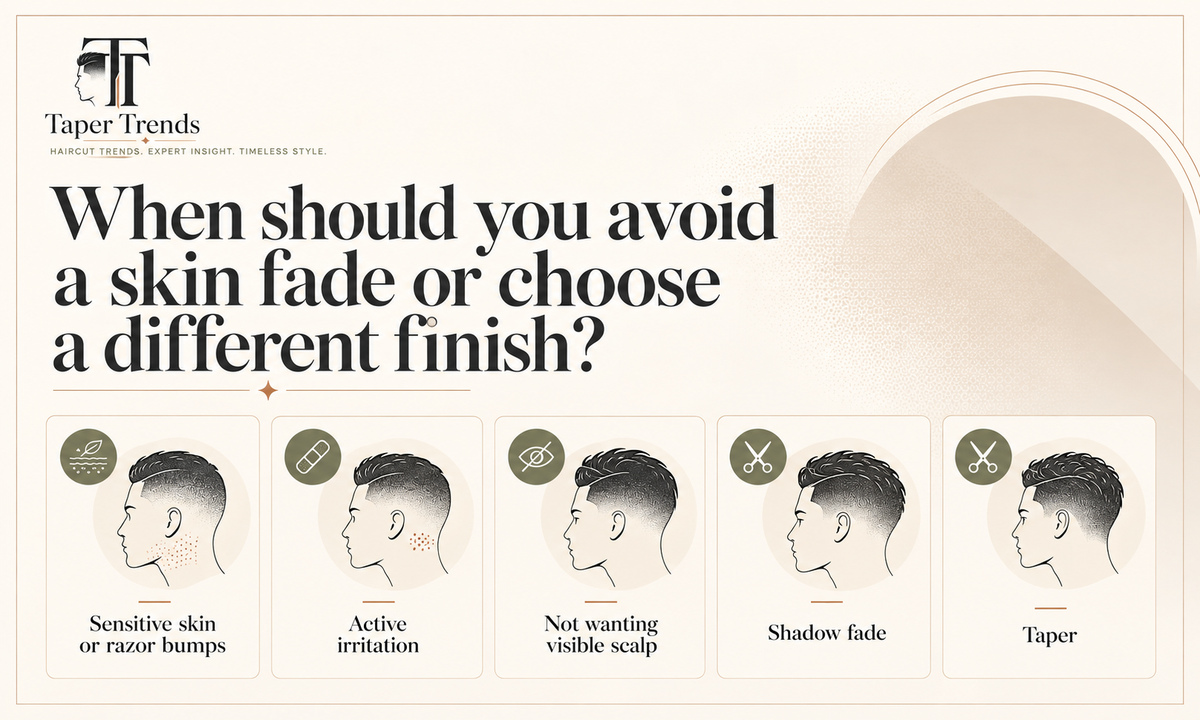
Skip a razor-close finish if you regularly get razor bumps, have active scalp irritation, or simply don't like visible scalp. You can keep the same height with a shadow fade, or move to a taper. Pick the finish separately from the height, and tell your barber about any irritation history before cutting starts.
What if you have sensitive skin or razor bumps?
Close shaving can cause razor bumps, so talk through your history with your barber instead of forcing a bare finish. The American Academy of Dermatology says razor bumps form when shaving irritates the skin and that untreated bumps can leave deep grooves and raised scars. If they keep coming back, see a board-certified dermatologist. That guidance is written about shaving in general, not scalp fades specifically.
The nape needs extra attention, because that's exactly where a skin fade sits. The AAD says acne keloidalis nuchaeis often mistaken for razor bumps on the back of the neck, is most common in Black men, and can cause raised scars and hair loss without treatment. Persistent bumps there call for a dermatologist's assessment. Our skin fade guide has a razor-bump care routine for between visits.
Is a shadow fade or taper a better alternative?
Often, if bare scalp is the problem. A shadow fade stops just short of skin and leaves a film of very short hair at the base. A taper shortens only the edges, such as the sideburns and neckline, and keeps more length everywhere else. Shops define both terms differently, so describe the result you want instead of relying on the label. The skin fade vs taper fade comparison walks through the differences, and the low taper fade haircuts guide links every taper height and style.
How to choose low, mid, or high: a five-question check
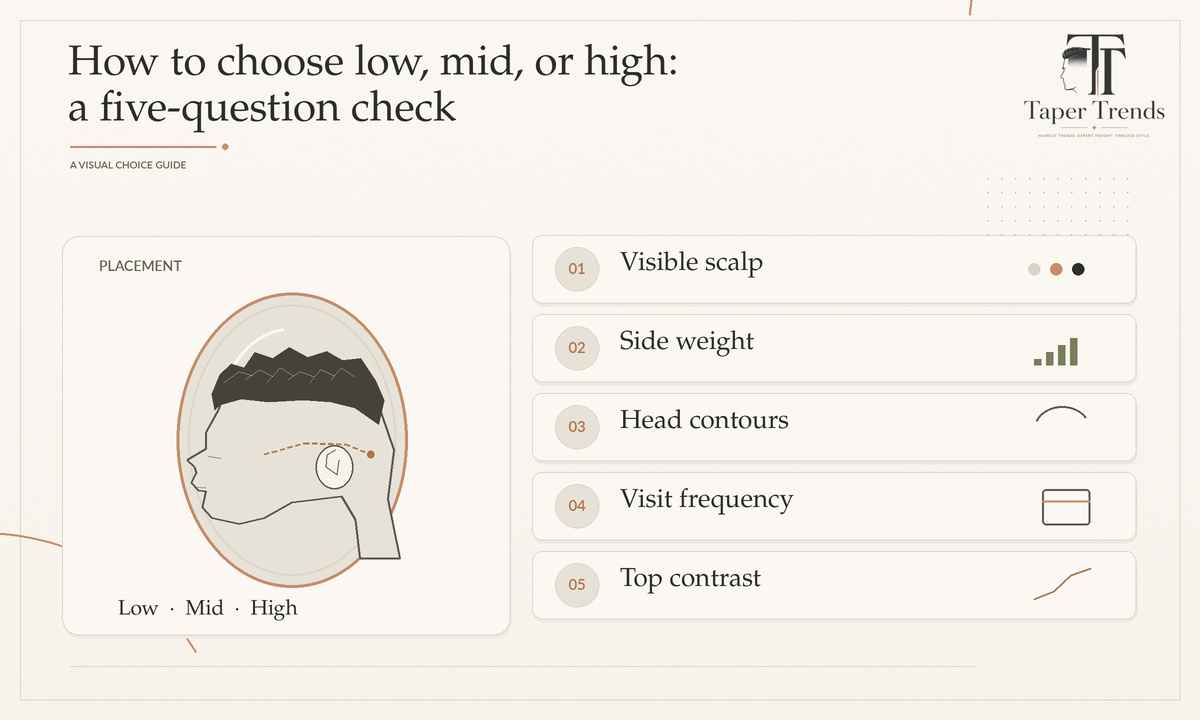
Run through these five questions in front of a mirror. Where your answers point in different directions, pick the lower option. As our skin fade guideputs the logic, you can go higher at the next visit, but you can't put hair back.
- 1. How much bare scalp are you comfortable showing?Less points low.
- 2. How much hair do you want above the ears?More points low.
- 3. Do you have scars, flat spots, or a thinning top?Any of those point lower.
- 4. Will you realistically rebook every two to three weeks?If not, lean lower.
- 5. Do you want a bold, prominent top with strong contrast?That points high.
The answer is a starting preference. Your barber confirms the exact placement once they can see your head. If your answers land between low and mid, our low mid taper fade guide shows a height in between, and the mid taper fade vs high taper fade comparison helps when the choice sits at the other end.
What should you tell your barber for a low, mid, or high skin fade?
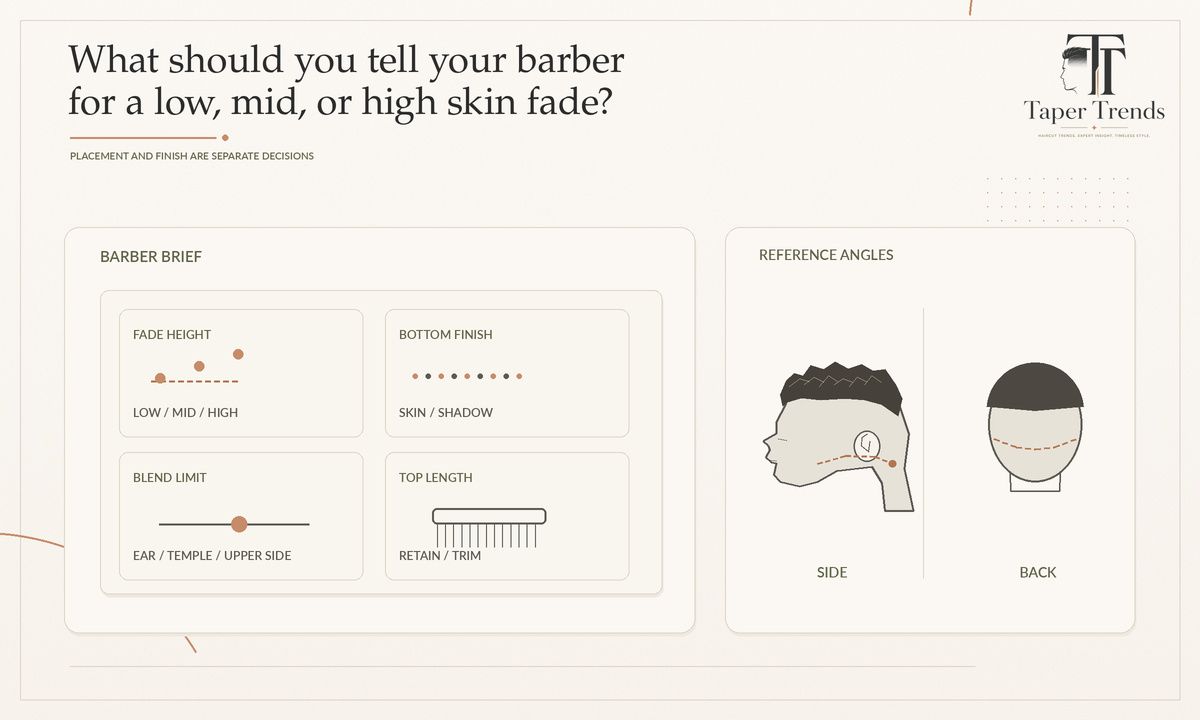
Tell your barber four things: how high the bare section should climb, whether it ends at skin or a shadow, where the blend should stop, and how much length stays on top. Bring side and back photos as well. A short script keeps it clear:
“I'd like a [low, mid, or high] fade, down to [skin or a shadow], blended out by [a landmark such as the top of the ear or the temple]. Keep [length] on top.”
Build the same request on your phone with our barber brief generator, which produces a card to show and a script to read out.
How do you describe fade height and the skin finish?
Name the placement and the finish separately, then point to the highest spot the bare section is allowed to reach. Landmarks such as the top of the ear or the temple work better than inches. Ask what “skin” means in that shop, because clippers alone can leave a faint shadow and some barbers finish with a foil shaver or razor, as our skin fade guide notes. Say which result you expect.
What photos and top-length details should you bring?
Bring side and back photos, because a front view hides most of a fade. Choose references where the hair texture is close to yours, and be ready to cover:
- The top length you want, or how much to take off
- How you style the top and which way it falls
- Your neckline shape, and whether the sideburns join a beard
- Any scar or thin patch you want protected
If the sideburns join a beard, the skin fade with beard guide has the six decisions to settle, and the low, mid and drop fade with beard guides cover the same handoff. For a younger client, the low, mid and high taper fade for boys guides keep each height school-friendly.
What mistakes cause the wrong skin fade?
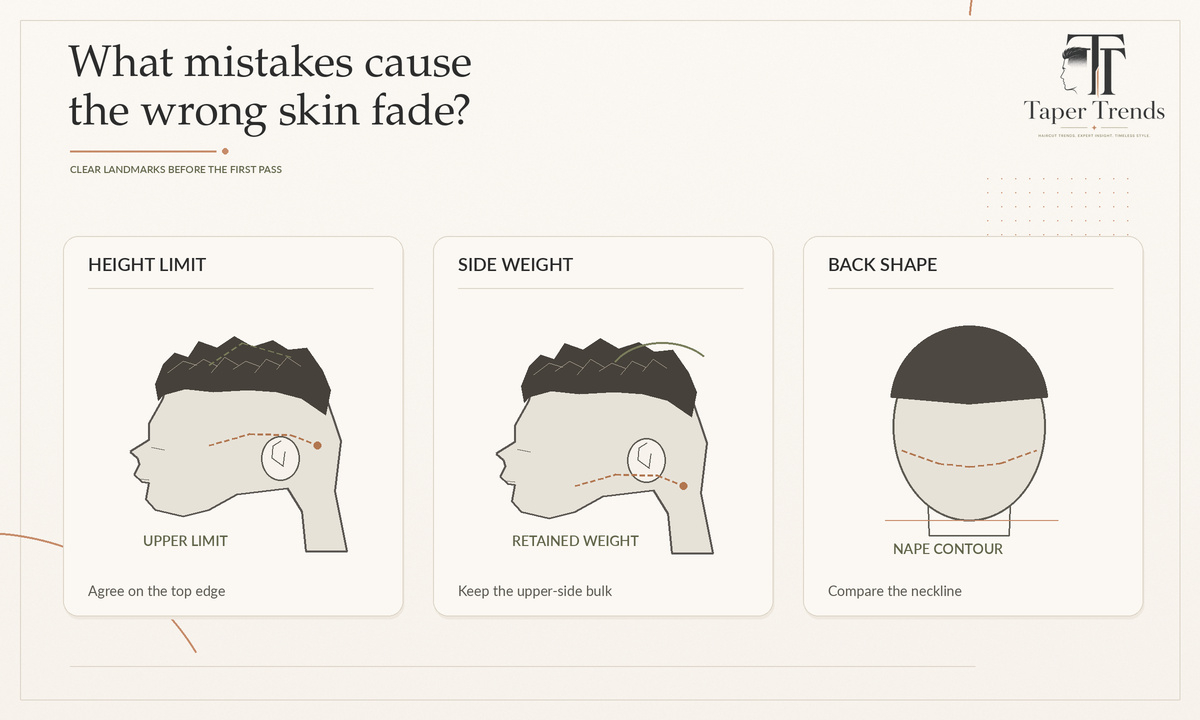
Most wrong skin fades come from vague instructions rather than bad cutting: a height label with no stopping point, a photo that hides the sides, or side-weight preferences nobody said out loud. A couple of execution slips are worth catching before you leave the chair. CADMEN lists uneven sides and a mismatched nape among the most common. If one slips through, see how to fix a bad fade.
| Mistake | Result | Prevention |
|---|---|---|
| Height named, upper limit not | Bare scalp climbs higher than expected | State the highest point using a landmark |
| Only “skin fade” or only “mid fade” said | Wrong finish or wrong height | Name both settings |
| Front-view photo only | Sides and back don’t match the idea | Bring side and back angles |
| Side weight never mentioned | Sides thinned more than you wanted | Say what fullness to keep |
| Sides set at different heights | One side looks higher | Compare both sides from the front |
| Nape left inconsistent | Back doesn’t match the sides | Check the back with a hand mirror |
How can you avoid a skin fade being cut too high?
Confirm the highest point of the bare section before the first pass, and show your barber where side weight should remain. Wahl's guide treats placing the fade line as the first decision because it shapes the entire transition. Moving that line is easy before blending, but afterward it usually means going higher. Ask to see the line in the mirror before the blend begins. Our skin fade vs taper fade comparisonhas a fix table for a fade that's already been cut too high.
Low vs mid vs high skin fade FAQs
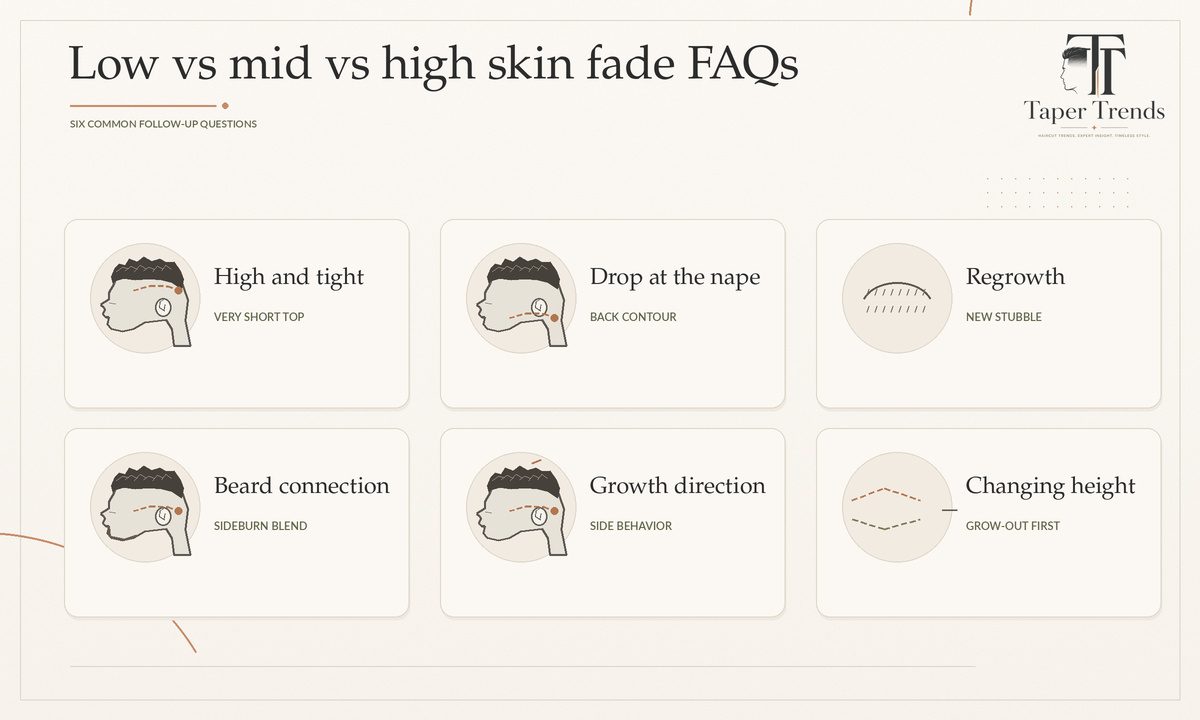
These answers cover what the main comparison leaves open: terminology, back shape, regrowth, beards, uneven growth, and changing your mind. They assume a skin finish unless noted.
Is a high skin fade the same as a high and tight haircut?
Not always. A high and tight is a military-style haircut, so the name describes the whole cut: very short, high sides and a short top. A high skin fade describes only the sides. A Marine Corps feature calls the high fade a close cousin of the high and tight that can be the same cut, so specify your top length. Our high taper fade buzz cut and high taper fade for short hair guides show the softer, non-skin versions of that short-top look.
Can a low skin fade drop lower behind the ear?
Yes. Height and back contour are separate choices. A drop fade dips lower behind the ear toward the nape, while a burst fade curves around the ear, and either one can be taken to skin. A standard low skin fade doesn't drop, so ask for “a low skin fade with a drop at the back” if you want that shape. Our low drop fade, mid drop fade and high drop fade guides cover the dip at each height, and the drop fade vs burst fade comparison sets it against the arc around the ear.
Does a skin fade make your hair grow back thicker?
No. Cleveland Clinicexplains that shaving cuts the hair shaft and leaves the root untouched, and it doesn't speed up growth either. New stubble can look darker or coarser because you're seeing the thicker base of each hair, but it returns to its original texture as it grows longer. Our complete skin fade guide covers how the bare section behaves between cuts.
Can you connect a skin fade into a beard?
Yes. The sideburn can blend gradually into the beard, or your barber can leave a clean break between them. Barbershop guidance summarized in our skin fade guidefavors blending the join over a hard edge and avoiding bare skin in the narrow gap between beard and sideburn. Your beard's density decides which option looks better, and the skin fade with beard guide walks through connected and disconnected sideburns at each height. The low, mid and high taper fade with beard guides cover the same join when the sides stop short of skin.
What if the hair on one side grows in a different direction?
Uneven growth direction can change how the blend sits, so tell your barber which side behaves differently. Aventura Barber Studiodescribes adjusting fade placement for each client's growth pattern, density, and head shape. Expect the result to differ slightly from a reference photo taken on someone else's head.
Can you change a high skin fade into a low skin fade at your next haircut?
Only once enough hair has grown back on the upper sides. A lower, fuller-sided fade needs hair there to blend into, and as Wahlpoints out, it's much easier to take length away than to add it back. Growth rates vary, so ask your barber when to return rather than expecting a fixed timeline. If you want a softer in-between step, the low mid taper fade guide shows a height between the two.
Final verdict: which skin fade should you choose?
No single skin fade is best. The right height depends on how much scalp you want to show, how much side weight you want to keep, and how often you'll sit in the chair.
- Choose a low skin fade for the most side weight, the softest contrast, and the gentlest grow-out.
- Choose a mid skin fade for visible definition with some fullness left and the most room to blend.
- Choose a high skin fade for a bold, prominent top, if you accept more upkeep and more visible head shape.
Still unsure? Start one step lower than you think you want. If it feels too soft, your barber can take it higher next time. From here, the complete skin fade guide, skin fade with beard, skin fade curly hair and skin fade vs taper fade guides continue the series.
The bottom line
Low, mid and high skin fades all finish at bare scalp. The height only decides how much scalp shows, how much side weight stays, and how soon regrowth appears.
Name the height and the finish separately, point to a landmark, bring side and back photos, and start one step lower if you're unsure.
Want more fade comparisons?
Browse clean, barber-ready breakdowns for every fade and hair type.