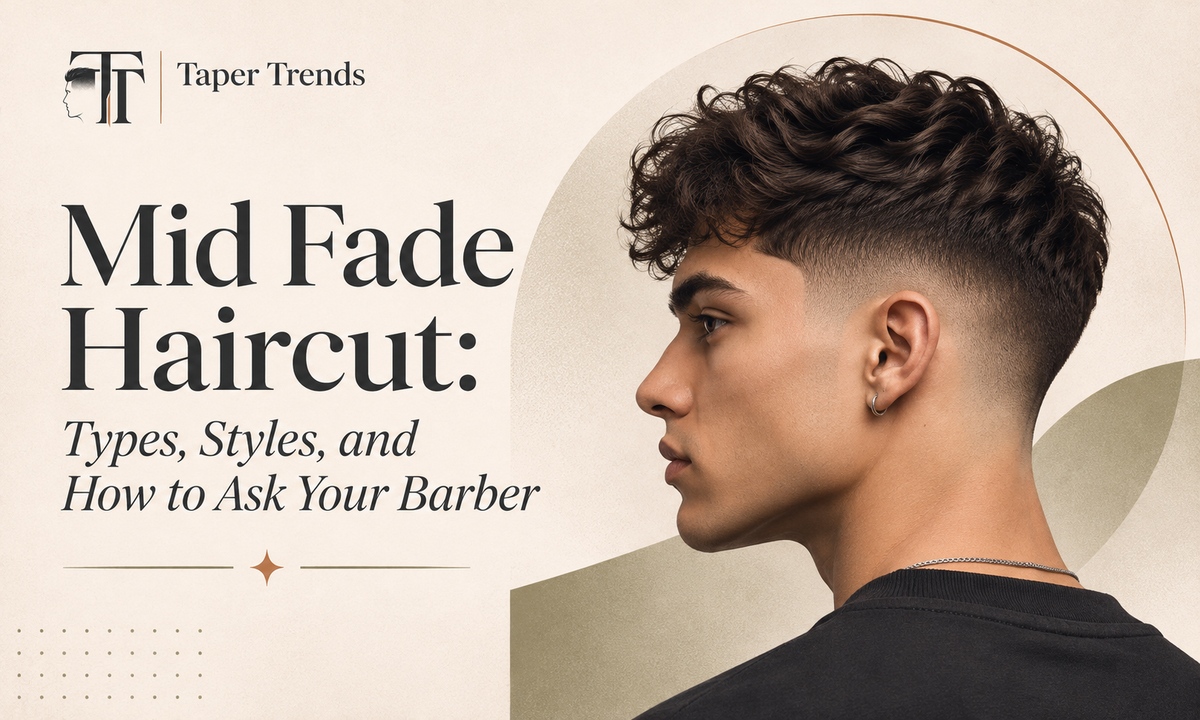
A mid fade haircut blends the sides and back from short hair at the bottom to longer hair above, with the blend starting around the temple. It sits between a low fade and a high fade, so you get clear contrast without losing most of your side length.
Getting the mid fade you pictured comes down to three choices: where the blend starts, how short the bottom goes, and which path the line takes around your head. For the wider picture, types of fade haircuts sorts every fade name by those same choices, and the low taper fade guide covers the softer option one step below this one.
What is a mid fade haircut?
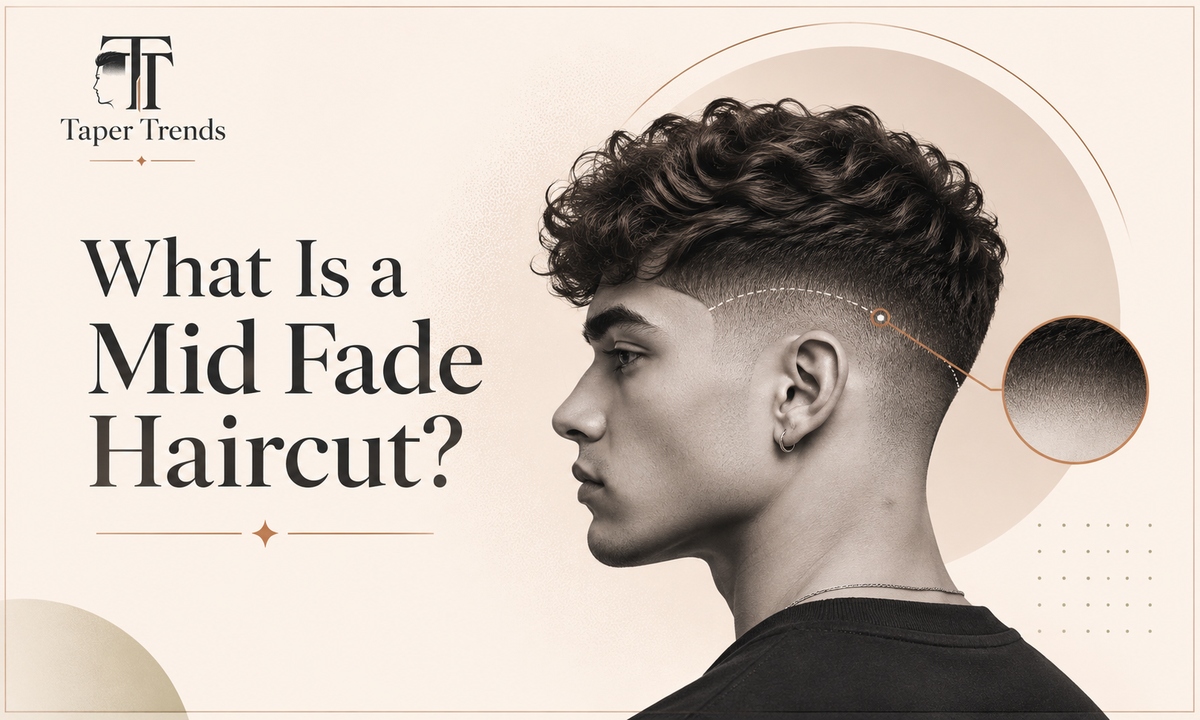
A mid fade is a gradual blend that begins around the middle of the side of the head, usually level with the temple, and shortens toward the ears and neckline. The term describes only the sides and back. The top can be cropped short, left at medium length, or grown long enough to slick back.
Where does a mid fade start?
A mid fade starts around the temple, between the top of the ear and the parietal ridge, the widest part of the skull where the side of the head turns into the top. Highgate Cuts lists these as the landmarks barbers work from. Heads differ, so touch the exact spot where you want the blend to begin. The taper height diagram lets you see how the starting line moves up and down the head.
What does a standard mid fade look like from the back?
A standard mid fade wraps around the back at the same height it starts on the sides, forming a level band that shortens toward the neckline, as TaperMode's side and back diagrams show. If the line curves down behind the ear instead, that's a mid drop fade.
Is a mid fade the same as a skin fade?
No. “Mid” tells the barber where the blend starts; “skin” tells them how short the bottom gets. A mid fade can finish at bare skin, a very short clipper length, or a longer guard such as a #1 or #2. Aventura Barber Studio treats height and shortest length as two separate decisions.
Mid fade vs low fade vs high fade
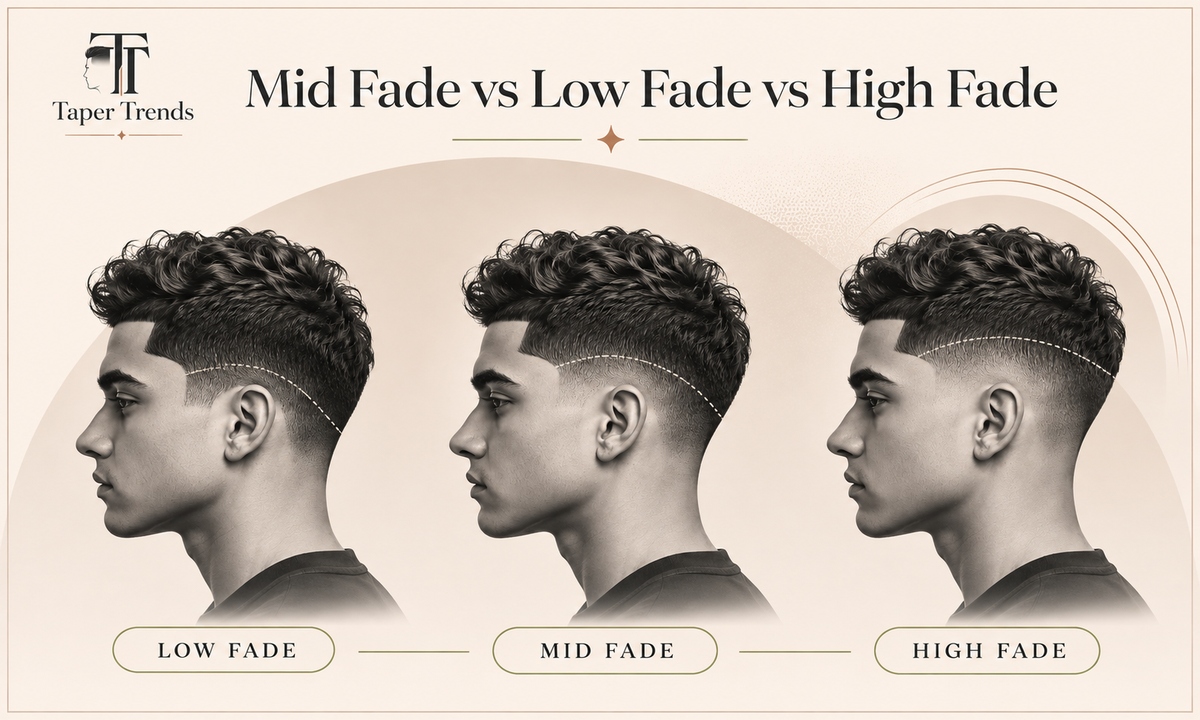
The difference between a low, mid, and high fade is where the blend begins. A low fade starts just above the ear, a mid fade around the temple, and a high fade near the top of the sides. The higher the start, the more side length disappears and the sharper the contrast with the top.
| Feature | Low fade | Mid fade | High fade |
|---|---|---|---|
| Blend starts | Just above the ear | Around the temple | Near the top of the sides |
| Side length kept | Most | Some | Least |
| Contrast with top | Subtle | Balanced | Strong |
| Regrowth shows | Latest | Moderate | Soonest |
How does fade height change your overall look?
Raising a fade takes weight off the sides, which makes the top look more prominent and narrows the silhouette. Barber Eric Garibay of BLVD Barbershop, speaking to Barbers Take, describes moving a fade higher as “changing the proportions of the entire cut.” A mid fade keeps the upper side at full length, so the outline stays softer than a high fade, which can expose more of your natural head shape.
Mid fade vs mid taper: what is the difference?
A fade shortens a larger area, usually down to very short hair or skin, while a taper shortens mainly around the ears and neckline and keeps noticeable side length, according to master barber Adrian Carranza. In practice, many shops say “mid taper” for a mid fade that stops before bare skin. Ask exactly which areas will be shortened, and how short.
Which fade should you choose?
Choose by the contrast you want and how often you'll realistically book:
- Low fade: visible mainly from the side and back, with an easy grow-out
- Mid fade: obvious from the front without giving up most of the side
- High fade: maximum contrast, with frequent visits
Torn between two? Pick the lower one. TaperMode notes a barber can always go higher but can't put length back.
Types of mid fade haircuts
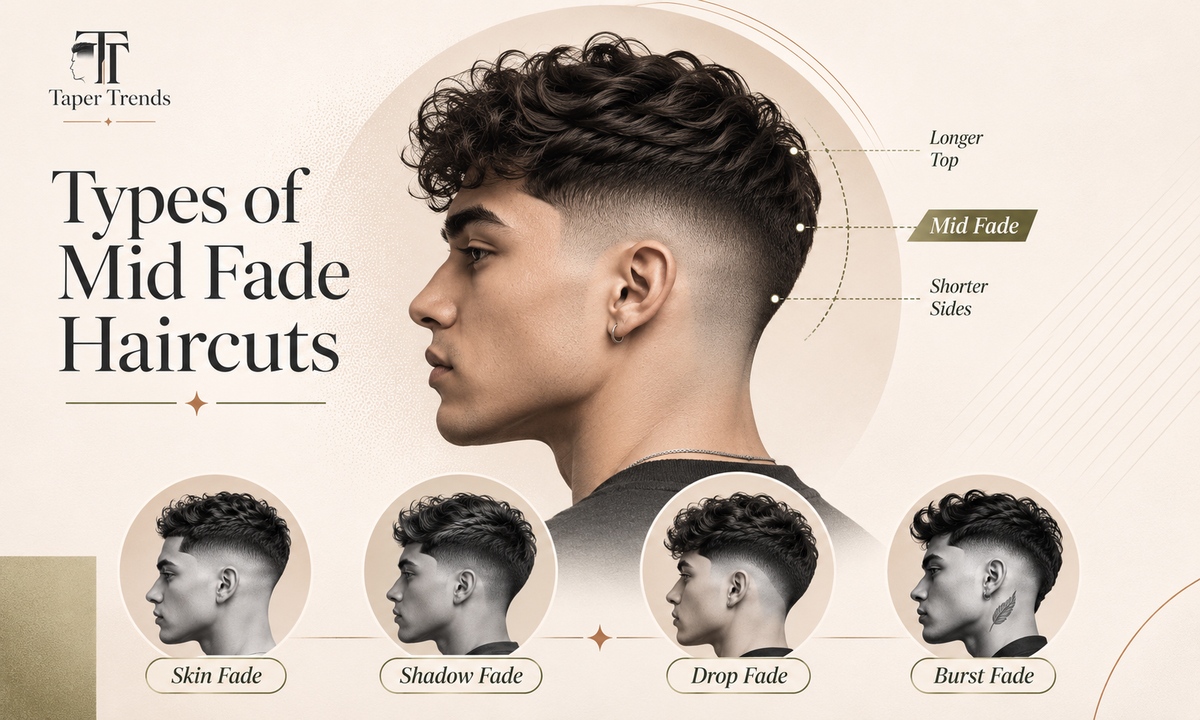
Every mid fade starts near the temple, but the finished cut changes with the bottom finish and the shape of the line. Think of three dials:
- Height (low, mid, high) sets where the blend starts.
- Finish (skin, shadow, or a clipper guard) sets the shortest length.
- Shape (standard, drop, burst) sets the path around the ear and back.
A “mid skin drop fade” is simply one setting on each dial. Our different kinds of fades guide lines up the other settings.
Mid skin fade vs mid shadow fade
A mid skin fade blends down to bare skin, giving the sharpest contrast and the fastest-showing regrowth. A mid shadow fade stops at a very short clipper length, leaving a faint layer of hair for a softer finish. If you're unsure, Highgate Cuts suggests starting with the shadow version: going shorter next visit is easy, but waiting for skin to grow back isn't.
What is a mid drop fade?
A mid drop fade starts at mid height near the temple, then curves down behind the ear so the line sits lower at the back. The arc follows the skull, which 10Trim says suits flatter-backed heads. Barbers Take pairs it with textured crops, pompadours, and spiky tops.
What is a mid burst fade?
A mid burst fade curves in a semicircle around the ear instead of running as a band around the head, leaving more length at the back. That fuller back makes it a popular base for mohawks, faux hawks, curls, and modern mullets. Our drop fade vs burst fade comparison shows how the two curves differ.
Mid temp fade and other localized variations
A mid temp fade focuses on the temples and the corner of the hairline instead of fading the whole side and back. Barbers Take describes it as leaving the back untouched. Shops define temp fades and tapers differently, so confirm which areas will be cut before the clippers start.
Best mid fade hairstyles and top combinations
A mid fade works under crops, curls, quiffs, side parts, buzz cuts, and slick backs. The fade handles the sides; the top decides whether the cut reads as office-ready, casual, or bold. Pick the top first, since it changes how your barber builds the blend.
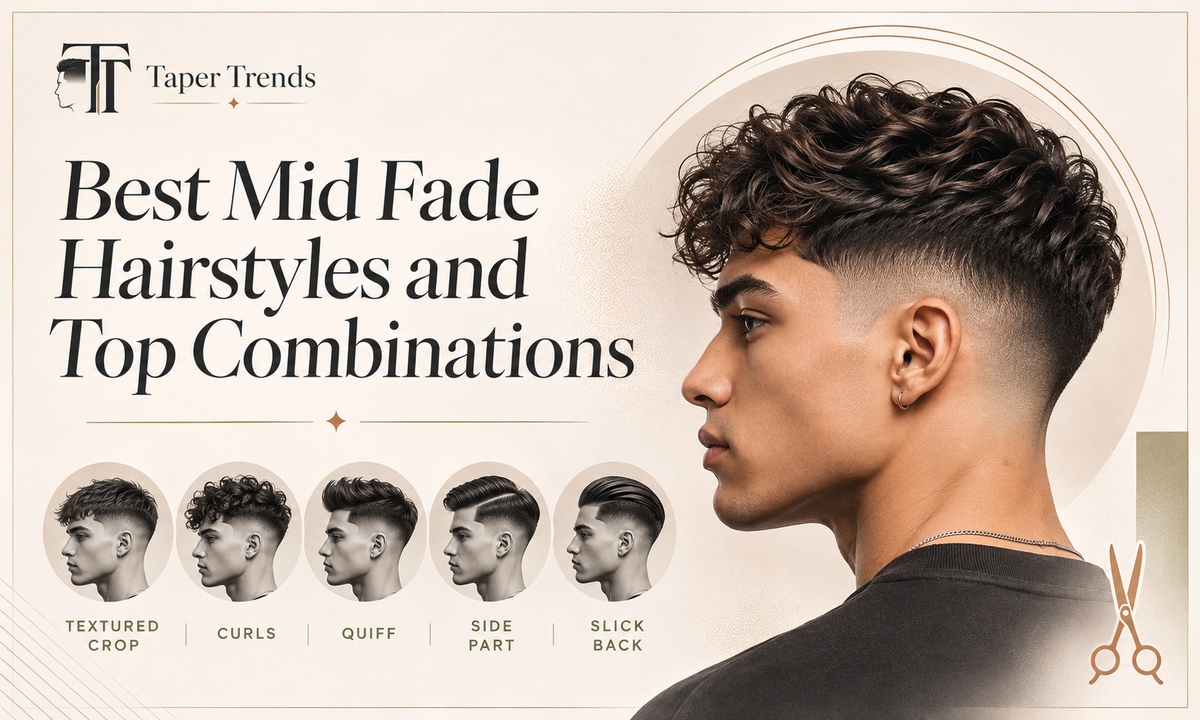
Mid fade with textured crop or French crop
A textured or French crop pairs a short, choppy, forward-styled top with faded sides. 10Trim suggests 1.5 to 3 inches on top, styled with matte clay. It suits thick or coarse hair, and the fringe can hide receding corners.
Mid fade with curly hair, Afro, twists, or waves
Faded sides take width away so natural texture becomes the shape. A mid fade frames an afro, high-top, or short twists cleanly and keeps the edges tidy for brushed waves. Curly hair shrinks as it dries, so ask for more length on top than feels necessary.
Mid fade with quiff or pompadour
A quiff or pompadour lifts length up and back, and clean sides make the volume stand out. A quiff needs roughly 3 to 5 inches at the front, and a pompadour more, per 10Trim. Expect to blow-dry most mornings; fine hair usually needs a pre-styler.
Mid fade with side part or comb-over
A side part or comb-over gives a mid fade its most polished, office-friendly finish. Around 2 to 3 inches on top is enough, with either a natural part or a hard part cut in with a trimmer. Blow-dry across and finish with pomade or cream.
Mid fade with buzz cut, fringe, or slick back
A buzzed top is the lowest-effort option. A forward fringe makes a tall forehead look shorter. A slicked-back top is the most formal and needs pomade, a fine comb, and enough length to sweep back cleanly.
Is a mid fade right for your face shape and hair type?
A mid fade suits most face shapes and hair types, but the fade alone doesn't decide the result. Top length, density, growth patterns, and head shape all change how the cut looks. Treat face-shape advice as a starting point, not a rule.
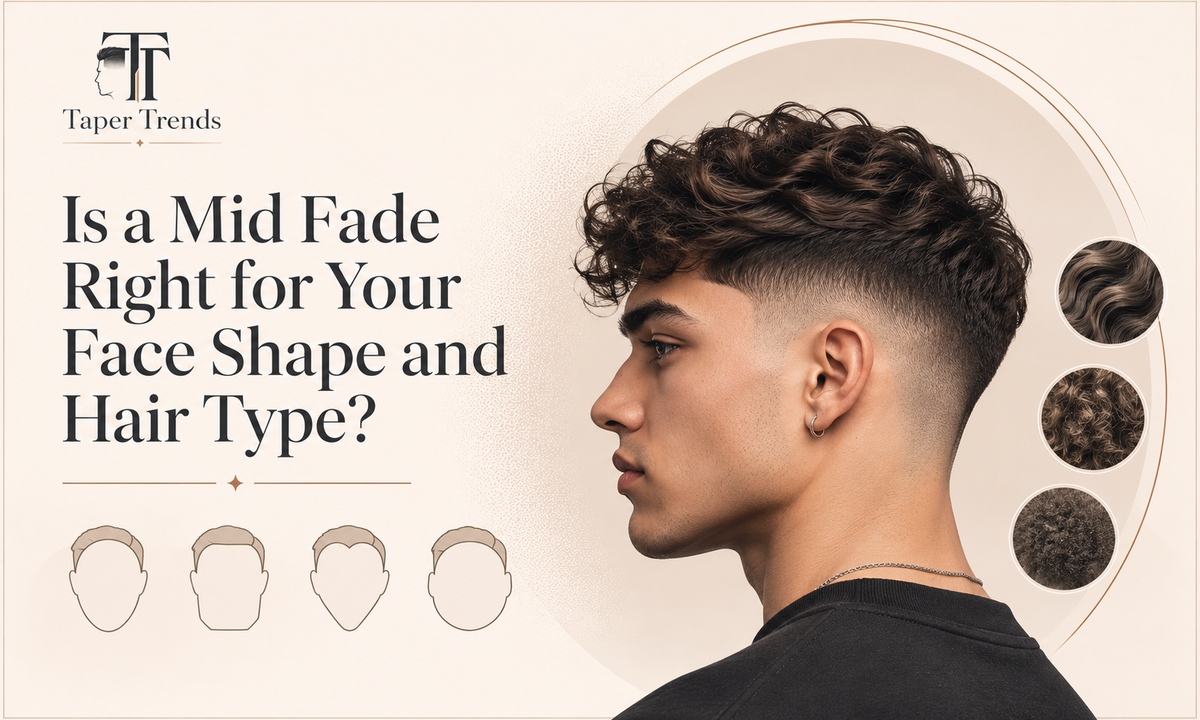
How to choose a mid fade for your face shape
Because the fade trims the sides, the top does most of the balancing. The open-licensed BCcampus barbering textbook treats face shape as one factor alongside head shape, growth patterns, and client preference. Its guidance, with cautions from 10Trim and Highgate Cuts:
| Face shape | What tends to help | What to watch |
|---|---|---|
| Round | Height on top, width above the temple, angular shapes | Flat, forward-combed tops |
| Oval | Most styles | Heavy fringes that shorten the face |
| Square | Softer, rounded edges toward the temples | Very hard lines, if you want softer corners |
| Long or oblong | Side-swept styles over the temples, moderate top | Tall quiffs and pompadours |
| Triangle or heart | Length or fullness at the nape and jawline | Styles that expose the full forehead |
| Diamond | Textured styles that add width at the temples | Slicked-back styles |
Our best fade for your face shape guide goes through each shape at every height, and the face shape detector can help if you're not sure which one you have.
How hair texture, density, and growth patterns affect a mid fade
Texture changes how visible the blend is, density changes the bulk on the sides, and growth patterns change how hair responds to clippers. The hair type quiz is a quick way to pin down your texture.
Straight and wavy hair
Straight hair shows every step of the blend, good or bad. TaperMode suggests asking for the blend to be checked dry, since weight lines show most on straight, dense hair. Wavy hair is more forgiving because its movement hides small flaws.
Curly and coily hair
Curly hair sits shorter than it measures, so tell your barber how it behaves wet and dry. Coily hair on faded sides can dry out quickly, and Barbers Take recommends a daily leave-in conditioner.
Thick, fine, or thinning hair
Thick hair can turn boxy, so barbers point-cut or thin it out. Fine hair goes flat at longer lengths and looks fuller in short styles like a Caesar or textured crop. With thinning hair, tighter sides reduce the contrast in density, which is why Highgate Cuts calls the mid fade a good option. No haircut reverses thinning, though.
Growth patterns and head shape
Whorls, double crowns, and cowlicks change how hair responds to clippers, especially at the hairline and nape, as the BCcampus textbook explains. To disguise a pronounced occipital bone, the same text favors a slightly longer cut over a tight fade. Highgate Cuts adds that a skin finish shows bumps or a flat back more than a short guard does.
How to ask your barber for a mid fade
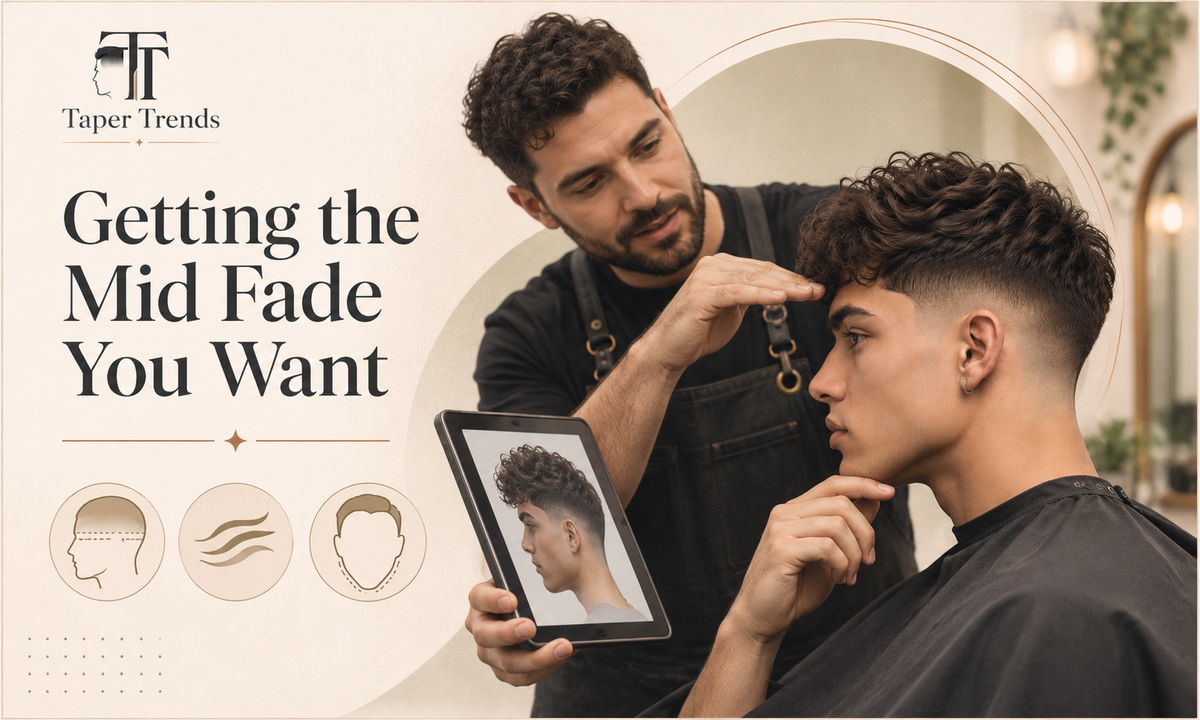
To ask for a mid fade, name the height and point to it, then give the shortest length, the line's shape, the top length, and the neckline, and show a reference photo. “Mid fade” alone leaves too much open. Adrian Carranza's rule is to state the height first and the shortest length second. Our how to ask for a fade guide covers the same request at other heights.
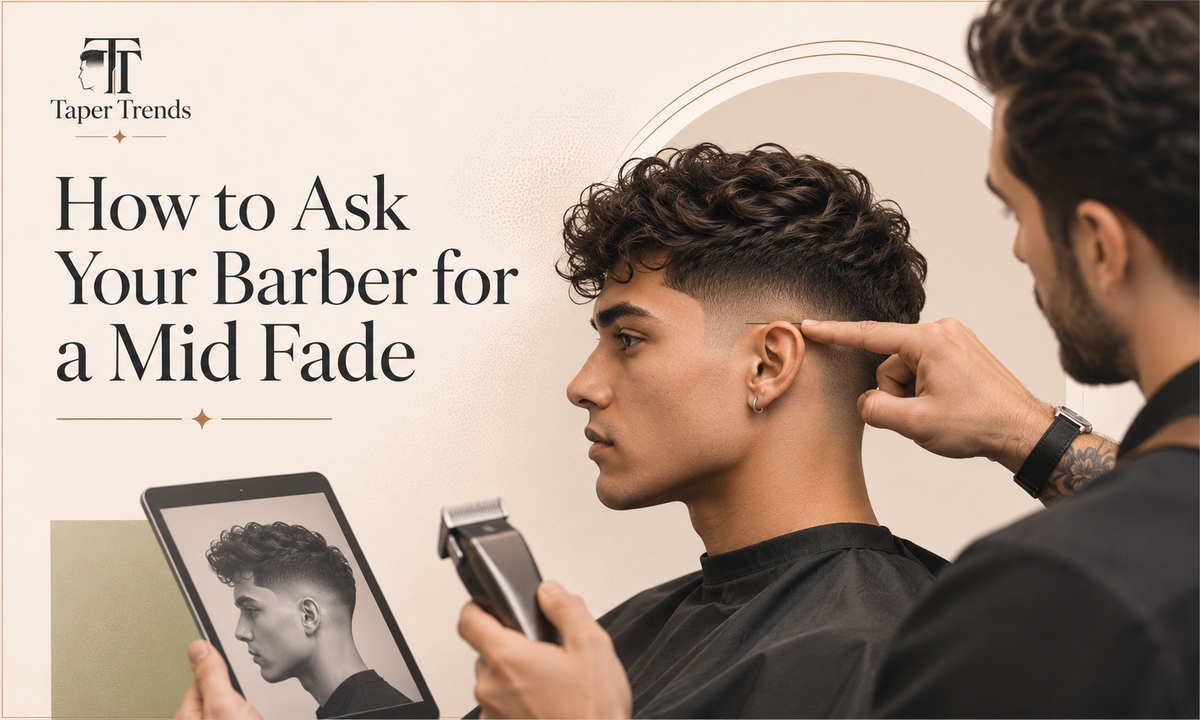
What details should you specify to your barber?
- Height: say “mid fade” and touch where the blend should begin.
- Finish: skin, shadow, or a guard number. On Wahl's guard chart, #½ is the shortest guard short of bald, and higher numbers leave longer hair.
- Shape: level, drop, or burst.
- Top length: inches or finger-widths, plus how you style it.
- Neckline: a natural, tapered neckline grows out cleanest; a squared one stays sharp only a few days.
- Sideburns and beard: blended or separate. Our mid taper fade with beard guide shows the options.
- Anything unusual: cowlicks, flat spots, scars, sensitive skin, and how often you'll return.
If a term comes back at you that you don't recognize, barber terms explained decodes it, and the barber brief generator turns these seven details into a request you can show on your phone.
What should you say when requesting different mid fade styles?
Combine height and finish with a short description of the top, then adjust for your hair:
Softer mid fade: “Mid fade starting at my temple, down to a #1 instead of skin, two inches on top, scissor-cut for texture.”
Mid skin fade: “Mid skin fade starting here, bare skin at the bottom, textured crop on top, natural neckline.”
Mid drop fade: “Mid drop fade starting at my temple, curving down behind the ear, three inches on top to comb across.”
How to use reference photos effectively
Bring front, side, and back photos of someone whose hair texture and density resemble yours. If your reference differs from your hair, say so and ask what will change. Before the clippers start, ask your barber to repeat the plan back. Fixing a misunderstanding in the chair takes a minute; fixing it afterward takes weeks of regrowth.
How often to get a mid fade and maintain it
How often a mid fade needs a touch-up depends mainly on its finish. The shorter the bottom, the faster regrowth softens the blend, so a mid skin fade needs attention sooner than a guard finish or a mid taper.
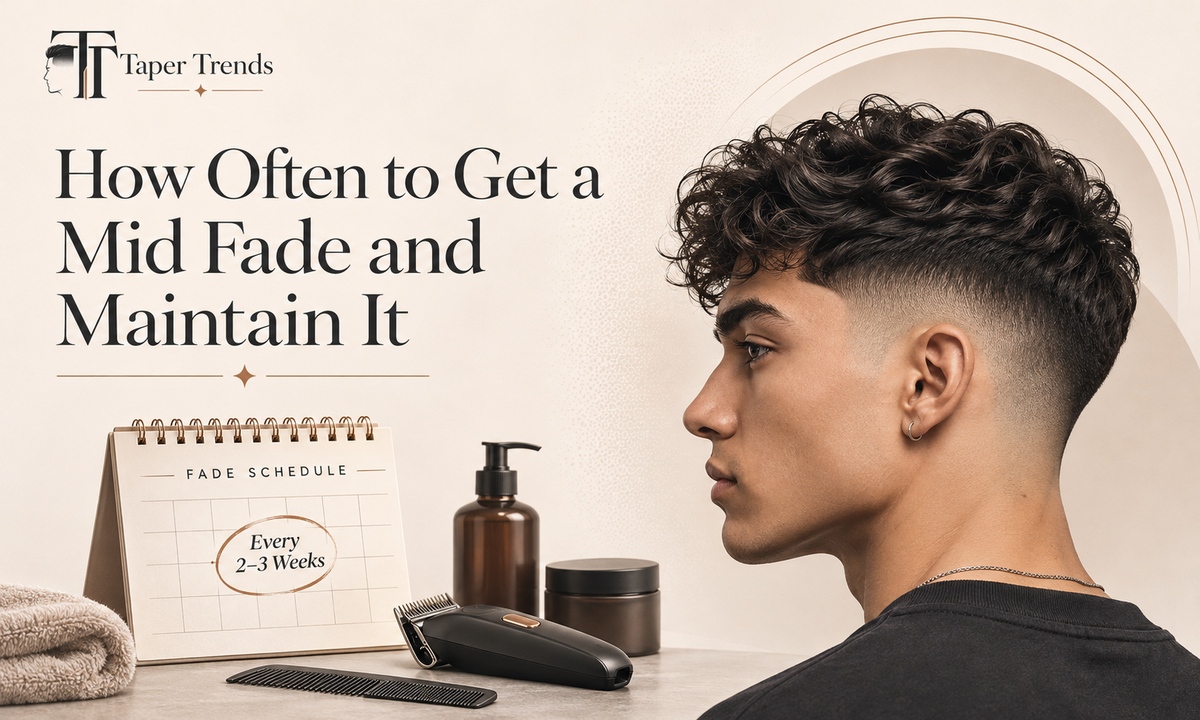
How often should you get a mid fade touch-up?
These are estimates from Barbers Take and 10Trim, not fixed schedules:
| Finish | Typical touch-up window |
|---|---|
| Mid skin fade | 10 to 14 days |
| Short guard, drop, or burst | 2 to 3 weeks |
| Mid taper | 3 to 5 weeks |
The sources differ on tapers: 10Trim says three to four weeks, Barbers Take four to five.
The next haircut calculator works out when to book again, based on your own cut.
How to maintain a mid fade between barber visits
Keep the neckline and sideburns tidy and leave the blend to your barber. Trim the neckline along its existing shape, because raising it each time makes it creep upward. Guides disagree on home touch-ups: 10Trim suggests running a guard over the lowest section, while Barbers Take and Highgate Cuts warn that home clipper passes usually leave a visible step. Unless you're practiced, stick to the neckline.
What if your scalp gets irritated after a skin fade?
Tell your barber and ask for a longer guard finish next time. The American Academy of Dermatology explains that razor bumps form when shaving irritates the skin, that shaving with the direction of growth helps, and that untreated bumps can scar. If bumps keep returning, see a board-certified dermatologist.
How to style a mid fade at home
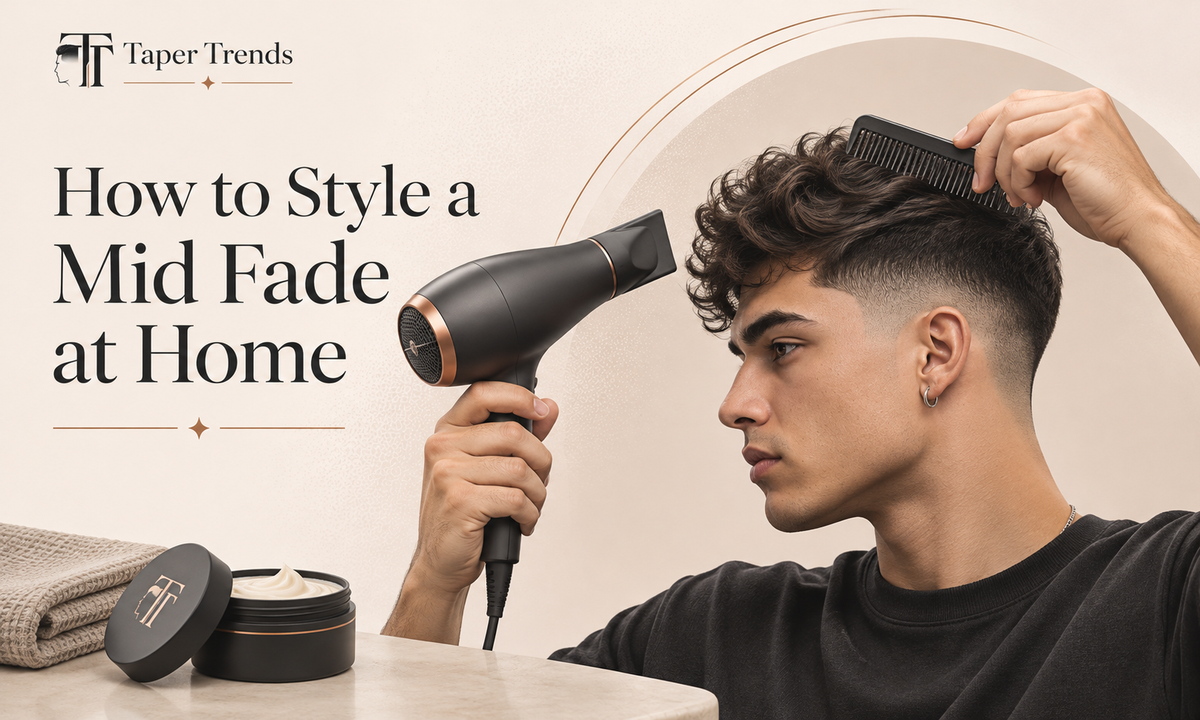
Styling a mid fade really means styling the top. Match the product to your texture, use less than you think, and blow-dry when the style needs height. Our low taper fade styling guide walks through the same routines, which carry over because the top is doing the work.
Which styling products work best with a mid fade?
Choose for the top, not the fade. These pairings follow Barbers Take:
| Product | Best for |
|---|---|
| Matte clay or paste | Crops and textured tops |
| Curl cream | Curls, applied to damp hair |
| Pomade | Slick backs, side parts, comb-overs |
| Sea salt spray | Loose, air-dried waves |
Our best hair products for fades guide covers each one by hair type.
A simple daily mid fade styling routine
- Towel-dry clean hair until damp.
- If the style needs height, blow-dry the top in the direction you want.
- Warm a small amount of product in your palms.
- Work it through from roots to ends.
- Shape with fingers, a comb, or a brush.
Common mid fade haircut mistakes to avoid
Most disappointing mid fades come from a vague brief, not a bad barber, a point Highgate Cuts makes directly.
Choosing the wrong height or finish for your schedule
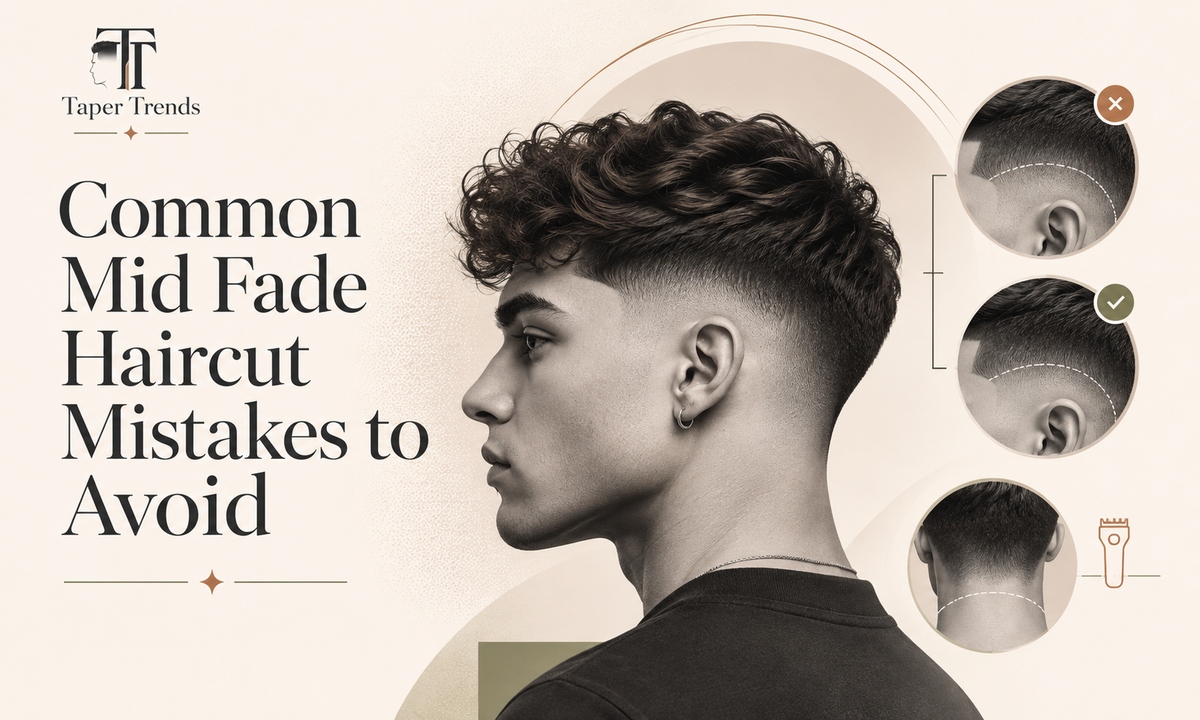
Many men picture a fade just above the ear, call it “mid,” and get more skin than expected. Pointing fixes that. A mid skin fade on a six-week schedule spends most of its life grown out, so match the finish to how often you book. Higher fades also make the forehead look taller.
Ignoring the back, neckline, and top connection
Check the back, neckline, and where the top meets the sides before you leave. Heavy weight at the corners can form a shelf as hair grows, so ask for them to be blended. The BCcampus textbook recommends following the natural nape hairline so the neckline grows out naturally.
Mid fade haircut FAQs
Is a mid fade a good first fade haircut?
Yes. Adrian's Barbershop calls the mid fade the most common request and the safest default, since its contrast is clear without a high fade's exposure. For a first visit, say it's your first fade and ask for a guard finish rather than skin.
Related: How to ask for a fade · Types of fade haircuts · Taper quiz
Can you get a mid fade without showing your scalp?
Yes. Ask for a mid fade that finishes at a longer guard, such as a #1 or #2, or ask for a mid taper. Some hair stays at the shortest point, so the result looks far softer than bare skin, although a very short guard can still let a little scalp show.
Related: Shadow fade · Mid taper fade · Haircut numbers
Does a mid fade work with a receding hairline?
Often, depending on the pattern. If thinning sits mostly at the temples, Adrian's Barbershop notes that a lower fade keeps contrast away from that area. A textured crop with a forward fringe can also disguise the corners. Have your barber look at your hairline before choosing a height.
Related: Haircuts for a receding hairline · Low fade haircut · Mid taper fade, textured fringe
Is a mid fade professional for work or school?
Usually, though dress codes vary. Highgate Cuts says a mid taper or shadow fade with a neat top looks tidy in almost any workplace, while a skin finish reads slightly bolder.
Related: Side part low taper fade · Mid taper fade for boys · Skin fade vs taper fade
How long does a mid fade take to grow out?
A mid fade looks visibly grown out within two to three weeks and loses its blend by weeks four to six, according to Barbers Take. Returning to a longer cut takes months, since hair grows roughly 1 cm a month, per TaperMode.
Related: How to grow out a fade · Haircuts that grow out well · Next haircut calculator
Can you combine a mid fade with a beard?
Yes. Ask your barber to blend the sideburns into the beard so there's no gap, and trim both at the same visit. Highgate Cuts treats this as a separate technique, the beard fade, so mention it when booking to allow enough time.
Related: Mid taper fade with beard · Skin fade with beard · Drop fade with beard · Burst fade with beard
Do you need to know clipper guard numbers before visiting a barber?
No. Describe the look and let your barber choose the guard sequence. Numbers can mislead anyway: guards leave longer hair as numbers rise, but some barbers use blade sizes, where the scale runs the other way, as 10Trim points out.
Related: Haircut numbers · Clipper guard sizes · Barber terms explained
Sources named in these answers: Adrian's Barbershop, Highgate Cuts, Barbers Take, TaperMode and 10Trim.
Getting the mid fade you want
The bottom line
A mid fade adapts to almost any hair type, as long as the request is specific. Settle height, finish, and shape, choose your top first, and match the finish to how often you'll book.
Bring a reference photo that resembles your own hair, point to where the blend should start, and have your barber repeat the plan before cutting. If the first cut isn't quite right, adjust the height or finish next time. The barber brief generator and how to ask for a fade will help you put the request together.
Keep reading
Fade heights compared
Fade basics
Skin, shadow, drop, burst and temp fades
Top styles at mid height
By hair type and who's wearing it
Face shape, hairline and beard
Asking, cutting and upkeep
- How to ask for a fade
- Barber terms explained
- Haircut numbers and guard sizes
- How to cut a fade
- Best clippers for fades
- Scissor cut vs clipper cut
- Best hair products for fades
- How to style a low taper fade
- How often to get a haircut
- How to grow out a fade
- Haircuts that grow out well
- How to fix a bad fade
- How much to tip your barber
Want more fade guides?
Browse clean, barber-ready breakdowns for every hair type.