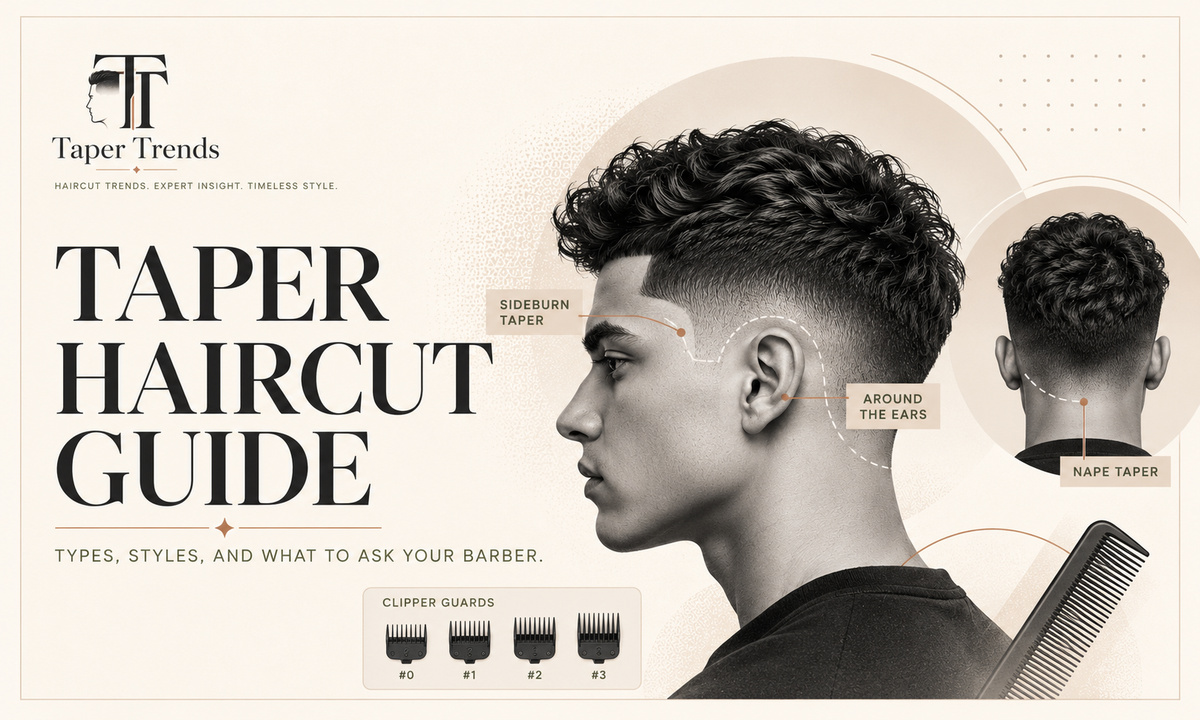
The word taper haircut sounds simple, but it hides four separate choices: how high the shorter hair climbs, how far around the head it travels, how close the bottom gets, and how much weight stays on the sides.
Get those four right and you get a clean, low-drama cut that suits almost any top. If you want a deeper look at the version most people book first, our complete low taper fade haircuts guide covers it by texture, and the taper fade guide covers the wider blend.
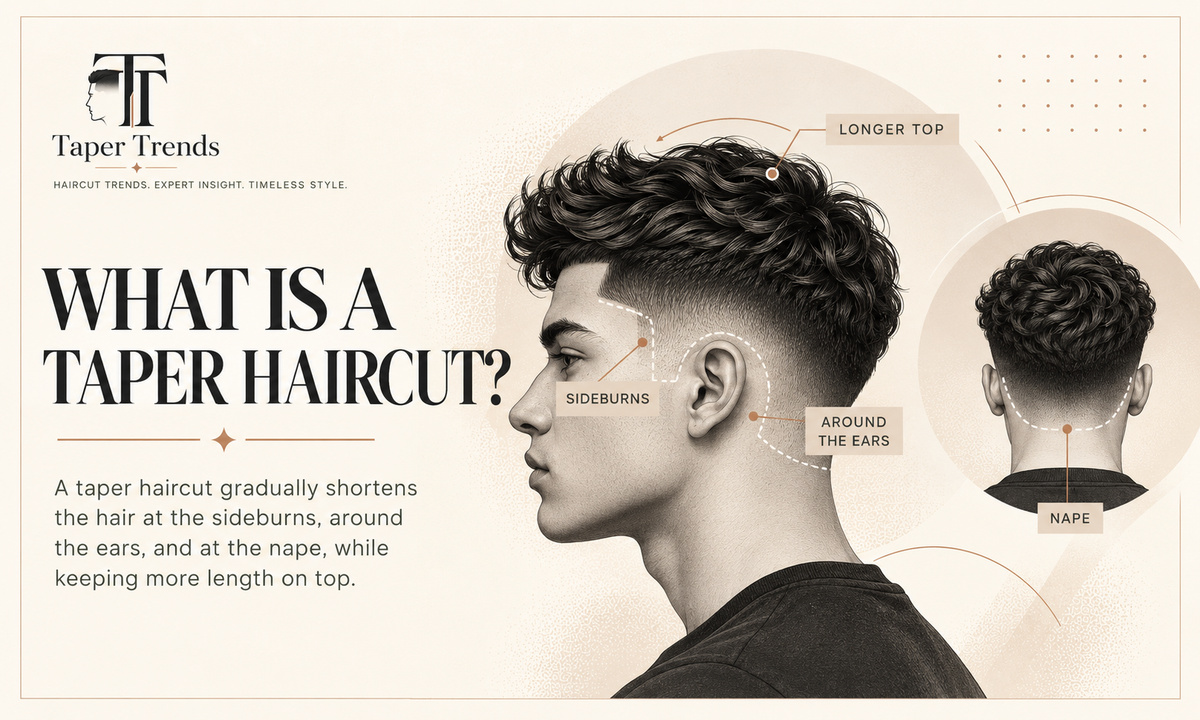
What is a taper haircut?
A taper haircut is a gradual change from longer hair to shorter hair at the edges of a haircut, mainly the sideburns, the hair around the ears, and the nape. The top and most of the side panel keep their length, so the shortening reads as a clean outline rather than an obvious gradient.
CADMEN Barber Academy places the length reduction at the neckline, around the ears, and at the sideburns, usually within the last inch or two before the natural hairline. FashionBeansdescribes it starting roughly a centimeter above the ear and running around to the nape. Dan Glass, a senior barber at Murdock London, tells FashionBeans that tapering is “a feature of every good haircut” and that barbers finish most cuts with one unless asked not to.
So “taper” can describe the graduated shape of a whole haircut or just the cleanup at its edges; this guide deals mostly with the second. To read one, check the profile for where shortening starts above the ear, then the back for how the nape ends: blended into the hairline, or cut square. If you want to see the shape from every angle before you book, our guide on what a low taper fade looks like walks through it.
How is a taper haircut different from a fade?
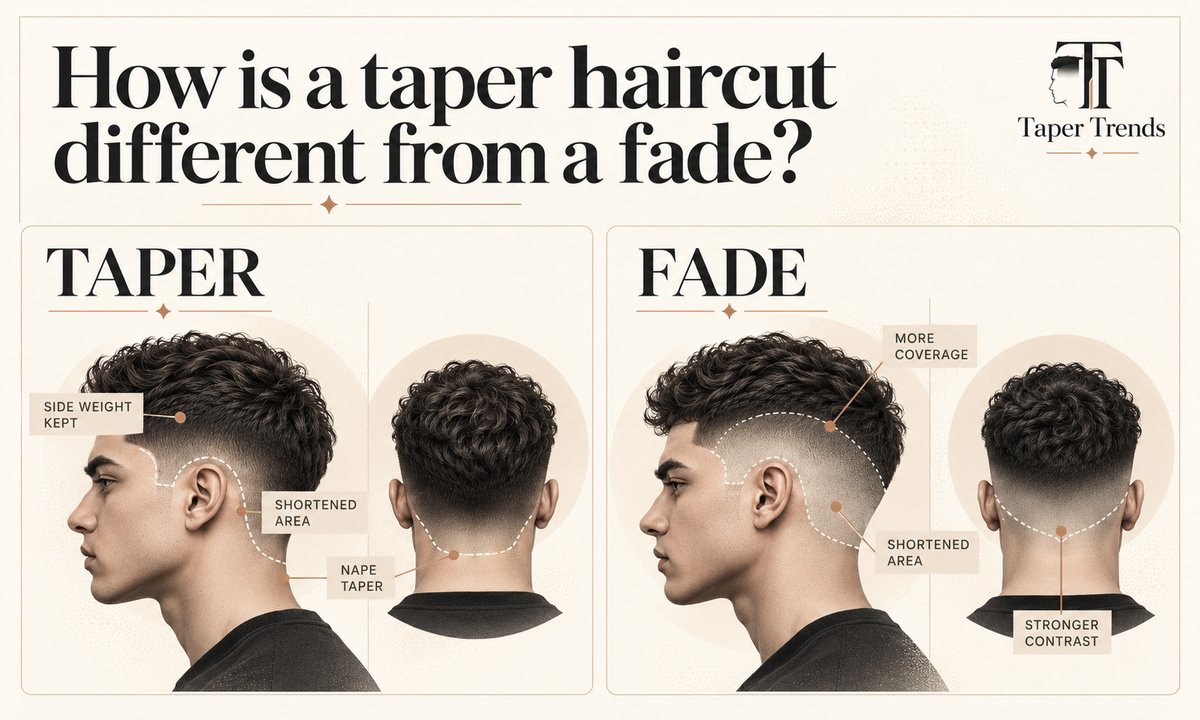
The clearest difference between a taper haircut and a fade is coverage. A taper keeps the shortest work at the sideburns and nape and leaves most of the side weight in place. A fade carries that short blend across a much larger part of the sides and back. Whether either one reaches bare skin depends on the shop, so ask about the finish separately.
| Taper | Fade | |
|---|---|---|
| Area shortened | Sideburns, around the ears, nape | Most or all of the sides and back |
| Side weight | Mostly kept | Removed up to the fade height |
| Contrast | Usually subtle | Soft to very strong |
| Grow-out | Softer and less obvious | Short bases show regrowth sooner |
| Shortest finish | Varies by shop | Varies by shop |
Barber.Style draws the coverage line the same way. The finish is where published sources split. CADMEN treats skin as the dividing line and says a taper never goes to bare skin. Barber.Style describes skin tapers as a normal option, and Glass recommends one under a pompadour in the FashionBeans guide. Neither camp is wrong, so name the finish you want in plain terms.
Our taper vs fade guide covers the comparison in more depth, skin fade vs taper fade settles the bare-scalp question, and low taper vs low fade compares the two at the same height. For the end of the spectrum that finishes in short visible hair, see the shadow fade guide, and for the localized version at the front, the temp fade guide. The different kinds of fades overview and the types of fade haircuts guide lines up the rest, including the curved burst fade vs taper fade comparison, the drop fade, and the full mid fade.
What are the main types of taper haircuts?
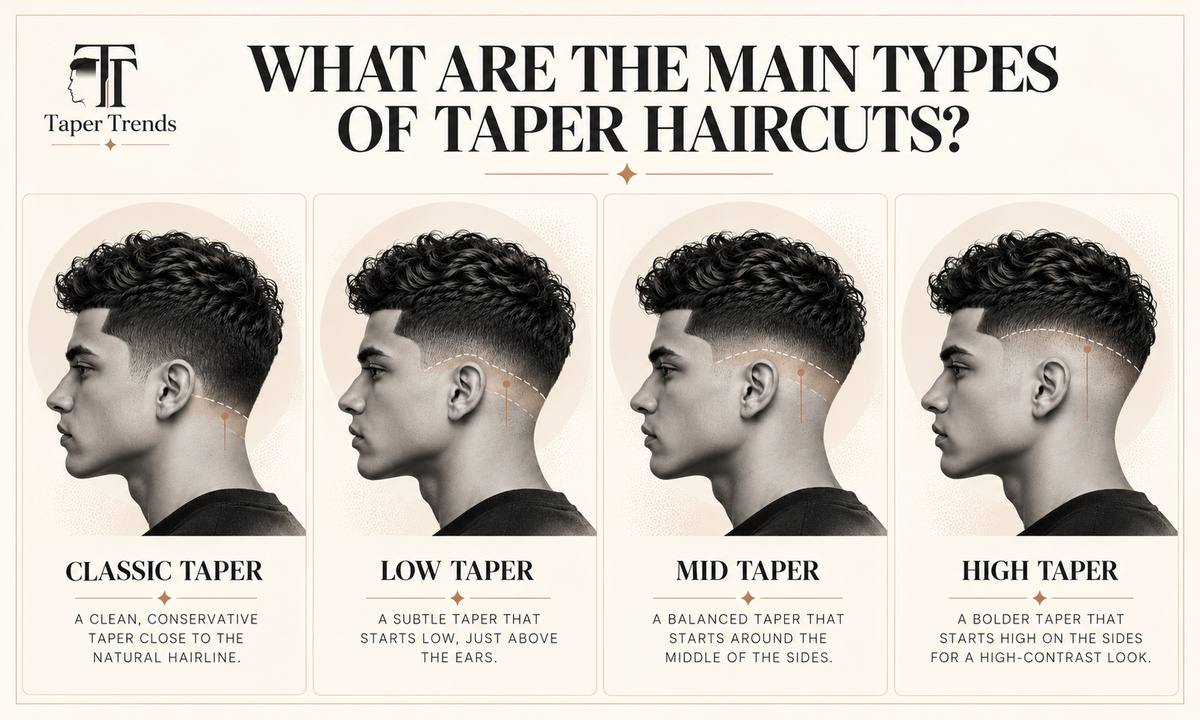
The main types of taper haircut are classic, low, mid, and high. “Classic” describes an overall approach, gradual and conservative and close to the natural hairline, while low, mid, and high describe how far up the head the transition sits. Shops draw those height boundaries differently, so treat each name as a starting point and point to the exact spot you mean.
Classic taper haircut
A classic taper is the conservative version: a gradual shortening at the sideburns and nape that keeps most of the side length and follows the natural hairline. It works under almost any top, from a short crew cut to a mid-length scissor cut (see scissor cut vs clipper cut for how the tools differ). Glass suggests tapering a scissor cut at the edges to keep its length but sharpen the ears and neck. The same idea underlies a low taper fade comb over.
Low taper haircut
A low taper keeps the transition tight to the edges, close to the ear and the neckline. Because so little changes, the sides stay nearly full and the result looks soft from most angles. With so little contrast to blur, it is also the easiest version to live with as it grows. Our low taper fade haircuts guide is the pillar for this height, and low mid taper fade covers the step between low and mid.
Mid taper haircut
A mid taper reaches farther above the sideburn and neckline before it blends out. The transition becomes easier to see in profile, and slightly less side weight remains than with a low taper. “Mid” varies most between shops, so bring a side-view photo and touch the highest point you will accept. Our mid taper fade guide goes deeper, and low taper vs mid taper fade compares the two angle by angle.
High taper haircut
A high taper starts the transition farther up the head. FashionBeans notes that this creates a smoother gradient under top-heavy styles such as a textured quiff, so the volume looks less disconnected from the sides. It also removes more of the side panel, and Barber.Style warns it can start to look like a full fade, so agree on a ceiling first. Our high taper fade guide covers the cut, and mid taper vs high taper fade and low taper vs high taper fade help you pick a height.
Which taper haircut should you choose?
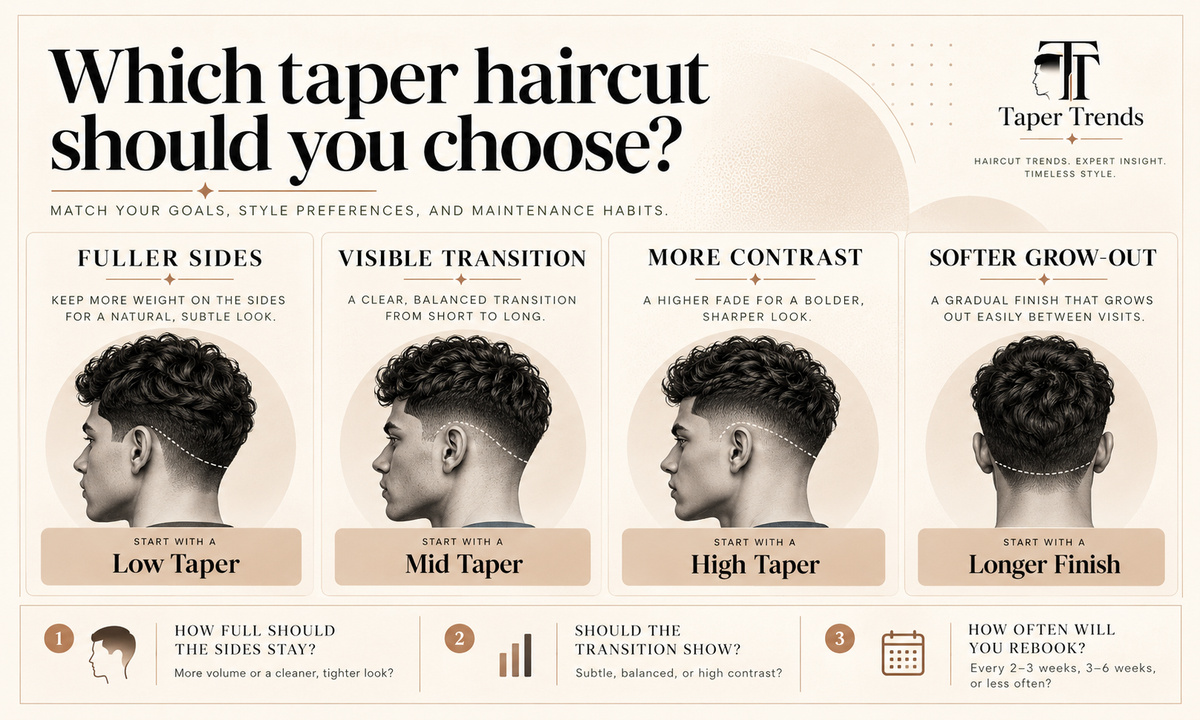
Choose a taper haircut by the result you want, not by its name. Decide how full the sides should stay, how visible the transition should be, what the top will do, and how often you plan to go back. If you are unsure, start longer and lower, because more can always come off next time.
| If you want | Start with | Trade-off |
|---|---|---|
| Full sides with a barely noticeable edge | Low taper, longer finish | Least contrast |
| A transition people can see | Mid taper | More side weight removed |
| Contrast under a quiff or pompadour | High taper with an agreed ceiling | Closest to a fade; regrowth shows sooner |
| A soft grow-out between visits | Any height, longer finish | Less crisp on day one |
If the table doesn't settle it, answer three questions:
- How full should the sides stay? Very full points to low. Noticeably trimmed points to mid or high.
- Should someone across the room see the transition? If not, stay low.
- How soon will you rebook? Skin-close finishes show regrowth first, while longer finishes forgive a longer gap.
You can also build a card to show your barber with the barber brief generator, and check what the numbers mean on the clipper guard sizes tool.
How does a taper haircut work with different hair textures?
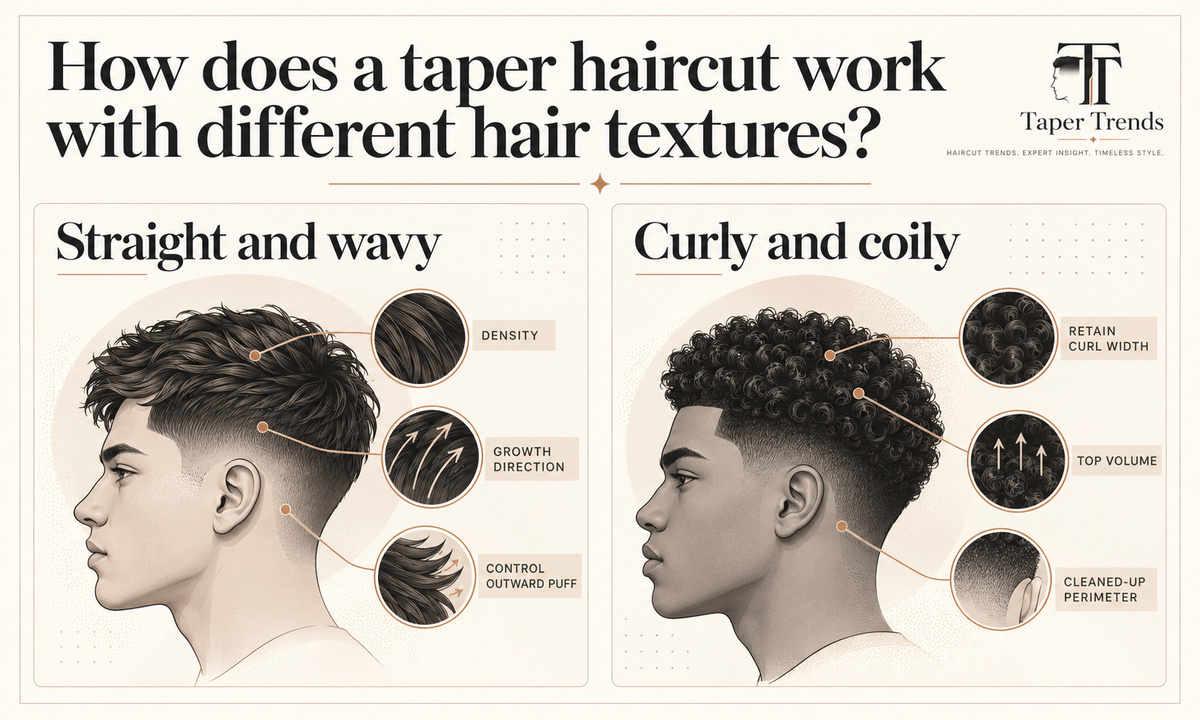
A taper haircut works on straight, wavy, curly, and coily hair. What changes from head to head is how the edge reads. Density, shrinkage, and growth direction decide whether the perimeter looks crisp or stays soft, so pick references from someone whose hair behaves like yours.
Straight and wavy hair
On straight and wavy hair, density and growth direction matter most. FashionBeans points out that a taper can take weight out of thick or wavy hair and make it easier to manage, which helps when the sides tend to puff outward. With thick hair, ask for weight to come off at the perimeter so the sides sit closer to the head. Fine or sparse hair is the opposite case: a very short edge shows scalp sooner, so a longer finish looks fuller. Our guides on low taper fade wavy hair, straight hair, and thin and thick hair cover each case, and mid taper fade wavy hair and mid taper fade straight hair do the same at a higher height.
Curly and coily hair
A taper suits curly and coily hair when the barber cleans up the perimeter and leaves curl width on the sides and top. Shrinkage is the variable to plan around. Curls spring shorter than their stretched length, so the barber should judge length on hair worn the way you actually wear it, not pulled straight.
Between cuts, the American Academy of Dermatology recommends detangling curly hair while it is wet, with a leave-in conditioner and your fingers or a wide-toothed comb, and avoiding brushing it dry, which can cause breakage and frizz. For the full cut on these textures, see curly low taper fade, mid taper fade curly hair, high taper fade curly hair, and low taper fade with dreads.
Which hairstyles work with a taper haircut?
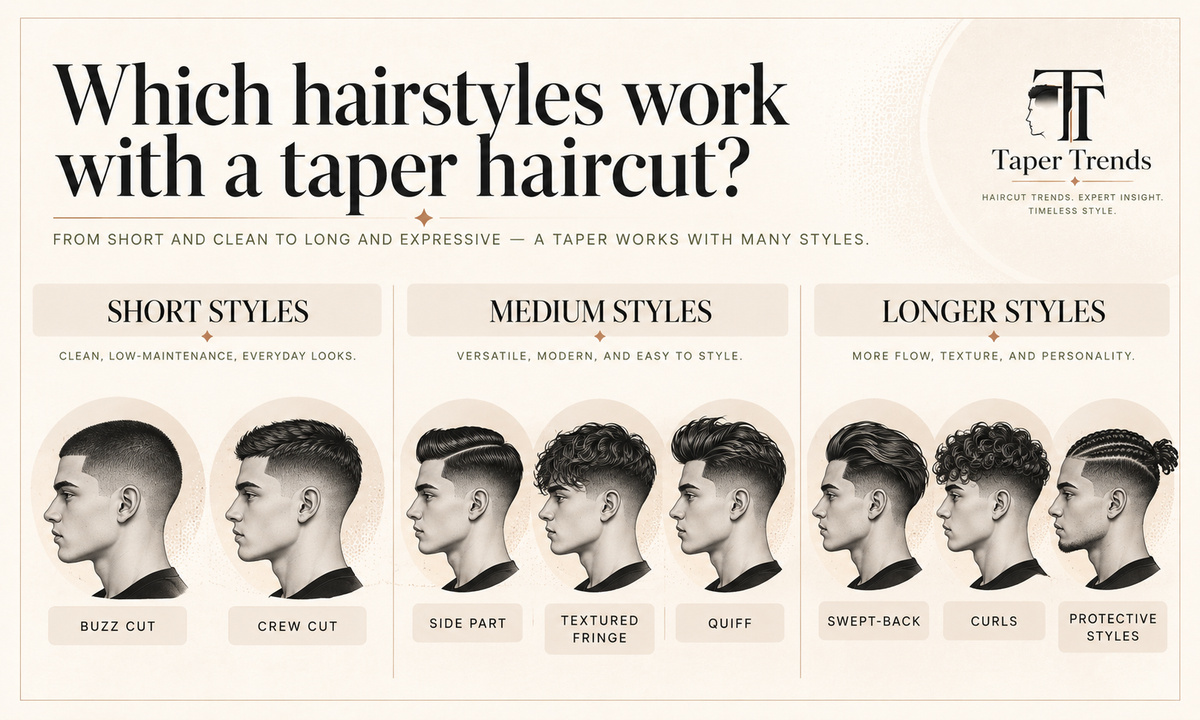
Almost any hairstyle can sit on top of a taper haircut, because the taper only controls the perimeter and the side transition. Choose the top first, then pick the height and finish that support it.
Short styles: buzz cut and crew cut
On a buzz cut, a taper adds shape and a cleaner edge to otherwise uniform length. FashionBeans describes a No. 2 back and sides as the tapered take on a buzz or crew cut. Wahl places the #4 guard in crew-cut territory and suggests starting with a lower guard near the bottom and working up for a tapered look. See low taper fade buzz cut, mid taper fade buzz cut, high taper fade buzz cut, and low taper fade for short hair.
Medium styles: side part, textured fringe, and quiff
Medium-length tops depend on the side weight a taper leaves behind. With a side part, a clean taper frames the part and keeps the outline neat; Wahl's side-part example uses a #4 on the sides with a #8 on top. A textured fringe needs only a tidy perimeter. A quiff pairs well with a high taper, and FashionBeans notes the extra length lets you rework it into a parting. Our guides to the side part low taper fade, textured fringe with a low taper fade, French crop low taper fade, low taper fade fringe, and low taper fade for medium length hair show each one in detail, and the middle part low taper fade covers the center-parted version.
Longer styles: swept-back hair, curls, and protective styles
Tapering tidies the perimeter without forcing a shorter top. FashionBeans lists a slicked-back undercut with an even taper on the sides and back, and a braided taper fade that defines the hairline around cornrows, long braids, locs, or twists. Our low taper fade slick back, long hair low taper fade, low taper fade mullet, and fluffy hair guides cover these tops. Keep the tension gentle. The AAD warns that tight hairstyles can cause traction alopecia, and the hairline is one of the first places it shows.
How do you ask your barber for a taper haircut?
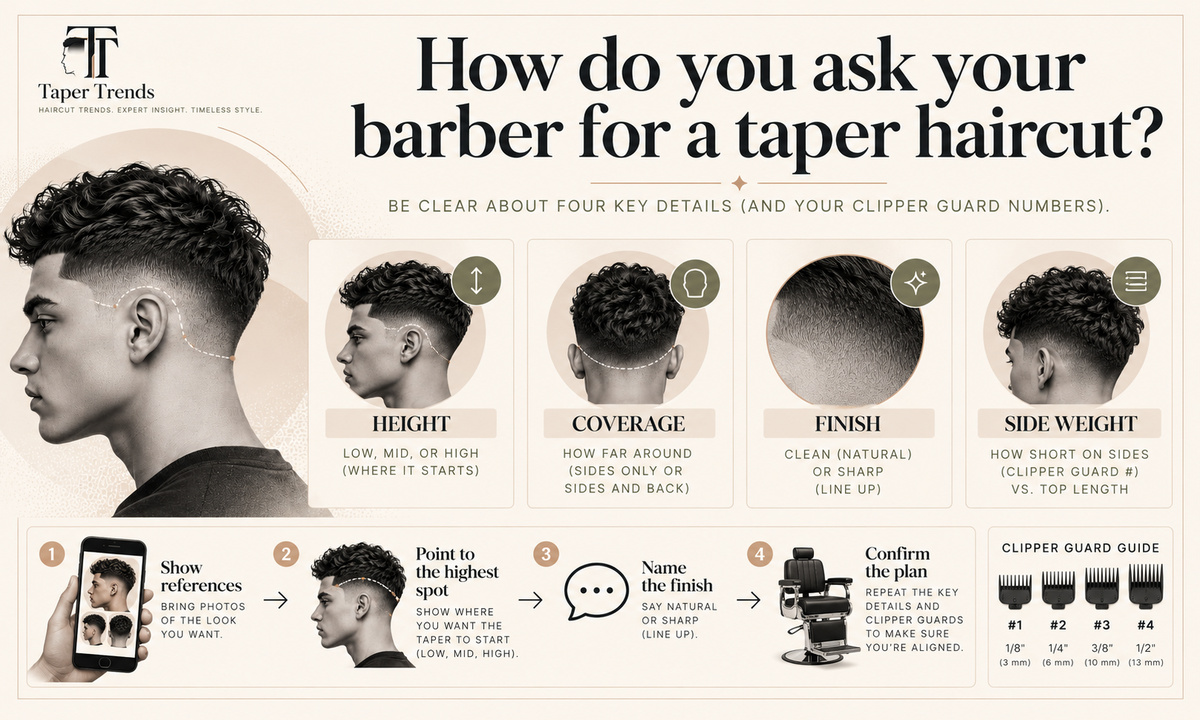
To ask for a taper haircut, give your barber four outcomes instead of one word: how high the transition may go, how far around the head it travels, what it finishes at, and how much side weight stays. Then show front, side, and back references and ask the barber to repeat the plan before cutting, the same check our guide on how to ask for a fade uses for a full fade.
Save reference photos from three angles before you go, then walk through these steps:
- Name the haircut and point to the area. Say “taper” and show where the shortening should sit: sideburns, around the ears, nape.
- Set the highest acceptable point. Touch the spot on your head rather than relying on “low” or “mid.”
- State the shortest finish and how full the sides should stay. Hair, shadow, or skin are clearer words than guard numbers.
- Cover the top, the neckline, and any beard. Give the top length in inches, choose a natural or blocked neckline, and say whether the sideburns should join a beard.
- Show your references and confirm. Ask the barber to repeat the plan back to you.
A request that covers all five might sound like this:
“I’d like a classic taper, short work only at the sideburns and nape, no higher than here. Finish at a shadow, keep the sides full, and leave about three inches on top. Natural neckline. Can you repeat that back?”
If the barber suggests a change, ask which of the four it alters: height, coverage, finish, or side weight. For more wording to adapt, see the barber scripts in our taper fade guide and low taper fade with beard guide, where the sideburn-to-beard join is the detail to settle first.
What do clipper guard numbers actually mean?
Clipper guard numbers are nominal cutting lengths, not haircut names. Wahl lists #1 at 1/8 inch, #2 at 1/4 inch, #3 at 3/8 inch, and #4 at 1/2 inch. No single guard defines a taper, because a taper is a blend between several lengths.
| Guard | Length | How Wahl describes it |
|---|---|---|
| #1 | 1/8 in | Short buzz cut |
| #2 | 1/4 in | Traditional buzz cut |
| #3 | 3/8 in | Longer buzz; a fade can build up to it |
| #4 | 1/2 in | Crew-cut or brush-cut territory |
Below the #1, Wahl's #1/2 guard cuts to 1/16 inch, which it calls as short as you can go without going bald. The clipper's taper lever also changes the cut by 1/16 inch between its open and closed positions, which is how barbers smooth the line between two guards (our how to cut a fade guide shows it step by step, and our best clippers for fades guide compares levers by model). Describe the finish you want and leave the guard choice to the barber. Our full haircut numbers guide explains every guard in inches and millimeters, and the clipper guard sizes chart lists every size and converts it to millimeters.
What happens during a taper haircut appointment?
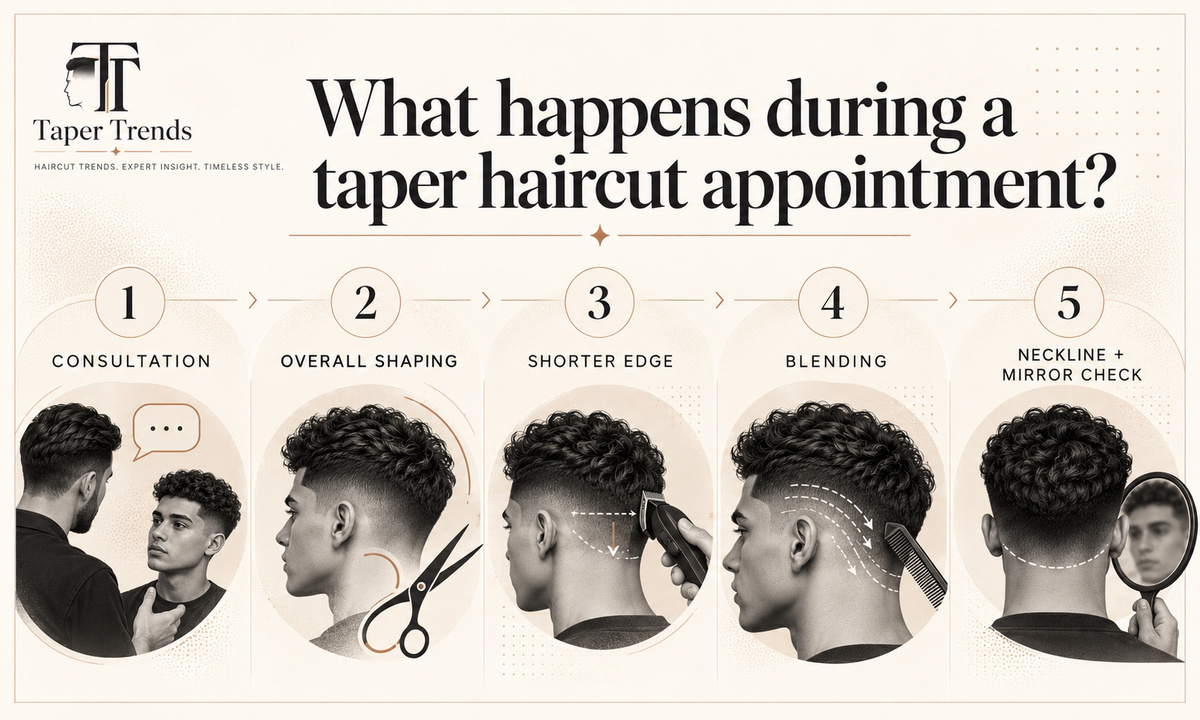
A taper haircut appointment usually moves through five stages: consultation, overall shaping, building the shorter edge, blending, and a final check. Order and tools vary by barber.
- Consultation. You agree on height, finish, side weight, and top length.
- Overall shaping. The barber removes bulk and sets the top and side length with scissors or clippers.
- The shorter edge. At the sideburns and nape, the barber works with guards, the taper lever, or clipper-over-comb, where a comb lifts the hair and the clipper cuts across it.
- Blending. The short edge is softened into the longer hair above it.
- Neckline and mirror check. The barber refines the nape. Ask for a hand mirror and check the back before you leave.
How do you style a taper haircut?
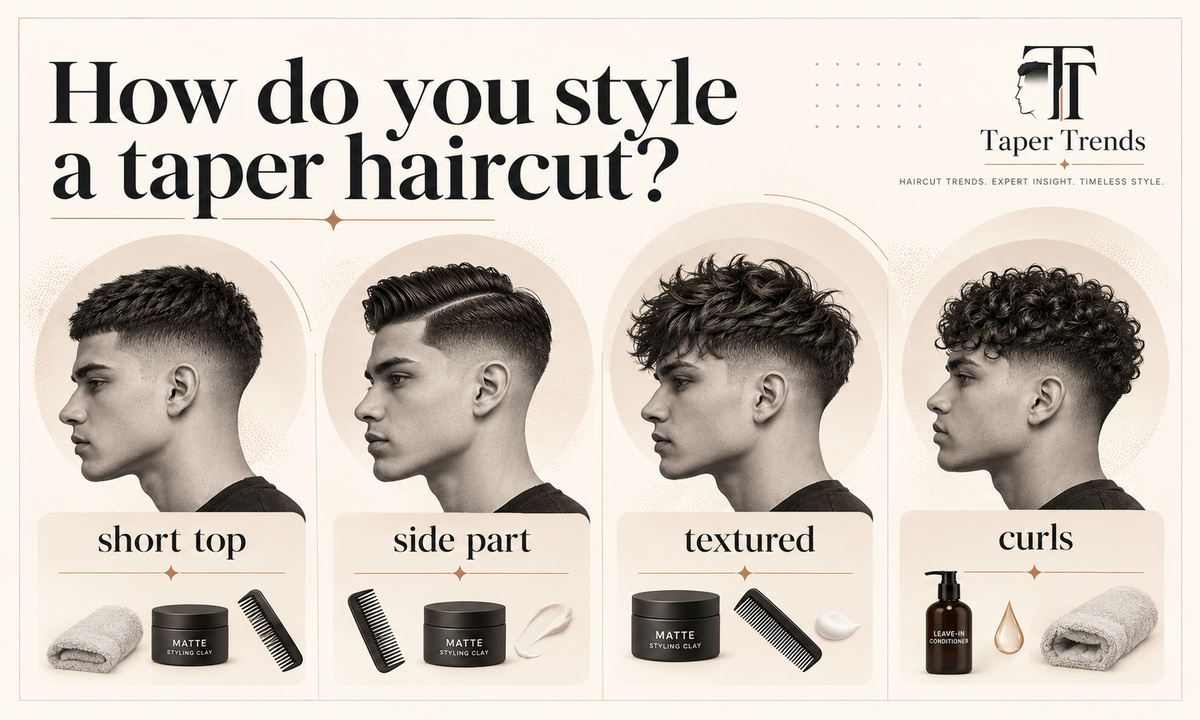
A taper haircut needs very little daily styling, because the top decides the routine. Short tops need almost nothing, parted or textured tops need a little product, and curls need moisture more than hold.
For a short top, towel-dry and push it into place; Glass told FashionBeans that short clippered hair doesn't need extra styling. For a side part, comb the part into damp hair. For a textured look, warm a little matte product between your fingers and push the top back loosely. For curls, the AAD recommends conditioning all of your hair, not just the ends, then adding a leave-in conditioner or oil. Our step-by-step guide to styling a low taper fade walks the same routine through for every texture.
How often does a taper haircut need maintenance?
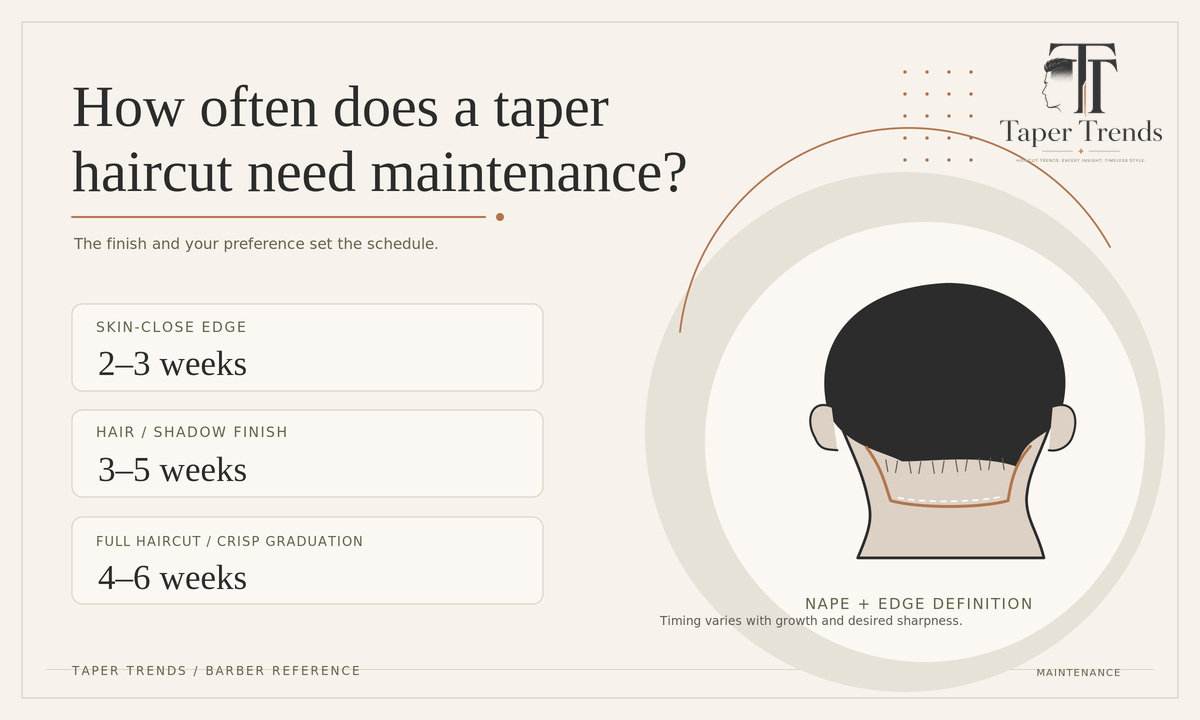
Most taper haircuts look sharpest for a few weeks. The right interval depends on how short the edge is and how crisp you like it. Published barber guidance runs from a quick tidy every couple of weeks for sharp, skin-close edges to a full cut every four to six weeks for softer tapers.
MedlinePlus says healthy hair takes about a month to grow half an inch. At that average rate, an edge cut with a #2 grows from a quarter inch to roughly three quarters in a month. Individual rates vary, so treat that as an explanation of why edges blur, not a schedule.
| Finish | Published guidance | Sign a visit is due |
|---|---|---|
| Skin-close edge | Cleanup after a couple of weeks (Barber.Style) | Stubble returns around the ears and nape |
| Hair or shadow finish | Presentable for several weeks (Barber.Style, CADMEN) | The blend loses definition |
| Keeping the graduation crisp | A full cut every four to six weeks (CADMEN) | Hair starts covering the ears or collar |
If a full cut feels too frequent (our guide to how often you should get a haircut compares the windows by style), ask about a neck-and-edge tidy between appointments; Glass told FashionBeans a tidy every couple of weeks stops stray hairs blunting the edge. A skin-close finish is covered in the skin fade guide, including bump-safe care, and the low, mid and high skin fade comparison shows how height changes grow-out. A taper is also the quickest landing spot when you want to grow out a fade.
What taper haircut mistakes should you avoid?
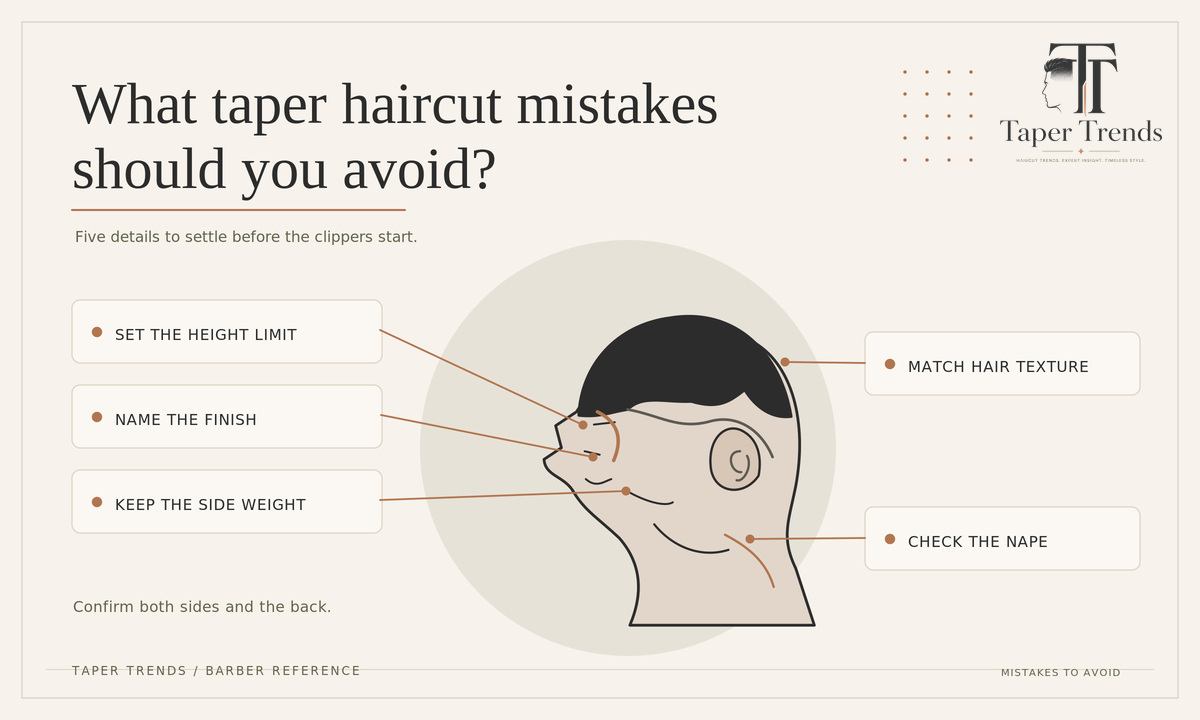
Most disappointing taper haircuts come from details nobody said out loud, not from a lack of skill (and when one does go wrong, how to fix a bad fade explains the repair). The fix is the same for each mistake below: say the detail, show it, and confirm it before cutting starts.
| Mistake | What happens | Prevention |
|---|---|---|
| No stated height limit | The taper creeps up toward a fade | Point to the highest spot you will accept |
| Leaving the finish unnamed | The bottom comes out shorter than expected | Say hair, shadow, or skin |
| Taking too much side weight | Sides look thin and take weeks to recover | Start longer; go shorter next visit |
| Copying a photo of different hair | Texture and density change the result | Choose references that match your hair |
| Checking only the front | The nape or sides surprise you at home | Look at both sides and the back before leaving |
A single request can also lead to the wrong family of cut altogether, so if you are torn between a taper and something sharper, our low taper vs low fade and skin fade vs taper fade breakdowns are worth reading first.
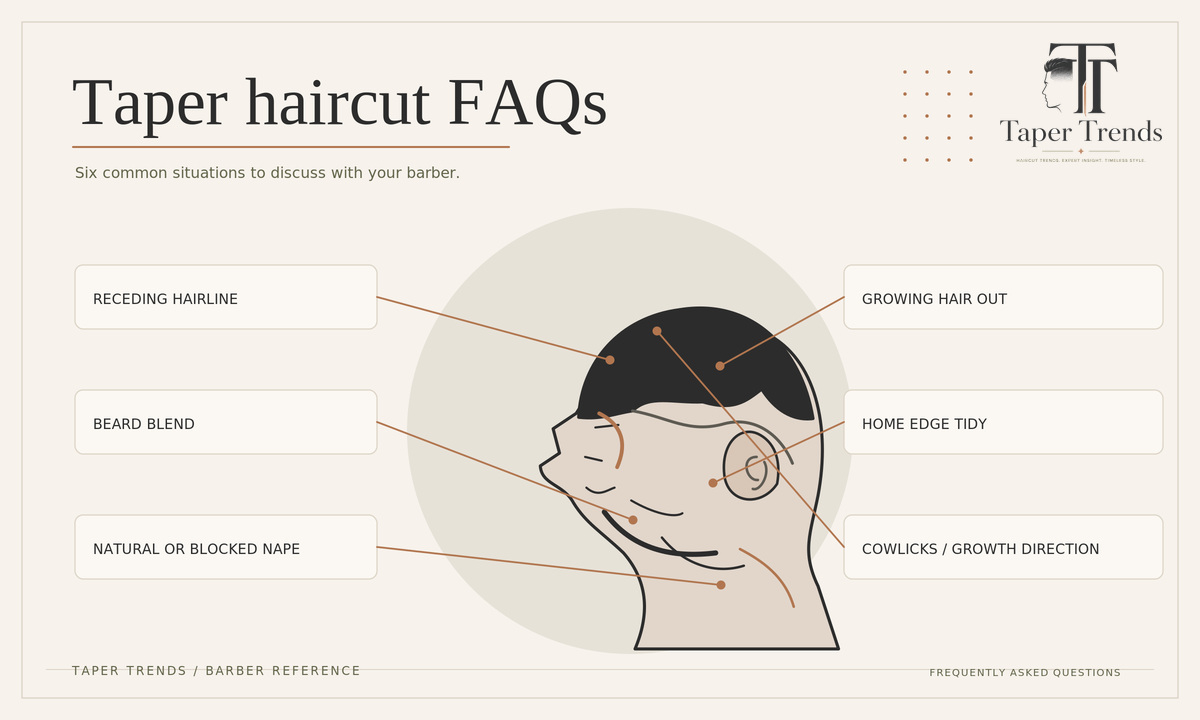
Taper haircut FAQs
These questions cover edge cases the main guide doesn't.
Can a taper work with a receding hairline?
Yes, a taper can work with a receding hairline, but it won't change or hide the hairline itself. The top's length and how it sits at the temples decide how recession reads. Ask your barber how much length the front needs, and be wary of any promise that a haircut will conceal thinning.
Can you blend a taper into a beard?
Yes, a taper can blend into a beard. The sideburn can run straight into the beard, or the taper can stop short and leave a visible break. Beard density and the line you prefer decide which looks better. Before cutting starts, ask the barber to show you where the sideburn will end and the beard will begin.
Should you choose a natural or blocked neckline?
Choose a natural neckline for a softer edge that follows your hairline and grows out gradually. Choose a blocked neckline for a defined, squared edge that needs cleaning up sooner. If you get razor bumps, mention it first, because a slightly longer finish is usually gentler on sensitive skin than a foil-shaved one.
Can you keep growing out your hair with a taper?
Yes, you can grow your hair out with a taper, within limits. A light edge cleanup keeps everything above the perimeter at full length, but repeated high tapering removes hair you may want later. Tell your barber you are growing it out and keep the taper low until you reach the length you want.
Can you touch up a taper at home?
You can tidy stray hairs at the edge of a taper at home, but recreating the blend is much harder, especially behind your head where you can't see. Never set a new, lower line than your barber's, and leave the nape to the shop.
What if you have cowlicks or uneven hair growth?
If you have cowlicks, tell your barber where they sit, usually at the crown or nape. Growth direction can make equal lengths lie differently, so ask the barber to judge the finish on dry hair rather than forcing one setting everywhere.
For a beard-specific answer, see high taper fade with a beard and mid taper fade with a beard.
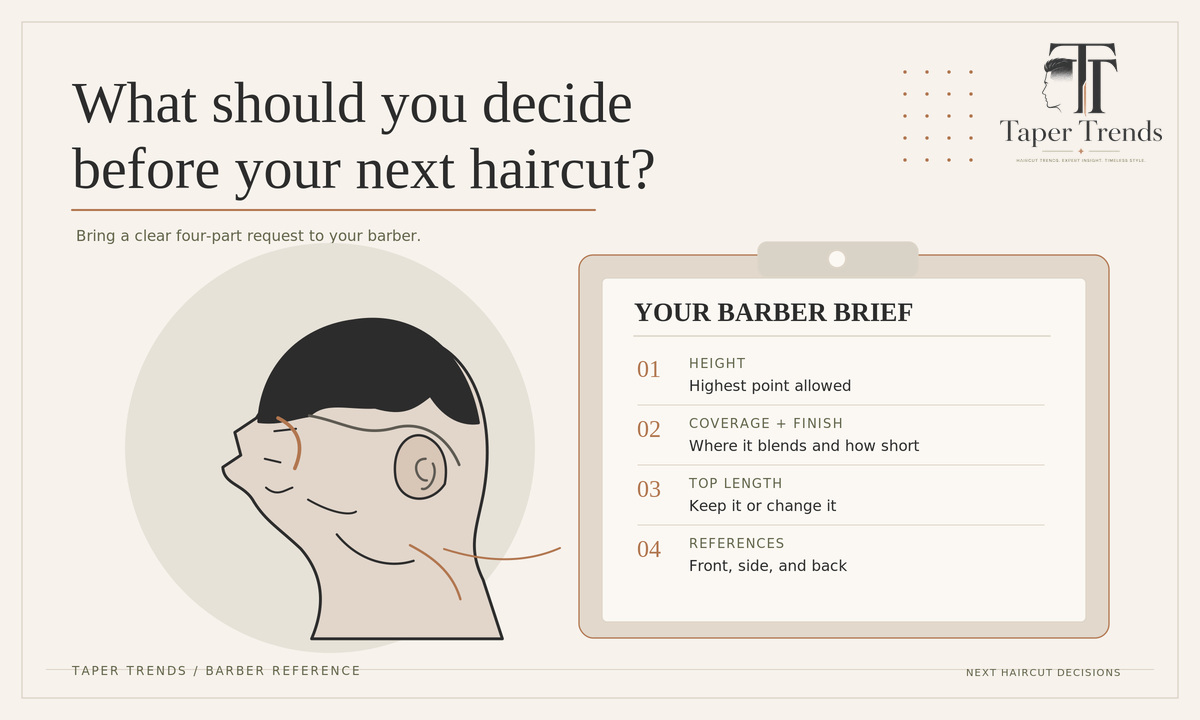
What should you decide before your next haircut?
Before your next haircut, decide four things: the highest point the taper may reach, the area it covers and how short it finishes, whether the top stays or changes, and which references you will bring. Then write your request as one sentence on your phone.
If you want a wider blend instead, the taper fade guide covers placement and finish, and the low taper fade haircuts guide has more wording to adapt. Either way, have your barber repeat the plan before the clippers start.
The bottom line
A taper haircut is a small change with a big effect: it tidies the sideburns, ears, and nape while the rest of your haircut keeps its length. The word “taper” alone doesn't tell a barber enough, though.
Name the height, the coverage, the finish, and the side weight, show references that match your hair, and ask for the plan to be repeated back. Do that and the result is the one you pictured.
Want more taper fade guides?
Browse clean, barber-ready breakdowns for every hair type.