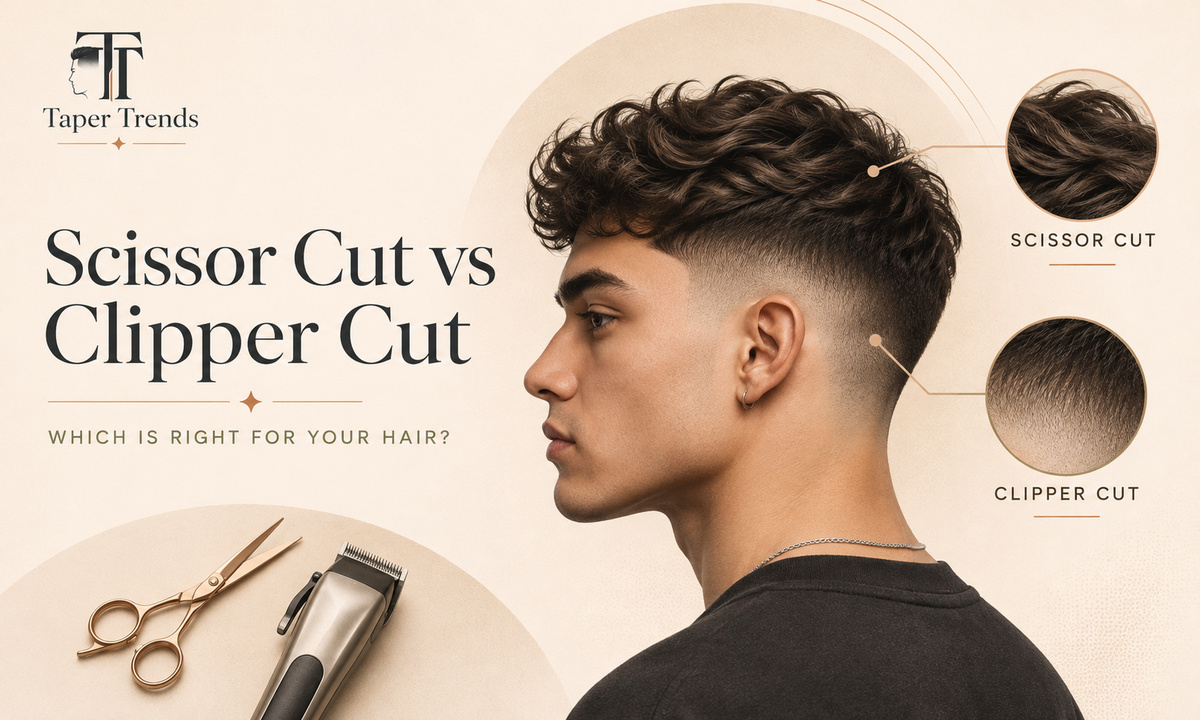
A scissor cut shapes hair with shears and a comb, so the barber can change length, layering, and weight section by section. A clipper cut uses an electric blade, usually fitted with a guard, to set short, even lengths and fades quickly. Neither one wins outright. Scissors suit longer and softer shapes, clippers suit close sides, and plenty of good haircuts use both.
That makes the more useful question one you can actually bring to the chair: which tool belongs on which part of your head for the result you want? If the vocabulary still feels slippery, skim barber terms explained and haircut numbers first, then use the free barber brief generator to turn your answer into one clear request.
Scissor cut vs clipper cut: what are the main differences?
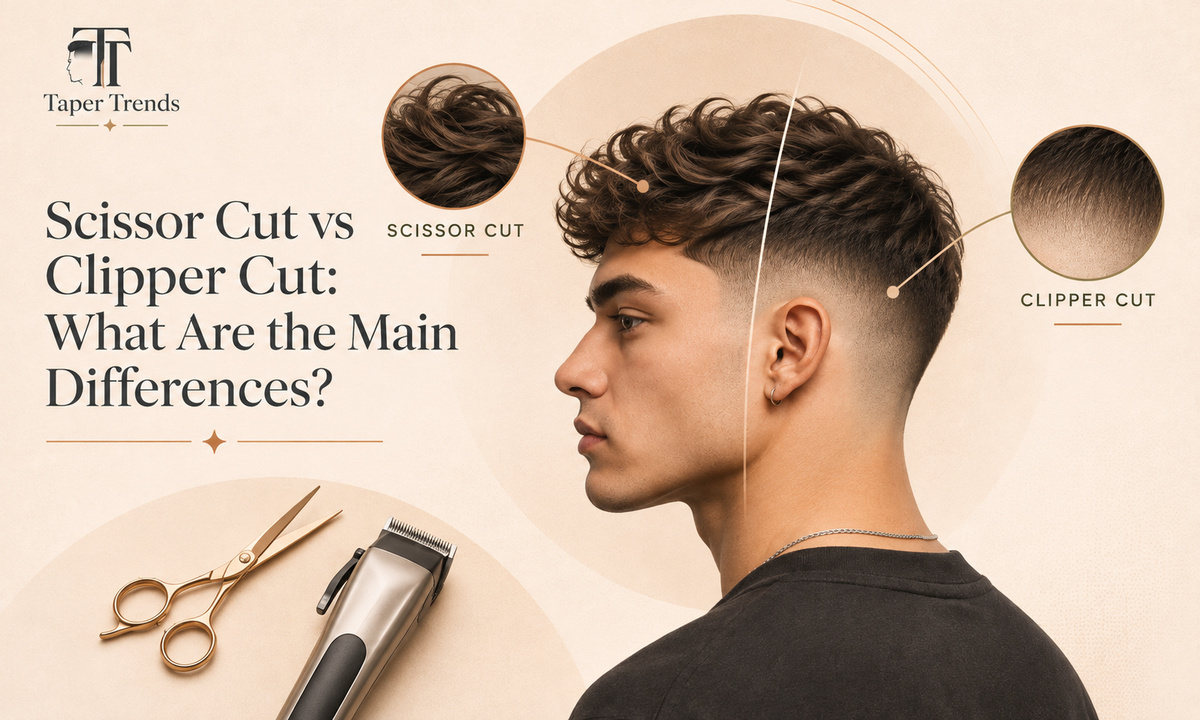
Scissors give a barber more freedom to shape hair, vary length, and customize the finish. Clippers set controlled short lengths and gradients faster and more consistently. That split is why most modern barbershop cuts put clippers on the sides and back and shears on top, a pattern CADMEN Barber Academy describes as the norm. You can see it in almost every taper fade and in the low taper fade that anchors this site.
| Feature | Scissor cut | Clipper cut |
|---|---|---|
| Main tool | Shears, usually with a comb | Electric blade, often with a guard |
| Best for | Longer, layered, or softer shapes | Short, even lengths, tapers, and fades |
| Length control | Adjusted by hand, section by section | Set by guard, blade, or taper lever |
| Typical finish | Natural and shape-led | Clean, uniform, or sharply graduated |
| Blending method | Scissor-over-comb | Clipper-over-comb |
| Skill focus | Angles, sectioning, and weight | Even transitions across the head's contours |
| Role in mixed cuts | Shapes the top and refines detail | Handles the sides, back, and neckline |
A quick rule of thumb: short sides with a longer top usually means both tools. Length all over means mostly scissors. One short, even length means mostly clippers.
How does a scissor cut work?
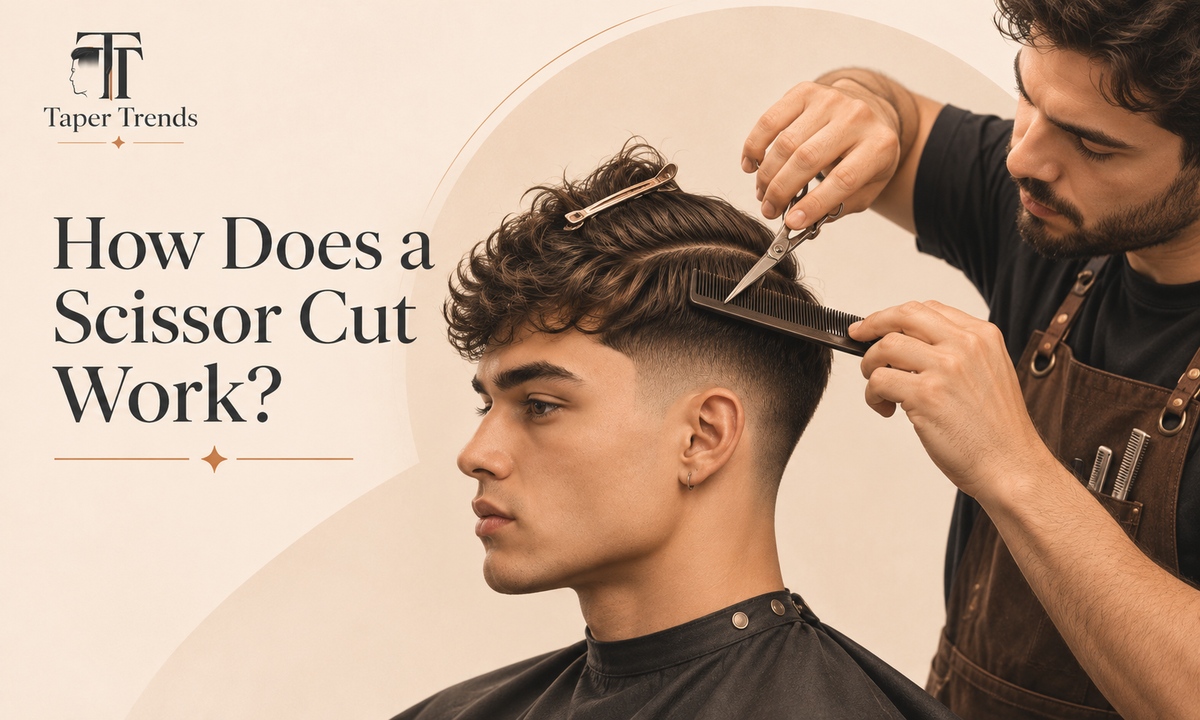
In a scissor cut, the barber divides hair into sections, lifts each one to a chosen angle, and cuts to a guideline. Changing the elevation (how far the hair is lifted from the head) and the cutting angle controls length, layering, and weight, so the shape follows your head and hair rather than a fixed guard length. Because length can change from one section to the next, scissors are the usual choice when a haircut needs movement or real length on top, as in a low taper fade with medium length hair or a long hair low taper fade.
Scissor-over-comb cutting explained
Scissor-over-comb is the technique where a comb lifts the hair and the shears trim along its edge. It lets a barber taper and blend short areas without clippers. Sam Villa educator David Boyd explains that comb angle controls weight: a horizontal comb holds weight, a diagonal comb moves and blends it, and a vertical comb removes it. Australia's national training unit for over-comb haircutting (SHBHCUT005) also has barbers work the scissors over the fine or coarse end of the comb to vary the taper and shape the neckline. The same idea is behind the classic taper haircut, and barber terms covers how scissor-over-comb differs from clipper-over-comb.
Layers, point cutting, and shape control
Shear angle decides much of what a scissor cut looks like. In point cutting, the barber cuts into the ends with the tips of the shears. Sam Villa's haircutting guide notes that a shear held roughly parallel to the hair's grain leaves a soft, wispy finish, while a diagonal angle creates more visible texture. That is the finish behind a textured fringe or a French crop.
Elevation, over-direction (pulling hair away from where it naturally falls before cutting), and finger angle shape the silhouette as well. That is why two scissor cuts at the same length can look quite different. Scissors also cut clean, blunt lines, so a scissor cut is not automatically a soft one.
How does a clipper cut work?
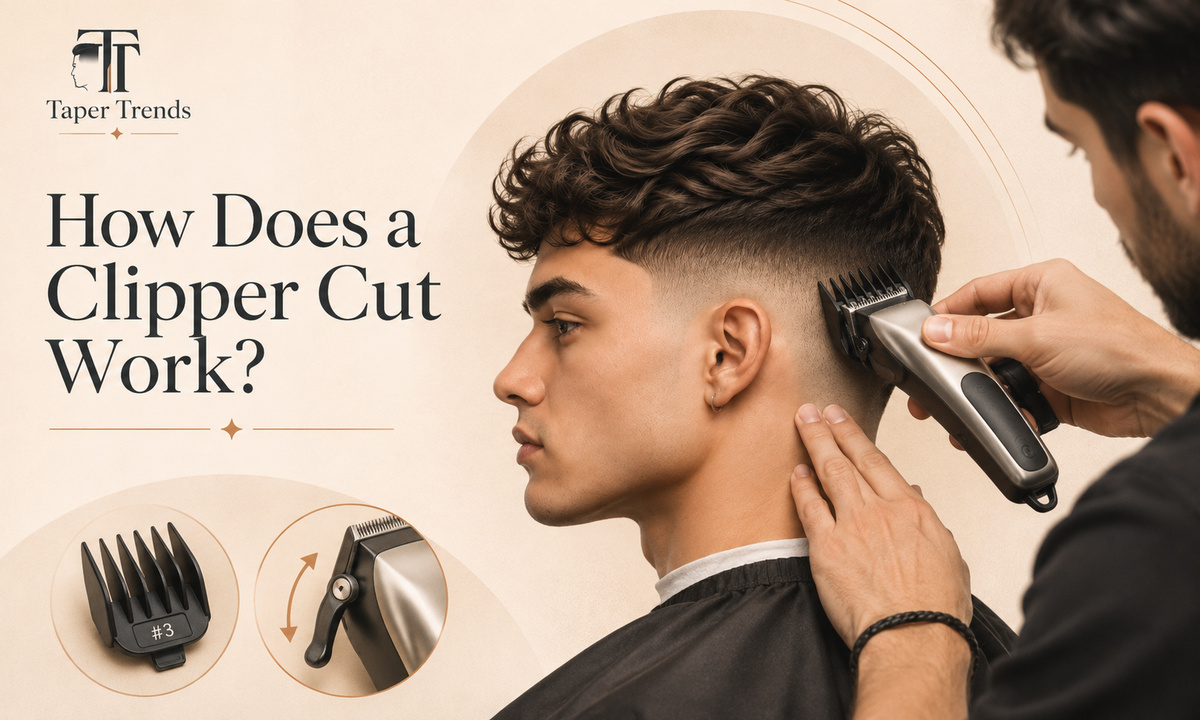
A clipper cuts with a blade that moves rapidly across a fixed one, and the barber controls length with attachment guards, the blade setting, or a comb. Those controls make uniform lengths, graduated fades, and tapers quick to produce. Guards are the simplest: according to Wahl's guard guide, a guard cuts any hair longer than its listed length down to that length. If you want the tool itself, see the best clippers for fades, and if you want to try it at home, how to cut a fade walks through a guarded fade step by step.
Clipper guards, haircut numbers, and taper levers
Higher guard numbers leave longer hair. Here is how Wahl describes the common numbers, with lengths where the source states them:
| Guard | Length | What Wahl says it gives |
|---|---|---|
| #1/2 | Not listed in text | The shortest cut outside of bald; skin-fade territory |
| #1 | Not listed in text | A short buzz cut |
| #2 | 1/4 inch (per CADMEN) | A traditional buzz cut |
| #4 | Not listed in text | Crew cut or brush cut territory |
| #8 | 1 inch | The longest guard in Wahl's standard chart |
| #10 / #12 | 1.25 / 1.5 inches | Sold separately as long-hair guards |
Wahl's own guide calls the #8 as long as a clipper goes, yet the company sells #10 and #12 guards that leave 1.25 and 1.5 inches. So the often-repeated claim that clippers can't leave more than an inch isn't true. A taper lever on the side of the clipper fine-tunes closeness between guard sizes: down for longer, up for closer. Guard sets vary by brand and model, so ask your barber what their numbers mean before you quote one. The full chart lives in haircut numbers, and the clipper guard sizes tool lets you check a number quickly.
Fades, tapers, and clipper-over-comb blending
Clippers create fades and tapers by stepping through progressively longer lengths. Wahl's sample fade pairs a #1/2 on the lower sides and back with a #2 on the upper sides, using an upward rocking motion at the top of each section so one length doesn't cut into the next. The result can be as close as a skin fade or as soft as a shadow fade, and the height can be low, mid, or high (see low, mid, and high skin fades or our mid fade haircut guide).
Clipper-over-comb connects those short areas to longer hair. The SHBHCUT005 standard describes lifting clean sections with a comb and using a smooth, fast, fluid clipper action at various angles to blend. It also has barbers shape necklines and blended hairlines with clippers or razors. Because guards fix the length, clippers are especially efficient on short, uniform areas like these.
What do scissor and clipper cuts look and feel like?
Scissor cuts usually look softer and more shape-led, while clipper cuts look closer, more uniform, or sharply graduated. Technique blurs the line, though: scissors can leave crisp edges, and a patient barber can blend clipper work softly. Compare a low taper with a high taperand you'll see how much of the finish comes from where the clippers stop rather than which tool did the work.
Clippers are motorized, so you'll notice sound and vibration near the scalp. Some people find that relaxing and some don't, so tell your barber if either tool bothers you. If you want a clearer picture of the finished look before you book, see what a low taper fade looks like.
Which technique suits your hair type?
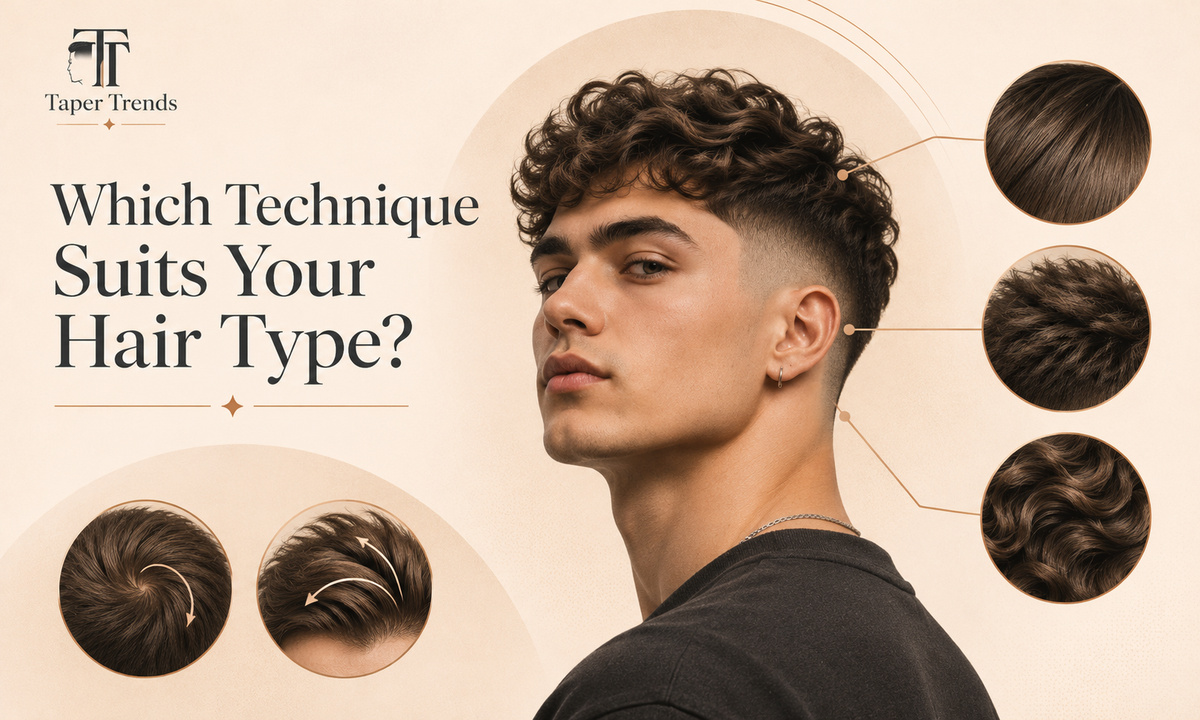
Length, density, curl pattern, growth direction, and the style you want matter more than any rule pairing one tool with one hair type. A skilled barber can use either tool on almost any texture. What changes is where each tool goes and how much weight stays. Treat the notes below as conversation starters, not verdicts, and use the hair type quizif you're not sure which texture you have.
Fine or thinning hair
Density sets the risk. Sam Villa's guide warns that blending makes fine hair finer, which makes it harder to layer without losing the perimeter. Old Fashioned Barbershop, a Stockholm shop, adds that heavy texturizing can expose more scalp on lower-density hair, while keeping hair consistently short with clippers can reduce the contrast between thicker and thinner areas. Either way, ask for conservative weight removal. Our guides to low taper fades for thin and thick hair and haircuts for a receding hairline go deeper.
Thick or coarse hair
Scissors let a barber remove weight from the interior while keeping the outer shape. Old Fashioned Barbershop points out that cutting every section shorter may not fix width or styling trouble on dense hair. On dry or coarse hair, Sam Villa's educators avoid hard blunt lines, which tend to show after a blow-dry, and point-cut into each section instead. Clippers still work well for short sides. The main risk is over-texturizing, so ask how much bulk will come out and from where.
Wavy, curly, or coily hair
Curls can shrink noticeably once dry, Old Fashioned Barbershop notes, so a cut judged only on wet hair may end up shorter than expected. Scissors help a barber read how the curls form and shape longer hair, while clippers can create close sides. Ask how your barber accounts for shrinkage before the first cut, not after it. For worked examples, see the low taper fade for wavy hair, the curly low taper fade, the low taper fade for an afro, and the low taper fade with waves.
Cowlicks, crowns, and growth patterns
David Boyd advises taking extra time around growth patterns and cowlicks, and Sam Villa's layering tutorials warn that ignoring growth patterns at the crown can create a cowlick. Direction matters with clippers too. Wahl recommends cutting against the growth when using guards so every hair feeds through the teeth evenly, while the SHBHCUT005 standard has necklines shaped in the direction of growth. A swirling crown or an uneven nape is worth pointing out before the barber starts.
Which haircuts use scissors, clippers, or both?
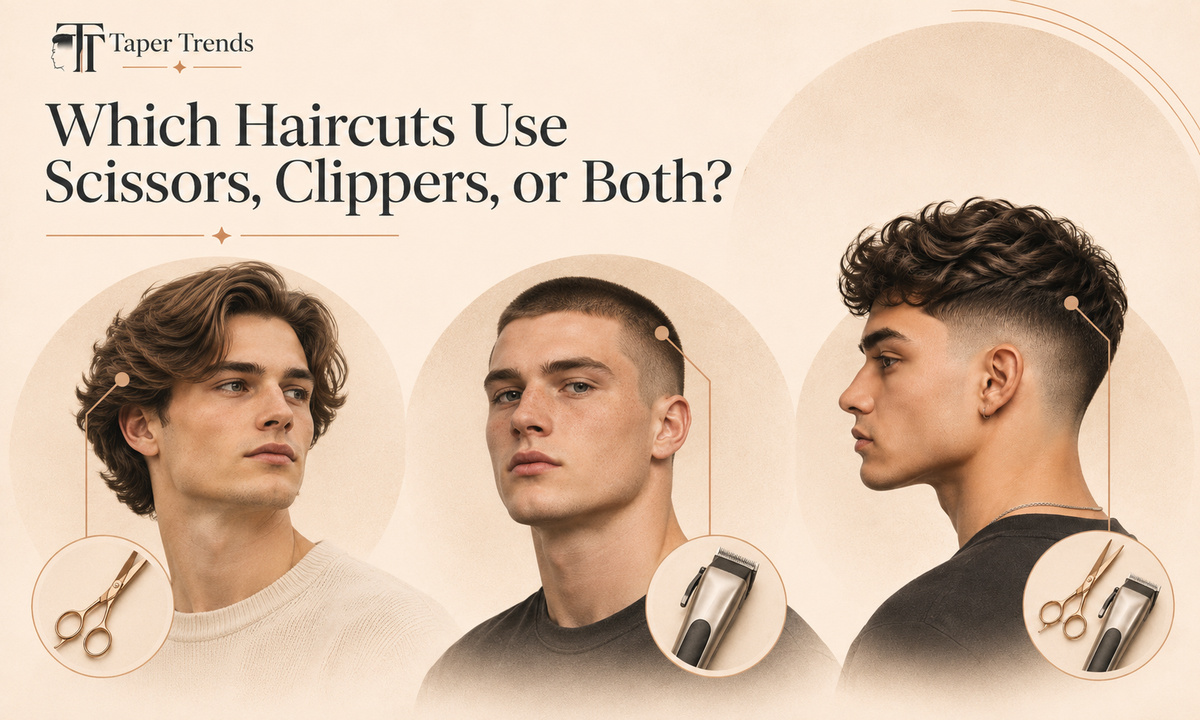
Buzz cuts and very close fades are usually clipper-led, flowing or longer layered styles are usually scissor-led, and many short-back-and-sides cuts use both. Most haircuts have a primary tool rather than an exclusive one, so ask which tool handles which area of the head.
Scissor-led hairstyles
Old Fashioned Barbershop lists layered cuts, textured cuts, natural side parts, and medium-length styles as typical scissor work. CADMEN adds that a fully scissor-cut style suits longer hair where a natural taper is preferred, with scissor-over-comb handling the sides and back. Good places to start are a side part with a low taper, a middle part with a low taper, and a slick back.
Clipper-led hairstyles
Buzz cuts, crew cuts, high-and-tights, and short tapers rely heavily on clippers. CADMEN estimates a buzz cut might be 90% clipper work. In Wahl's examples, a buzz cut is a #2 on the sides and top. Short sides and one consistent length are the clues that a cut is clipper-led. See the low taper fade buzz cut, the mid taper fade buzz cut, and the high taper fade buzz cut, plus low taper fades for short hair.
Mixed-tool hairstyles
Most modern barbershop cuts combine the two: clippers on the sides and back for the fade or taper, scissors on top for length and texture. A textured crop pairs faded sides with a choppy, scissor-cut fringe (the low taper fade with a fringe is a good example). A classic taper with a longer top uses clippers low and shears above, which is how a low taper fade comb over is built. Curls on top with faded sides follows the same split, as in the mid taper fade for curly hair. Wahl's side part, a #4 on the sides with a #8 on top, shows that even a clipper-heavy cut usually gets scissor detailing on top.
Which cut grows out better and needs less maintenance?
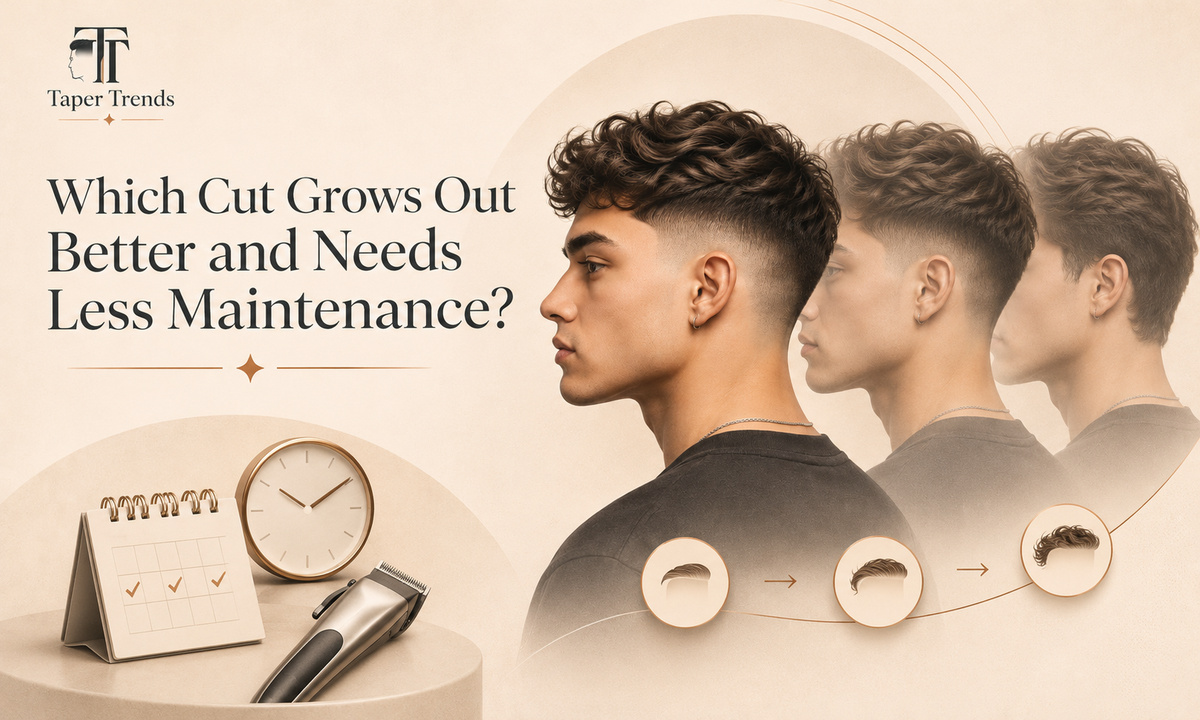
Very short, sharply defined areas tend to look untidy sooner, while softer or longer shapes can absorb more growth before they visibly change. This is about appearance, not biology. Cleveland Clinic puts average scalp hair growth at 4 to 6 inches per year, whichever tool made the cut. For more on shapes that stay presentable, see haircuts that grow out well.
Why haircut shape changes as hair grows
A skin-close fade depends on contrast, and contrast fades as the shortest areas lengthen. At the average rate above, hair gains roughly a third to a half inch per month. On a fade that starts near the skin, that's enough to blur a tight gradient. Old Fashioned Barbershop says a fade can start losing definition within a few weeks, while a scissor cut's softer transitions grow out more gradually. That's a barber's observation rather than measured data, so treat any timeline as a rule of thumb. If you decide to let a fade go, how to grow out a fade lays out the plan.
Planning touch-ups and daily styling
The same shop suggests that clients who want a very defined fade may return every two to three weeks. A medium-length scissor cut may need fewer visits but more time with a dryer and product at home. Decide which you'd rather spend: chair time or mirror time. Then tell your barber, who can shape the cut around that choice. Our guide on how often to get a haircut and the haircut frequency calculator help you pick an interval, while how to style a low taper fade and the best hair products for fades cover the mirror-time side.
Do scissor cuts cost more or take longer?
Often, but not always. Simple single-length clipper cuts usually cost less and finish sooner than detailed scissor work, but price follows the shop, the barber's experience, the haircut's complexity, and what the service includes. Compare services within one shop rather than averaging across shops. Whatever the price, the usual tip is covered in how much to tip your barber, and the barber tip calculator does the math.
Haircut time and service pricing
Two published US menus, checked on November 3, 2026, show how uneven the pattern is:
| Shop | Service | Listed price | Listed time |
|---|---|---|---|
| Generations Barber Co. (Pittsburgh, PA) | Buzz cut | $20+ | 15 min |
| Basic men's cut | $25+ | 30 min | |
| Fade cut | $30+ | 30 min | |
| Scissor cut (includes wash) | $35+ | 30 min | |
| Eminent Barbershop (Galt, CA) | Clipper cut | $35–$40 | 35–60 min |
| Scissor cut | $35–$45 | 1 hour |
Sources: Generations Barber Co. and Eminent Barbershop (via Squire) service menus.
Menus are linked here for reference: Generations Barber Co. and Eminent Barbershop. At Generations, the scissor cut starts $5 above the fade with the same listed time, but it bundles a wash, and the shop sells a wash add-on for $5. Strip that out and the two cuts start at about the same price. At Eminent, the price ranges overlap and the scissor cut books a fixed hour. Two shops are not a national average, and menus change, so confirm current prices before booking.
Choosing the correct booking category
Menu labels don't always match the tools. Eminent's scissor cut includes clipper work, while its clipper cut excludes scissor work entirely. Generations describes its basic cut as one clipper length on the sides and back with shear work on top. A “scissor cut” listing can still involve clippers, so read the description and describe the finish you want when booking. If the menu is unclear, call the shop.
What are the limitations and risks of each technique?
Both tools need skilled hands. Clippers can leave hair shorter than intended or leave visible steps between lengths, and scissors can leave uneven shaping or remove too much weight. Neither is unsafe when used correctly on clean, well-maintained equipment. If a cut does go wrong, see how to fix a bad fade for what a barber can correct and what needs regrowth.
Common cutting mistakes, comfort issues, and hygiene
| Problem | Likely cause | Prevention |
|---|---|---|
| Visible step between lengths | Rushed blending | Ask the barber to cross-check before finishing |
| Sides shorter than expected | Wrong guard or length | Agree on a guard number or length first |
| Thin or wispy ends | Over-texturizing | Ask for gradual weight removal |
| Pulling or discomfort | Snagging or sensitive skin | Speak up so the barber can adjust |
Sam Villa's guide stresses cross-checking and a slow, methodical approach to removing weight. Hygiene rules depend on where you live. In California, the barbering board's health and safety regulations require clippers to be disinfected before each use (§ 980), set a separate clean-and-disinfect procedure for shears (§ 979), and bar services on inflamed or broken scalp skin (§ 984). Mention any irritation before the cut starts.
How should you choose between scissors and clippers?
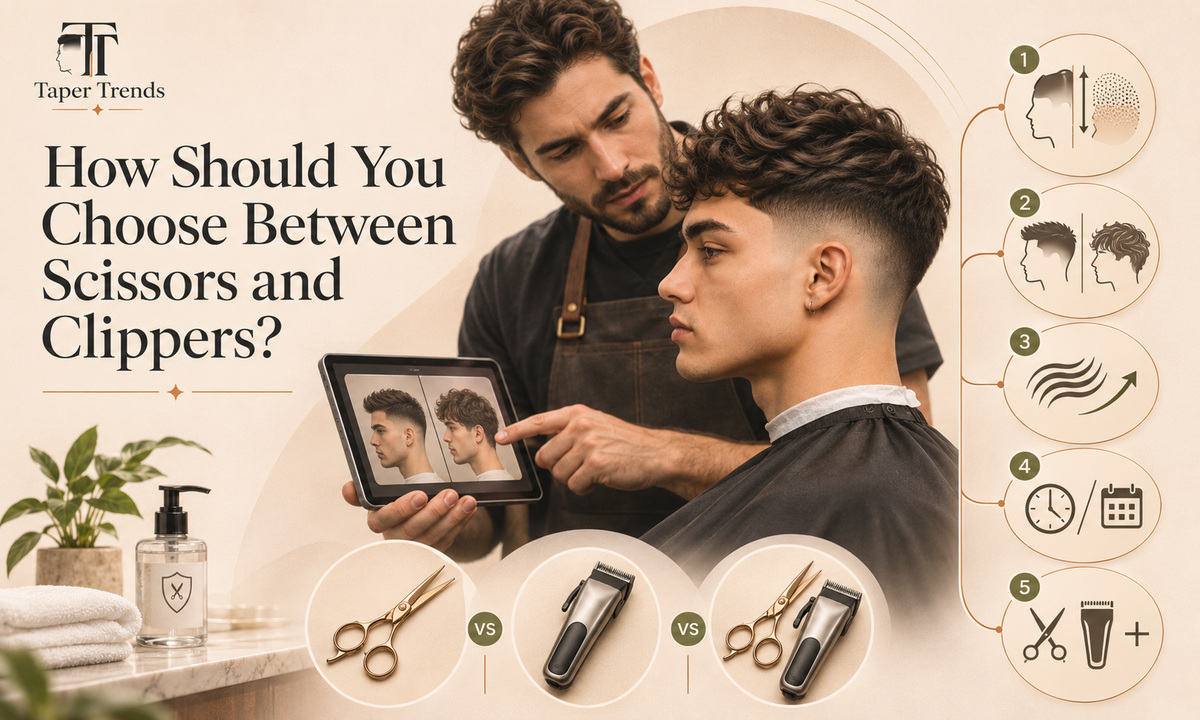
Choose by result, not by tool. Decide the finished length, the type of finish, and the upkeep you'll accept, then let the barber match tools to each area of your head. Hair characteristics and comfort come next, and a mix of both tools is common. Your head shape matters too, so pair this with the best fade for your face shape and the free face shape detector.
A five-step haircut decision checklist
- Set your target length and scalp coverage. Decide how much length to keep on the sides and crown, and how much scalp you're comfortable showing. A true skin fade requires clippers; anything longer leaves more options. The taper height diagram shows how high each blend sits.
- Choose between a sharp and natural finish. Pick a crisp, defined outline or a soft, blended one. Crisp leans toward clippers and soft toward scissors, though a mixed cut can give you crisp sides and a soft top. Skin fade vs taper fade shows how far that choice can go.
- Account for hair texture and growth direction. Note your density, curl pattern, and any cowlicks, and name them at the start of the appointment.
- Consider styling time and touch-up frequency. Be honest about how many minutes you'll spend styling and how often you'll return. Pick the trade-off you can keep up.
- Choose scissors, clippers, or a combination. Assign each area a tool: clippers where you need short, even lengths, scissors where you want movement. Ask your barber to confirm the plan before cutting. The taper quizcan help if you're still deciding on a style.
What should you tell your barber?
Show a reference photo, describe the side and top lengths you want, and say whether you prefer a soft or sharp finish. Mention your styling habits too. The SHBHCUT005 standard has barbers discuss preferences, lifestyle, and self-care routines during consultation, using visual aids, so a good barber will expect that conversation. For word-for-word scripts, read how to ask for a fade, and let the barber brief generator build the request for you.
Three ready-to-use barber consultation examples
For a natural scissor cut
“I'd like to keep length on the sides and top, with a soft taper and natural texture. Please avoid a close clipper finish.”
For a short clipper cut
“I'd like a #2 on the sides with a gradual blend and a short, tidy top.”
For a mixed-tool haircut
“I'd like a low fade with clippers, but please leave enough length on top to style and texture with scissors.”
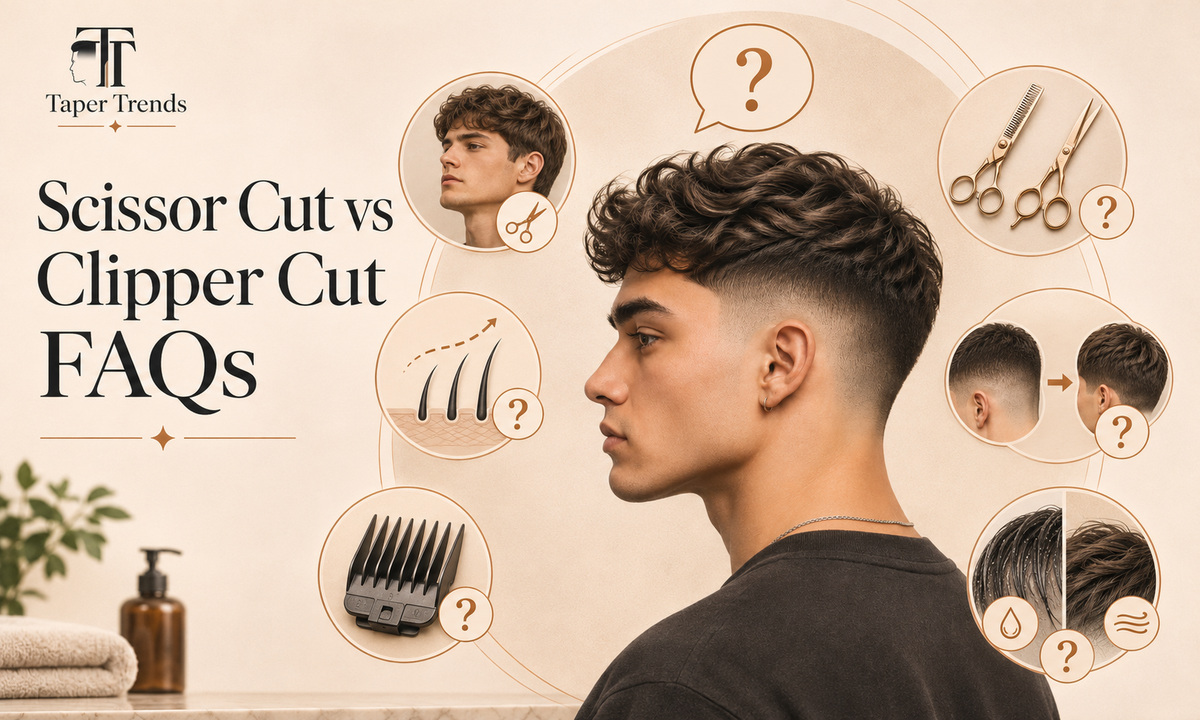
Scissor cut vs clipper cut FAQs
Can you get a short haircut using only scissors?
Yes, to a point. Scissor-over-comb can produce short, tapered sides, and CADMEN confirms you can ask for a scissor-only cut with no clippers. Very close fades are different: Old Fashioned Barbershop notes that a fade requires clippers. Ask your barber how short they can comfortably go without them.
Related: Taper haircut basics · Taper vs fade · Barber terms explained
Will using clippers make hair grow back thicker?
No. Mayo Clinic says shaving doesn't change hair's thickness, color, or growth rate. Its answer concerns shaving, but the same logic applies to clipping: a cut leaves a blunt tip that can feel coarse as it grows out, which may make hair look thicker for a while.
Related: How to grow out a fade · Haircuts that grow out well
Do hair clippers always need a guard?
No. A guard is an attachment that sets cutting length, and clippers work without one. Barbers also control length with a comb in clipper-over-comb work, and the SHBHCUT005 standard lists outlining sideburns, necklines, and hairlines with clippers among core barbering tasks.
Related: Haircut numbers and guard sizes · Clipper guard sizes tool · Best clippers for fades
Are thinning shears the same as regular haircutting scissors?
No. Standard shears cut a clean line to set length and shape. Thinning, blending, or texturizing shears have teeth on one or both blades, so each closure removes only some of the hair in the section. Sam Villa describes blending shears as a way to reduce weight gently without overdoing it. Ask how much your barber plans to take out.
Related: Low taper fade for thin and thick hair · Low taper fade, fluffy hair · Textured fringe with a low taper fade
How do you transition from a clipper fade to a scissor cut?
Let the sides grow while your barber keeps them tidy and trims the top just enough to stay balanced. Old Fashioned Barbershop recommends scissor-over-comb for haircuts that need to grow out smoothly. Growth varies by person, so ask for a realistic timeline before you commit.
Related: How to grow out a fade · Low taper fade, medium length hair · How often to get a haircut
Should a scissor cut be done on wet or dry hair?
Either can work, depending on the haircut and the barber's technique. Sam Villa recommends dry cutting for fine hair and for strong shapes because it shows the true visual edge, while some of its other tutorials start on damp hair. With curly hair, ask how your barber will account for shrinkage.
Related: Curly low taper fade · Low taper fade, wavy hair · Barber brief generator
Sources named in these answers: Mayo Clinic, CADMEN Barber Academy, Old Fashioned Barbershop and Sam Villa.
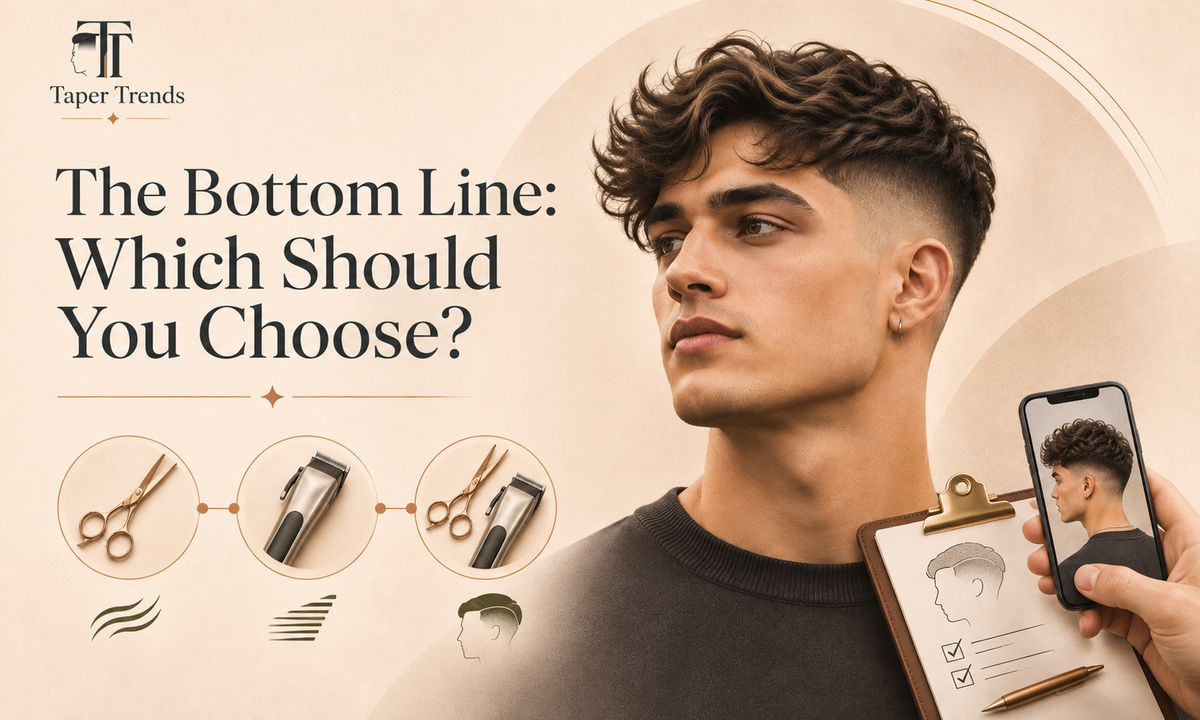
The bottom line: which should you choose?
The bottom line
Choose scissors when you want a customized shape, movement, or longer lengths. Choose clippers for efficient short lengths, close sides, and fades. Choose both when you want close sides with flexible shaping on top, which describes a lot of modern haircuts.
The tool matters less than the result you can describe. Before your next appointment, settle on the length, finish, and upkeep you can live with, bring a reference photo, and ask your barber which tool will handle each area. Put it together with the Taper Trends barber brief generator and the low taper fade guide. If the plan sounds clear before the first cut, you're in good hands. If it doesn't, ask for a clearer one.
Keep reading
Clipper work: guards, blends and tools
Tapers and fades: where clippers and scissors meet
Clipper-led cuts
Scissor-led and mixed-tool cuts
By hair type
- Low taper fade, wavy hair
- Mid taper fade, wavy hair
- Curly low taper fade
- Mid taper fade, curly hair
- High taper fade, curly hair
- Low taper fade, thin and thick hair
- Low taper fade, straight hair
- Low taper fade, fluffy hair
- Low taper fade, afro
- Low taper fade with waves
- Low taper fade for Black men
- Low taper fade, Asian hair
Face shape, hairline and styling
Grow-out, upkeep and etiquette
Want more taper fade guides?
Browse clean, barber-ready breakdowns for every hair type.