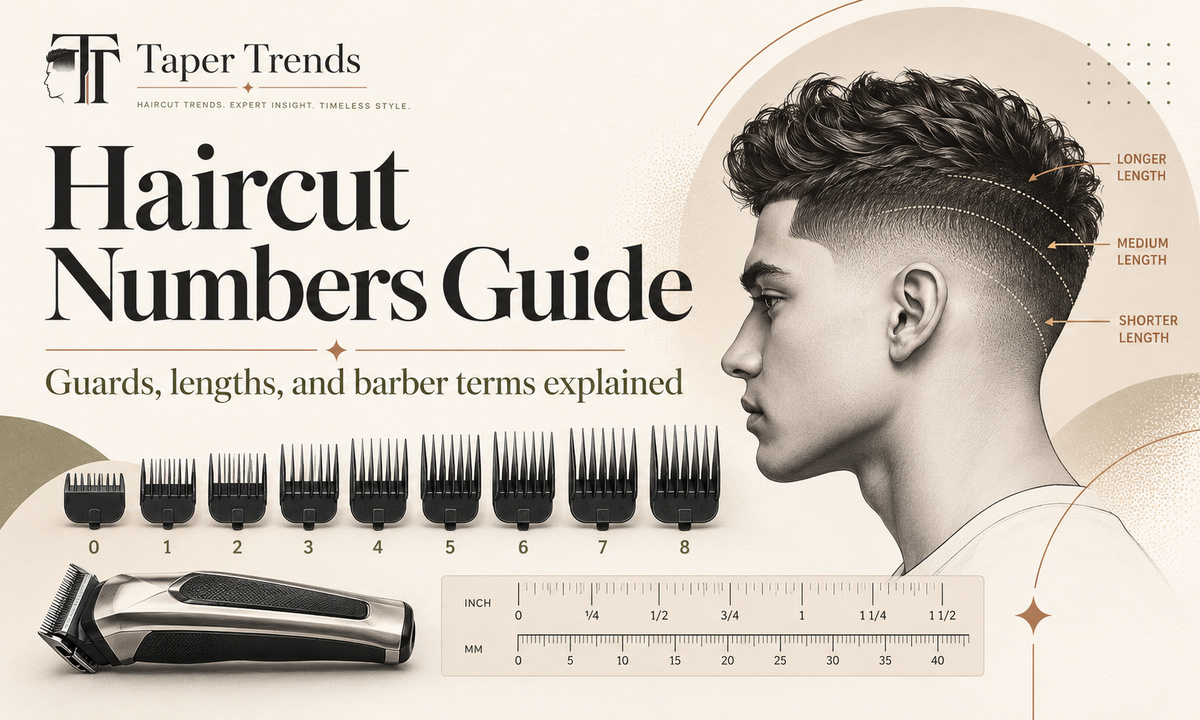
Haircut numberstell you how much hair a clipper guard leaves on your head, not how much it takes off. On the Wahl scale most US barbers use, a #1 leaves 1/8 inch (3 mm), a #8 leaves 1 inch (25 mm), and each number in between adds another eighth of an inch. Other brands don't always line up, so the measurement matters more than the label. The full chart is just below.
Once you know the length, the next question is where it goes. Numbers feed straight into the taper haircut, the taper fade, and every style in our types of fade haircuts guide. If you would rather look a size up than read, the clipper guard sizes tool converts any guard to millimeters, and our guide to the best clippers for fades compares the guard sets each clipper kit includes.
What do haircut numbers mean?
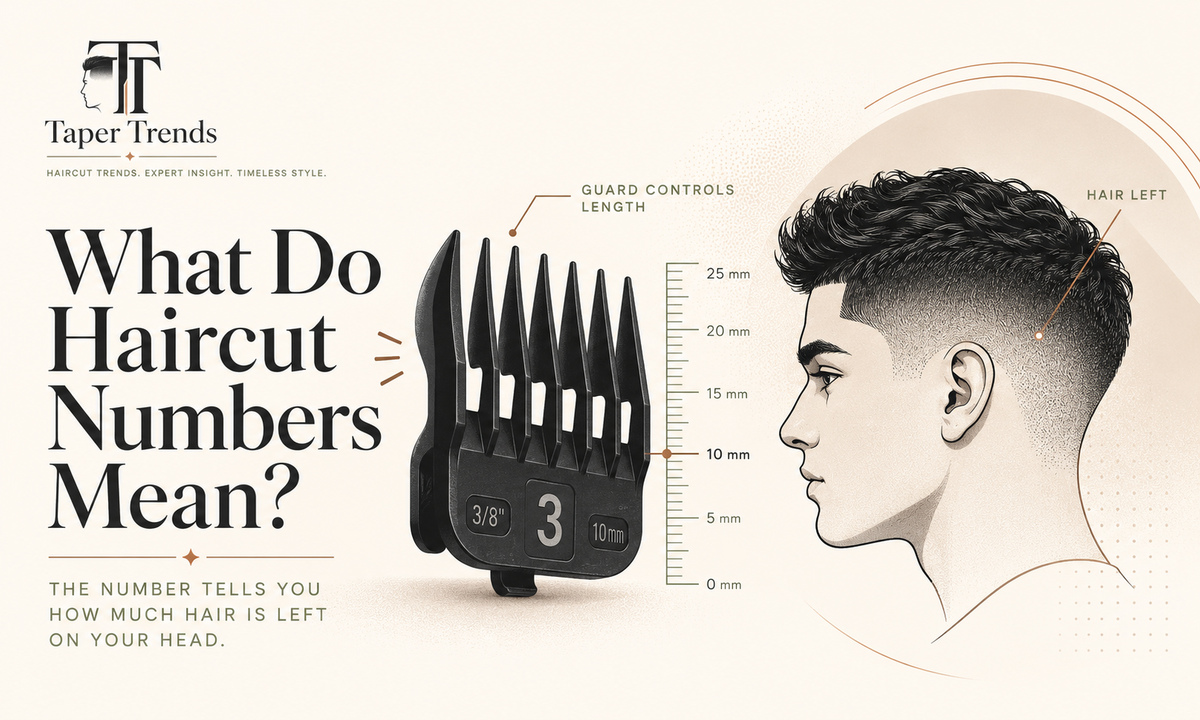
A haircut number is the label on a clipper guard, the plastic attachment comb that snaps over the blade. It names the approximate length of hair left after the clipper passes. Higher numbers leave longer hair. The number tells you nothing about the haircut's shape, fade height, or how the sides connect to the top, which is why guides like our different kinds of fades treat height and finish as separate choices.
Wahl says it created the guide comb numbering system in use today, and that each number represents the length of hair left on the head, according to its hair clipper buying guide.
Do haircut numbers tell you what gets cut or what stays?
They tell you what stays. A #2 leaves about 1/4 inch of hair whatever you start with. On four-inch hair, that means removing roughly three and three-quarter inches. On hair that's already half an inch long, the same guard takes off only a quarter inch. The result is the same length either way.
How does a clipper guard control hair length?
The guard holds the cutting edge a fixed distance from the scalp. Hair that rises above the comb's teeth reaches the blade and gets cut, while shorter hair slips through untouched. A taller guard holds the blade farther out, so more hair remains. The blade, the taper lever, and the direction you move the clipper also affect the result, which is why two #2 cuts can look slightly different. For where clippers stop and scissors take over, see scissor cut vs clipper cut. If you are curious how a fade climbs through several of these lengths, our low, mid and high skin fade comparison shows it from the shortest end.
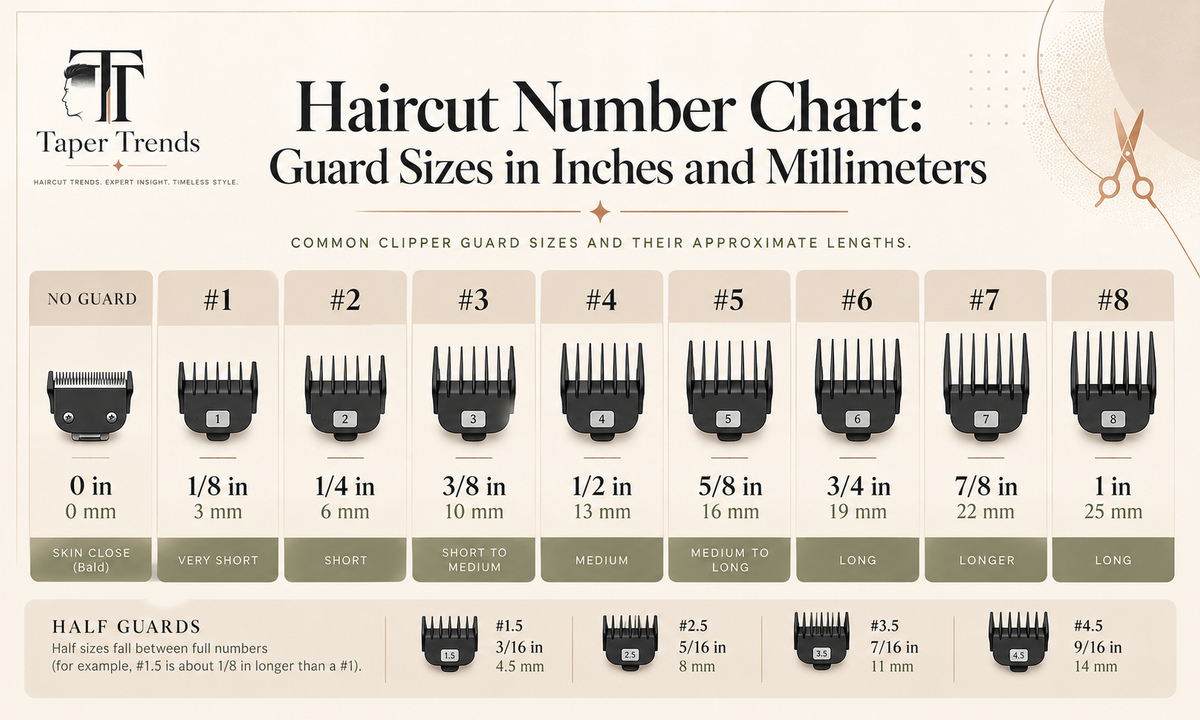
Haircut number chart: guard sizes in inches and millimeters
This chart uses Wahl's numbering, the system most US clipper kits follow. The figures are the manufacturer's nominal cutting lengths, not measurements of freshly cut hair, and the metric values are rounded. Other brands and models can label guards differently, so confirm the system before any very short cut.
Standard haircut numbers #1 through #8
In Wahl's system, the eight standard guards run from #1 at 1/8 inch to #8 at 1 inch, rising in 1/8-inch steps. The lengths below come from Wahl's 10-piece guide comb set. The millimeter column is Wahl's own rounding: 1/8 inch is exactly 3.175 mm, so a #8 actually leaves 25.4 mm.
| Guard | Inches | Approx. mm | How it reads |
|---|---|---|---|
| #1 | 1/8 | 3 | Closest standard guard |
| #2 | 1/4 | 6 | Very short |
| #3 | 3/8 | 10 | Short |
| #4 | 1/2 | 13 | Short, more coverage |
| #5 | 5/8 | 16 | Short to medium |
| #6 | 3/4 | 19 | Medium-short |
| #7 | 7/8 | 22 | Medium |
| #8 | 1 | 25 | Longest standard guard |
Wahl nominal lengths, checked October 2026.
What are half guards and sizes above #8?
Half guards fill the gaps between whole numbers at the short end, where an eighth of an inch makes a visible difference. Extended guards go past #8 for longer clipper cuts. Most basic kits include neither, so check what's in your set before planning a cut around them. The half sizes matter most for the closest finishes, such as a skin fade or the short end of a shadow fade.
| Guard | Length | Source |
|---|---|---|
| #½ | 1/16 in (1.5 mm) | Wahl buying guide |
| #1½ | 3/16 in (4.5 mm) | Wahl USA |
| #10 | 1¼ in (32 mm) | Wahl USA long-hair set |
| #12 | 1½ in (38 mm) | Same set as #10 |
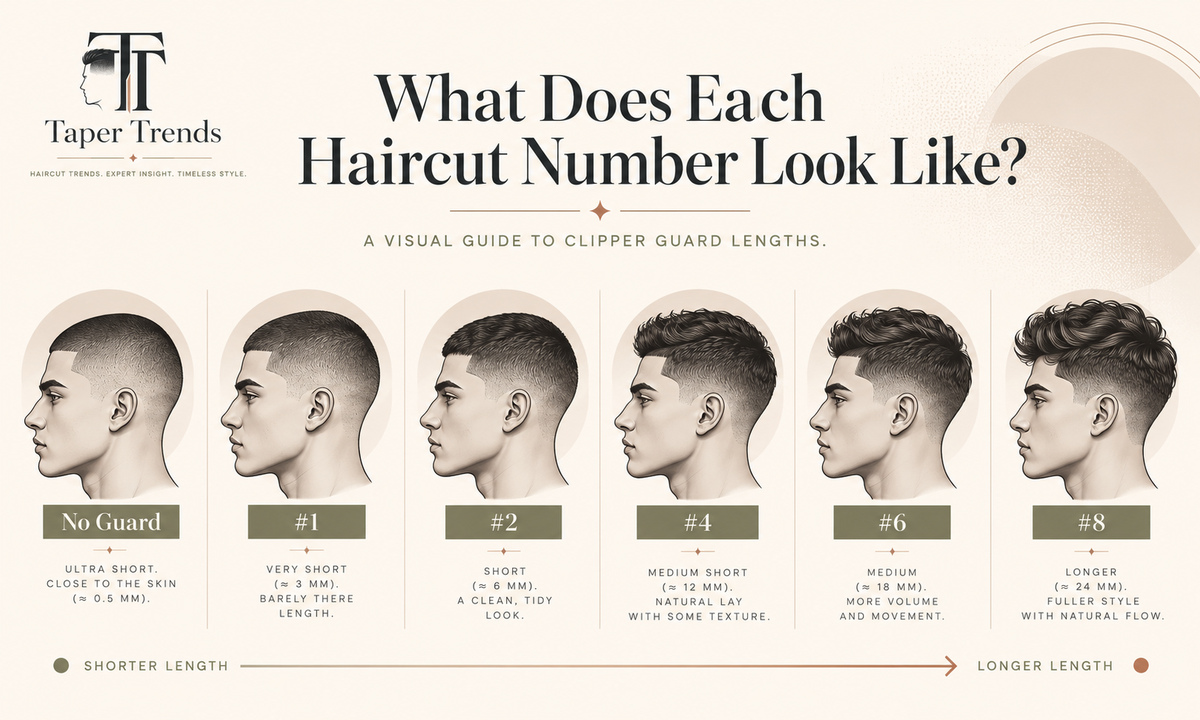
What does each haircut number look like?
A guard number fixes length, not appearance. Hair thickness, density, curl pattern, growth direction, head shape, and even lighting change how a given length looks, so no number guarantees a set amount of visible scalp. The descriptions below are based on published lengths, not photographs of tested haircuts.
No guard, #0 and #½ haircuts
No guard means the attachment comb is off and the bare blade does the cutting. How short that gets depends on the blade. Wahl puts its standard blade at 0.8 mm, its Close Cut blade at 0.4 mm, and its Baldfader at 0.5 mm, per its buying guide.
“Zero” is the slipperiest term in the barbershop. Many people use it to mean no guard. Andis, though, sells an actual #0 comb at 1/16 inch, the same length Wahl labels #½. If a barber says “zero,” ask which one they mean.
A skin fade is different again. It describes a finish that blends down to bare skin, usually with a very close blade or a shaver, not a single guard setting. Our skin fade vs taper fade breakdown and the skin fade with a beard and skin fade for curly hair guides show how that finish plays out.
#1 and #2 haircuts
A Wahl #1 leaves about 3 mm and a #2 about 6 mm. These are the shortest standard buzz lengths. The gap is only 1/8 inch, yet a #2 leaves twice as much hair. Scalp often shows through at #1, especially with fine or sparse hair, while thick hair can look surprisingly dense at the same length. Both work for all-over buzz cuts and very short sides, the way a low taper fade buzz cut uses them. Because so little length separates them, they also grow out fastest; our guide to how often you should get a haircut covers buzz-cut timing.
#3 and #4 haircuts
A #3 leaves about 10 mm (3/8 inch) and a #4 about 13 mm (1/2 inch). Both keep noticeably more hair than a #1 or #2, which makes them a good fit if you want a short cut that doesn't feel close. At half an inch, a #4 starts to show texture and the direction hair grows, though how much depends on your hair type. Our mid taper fade buzz cut and high taper fade buzz cut guides show these lengths on top.
#5 through #8 haircuts
Wahl's #5 through #8 run from 5/8 inch (16 mm) to 1 inch (25 mm). These lengths leave enough hair to comb, brush, or push into a style, though how it sits depends on texture and growth patterns. Tightly curled hair coils back on itself, so it often looks shorter than its measured length. For more length on top, the #10 and #12 continue the progression. Our guides to short hair, medium length hair, and curly hair show where these lengths land.
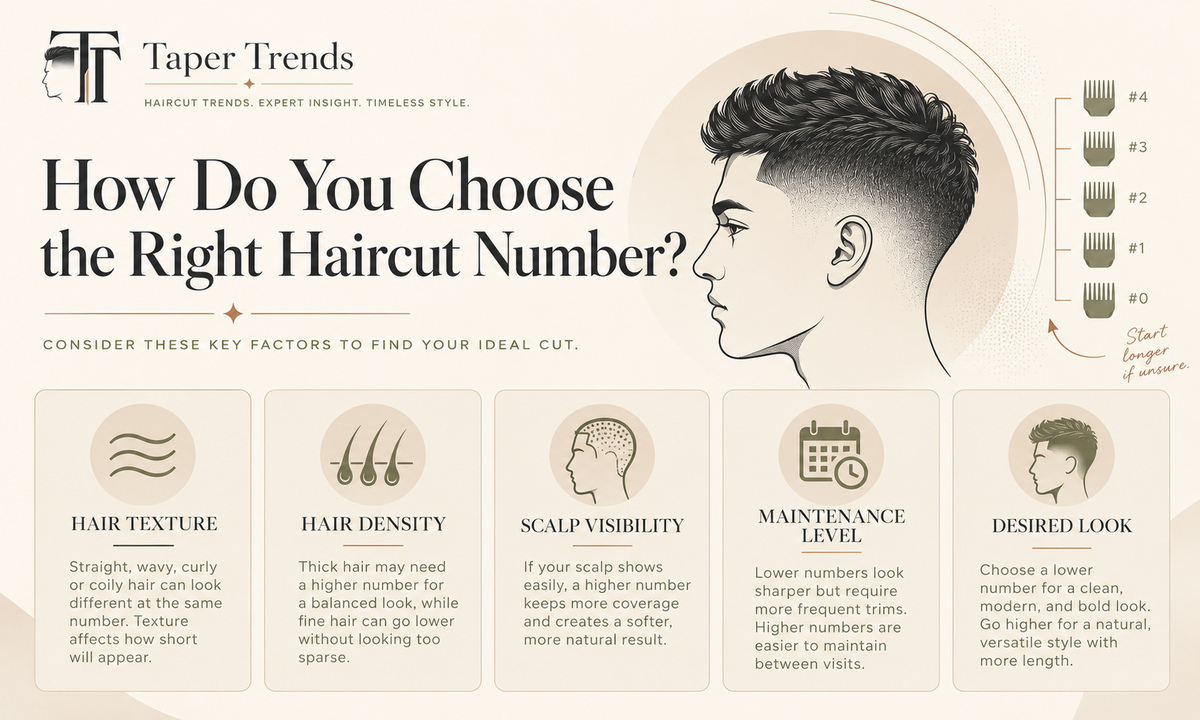
How do you choose the right haircut number?
Choose a haircut number by starting with the longest length you'd be happy to walk out with, then adjusting for where it goes and how your hair behaves. No single guard suits everyone. When in doubt, Wahl advises starting with a larger guide comb, because you can always cut more but can't put hair back.
- Pick a length in inches or millimeters. Think about the result, not the number.
- Decide where it goes. All over, or only on the sides and back?
- Factor in your hair. Fine or thinning hair shows more scalp at the same guard.
- Go one size longer if you're unsure. A second pass costs five minutes. A cut that's too short costs weeks.
How do hair texture, density and scalp visibility change the look?
The same nominal length can look quite different on straight, wavy, curly, or coily hair, and at different densities. Dense hair usually looks fuller under a given guard, while fine or sparse hair lets more scalp show. A guard fixes cutting distance, not coverage. Our guides for thin and thick hair, straight hair, wavy hair, and Afro hair go through each case.
Growth direction matters too. Cowlicks and whorls make hair stand up or swirl, and Wahl recommends cutting a whorl against the direction it growsto keep it lying flat. If you're unsure how a length will look on you, ask for a test pass on a small, low-visibility area first.
Which is shorter: a #2, #3 or #4 haircut?
A #2 is the shortest of the three at 1/4 inch, followed by #3 at 3/8 inch and #4 at 1/2 inch. On Wahl's rounded figures, the whole span from #2 to #4 is only about 7 mm, with each step adding 3 to 4 mm.
Because the differences are small, a cautious first choice costs little. If you want “short, but not buzzed” and have never worn a #2, try a #3 or #4 first. A barber can always go shorter on your next visit. If you've worn a #2 before and liked it, ask for it again, after confirming the shop uses the same guard system. Not sure which look suits you? The face shape detector and our what a low taper fade looks like guide help you picture it first.
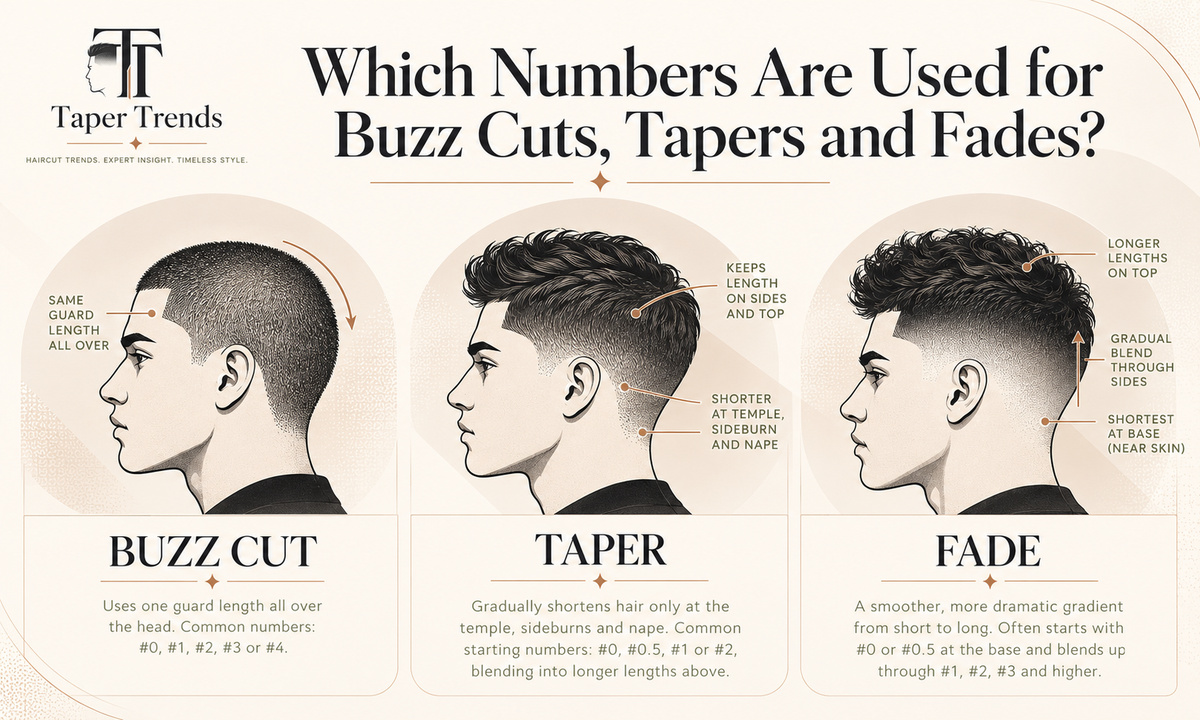
Which numbers are used for buzz cuts, tapers and fades?
No single number defines a buzz cut, taper, or fade. A buzz cut usually uses one guard all over, while crew cuts, tapers, and fades combine several lengths in different places. The guard sets the length. Technique decides where the length changes, which is why identical guards can produce very different haircuts.
| Style | How length is used | Manufacturer example |
|---|---|---|
| Buzz cut | One length all over | Wahl UK: #2 or #3 |
| Crew cut | Shorter sides, more length on top | Wahl US: #2 sides, #5 top. Wahl UK: #4 sides and back |
| Fade | Several lengths blended, shortest at the bottom | Wahl UK: a combination of #0 to #4 |
| Taper | Shortest length kept near the neckline and sideburns | Varies by barber |
Treat these as examples, not prescriptions. Even Wahl's own US and UK guides disagree on the crew cut.
What numbers are typical for a buzz cut or crew cut?
A buzz cut keeps one short length across the whole head, so the only decision is the guard. A crew cut is graduated: the sides and back go shorter, and the top stays longer, often blended so there's no hard line. Exact guards vary with hair type and how much contrast you want between the sides and top, up to the deliberate break of an undercut. See high taper fade short hair and mid taper fade short hair for cropped tops in practice.
How are guards used differently for tapers and fades?
A fade blends between lengths over part or all of the sides and back, often reaching very short or bare skin at the bottom. A taper usually limits the shortest transition to the sideburns and neckline, leaving the sides longer overall. Barbers don't all use these terms the same way, so describe what you want as well as naming it. Our taper vs fade, low taper vs low fade, and burst fade vs taper fade guides cover the differences.
Guard numbers define the length steps. They don't set where a transition starts, how high it climbs, or how smooth the blend looks. Fade height, described as low, mid, or high, is a separate instruction, covered in low vs mid vs high fade, mid fade haircut, low taper vs mid taper fade, mid taper vs high taper fade, and low taper vs high taper fade. Wahl notes its taper lever is especially useful for fading and blending, because it fine-tunes length between guard sizes. For curved blends, the drop fade, burst fade, and drop fade vs burst fade guides show how the same guards change shape.
Does “#2 on the sides” mean a #2 all over?
No. “#2 on the sides” sets a length for one area and usually means the top stays longer. “#2 all over” asks for that single length across the whole head. Sides, back, top, blending, and fade height are separate choices (our barber terms glossary defines each one), so the first request leaves several of them open.
- “A #2 on the sides and back, blended into about two inches on top.”
- “A #2 all over.”
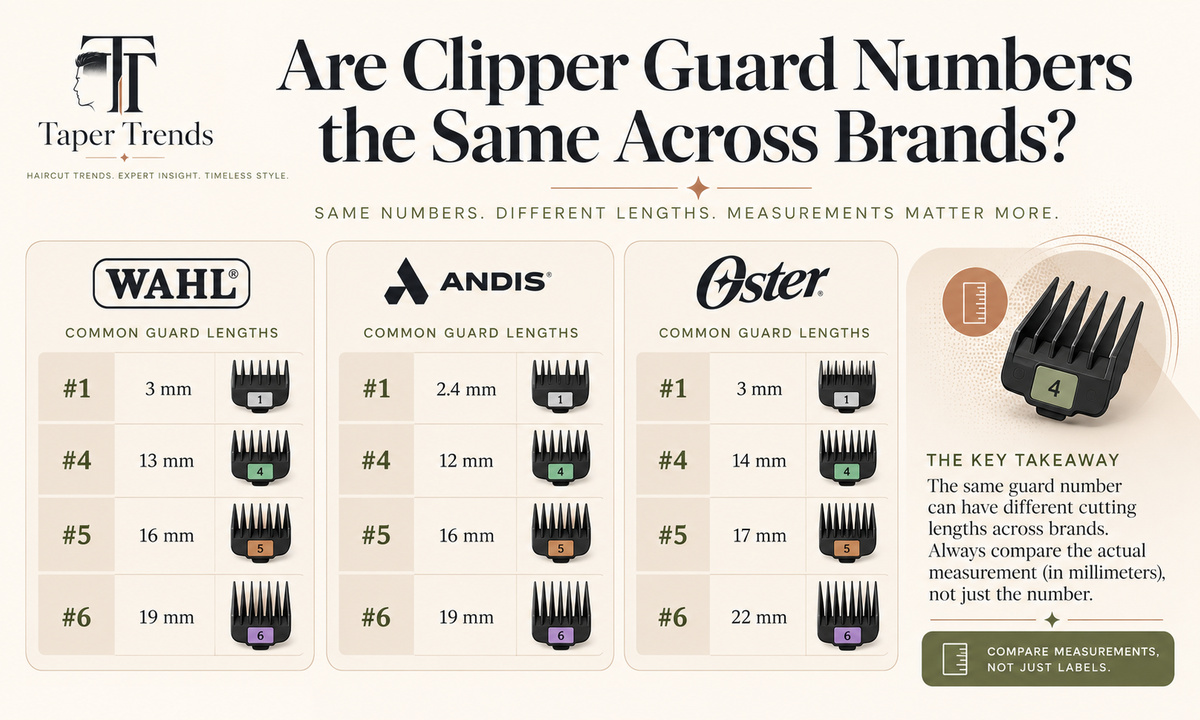
Are clipper guard numbers the same across brands?
Not always. Several short guards match across the products compared below, but labels split apart on specific attachments and models. Wahl's own cutting-length guide warns that guard sizes may differ between brands. Compare the printed measurement rather than the number, especially for very short guards and anything above #4.
How do Wahl, Andis and Oster labels differ?
Each column below reflects one specific product, not an entire brand. Wahl figures come from its guide comb set and buying guide, Andis from a retailer listing of its 11-comb set, and Oster from a retailer listing of the Craftsman Adjustable Mag Clipper.
| Label | Wahl | Andis 11-comb set | Oster Craftsman |
|---|---|---|---|
| #0 | Not sold | 1/16" | Not included |
| #½ | 1/16" | 3/32" | Not included |
| #1 | 1/8" | 1/8" | 1/8" |
| #4 | 1/2" | 1/2" | 1/2" |
| #5 | 5/8" | 5/8" | 3/4" |
| #6 | 3/4" | 3/4" | 1" |
Checked October 2026. Kit contents change, so confirm before relying on a label.
The Oster row is the one that catches people out. The Craftsman ships with six combs, and its #6 leaves the same inch of hair as a Wahl #8. Ask a barber using that clipper for a “six” and you could get a quarter inch more than you expected.
What about clippers with millimeter settings?
Some clippers skip guard numbers entirely and use adjustable combs marked in millimeters. The Philips Hairclipper series 5000 (HC5612), for example, offers 28 settings: 3 to 28 mm in 1 mm steps, a 2 mm stubble comb, and 0.5 mm with no comb. Settings vary by model. If your clipper works in millimeters, give your barber that figure instead of guessing a number, and use the clipper guard sizes tool to convert between the two.
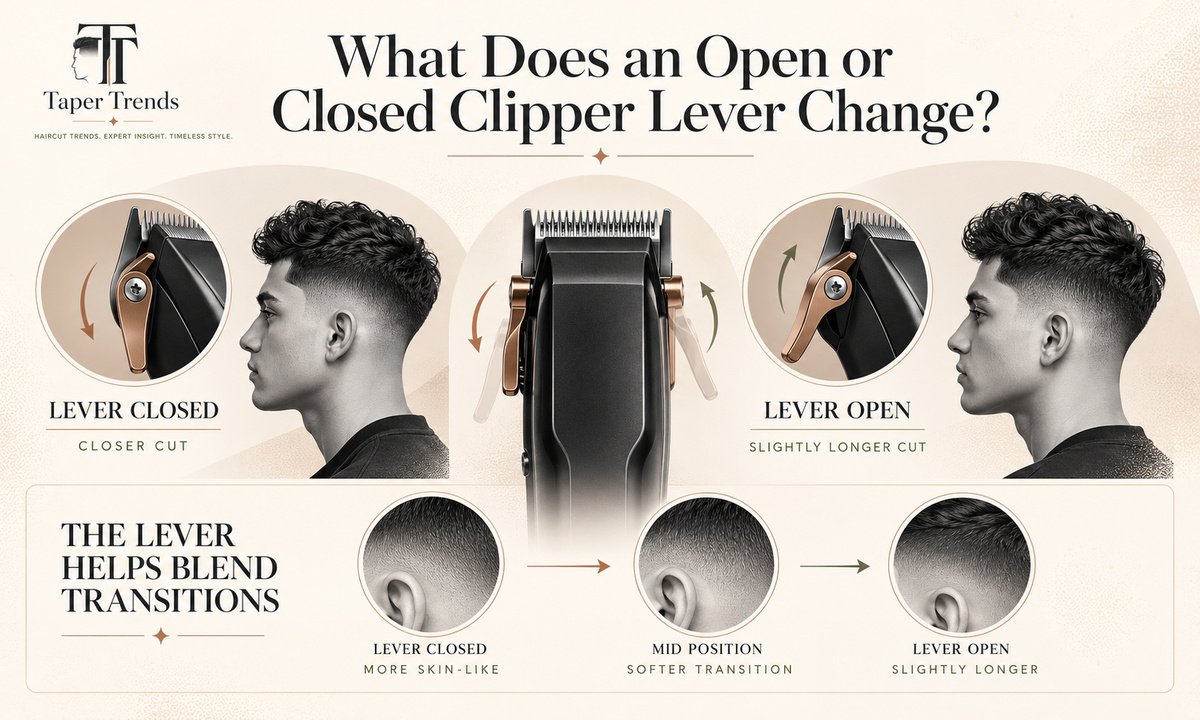
What does an open or closed clipper lever change?
On clippers with a taper lever, closing it gives a closer cut and opening it leaves hair slightly longer. Wahl describes the lever as changing closeness between guide comb lengths. Not every clipper has one, so check yours before using these terms.
What is the difference between a lever-open and lever-closed cut?
Wahl tells users to move the lever up for the closest cut and down for a longer one. Barbers often stop at positions in between to soften the line where one guard meets the next. “Open” and “closed” describe how the clipper is set, not a measured length, and a clipper without a taper lever has neither position. The softened line is what makes a low taper fade or a mid taper fade look gradual instead of stepped.
Does opening the lever add a fixed millimeter length?
No. The change depends on the blade and the clipper, so don't assume a universal figure. Oster, for example, describes the Craftsman's lever range as running from #000 to #1, a scale specific to its own blades. Treat any claim that “open equals a half guard” as model-specific, and ask your barber what their clipper actually does.
How do you ask a barber for the right haircut number?
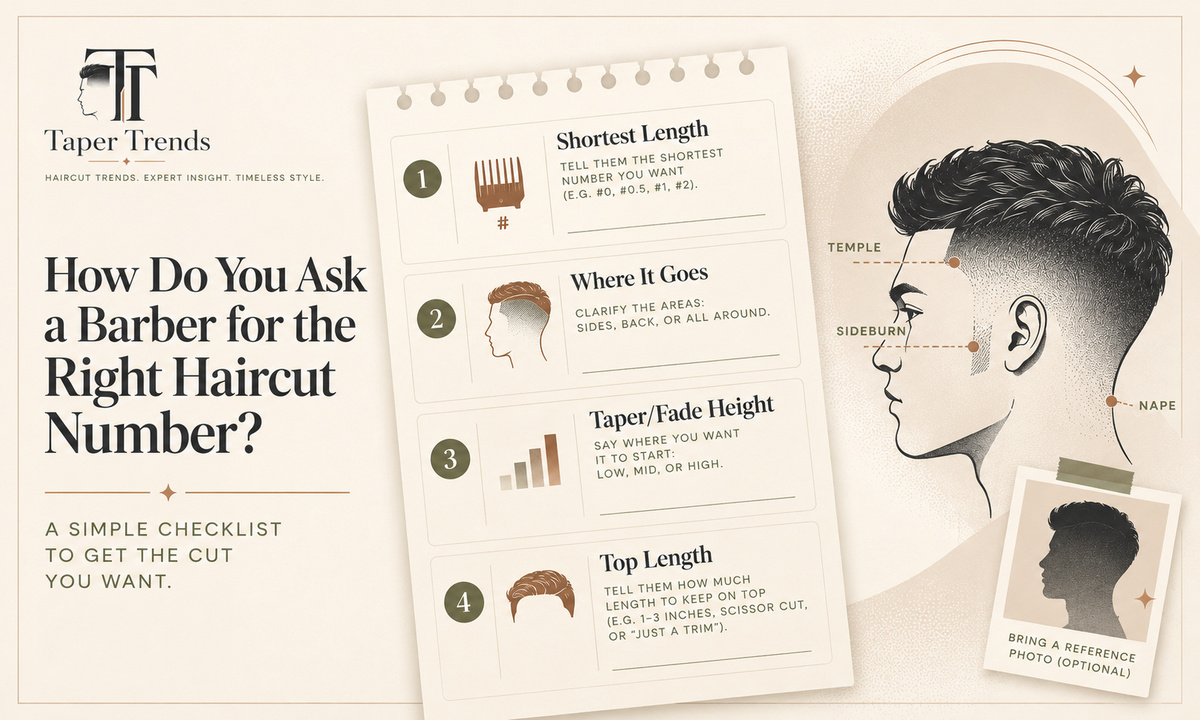
Ask a barber for the right haircut number by stating the length you want left, where it applies, how the sides meet the top, and how much length stays on top. Name the guard system or give a measurement, bring a reference photo, and ask the barber to confirm the length before the first pass. The barber brief generator turns those answers into a card you can show in the chair.
What should you specify for the sides, back and top?
Cover four things, in this order:
- The shortest length, and where it goes.
- How it blends into the top, including fade or taper height.
- The length you want to keep on top.
- Which guard system the shop uses, or the length in inches or millimeters if you're not sure.
An example, assuming Wahl-style numbering:
“A #3 on the sides and back, a low taper at the neckline, and about an inch and a half on top, blended where they meet.”
For more wording to adapt, start with how to ask for a fade haircut. The barber scripts in our taper haircut, skin fade, temp fade, and low taper fade with beard guides each add a different detail to settle.
How should you use haircut photos at the barber?
Bring front, side, and back photos that show shape and placement, ideally of hair similar to yours. Don't expect anyone to read a guard number reliably off a photo, since lighting, texture, and styling all change how length looks. Use the photo for shape and the measurement for length, and confirm both before the clipper touches your head.
What common haircut-number mistakes should you avoid?
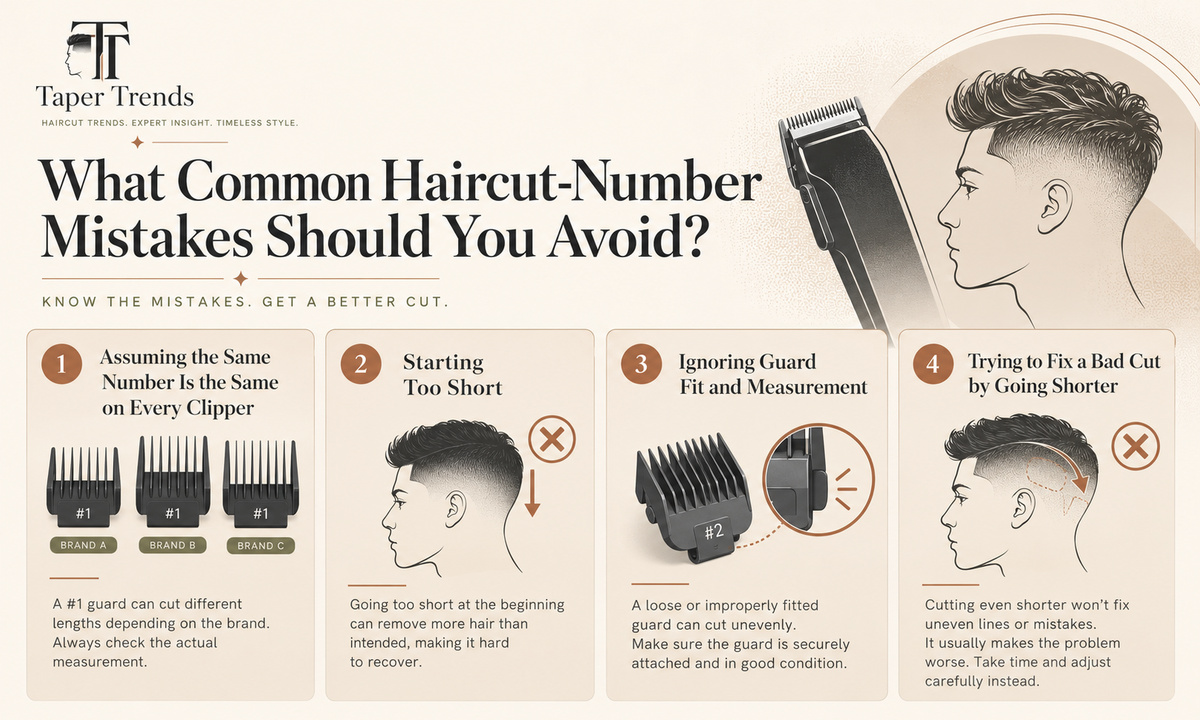
The costliest haircut-number mistakes are treating a number as identical on every clipper, starting too short, skipping equipment checks, and pressing on after a cut goes wrong. All of them are avoidable with a minute of preparation, and if one has already happened, how to fix a bad fade shows what is still fixable.
| Mistake | What to do instead |
|---|---|
| Assuming a #6 is the same on every clipper | Compare inches or millimeters |
| Treating “zero” as one setting | Ask whether it means no guard, a #0 comb, or a shave |
| Starting with the length you think you want | Start one size longer and work down |
| Ignoring cowlicks and whorls | Check growth direction before cutting |
| Chasing an uneven spot | Stop and get it fixed |
What should you check before using a guard at home?
Confirm the guard's printed length and that it fits your clipper, then test a small area before committing to the whole head; our step-by-step guide to how to cut a fade builds on these checks.
- Turn the clipper off before attaching or removing a guard, as Wahl's instructions direct.
- Snap the guard on firmly and make sure it doesn't wobble.
- Check the blade is clean and oiled. Wahl recommends oiling before first use and after every use.
- Make a short first pass in a low-visibility spot, and let the clipper do the work rather than forcing it through.
When should you stop and ask a barber to correct the cut?
Stop when the cut is already shorter than you intended, the transition is uneven beyond a quick fix, or the clipper or guard behaves oddly. Resist the urge to keep shortening the surrounding hair to match. A barber can often improve a blend but can't restore lost length. If the blades jam, Wahl suggests moving the taper lever up and down, then brushing out the hair. If that doesn't fix it, put the clipper down. Once it grows back, our guide to styling a low taper fade helps you work with what you have.
Haircut numbers FAQs
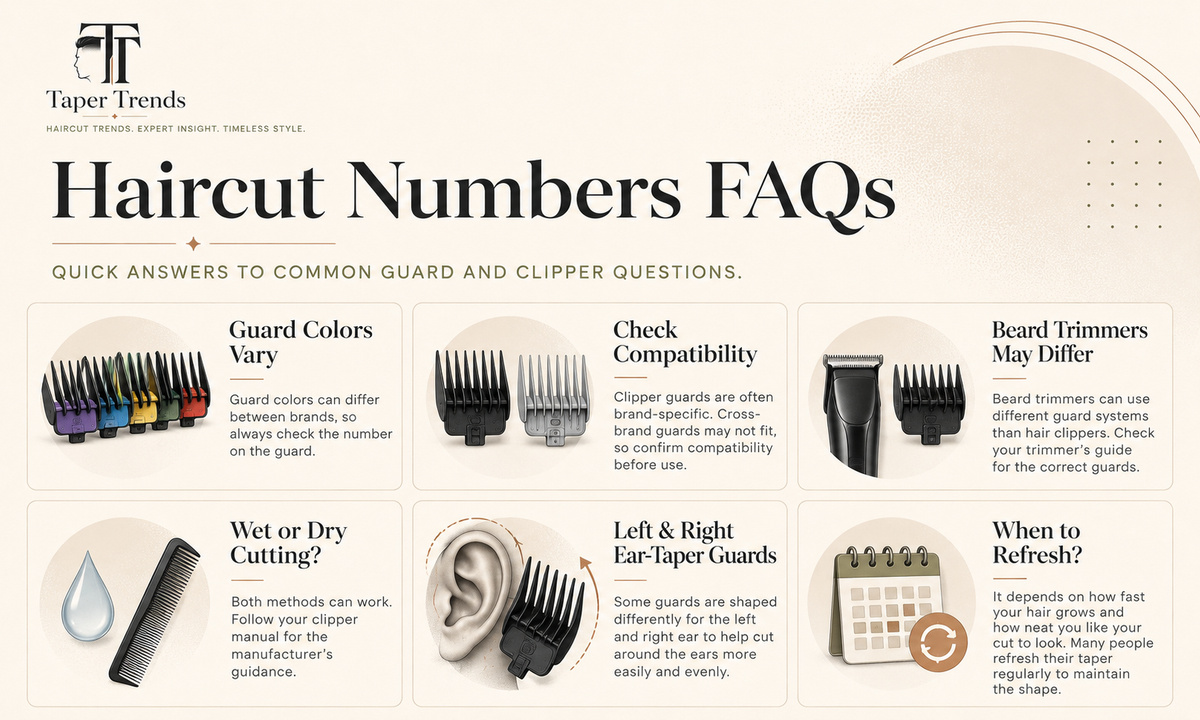
These answers cover smaller questions that don't need a full section. Equipment details come from the manufacturers named, so check your own model's manual.
Are clipper guard colors the same across brands?
No, and they aren't consistent within a single brand either. Wahl's #1 and standalone #12 are both black, its #1½ is burgundy, and the #12 in its long-hair set is yellow. Read the printed length instead of trusting the color.
Can you use a Wahl guard on an Andis clipper?
Don't assume so. Fit depends on blade dimensions and the specific attachment. Wahl says its guide combs work with all Wahl hair clippers, while the Andis 11-comb set lists the Andis US-1, LCL, and AAC-1. Neither claims cross-brand compatibility, so check the listing for your exact clipper.
Can haircut numbers also be used for beard trimming?
Sometimes. Wahl's trimmer guide comb kit uses the same #1 to #8 lengths as its clipper guards, plus stubble combs labeled I, II, and III (1/16 to 3/16 inch). Those combs fit a trimmer blade, not a full-size clipper. Other brands label beard guides differently, so go by the printed measurement.
Should hair be dry before using a clipper guard?
Usually, but follow your clipper's manual. Wahl's instruction booklets say hair should be dry for best results. Oster, on the other hand, describes the Craftsman as cutting wet or dry hair. The right answer depends on the model.
What are left and right ear-taper guards?
Ear-taper guards are shaped attachments for cutting around the ears. Unlike numbered combs, they aren't one fixed length. Wahl includes a left and right pair in its 10-piece comb set and describes them as a way to cut evenly around the ears.
How often should you refresh a numbered buzz cut?
There's no universal interval. Timing depends on how fast your hair grows, the length you started with, and how much growth you'll tolerate before the cut looks untidy. Shorter cuts show growth sooner, because the same amount of new hair is a bigger share of the total. Your barber can suggest a schedule after seeing how your hair grows out.
Sources for the colors, compatibility, and trimmer details above: Wahl #1, Wahl #12, and Wahl's long-hair set. For beard work in particular, see high taper fade with a beard, mid taper fade with a beard, and drop fade with a beard.
Quick checklist before your next haircut
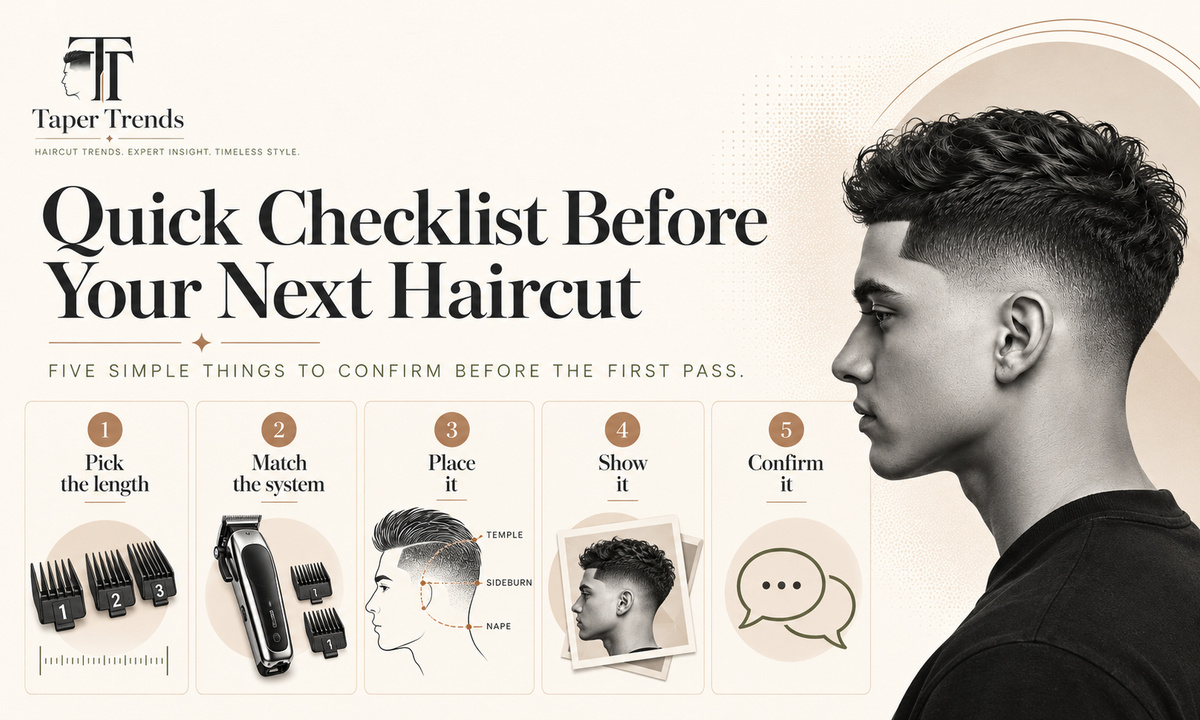
Run through this before you sit down, or before the first pass at home:
- Pick the length.Decide the longest length you'd accept, in inches or millimeters, not just a number.
- Match the system. Confirm which guard system or clipper the barber uses.
- Place it. Say where the shortest length goes and how it blends into the top.
- Show it. Bring front, side, and back photos for shape.
- Confirm it. Ask the barber to repeat the length before the first pass, and speak up if it looks shorter than you expected.
Guard lengths in this guide are published manufacturer specifications from Wahl, Andis, Oster, and Philips, checked in October 2026. They are nominal cutting lengths, not measurements of cut hair, and kit contents can change.
Keep going: guides that put these numbers to work
A guard number is only the first decision. These guides cover the rest: where the length changes, how high it climbs, and what sits on top.
- Taper haircutHow a taper uses short lengths only at the edges, and the four things to tell your barber
- Taper fadeThe broad guide to the blend, from low to high, with barber wording
- Types of fade haircutsEvery fade family sorted by height, finish, and shape
- Different kinds of fadesThe fade overview, so you can match a guard to a look
- Skin fadeThe fade taken to bare scalp, where the blade and finish matter more than the guard
- Shadow fadeA fade that ends in short visible hair, and which guard makes it
- Temp fadeThe localized blend at the temples, and where short lengths start and stop
- Taper vs fadeThe core difference, so a number lands where you expect
- Skin fade vs taper fadeWhether a taper can go to skin, and what to agree before the first pass
- Low taper vs low fadeThe same height, two different amounts of short hair
- Low taper fade haircuts guideThe pillar guide for the most requested taper height
- Low taper fade buzz cutA buzzed top over a low taper, with guard lengths
- Mid taper fade buzz cutA short buzzed top over a temple-height taper, with guard lengths
- High taper fade buzz cutA buzzed top under a taper that starts high, with guard lengths
- High drop fadeA fade that curves behind the ear, with guard sizes explained
- Burst fade vs taper fadeThe geometry that separates two curved blends
- Low taper fade short hairCrew cut to textured crop, and how short is short enough
- How to style a low taper fadeThe at-home routine once the length is right
The bottom line
A haircut number is a shorthand for how much hair stays, and the same number can mean different lengths on different clippers. The measurement is what you can trust.
Ask in inches or millimeters, say where the length goes and how it blends, start one size longer if you're unsure, and have the barber repeat the plan before the first pass.
Want more taper fade guides?
Browse clean, barber-ready breakdowns for every hair type.