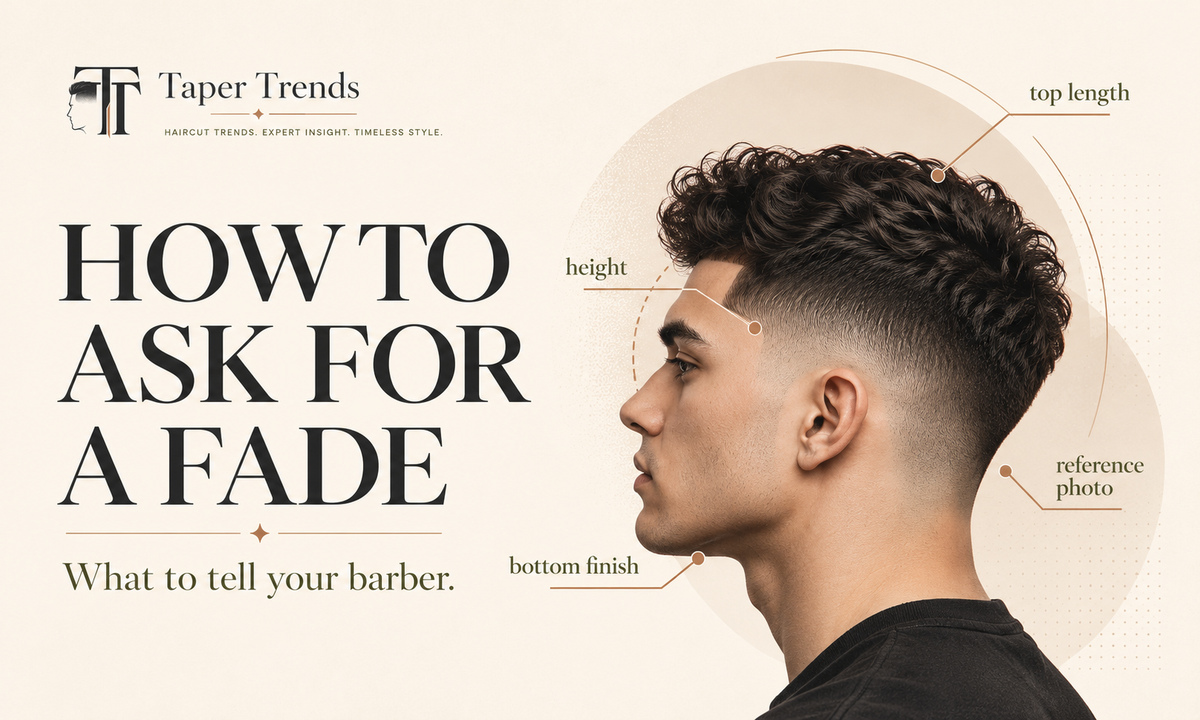
To ask for a fade, give your barber four details: how high the fade starts, how short it gets at the bottom, how much length stays on top, and how you want the edges finished. Then show a photo and have the barber repeat the plan back. You don't need barbershop vocabulary. You need specifics.
A complete request can be this short: “Mid fade, a little stubble at the bottom, about two inches on top, natural neckline. Here's a photo of the height I like.” If you are still deciding which cut that should be, our types of fade haircuts and different kinds of fades guides sort the options first, and our barber terms glossary explains the words your barber may use back. Once you know, the barber brief generator turns your answers into a card you can show in the chair.
How do you ask your barber for a fade haircut?
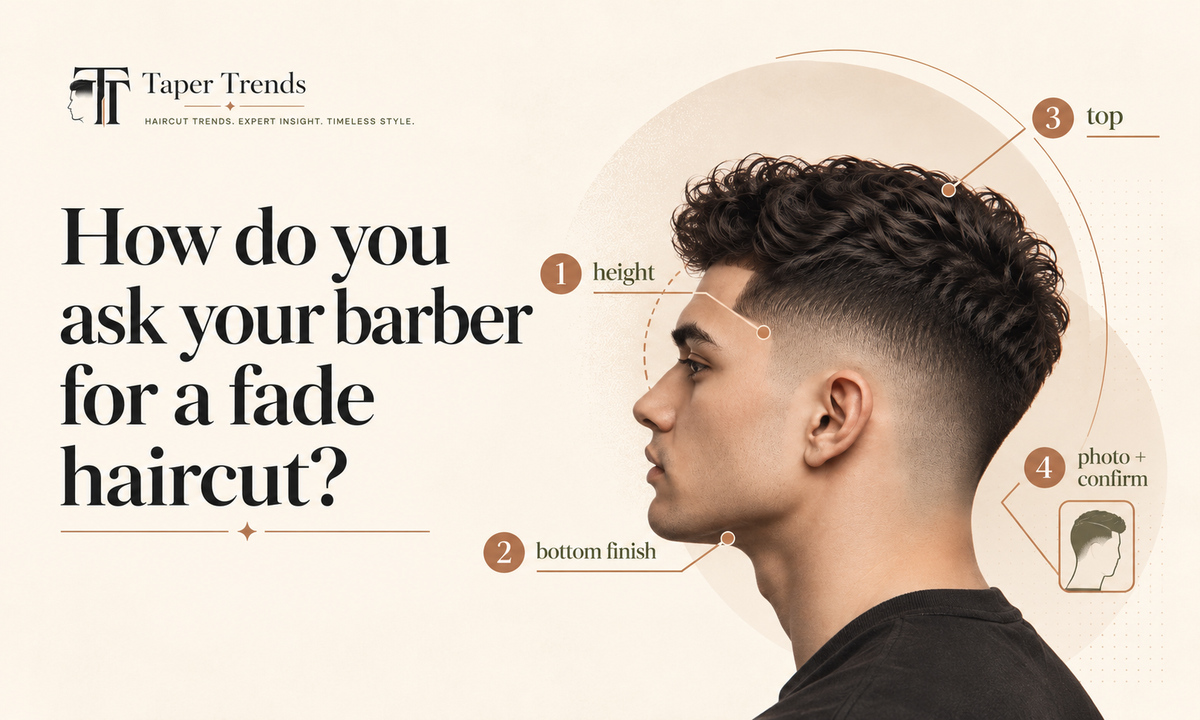
Ask for a fade in four steps: name the height where the fade starts, say how short the bottom should finish, describe the top, and confirm with a photo. The word “fade” alone isn't enough. K Lawrence Barbershop in San Diego calls a fade a range of haircuts rather than one cut, because the word says nothing about where the blend starts or how short it ends. That is also why a taper fade and a full fade can leave the same shop looking nothing alike.
Step 1: Choose the fade height
Say low, mid, or high, then point to where the short hair should stop. Barbers draw these lines in slightly different places, so a finger on your own head is clearer than the label. “Keep it low, just above my ear” leaves very little to interpret. Our low vs mid taper fade and mid vs high taper fade comparisons show what each start line looks like.
Step 2: Say how short the bottom should be
Tell the barber whether the bottom should go down to bare skin or keep visible hair. This is a separate decision from height, and it's the one people skip most often. If you know a guard number, give it as a starting point the barber can confirm. The skin fade and shadow fade guides cover the two ends of that choice, and our haircut numbers guide explains what each guard leaves.
Step 3: Explain what happens on top
Give the top its own instructions: how much length to keep, how you style it, and whether it should blend smoothly into the sides. Use inches. “Just a trim” means something different in every shop.
Step 4: Show a photo and confirm the plan
Show a reference photo and point to the parts you want copied. CADMEN Barber Academy, a barber-training provider, calls a reference photo the fastest and most accurate way to agree on the result before any cutting happens. Then ask, “What are you picturing?” and listen to the answer.
What are low, mid, and high fades, and which should you ask for?
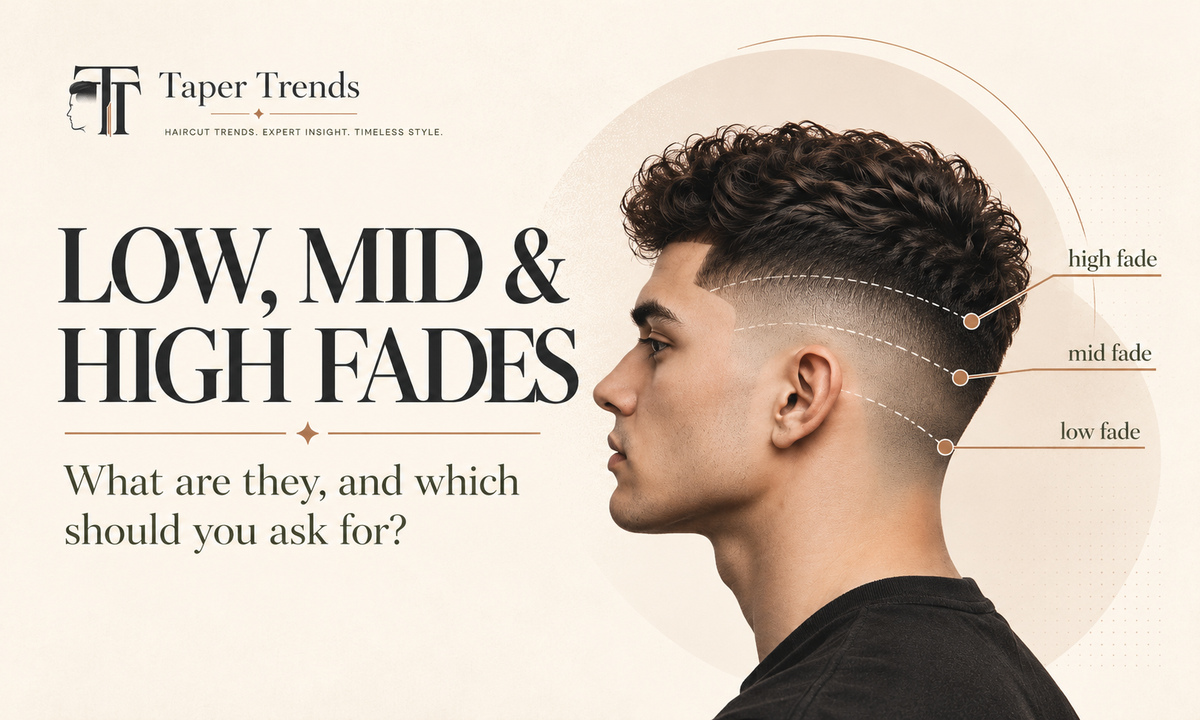
Low, mid, and high describe where a fade starts on the side of your head, not how short it gets. A low fade starts just above the ears and neckline, a mid fade starts partway up the sides, and a high fade starts at or above the temples. Shops don't draw these lines in the same place, so confirm yours by pointing.
The disagreement is real. K Lawrence places a mid fade between the ear and the temple. The Kinsman, a New York barbershop, places it around the temple. A barber at Hair Saloon puts it about half an inch above the ears. Same name, three different lines. Our low vs mid vs high fade guide, the low, mid, and high skin fade breakdown, and the low vs high taper fade comparison show those lines side by side.
How do you ask for a low fade?
Ask the barber to keep the shortest hair near the ears and nape and leave most of the side length above it. The Hair Saloon barber suggests a low fade as a first fade because it's the least drastic. Low doesn't mean skin, so say the bottom length too. If you want it even softer, our low taper vs low fade guide explains how a low taper keeps more hair at the same height.
“Low fade, visible hair at the bottom, keep the sides full above it.”
How do you ask for a mid fade?
Ask for the blend to start partway up the sides, then state the bottom length separately. K Lawrence notes that a mid fade is what most people mean when they just say “fade.” Because shops place it differently, point to the spot. The mid taper fade guide shows the gentler version of the same height.
“Mid fade, starting about here, skin at the bottom.”
How do you ask for a high fade?
Ask for the fade to start at or above the temples, and agree on exactly where it stops before cutting begins. High fades give the strongest contrast and, according to K Lawrence, grow out the fastest. Name the stopping point so the sides don't go higher than you wanted. Our high taper fade guide covers the same placement with a softer finish, and if you are leaving a fade behind, how to grow out a fade has the script for those appointments.
“High fade, stop where my head starts to curve.”
| Fade height | Where it usually starts | Contrast | What to clarify |
|---|---|---|---|
| Low | Just above the ears and neckline | Subtle | Keep it below the temples |
| Mid | Partway up the sides | Moderate | Point to the upper boundary |
| High | At or above the temples | Strong | Show where top length begins |
Contrast also depends on hair color, density, and how short the bottom goes, so two mid fades can look quite different.
Should you ask for a skin fade, shadow fade, or taper?
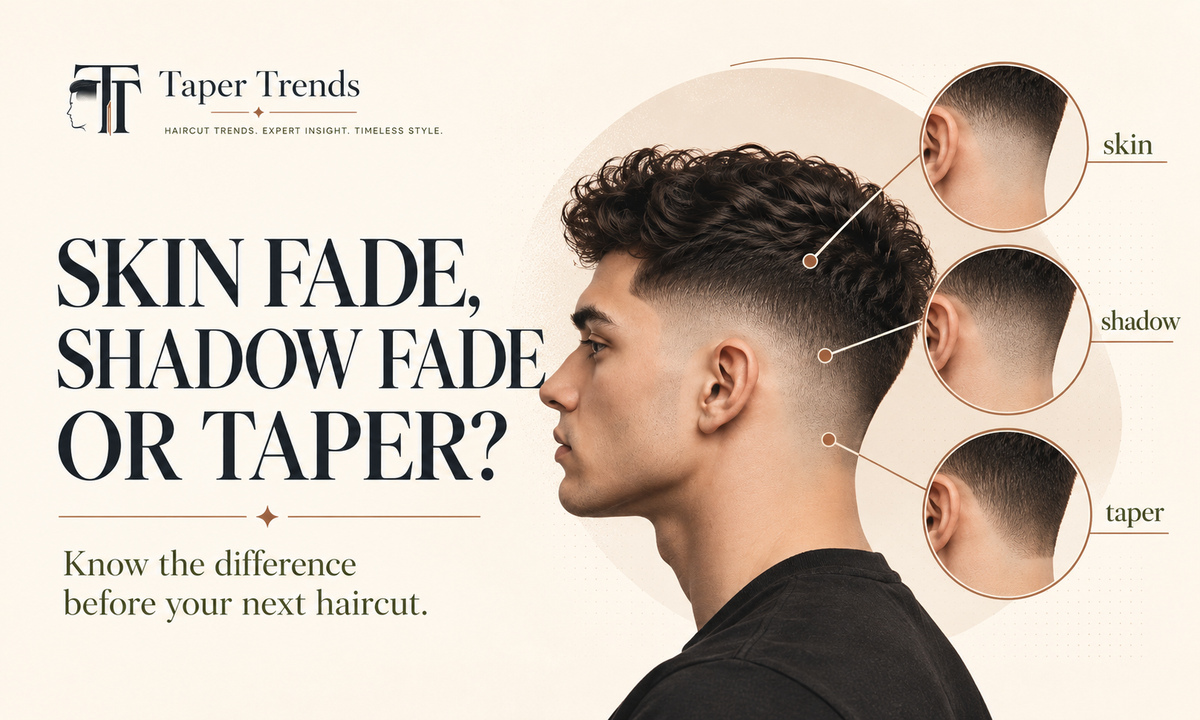
Fade height doesn't tell your barber how close to cut, so choose the finish separately. A skin or bald fade ends at bare or nearly bare scalp, a shadow fade leaves a thin visible layer of hair, and a taper shortens mainly the sideburns and neckline while keeping most of the side length. Shops use these names differently, so describe the result too. Our taper vs fade and skin fade vs taper fade guides go deeper on where the lines fall.
What should you say for a skin or bald fade?
Say “skin fade” and add the height, as in “mid skin fade.” Then ask whether the finish will be razor-smooth or leave slight stubble, because shops genuinely disagree on what these words mean:
| Term | The Kinsman (New York) | Hair Saloon (St. Louis area) | Suavecito (grooming brand) |
|---|---|---|---|
| Skin fade | Bare skin, no guard | Same as bald: straight razor to the scalp | Down to the skin, tiny bit of stubble |
| Bald fade | Same cut as skin fade | Straight razor, no hair left | Razor or shavette, fully bald |
| Zero fade | Another name for skin fade | Clipper cut that leaves stubble | Not defined |
Sources: The Kinsman, Hair Saloon, Suavecito.
If close shaving irritates your scalp, say so before a razor finish. For how the same finish behaves on other hair, see skin fade for curly hair.
What should you say for a shadow or non-skin fade?
Ask for a fade that stops short of bare skin. Suavecito calls this a shadow fade: a short layer of hair at the bottom with softer contrast. Don't say “zero” and assume it's understood, since K Lawrence uses it for roughly 1/16 inch of hair while The Kinsman treats it as skin.
“No scalp showing. Leave a soft shadow at the bottom.”
How do you ask for a taper instead of a full fade?
Say you want to keep the side length and only clean up the sideburns and neckline. The Kinsman defines a taperexactly that way and warns against treating “taper” and “fade” as the same word. Some shops still say “taper fade” for a short blend at the neck, so describe the result. If you only want the temples cleaned, a temp fade is the narrower request.
“Taper, not a full fade. Keep the sides, just clean up the ears and neckline.”
What clipper guard number should you ask for with a fade?
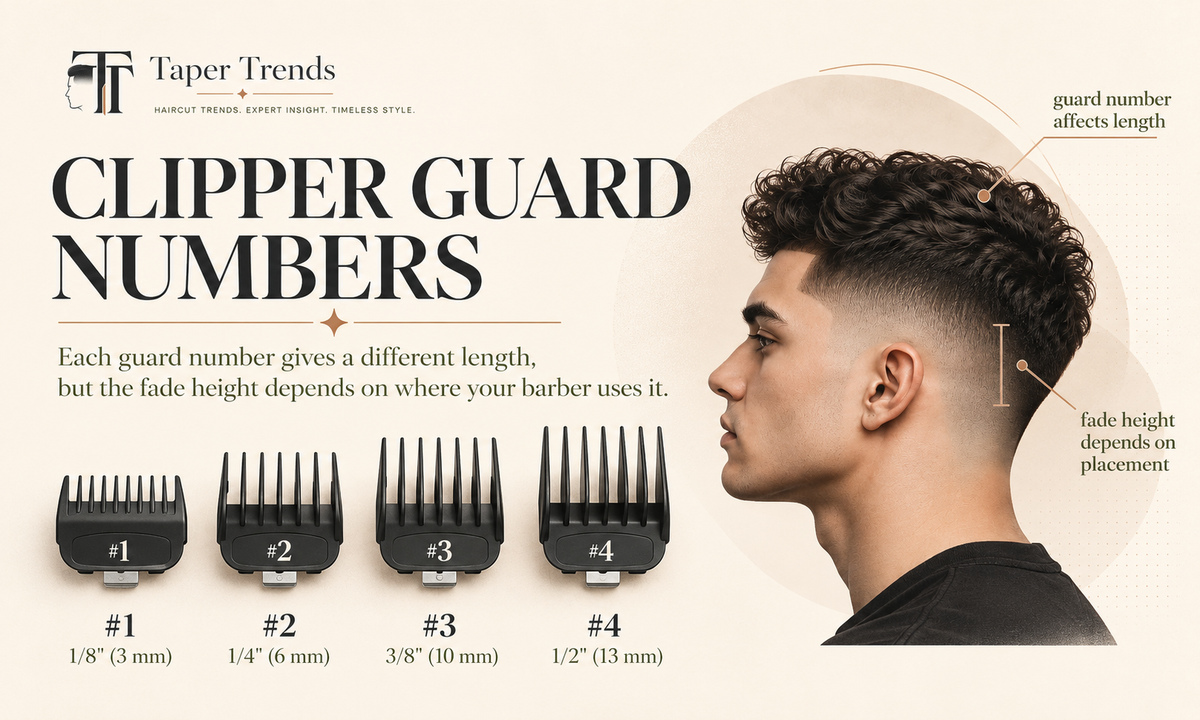
A clipper guard number sets an approximate length for the shortest part of a fade, but it says nothing about the fade's height or shape. Give a number if you know one, then ask what it will actually leave. CADMEN notes that the same guard looks shorter on thick hair than on fine hair, so one number can look different on different heads.
What do #1, #2, #3, and #4 clipper guards mean?
Clipper guards cut longer hair down to the length listed on the guard, and the numbers climb in eighths of an inch. These are the nominal lengths Wahl lists for its guide comb set, checked October 2026. Other brands can differ slightly.
| Guard | Inches | Millimeters |
|---|---|---|
| #1 | 1/8 | 3 |
| #2 | 1/4 | 6 |
| #3 | 3/8 | 10 |
| #4 | 1/2 | 13 |
The full chart, half guards, and brand differences are in our haircut numbers guide, and the clipper guard sizes tool converts any guard to millimeters.
Why should you clarify “zero” and “no guard”?
“Zero” and “no guard” can describe several setups, so confirm the finish instead of trusting the label. Wahl's guide describes a #1/2 guard as the shortest option short of bald, and says the clipper's taper lever adjusts closeness between guard lengths, the tool our how to cut a fade guide leans on for every blend and our best clippers for fades guide treats as the first feature to check. A trimmer, foil shaver, or straight razor goes closer still.
“Will that leave stubble or bare skin?”
How do you tell your barber what to do with the hair on top?
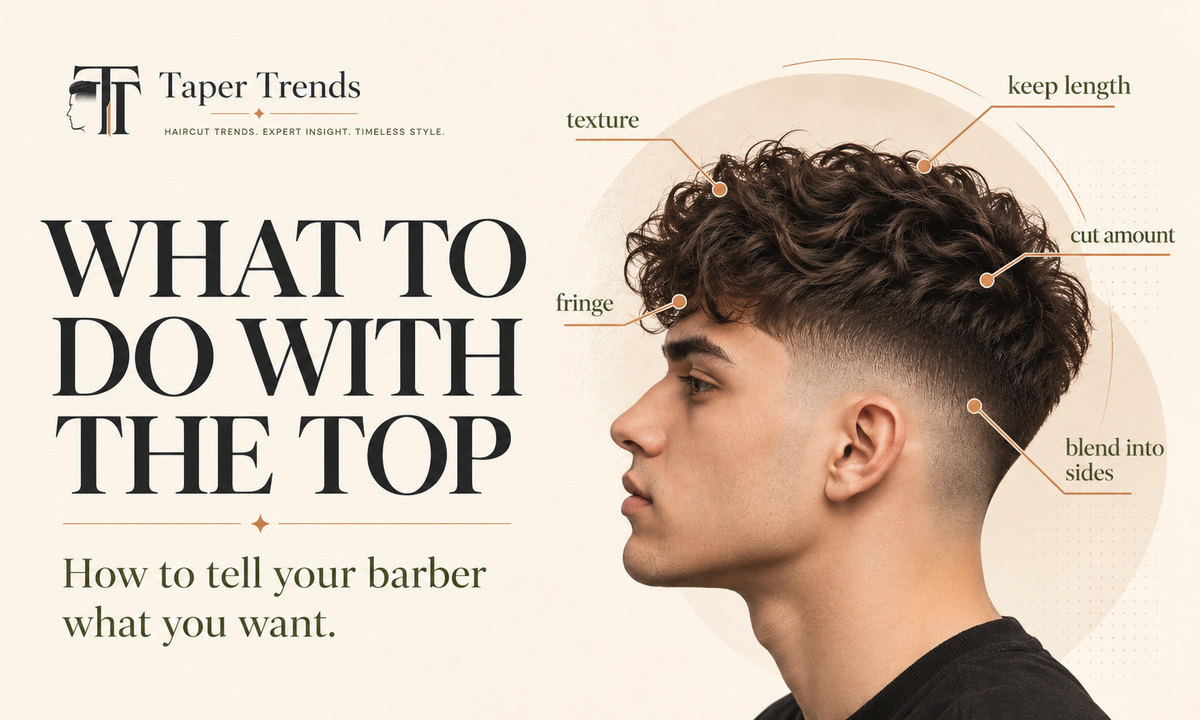
Treat the top as its own request: how much length stays, how it should sit, and how it connects to the sides. A fade only covers the sides and back, so if you say nothing about the top, the barber has to guess. K Lawrence says this is where most fade requests fall apart.
Should you say how much hair to keep or how much to cut?
Either works if it's a real measurement. “Keep two inches” sets a final length, while “take an inch off” depends on how long your hair is now. CADMEN treats “just a cleanup,” “shorter than last time,” and a length in inches as different instructions. Replace “a little off the top” with “keep the front about two inches, don't go shorter.” Our guides to short hair, medium-length hair, and long hair over a fade show what different top lengths look like.
How do you explain texture, fringe, and blending into the sides?
Describe how the top should sit and how it meets the sides. The Kinsman uses “scissor finish” for natural texture, “blended in” for a smooth transition, and “hard line” or “disconnected” for a visible break, the line that separates an undercut from a fade. Mention your part and your product, whether pomade, matte paste, or nothing. If you are unsure which tool should do the work, scissor cut vs clipper cut explains the difference. CADMEN points out that hair worn back needs enough length in front to sweep.
If you already know the top style, name it: a textured fringe, a French crop, a side part, a middle part, a comb over, or a slick back. Each guide lists the length the front needs before you sit down.
How should you use reference photos when asking for a fade?
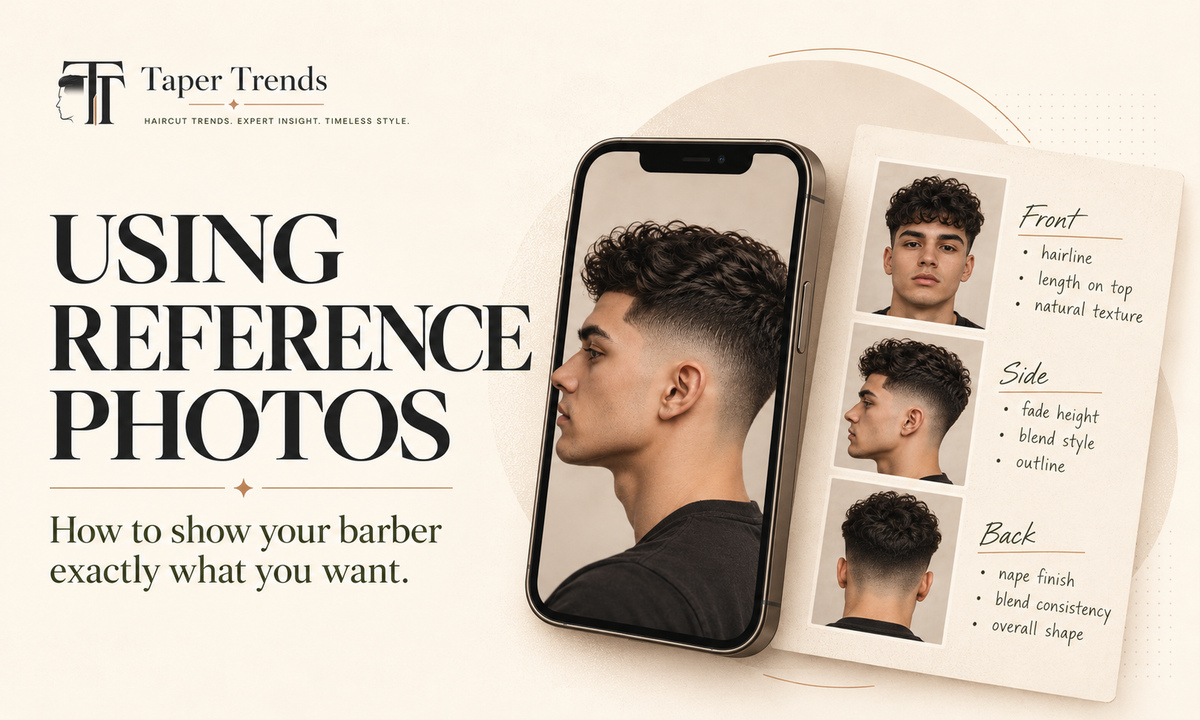
Use a reference photo as a target, and tell the barber which parts of it you want copied. A photo removes most of the guesswork, but it isn't a promise, because the barber still has to adapt the cut to your hair, hairline, and head shape.
What photos should you bring to the barber?
Bring a clear side view, plus front and back views if you can find them. K Lawrence says a photo of your own hair after a cut you liked beats a stranger's. The Kinsman asks for real haircuts on real people, not renders or AI-generated images. Pick hair similar to yours, and skip filters that hide the blend. Our what a low taper fade looks like guide shows the angles worth saving.
What should you point out in the reference photo?
Name the fade height, bottom finish, top shape, and neckline you want, and say what you don't want copied. CADMEN tells barbers to confirm fade height, top length, and style direction against the photo. Not sure the style in the photo suits you? The face shape detector gives you a starting point first, and our best fade for your face shape guide shows which heights tend to suit each shape.
“Match the height and the skin finish, but leave more length on top than he has.”
What should you say to your barber for different fade styles?
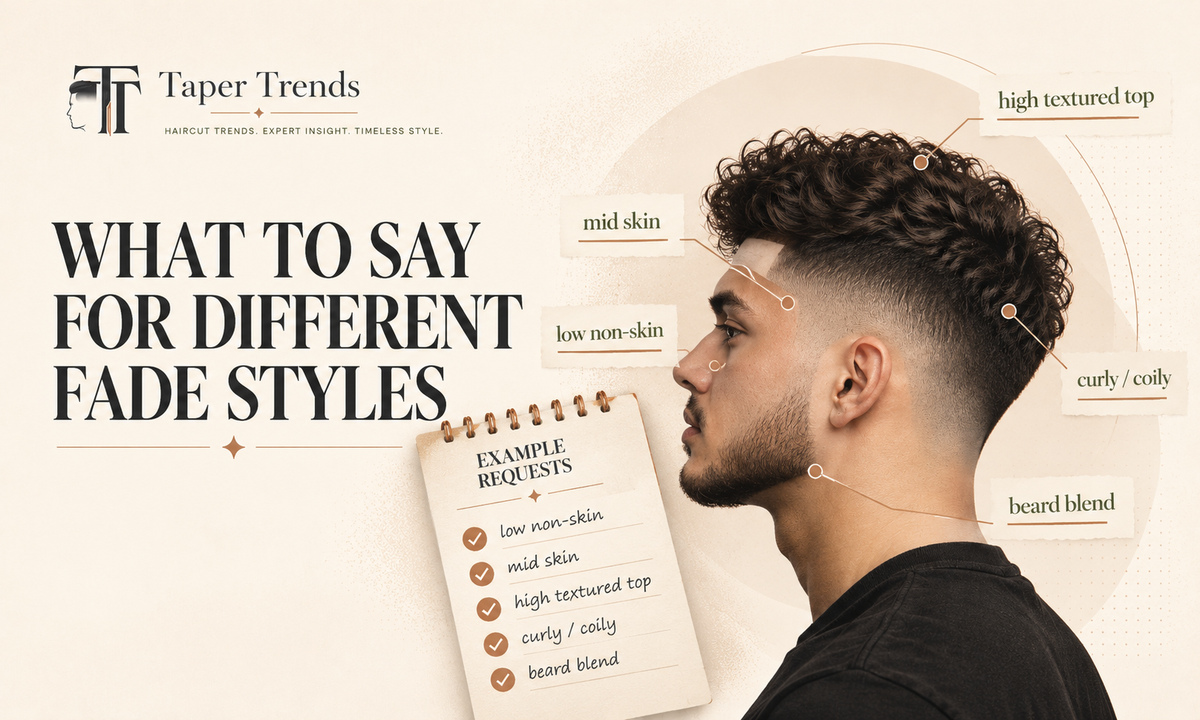
Each script below changes at least one of the four details: height, bottom finish, top, or shape. Pick the closest one, swap in your own lengths, and let the barber confirm before cutting starts.
How do you ask for a subtle low fade without showing scalp?
Combine a low height with a visible-hair finish. It's the safest first fade if you aren't sure how much contrast you'll like, and our low taper fade guide covers the softest version of it.
“Low fade, keep visible hair at the bottom, nothing down to the skin, and leave the sides full above it.”
How do you ask for a mid skin fade?
Pair the mid height with a skin finish and a top length. Pointing to the start line matters most here, since mid placement varies so much between shops. Our skin fade guide covers the razor and foil finishes.
“Mid skin fade starting about here, bare skin at the bottom, about two inches on top, blended in.”
How do you ask for a high fade with a short textured top?
Agree on where the high fade stops, then describe the top. Naming the stopping point keeps the sides from creeping higher than planned. See high taper fade short hair and high taper fade with a textured fringe for how that top sits.
“High fade, stop where my head starts to curve, short textured top, front about an inch.”
How do you ask for a fade with curly or coily hair?
State the curl length you want to keep when dry. K Lawrence notes that curly and coily hair shrinks after drying, so a length that looks right wet can read much shorter an hour later. CADMEN adds that a skin fade on very curly hair looks different from the same cut on straight hair. Our curly low taper fade, mid taper fade for curly hair, and low taper fade afro guides go through the curl specifics.
“Mid fade, keep my curls about three inches when dry.”
How do you ask for a drop fade, burst fade, or fade with a beard?
Name the curve or the transition, not just the style. The Kinsman describes a drop fade as dipping behind the ear toward the nape, and a burst fade as fanning out around the ear while leaving the back longer. If the two still blur together, the drop fade vs burst fade and burst fade vs taper fade comparisons settle it. For beards, see skin fade with a beard and low taper fade with a beard.
“Burst fade, blend my sideburns into my beard, and leave the beard length alone.”
How can you choose a fade that works with your hair and routine?
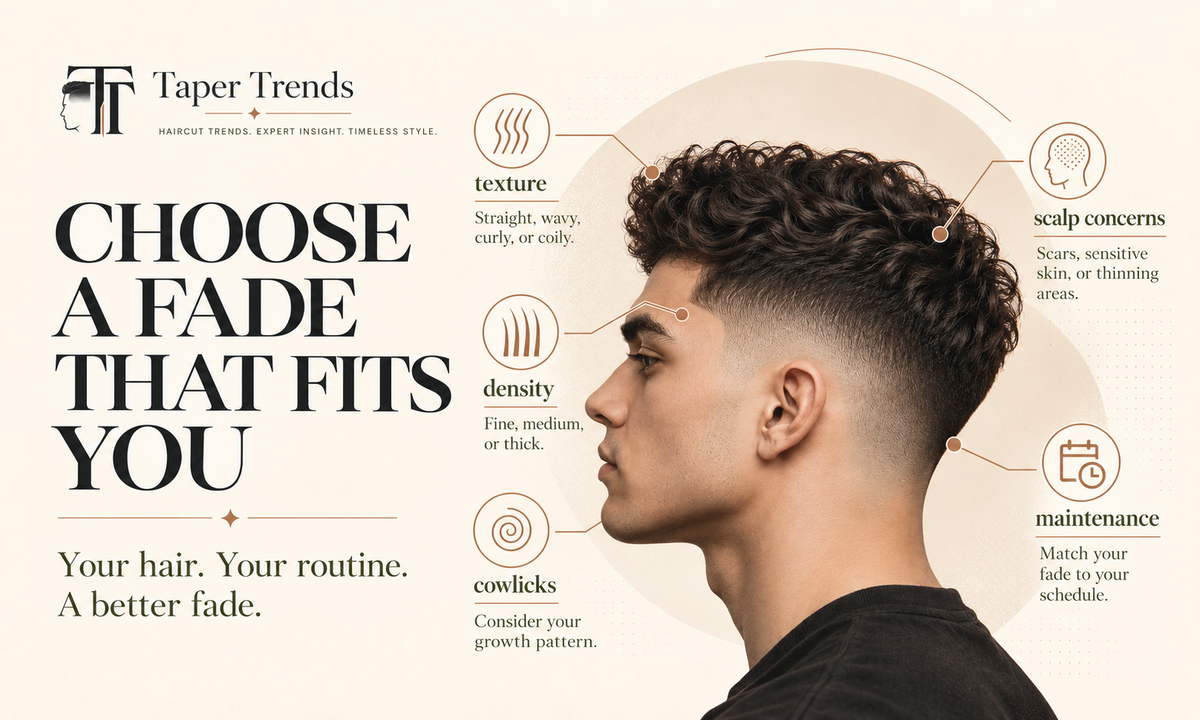
Choose a fade by telling your barber what changes how the haircut will behave: your hair's texture and density, its growth patterns, any scalp concerns, and how often you'll come back. A barber can adjust the height and finish for all of these, but only if you mention them before cutting starts.
What should your barber know about hair texture, density, and growth patterns?
Mention cowlicks, thinning, uneven density, curl shrinkage, and anything you'd rather not expose, such as a scar. CADMEN says a cowlick changes how hair sits once it dries. K Lawrence notes that fine, straight hair shows every line, while thick hair holds a high fade well. If you're thinning above the ears, The Kinsman suggests a low fade or taper may suit you better than a skin fade.
Our texture guides spell out what to mention for thin and thick hair, straight hair, wavy hair, and 360 waves.
How should maintenance and styling affect your fade request?
Match the fade to how often you'll actually return. K Lawrence suggests about every two weeks for a high or skin fade and three to four weeks for a mid or low fade. The Kinsman says a skin fade has lost most of its contrast by around three weeks, so a low fade or taper fits a monthly schedule better. Treat these as estimates, since hair grows at different rates. Our guide to how often you should get a haircut sets out the window for each cut. Between visits, our guide to styling a low taper fade keeps the top working.
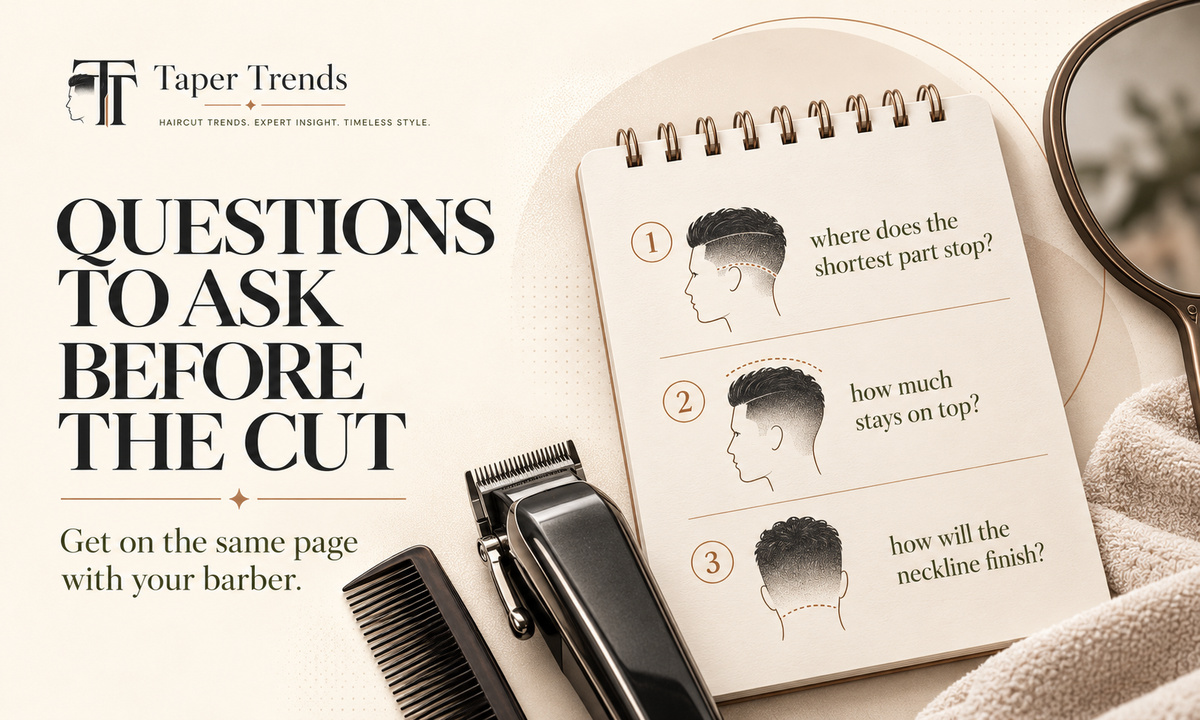
What should you ask before the barber starts cutting?
Confirm the plan out loud before the clippers touch your hair. Ask where the shortest part will stop, how much length stays on top, and how the neckline will finish. The answers take seconds, and they catch a mismatch while every option is still open.
Which questions should you ask your barber to confirm the fade?
Ask three questions:
- “Where will the shortest part stop?”
- “How much length is staying on top?”
- “How are you finishing the neckline?”
K Lawrence lists squared, rounded, and natural necklines, and notes that a natural one grows out better. If any answer surprises you, adjust before the first pass.
What if you are not sure which fade you want?
Describe the result and your limits instead of guessing at a name. CADMEN teaches barbers to narrow vague requests by asking whether you want it shorter overall or mainly on the sides, so expect that question. When in doubt, start longer, because a barber can always take more off. A low-mid taper fadeis a common middle ground if you can't decide between two heights.
“I want the sides shorter, but no scalp showing.”
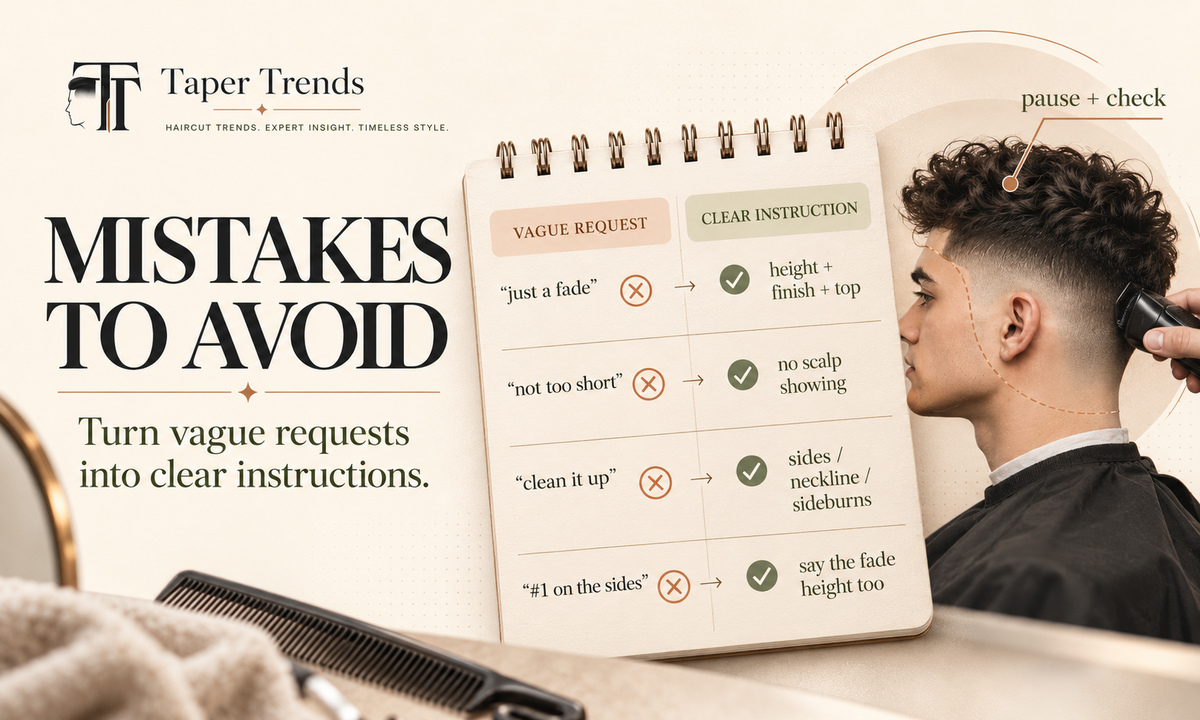
What mistakes should you avoid when asking for a fade?
The most common fade mistakes come from requests that sound complete but leave one decision to the barber. CADMEN traces most haircut complaints back to the consultation rather than the cutting. Fill each gap with a specific instruction, and speak up early if the cut starts drifting. If it already has, see how to fix a bad fade.
Which vague requests can lead to the wrong fade?
Swap incomplete phrases for instructions a barber can act on.
| Vague request | Say this instead |
|---|---|
| “Just a fade” | The height, bottom finish, and top length |
| “Not too short” | A length in inches, or “no scalp showing” |
| “Clean it up” | Which areas: sides, neckline, or sideburns |
| “Number one on the sides” | The height and finish too; a #1 all over is a buzz cut, not a fade |
That last row trips people up most. If a short, even length is what you actually want, our low taper fade buzz cut guide shows how to pair a buzzed top with a fade instead of a single length all over.
How do you speak up if the haircut is going shorter than expected?
Ask the barber to pause, then name the concern. The Kinsman says mid-cut is the best moment to speak up, since a quick fix now beats weeks of regret. If the hair is already too short, CADMEN suggests fixing the shape at the next visit once it grows back.
“That's higher than I wanted. Can we stop and look?”
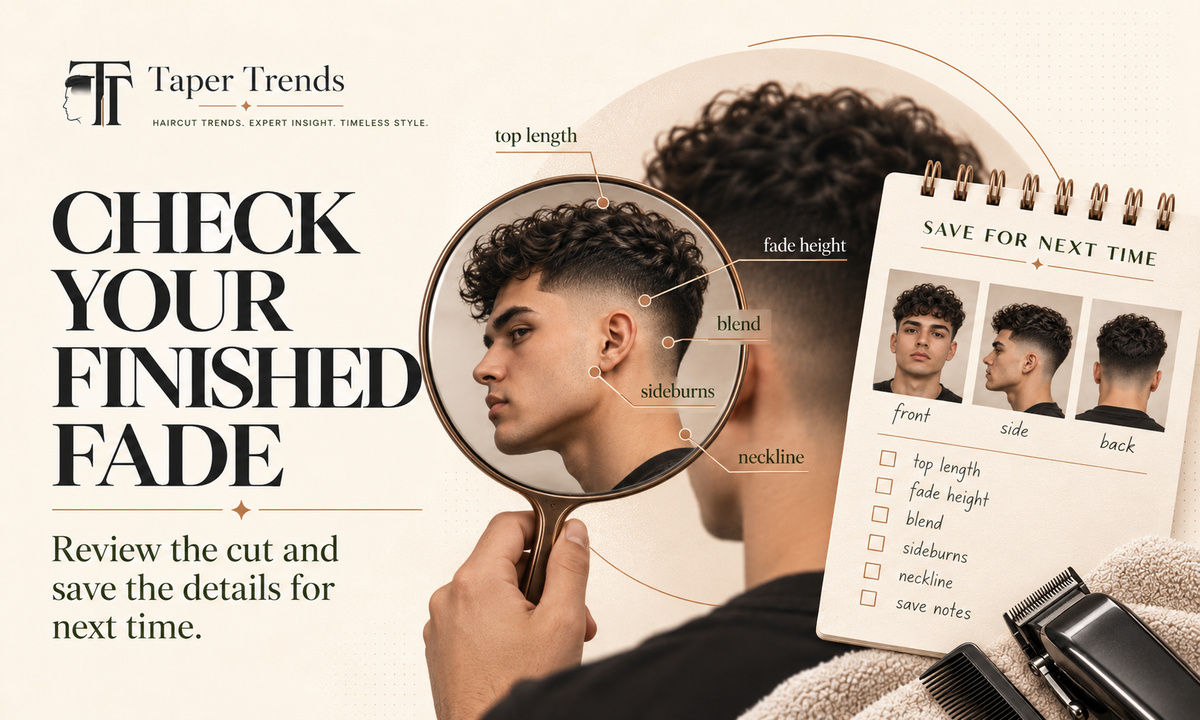
How do you check your finished fade and request it again next time?
Check the result before you leave the chair, then record what worked. A short inspection catches small fixes while the barber can still make them, and a few saved notes spare you a full consultation next time.
What should you check before leaving the barber's chair?
Use the hand mirror to review the front, both sides, the back, and the top. Compare the blend, sideburns, neckline, and top length with what you agreed, and calmly ask for any fix that's still possible. The Kinsman offers a small tidy-up within the first week if you notice something at home, so ask whether your shop does the same. If you're happy, the barber tip calculator works out the tip before you pay, and our guide to how much to tip your barber covers the etiquette.
What should you save for your next appointment?
Take photos of the side, back, and front within a day of the cut. Write down the fade height, bottom finish, top length, and any guard numbers the barber mentioned. CADMEN's recommended client notes cover the guard size on the sides, top length in inches, and any specific requests. The barber brief generator keeps those details on one card for next time.
How to ask for a fade FAQs
These answers cover narrower situations the main sections don't. Barbers and shop menus vary, so treat each one as a starting point for the conversation.
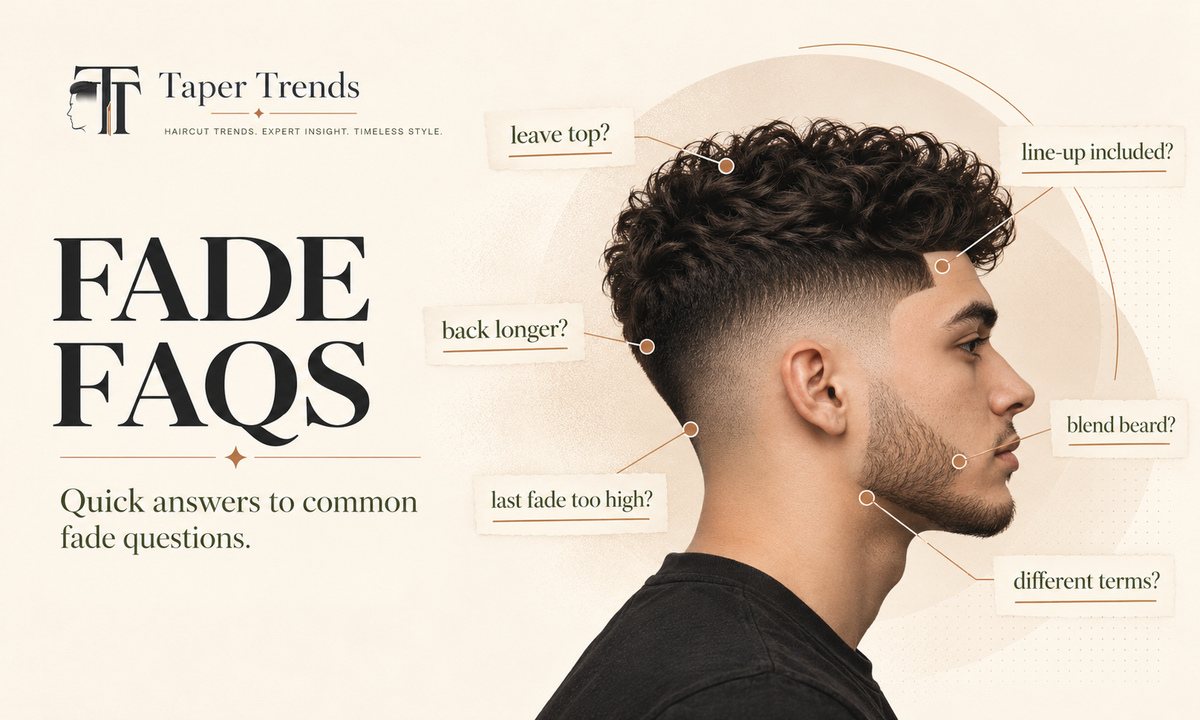
Can I get a fade without shortening the hair on top?
Yes. A fade changes the sides and back, so you can ask for the top to stay at its current length. Ask how the barber plans to connect the top to the sides, since a long top over a short fade sometimes needs a little blending at the edges. Try: "Fade the sides, leave the top as it is."
Does a fade haircut automatically include a line-up?
Not always. K Lawrence includes a straight-razor line-up with every haircut and also sells a line-up as a separate service, while other shops treat it as an add-on. If you want a sharp hairline, or specifically don't want one, ask whether it's included when you book or sit down.
How do I ask for a fade that blends into my beard?
Say where the blend should end and which parts of the beard stay untouched. Try: "Blend the sideburns down into my beard line, and don't trim the beard itself." If you also want the beard shaped or shortened, ask for that separately so the fade doesn't change your beard length by accident.
What should I ask for if I want the back longer than the sides?
Say how much longer the back should stay and where the shape should end at the neckline. A standard fade shortens the back too, so this needs an explicit instruction, though a burst fade leaves the back longer by design. Try: "Keep the back about an inch longer than the sides, ending at my natural neckline."
What should I say if my last fade was too high?
Show a photo of that cut and ask for the fade to start lower this time. CADMEN calls "anything you want different from last time?" the most important question for returning clients, so answer it directly. If the sides are still very short, the barber may suggest waiting for some regrowth before lowering the line.
What if my barber uses different names for fade styles?
Describe the length, shape, and placement you want instead of relying on labels. Hair Saloon notes that even industry professionals use some fade terms interchangeably. Ask, "What would that leave at the bottom, and where does it stop?" The barber's answer shows whether you both mean the same cut.
For the beard and back-length questions above, our drop fade with a beard, burst fade with a beard, burst fade mullet, and low taper fade mullet guides show each request in full.
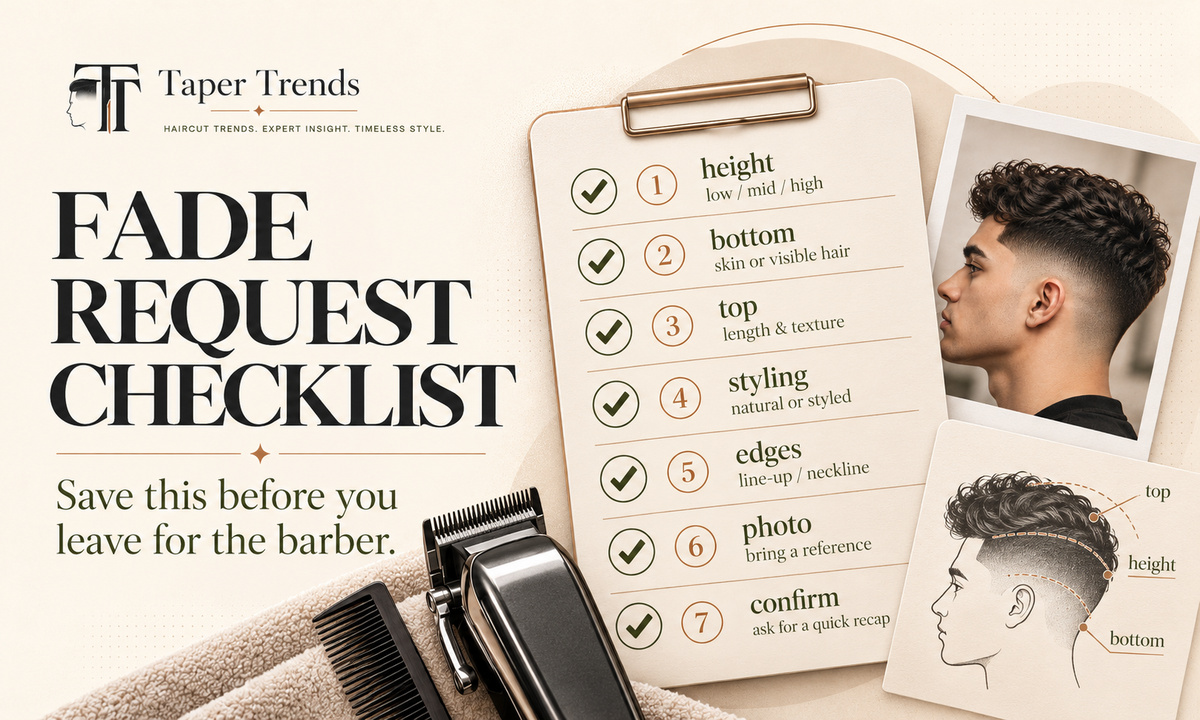
Quick fade request checklist before you leave for the barber
Save this list on your phone for the chair:
- Height: low, mid, or high, or point to where it starts.
- Bottom: bare skin or visible hair.
- Top: the length to keep, in inches.
- Styling: how you wear it and what product you use.
- Edges: neckline shape, sideburns, and line-up or not.
- Photo: a clear reference, with what to match and what to skip.
- Confirmation: the barber repeats the plan back.
If the plan you hear matches what you meant, you're ready. If it doesn't, fix it now, before the first pass.
Keep going: guides that make the request easier
Knowing how to ask is half of it. These guides cover the cuts themselves, so you can pick the height, finish, and shape before you sit down.
- Types of fade haircutsEvery fade sorted by height, finish, shape, and coverage
- Different kinds of fadesThe fade overview, with the sentence to say in the chair
- Haircut numbersWhat each clipper guard leaves, in inches and millimeters
- Skin fadeThe fade taken to bare scalp, and how to agree the finish
- Shadow fadeA fade that stops at short visible hair instead of skin
- Skin fade: low, mid, highWhere each skin fade height starts, side by side
- Taper vs fadeThe core difference, so the word you use gets the cut you want
- Taper haircutKeeping the sides and cleaning only the sideburns and neckline
- Taper fadeThe broad guide to the blend, with barber wording
- Skin fade vs taper fadeWhether a taper can go to skin, and what to agree first
- Temp fadeA blend at the temples only, and where it stops
- Low taper vs low fadeThe same height, two very different amounts of short hair
- Low vs mid taper fadeHow much height and contrast each start line gives
- Mid vs high taper fadeChoosing between a temple start and a high start
- Drop fadeThe fade that dips behind the ear toward the nape
- Burst fadeThe curve around the ear that leaves the back longer
- Drop fade vs burst fadeTelling the two curved fades apart before you ask
- Skin fade with a beardBlending a fade into the sideburns and beard line
- Low taper fade guideThe pillar guide for the most requested taper height
- How to style a low taper fadeThe at-home routine once the cut is right
The bottom line
“Fade” names a family of haircuts, not one cut. The barber can only give you the one you pictured if you spell out the height, the bottom finish, the top, and the edges.
Point to the start line, say skin or no skin, give the top a length in inches, bring a photo of hair like yours, and have the barber repeat the plan before the first pass.
Want more fade guides?
Browse clean, barber-ready breakdowns for every hair type.