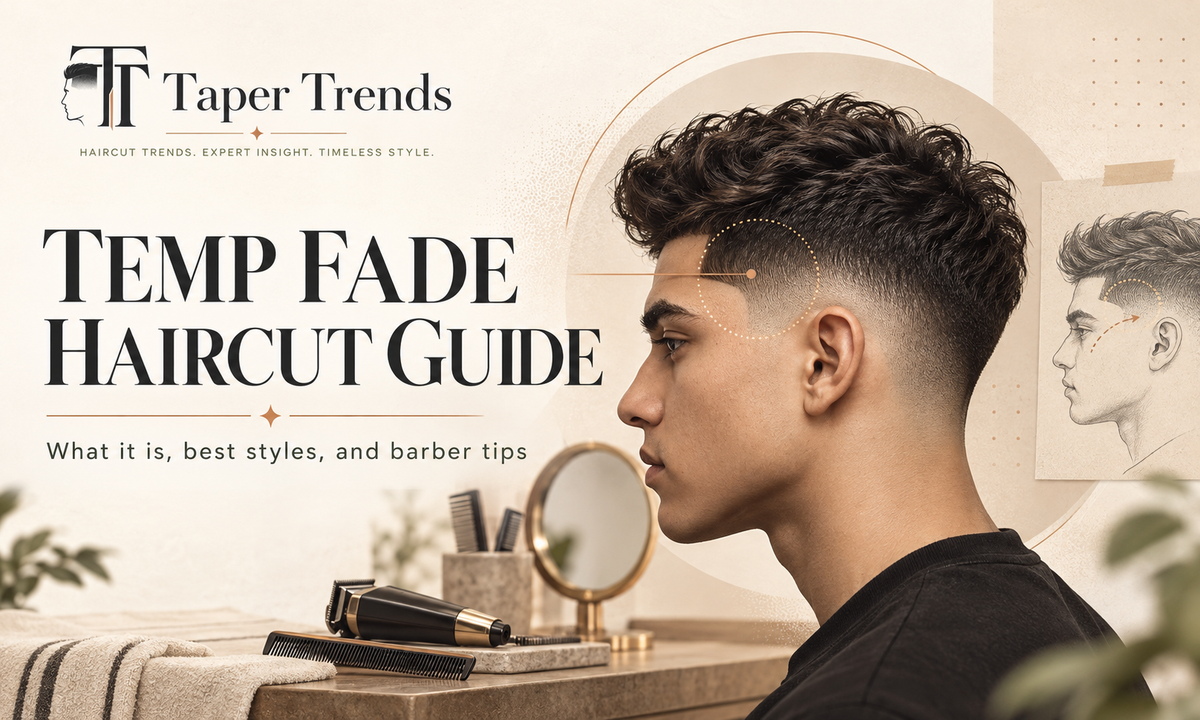
A temp fade, short for temple fade, blends the hair at your temples and front sideburns from very short up into your existing length. The top, the back, and most of the sides keep their length, so you get a sharper frame around the face without committing to a full fade.
Barbers don't all agree on what the name includes, though, so knowing where the fade starts, where it stops, and what comes with it is how you get the cut you pictured.
If you are still sorting out the vocabulary, start with the guide to every type of fade haircut, the taper vs fade explainer, and the types of fade haircuts comparison. The low taper fade haircuts guide is the hub for every taper and fade on the site, and the barber brief generator turns your choices into a message you can show in the chair.
What is a temp fade haircut?
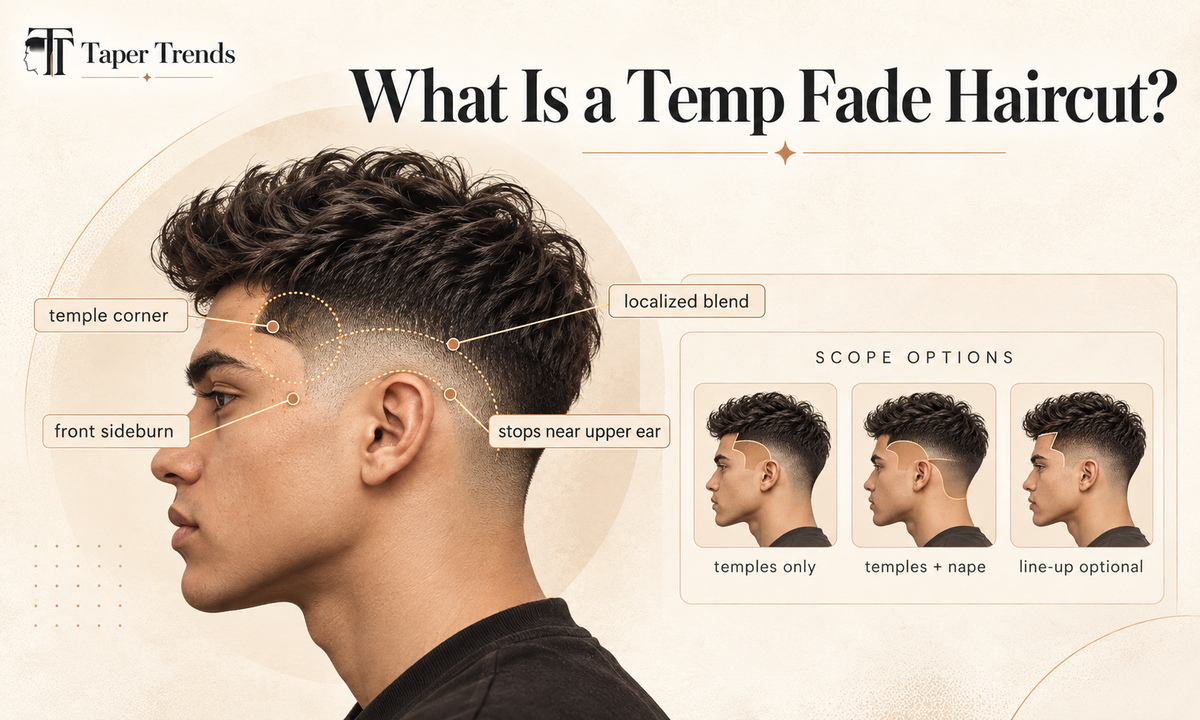
A temp fade haircut is a localized fade that graduates the hair around the temple and front sideburn, usually from skin or near-skin up into the surrounding length. The hair behind and above that zone keeps its length, which is what separates a temp fade from a fade that runs around the whole head, like those in our skin fade guide or the taper fade guide.
The temple is the stretch from the corner of your forehead back toward the ear. CADMEN Barber Academy points out that this is often where hairlines recede first and where growth turns irregular, so tidying it changes how polished the entire haircut looks. Some shops call the cut a Brooklyn fade, as Haircut.info notes, and that name can carry a slightly different meaning (more in the FAQ).
Where does a temp fade start and stop?
A temp fade starts at the temple corner, where the front hairline meets the sideburn, and runs back toward the top of the ear. It stops where the blend reaches your existing side length. Haircut.info puts the zone at roughly 2 to 4 cm wide, and City Barbers in Manhattan describes the fade as an inch or two long.
CADMEN stresses the top edge: a fade that ends abruptly at a line looks cut rather than graduated. Treat the measurements as typical, not fixed.
One edge case is worth knowing. Markcutit, a barbershop in Mississauga, Ontario, notes that some barbers use “temp fade” loosely for any fade that begins at the temple line and wraps around the head. That's really a mid fade, so if you want the back left alone, say so. The mid taper fade guide and the low-mid taper fade guide show what the wrap-around versions look like.
Does a temp fade include the neckline or a line-up?
Not necessarily. The strict version fades only the temples and sideburns, but many shops also fade the nape. A line-up, which is a crisp trimmer edge along the hairline, is a separate treatment that may or may not come with it. Confirm both before the cut starts.
Haircut.info documents two common scopes:
- Temples only: the temple and sideburn are faded, and the nape keeps its natural length.
- Temples and nape: the front and the neckline are both faded, with full length in between.
The line-up is where sources disagree most. City Barbers treats the sharp line as the signature of the cut, while CADMEN and Haircut.info treat the fade as the defining feature and the line as optional. If you don't want a hard edge, Haircut.info suggests asking for a temple fade with a natural finish.
Temp fade vs taper fade, full fade, and line-up: what's different?
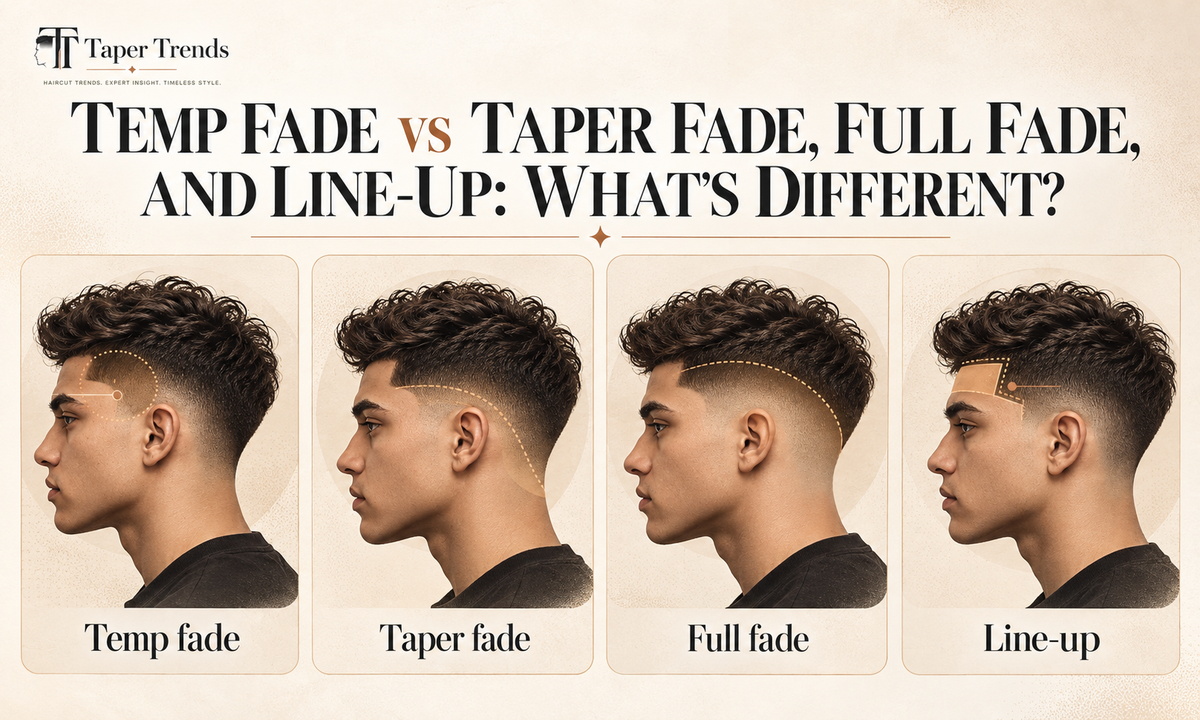
Placement and the amount of hair removed separate these cuts better than their names do, as the table shows.
| Cut or service | Typical treatment area | Main visible change |
|---|---|---|
| Temp fade | Temples and front sideburns | Localized blend at the front corners |
| Taper fade | Sideburns and neckline, depending on the shop | Shorter edges with fuller sides |
| Low, mid, or high full fade | Sides and back, all the way around | Broad graduated coverage |
| Line-up | Hairline perimeter | Defined edge, no change in length |
Temp fade vs taper fade
A temp fade and a taper haircut overlap because both shorten the edges while keeping the sides fuller. A taper usually works the sideburns and neckline and often stops at a short guard, while a temp fade concentrates on the front corners and frequently goes down to skin.
Haircut.info sums it up as a taper with more contrast, though neither name guarantees bare skin. Ask for a taper if you want a softer edge, and ask for a temp fade, with the finish named, if you want skin-close contrast at the temples. The low vs mid taper fade, burst fade vs taper fade and skin fade vs taper fade comparisons cover the neighboring decisions.
Temp fade vs low, mid, or high full fade
A temp fade is a small transition at the front corners. A low, mid, or high full fade graduates hair all the way around the head and sets the shape of the entire side and back (compared in low vs mid vs high fade). Because a temp fade leaves most side length alone, it suits styles that depend on volume, such as Afros, curls, and waves.
The two can be combined. City Barbers notes that a temp fade can sit on top of a skin fade, with the temp fade supplying the front line and the skin fade supplying the gradient. See the low vs mid vs high skin fade comparison for the full-fade side of that pairing, and the low taper vs low fade comparison for where a taper stops and a fade begins.
Temp fade vs line-up or shape-up
A line-up, also called a shape-up or edge-up (see our barber termsglossary), defines the hairline edges with a trimmer and doesn't change the length behind that edge. A temp fade creates a gradual length change at the temples. You can get either alone or both together, and many shops price them separately.
Which types of temp fade can you choose?
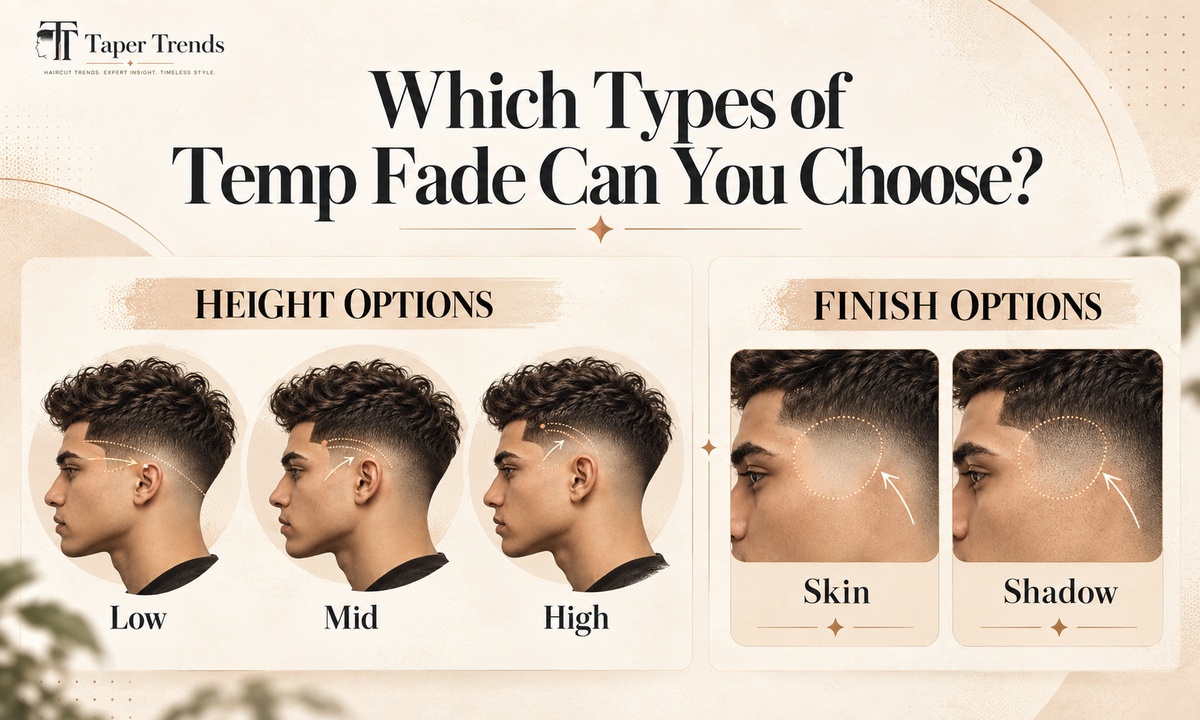
Two choices shape most temp fades: how high the blend sits at the temple, and how short it gets at its shortest point. Neither depends on your top hairstyle, and labels vary by shop, so match them to a reference photo.
Low, mid, and high temp fade
A low temp fade keeps the blend tight to the temple and sideburn. Mid and high versions carry it further up the side, which raises contrast and exposes more scalp. Push it far enough and the cut starts to read as a broader side fade.
City Barbers says most of its clients choose low or mid. No standard measurements sit behind these labels, so point to how far up you want the blend to climb, a habit our guide on asking for a fade applies to every height. Our mid taper fade and high taper fade guides show how each height reads on the side of the head, and the mid vs high taper fade comparison lays them side by side.
Skin temp fade vs shadow temp fade
A skin temp fade goes to bare skin at its shortest point, while a shadow temp fade stops just short and leaves a faint layer of hair. Skin gives the most contrast but shows regrowth fastest. Shadow looks softer, grows out more gently, and is easier on skin that reacts to close cutting. The shadow fade guidecovers the same finish across the whole side and back.
Haircut.info names a #0.5 guard for a shadow finish. On Wahl's guard chart, the #1/2 guard cuts to 1/16 inch, the shortest guard Wahl lists. Actual length still varies with the clipper, blade, and taper-lever setting, as our how to cut a fade guide explains. Our clipper guard size chart converts every guard number to inches and millimeters, and the haircut numbers guide explains how those labels differ between brands.
Which hairstyles look best with a temp fade?
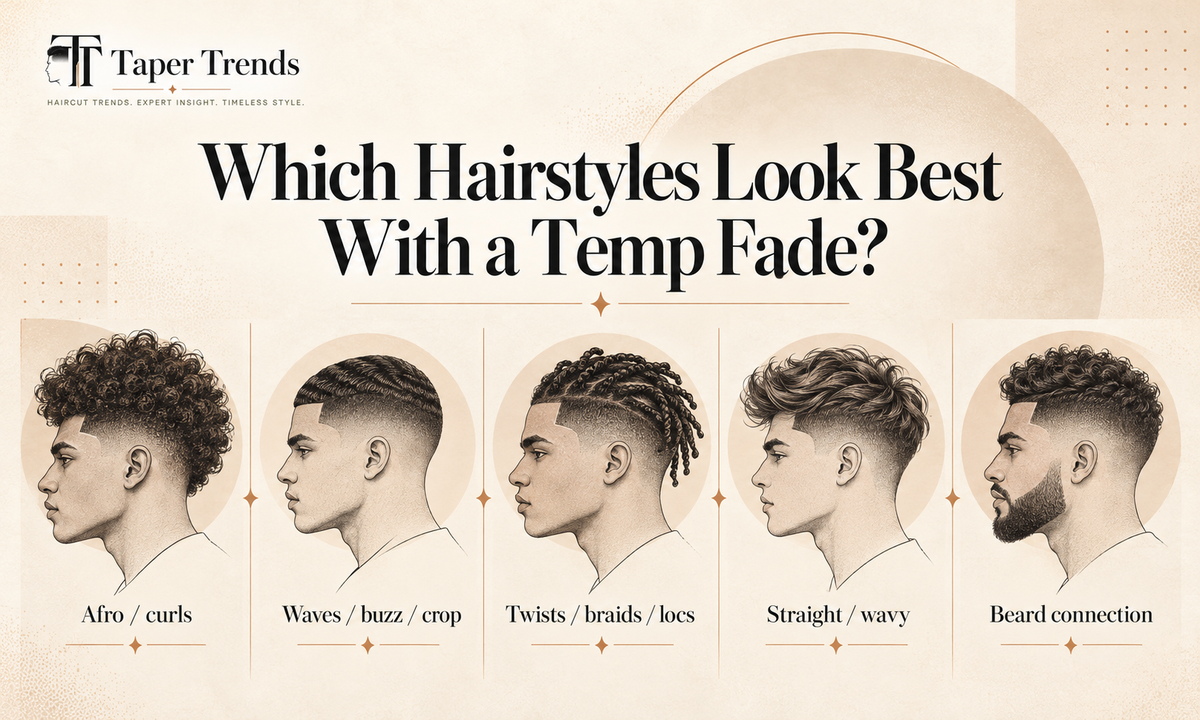
Most hairstyles work with a temp fade, because it changes only the front corners. The real decisions are how much side length to keep and how much contrast you want at the temple.
Temp fade with an Afro, curls, or sponge curls
A temp fade defines the front of an Afro, curls, or sponge curls without shrinking the overall shape. Because the fade stays small, the sides keep their fullness and the top keeps its volume, both of which a fade around the whole head would reduce.
CADMEN says a shaped Afro with a clean temple fade and a defined line-up reads as intentional, while the same Afro without temple definition can look unfinished. James Goodman, a retired licensed barber who edits Men's Hairstyles Today, notes that the faded sides draw attention to the volume on top. Common versions include:
- A short natural Afro with the temples blended and the outline kept soft
- A curly or coily top with full sides left in place
- Sponge curls with a crisp edge under the textured top
For full guides, see the low taper fade Afro, mid taper fade Afro and high taper fade Afro, plus the low taper fade for curly hair, mid taper fade for curly hair and high taper fade for curly hair. The low taper fade for Black men and high taper fade for Black men guides add barber wording for tight textures.
Temp fade with waves, a buzz cut, or a short crop
On 360 waves, a buzz cut, or a textured crop, temple detailing adds a cleaner front without changing the pattern or uniform length of the rest.
CADMEN notes that a clean temple transition draws the eye to the wave pattern above it. Markcutit says a single-guard buzz cut or Caesar looks deliberate once the temples are blended and edged, and Ape to Gentleman calls a natural crop with a temple fade a modern take on the French crop. Our low taper fade with waves, mid taper fade with waves, low taper fade buzz cut, mid taper fade buzz cut and French crop with a low taper fade guides go deeper on each.
Temp fade with twists, braids, or locs
A temp fade can clean up the temples on twists, braids, or locs while the longer hair above and behind stays untouched. What matters is where your outermost sections begin, because the fade should stop at that boundary instead of cutting into the style's perimeter.
Men's Hairstyles Today pairs wick dreads with a low temp fade and suggests going higher for more drama. Layouts vary, so show your barber where your sections start. See the low taper fade with dreads and locs and mid taper fade with dreads and locs guides for how the perimeter is handled.
Temp fade with straight, wavy, or textured hair
Straight and wavy hair can take a temp fade, but the result reads differently than on tightly coiled hair. On a short cut the fade shows clearly. On longer straight hair, Markcutit points out, the surrounding length hides most of the blend.
That makes top styling the bigger choice. Haircut.info says a temp fade under a side part makes the front of the part look cleaner, and Ape to Gentleman pairs the cut with comb-overs and pompadours. Our side part with a low taper fade, low taper fade comb over, low taper fade slick back, low taper fade for straight hair and mid taper fade for wavy hair guides cover those tops, and the low taper fade for wavy hair guide shows the wavy version.
Temp fade with a beard
A temp fade can connect to your sideburn and beard without a full side fade. Decide whether you want a smooth blend from temple into beard or a deliberate gap. Neither happens by default.
Markcutit notes that a temple fade doesn't automatically include beard shaping, so you may need to book a haircut-and-beard service. Men's Hairstyles Today shows both directions, from a low temp fade flowing into a thin beard to a wide gap between hairline and facial hair. Our low taper fade with beard, mid taper fade with beard, high taper fade with beard and skin fade with beard guides show how the sideburn join changes at each height.
Who should choose a temp fade?
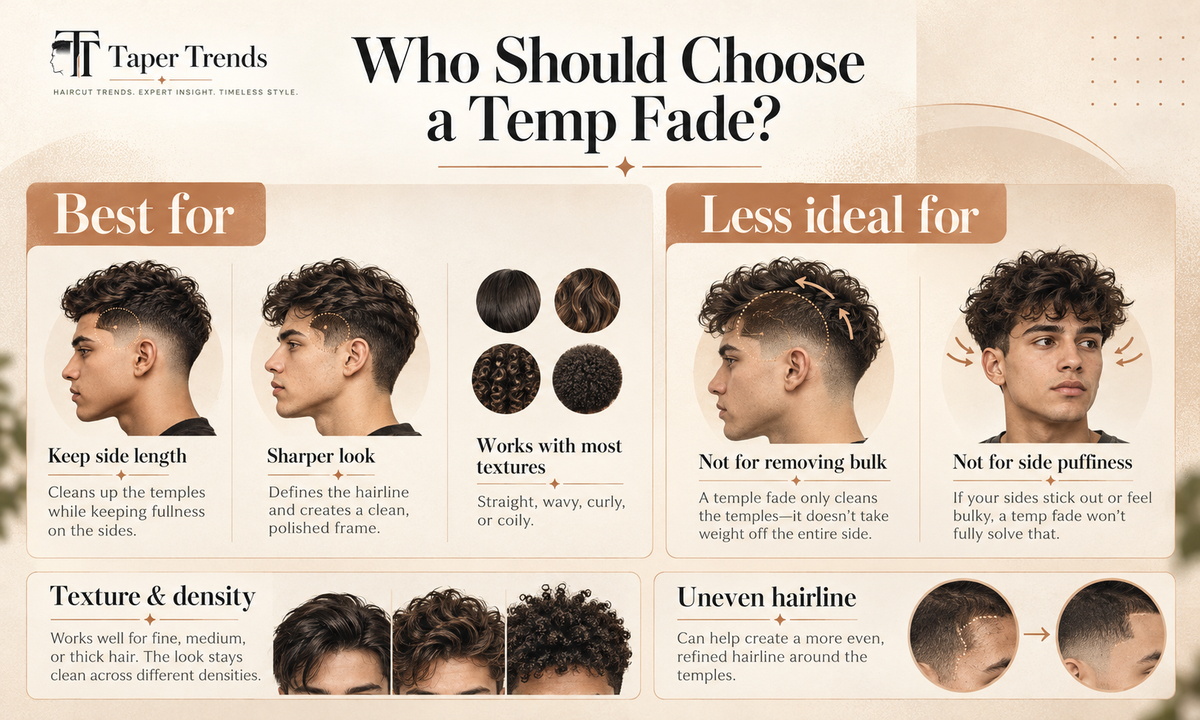
A temp fade suits someone who wants cleaner temples without losing much side length, and barber guides describe it as workable on every hair type. It won't slim bulky sides or change your silhouette, and it needs regular edging to stay crisp. If you want visible change across the whole side, a full fade fits better, such as a low taper fade or a skin fade.
Skip it if your sides puff out as they grow. Markcutit points out that a temple-only fade removes no bulk, so it can't solve that problem.
How do hair texture and density affect the result?
Texture and density change how the temple blend looks, mostly through contrast and how evenly hair grows at the corners. Dark, dense hair shows a strong gradient. Sparse or uneven corners can look patchy at skin level and often look better with a shadow finish.
CADMEN notes that temples are often where growth turns irregular, and Markcutit says tight curls tend to hold their length evenly across the sides. Before your appointment, check in a mirror whether both temples grow the same way and whether the corners are as dense as the sides. If not, tell your barber. The thin and thick hair guide explains how density changes any fade.
What about face shape or an uneven hairline?
Face shape is a styling preference, not a rule, and a barber can adjust edge shape and temple width to suit you. Graham Jones of Ape to Gentleman suggests the tight lines add structure to a round face and highlight a square jaw, which is one writer's view. Our face shape detector can give you a starting point to discuss.
An uneven or receding hairline matters more. Haircut.info recommends a natural finish so the fade blends into your existing hairline instead of cutting a hard edge. City Barbers adds that a curved line looks more natural and grows out more forgivingly than a perfectly straight one.
How do you ask your barber for a temp fade?
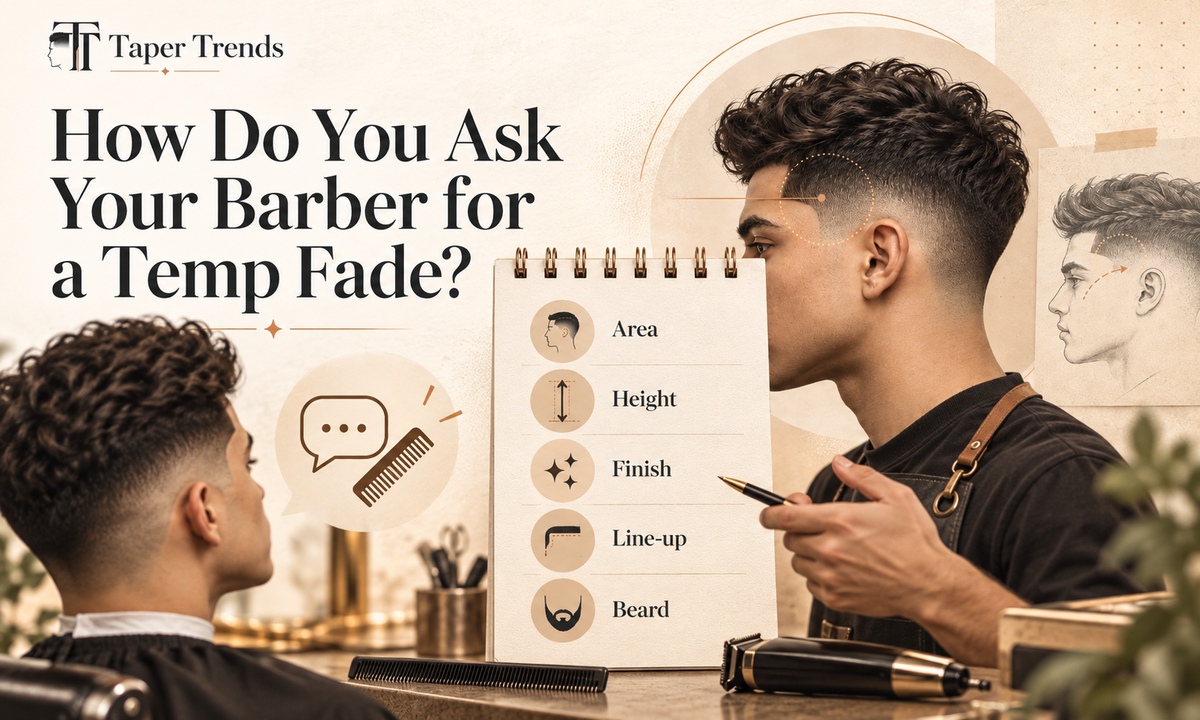
Saying “temp fade” alone leaves placement, neckline, line-up, and shortest length to your barber's interpretation. Bring front and side photos, say what to fade and what to leave, and confirm the boundaries before the clippers start. The barber brief generator can help you organize those details.
What five details should you confirm before the cut?
Go through these in order:
- Which areas get faded: temples and sideburns only, or the nape as well.
- Placement: low, mid, or high, matched to your photo.
- Finish: skin or shadow at the shortest point.
- Edges: whether the front hairline and neckline are lined up sharp, tapered, or left natural.
- Length to keep: how much stays on top and on the sides behind the ear.
If you're unsure, a shadow finish with a natural edge is the safer first attempt, because a temple cut back too far takes weeks to recover. Here's a sample request to adapt, not a clipper recipe:
“I'd like a low temp fade, skin at the shortest point, placed like this photo. Follow my natural hairline and keep the front edge soft. Leave the nape natural, don't take length off the top or the sides behind the ear, and show me the temple shape before you finish.”
How does a barber create a temp fade?
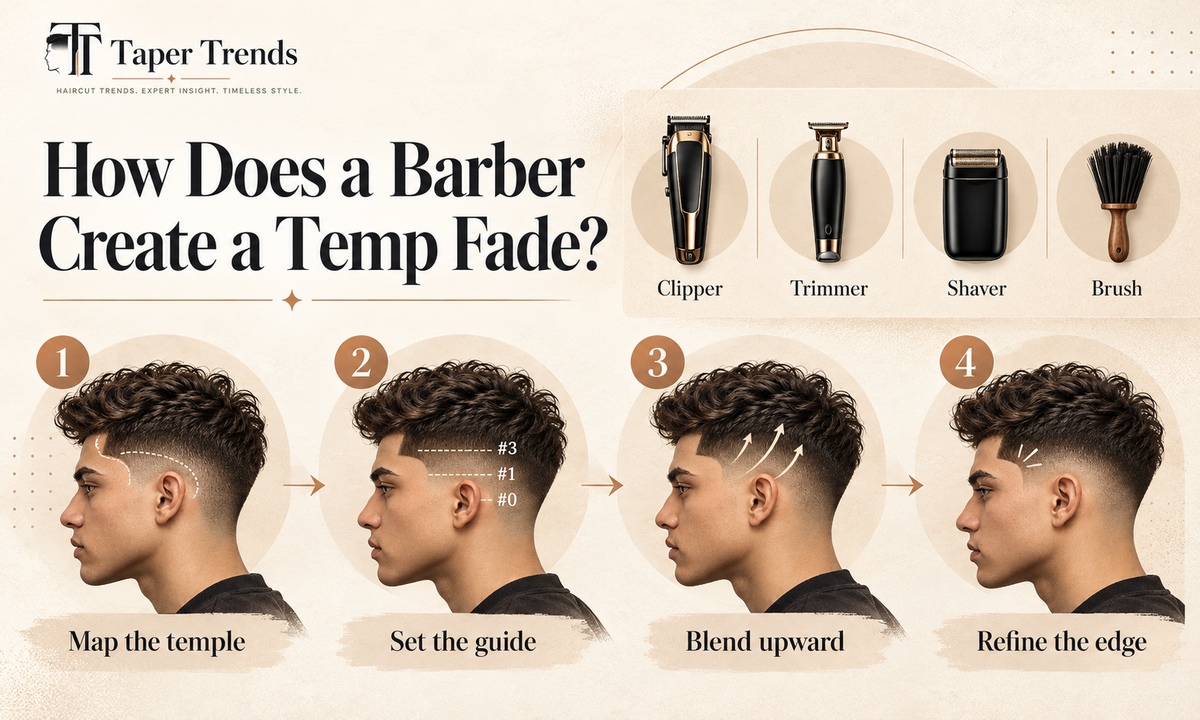
A barber marks out the temple zone, cuts its lowest point shortest, and blends upward into the surrounding length, then details the hairline if asked. Most of the skill lies in matching both temples and hiding the top of the transition.
What tools and steps are typically used?
CADMEN's technique guide and Wahl's clipper instructions describe a sequence most professional temple fades follow:
- Agree on the boundaries and how sharp the edges should be.
- Set the shortest point at the lower temple with a trimmer, a balding clipper, or a very short guard.
- Step up through slightly longer guards, using the taper lever to fine-tune between them. CADMEN lists #0.5, #1, #1.5, and #2.
- Blend the upper edge with an upward rocking motion so no line remains.
- Compare both sides for symmetry, then add a line-up if requested.
Those guard numbers are reference points, not required settings, and lever range differs by clipper, as our best clippers for fades guide shows. The same blending logic runs through our taper fade guide, and the clipper guard size chart shows what each guard leaves behind.
How often does a temp fade need maintenance?
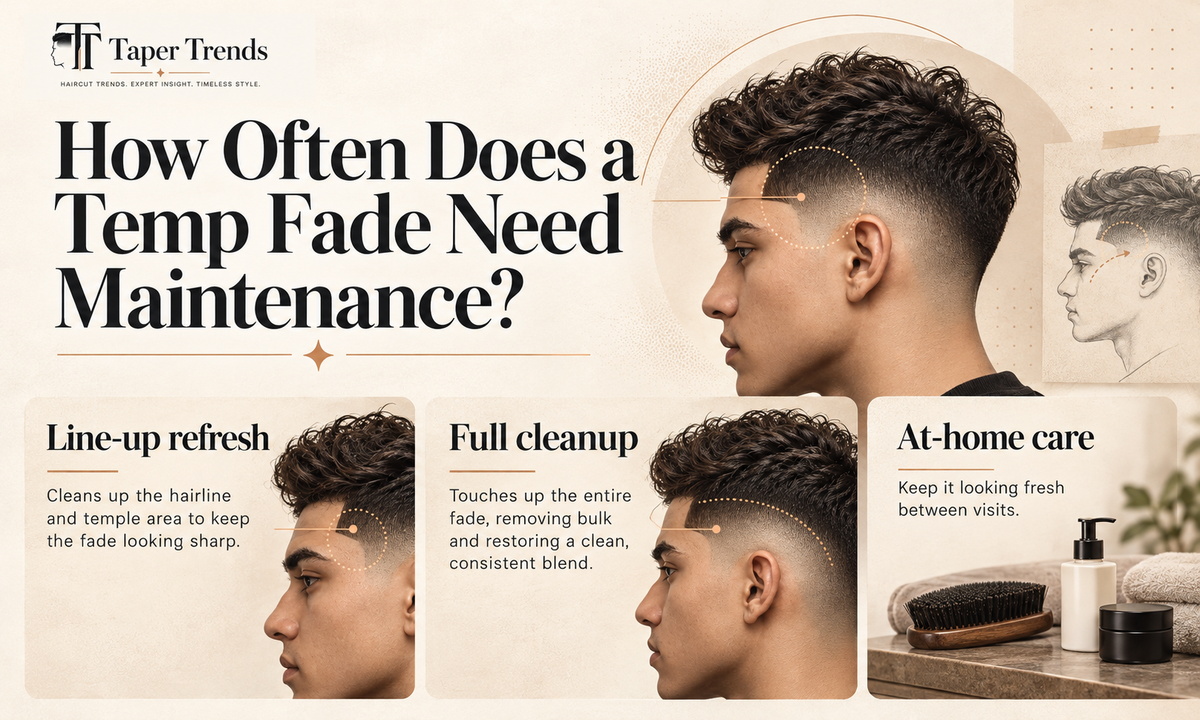
Plan on a refresh every one to four weeks, depending on how short the fade starts, how fast your hair grows, and how sharp you like it. City Barbers sees most temp fade clients every two to three weeks. Markcutit recommends a line-up every one to two weeks and a full cut every three to four. Haircut.info says a skin finish shows stubble within about a week, while a shadow finish at #0.5 can go three to four weeks. These are shop guidelines, not guarantees; our guide to how often you should get a haircut sets them beside every other cut.
When is a line-up enough, and when is a full cut needed?
A line-up is enough when only the edges have blurred and the blend still looks graded. Book a full cut when the gradient has disappeared or your overall length has grown past what you like. Markcutit suggests a line-up around day 10 to 14, when the corners start to soften, and a full cut once your length runs about 5 mm past your preference.
How can you maintain the look at home?
Keep the area clean and leave the edges to your barber. City Barbers recommends a gentle cleanser on the temples and warns that razor edging at home can overshoot into hair that should stay. Markcutit adds that rubbing product into freshly edged temples can irritate the skin. For styling the length you keep, see how to style a low taper fade in our styling guide.
What common temp fade mistakes should you avoid?
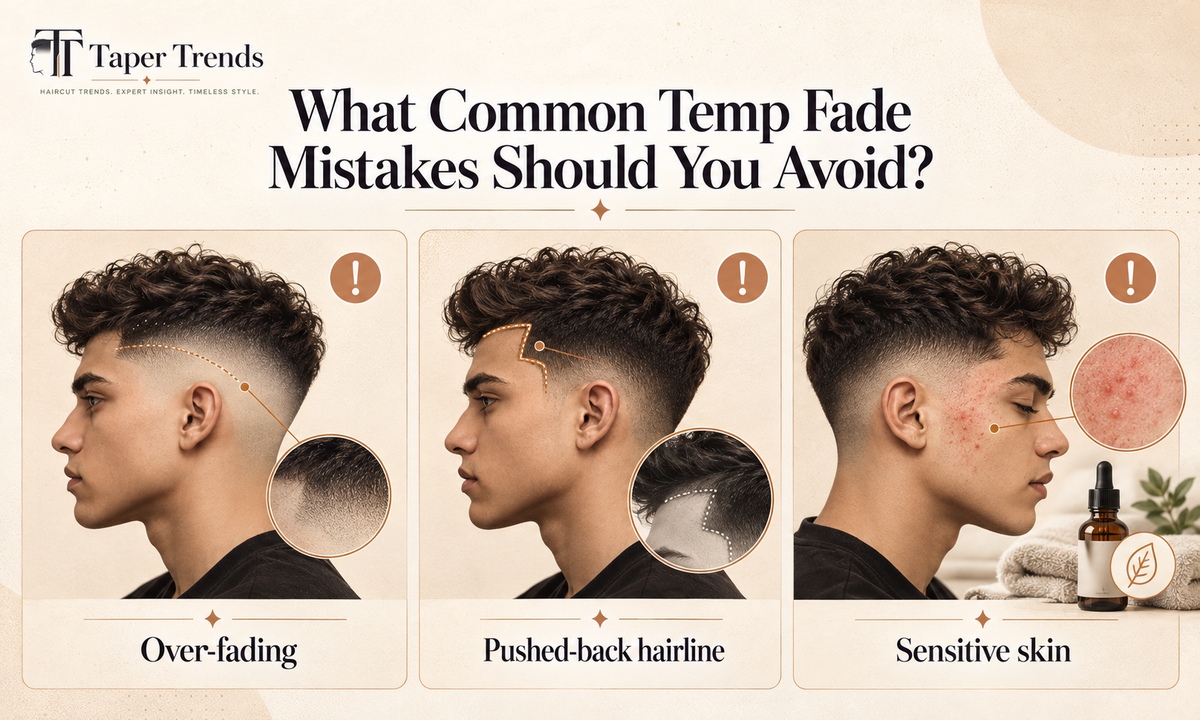
Most temp fade mistakes come from vague requests or over-correction: a blend placed too high, squared corners forced onto a natural hairline, an unrequested neckline fade, a visible line at the top of the blend, or repeated close shaving on reactive skin. When one has already happened, how to fix a bad fade covers what can be corrected.
How do you avoid over-fading or pushing back the hairline?
Agree on your natural hairline before any clipping, and ask the barber to follow it rather than create a new one. Check both sides in the mirror before the edge is taken. Markcutit warns that home trimmers used in a mirror tend to push the corners back a little more each time, and a receding temple is hard to undo.
What if you get razor bumps or have sensitive skin?
Very close shaving can cause razor bumps, especially with coarse, curly hair, so if you're prone to them, ask for a shadow finish or a softer edge. The American Academy of Dermatology explains that bumps form when shaved hairs curl back into the skin.
The AAD's razor bump guidance, written mainly for the beard area, advises shaving in the direction of growth with a sharp blade, avoiding very close shaves, and never pulling the skin taut or plucking a hair inside a bump. Bumps that keep returning can leave scars, so see a board-certified dermatologist if changing your routine doesn't help. Our skin fade for curly hair guide covers bump-safe habits for tight textures.
Temp fade FAQs
Is a Brooklyn fade always the same as a temp fade?
Usually, but not always. Markcutit says temp fade, temple fade, and Brooklyn fade all describe the same cut in its area, while Haircut.infonotes that many shops use “Brooklyn fade” for the version that also fades the neckline. A reference photo settles it. If the neckline is included, the cut starts to resemble the nape work in our taper fade guide.
Can you get a temp fade without cutting the top?
Yes. A temp fade is confined to the temples and sideburns, so the top can stay untouched. Tell your barber you want no trim on top, and confirm how the fade should blend into your existing length. Our low taper fade for medium-length hair and low taper fade for long hair guides show how much length a top can carry with short edges.
Can you grow out a full fade and switch to a temp fade?
Yes, once the sides grow back. Haircut.info puts hair growth at about half an inch a month, though yours may differ, so there's no fixed date. Leave the sides alone while they grow and ask for temple-only upkeep in the meantime. If you are coming from a bare-scalp cut, the skin fade guide explains what the grow-out looks like, our full guide on how to grow out a fade gives the timeline, and the low taper vs low fade comparison shows a softer stepping stone.
What if one temple has less hair than the other?
Ask the barber to design around it with a natural edge, rather than cutting the fuller side back to match the thinner one. Sudden or worsening thinning is a medical question, so mention it to a doctor or dermatologist. Our taper fade guide for thin and thick hair explains how density changes any fade.
Does a temp fade cost more than a regular haircut?
It depends on the shop. City Barbers includes a temp fade in its $40 haircut. Dayy The Barber in Philadelphia lists a shape-up and temple fade on Booksy for $35, against $40 for a haircut (checked October 17, 2026). These are single-shop examples, not national averages. Our barber tip calculator helps you budget the whole visit.
How long does a temple-only appointment take?
It depends on what you book. Haircut.info estimates 10 to 20 minutes for the temple fade alone and 30 to 45 minutes with a full haircut. The same Booksy listing shows 30 minutes for a shape-up and temple fade, versus 15 minutes for a line-only shape-up.
What's the best way to try a temp fade for the first time?
Start conservative: temples only, a shadow finish, and a natural edge. Live with it for two weeks and watch how the corners grow back. If you want more contrast, go shorter or sharper at the next visit. Hair that's still there can always come off later, but a temple that's been pushed back takes far longer to return.
When you are ready to go further, explore the full set of low taper fade guides, compare a burst fade or drop fade, or look at the skin fade vs taper fade breakdown.

The bottom line
A temp fade is a small, precise blend at the temples and front sideburns. Everything else keeps its length.
Name the areas, the placement, the finish, the edges, and the length to keep, bring photos, and start conservative if you're unsure.
Want more fade guides?
Browse clean, barber-ready breakdowns for every fade and hair type.