A skin fade with beard takes the hair on the sides and back down to bare skin while your facial hair stays on. The two meet at the sideburn, where your barber either blends short hair into the beard or leaves a deliberate gap.
Three choices shape the result: how high the fade sits, how much beard you keep, and how the sideburn connects. Make them together, and your barber gets a request they can actually cut.
For the haircut on its own, start with our complete skin fade guide. The skin fade vs taper fade comparison helps if you're still choosing a finish, and the low taper fade haircuts guide is the hub for every taper and fade on the site.
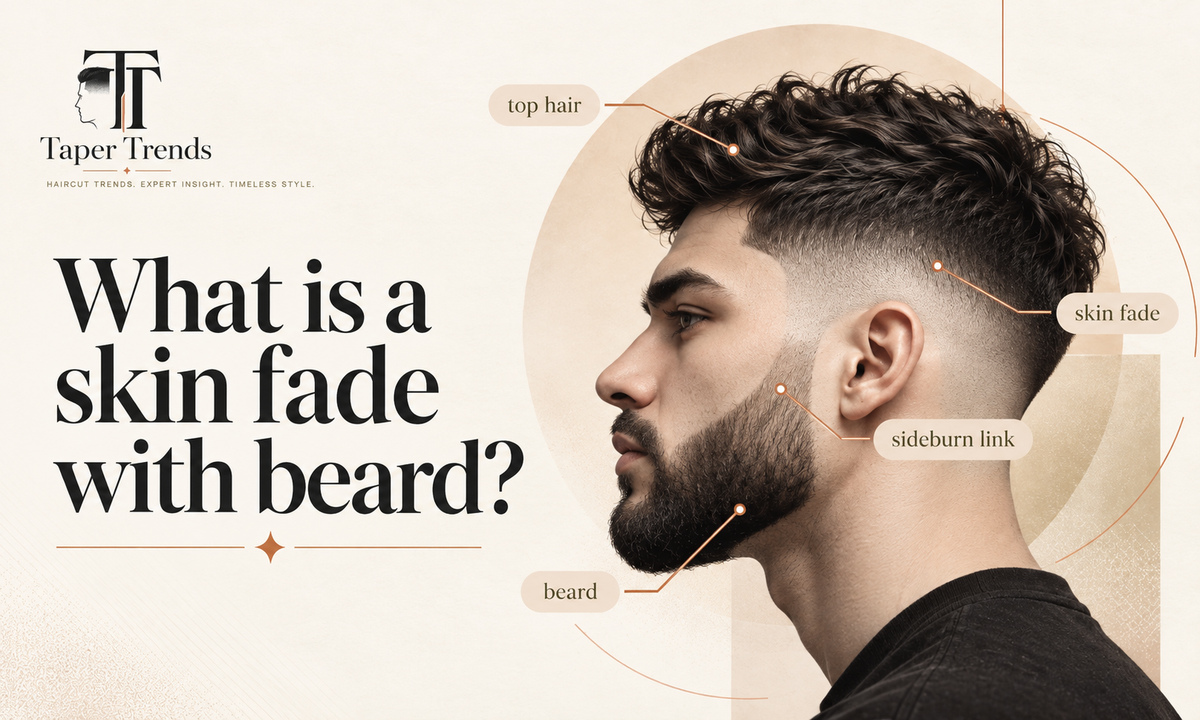
What is a skin fade with beard?
A skin fade with beard is a haircut in which the sides and back graduate down to bare skin while the beard stays on the cheeks, jaw, and chin. The sideburn links the two. The hair on top is a separate decision and can stay any length you like.
Three terms get mixed up here. “Skin fade,” also called a bald fade, describes where the fade ends. DIDA NYC Hair Studioexplains that a skin fade tapers all the way to bare skin and can be low, mid, or high. Those three words describe where the fade starts. So a skin fade and a high fade aren't the same thing; a high skin fade is both at once.
A beard fade is the third idea. Philips describes it as a continuous flow from the haircut through the sideburns into the beard, with no clunky gap in between.
Our guide to every type of fade haircut lines up the rest of the names, and the taper vs fade explainer and low taper vs low fade comparison show where a fade stops and a taper begins. If a softer finish is what you're after, the taper fade haircut guide covers it from the ground up, and our clipper guard size chart shows how close each guard number cuts.
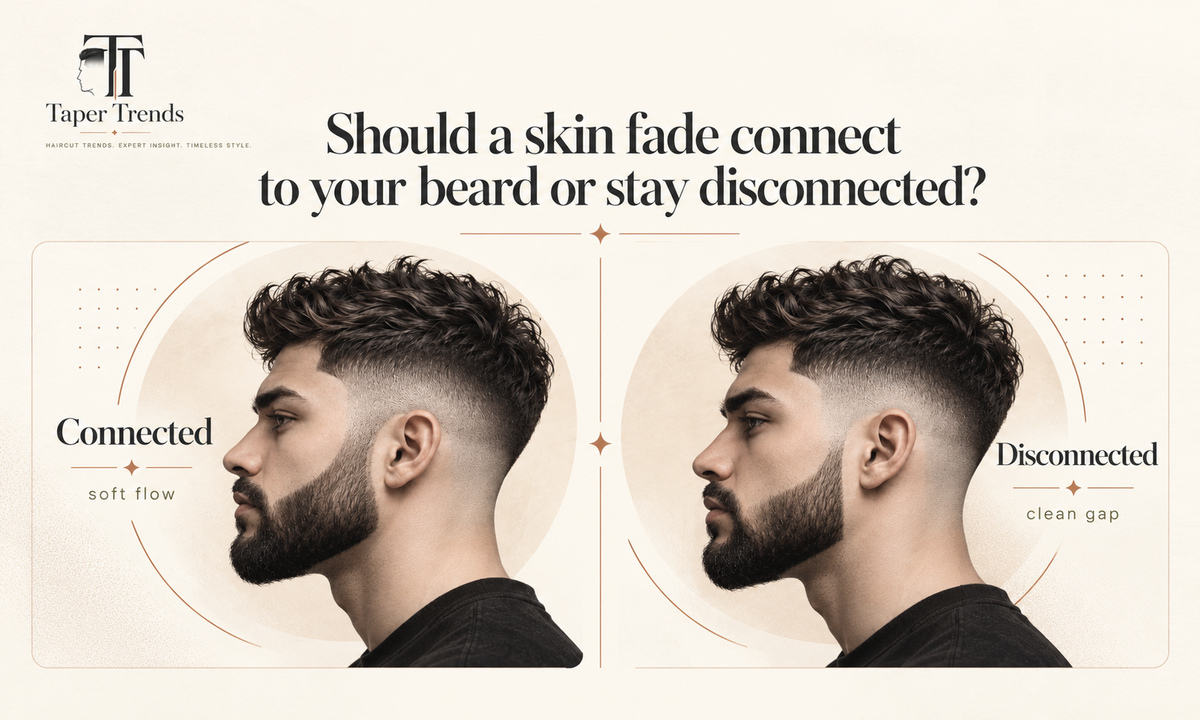
Should a skin fade connect to your beard or stay disconnected?
Both approaches work. A connected skin fade blends the shortened sideburn into the beard with no visible step, while a disconnected one leaves a deliberate strip of skin between haircut and beard. The only real mistake is not choosing, because a gap nobody planned looks like an error rather than a style.
| Detail | Connected | Disconnected |
|---|---|---|
| Sideburn | Tapers into the beard | Cut down to skin |
| Overall look | Continuous and softer | Sharper, higher contrast |
| Works best when | Growth near the ears is reasonably full | You want contrast or growth near the ears is thin |
What does a connected skin fade and beard look like?
Seen from the side, the hair shortens from the temple, reaches its shortest point near the top of the sideburn, then gets longer again across the cheek until it hits full beard length. The Philips beard-fade method aims for exactly this finish, with the top of the sideburns blending into the sides of the haircut.
The same connected join appears on every fade shape. Our low taper fade with beard shows it under a softer taper, the mid taper fade with beard and high taper fade with beard move it up the head, and the drop fade with beard and burst fade with beard guides show how a curved fade line meets the sideburn.
When does a disconnected beard look better?
A disconnected beard suits you if you want strong contrast, or if hair near your ears grows too thin to support a dense blend. Cutting the sideburn to skin makes a clean break that pairs well with a goatee or a short, sharply shaped beard. Agree on the width and position of the gap first. An uneven one reads like a missing sideburn.
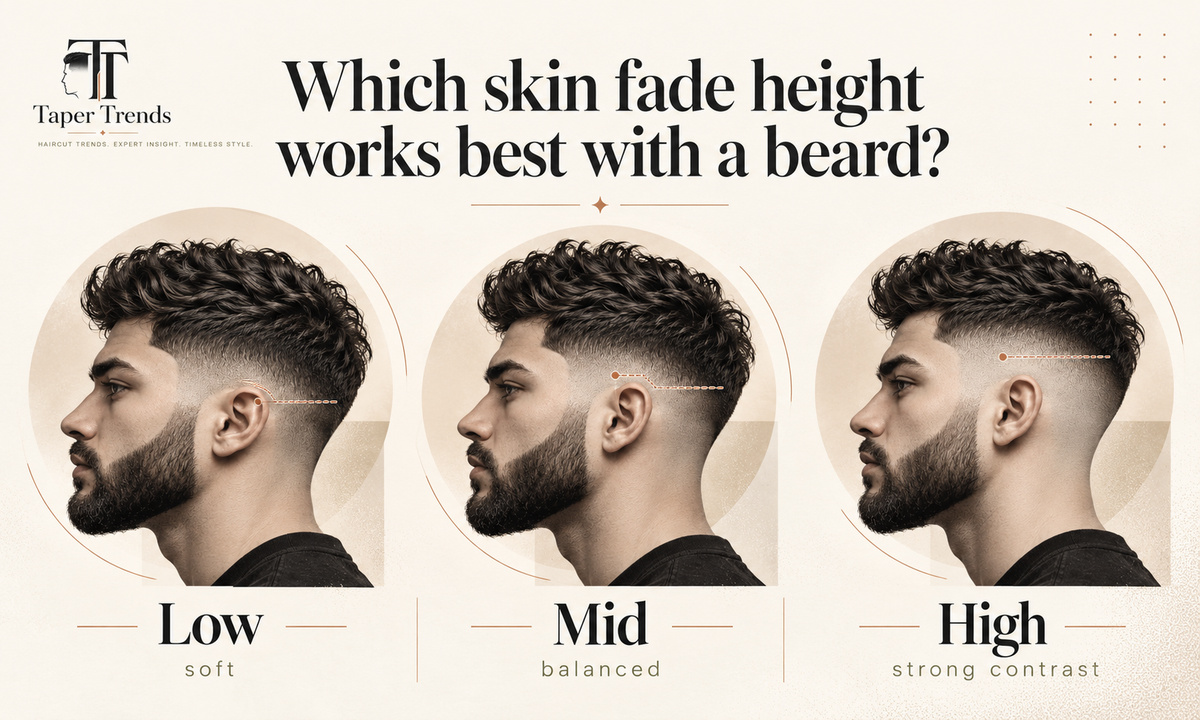
Which skin fade height works best with a beard?
No fade height suits every beard. Low, mid, and high describe where the skin fade starts on the side of the head, which controls how much side hair stays and how much the beard stands out against bare skin. Pick the contrast you want, then confirm the placement in the mirror before cutting starts.
Barbering educators at America's Beauty Show place a low fade about a third of the way up the head, a mid fade between one and two thirds, and a high fade in the top third. Shops vary, so point to the exact spot.
| Fade height | Where it starts | Beard pairings to consider | Trade-off |
|---|---|---|---|
| Low | Just above the ear | Stubble, short boxed, or full beard | Keeps the most side hair; softest contrast |
| Mid | Around the temples | Short boxed to full beard | Clearer contrast, still flexible |
| High | Near the top of the head | Short shaped or full beard | Strongest contrast; regrowth shows soonest |
Treat these pairings as starting points, not rules. Height works the same way on tapers, which our low vs mid taper fade, low vs high taper fade and mid vs high taper fade comparisons lay out side by side.
Low skin fade with beard
A low skin fade starts just above the ear, according to licensed barber Sebastian Mondragon of Barber's Take, so the bare-skin section stays near the bottom of the sides and back. You keep the most side hair and the softest outline. Stubble, a short boxed beard, and a full beard all sit comfortably under it.
Our low drop fade starts at the same height and can finish at skin, and the low taper fade from every angle shows where “just above the ear” sits on a real head.
Mid skin fade with beard
A mid skin fade starts around the temples, roughly halfway between the ears and the top of the head. It removes more side hair than a low fade and creates a more visible step between scalp and beard. A connected sideburn running into a short boxed or full beard is a common pairing.
The mid taper fade guide and the in-between low-mid taper fade show where the temple line can sit, while the mid drop fade and mid burst fade curve that height around the ear.
High skin fade with beard
A high skin fade starts near the top of the head and removes the most side hair. With so little left on the sides, the beard becomes the dominant shape, so its volume matters. A fuller beard balances the look, while a short shaped beard makes it sharper. Expect regrowth to show sooner, too.
Our high taper fade guide covers the height with a little more hair kept, and the high drop fade and high burst fade show the curved versions taken to skin.
What beard length and shape pair best with a skin fade?
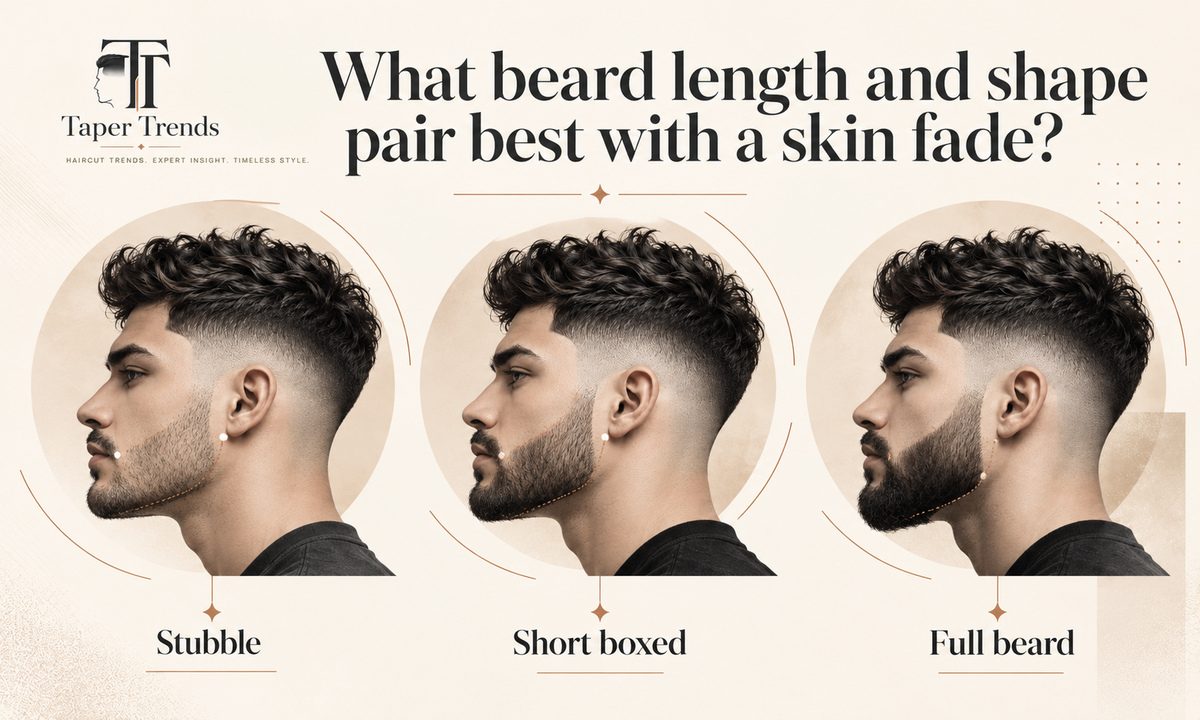
Stubble, a short boxed beard, and a full beard all work with a skin fade. The right choice depends on how much contrast you want and how evenly your beard grows. Three details decide the finished look: where the sideburn connects, how high the beard sits on the cheek, and how the jawline is shaped.
Skin fade with stubble
Stubble keeps facial hair light under the fade, so the sideburn transition is subtle. Because so little length separates beard from bare skin, any regrowth shows quickly. Ask for a soft, even blend rather than a blocky connection at the sideburn.
Stubble pairs naturally with a buzzed top; our low taper fade buzz cut, mid taper fade buzz cut and high taper fade buzz cut guides show those short lengths across the whole head.
Skin fade with a short boxed beard
A short boxed beard adds structure through neat cheeklines, a controlled jaw outline, and a trimmed sideburn. That defined edge frames the fade cleanly.
It suits tidy, structured tops such as the French crop, the side part, the comb over and the slick back. For cropped tops, see the low taper fade for short hair, plus the mid taper and high taper short-hair guides.
Skin fade with a full beard
A full beard keeps length and volume below the sideburn, which creates strong, deliberate contrast with the bare sides. The blend zone is longer. Ask your barber to shape the beard rather than shorten it more than necessary.
A full beard balances a longer top well. Our low taper fade for medium-length hair, low taper fade for long hair and mid taper fade for long hair show how much length a top can carry, and the low taper fade mullet, drop fade mullet and burst fade mullet keep the back long, too.
How does a barber blend a skin fade into a beard?
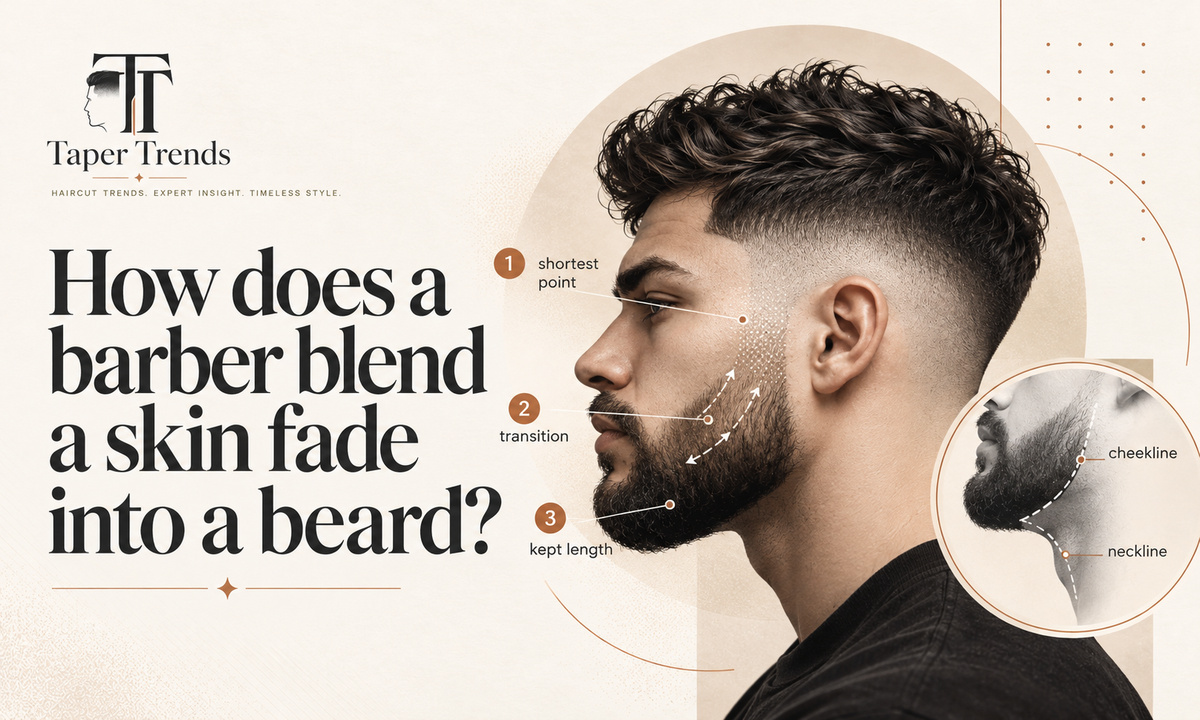
A barber blends a skin fade into a beard by setting the shortest point at the top of the sideburn, then letting the hair lengthen in small, overlapping steps down the cheek until it meets the beard's kept length. The sideburn blend and the beard outline are separate jobs, and the blend usually comes first.
Philips' home-trimmer guideshows the same logic. It starts an inch above the jawline with the trimmer set one step shorter than the rest of the beard, then works toward the sideburns an inch at a time, shortening the setting at each step until the sideburns meet the haircut. That's tool-specific; no single guard sequence suits every beard, and our best clippers for fades guide explains why a beard trimmer is no substitute for a clipper on the fade itself.
How is the sideburn transition built?
The sideburn transition runs from a very short point at the top to full beard length below, with intermediate lengths in between. A good barber fixes both endpoints first, then fills the gap without hollowing out the cheek.
- 1.Set the shortest point where the haircut meets the sideburn.
- 2.Build intermediate lengths moving down the cheek.
- 3.Merge into the kept beard length, then compare both sides.
How are the cheekline and neckline finished?
The cheekline and neckline define the beard's upper and lower edges, and they're shaped separately from the sideburn blend. For a crisp cheekline, Philips suggests a straight or slightly curved line from the bottom of the sideburn to the corner of the mustache. A natural cheek just gets stray hairs cleared. For the neckline, Philips uses a finger placed just above the Adam's apple as the guide.
How do barbers avoid visible lines in the beard fade?
Visible bands appear when neighboring lengths differ too much. Smaller steps and overlapping passes smooth the transition, while a skipped step leaves a stripe. If you spot a band in the mirror, ask for it to be re-blended before the cut ends.
The fade line above the sideburn can also curve. Our drop fade haircut guide and burst fade haircut guide explain each shape, the drop fade vs burst fade comparison shows how to tell them apart, and the low taper drop fade and taper low burst fade show both curves started low.
How do you choose a skin fade and beard for your features?
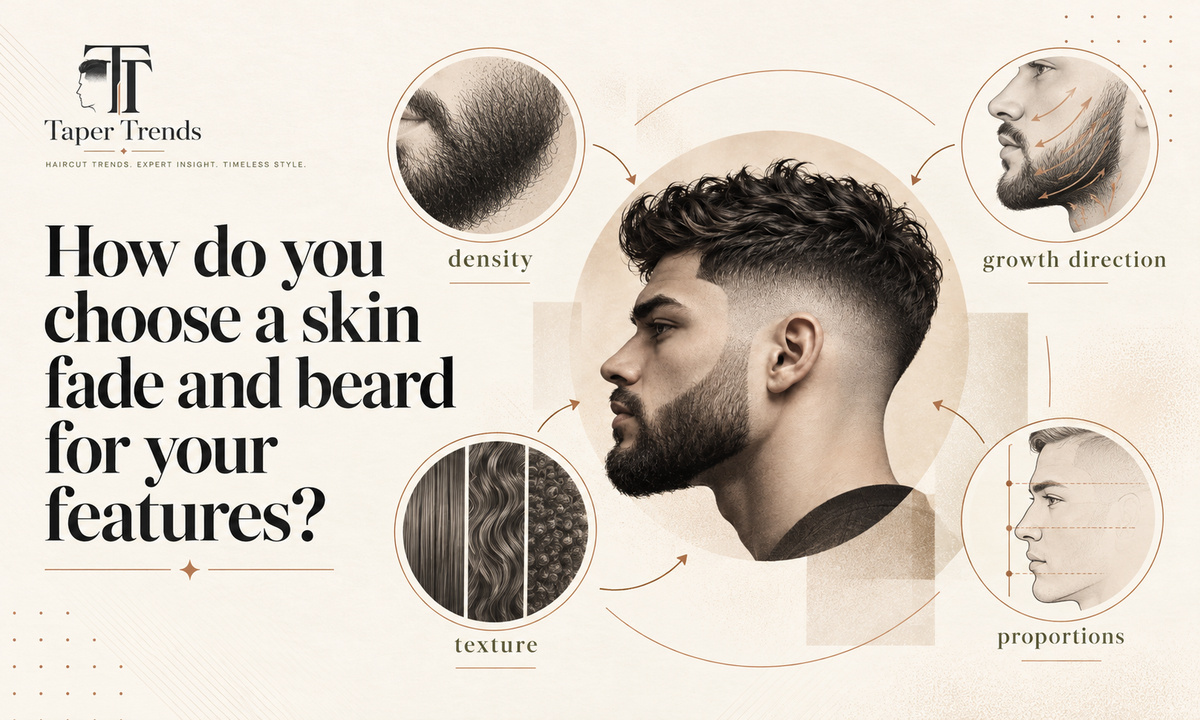
Start with what you can't change. Beard density, hair texture, and growth direction decide what will blend smoothly, and fade height and beard width are the tools for adjusting proportion. Pall Mall Barbers says its barbers assess density, growth direction, and facial proportions before shaping a beard, so raise those three at your consultation.
What if your beard is patchy or thin near the sideburns?
Thin growth near the sideburns limits how dense a continuous blend can look, but it doesn't rule out the cut. A softer transition, or a deliberately disconnected sideburn, can still look clean. Pall Mall Barbers notes that good beard shaping works with natural growth rather than forcing symmetry where hair grows thinner. Avoid cutting deeper into sparse areas, because a gap there can take weeks to fill back in.
Our fade guide for thin and thick hair explains how density changes the right height on the scalp, too.
How should face proportions influence the choice?
Face-shape charts oversell certainty. These three adjustments change how proportions read; treat them as aesthetic judgments, not rules.
| Adjustment | Likely visual effect |
|---|---|
| Higher fade | Narrower sides, more scalp showing |
| Fuller beard | More width and weight in the lower face |
| Longer chin hair | More vertical length |
For a starting point rather than a verdict, our face shape detector reads your proportions from a photo in your browser.
Does hair texture change the fade-and-beard combination?
No texture rules it out. English barber Oscar McMillan told Latest Hairstyles that a skin fade suits straight, wavy, curly, and afro hair. Curly and coily hair do need a barber who understands how that texture grows, so mention your growth direction and ask about their experience with it.
On curls, our skin fade curly hair guide covers dry length and shrinkage, with the curly low taper fade, drop fade for curly hair and burst fade for curly hair as softer or curved options. For coily hair, beards and bump-prone skin, see the low taper fade for Black men, mid taper fade for Black men, high taper fade for Black men, drop fade for Black men and burst fade for Black men guides.
Straight hair shows every line of a fade, which the low taper fade for straight hair, drop fade on straight hair and burst fade on straight hair guides deal with. Wavy hair sits in between; see the low taper fade for wavy hair. Thick, coarse hair is covered in the Hispanic and Mexican low taper fade and low taper fade for Asian hair, and finer textures in the low taper fade for white guys.
What should you tell your barber for a skin fade with beard?
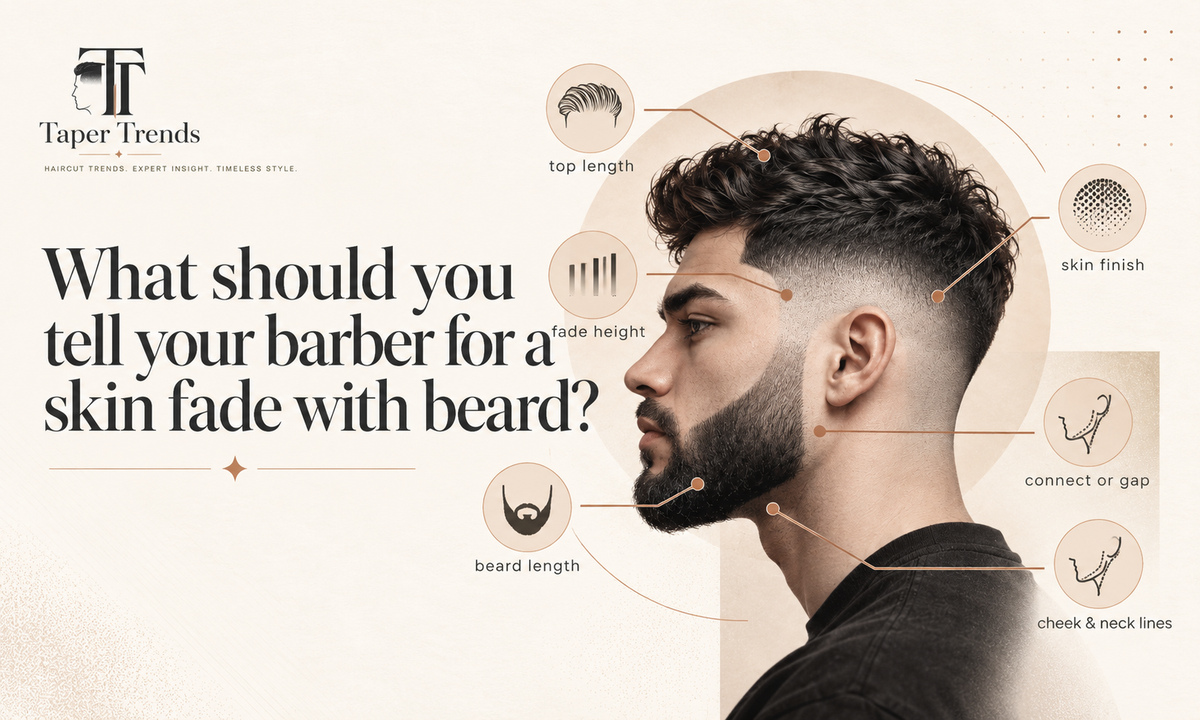
Give your barber six decisions: skin finish, fade height, top length, beard length, connected or disconnected sideburn, and beard outline. Say them in that order, describe the result you want instead of quoting guard numbers (shops and tools differ), and ask to see the sideburn transition before the barber finishes.
How do you describe the haircut and beard blend clearly?
Name the fade height and whether it ends at skin or at a short taper; DIDA NYC Hair Studio suggests phrasing such as “mid skin fade” or “low taper fade.” Then describe the beard, how much cheek weight to keep, and the neckline. Here's a sample request you can adapt:
“I'd like a low skin fade, leaving the top length mostly unchanged. Please blend the sideburn into my short beard without taking too much weight out of the cheeks. Keep the neckline natural and show me the sideburn transition before finishing.”
Our barber brief generator turns those six decisions into a note you can show on your phone, and the Taper Trends gallery has side and back reference shots worth saving.
What photos and details should you confirm before cutting?
Mancave Barbershop names asking for the wrong type of fade as the most common thing that goes wrong, which is why photos help and why our guide on how to ask for a fade starts with the height and finish. Bring front, side, and back references, then confirm these points before cutting starts:
- 1.The fade height in the photo matches what you want.
- 2.The hair density and growth in the photo resemble yours.
- 3.Both sideburns will end at the same point.
- 4.The neckline will be natural or defined.
- 5.The finish will be skin-close or clipper-close.
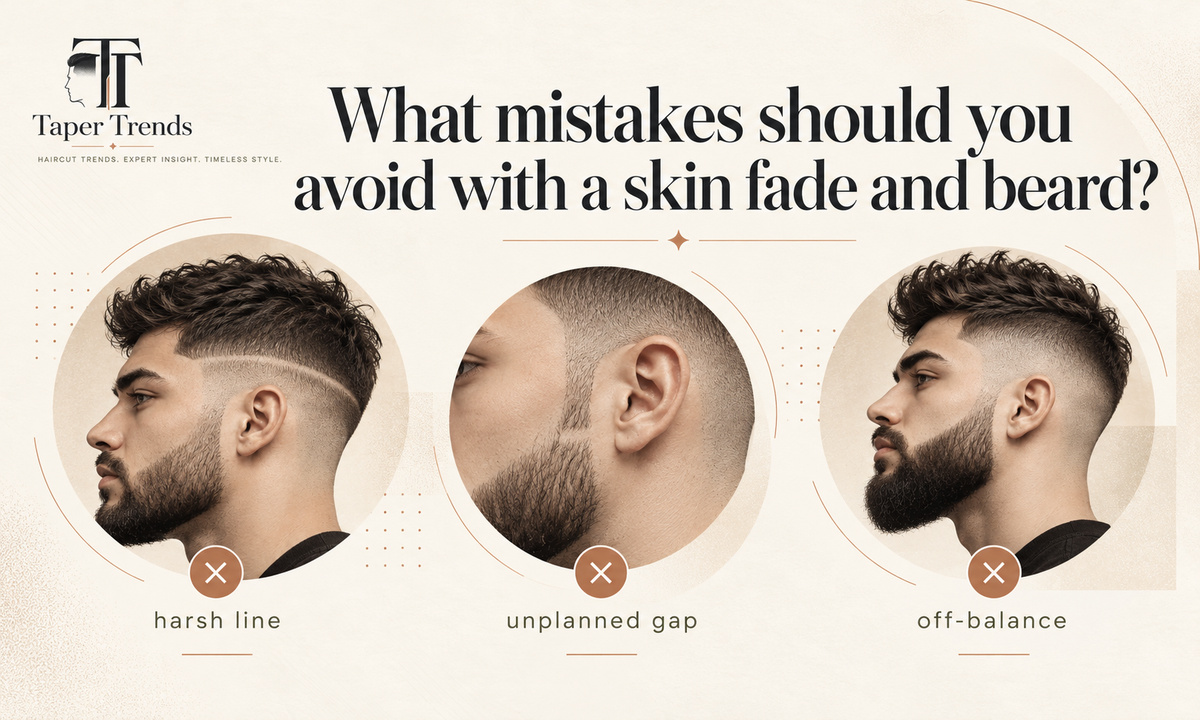
What mistakes should you avoid with a skin fade and beard?
Most disappointing skin fades with beards come from vague requests rather than poor clipper work. The usual culprits are an unplanned gap, sideburns cut too short, an uneven beard outline, and a fade height nobody specified. Checking both sides in the mirror during the cut catches most of them early.
Mistakes that make the beard connection look uneven
An uneven connection looks accidental, while deliberate contrast looks designed.
| Problem | Likely cause | What to ask for |
|---|---|---|
| Abrupt block at the sideburn | Too few intermediate lengths | A softer, longer transition |
| Light patch on the cheek | Too much weight removed | Keep cheek density |
| Left and right sides differ | Uneven growth or uneven cutting | A side-by-side check in the mirror |
Mistakes when choosing fade height and beard shape
Fix these before the cut starts:
- Saying only “a fade.” Name the height (low, mid, or high) and the finish (skin or taper).
- Over-trimming the beard. Base its length and shape on your actual density.
- Copying a photo blindly. Check that its fade height, beard density, and connection resemble what your hair can do.
If “a fade” and “a taper” still sound interchangeable, the burst fade vs taper fade and skin fade vs taper fade comparisons show the difference in photos.
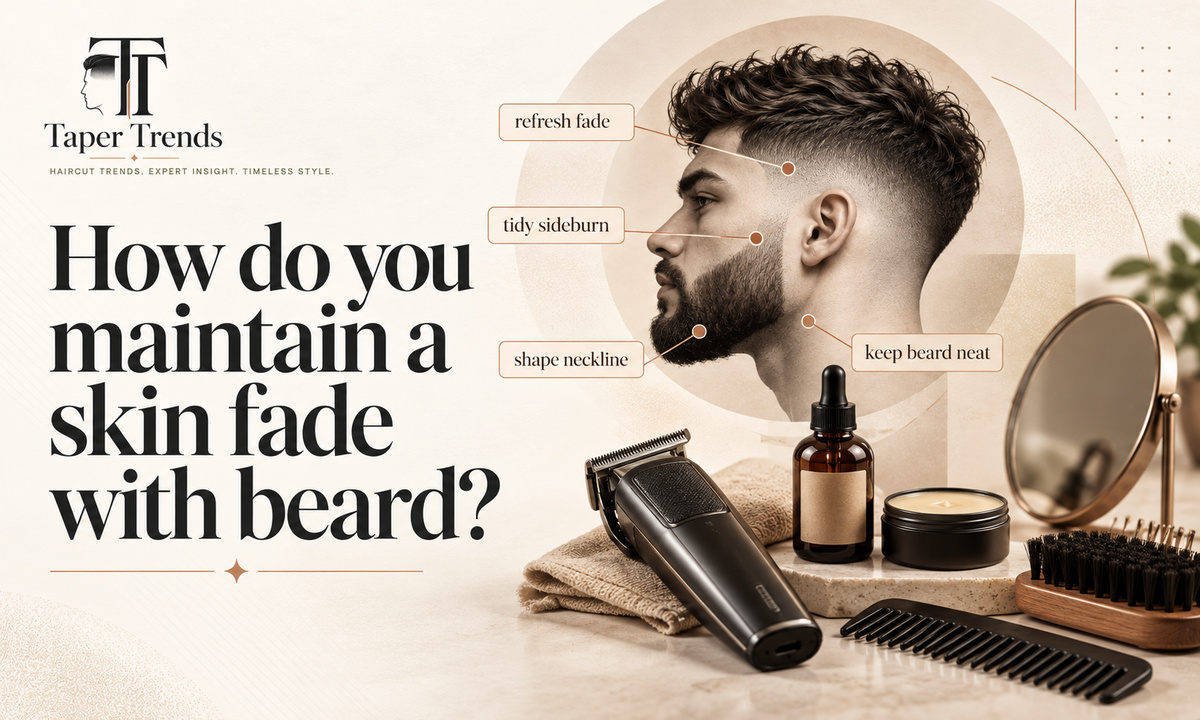
How do you maintain a skin fade with beard?
A skin fade loses its sharp edge as hair regrows, while the sideburn connection and beard outline drift at their own pace. Maintaining a skin fade with beard means a fresh fade and blend at the barbershop, plus light cleanup at home in between (our DIY fade guide covers what a touch-up should leave alone).
How often should you refresh the fade and beard blend?
Book a refresh when the sideburn stops reading as a smooth gradient or the beard outline looks soft. DIDA NYC Hair Studio puts skin fades at every one to two weeks for a consistently sharp look, though relaxed clients can stretch low and mid fades closer to four weeks. Pall Mall Barbers suggests professional beard shaping every three to four weeks. Treat these as estimates, not schedules; our guide to how often you should get a haircut compares them with every other cut.
What can you safely maintain at home?
Home upkeep should protect the shape your barber set, not recreate the sideburn blend.
- 1.Comb or brush the beard daily so strays stand out.
- 2.Trim isolated strays only, without moving the outline.
- 3.Leave the sideburn transition and neckline to your barber.
- 4.Keep your tools clean. The American Academy of Dermatology advises cleaning an electric razor every five to seven shaves and replacing a disposable razor on the same schedule.
For the top, our five-step guide to styling a faded cut matches products to each texture, and the barber tip calculator helps on those frequent refresh visits, and our guide to how much to tip your barber covers beard trims and shaves.
Is a skin fade with beard suitable for sensitive skin or razor bumps?
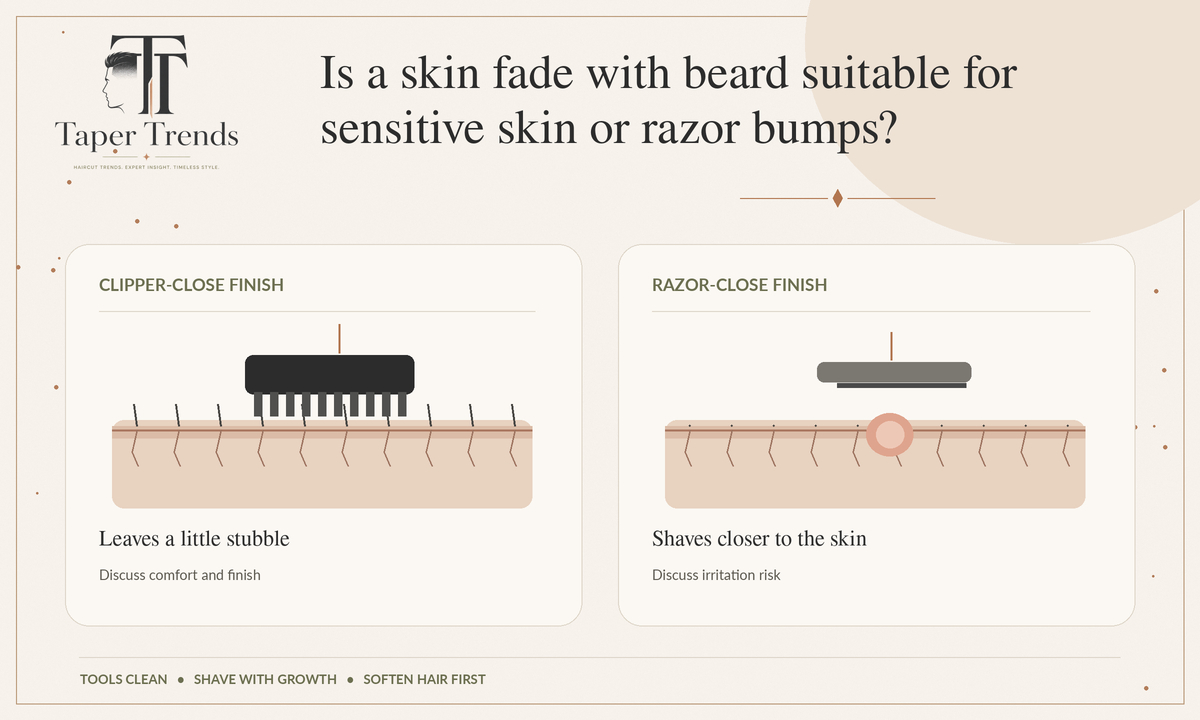
A skin fade with beard can work with sensitive skin, but a razor-close finish may irritate skin that's prone to bumps. The American Academy of Dermatology (AAD) says anyone can get razor bumps and that changing shaving habits can reduce them. If bumps keep coming back, discuss a less aggressive finish with your barber.
Should you request a clipper-close finish instead of a razor-close finish?
It's worth discussing if you get bumps repeatedly. A clipper-close finish leaves a trace of stubble instead of razor-smooth skin, so there's less friction against the skin. It isn't a guarantee, and the fade looks slightly softer.
What helps reduce irritation around the beard?
In its razor-bump guidance, the AAD recommends shaving in the direction your hair grows, shaving when hair is soft (at the end of a shower or after a warm, damp washcloth), and using a moisturizing shaving cream. Board-certified dermatologist Cameron K. Rokhsar, MD, also notes that untreated razor bumps can leave lasting marks, so see a board-certified dermatologist if they persist after you change your habits. This is general guidance, not medical advice.
Coarse, curly beard hair is the most bump-prone, which is why our low taper fade with waves, mid taper fade with waves, high taper fade with waves and mid taper fade afro guides all cover bump-safe finishes on coarse, curly hair.
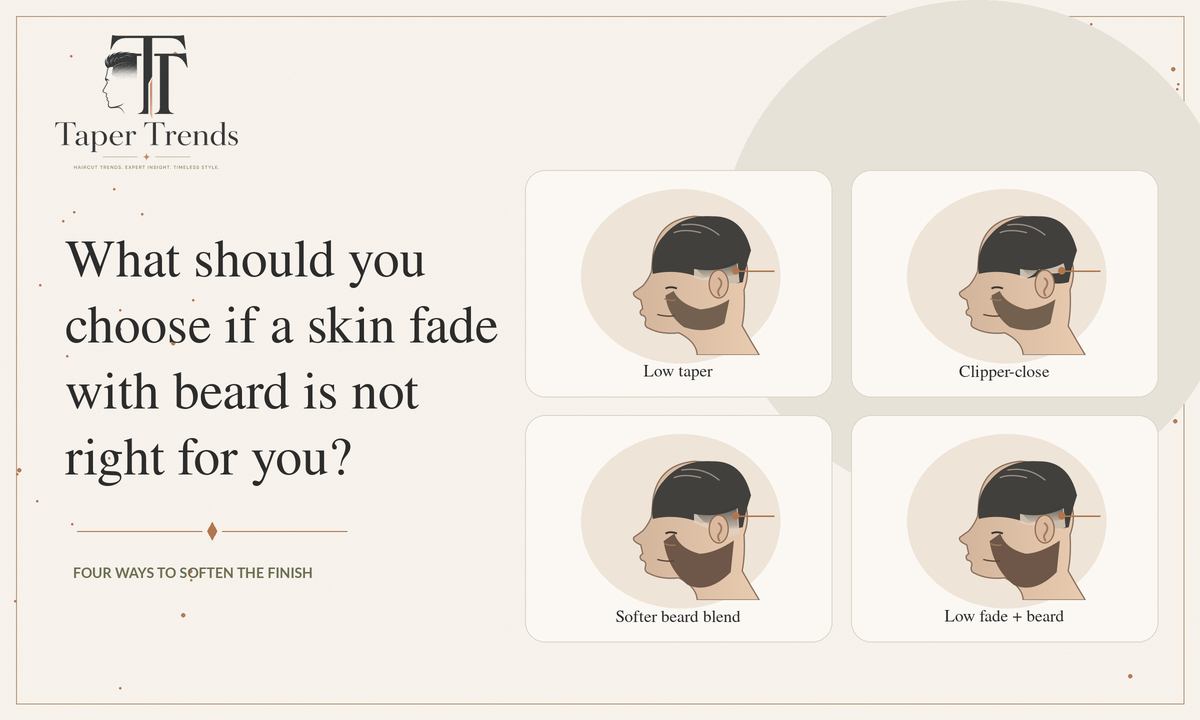
What should you choose if a skin fade with beard is not right for you?
Choose the alternative that fixes your specific objection, whether that's how much bare skin shows, how harsh the finish feels, or how abrupt the beard transition looks. America's Beauty Show calls the taper fade one of the subtlest fades and notes it can help a beard blend into the haircut.
| Alternative | What changes | Why consider it |
|---|---|---|
| Low taper with beard | Shortening stays near the sideburn and neckline | Keeps more side hair and still connects the beard |
| Clipper-close fade | Ends at close stubble instead of bare skin | Softer finish, gentler regrowth |
| Softer beard blend | Less abrupt change in beard density | More natural-looking transition |
| Low skin fade, more beard kept | Smaller bare-skin area | Keeps the skin finish with less contrast |
Change one variable at a time so you can tell what helped. Our low taper fade with beard is the closest softer option, and the mid taper and high taper versions keep more hair at each height. The skin fade vs taper fade comparison weighs the trade-offs in full.
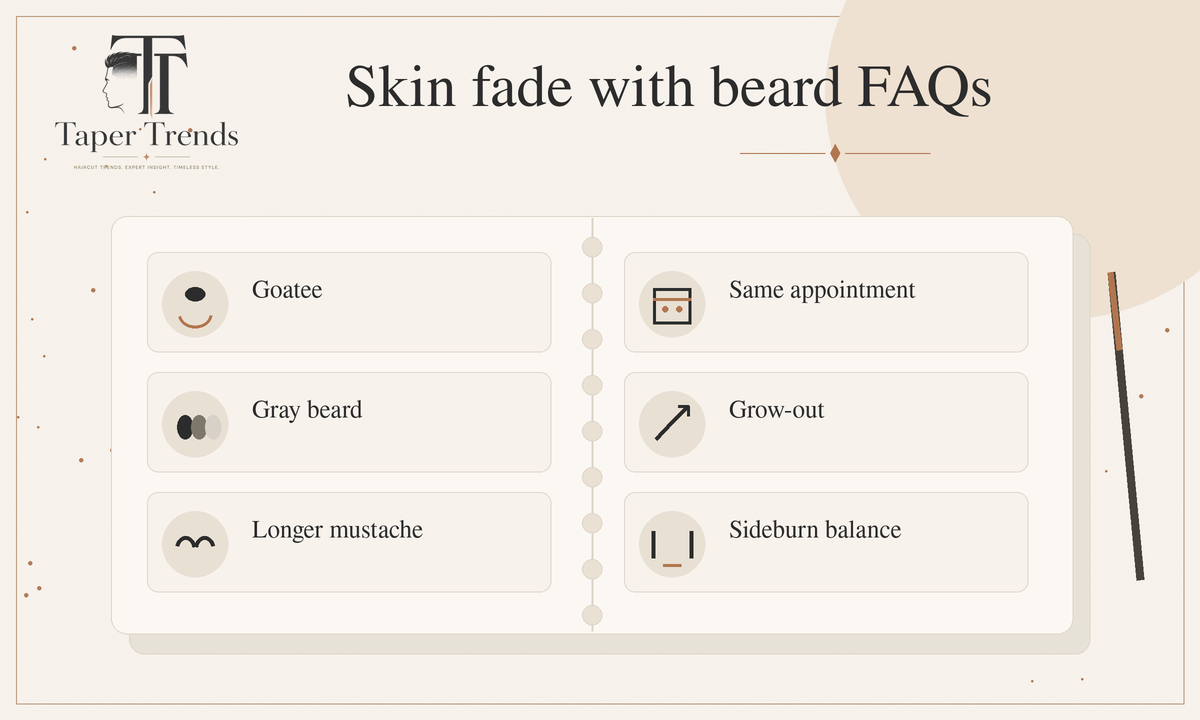
Skin fade with beard FAQs
Can you have a skin fade with a goatee?
Yes. A goatee works with a skin fade without any sideburn-to-cheek connection, because the cheeks are cut clean and the haircut and goatee read as separate elements. Ask your barber to keep the goatee outline crisp and to confirm exactly where the sideburn will end.
Does a skin fade work with a gray or salt-and-pepper beard?
Yes. Beard color doesn’t rule out a skin fade. Mixed gray and dark hairs can make the density change in the blend look different than it would on a single-tone beard, so ask your barber to check the transition in good light before finishing.
Can you keep your mustache longer than your beard?
Yes. Mustache length is independent of the sideburn blend and the rest of the beard. Philips recommends trimming along the top lip line to remove hairs growing over the lip. Tell your barber the length and outline you want.
Should you book a haircut and beard trim together?
Usually, yes. When one barber does both, the sideburn transition gets planned as a single design instead of two separate jobs. Service bundles vary by shop, so confirm that beard shaping is included when you book. Our barber tip calculator works out the tip on a combined cut-and-beard service.
How do you grow out a skin fade without losing your beard shape?
Keep the beard outline and neckline maintained while the sides grow, and avoid cutting the sideburns shorter during the transition. America's Beauty Show suggests a drop fade for clients moving away from a harsh fade or growing out length. Our drop fade haircut guide explains that shape, and the drop fade with beard guide shows how its sideburn meets a beard.
Do both sideburns need exactly the same length?
No, but both sideburns should look balanced. Growth density and direction often differ from one side of the face to the other. Gillette cautions that uneven sideburns undermine beard styling, so ask your barber to compare both sides in the mirror and adjust whichever looks heavier.
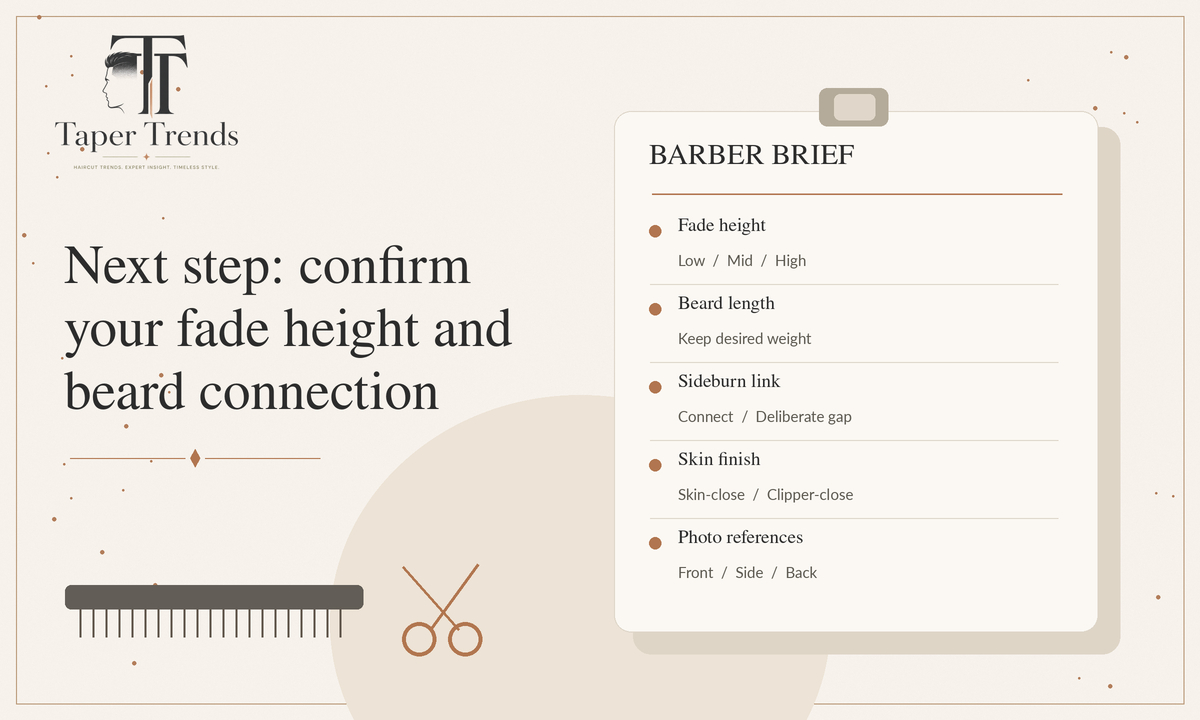
Next step: confirm your fade height and beard connection
Before your appointment, settle five things: low, mid, or high placement; how much beard to keep; a connected or disconnected sideburn; a skin or clipper-close finish; and front, side, and back photos that match your hair. Ask to see the sideburn transition before the barber finishes.
Our skin fade guide covers the haircut side in more depth, and the low taper fade haircuts guide links every cut and hair-type guide on the site. Our low vs mid vs high skin fade breakdown shows how the same three heights behave once the finish reaches skin.
The bottom line
A skin fade with beard is three decisions made together: how high the fade sits, how much beard you keep, and whether the sideburn connects.
Name the height and finish, bring side and back photos, check the sideburn transition before the barber finishes, and switch to a clipper-close finish if bumps keep coming back.
Want more fade and beard ideas?
Browse clean, barber-ready breakdowns for every fade and hair type.