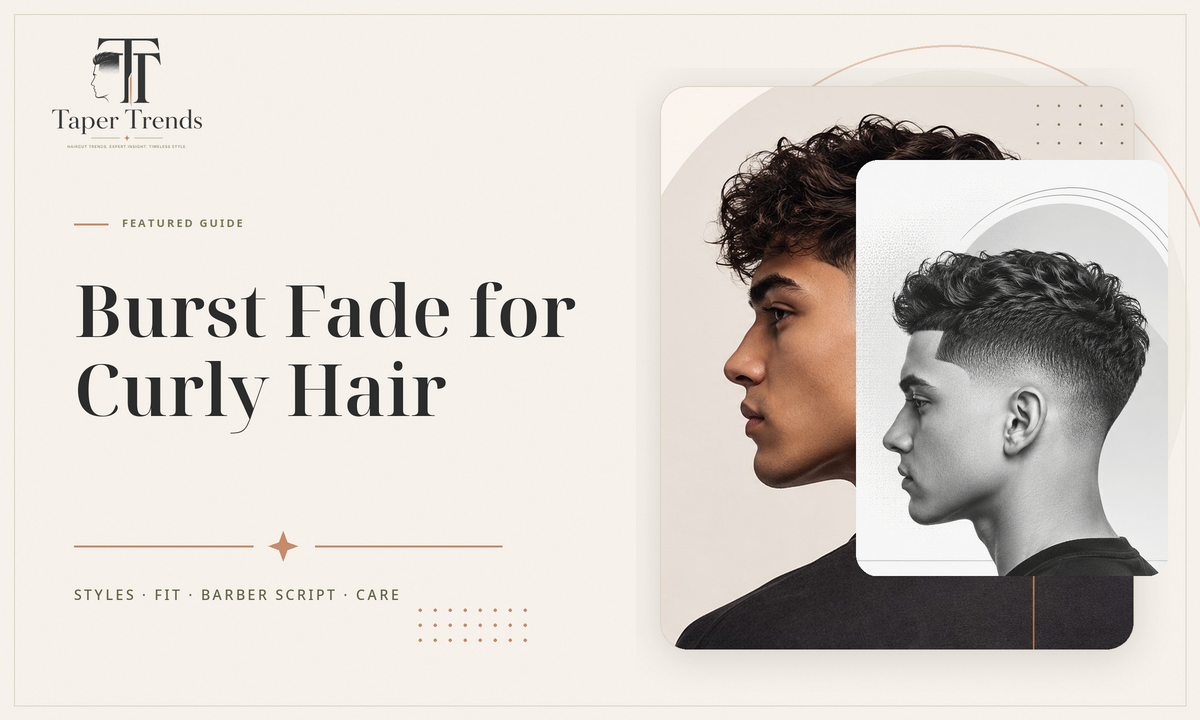
A burst fade on curly hair is a haircut in which the fade curves in a rounded arc around and behind the ear instead of running straight down the side of the head. It works on wavy, curly, and coily hair because the shape of that arc is a separate decision from how short the lowest point is cut. The same curve can finish at bare skin or stop at a soft shadow, and it sits under almost any length or texture on top.
This guide is for anyone with textured hair deciding whether the cut suits them, and for anyone choosing a style for someone else. Three decisions carry most of the result: fade height, shortest finish, and how much length stays on top and at the back. If you want the arc explained on its own first, our complete burst fade haircut guide covers the geometry, the high burst fade guide covers the tallest arc, our guide to every kind of fade haircut sets the burst beside its relatives, and the complete low taper fade haircuts guide covers the quieter end of the same spectrum. For the opposite texture, our burst fade for straight hair guide shows what changes when there is no curl to soften the blend, and our drop fade for straight hair does the same for the curve behind the ear.
What is a burst fade on curly hair?
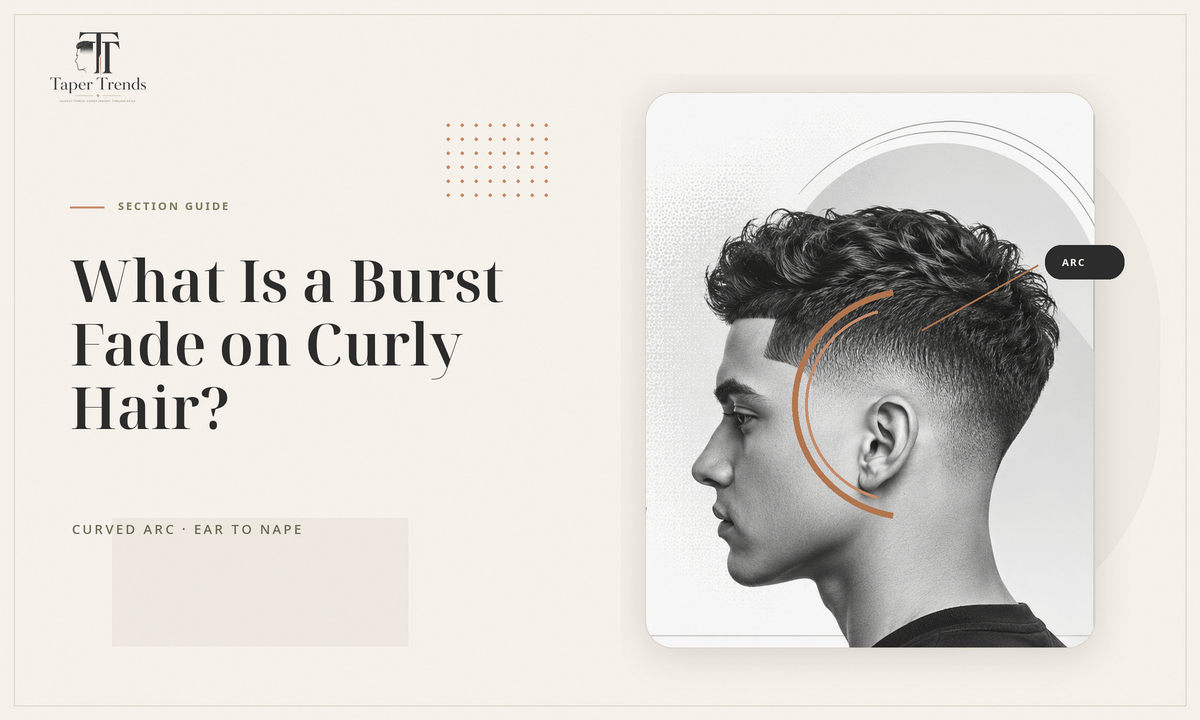
A burst fade is defined by its path, not by its shortest point. The fade curves in a rounded arc around the ear and tapers toward the nape rather than dropping straight down the side of the head. On curly hair, that curved zone blends into the natural texture above it, however long the top is left. The curls complement the technique; they do not define it.
From the side, the arc roughly traces the shape of the ear. From the back, it settles into a shorter or natural neckline. What changes between two haircuts sharing the name is everything around that curve: where it starts, how short it finishes, and how much hair is left above it. That shape-versus-depth split is the same one our taper vs fade explainer untangles, and it is why a taper low burst fade can share the same curve with far less contrast. If you're weighing a bare-scalp finish instead, our low vs mid vs high skin fade comparison shows where each skin fade height stops.
Which parts of the haircut can be customized?
Six variables make two burst fades on curly hair look completely different. Naming them separately, instead of pointing at one photo, is what prevents a mismatched result.
| Variable | What you are deciding |
|---|---|
| Height | Where the arc starts — low, mid, or high |
| Finish | Skin, zero, shadow, or guarded at the shortest point |
| Arc width and depth | How wide the curve is and how far back it travels |
| Side weight | How much hair remains directly above the fade |
| Top length and shape | Cropped curls, a fringe, a rounded top, or more height |
| Back length and neckline | Natural, tapered, or longer for a mullet-style back |
Why does the burst shape work with curls?
The curved line removes bulk from a defined area around the ear instead of flattening the whole side, so it frames volume on top rather than competing with it. That makes it a practical way to manage side bulk on curly or coily hair without shortening the curl pattern overall — the same logic behind a curly low taper fade and behind the taller contrast of a high taper fade on curly hair.
It is not automatically flattering or low maintenance. How well it reads depends on the side weight left relative to your density, and a crisp arc needs regular attention as it grows.
Will a burst fade suit your curls?
In most cases, yes. A burst fade adapts to loose waves, defined curls, and tight coils by adjusting the arc's height, the side weight above it, and the shortest finish. Suitability depends far more on density, shrinkage, and growth direction than on a curl-type label, so treat it as a set of variables to discuss rather than a yes or no rule. Looser patterns behave much like the texture in our low taper fade for wavy hair guide; denser coils sit closer to the low taper fade afro and to the 15 textured versions in our burst fade guide for Black men.
What hair factors matter most?
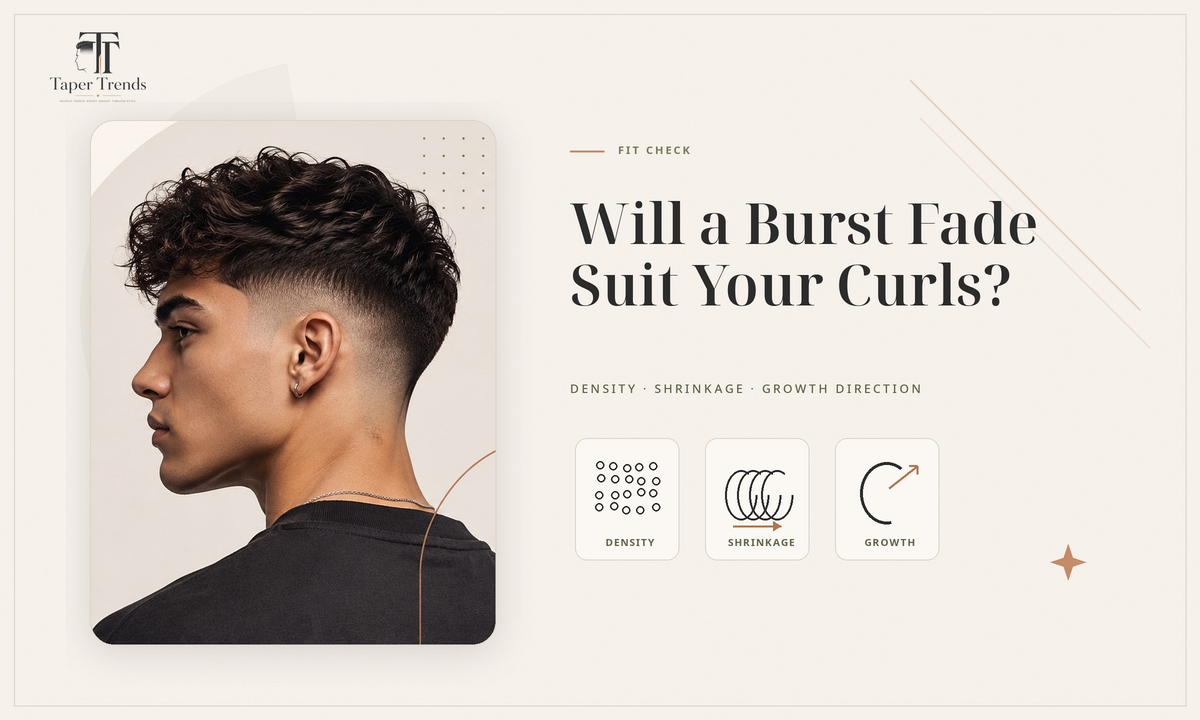
Density, shrinkage, and growth direction change the result more than curl pattern alone. Higher density carries a wider or higher arc without looking thin. Hair that shrinks noticeably as it dries has to be judged in its natural state, or the shape reads correctly only while it is still stretched.
| Factor | How it changes the cut |
|---|---|
| Density | Higher density supports a wider or higher arc; lower density needs more weight left in |
| Strand thickness | Fine strands show scalp sooner at the same guard length |
| Shrinkage | Dry length can sit well short of wet length, so the top is often left longer than it looks wet |
| Crown and cowlick growth | Decides where the arc can blend cleanly into the top |
Barbers differ on whether to cut textured hair wet or dry, and there is no single correct method. What matters is that someone checks how your hair behaves dry before deciding how much to remove. Chemically loosened curls behave differently again, which is why a low taper fade with a perm is planned around the new pattern rather than the old one, and why locs and dreads are measured by the loc, not by the guard.
What face, head-shape, and lifestyle factors matter?
Head shape and the upkeep you will commit to matter more than rigid face-shape rules. A wider or higher arc adds visual height and contrast. A lower, softer one is easier to grow out and stays tidy longer between appointments — the trade-off our low vs high taper fade comparison walks through in detail.
Worth weighing alongside the hair itself
- The shape of your crown and the back of your head
- Neckline length
- Conservative versus statement finish
- How often you realistically get to a barber
- Any workplace or school policy
- Scalp sensitivity around the ear and nape
Should you choose a low, mid, or high burst fade?
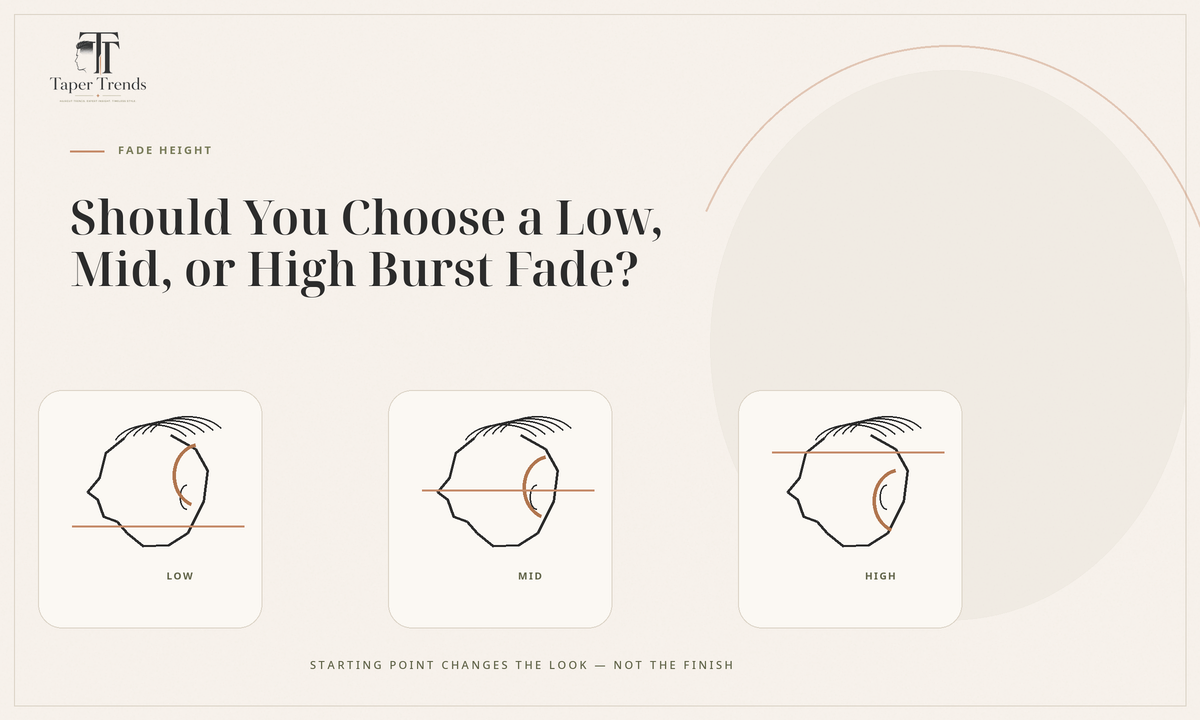
Low, mid, and high describe where the fade begins on the side of the head, not how short it finishes. Wahl's fade guide puts the distinction in the starting line: a low fade begins close to the ear, a high fade starts higher on the head to draw attention to the hair on top, and a mid fade sits between them. The same three heights run through every fade family, from the low-mid taper fade to the high taper fade. For the curved version of the middle setting, see the mid burst fade guide.
| Low | Mid | High | |
|---|---|---|---|
| Starting position | Near the ear | Between the ear and mid-head | Near the top of the head |
| Visual contrast | Subtler | Balanced | Strongest |
| Side weight retained | Most | Moderate | Least |
| Grow-out visibility | Least noticeable | Moderate | Most noticeable |
| Often paired with | Natural neckline, softer finishes | Most top and back styles | Cropped tops, fringes, statement shapes |
None of the three is objectively best; it is a trade-off between contrast and upkeep. Choose low for a subtler transition and an easier grow-out, mid for balanced contrast in most everyday settings — the middle ground our mid taper fade for curly hair guide covers — and high when you want the fade itself to be a visible part of the look, as in a high taper fade afro.
Which curly burst fade style should you show your barber?
Choose by silhouette, retained side and back length, and shortest finish rather than by style name. Two barbers can use one name for different shapes, so treat the names below as starting points and bring both a side and a rear reference photo.
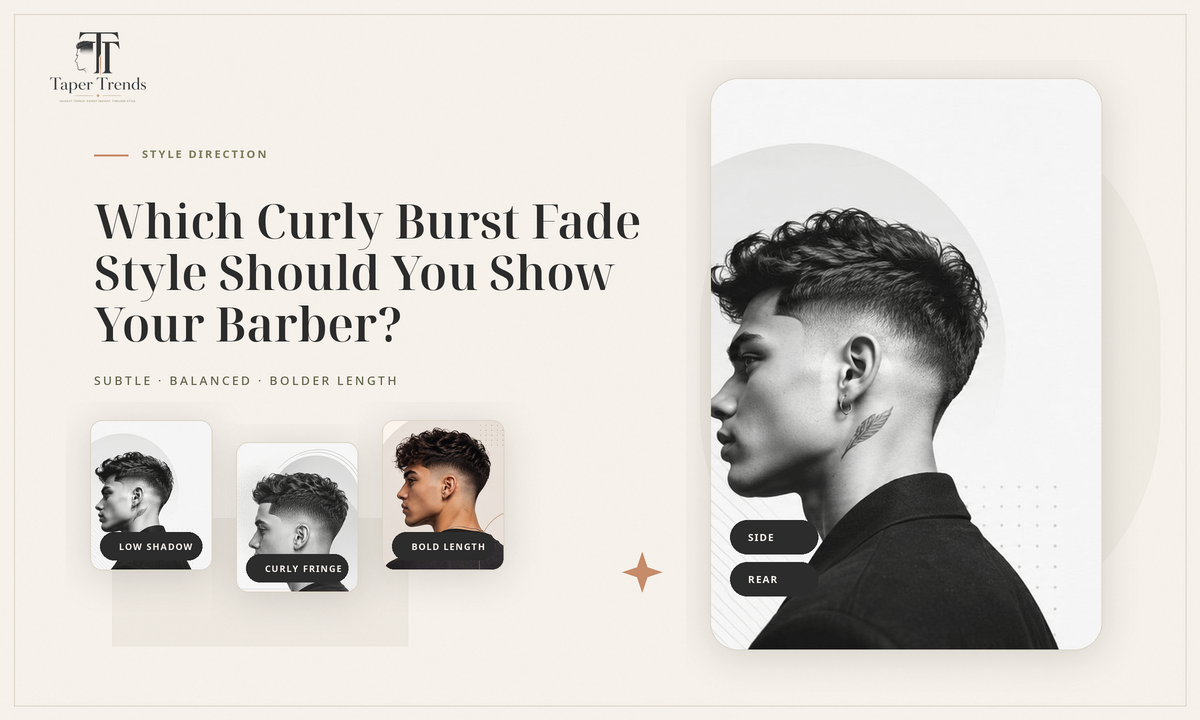
Which options look subtle and grow out softly?
These place the arc lower or stop short of bare skin, so more weight stays around the ear and the transition reads as gradual. A fit if you want the cut to still look intentional weeks after a trim.
Low shadow burst fade
The arc sits close to the ear and stops at a shadow finish rather than skin, leaving very short hair instead of exposed scalp.
Low burst fade with short curls or cropped coils
Cropped curls or coils on top keep the silhouette compact, so upkeep is mostly about the shape of the top rather than a fast-moving contrast line.
Low burst fade with a natural or tapered neckline
The back is left natural or lightly tapered instead of shaped into a hard edge, so the outline grows out without a line to maintain.
Which options balance contrast and everyday versatility?
Mid placement gives enough contrast to read as a defined haircut with less upkeep than a fade starting near the crown. A reasonable default when you are unsure which height to request. A curly fringe here behaves much like the one in our textured fringe with a low taper fade, burst fade textured fringe and drop fade textured fringe guides, and a rounder, fuller top edges toward the blowout low taper fade on curly hair.
Mid burst fade with defined curls or coils
The fade meets defined curls or coils on top, so contrast comes from texture as much as length. A common everyday combination.
Burst fade with curly fringe
A curly fringe is left long enough to fall forward, framing the face while the sides stay controlled by the fade.
Mid burst fade with a rounded curly top
The top is shaped into an even, rounded silhouette instead of pushed in one direction, which suits a wide range of curl densities.
Which options preserve length and make a bolder statement?
These use a higher arc, stronger contrast, or deliberately retained length, so the result reads as a statement. A rear-view reference matters more here, since the back silhouette carries the look — exactly the problem our burst fade mullet guide is built around, and one a low taper fade mohawk shares with the curly burst fade mohawk.
High burst fade with volume
The arc starts higher and removes more side weight so volume on top stands out. Expect regrowth to show sooner than with a lower placement.
Curly burst-fade mullet
The sides are faded short while the back is left noticeably longer, creating a clear contrast between the arc and the back.
Curly frohawk or mohawk
Sides are faded close while a central strip of curls is left longer and styled upward, concentrating volume down the middle of the head.
Burst fade vs drop fade vs taper: what is the difference?
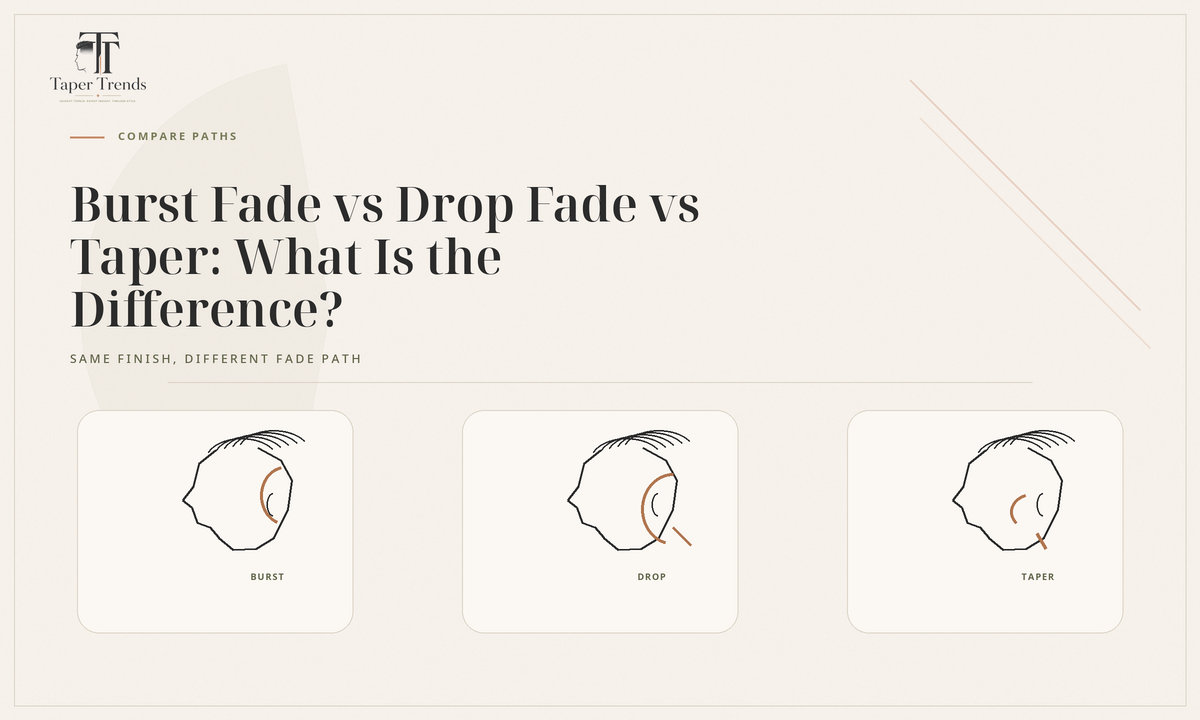
A burst fade concentrates a rounded arc around and just behind the ear without necessarily continuing around the head. A drop fade on curly hair follows a curved line that keeps descending toward the nape. A taper leaves more length at its shortest point and limits graduation to the edges near the ears and neckline. Barbers apply these terms with some variation, so a reference photo still matters; our drop fade vs burst fade comparison shows which angles to check.
| Burst fade | Drop fade | Taper | |
|---|---|---|---|
| Fade path | Arc around and behind the ear | Curved line dropping toward the nape | Graduation limited to the edges |
| Typical contrast | Sharp but localized | Moderate to high, across more of the head | Softer, more length kept overall |
| Rear treatment | Blends into a shorter or natural back | Line usually continues into the back | Neckline graduated, rarely skin |
| Grow-out | Arc softens at its edges | Line blurs gradually along its length | Little visible line to begin with |
None of these names guarantees bare skin or a set length. Skin and zero describe the finish, and either pairs with any of the three paths. Confirm path and finish separately — the distinction our low taper vs low fade breakdown spends its whole length on.
How do you ask your barber for a curly burst fade?
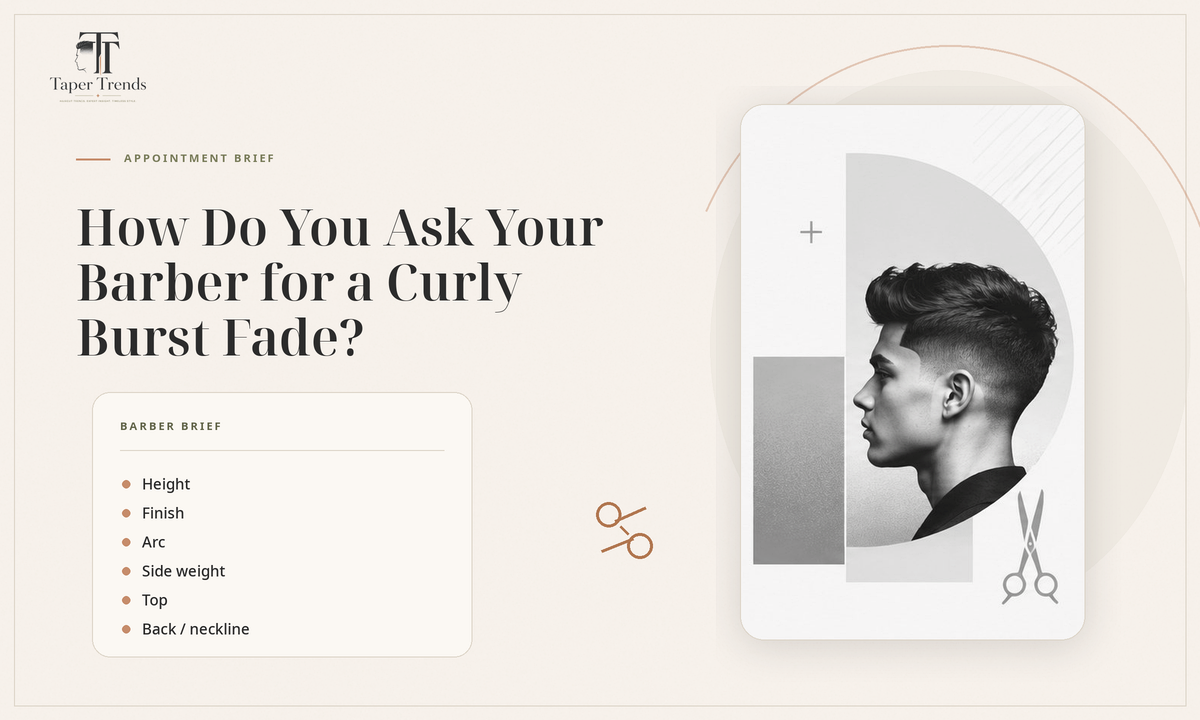
The clearest brief specifies six variables rather than a single style name, paired with side and rear reference photos. Ask the barber to assess your curl pattern in its natural, dry state instead of working from a guard number alone, since guard length says nothing about how far the hair draws up as it dries.
Which six decisions should you make first?
Decide these six things before the appointment. Each changes the result more than the style's name does.
- 1Height. A low, mid, or high arc.
- 2Finish. Skin, zero, shadow, or a guarded shortest point.
- 3Arc. Narrow and tight, or wider and more gradual.
- 4Side weight. How much hair stays directly above the fade.
- 5Top. The length and shape you want once dry, not just a guard number.
- 6Back and neckline. Natural, tapered, or left longer.
Guard numbers describe clipper length, nothing more. Wahl notes that a smaller guide comb leaves shorter hair and that starting longer is safer, since length can always come off later. Describe the result you want and let the barber pick the tool.
What should your barber brief and reference photos include?
The strongest brief pairs a short verbal description with matching side and rear photos, so nothing rests on recalling a style name mid-appointment. State what to keep as clearly as what to remove, and mention your shrinkage and growth direction so the barber can plan for the dry result.
Bring a checklist: what to keep, what to remove, finish preference, how you style the top, and anything in the reference photo you do not want copied. Then adapt this script:
“I would like a [low/mid/high] burst fade that curves around my ear, finished at [skin/zero/shadow]. Please leave [amount] of weight above the arc, keep the top close to [desired result], and leave the back [natural/tapered/longer]. My hair shrinks noticeably as it dries, so please account for that and for how it grows.”
How should you style a curly burst fade?
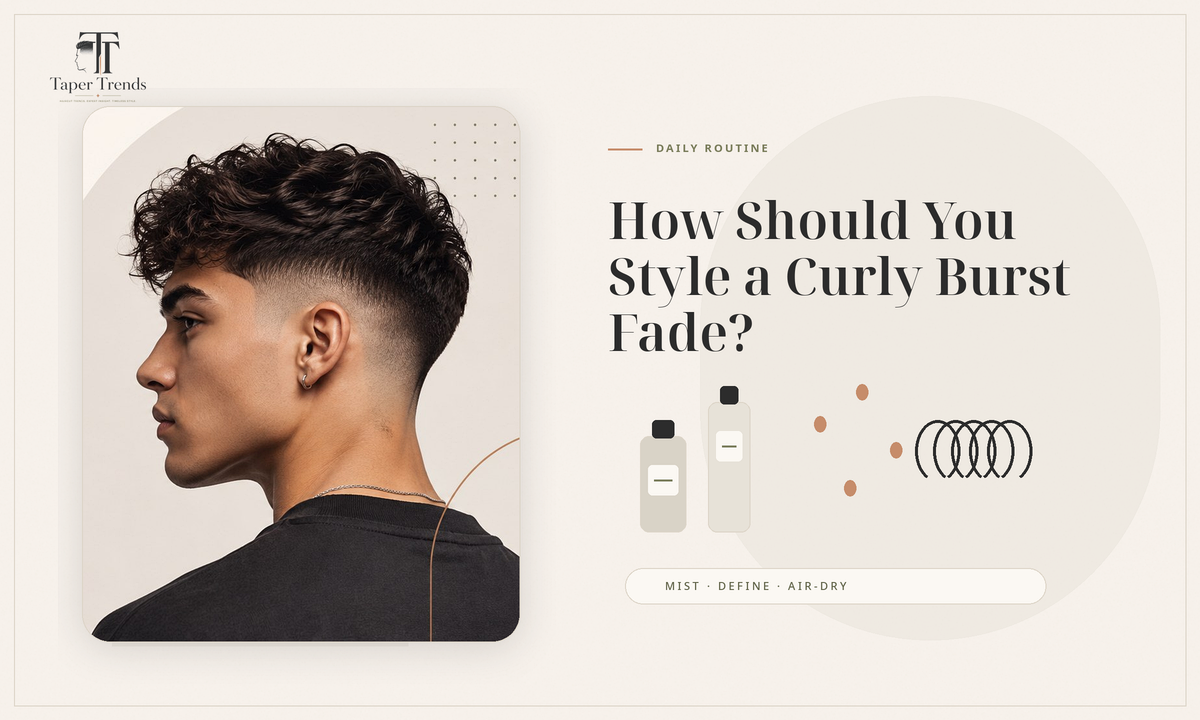
A damp-hair routine works for most patterns: re-wet the hair, work a small amount of leave-in or cream through the lengths, shape by hand, then air-dry or diffuse on low heat. How much product you need depends on density and the hold you want. The AAD suggests applying oil or leave-in conditioner after washing and conditioning to help hold moisture in. Our styling guide for a faded cut covers the product side in more depth.
What is the fastest daily styling routine?
- 1Mist with water until the curls loosen and reform.
- 2Apply a small amount of leave-in or cream through the lengths.
- 3Scrunch or finger-coil to reform the curl pattern.
- 4Position the top or fringe.
- 5Air-dry, or diffuse on low heat with as little handling as possible.
Fine or lower-density curls need less product. Too much weighs the curl down instead of defining it. If you want more height rather than more definition, the round-brush approach in our low taper fade blowout guide is the alternative.
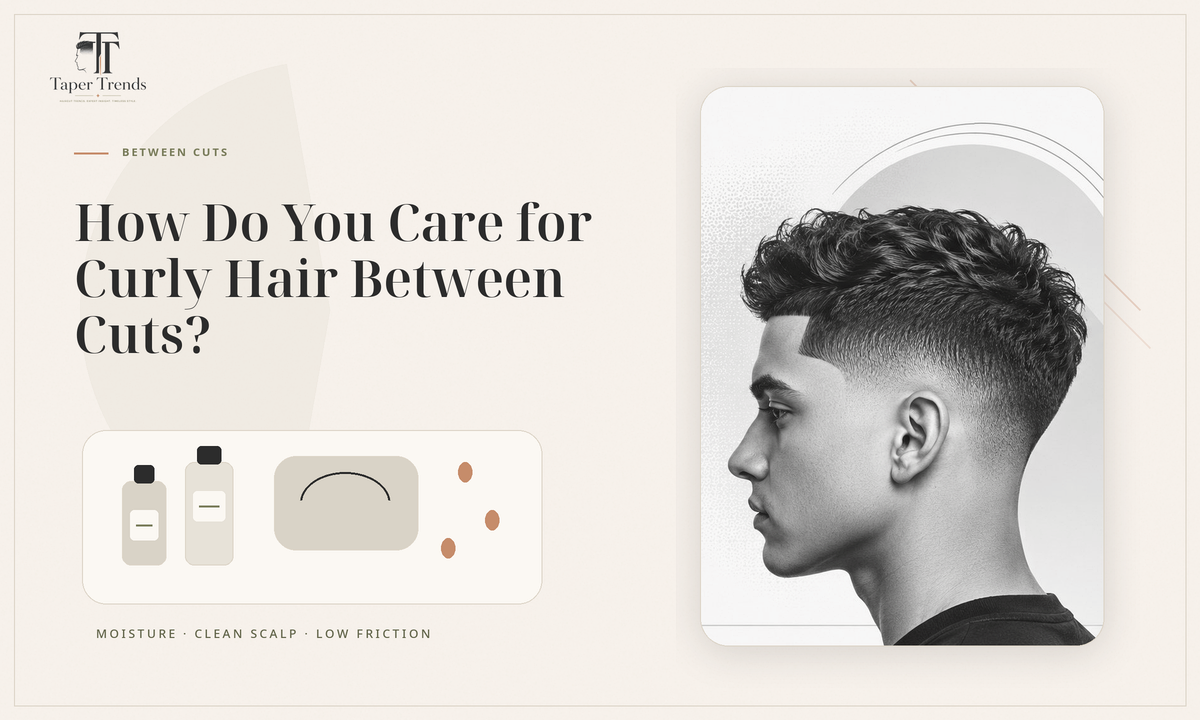
How do you care for curly hair between cuts?
Between cuts, protect moisture, limit mechanical stress, and keep the scalp clean. No wash schedule suits everyone. The American Academy of Dermatology advises washing curly hair only when needed, since thick curly hair rarely needs daily or weekly washing, while still recommending a wash at least every two to three weeks for scalp and hair health.
What should wash-day care include?
Condition all of the hair rather than only the ends. The AAD suggests a clarifying shampoo before a moisturizing one if you regularly use gels, oils, creams, or pomades, and washing long or thick hair in sections to reduce tangling. The same routine keeps a mid taper fade afro or a set of mid taper fade dreads looking sharp between appointments.
How should you protect curls overnight?
Reduce friction while you sleep. Where length allows, the AAD suggests a loose ponytail on top of the head, often called a pineapple, or a loose braid, to preserve the curl pattern and reduce rubbing against the pillowcase. Very short curls mainly need a gentle re-wetting in the morning.
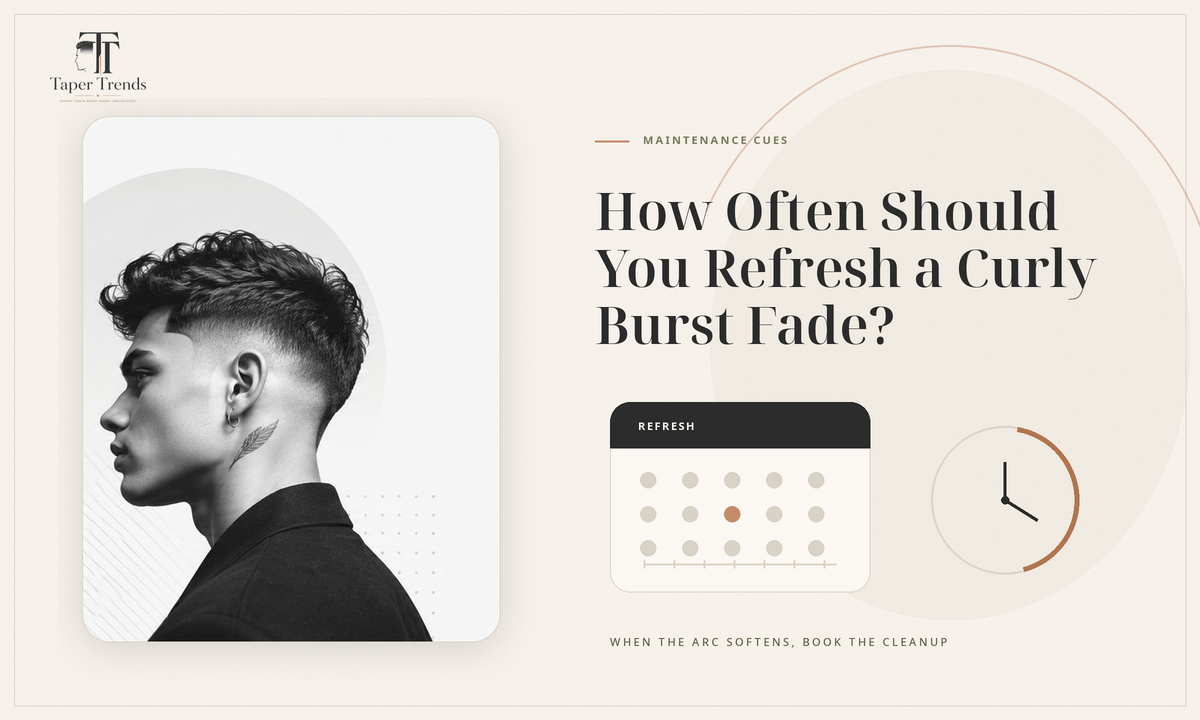
How often should you refresh a curly burst fade?
There is no universal interval. A skin finish with a precise arc needs attention sooner than a shadow finish, because bare skin shows new growth first. Growth rate, finish, and how crisp you want the outline matter more than a fixed number of weeks. Cleaning up the fade is also a separate job from reshaping the curly top.
What signals matter more than a fixed calendar?
Watch for signs instead of counting days
- The arc no longer reads as a clean curve
- Contrast against the top has flattened
- The neckline has drifted from the shape you asked for
- The top has lost its balance
- Styling takes noticeably longer
How do you grow out a curly burst fade cleanly?
Reduce contrast in stages rather than letting the arc grow in unevenly. Soften a skin finish toward shadow, bring a high placement down a step at a time, and stop widening the arc so side weight rebuilds. Use the added length to move toward a taper, a curly crop, a soft mullet, or an all-over scissor shape. A French crop with a low taper fade and a longer-haired low taper fade are both natural landing points, and a burst fade Edgar keeps the arc while trading the curly crop for a blunt front line.
What can go wrong, and how do you fix it?
Most problems trace back to four causes: an arc cut too high or wide, too little side weight to support the curls, shrinkage that was not accounted for, or product too heavy for the density. Naming the symptom helps a barber far more than calling the whole cut wrong.
Which haircut or styling mistakes are most common?
An arc taken too high or wide; ignoring how the hair grows around a crown or cowlick; cutting stretched curls without allowing for recoil; product too heavy for fine curls; and brushing curls dry instead of detangling them wet and conditioned, which the AAD warns causes breakage and frizz.
When should irritation or bumps change the plan?
Persistent, painful, or scarring bumps at the nape are not ordinary razor burn. Clinical guidance on acne keloidalis nuchae from the Primary Care Dermatology Society advises avoiding short haircuts and shaving on the affected area, since close shaving of the neck often aggravates it. See a clinician rather than changing only your barber.
What are the best alternatives to a curly burst fade?
The closest alternatives map to specific objections: a low taper for subtlety, a drop fade for a curve that continues into the back, a temple fade for the least hair removed, and a scissor taper for the slowest grow-out.
| Alternative | Fade path | Contrast | Strongest reason to choose it |
|---|---|---|---|
| Low taper | Edges only, near ears and neckline | Low | You want tidy, not designed |
| Drop fade | Curve continuing toward the nape | Moderate to high | You want the curve to carry around the back |
| Temple fade | Small area at the temples | Lowest | You want to keep almost all your side length |
| Scissor taper | Graduated by scissor, no clipper line | Low | You want the softest grow-out |
If the low taper is the one that appeals, our curly low taper fade guide covers it on textured hair, and low taper fades with waves or a low taper fade with a fringe show the same idea with different tops.
Curly burst fade FAQs
Does a burst fade have to go down to skin?
No. Burst describes the curved fade path, not the finish, and it pairs with a skin, zero, shadow, or guarded finish. State the finish separately from the shape when you describe the cut you want.
How long should curly hair be on top for a burst fade?
There is no universal length in inches. What matters is enough length, after shrinkage, to form the shape you want: cropped curls, a fringe, a rounded top, or a longer mullet-style back. Ask your barber to judge it on dry hair.
Can a burst fade work with loose waves and tight coils?
Yes. It adapts across patterns by adjusting fade height, side weight, and top length. A version built for one density will not automatically translate to another, so treat any example photo as a direction, not a template.
Is a curly burst fade professional enough for work or school?
It can be, particularly a low or shadow version with a controlled neckline and no bare skin. Acceptability depends on the dress code that applies to you, so check the local rule rather than assuming a general standard.
Can fine or low-density curls wear a burst fade?
Yes, if the barber preserves enough supporting weight above the arc and avoids taking it too high or wide. A softer, lower finish and an in-person consultation beat copying a photo taken on denser hair.
Does a burst fade have to be paired with a mullet?
No. A mullet is one pairing among several. Short curls, rounded tops, fringes, cropped coils, and frohawks use the same fade geometry. The mullet describes the back, not the arc itself.
On the school question, our burst fade for boys guide covers this same curved arc on curly and coily hair sized for a younger kid, with its own school-friendly heights and finishes.
Your barber-ready next step
Three decisions settle a curly burst fade: fade height, shortest finish, and what stays on top and at the back. Make those before booking, save a side view of the arc and a rear view of the neckline, and bring the six-point brief. A barber experienced with curly hair will still ask questions beyond the photo, which is a good sign.
Still weighing the shape itself? Read the burst fade haircut guide for the arc on its own, the low taper fade haircuts guide for the quietest version of the same idea, or the full rundown of fade types to place the burst beside everything else on the menu.
The bottom line
Burst names the path of the fade and nothing else. Your curls decide how much weight has to stay above that arc; the height, the finish and the back length are the parts you have to name before the first pass.
Bring a side photo and a rear photo, state the six variables, and say out loud that your hair shrinks as it dries. That one sentence does more for a curly fade than any style name does on its own.
Want more fade guides?
Browse clean, barber-ready breakdowns for every fade shape and hair type.