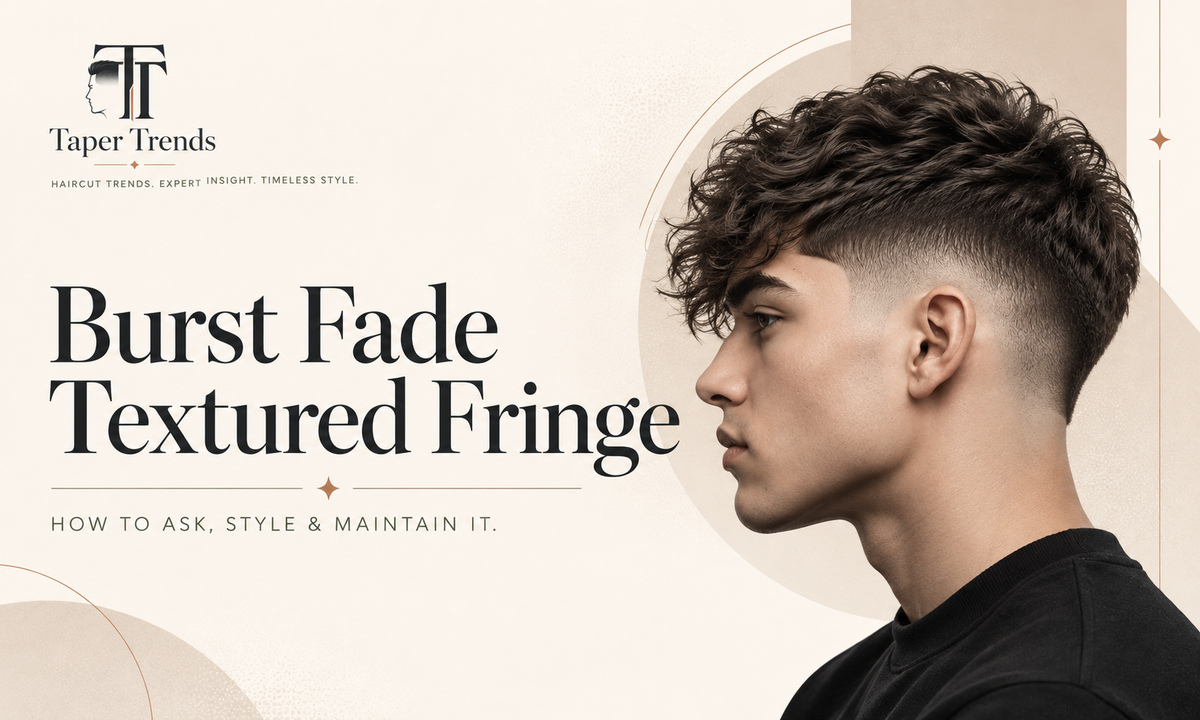
A burst fade textured fringe is a men's haircut that pairs a curved fade around the ear with longer top hair pushed forward into separated, piecey sections. The fade adds contrast to the side profile, and the fringe (bangs, in US usage) frames the forehead. Fade height, shortest length and how much hair stays at the back decide how bold the finished cut looks.
That last point is where most disappointing appointments start. The name describes a family of haircuts rather than one fixed recipe, so two barbers can hear the same words and produce noticeably different results. This guide splits the cut into its parts, shows which versions suit which hair, and ends with a brief you can read out in the chair. If you want the arc on its own first, the complete burst fade haircut guide covers it from every angle, and the low taper fade haircuts guide is the hub for every fade and fringe combination on the site.
What is a burst fade textured fringe?
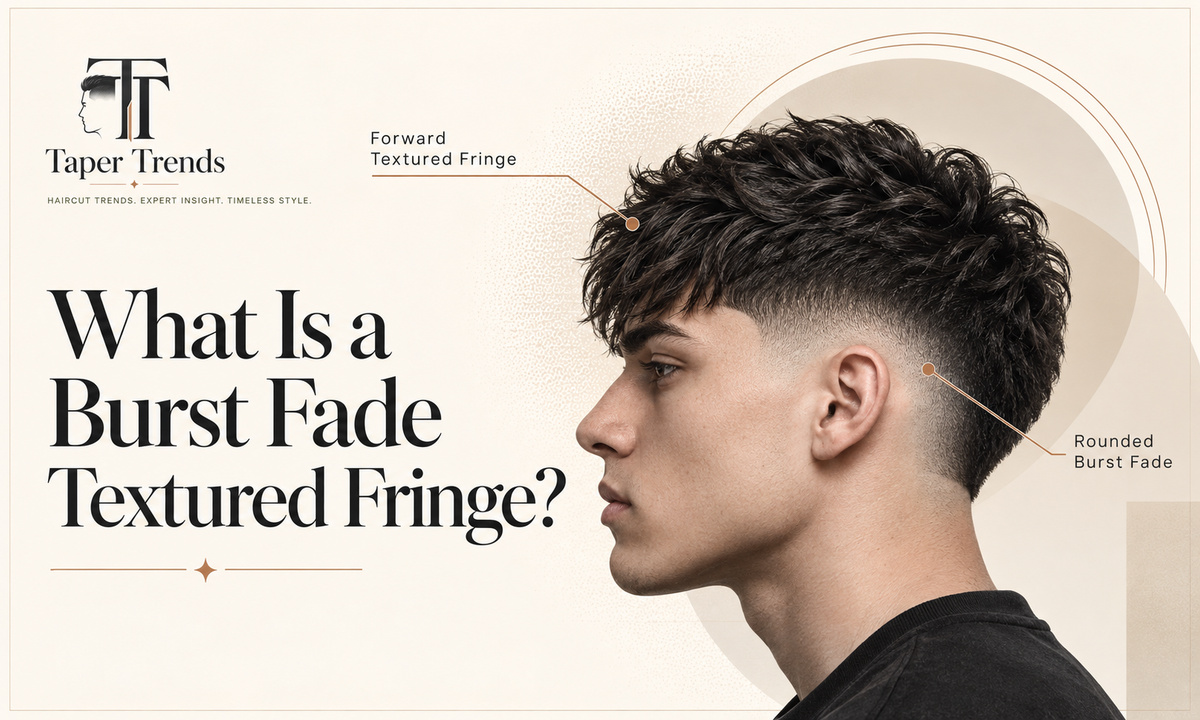
A burst fade textured fringe combines two separate elements: a burst fade, which shortens the hair in a rounded arc centered on the ear, and a textured fringe, which directs longer top hair forward with visible separation. Licensed barber Sebastian Mondragon of Barbers Take describes the burst fade as a semicircular fade that curves around the ear and contrasts with longer hair on the top and back, which is why it pairs so often with fringes, crops and mullets.
Because each element has its own settings, it helps to think of the haircut as a set of dials rather than a single style. The same fringe over a straight-line blend is our textured fringe with a low taper fade; the burst simply swaps the band for a curve.
The rounded fade around the ear
The burst fade starts near the top of the ear and curves down and behind it, so the shortest hair sits in a half-circle instead of a level band running around the head. Placement changes how much of that arc shows. A low burst hugs the ear, a mid burst climbs toward the temple, and a high burst exposes a larger curve with sharper contrast. The taper low burst fade is the quietest version of that curve.
Shape and length are separate decisions. “Burst” tells the barber where to fade, not how short to go, so the shortest point can be bare skin, a zero or a guarded length. Behind the arc, the back usually keeps more weight than it would in a conventional all-around fade, and that retained length is what gives some versions a rounded or mullet-leaning outline — taken all the way, it becomes a burst fade mullet.
The forward textured fringe
On top, the hair is cut long enough to fall or be pushed toward the forehead, then broken up so individual sections stay visible. Barbers usually create that separation with point cutting, which means snipping into the ends instead of cutting one straight line, and the finish comes from a matte product rather than gel or shine. Our low taper fade fringe guide covers where a fringe should land on different foreheads.
Texture is not the same as removing as much hair as possible. Fine hair often needs its weight kept so the fringe doesn't look sparse. Thick hair may need bulk taken from inside the top section so it sits closer to the head, and curly hair needs enough length left for its dried, shrunken shape. The fringe itself can stop high on the forehead for a cropped look or drop toward the brows for more coverage.
Who does a burst fade textured fringe suit?
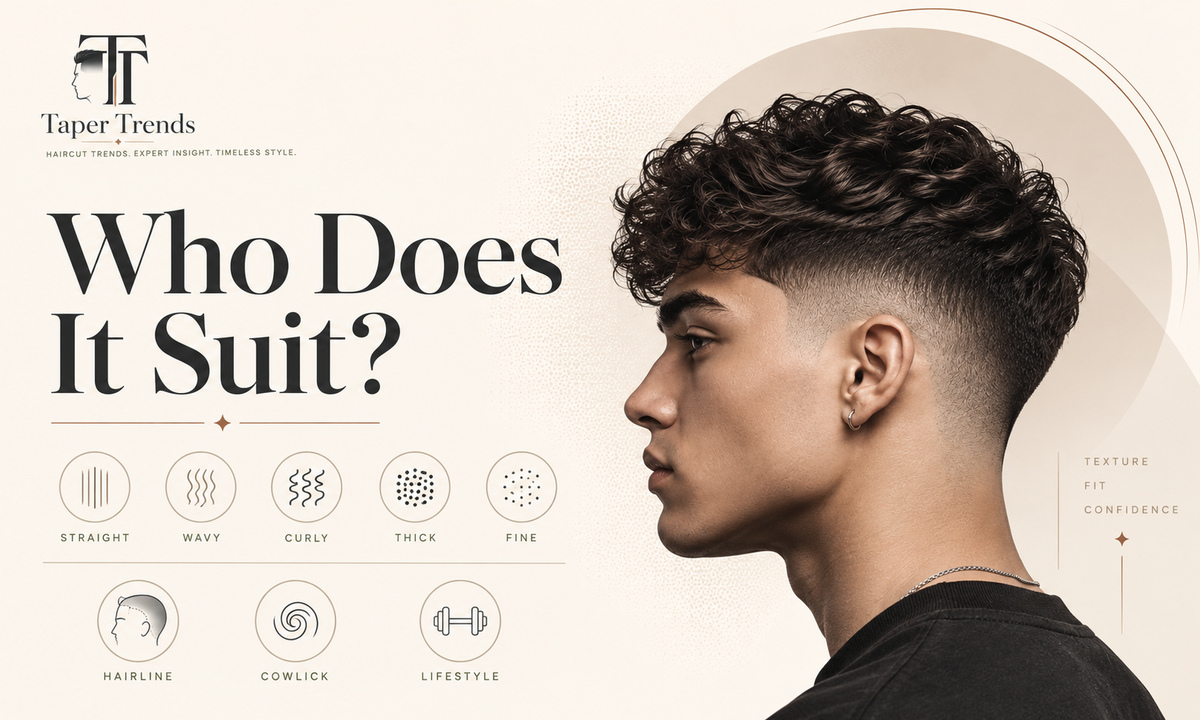
A burst fade textured fringe works on straight, wavy, curly and coily hair, provided there is enough top length to form a fringe. Suitability depends less on face shape than on hair density, growth direction, how the hair behaves when dry, and how much styling and upkeep the wearer will tolerate. A good barber adjusts the cut to those factors.
Hair type and density
| Hair type | Why it can work | What to watch | What the barber adjusts |
|---|---|---|---|
| Fine or low density | Side contrast makes the top look fuller | Heavy thinning leaves gaps in the fringe | Keeps weight, uses light point cutting |
| Straight, medium density | Holds a forward direction easily | Can lie flat and look helmet-like | Adds separation at the ends |
| Wavy | Natural bend adds movement with little product | Short fringes can spring up when dry | Leaves extra length at the front |
| Curly or coily | Curl groups create texture on their own | Shrinkage shortens the fringe after drying | Judges length dry, keeps curls intact |
| Thick | Plenty of hair to build shape | Top can grow wide and heavy | Removes bulk from inside, keeps structure |
Every row points to the same rule: the barber should cut for how your hair looks dry on an ordinary day, not how it looks wet in the chair. Each texture has its own burst guide worth reading next — the burst fade on straight hair, the drop fade on straight hair, the burst fade on curly hair and the burst fade for Black men on coils, waves and twists. For density specifically, the low taper fade on thin and thick hair explains how barbers keep or remove weight, and the low taper fade on wavy hair deals with fringes that spring up as they dry.
Hairline, cowlicks and lifestyle fit
Face-shape rules are a weak guide here because fringe length and width can be changed to suit almost any proportions. A longer, fuller fringe covers more forehead, and a shorter or broken one shows more skin. What a fringe can't do is reliably hide a receding hairline. It may soften how much forehead shows, but that is not the same as concealing recession — the low taper fade for fine, straight hair is honest about what a fringe can and can't do there.
A strong cowlick, a patch of hair that grows in a swirl or a different direction, changes the plan. Forcing that section straight forward rarely lasts until lunchtime, so an angled or asymmetrical fringe, or a little extra weight left over the cowlick, usually works better. Mention it before the cutting starts.
Then there's the practical side. A high skin burst looks bold and shows regrowth quickly, while a low or shadow version looks quieter and grows out more gently. If your school or employer has a written grooming policy, check it before choosing the bolder end of the range.
Which burst fade textured fringe variation should you choose?
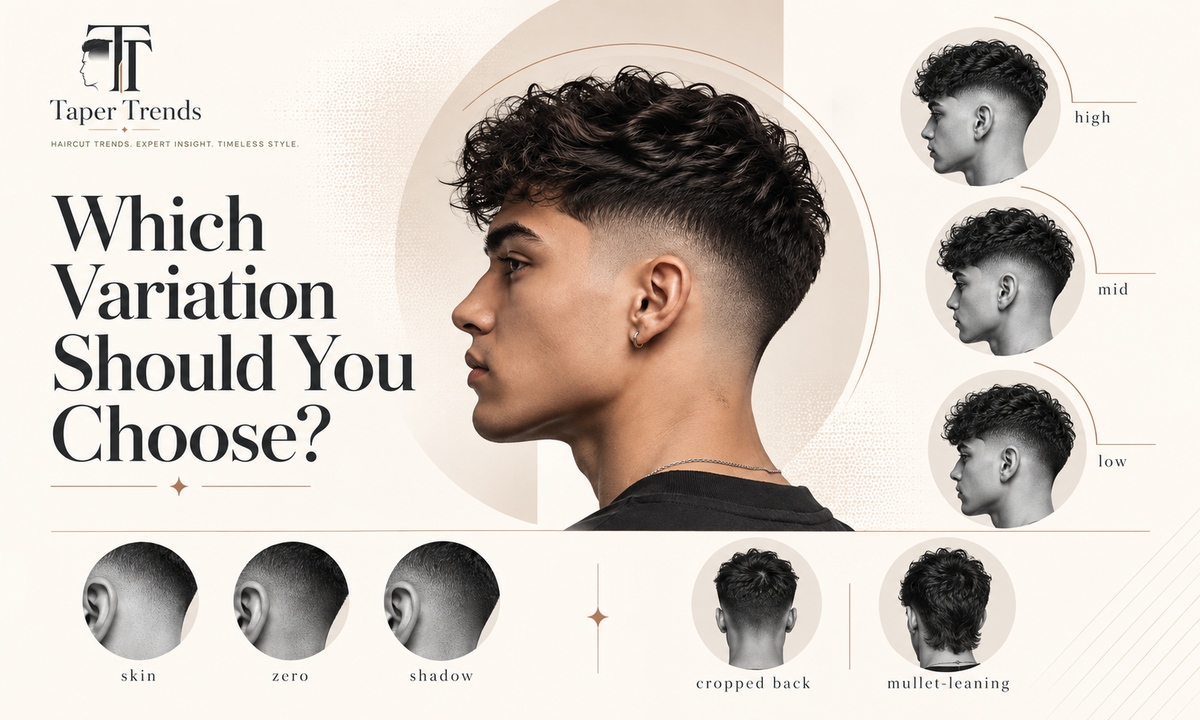
Choose a low or shadow burst for a softer transition, a mid burst for balanced contrast, or a high skin burst for the strongest side profile. Then decide separately how much length stays at the back. The back profile, more than the fringe, decides whether the finished haircut looks neat and cropped or closer to a mullet.
Fade placement and finish
Placement controls where the arc sits. Finish controls how short the shortest hair gets. Mixing up the two is one of the most common reasons people end up with more scalp showing than they expected.
| Option | Choice | Visual effect | Good fit for |
|---|---|---|---|
| Low burst | Placement | Small arc, more hair around it | Understated, everyday contrast |
| Mid burst | Placement | Clear arc that doesn't dominate the head | Most hair densities and settings |
| High burst | Placement | Large, exposed curve | Thick tops that can balance it |
| Skin or bald | Finish | Sharpest contrast, fastest visible regrowth | Wearers happy to book often |
| Zero | Finish | Very short, with a faint shadow of hair | A crisp look with less bare skin |
| Guarded or shadow | Finish | Softer blend, gentler grow-out | Sensitive skin or stricter dress codes |
Placement and finish combine freely. Barbers Take points to the low skin burst as an understated option, which suits people who want sharpness without a large exposed arc. If you're weighing heights, the same logic runs through the straight-line fades: compare the mid taper fade with a textured fringe and the high taper fade with a textured fringe, or read the low vs high taper comparison for how contrast and upkeep move together.
Fringe length and back profile
A short, broken fringe shows more forehead and takes less styling. Without clear forward direction and separation, though, it can drift toward a French crop or a burst fade Edgar. A longer, sweeping fringe gives more movement and coverage but needs more drying control each morning.
At the back, a cropped profile keeps the haircut close to a conventional fade. Leaving more weight behind the arc pushes it toward a soft mullet, which some people want and others are horrified to discover in the mirror. Either is fine. The mistake is leaving it unspoken. The low taper fade mullet and mid taper fade mullet show what a weighted back looks like once it has grown in, and the drop fade mullet shows it under a curve that dips behind the ear.
How does it compare with similar haircuts?
A burst fade shortens the hair in a rounded arc around the ear, a drop fade continues its curve down behind the ear toward the nape, and a low taper shortens mainly the edges near the sideburns and neckline. On top, a textured fringe is looser than an Edgar's blunt line or a Caesar's uniform crop, and it overlaps heavily with a French crop.
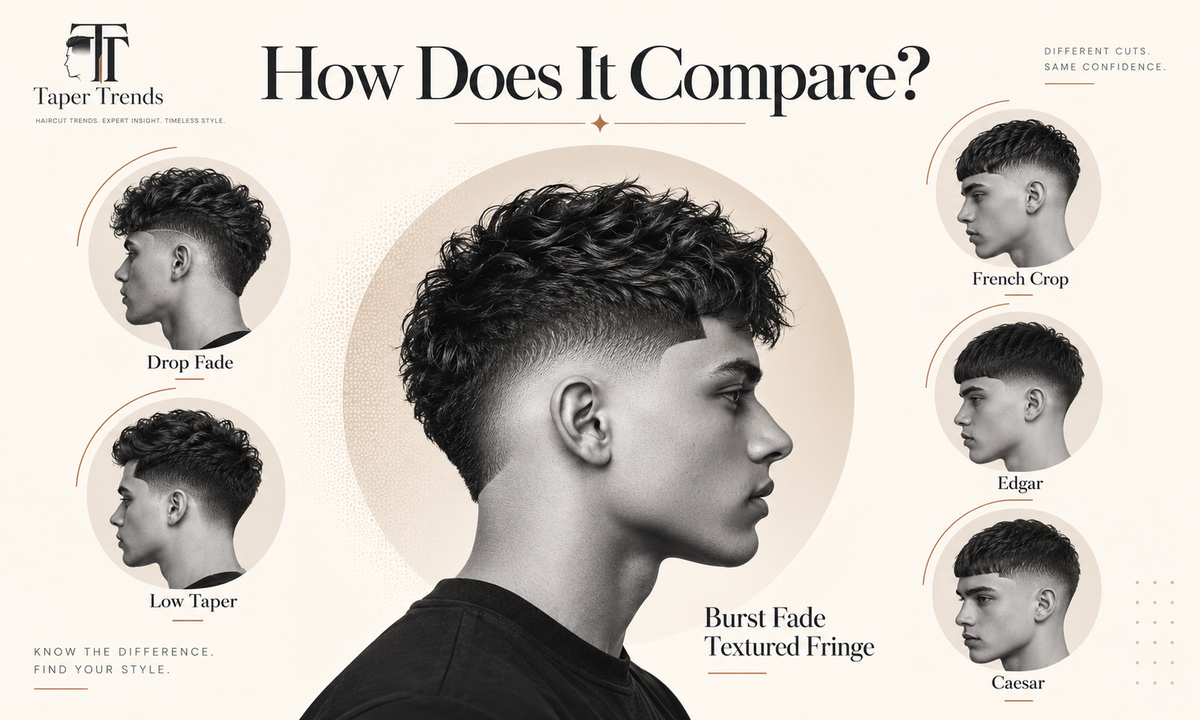
Burst fade vs drop fade vs low taper and blowout taper
| Cut | Where the shortest hair sits | Back length | Overall contrast | Grow-out |
|---|---|---|---|---|
| Burst fade | Half-circle centered on the ear | Often kept longer | Medium to high | The arc blurs first |
| Drop fade | Curves from the temple, behind the ear, to the nape | Shortened more evenly | Medium to high | Gradual, all around |
| Low taper | Edges at the sideburns and neckline | Close to natural length | Low | Soft and forgiving |
According to Barbers Take, the burst fade concentrates on the sides around the ear, while the drop fade blends lower into the back near the neckline and gives a smoother overall silhouette. You'll also see “blowout taper with textured fringe” on social media. That label is used loosely, usually for a low taper with a fuller, blow-dried top, so show your barber a photo rather than relying on the name. Our drop fade vs burst fade comparison explains the burst-versus-drop split in full.
Our low taper drop fade shows the drop shape on its own, our drop fade textured fringe puts this same fringe on that curve, the low taper fade blowout covers the blow-dried top people usually mean by “blowout taper,” the taper vs fade explainer untangles the two words, and the rundown of every kind of fade haircut puts the burst beside all its relatives.
Textured fringe vs French crop vs Edgar vs Caesar
| Top style | Front edge | Top length | Typical sides |
|---|---|---|---|
| Textured fringe | Irregular, separated pieces | Short to medium | Any fade, often a burst |
| French crop | Textured, often choppy | Short, with a longer fringe | Usually a fade |
| Edgar | Blunt, straight horizontal line | Short and blocky | Often a high or skin fade |
| Caesar | Short, even fringe | Very short, clipper length | Short or faded |
Barber and Wahl Pro educator Trevor Moots told PureWow that a Caesar is cut with a clipper guard and shows little texture, while a French crop is styled forward with a textured, usually longer fringe. The Edgar is defined mainly by its straight-across fringe and tapered sides, and it is most associated with young Latino wearers in the US — our mid taper fade Edgar and Hispanic and Mexican low taper fade guides cover that culture and cut in detail.
In practice, a textured fringe on a burst fade sits very close to a French crop on top. What separates it is the burst on the sides and the length kept at the back, which is exactly why reference photos work better than haircut names.
How to ask your barber for a burst fade textured fringe
Ask for a burst fade textured fringe as five decisions: burst height, shortest length, back profile, fringe length and amount of texture. Bring front, side and rear reference photos, and say what you don't want as well as what you do. Haircut names vary between shops and regions, so a specific brief is more reliable than the name alone.
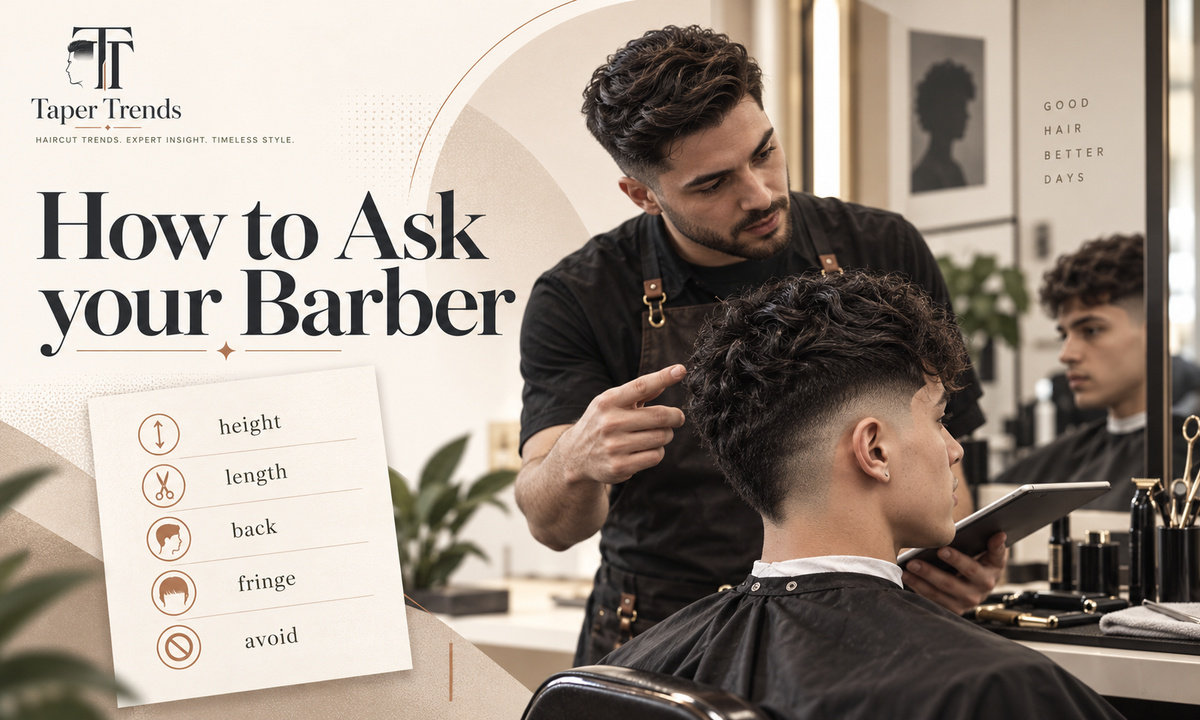
Five decisions to make before the appointment
- Fade height: low, mid or high relative to the ear.
- Shortest length: skin, zero, or a guarded shadow finish.
- Back and neckline: cropped close, or weighted with length kept behind the arc, plus whether the neckline should look natural, rounded or sharply lined.
- Fringe length and edge: where it should land when dry, and whether the edge is broken or more even.
- Texture: how much separation you want in the fringe, and where weight should stay, especially if your hair is fine.
Decide these at home. It's much harder to think clearly about neckline shape with a cape around your neck and a queue of customers behind you. The low taper fade from every angle is a useful way to practise judging front, side and back views before you choose photos.
Reference photos, a sample brief and a final check
Bring at least three photos: a front view of the fringe, a side view showing fade height, and a rear view showing how much length stays at the back. The rear photo is the one people forget, and it's where many mismatches happen, since the client pictures a tidy back while the barber assumes more length is wanted. Pick examples with hair similar to yours where you can, and add one photo of a result you want to avoid.
A fill-in brief keeps the conversation specific:
“A [low/mid/high] burst around the ear, down to [skin/zero/guard], with the back kept [cropped/weighted]. Leave the fringe around [where it lands dry], with [light/medium/heavy] separation, and please avoid [the result you don't want].”
Before the first clipper pass, repeat the fade height, shortest length, back shape and dry fringe length out loud. A misunderstanding takes seconds to fix in conversation and weeks to fix once the hair is gone.
How to style a burst fade textured fringe at home
To style a burst fade textured fringe, start with damp hair, apply a light pre-styler, blow-dry the top forward while lifting the roots, then separate the fringe with a small amount of matte product. Fine hair needs lighter products, and curly hair needs moisture and gentler airflow. A well-styled fringe moves when you move instead of sitting in one solid piece.
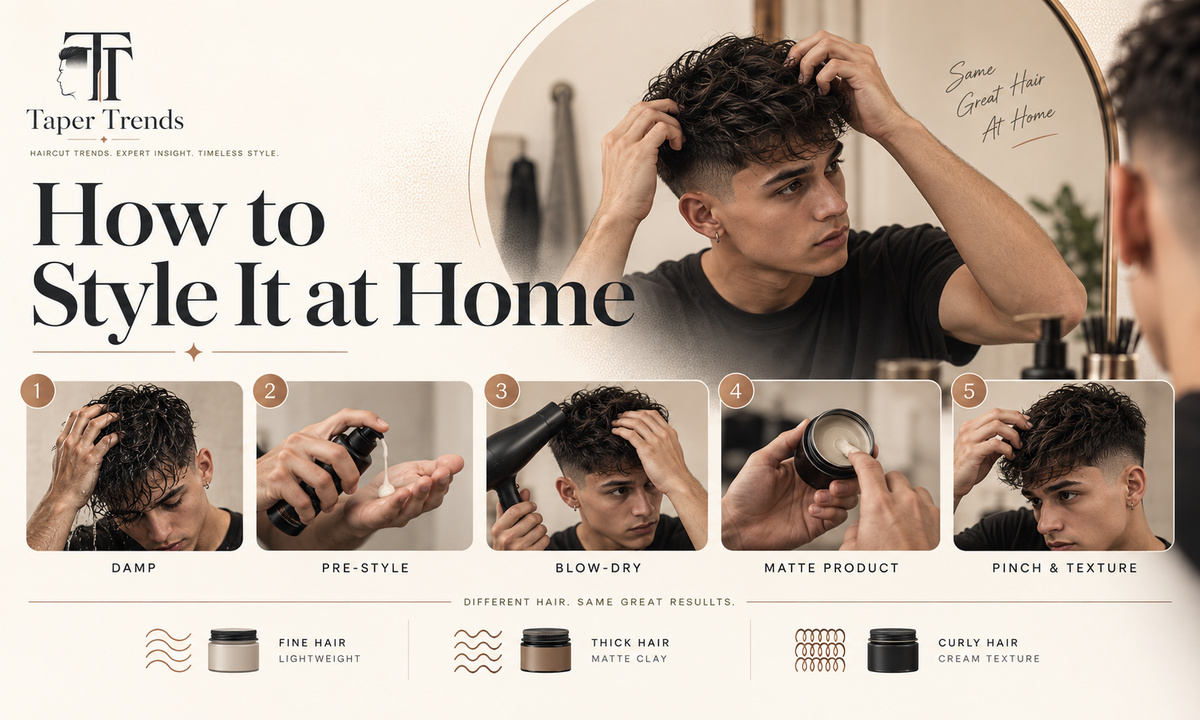
Five-step styling routine
- Dampen the hair evenly, without soaking it, to reset the direction it slept in.
- Apply a pre-styler suited to your hair: sea-salt spray or mousse for straight and wavy hair, curl cream for curls, plus a heat protectant if you'll use a dryer.
- Dry the top forward, lifting at the roots with your fingers. Curly hair usually does better with a diffuser or a lower heat setting.
- Warm a small amount of matte paste, clay or texture powder between your palms and work it through the mid-lengths and ends, away from the roots. Start with less than you think you need.
- Pinch and twist a few fringe sections with your fingertips to break up uniformity.
The order matches the routine Moots gave PureWow for a French crop: sea-salt spray on damp hair, forward blow-drying or diffusing, then texture powder once the hair is dry. Our guide to styling a low taper fade walks through the same drying-first approach step by step.
Products by hair type and common mistakes
| Hair type | Product direction | Main caution |
|---|---|---|
| Fine or low density | Light spray, mousse or a little powder | Heavy clay flattens roots and exposes gaps |
| Straight, medium density | Pre-styler plus light matte paste | Too much product creates stiff spikes |
| Thick or wavy | Small amount of paste or pliable clay | Product piled at the front looks patchy |
| Curly or coily | Curl cream or mousse, optional light finisher | Brushing breaks up curl groups |
Most styling problems come from two habits: using too much product and skipping the drying step. If the fringe looks greasy by midday, use less product before switching brands. If the top falls flat, it needs more lift during drying, not more hold afterward — the low taper fade on fluffy hair explains what actually creates that lift. Spiky texture usually means the sections being twisted are too small. And if the fringe keeps splitting into wide gaps, that's a cutting issue, so ask for more weight to be kept at the next appointment.
Curly and coily fringes follow different rules. The curly low taper fade covers moisture and diffusing, and the mid taper fade on wavy hair shows how to keep a bend moving without frizz.
How to maintain a burst fade textured fringe
Barbershop guidance usually puts a burst fade touch-up at about two to three weeks. Tight skin versions look sharpest for only one to two weeks, while lower, guarded versions stay neat for longer. The fade and the fringe grow at the same rate but lose their shape differently, so they can be maintained on separate schedules.
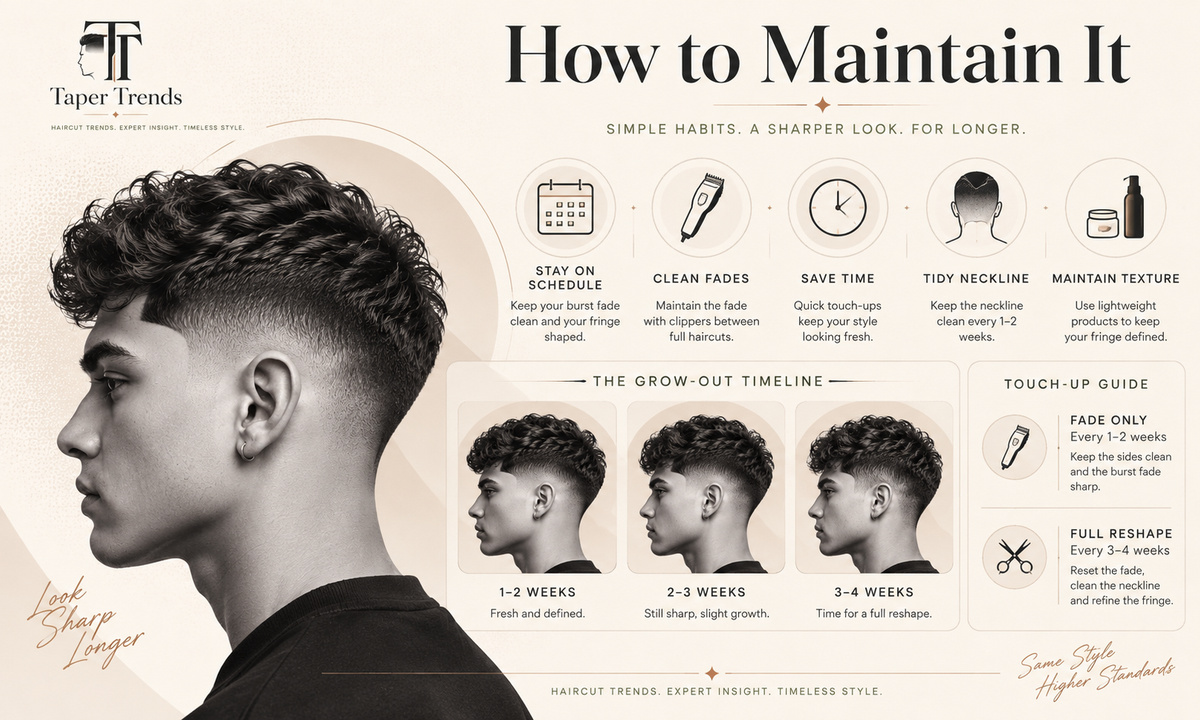
Touch-up timing and grow-out
The Bus Stop Barbershop groups burst and drop fades together at two to three weeks, because their curved shapes lose definition quickly. Mr. Winston's Barbershop shows how much contrast matters: skin fades typically stay sharp for one to two weeks, while low fades can stay clean for three to four weeks or longer. Growth rates differ from person to person, so treat these as starting points and adjust after your first cycle. To choose between the three skin heights, read our low, mid and high skin fade comparison before you book.
Not every visit needs a full haircut. A fade-only touch-up restores the arc and neckline without touching the fringe, while a full reshape resets height, length and texture together. If you like how the back looks as it grows, you can let it develop toward a fuller, mullet-leaning shape instead of trimming it each time. If you'd rather grow out of the fade entirely, the low taper vs low fade comparison explains the softer option you'd land on.
Home touch-ups are risky with this cut. Tidying stray neckline hairs is manageable, but trying to redo the arc yourself can raise it, leave the two sides uneven or push the fade too far into the back.
Fringe, scalp and skin problems
Most appearance problems are styling or cutting issues: oily residue, a flat top from too little lift, or a sparse fringe after over-thinning. Those can be fixed at home or at the next appointment.
Skin problems are different. Cleveland Clinic explains that ingrown hairs, sometimes called razor bumps or barber bumps, are more likely with frequent shaving and in people with thick, coarse or curly hair, because the regrowing hair can curl back into the skin. If you're prone to them, a guarded or shadow finish is a reasonable alternative to taking the arc down to skin — the high taper fade for Black men covers bump-safe finishes in more detail. Bumps that grow, become more painful or fill with pus can signal infection and need a healthcare provider.
Recurring bumps or raised scars on the back of the neck and scalp deserve attention too. The American Academy of Dermatology notes that acne keloidalis nuchae is often mistaken for acne or razor bumps in that area and advises seeing a board-certified dermatologist when the bumps appear, since the condition tends to worsen without treatment.
Should you get a burst fade textured fringe or an alternative?
A burst fade textured fringe suits people who want visible side contrast and forward texture, and who don't mind daily styling and a touch-up every few weeks. It is a weaker choice for anyone who wants a haircut they can ignore for six weeks, or who dislikes visible scalp. For them, a softer relative of the cut usually works better.
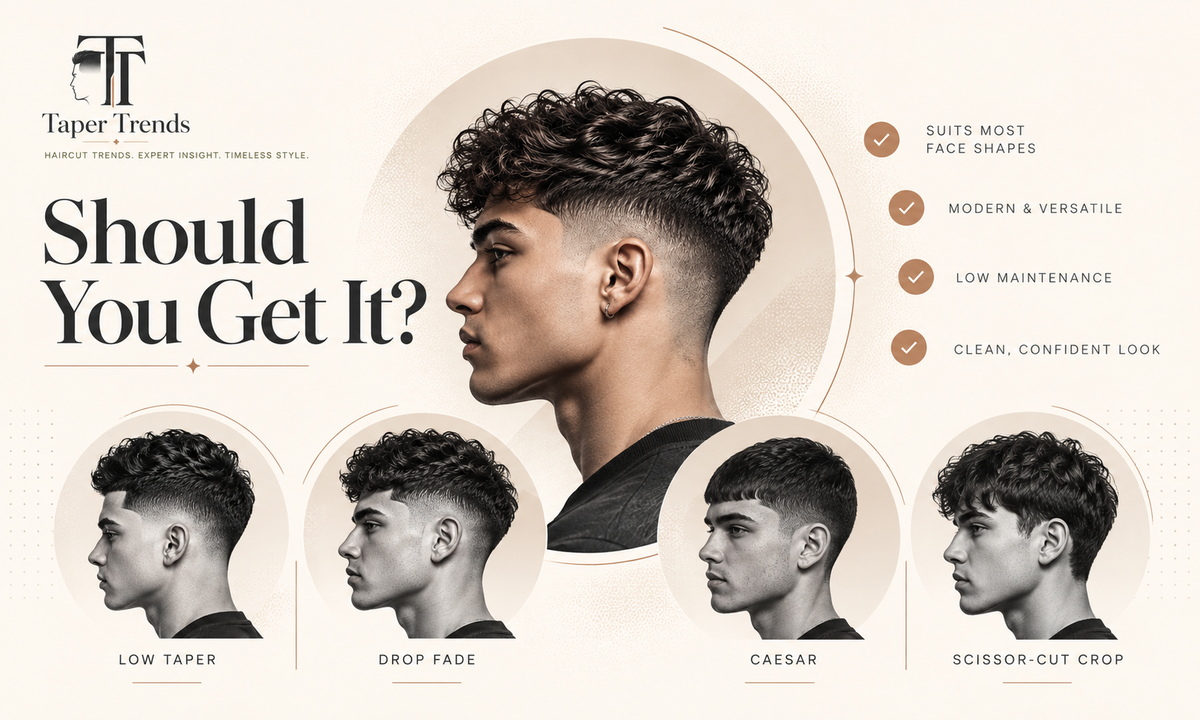
Decision checklist
It's a strong fit if you:
- Want a defined curve at the side rather than an all-over fade
- Have, or can grow, enough top length for a forward fringe
- Are comfortable booking regular fade touch-ups
- Will blow-dry or use a small amount of product on most days
- Have found a barber whose portfolio shows both burst fades and textured tops
Alternatives by objection
| If this bothers you | Ask about |
|---|---|
| Exposed scalp at the sides | Low taper with a textured fringe |
| Harsh grow-out | Shadow burst or scissor-cut taper |
| Extra length at the back | Drop fade or a cropped textured cut |
| Daily styling | Short French crop or Caesar cut |
| Not enough length at the back | Soft mullet with a burst fade |
| Clippers close to the skin at all | Scissor-cut textured crop with no fade |
If the fringe is the part you love but you want a different shape on top, the burst fade mohawk keeps the same arc under a center strip, and the low taper fade middle part is the natural next step once the fringe grows long enough to split.
Frequently asked questions
How long does the top need to be before the cut?
There is no universal minimum top length for a burst fade textured fringe, because curl pattern, shrinkage and where you want the fringe to land all change the requirement. The practical test is whether the front hair, when dry, already reaches or can be pushed to your intended fringe line. Ask the barber to check it dry, since wet hair looks longer, especially on curly and wavy textures.
Can a burst fade textured fringe work with a cowlick?
Yes, with some adjustment. Instead of forcing every strand forward, a barber can angle the fringe, leave extra weight over the cowlick or shorten that section slightly to reduce lift. Strong cowlicks usually suit a broken or asymmetrical fringe better than an even, straight-across edge, so point out where yours is during the consultation.
Does it work with thinning hair or a receding hairline?
Sometimes. A forward textured fringe can reduce how much forehead shows, but heavy texturizing can make low-density hair look thinner, so barbers usually keep weight on top and choose a softer fade. No haircut reliably hides ongoing hair loss. For sudden, patchy or worsening thinning, the American Academy of Dermatology recommends seeing a board-certified dermatologist to find the cause.
Do you need a skin fade for this haircut?
No. In a burst fade, “burst” describes the rounded placement of the fade, not how short the shortest hair is. A skin burst gives the sharpest contrast and shows regrowth soonest. A zero, guarded or shadow burst looks softer, grows out more gently and may suit sensitive skin or stricter dress codes better. Pick the finish for comfort and upkeep rather than for the name.
How long does it take to style each morning?
Styling time for a burst fade textured fringe depends on hair texture and how polished you want the result, so there is no single honest number. Straight hair mostly needs one pass of directional drying and a small amount of product. Curly or coily hair may take longer because it needs moisture and diffusing to limit frizz. The routine usually gets quicker once the cut suits your hair’s natural direction.
Is the cut appropriate for school or work?
Often, yes. A burst fade textured fringe usually fits school and work settings when the fade is low or shadowed, the back is kept tidy and the fringe is neat rather than long and loose. A high skin burst or mullet-leaning back looks bolder and may not suit stricter settings. Grooming rules differ between schools, employers and countries, so check the written policy that applies to you rather than assuming.
For sudden, patchy or worsening thinning, the American Academy of Dermatology recommends seeing a board-certified dermatologist. On the school question, our burst fade for boys guide covers this curved arc sized for a kid, and the low taper fade for boys and the high taper fade for boys cover dress-code-friendly straight-line versions of a fringe and fade.
Before you book
Pick a fade height and finish, decide what happens at the back, and choose a fringe length that works with your hair's natural direction. Save front, side and rear photos, and ask the barber to judge your length dry. If you're unsure how bold to go, start lower and softer, because a gentle version is easier to take further next time than a high skin burst is to grow out.
Still comparing? The burst fade haircut guide covers the arc on its own, the full taper fade guide places low, mid and high side by side, and the low taper fade haircuts guide is the hub for every variation. For the closest fringe neighbors, read the textured fringe low taper, the mid taper textured fringe, the high taper textured fringe or the burst fade Edgar.
The bottom line
“Burst fade textured fringe” names two elements and settles none of their settings. Fade height, shortest length, the back, fringe length and texture are still yours to decide.
Once a cut turns out right, photograph it from all three angles. Those photos will be the most useful brief you ever bring to a barber.
Want more fade guides?
Browse clean, barber-ready breakdowns for every fade shape and hair type.