A drop fade mulletis a mullet whose faded sides curve downward behind the ear while the crown and back stay long. “Drop” describes the path of the fade line, not how short the sides go or how high the fade starts. Three choices decide the result: the fade's shape, its height and shortest length, and how much hair stays through the crown and back. Settle those before the appointment and your barber has nothing to guess.
For the same curve without the long back, see our complete drop fade guide, and for every taper, fade and mullet on the site, start at the low taper fade haircuts guide.
What is a drop fade mullet?
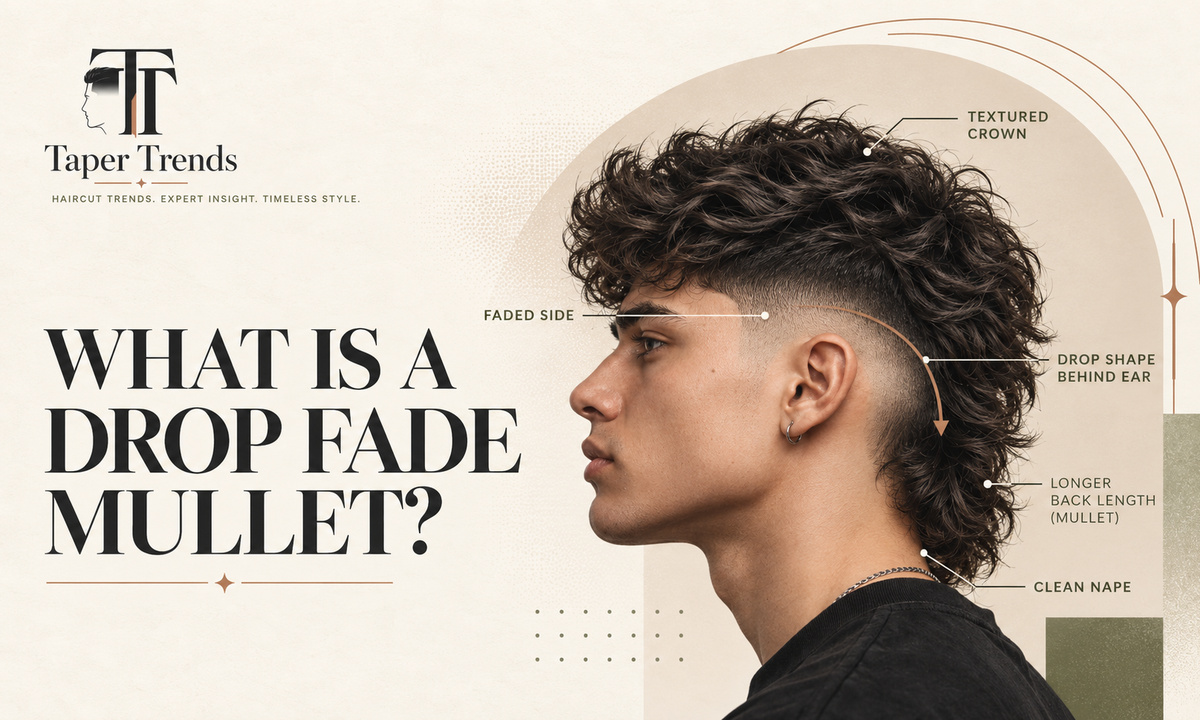
A drop fade mullet pairs a fade that arcs downward behind the ear with the deliberately longer crown and back of a mullet. The drop is a shape, not a length. The same drop fade can start low or high and finish at bare skin or at visible stubble, and it is still a drop fade.
In barber training terms, CADMEN Barber Academy describes the drop fade as a standard fade with one change: the graduation line curves downward as it passes behind the ear instead of running level around the head. On a mullet, that curve also protects the length at the back. Our guide to the different kinds of fade haircuts lays out shape, height and finish side by side.
The anatomy of the cut
Five zones matter: the faded sides, the area behind the ear where the line starts to drop, the top, the crown and the nape. The sides set the contrast, and the nape is where the haircut reads as a mullet. The crown is the zone people forget. It links the top to the back, and if it is cut too short, the back looks like it belongs to a different haircut. Hairstyle Atlas warns that a fade wrapped around the whole back leaves a short haircut with a strip of tail below it, which is not a mullet at all.
Why the drop shape works with a mullet
Because the line dips behind the ear, the center back keeps more length than a level fade would leave at the same side height, CADMEN explains. That retained weight is what a mullet needs. One catch: in CADMEN's description of a standard drop fade, the arc reaches its lowest point near the center of the neckline. On a mullet, you usually want the curve to descend behind the ear and then hand over to the long back, which is how Hairstyle Atlas describes a well-cut mullet fade. If your barber hears only “drop fade,” the nape may get faded too, so say where the fade should stop.
Drop fade mullet vs burst fade, taper and regular fade
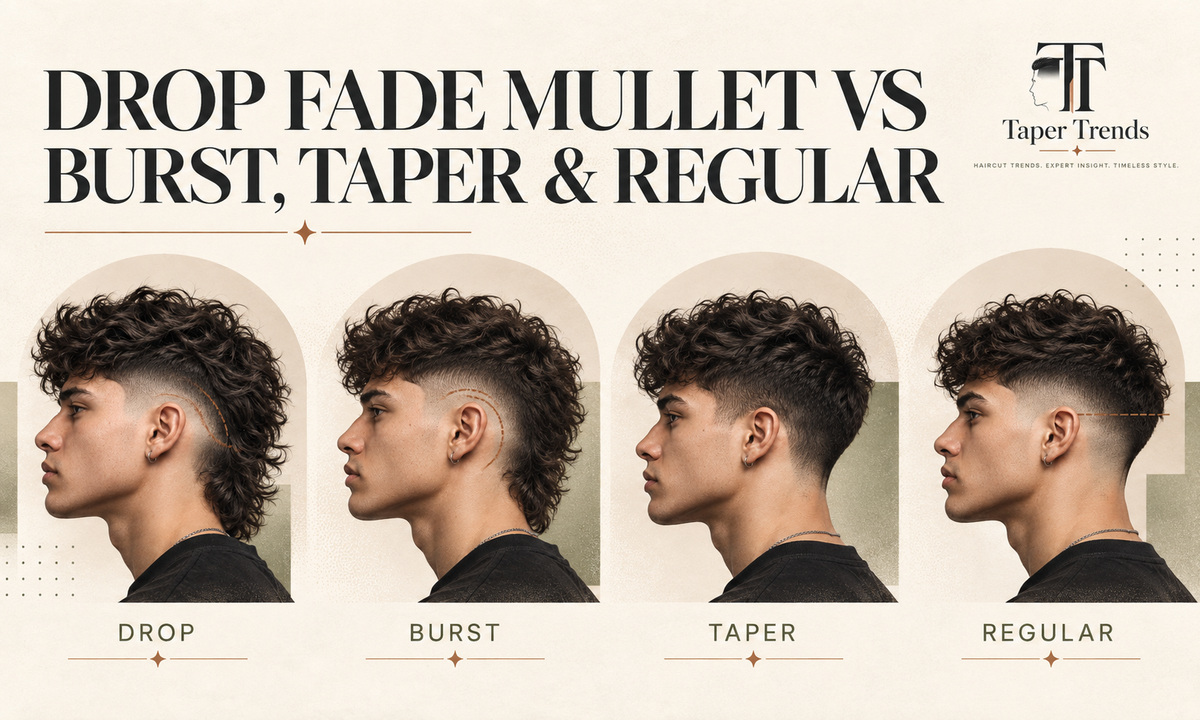
None of these fades is better in general. They differ in where the shortest hair travels around the ear and the back of the head, which changes how much side hair disappears and how much rear weight survives. Choose by the silhouette you want, then confirm it with photos, because shops do not use these names consistently.
| Style | Where the short zone goes | Effect on a mullet |
|---|---|---|
| Drop fade | Arcs downward behind the ear | Keeps more weight at the center back than a level fade |
| Burst fade | Semicircle centered on the ear | Exposes the ear; more hair stays above the temple and behind the ear |
| Taper | Only the edges go short, usually without bare skin | Softest contrast; most side weight stays |
| Regular fade | Roughly level around the sides and back | Can remove nape length if carried around the back |
Drop fade mullet vs burst fade mullet
Both fades are curved. According to CADMEN's burst fade guide, the difference is where the lowest point of the curve sits: a drop fade dips toward the back of the neckline, while a burst forms a semicircle centered around the ear. Hairstyle Atlas adds that a burst keeps full hair above the temple and behind the ear, so it removes less of the side than a drop does. Our drop fade vs burst fade comparison lays the two shapes side by side, our burst fade mullet guide covers the ear-centered version in full, and the burst fade haircut guide shows the burst under every top.
In real shops the labels blur. A 2022 Beardbrand feature described its drop fade mullet as faded farther back on the head, somewhere between a short mullet and a mohawk. That is not what a barber school would draw, which is why side and rear photos beat the name. If the mohawk end of that spectrum appeals, our burst fade mohawk and low taper fade mohawk guides show where the two shapes split.
Drop fade mullet vs taper mullet
A taper is about depth and edges rather than path. CADMEN describes a taper as stopping at short, visible stubble instead of bare skin, and Hairstyle Atlas calls the taper mullet the quietest version, short only at the hairline around the ear. Because shape and depth are separate choices, you can combine them. A low drop fade finished at taper depth gives you the curve without any bare skin, which is exactly the low taper drop fade. For the level-line taper versions, compare our low taper fade mullet and mid taper fade mullet guides, and our taper vs fade explainer untangles the depth vocabulary.
Drop fade mullet vs standard fade mullet
A standard fade runs at roughly one height around the sides and back, so on a mullet it tends to wrap the nape and eat into the length the haircut depends on. A drop fade lowers the line behind the ear, so more hair survives at the back. Our burst fade vs taper fade breakdown shows the same trade-off from the burst side.
Low, mid or high drop fade mullet: which should you choose?
Choose the height by how much contrast you want and how often you will see a barber. A low drop fade keeps most of the side hair and looks subtle, a high one removes nearly all of it and looks loud, and mid sits between them. Height is a separate decision from the drop. CADMEN breaks every fade into level, depth and shape, and “drop” is only the shape.
| Height | Where it starts (per CADMEN) | Contrast | Good fit if |
|---|---|---|---|
| Low | Just above the natural hairline; lower quarter to third of the side | Subtle | It is your first mullet or you need a quieter look |
| Mid | Around the temple midpoint; roughly the lower half of the side | Clear | You want visible contrast and can keep regular appointments |
| High | Near the top of the sides, just below the crown | Maximum | You want a bold look and will maintain it |
Low drop fade mullet
A low fade keeps most of the side length, so the mullet shows mainly from the side and back. Hairstyle Atlas recommends a low taper version as the safest first mullet because it grows out gracefully and survives a missed appointment. Our low drop fade guide covers this height under every top.
Mid drop fade mullet
A mid fade gives clear contrast with the top without the starkness of a high fade. This is also where upkeep starts to matter. Hairstyle Atlas notes that a mid skin section fills in within about a week and looks visibly softer by week three. See our mid drop fade guide for where the mid line sits and the guard numbers behind it.
High drop fade mullet
A high fade leaves almost no side length, so the crown and back have to do more of the work. Hairstyle Atlas warns that a high skin fade over a back that only reaches the nape reads as a regular cut someone forgot to get trimmed. If you want this height, plan for more back length and more frequent visits. Our high drop fade guide explains the high start, and the high taper fade mullet shows a softer, level-line way to wear the same height.
Skin, shadow or taper finish
“Drop” does not mean skin. A skin fade takes the shortest zone to bare skin, while a shadow or taper finish stops at short visible stubble. CADMEN notes that taper-depth fades grow out more gracefully because there is no bare skin to mark new growth. Any height can take any finish, so a high drop to stubble and a low drop to skin are both normal requests. Our clipper guard size chart converts each guard number to inches and millimeters if you want to name a stubble length.
Drop fade mullet variations by hair type and length
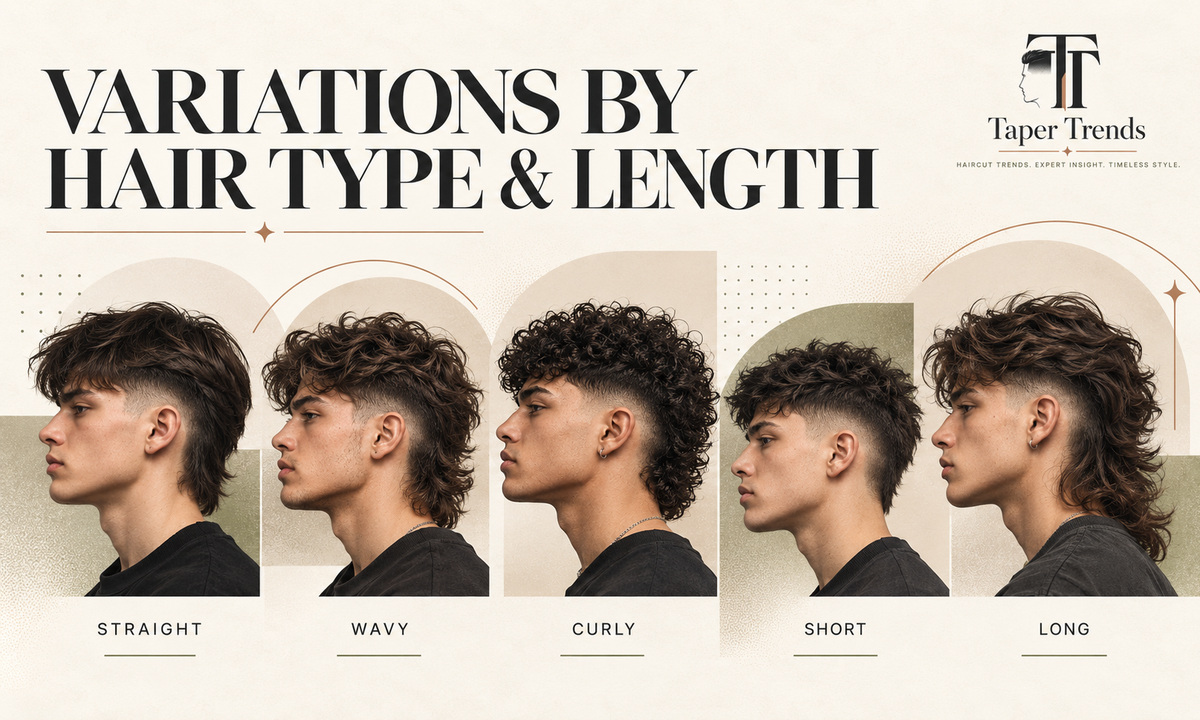
Keep the same drop fade geometry and adapt the crown, back and texture work to your hair. Texture changes how much length to leave, how much weight to remove and how much styling you will do. The back-length ranges below come from Hairstyle Atlas and are starting points, not rules.
Straight hair drop fade mullet
Straight hair shows every layer and perimeter line, so a blunt back or a thin crown is hard to hide. Barbers Take, a guide written by a licensed barber, says straight hair rewards bold layering and sharp point-cutting. Hairstyle Atlas suggests about 3 to 4 inches at the back, point cut so the ends break up instead of sitting like a helmet edge. Fine straight hair needs gentler thinning. Our drop fade for straight hair, burst fade for straight hair and high taper fade for straight hair guides show how straight tops behave over a close fade.
Wavy drop fade mullet
Hairstyle Atlas and Barbers Take both rate waves as the easiest texture for a mullet, because the top and back create their own movement. Hairstyle Atlas offers 3 to 5 inches at the back as a starting range and says every fade height works on wavy hair. Ask for light texturizing rather than heavy thinning. Our low taper fade for wavy hair and mid taper fade for wavy hair guides cover how much length waves need to show.
Curly or coily drop fade mullet
Curls shrink as they dry, so decide where you want the back to sit when your hair is dry and natural, then let the barber cut for that. Hairstyle Atlas suggests asking for the length to be measured wet, around 4 to 5 inches. Keep enough weight at the crown so the top and back stay connected. The long section also needs moisture, because the American Academy of Dermatology (AAD) notes that thick, curly hair is more prone to dryness and breakage than other types. Our drop fade for curly hair, drop fade for Black men and burst fade on curly hair guides go deeper on curl and coil tops.
Short drop fade mullet
A short version leaves only a modest step of extra length at the back, making it the lowest-commitment option. Beardbrand's 2022 article called the drop fade mullet a starting point for easing into mullets or growing one out of a skin fade, since it needs less back length and grows out well.
Longer, layered drop fade mullet
A longer back widens the gap between sides and back, so the crown carries more of the design. Layering through the crown and nape lets the length step down instead of hanging as one block. Barbers Take advises keeping a long back conditioned and trimmed at the ends to prevent split ends. For more length across the whole head, our mid taper fade for long hair and long hair low taper fade guides show the same layering logic.
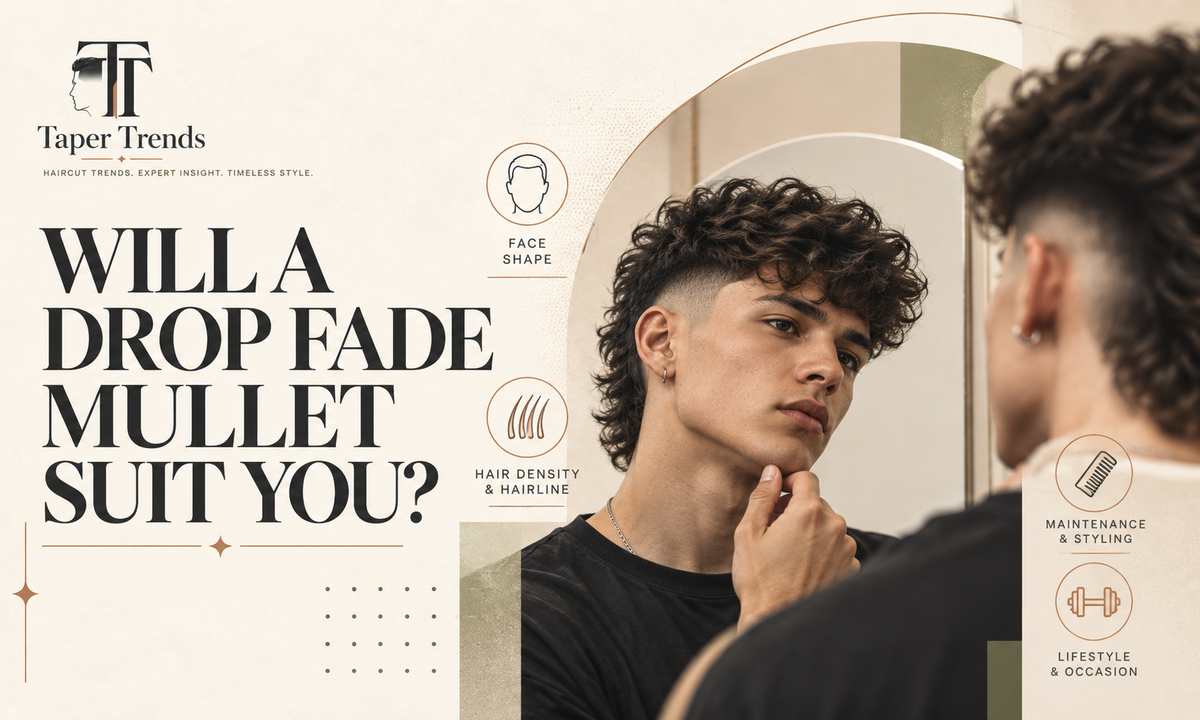
Will a drop fade mullet suit you?
Whether a drop fade mullet suits you depends less on a face-shape label than on side width, head shape, hair density, growth pattern, preferred contrast and the upkeep you will accept. The same cut can look balanced on one person and sparse on another with an identical face shape.
Face shape and head shape
Face-shape rules for this cut contradict each other. CADMEN's drop fade guide says the arc suits elongated and rectangular faces, its fade-types guide says oval and round, Barbers Take says oval and oblong, and FashionBeans says oval and square. When four sources name four different shapes, treat the rule as loose. If you still want a starting point, our face shape detector gives you one in a few seconds.
Side width is the more useful lens. CADMEN's general fade guidance is that mid and high fades reduce width on rounder or wider faces, while low and mid fades avoid over-lengthening longer or narrower ones. Ask your barber how much width each height would remove from your head specifically. Our low vs high taper fade comparison shows how much side width each height takes away.
Hair density, hairline and growth pattern
Barbers Take does not recommend a mullet as a first choice for fine or thinning hair, because the cut depends on density. For anyone who wants one anyway, it suggests a softer, shorter, more blended version without an extreme fade or an overly long tail. Crown hair often grows in a whorl, which changes how the back sits, and front cowlicks affect a fringe, as our drop fade textured fringe guide explains. Mention both before the cut. Our taper fade guide for thin and thick hair explains how density changes what a fade can carry.
Is it practical for your routine?
Match the finish to your schedule. A skin-level drop fade stays crisp for a shorter time than a shadow or taper finish, and Hairstyle Atlas suggests a taper mullet for anyone who sees a barber about once a month. A drop fade mullet is a sensible choice if these all apply:
- You want visible contrast and can book a fade touch-up every few weeks.
- You are happy to spend a few minutes styling the top and back.
- Your hair has enough density at the crown to connect the top and back.
How to ask your barber for a drop fade mullet
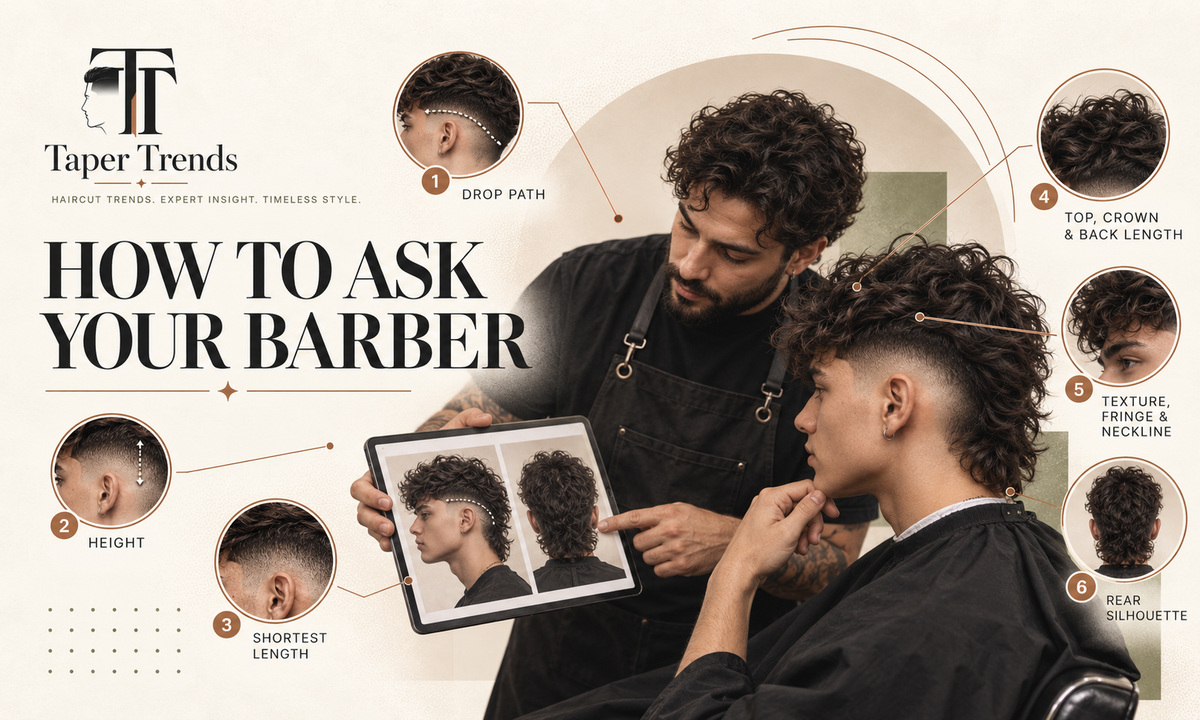
Do not ask only for “a drop fade mullet.” Name the fade path, height, shortest length, top and crown length, back length and finish, and bring side and rear photos. That prevents the most common mismatch: two people using the same name for different haircuts.
Six decisions to specify before the clippers start
Six variables decide the result more reliably than the name. Settle them in this order, because each one limits the next.
- 1. Confirm the drop pathSay where the arc should dip, and ask that the fade stop behind the ear instead of continuing across the nape. Hairstyle Atlas treats that single instruction as the one that prevents the most common mullet fade mistake.
- 2. Choose low, mid or highPoint to the spot on your head where the fade should top out. Hairstyle Atlas notes that height terms drift between barbers, and pointing removes the guesswork.
- 3. Choose the shortest lengthSay skin, shadow or a visible stubble length. If you want no bare skin at all, say so outright.
- 4. Set the top, crown and back lengthGive inches, or show where the back should land on your collar. For curly hair, describe where the back should sit when dry.
- 5. Choose texture, fringe and necklineAsk for point cutting or layering, say which way the fringe falls, and choose a natural or defined neckline.
- 6. Confirm the rear silhouette before cuttingAsk your barber to repeat the plan: where the fade stops, how much crown stays and how long the back will be. CADMEN points out that an uneven drop arc cannot be corrected by blending, so it has to be re-cut or grown back.
Here is an example, with the numbers adjusted to your own hair:
“Low drop fade to skin, stopping behind the ear with the center back kept full. About 3 inches on top, a layered crown, and the back to my collar, point cut, with a natural neckline.”
If you'd rather build the script step by step, our barber brief generator turns the same decisions into a note you can show on your phone.
What reference photos should you bring?
Bring at least one clean side view showing the fade path and one rear view showing how much back and nape remain. Hairstyle Atlas recommends a side profile because that is where a mullet fade shows its shape, and Barbers Take advises choosing photos of hair similar in texture to yours. A front-only photo hides both the drop and the back length. Our guide to what a low taper fade looks like from every angle shows the kind of side and rear shots worth saving.
How to style a drop fade mullet at home
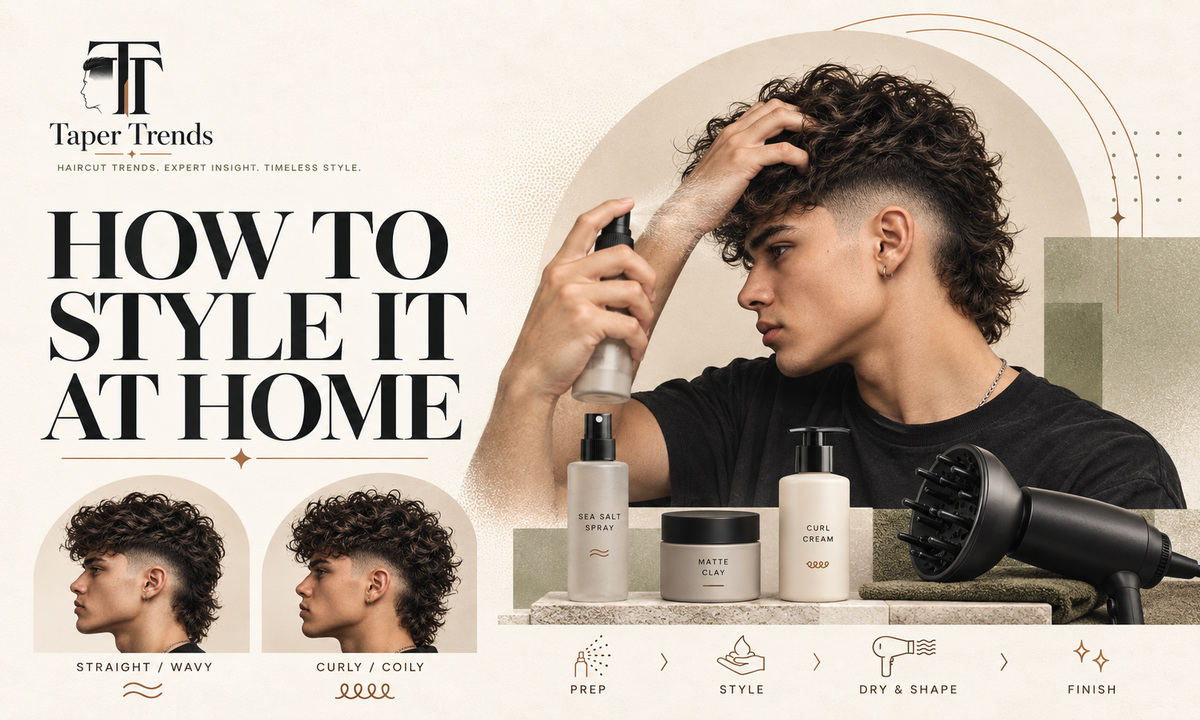
Style the longer top, crown and back, and leave the faded sides alone, since they rarely need product. Pick products by hair texture rather than by the haircut's name. Barbers Take sums up the goal as control with movement, not stiffness. Our guide to styling a taper fade covers the blow-dry and product basics in more depth.
Straight and wavy hair
- Towel-dry until the hair is damp, not soaking.
- Add a light pre-styler such as sea salt spray, which Barbers Take says adds grit and movement to any texture.
- Dry forward and up, or air-dry, then work a small amount of matte clay or paste through the top and back.
Curly and coily hair
- Condition all of your hair, not just the ends. The AAD says curly hair is drier than other hair types and recommends oil or leave-in conditioner after washing.
- Scrunch a curl cream or light mousse into damp hair.
- Air-dry or diffuse. The AAD advises against brushing curly hair while it is dry, which can cause breakage and frizz.
Maintenance, grow-out and skin considerations
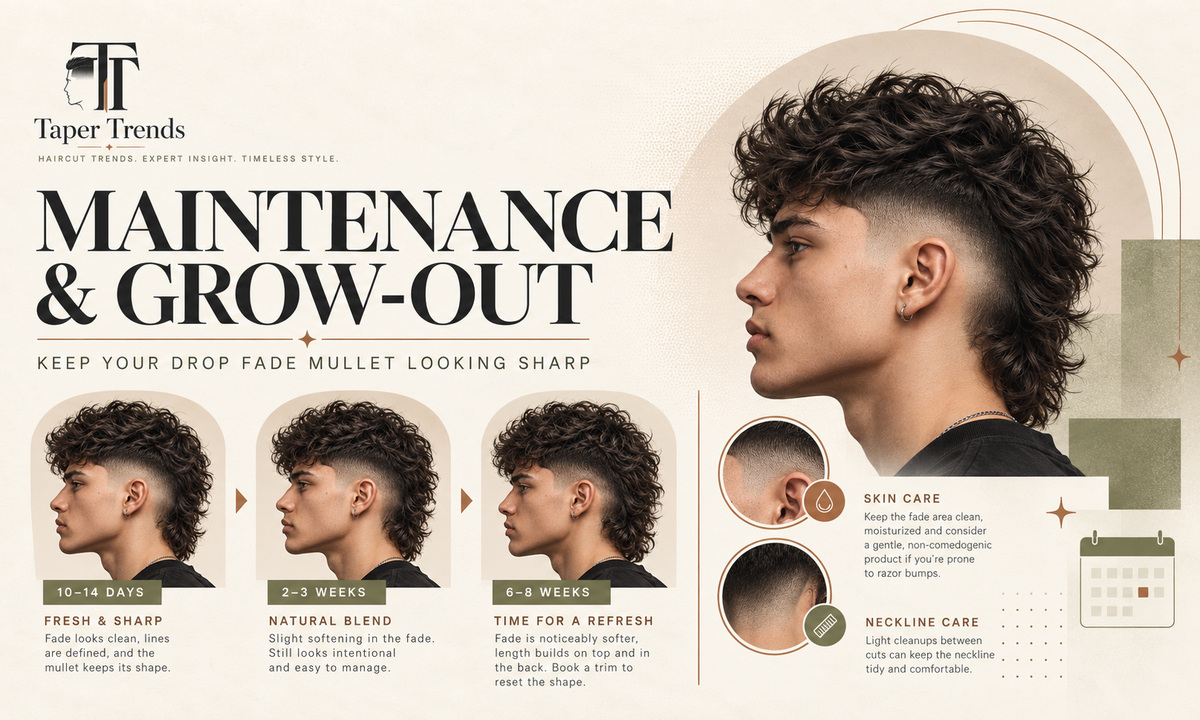
The fade and the mullet length run on different schedules. The short faded zone changes first, so it sets how often you need a barber, while the top and back can wait longer.
How often should you refresh the fade?
Barbers Take gives these ranges:
| Finish | Suggested refresh |
|---|---|
| Skin fade | Every 10 to 14 days |
| Drop, burst or mid fade | Every 2 to 3 weeks |
| Taper or scissor-cut sides | Every 5 to 6 weeks |
| Top and back | Every 6 to 8 weeks |
FashionBeans suggests 4 to 6 weeks for the sides of a drop fade mullet, while Hairstyle Atlas says a low taper looks overdue after about four to five weeks and skin fades soften within one to two. The numbers differ because finishes and tolerance for softness differ. Whatever the interval, ask your barber to refresh the fade without shortening the back. On a short rebooking cycle, our barber tip calculator works out what to leave at the chair.
How to grow the back without losing the shape
Keep the fade on schedule while leaving the back alone. Barbers Take puts hair growth at about half an inch a month, so building a back from a short cut takes roughly three to six months.
- Tell your barber the end goal so every trim moves toward it.
- Keep the sides and the area around the ears tidy in the meantime.
- Have only the ends of the back cleaned up to keep the length healthy.
What if close fades cause bumps or irritation?
If close fades keep leaving bumps, ask for a softer finish such as a shadow fade, and see a board-certified dermatologist if the bumps persist. The AAD explains that razor bumps develop when shaved hairs curl back into the skin. It also warns that bumps on the back of the neck or scalp may be acne keloidalis nuchae, a condition often mistaken for razor bumps. The AAD says it is most common in Black males, often starts between ages 14 and 25, and can lead to raised scars and hair loss without treatment. This is general information, not a diagnosis. Our burst fade for Black men guide covers bump-safe finishes in more detail.
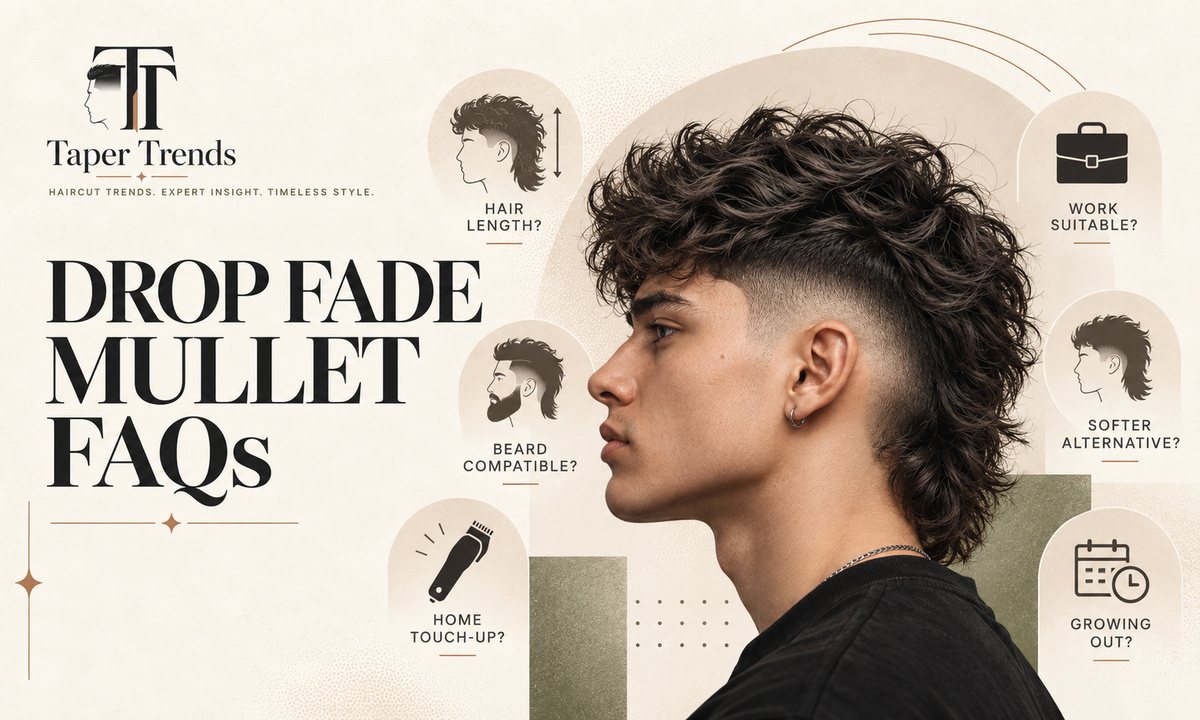
Drop fade mullet FAQs
How long does your hair need to be for a drop fade mullet?
There is no universal minimum. The back needs enough length to contrast clearly with the faded sides, and higher fades need more back length to balance. As a rough guide, Hairstyle Atlas suggests 3 to 5 inches for most textures and a little more, measured wet, for curls.
Can you wear a drop fade mullet to work?
Often, yes, if you choose a quieter version. Barbers Take says an understated mullet with a low taper can work in creative and casual workplaces, while conservative fields such as law and finance are less likely to accept it. A low drop at shadow or taper depth with a modest back is the safest combination.
Does a drop fade mullet work with a beard?
Yes. Barbers Take says a beard can balance the length and texture of a mullet, as long as the beard is kept shaped and in proportion to the cut. Mention the beard before the fade starts so your barber can plan how the sideburn blends into it.
What is a softer alternative to a drop fade mullet?
A taper mullet is the usual step down. It keeps the long back but shortens only the hairline around the ear, so there is little or no bare skin and the grow-out is gentler. Barbers Take also describes a scissor-cut taper mullet, with no clippers on the sides, as the most low-maintenance option among faded mullets.
Can you touch up a drop fade mullet at home?
It is not a good idea. Barbers Take advises leaving mullets to a barber because the fade, layering and length contrast are hard to cut well, and home attempts usually end with an uneven back or a poor fade. A lopsided drop arc usually means waiting for regrowth.
How do you get out of a drop fade mullet if you do not like it?
Ask your barber to cut the back down to match the rest. With a low or taper-depth version, Hairstyle Atlas points out that removing the back simply leaves you with a normal haircut. With a high skin fade, expect to wear a short cut for a few weeks while the sides grow back, which is one more reason to start low.
Sources for these answers: Hairstyle Atlas and Barbers Take. For the beard questions in more depth, see our drop fade with beard, low taper fade with beard and burst fade with beard guides (plus our skin fade with a beard guide for a skin finish), and for a softer base under the same shape, our taper fade guide. For the three skin heights side by side, our low vs mid vs high skin fade comparison shows where each bare section stops.
Bottom line: is the drop fade mullet right for you?
The bottom line
A drop fade mullet suits you if you want a curved fade, clear length at the back and regular fade refreshes. If you are unsure, start low or mid with a softer finish, and move to skin or a higher fade only if you will keep the appointments, since regrowth shows fastest there.
Before booking, settle the six decisions, save one side photo and one rear photo, and tell your barber to stop the fade behind the ear. At home, style the top, crown and back, and let the fade run on its own schedule.
Want more taper fade guides?
Browse clean, barber-ready breakdowns for every hair type.