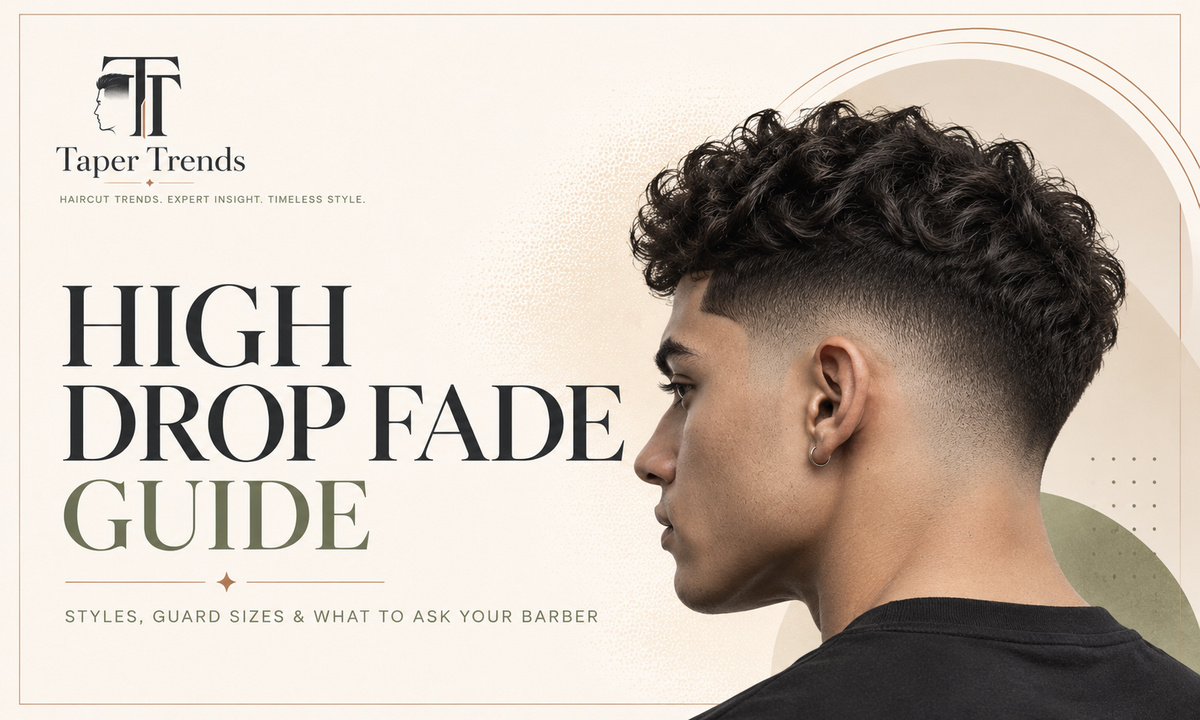
A high drop fadeis a fade that starts high on the sides of the head and then curves down behind the ear toward the nape. “High” tells the barber where the fade begins. “Drop” tells them which way the line travels around the back. Neither word says how short the shortest hair should be, and that gap is where a lot of disappointing high drop fades start. For the same curve at every height, see our complete drop fade guide, and for every taper and fade on the site, start at the low taper fade haircuts guide.
The easiest way to get the cut you actually want is to treat it as four separate decisions instead of one name. The name settles the first two. You still have to choose the last two.
| Decision | What it controls | Example answers |
|---|---|---|
| Height | Where the fade begins on the sides | Low, mid, high |
| Path | How the fade line moves around the back | Level (standard fade) or dropping behind the ear |
| Base | The shortest length at the bottom of the fade | Skin, #0.5, #1 |
| Top | Everything above the blend | Buzz, crop, curls, waves, quiff |
What is a high drop fade?
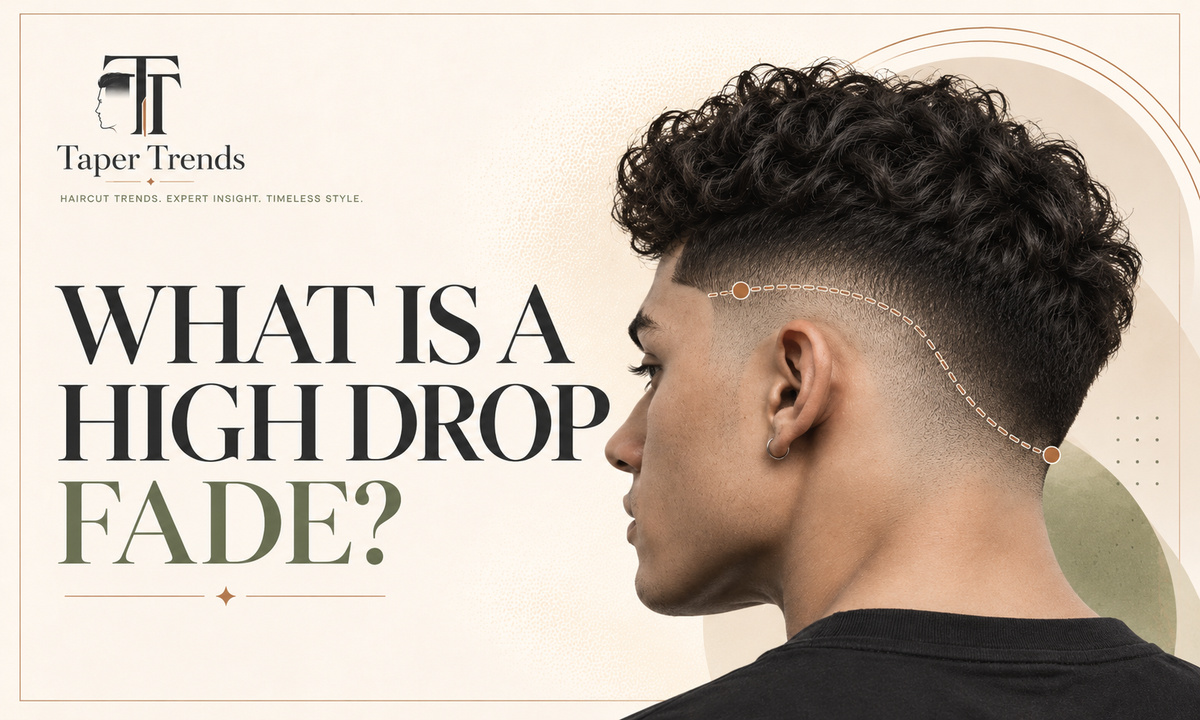
A high drop fade combines a high starting point on the sides with a fade line that dips lower as it wraps behind the ear. From the side, it looks a lot like a high fade. From behind, the line arcs downward through the back of the head instead of running level, and that arc is what gives the cut its name.
CADMEN Barber Academy describes the downward curve as the feature that separates a drop fade from a standard fade, which follows a roughly horizontal line around the head. Because the arc follows the round of the skull, a drop fade leaves more hair at the back than a standard fade cut with the same guards. CADMEN notes that this extra weight can make the top look fuller from every angle. Our guide to the different kinds of fade haircuts lays out height, shape and finish side by side.
What does “high” mean in a high drop fade?
“High” means the fade starts in the upper part of the sides, well above the ear, so more scalp shows and the hair on top becomes the focal point. Wahl's fade guide says a high fade begins higher on the head to put the focus on the top, while a low fade starts close to the ear. Our high taper fade guide shows that same starting height with a level line.
There's no standard measurement behind the word. One barber's high is another's upper-mid, so point to the spot on your own head.
What does “drop” mean in a drop fade?
“Drop” describes the path of the fade line, not its length. Instead of holding one height all the way around, the line falls lower behind each ear and toward the nape, then rises again on the other side. Viewed from behind, it forms an arc.
That arc is also why drop fades vary so much from shop to shop. CADMEN points out that a curve is harder to cut cleanly than a straight line and that the arc can differ between barbers. A rear reference photo settles where yours should land.
A high drop fade is not automatically a skin fade
A high drop fade can finish at skin, as any skin fadedoes, but it doesn't have to. Height and path describe the shape, while the base describes how short the bottom goes. “High drop skin fade” and “high drop fade on a #1” are both ordinary requests, and they look noticeably different. Our taper vs fade explainer untangles the finish vocabulary barbers use, and the skin fade vs taper fade guide shows where a skin finish ends and a taper begins.
| Base | Approximate length | How it reads |
|---|---|---|
| Skin (bald) | Clipped or shaved down to the scalp | Sharpest contrast |
| #0.5 guard (Wahl labels it #1/2) | 1/16 in., about 1.5 mm | Very close, faint shadow |
| #1 guard | 1/8 in., about 3 mm | Visible shadow, softer transition |
Wahl sells its color-coded Secure-Fit guard set in a 1/16-inch to 1-inch range, and Wahl's European guard guidelists the #1 at 3 mm, the #2 at 6 mm and the #3 at 10 mm. You'll sometimes see the #3 listed as 9.5 mm instead. Both are right, because 3/8 inch works out to 9.525 mm. Other brands don't always attach the same number to the same length, so ask about the inch or millimeter marking on the guard, not just the number. Our clipper guard size chart converts every guard number to inches and millimeters, and our haircut numbers guide explains how brands label them differently.
High drop fade vs high fade, mid drop and burst fade
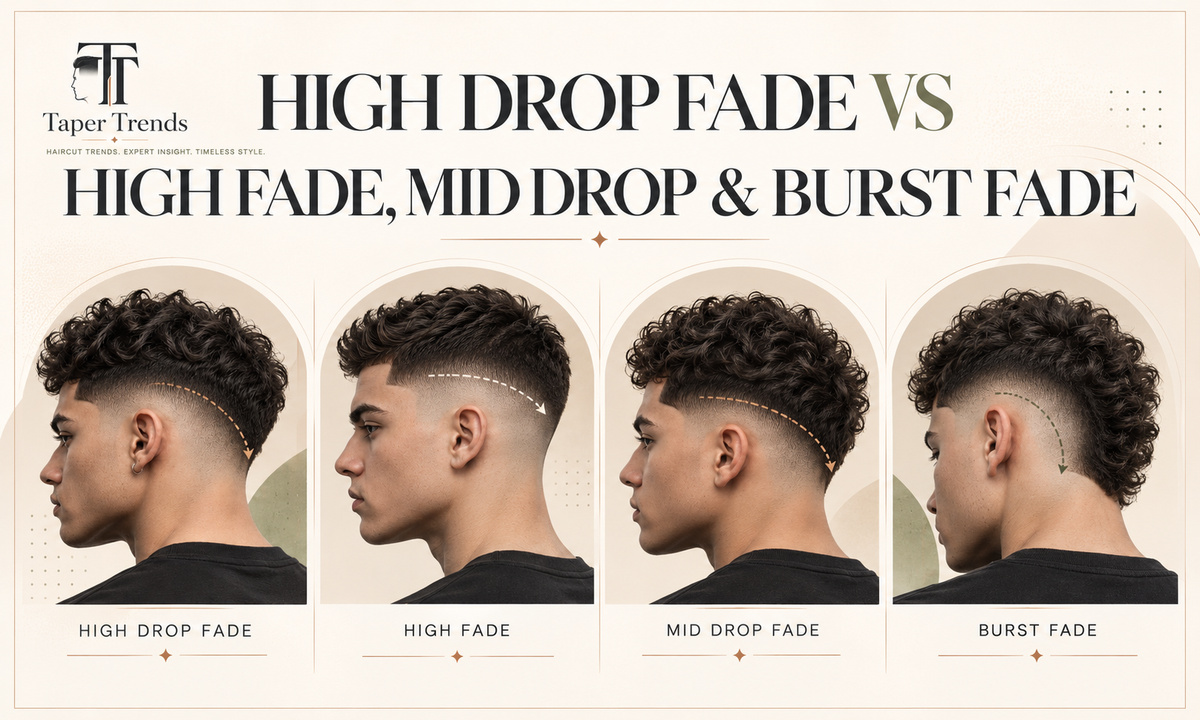
Each close relative of the high drop fade changes one variable. A standard high fade keeps the high start but loses the arc, just as a standard mid fade does one step lower. A mid or low drop fade keeps the arc but starts lower. A burst fade replaces the arc with a semicircle around the ear and usually leaves the back longer.
| Cut | Starting height | Path around the back | What happens at the nape |
|---|---|---|---|
| High drop fade | High on the sides | Curves down behind the ear | Faded as part of the arc |
| High fade | High on the sides | Roughly level | Faded at one height |
| Mid drop fade | Around the tops of the ears | Curves down behind the ear | Faded as part of the arc |
| Low drop fade | Close to the ear | Low, subtle curve | Faded as part of the arc |
| Burst fade | Around the ear | Compact semicircle, no full wrap | Often left longer and darker |
High drop fade vs high fade
Both start high (see low vs mid vs high fade for where that line sits), so the difference only shows from behind. A high fade holds a more even line around the head. A high drop fade dips behind the ear and carries that curve across the back. CADMEN argues that a level line works against the natural curve behind the ear and lower skull, which can create a visible step, while the drop follows that contour. To see how much a high start changes the silhouette compared with lower ones, our mid vs high taper fade and low vs high taper fade comparisons put the level versions side by side.
High vs mid vs low drop fade
The arc stays the same; the starting point moves. Barber.Style summarizes the trade-off neatly: a low drop fade keeps the most weight, a mid drop fade shows a clearer curve through the middle of the side, and a high drop exposes more of the side while still dipping behind the ear. The higher you go, the more contrast and the more of your head shape is on display. For the softest version of the curve, the low taper drop fade shortens mainly the edges.
High drop fade vs burst fade
These two get confused constantly. According to Barber.Style's burst fade guide, a burst fade is a compact semicircle concentrated around the ear that often leaves a darker or longer panel at the back, which is why it shows up so often with mullets, mohawks and curly tops. A drop fade carries its curve across the back and usually blends the nape; a drop fade mullet stops the curve behind the ear and keeps the back long instead. Front photos of the two can look almost identical, so compare rear shots before you decide, or use the photo checks in our drop fade vs burst fade guide. Our high burst fade guide shows the burst at the same starting height, the full burst fade guide covers every height, and the burst fade vs taper fade breakdown explains where the burst stops.
Is a high drop fade right for your hair and head?
A high drop fade isn't tied to one hair type or face shape. Whether it suits you comes down to four practical questions:
- Side hairHow much you’re willing to lose.
- Head shapeHow much of it you’re happy to show.
- Density on topHow much hair you have to carry the contrast.
- ContrastHow sharp a jump you want between the sides and the top.
Face-shape advice is where most guides get shaky. CADMEN says men with round heads often find drop fades flattering because the arc adds visual length, but consumer style sites contradict each other on which faces suit a high fade. Treat any face-shape rule as an opinion, not a verdict. If you still want a starting point, our face shape detector gives you one in a few seconds.
Straight, wavy, curly and coily hair
The fade itself works on any texture. The top is what changes. Straight hair shows every step of the blend, so a clean graduation matters more; our drop fade for straight hair guide plans the curve around fine, thick and cowlick-prone straight hair, and the high taper fade for straight hair covers tops at this height. Wavy hair needs enough length on top for the wave to show. Curly and coily hair shrinks as it dries, often by a lot, so the barber has to plan the top around its dry length rather than how it looks damp in the chair. For dense curls, Barber.Style suggests leaving a darker ridge above the fade to make the silhouette stronger. Our drop fade on curly hair and drop fade for Black men guides cover the high drop on curls, coils, waves and locs.
Density, crown and head contour matter more than face shape
A high drop removes a lot of side coverage. Anything the side hair used to soften, such as a flat spot at the back, a ridge, or a thin crown, becomes easier to see. That doesn't rule the cut out, but the conversation should happen before the clippers come out.
If your hair is fine or thinning on top, ask how the contrast will read on you. A guarded base and a little more length above the blend often look more balanced than a skin base under a sparse top. Our taper fade guide for thin and thick hair explains why a guarded base keeps the sides from reading sparse.
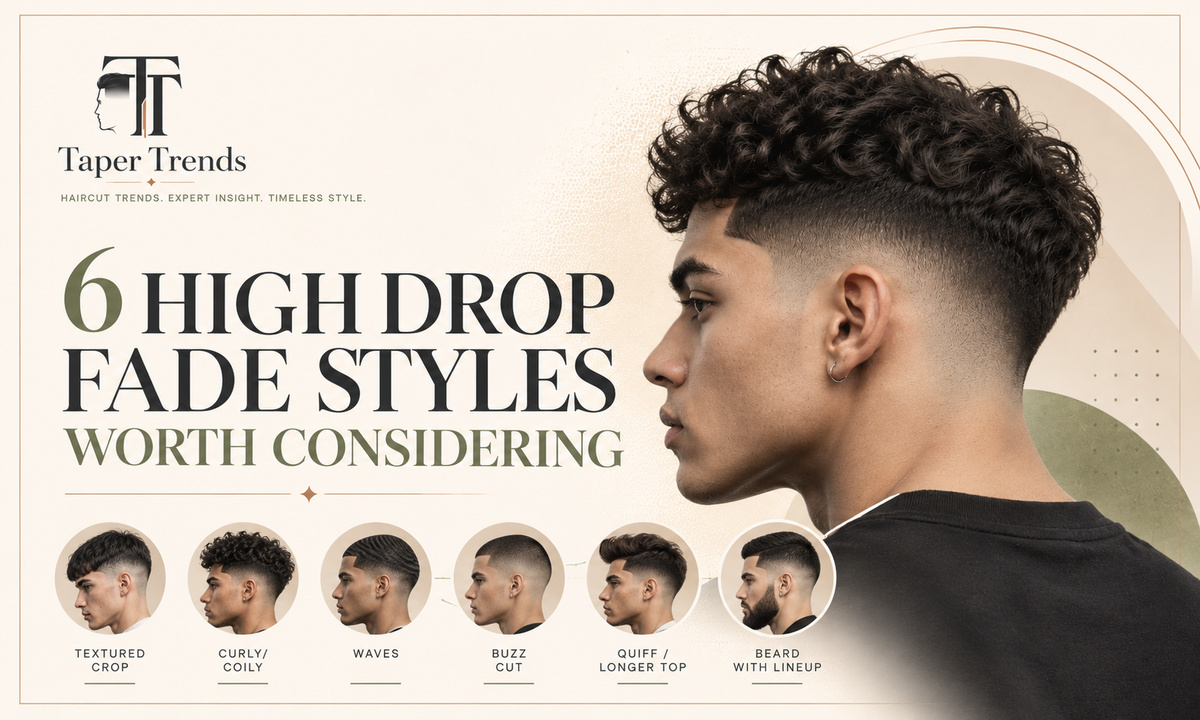
6 high drop fade styles worth considering
The fade can stay identical while the top changes completely. Pick the top by your texture, your density, how much styling time you'll realistically spend, and how much contrast you want.
1. High drop fade with a textured crop or fringe
A textured fringe pairs tight sides with a longer, choppy top pushed forward over the forehead. Wahl's textured fringe guidesays the look works best on curly or thick, wavy hair, and that straighter hair needs choppier layers and some product to get the same shape. Wahl's method blends the fade into the longer top with a #3 guard and point-cuts the top so it isn't cut straight across. Wahl demonstrates it over a low fade, but the top technique carries over to a high drop. Give your barber a fringe length in inches instead of “a bit longer.” Our drop fade textured fringe, high taper fade with a textured fringe and French crop taper fade guides show how to ask for the fringe line.
2. High drop fade with curly or coily hair
Curly and coily tops look sharp against a high drop because the close sides frame the curl shape. The real work is on top: keep enough length for the curl pattern to show once dry, and take out bulk rather than length if the shape is too wide. Wahl's textured cut guidenotes that a textured top tones down volume in thick hair and helps shape it. Bring a reference photo of dry hair with a similar curl pattern, because wet or stretched curls show length you won't have once they dry. The high taper fade on curly hair and high taper fade Afro guides cover the same height under rounder, fuller shapes.
3. High drop fade with waves
Waves are a brushed pattern on a short top, and a high drop fade leaves that pattern alone because the drop only governs the sides and back. Tell the barber you wave before they start. The top usually needs an even, short length so the pattern stays continuous, and a gradual transition from the fade into the waves keeps the pattern from looking chopped off at the sides. Our high taper fade waves guide covers wave-safe heights, and the high taper fade for Black men shows this contrast under coils and twists too.
4. High drop fade buzz cut
With a buzz on top, there's nowhere for the fade to hide. Barber.Style notes that the drop is more exposed under a very short buzz, so blend quality and head shape matter more here than with any other top. For the buzz length itself, Wahl's fade guide gives the safest rule: start with a larger guard, because you can always go shorter but you can't add hair back. Our high taper fade buzz cut guide covers top guard lengths for this look.
5. High drop fade with a quiff or longer top
A quiff or longer swept top gives the high drop its strongest contrast: close sides, real height on top. In Wahl's textured cut method, the barber blends shorter sides into a longer top with a #5 (5/8-inch) guide comb, which shows how much bridging length a longer top can need. Set the top length first, because the blend depends on it. Our high taper fade for short hair covers shorter tops at this height, and our guide to styling a taper fade walks through the blow-dry and product routine a quiff needs.
6. High drop fade with a beard and lineup
A beard and a lineup are add-ons, not part of what makes a fade a high drop. If you want the fade to connect to a beard, Wahl Australia's head-to-beard guide starts with an attachment comb one grade shorter than the beard, works against the grain, keeps the fade line level with the ear, and then steps down another grade to blend into the scalp. For the neckline, Wahl's beard lineup guidestarts just above the Adam's apple and works from that center point out toward each ear rather than ear to ear, which keeps the line even. Our high taper fade with beard and burst fade with beard guides walk through the sideburn blend step by step.
How to ask your barber for a high drop fade
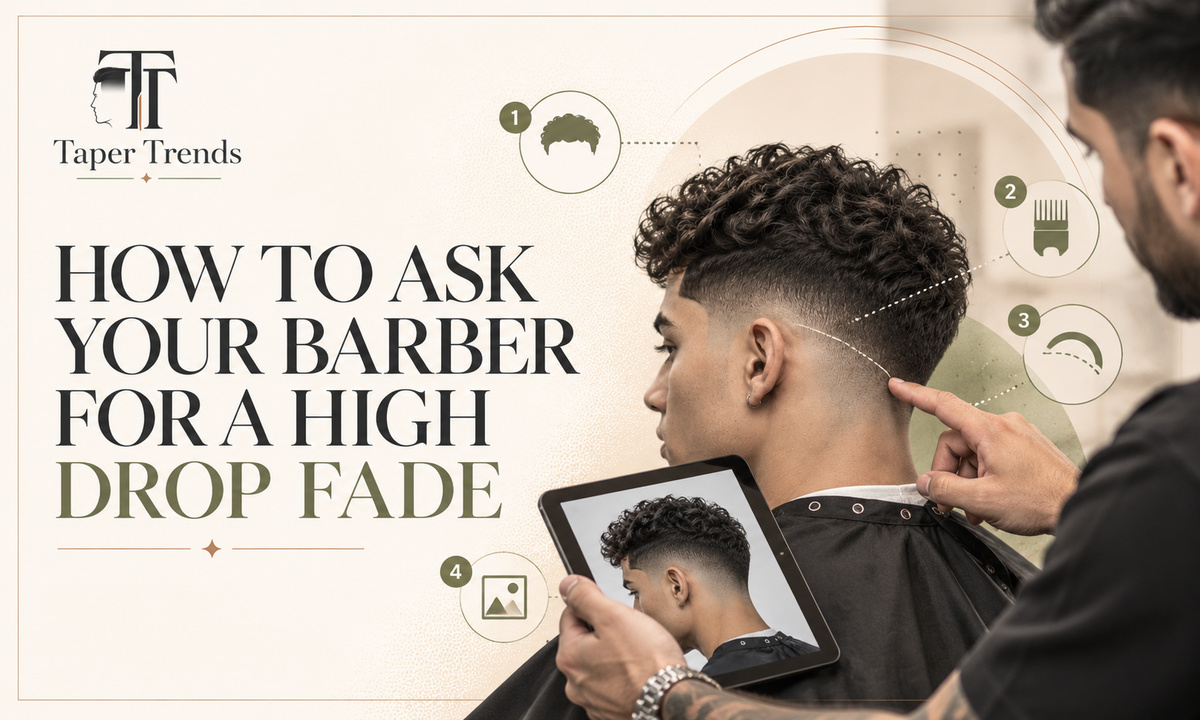
Give your barber four things, in this order: where the fade starts and how it drops, the base length, the top, and reference photos from the side and back. The geometry goes first because the base and top both depend on it. A good barber will repeat the plan back before cutting.
- 1. Start and dropPoint to the start line, then trace where the arc should fall behind your ear.
- 2. BaseSkin, #0.5 or #1, named by guard number and length.
- 3. TopA length in inches and a finish, plus how much weight stays above the blend.
- 4. PhotosA side view and a rear-three-quarter view of dry hair like yours.
Step 1: Show where the fade should start and drop
Point to the start line on the side of your head, then trace where you want the arc to fall behind your ear. If this is your first high drop, ask for a conservative first line. Barber.Stylerecommends having the barber mark a conservative guideline first when you're switching from a regular fade, because a curve taken too high can't be restored in the same visit. Check that guideline in the mirror before the bulk comes off.
Step 2: Choose skin, #0.5, #1 or another base
Decide on the base before you sit down. Skin gives the sharpest contrast and the shortest window before it looks grown in. A #0.5 or #1 keeps a slight shadow, softens the transition, and usually stretches a little longer between cuts. Say both the guard number and the length, since brands don't always label the same length with the same number.
Step 3: Specify the top and how much weight to keep
Describe the top with a length and a finish. “Two inches, textured” beats “medium” every time. Then ask how much weight will stay above the blend. That band of hair supports the arc, and if too much of it comes off, the top looks flat and the drop loses its shape. Confirm the top before the final detailing pass.
Step 4: Bring the right reference photos
Bring at least a side view and a rear-three-quarter view, ideally of someone whose texture and density are close to yours, photographed with dry hair. A front photo hides both the start line and the drop. Our guide to what a low taper fade looks like from every angle shows the kind of side and rear shots worth saving. Then use a short script and let the barber confirm how they read it:
“High drop fade, starting high on the sides and dropping behind the ear toward the back. Base at [skin / #0.5 / #1], about [length] on top, [textured / curly / brushed].”
No script guarantees an identical cut from every barber, but it makes the consultation much shorter. If you'd rather build it step by step, our barber brief generator turns the same decisions into a script you can show on your phone.
How often does a high drop fade need maintenance?
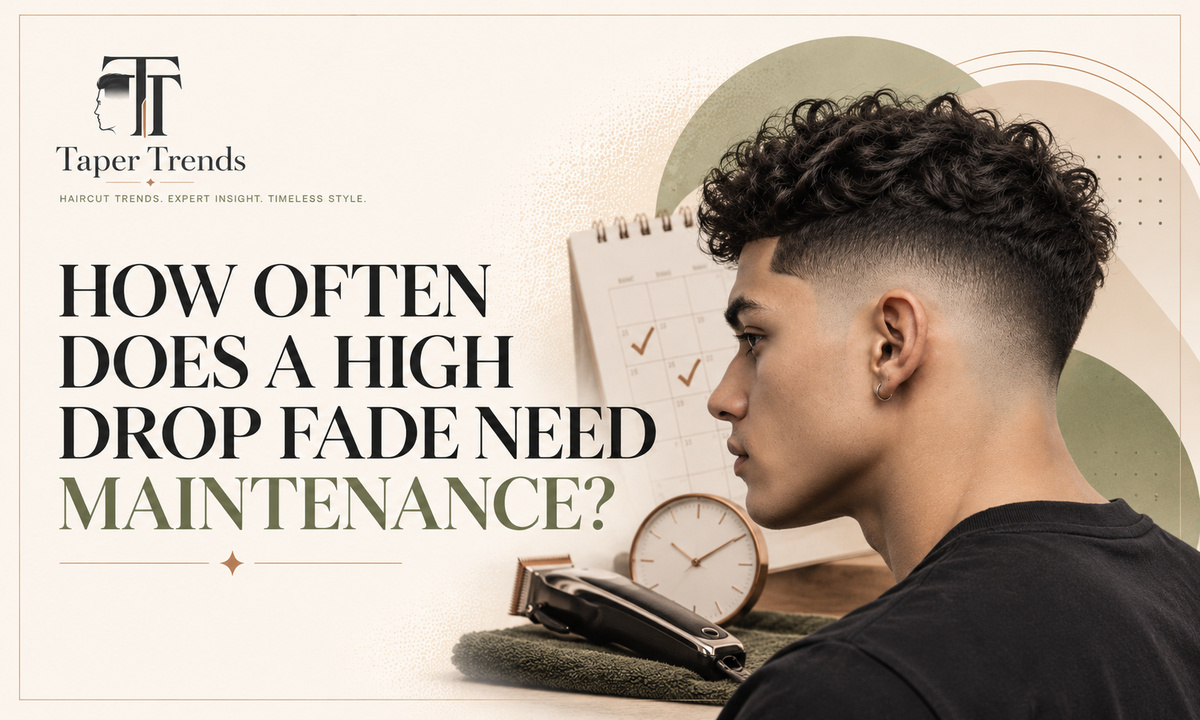
Most high drop fades start losing their crisp edges within two to three weeks, though there's no fixed schedule. CADMEN describes drop fades softening over that period into a less defined version of the same shape, and Barber.Style adds that skin bases soften soonest while a #0.5 or #1 can stretch longer. Your growth rate and your tolerance for fuzz decide the rest. Our drop fade guide compares refresh windows at every height.
When to refresh the fade
Book a cleanup when you can no longer see where the start line sits or where the arc bottoms out, or when the blend looks like one uneven length. Skin bases show regrowth first because their contrast is the first thing to go.
If you want the cut sharp every day, you're signing up for short intervals. If a softer look in the last week before each cut doesn't bother you, a guarded base and longer gaps are the easier path. When you're working out what to leave at the chair on a short rebooking cycle, our barber tip calculator does the math.
What you can maintain at home
Between visits, keep the neckline and the area around the ears tidy and style the top. Leave the start line and the arc to the barber. The arc is the hardest part to judge in a mirror, and nudging the lower edge up every week slowly turns a high drop into a different haircut.
For edges, Wahl's textured cut guide suggests the inverted clipper technique around the ears, sideburns and neckline: turn the clipper so the blade faces down, hold it like a thick pencil, and let the blade touch the skin without pressing.
Common high drop fade mistakes and edge cases
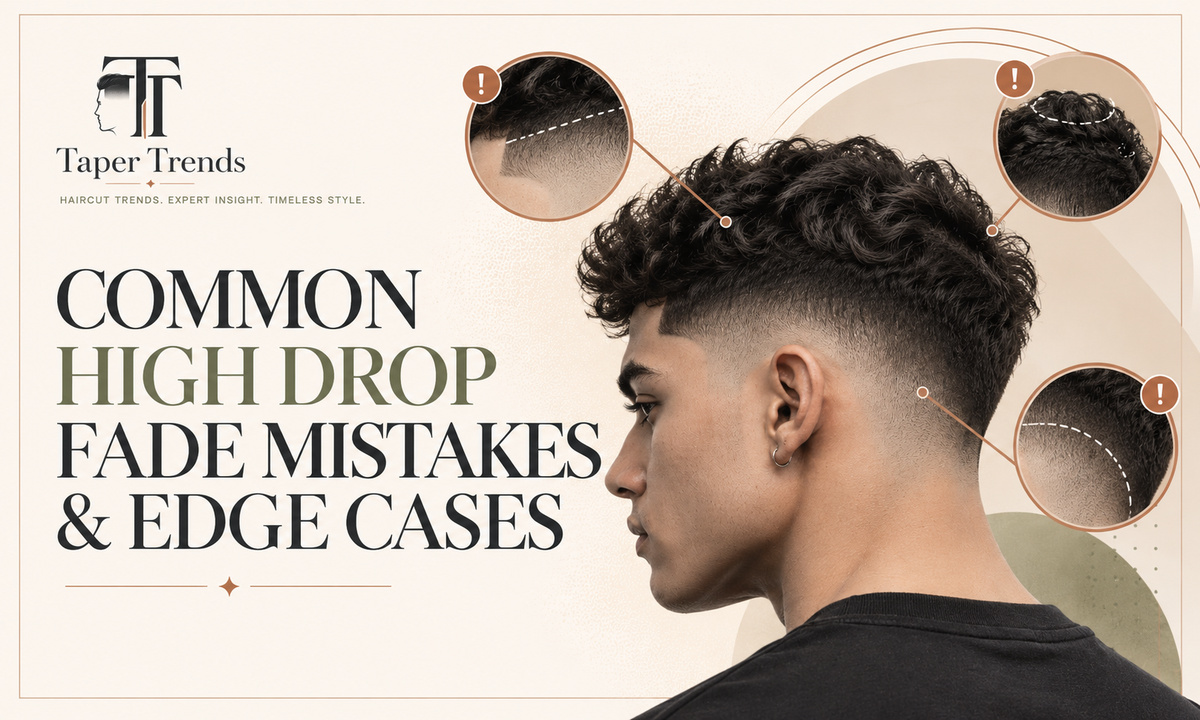
Most high drop fades that go wrong fail in one of three ways: the start line is set too high, the arc drops too steeply, or too much weight comes off near the crown. All three are easier to prevent than fix.
The fade starts too high or drops too aggressively
When the start line is too high or the arc is too steep, more scalp shows than you planned and the transition can look abrupt. Catch it at the guideline stage, before the bulk is removed, and ask the barber to lower the start or flatten the curve. Many clippers also have a taper lever, and Wahl's textured fringe guide explains that the lever narrows the gap between two guard lengths, which is how barbers smooth a harsh step without moving to a shorter guard (our home fade-cutting guide shows the technique). If the high start ends up feeling like too much, a mid drop fade is the natural next cut while it grows back.
Removing too much weight around the crown
Taking too much from the crown and upper back flattens the top and leaves the drop with nothing to frame. Ask the barber to keep the crown and upper back slightly longer than the sides, and judge the shape at its finished length rather than halfway through the cut.
Using the wrong photo or vague terms
“High,” “drop” and “skin” each describe a different variable, and “short” or “tight” mean something different in every chair. Name the guard and the length; Wahl's fade guide spells out the math, where a smaller guide-comb number means a shorter cut. A front-only photo hides the drop entirely. Our low taper vs low fade comparison shows how much one word can change the result.
High drop fade FAQs
Is a high drop fade the same as a skin fade?
No. A high drop fade describes where the fade starts and how its line curves behind the ear, while a skin fade describes the shortest finish. The two can be combined into a high drop skin fade, but a high drop fade can just as easily end on a #0.5 or #1 guard.
Can you get a high drop fade without going to skin?
Yes. Ask for a guarded base such as a #0.5 (about 1.5 mm) or a #1 (about 3 mm). The start line and the arc stay the same; only the bottom of the fade changes. A guarded base shows less scalp, softens the contrast, and according to Barber.Style can stretch a bit longer between cuts than skin.
Does a high drop fade work with a beard?
Yes. The beard is a separate decision, so it can stay full, get a sharp lineup, or be blended into the fade at the sideburns. Expect the beard’s neckline and cheek lines to need their own touch-ups, often on a different schedule from the haircut.
Does a high drop fade work with fine hair?
It can, if the top is planned for body. Wahl notes that a textured top helps fine or thinning hair look fuller. The bigger question is contrast: a high drop removes most of the side coverage, so ask the barber to keep enough length on top and consider a guarded base instead of skin.
How long does it take to grow out a high drop fade that was cut too high?
Expect weeks, not days. Scalp hair grows about half an inch a month on average, according to dermatologist Hadley King and the American Academy of Dermatology in a USA Today explainer. That’s roughly 3 mm a week, so an area cut to skin needs about two weeks to reach #2 length and about a month to reach #4. Individual rates vary, and trimming doesn’t speed growth.
What photo angles should I show my barber?
Show a side view and a rear-three-quarter view at minimum, plus a straight-back shot if you have one. Those angles reveal the start line, the arc and the nape. Photos of dry hair with a similar texture work best.
Sources for these answers: Barber.Style, Wahl and the USA Today hair growth explainer. For the same beard questions on this exact curve, see our drop fade with beard guide, which covers why a high drop beside a full beard can look bottom-heavy; at a lower height, see our low taper fade with beard guide, or our skin fade with beard guide for a high skin fade with a beard. To choose between the three skin heights, read our low, mid and high skin fade comparison before you book.
Before your next cut
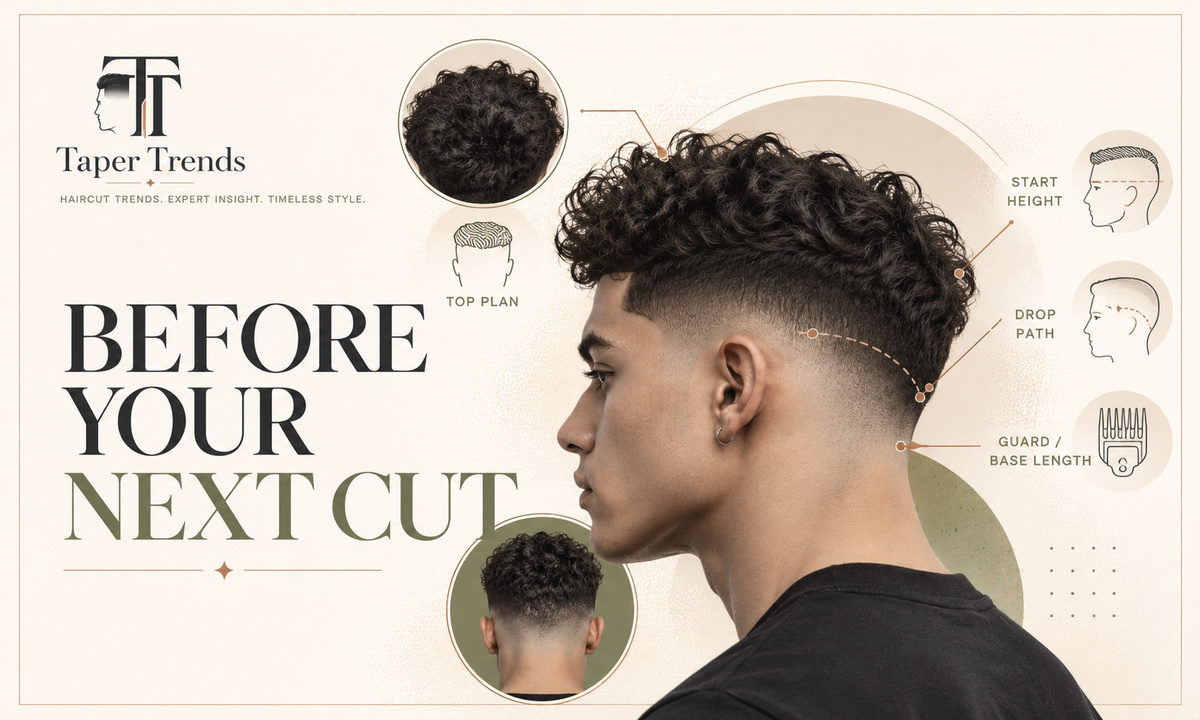
Walk in knowing four things: how high the fade starts, how far it drops, which base you want, and what stays on top. Bring side and rear photos, ask for a conservative first guideline, and check it before the bulk comes off. Get those right, and the rest comes down to your barber's hands.
The bottom line
A high drop fade is two decisions, a high start and a curve down behind the ear, sitting under two more: the base and the top. Straight, wavy, curly and coily hair all work above it.
Name all four in the chair, back them with side and rear photos, and have the guideline marked before the blend. If you want less scalp on show, keep the curve and raise the base.
Want more taper fade guides?
Browse clean, barber-ready breakdowns for every hair type.