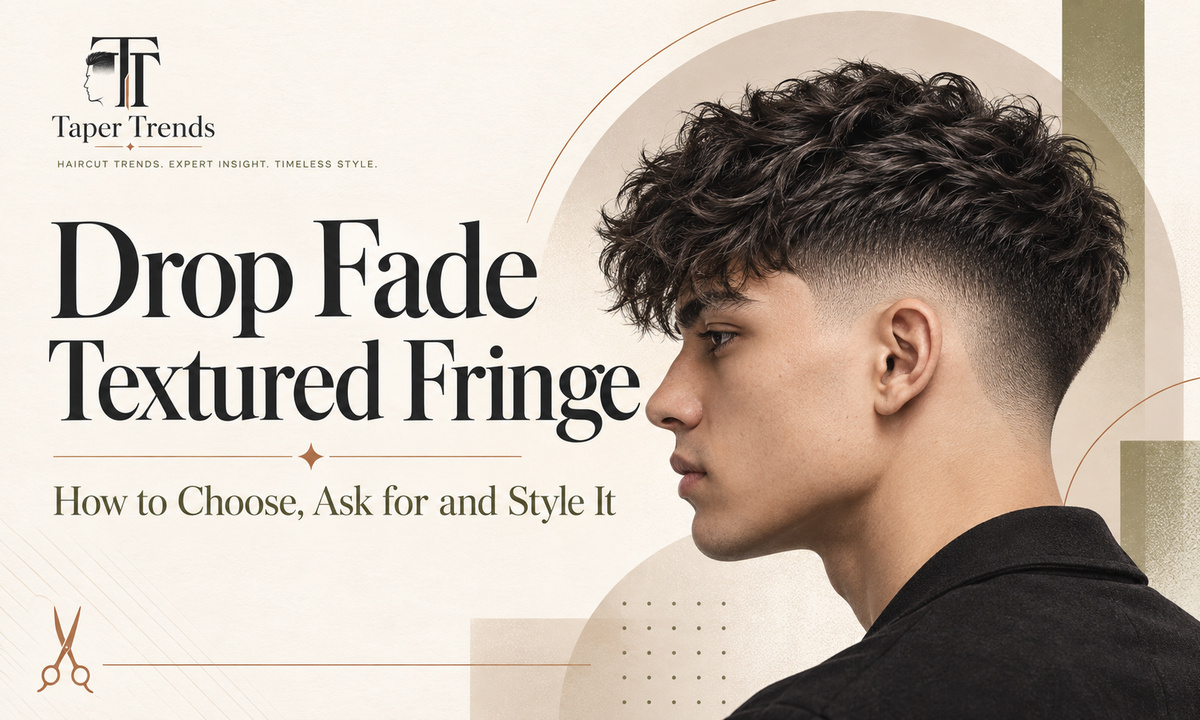
A drop fade textured fringe combines two separate parts of a haircut. On the sides and back, the fade line curves downward behind the ear instead of running level around the head. On top, longer hair is cut with separation and pushed forward into a loose, broken-up fringe.
The name tells your barber the shape. It doesn't say how high the fade starts, how short it goes, where the fringe should land or how much weight stays on top. Those choices decide whether you walk out with the cut in your reference photo or something that only resembles it.
For the drop shape under every other top, see our complete drop fade guide, and for every taper, fade and fringe on the site, start at the low taper fade haircuts guide.
What is a drop fade textured fringe?
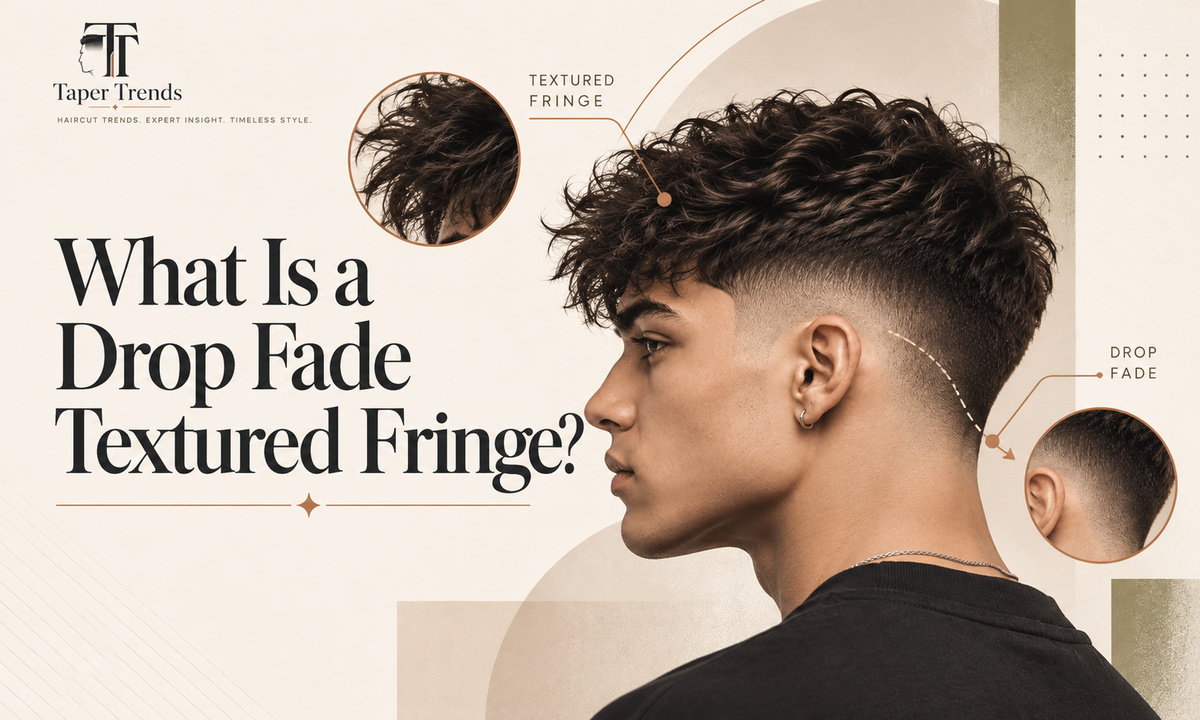
A drop fade textured fringe is a men's haircut that pairs a drop fade on the sides and back with a textured, forward-styled fringe on top. “Drop” describes the path of the fade line, which dips behind the ear toward the nape. On its own, it doesn't say how high the fade sits or whether it finishes on bare skin.
Because the side shape and the top style are chosen independently, two people asking for this cut by name can get very different results: a low, soft fade under a heavy fringe on the brow, or a high skin fade under a short, choppy crop. Our guide to the different kinds of fade haircuts lays out shape, height and finish side by side.
What makes the fade a “drop”?
In a standard fade, the graduation line sits at roughly the same height all the way around the head. In a drop fade, the line arcs downward as it passes behind the ear, reaches its lowest point at or near the center of the neckline, then curves back up on the other side. CADMEN Barber Academydescribes it as a standard fade with that one change to the line's path, which leaves more length in the center of the back than a level fade would at the same side height.
The arc only shows from the side and back. From the front, a drop fade and a level fade can look almost identical. If you want the same curve with a softer, taper-depth finish, our low taper drop fade guide shows how the arc works without bare skin.
What makes the fringe “textured”?
A textured fringe is cut so the front pieces separate and move instead of falling as one flat panel. Barbers usually get there with layering and by breaking up the ends (point cutting is a common method) rather than leaving the front at one blunt length.
Texture isn't the same as heavy thinning. On fine or low-density hair, taking out too much weight makes the fringe look sparse rather than textured, so how much comes out should depend on how much hair you have. Our textured fringe with low taper fade guide goes deeper on the fringe itself, and the low taper fringe styles gallery shows how many shapes the front can take.
Who does a drop fade textured fringe suit?
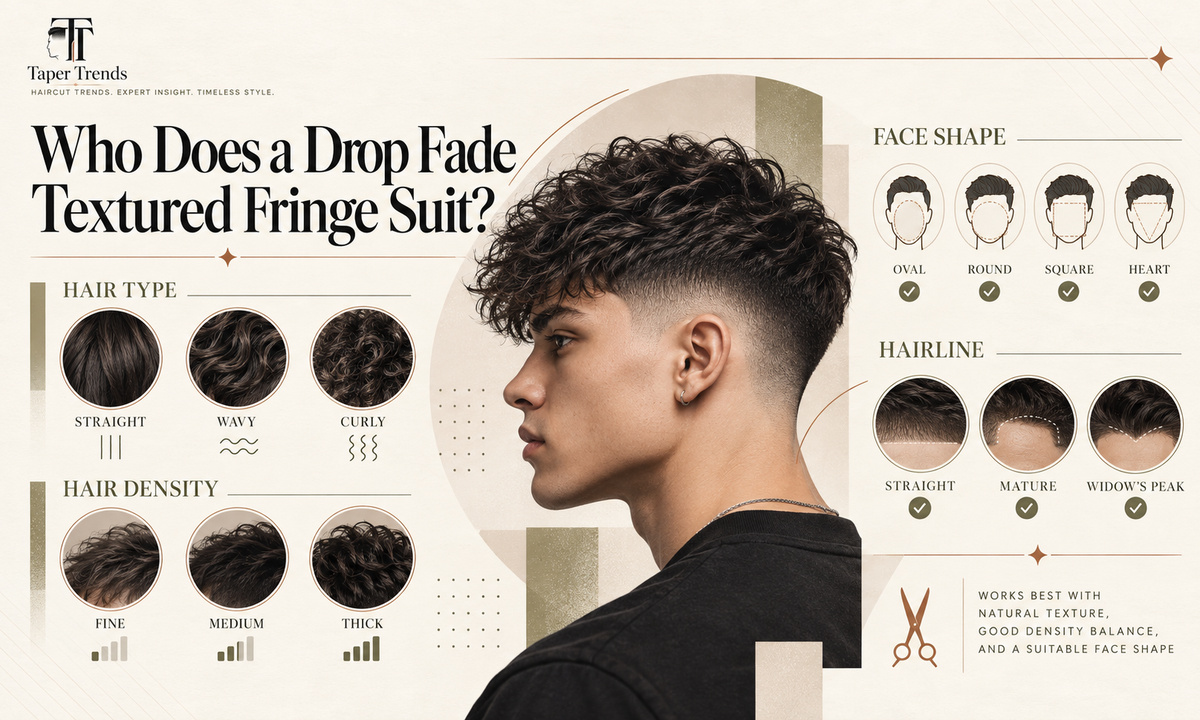
A drop fade textured fringe works on most hair types, but how well it works depends more on density, curl pattern, growth direction and how much styling you'll do each morning than on a face-shape chart. A good barber adjusts length, weight and fade height to the client rather than cutting a fixed template.
Working educators describe consultations the same way. In Salon Magazine, Vancouver barber and John Paul Mitchell Systems educator Corey Bakon names hair texture, density and face shape as the things to weigh. Hassan Nasser, owner of Avalon Hair Salon in Calgary and an American Crew educator, says shape, length, texture and styling should be adjusted to the client's preferences and head shape.
Hair type, density and growth direction
| Hair type | How it behaves with this cut | What to ask your barber for |
|---|---|---|
| Straight | Little natural movement, so the fringe tends to lie flat | Enough texture in the ends to separate; plan on light product |
| Wavy | Built-in movement does much of the styling | Moderate texture; don’t over-thin the waves |
| Curly or coily | Curls shrink as they dry, so the fringe sits shorter than it looks wet | Extra length on top, judged dry |
| Fine or low density | Fringe can look thin if too much weight comes out | Keep more weight; go easy on thinning shears |
| Thick or coarse | Top can sit heavy or puff outward | Some internal weight removal so the fringe falls forward |
Growth direction matters as much as texture. A front cowlick or a strong crown swirl isn't a reason to skip the cut, but your barber needs to see it first. Hair cut against its natural direction keeps trying to stand up or split, whatever product you use.
For more on each texture, our drop fade for straight hair, low taper fade for straight hair, burst fade for straight hair and high taper fade for straight hair guides show how flat strands sit over a close fade. Waves are covered in the low taper fade for wavy hair and mid taper fade for wavy hair guides, curls and coils in our drop fade for curly hair and drop fade for Black men guides, and density in our taper fade guide for thin and thick hair.
Face shape, head shape and hairline
Treat face shape as a proportion check, not a rule. A longer fringe covers more forehead, a higher fade exposes more of the side and raises contrast, and more height on top makes the face look longer. CADMEN says the drop fade suits most face shapes and singles out elongated or rectangular faces, where the arc adds interest at the back of the head. Because the drop shows from behind, head and neck shape affect where the arc looks best too. If you want a quick starting point, our face shape detector gives you one in a few seconds.
If your hairline is receding or your forehead is wide, say so at the start. Bakon warns that a hard, straight line across a wide or receding hairline can make hair loss look worse, and that the cut should be adjusted instead. A softer, broken-up fringe is usually the safer request. Our low taper fade for white guys guide covers how a forward fringe can soften early recession.
How much hair length do you need for a textured fringe?
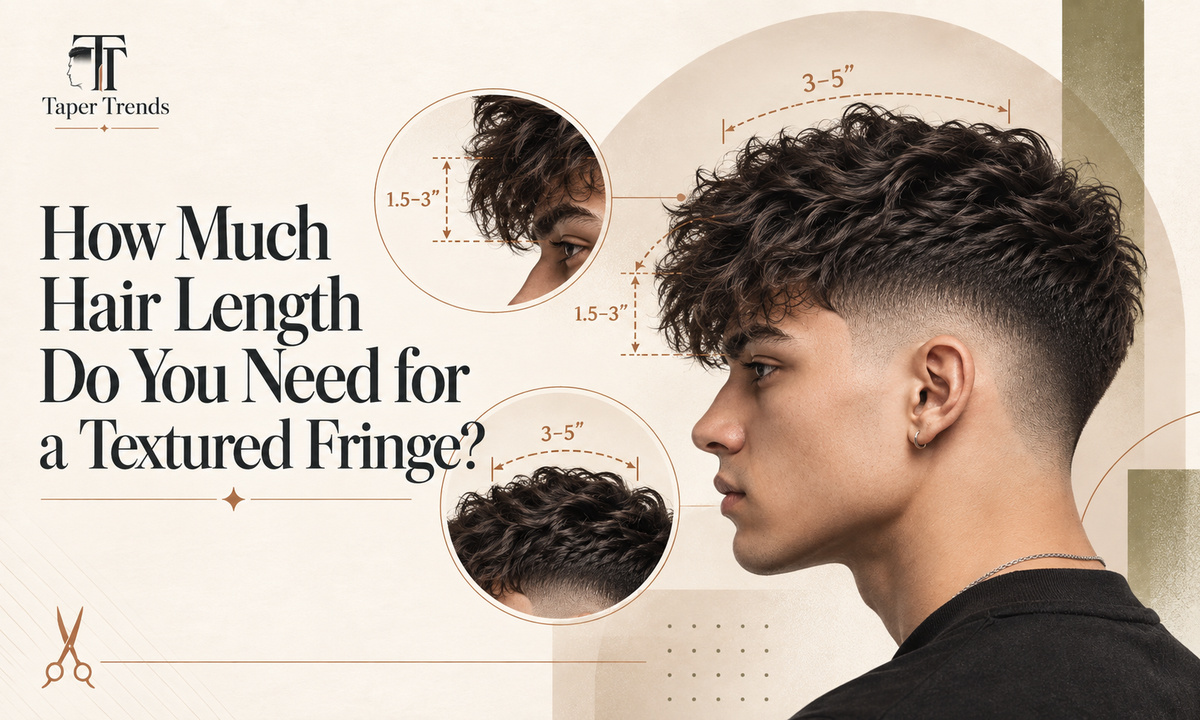
There's no single number for every head, because the length you need depends on where you want the fringe to land, your curl pattern and how much shrinkage to allow for. As a benchmark, Bakon describes starting a French crop at about two inches on top before texturizing. A longer, looser textured fringe needs more than that.
- Describe the finished position. “Just above my eyebrows when dry” is clearer than “medium.”
- Judge curly and wavy hair dry. A fringe that looks right wet can spring well above the brow once it dries.
- Leave room to go shorter. A barber can take more off but can’t put it back.
If you're growing out a shorter cut, wait until the front reaches your intended fringe position when pulled forward, plus a little extra for shaping. For the shorter end of the range, our French crop low taper fade and low taper fade for short hair guides show what two inches or less looks like, while our low taper fade for medium length hair guide covers a longer, looser front.
Low vs mid vs high drop fade textured fringe
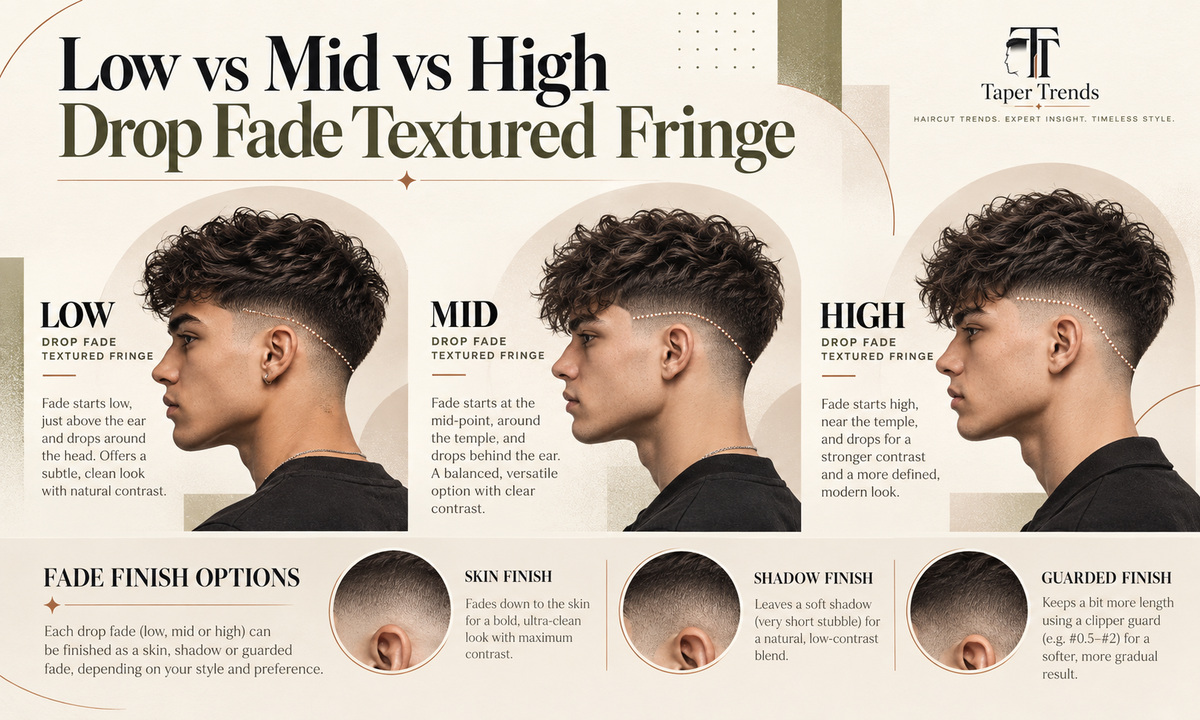
Low, mid and high describe where the fade begins on the side of the head, not how short it gets at its shortest point. A low drop fade keeps more length around the ears; a high drop fade exposes more of the side before the arc begins. None of the three terms says whether the fade finishes on skin.
| Factor | Low drop fade | Mid drop fade | High drop fade |
|---|---|---|---|
| Where the fade starts | Near the ear and hairline | Around the middle of the side | Higher up the side |
| Side length kept | Most | Moderate | Least |
| Contrast with the fringe | Soft | Noticeable | Strong |
| How visible regrowth is | Least | Moderate | Most |
| Best for | Keeping the fringe as the focus; conservative settings | Balance of contrast and wearability | A sharp look you’ll keep up |
Low drop fade textured fringe
A low drop fade keeps more hair on the sides, so the step down from the fringe is gentle and the fringe stays the main feature. It suits workplaces where a sharp fade would stand out, and because less scalp is exposed to begin with, it grows out less abruptly. Our low drop fade guide covers this height under every top.
Mid and high drop fade textured fringe
A mid drop fade creates a clearer jump between fringe and sides; a high drop fade leaves the least side length of the three. You get a crisper silhouette in exchange for regrowth that shows sooner. A high fade under a heavy top can also look disconnected if the barber doesn't manage the weight where the sides meet the top. Our mid drop fade and high drop fade guides show where each line starts and the guard numbers behind it.
Skin vs shadow or guarded finish
The finish is the length at the very bottom of the fade, and it's separate from fade height. A skin finish goes down to bare scalp for maximum contrast. A shadow or guarded finish, often a half guard (#0.5) or a #1, leaves a thin layer of hair that softens the edge and makes regrowth less obvious. Our clipper guard size chart converts each guard number to inches and millimeters.
CADMEN frames the drop fade as a variation of the skin fade, and many photos show it on skin. The arc is what defines it, though, and you can ask for the same shape over a guarded finish. Say height and finish separately, for example “mid drop fade, down to a #0.5.”
Drop fade textured fringe vs similar haircuts
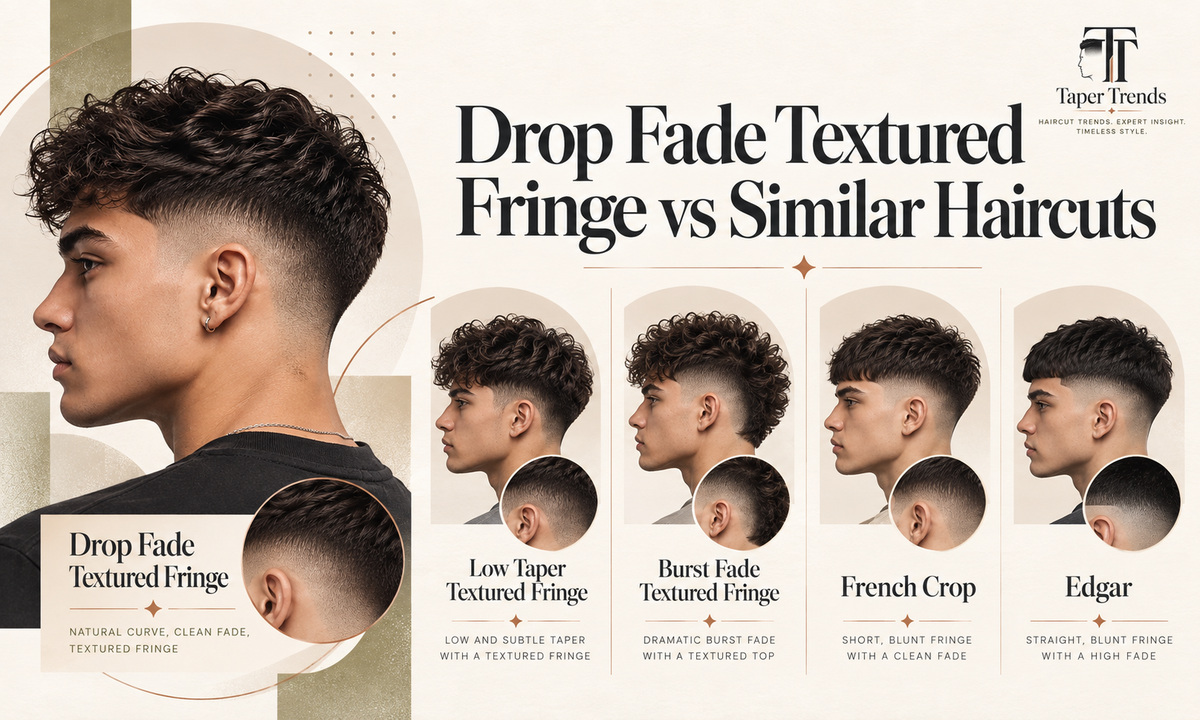
The same textured fringe can sit on several different side shapes, and the side shape usually changes the haircut's name.
| Haircut | Sides and back | Top and fringe |
|---|---|---|
| Drop fade textured fringe | Fade arcs down behind the ear toward the nape | Longer, separated, styled forward |
| Low taper textured fringe | Gradual, level shortening at nape and sideburns; more hair kept | Same textured fringe |
| Burst fade | Fade curves around the ear in a half-circle; length left at the back | Often a fuller top or mohawk-like shape |
| French crop | Any fade or taper | Short, forward top with a textured fringe |
| Edgar | Typically a high fade or taper (can be a drop fade) | Blunt, straight line across the front |
Drop fade vs low taper textured fringe
A taper and a fade are different cuts, even though people use the words loosely. BaByliss PRO ambassador Pete Cranfield explains in Modern Barber that a low taper gradually shortens hair toward the nape and sideburns and keeps more hair around the ears, while a fade exposes more scalp for sharper contrast. Our taper vs fade explainer and low taper vs low fade comparison cover the difference in more depth.
A low taper textured fringe therefore keeps a soft, mostly covered perimeter. A drop fade textured fringe has a fuller fade plus the curved line at the back, so it reads as more defined even when cut conservatively. Cranfield also notes that some clients ask for a fade when they actually want a taper, which is a good reason to show a photo. If you land on the taper side, our mid taper fade textured fringe and high taper fade textured fringe guides show the same fringe over a level taper at higher starting points.
Drop fade vs burst fade, French crop and Edgar
A burst fade curves around the ear and leaves length across the back. Wez Jones, owner of Heartbreak Barber Club, tells Modern Barber that it usually starts around the tip of the ear and fades outward in a circular motion. A drop fade carries the fade around the back instead, dipping toward the nape, as our drop fade vs burst fade comparison shows from every angle. Our burst fade textured fringe guide covers the ear-centered version of this cut, and the burst fade haircut guide and burst fade vs taper fade breakdown explain the arc itself.
“French crop” mainly describes the top. Wahl Pro educator Trevor Moots describes it as longer on top, styled forward with a textured fringe, and usually paired with a fade (PureWow). That fade can be dropped, level or a taper. Our French crop guide shows the crop over a low taper.
The Edgar is defined by its front line. In Modern Barber, barber Luke Hartley describes it as typically a high taper fade with a blunt cropped fringe, and Darren Fowler of Fowler35 notes the fade can even be a drop fade. The giveaway is the solid, bowl-style front line versus a separated, choppy fringe. Our burst fade Edgar and mid taper fade Edgar guides show that blunt front up close.
How to ask your barber for a drop fade textured fringe
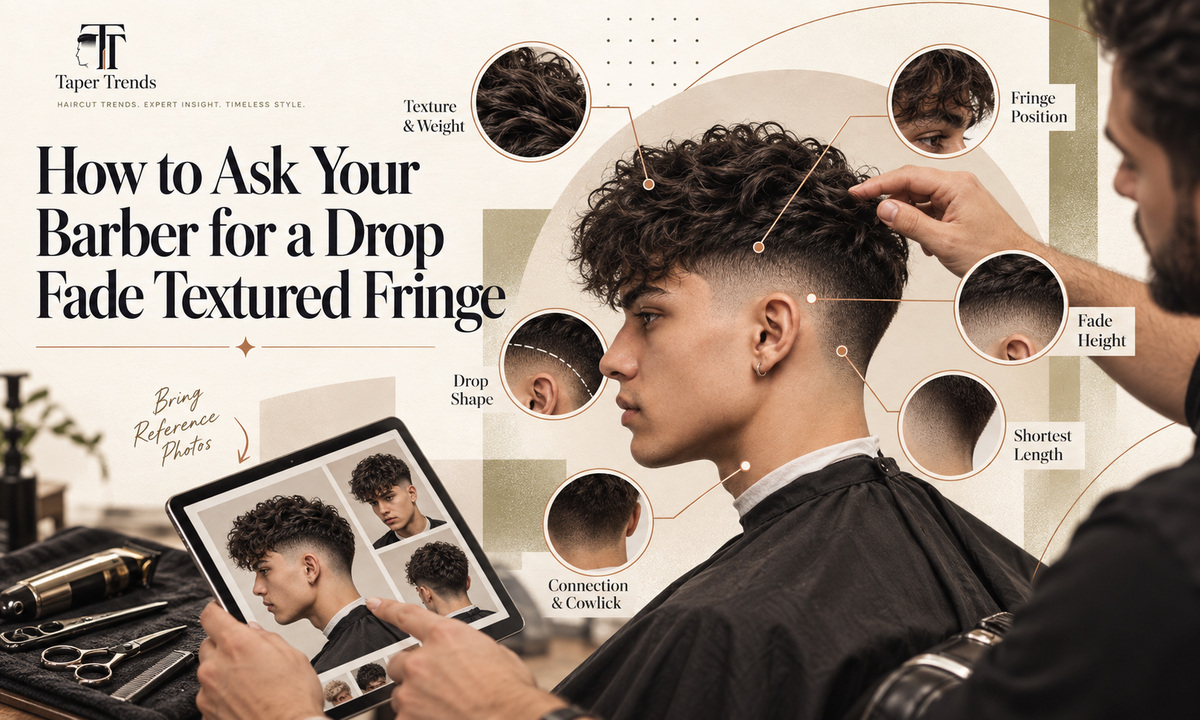
Naming the haircut is only a starting point, because “drop fade textured fringe” leaves height, shortest length, fringe length and texture open. Cover the six decisions below and show at least one side or back photo, so your barber works from a specification instead of a label. Cranfield points out that some clients don't realize how short a fade or skin fade really is, and agreeing on specifics first avoids that surprise.
The six decisions to specify
- 1. Fade shapeConfirm the line should drop behind the ear rather than stay level.
- 2. Fade heightLow, mid or high, so the barber knows where the fade begins.
- 3. Shortest lengthSkin, a zero, or a visible shadow such as a #0.5 or #1.
- 4. Fringe positionWhere the fringe sits when dry and styled forward: above the brow, at the brow or longer.
- 5. Texture and weightA fuller fringe or a lighter, choppier one. This decides how much weight comes out of the top.
- 6. Crown and side connectionA smooth blend into the fade or a visible disconnection. Mention any cowlick or crown swirl here.
Put together, a request might sound like this:
“Low drop fade down to a half guard, curving behind the ear. Leave the top long enough that the fringe sits just above my eyebrows when dry. Textured and separated, but don't thin it much because my hair's fine. Blend the top into the sides, and watch the cowlick at the front.”
If you'd rather build the script step by step, our barber brief generator turns the same decisions into a note you can show on your phone.
What reference photos should you bring?
Bring a side view and a rear view, not just a front shot. A front-facing photo can't show whether a fade is level, dropped or burst. CADMEN's cutting guidance has the barber confirm the arc's symmetry from behind the client before blending, which is exactly the view a front-only photo leaves out.
- Choose someone with texture and density close to yours. PureWow makes the same point about French crops: a cut on thick, wavy hair won’t look the same on fine, straight hair.
- Point out what you don’t want in the photo as well as what you do.
- If you only have one photo, use the side view.
Our guide to what a low taper fade looks like from every angle shows the kind of side and rear shots worth saving.
How do you style a drop fade textured fringe at home?
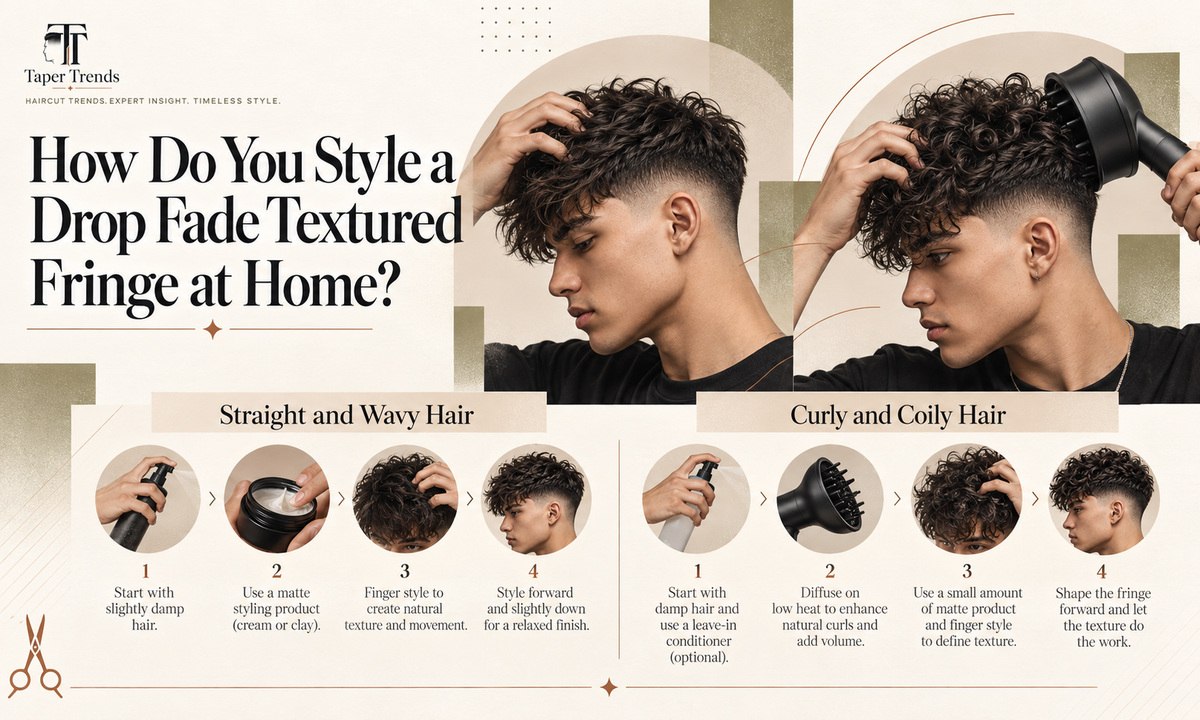
Set the direction while the hair is damp, dry the fringe forward, then add only enough product to separate the pieces. The order matters more than the product, because hair that dries in the wrong direction fights you all day. Our guide to styling a taper fade covers the blow-dry and product basics in more depth.
Straight and wavy hair
- Start damp. For extra grip, Moots suggests a sea salt spray at this stage.
- Dry it forward. Push the fringe forward and down with your fingers while blow-drying. The American Academy of Dermatology (AAD) recommends low or medium heat and a heat protectant, since excessive heat damages any hair type.
- Add a little product to dry hair. Texture powder or a light matte product works. American Crew's Matte Clay Cream, for example, is a medium-hold matte product the brand recommends for straight hair, applied to dry or towel-dried hair.
- Pinch, don't smooth. Twist small sections apart with your fingertips instead of combing them flat.
Wavy hair often needs less. Moots suggests a texturizing spray or gel for wavy and curly hair instead of a dry styling product. For softer, airier versions of the same forward finish, see our low taper fade fluffy hair and mid taper fade fluffy hair guides.
Curly and coily hair
Curly and coily hair already has texture, so the goal is keeping curls defined and moving forward.
- Detangle while wet.The AAD's curly hair guidance recommends a leave-in conditioner and detangling with fingers or a wide-tooth comb, and advises against brushing dry curls, which causes breakage and frizz.
- Use a moisture-friendly styler. A light gel or curl cream defines curls without stiff hold.
- Diffuse forward or air-dry. Moots mentions diffusing in a forward direction as an alternative to blow-drying. Keep the heat low.
- Wash only when needed. The AAD says thick, curly hair doesn't need washing daily or even weekly, but should be washed at least every two to three weeks.
Our burst fade on curly hair and mid taper fade curly hair guides show more forward-styled curl tops over a close fade.
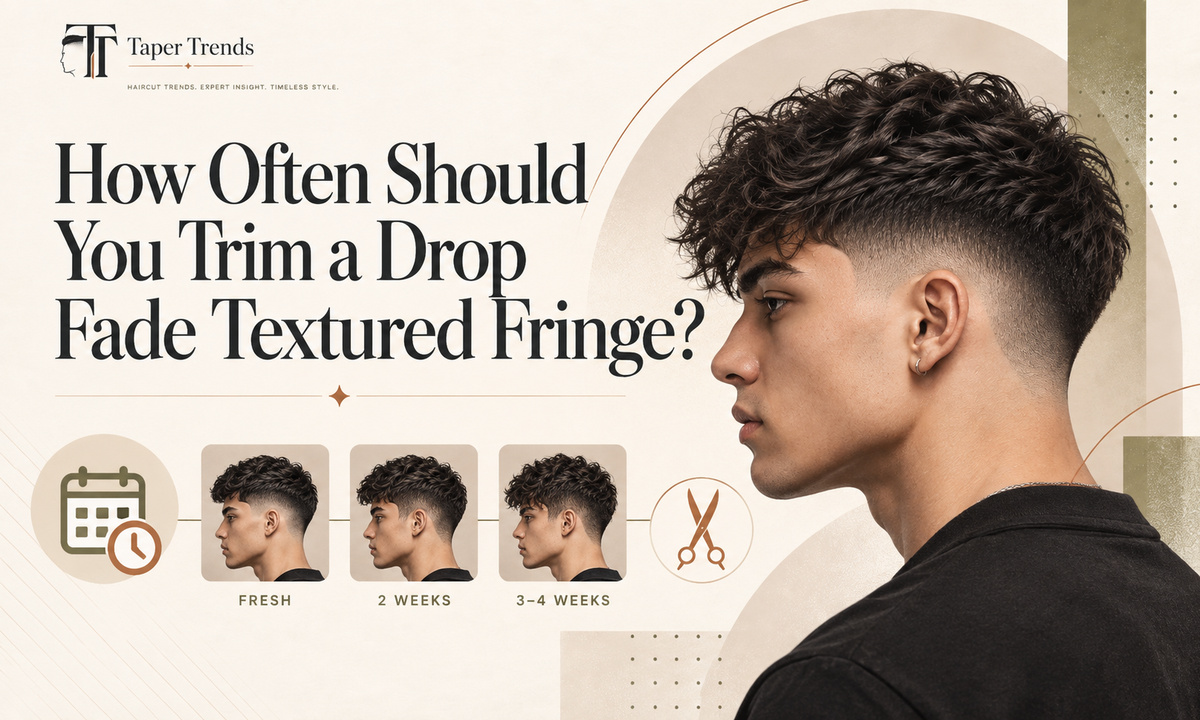
How often should you trim a drop fade textured fringe?
There's no fixed interval for everyone. The fade loses its crisp edge before the fringe needs cutting, so timing depends on how sharp you want the sides, how fast your hair grows and your budget. For a short, faded crop, Moots recommends a visit at least every two to three weeks to keep the sides and back even.
- Skin finishes and high fades show regrowth soonest.
- Low fades and #0.5 or #1 finishes blur as they grow and stay presentable longer.
- The fringe can usually go longer than the fade. Many shops offer a fade touch-up that cleans up the sides and arc without recutting the top, so ask yours.
Our low vs mid taper fade comparison shows how much faster a higher line looks overdue, and on a short rebooking cycle the barber tip calculator works out what to leave at the chair.
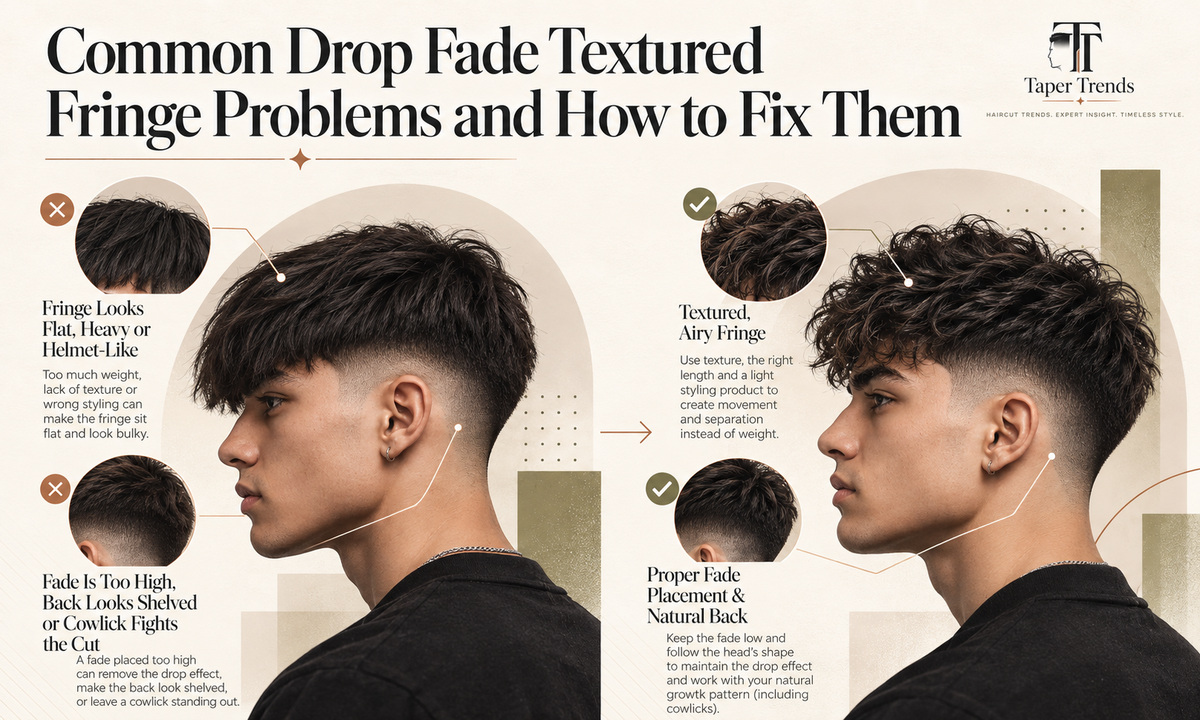
Common drop fade textured fringe problems and how to fix them
Most disappointing results trace back to three causes: the fringe has the wrong weight or dried in the wrong direction, the fade sits differently from the reference, or the cut ignored how the hair grows.
Fringe looks flat, heavy or “helmet-like”
A heavy, solid fringe usually means too much weight stayed in the top, or the hair dried flat instead of forward. Ask for more texture through the underside and ends next time, and at home set the direction while damp and work in less product with your fingers. A thin, gappy fringe is the opposite problem: too much weight came out, so ask for less thinning while it grows back. Thick, straight hair is the most prone to the helmet look, which our low taper fade for Asian hair and mid taper fade for Asian hair guides tackle with weight removal by density.
Fade is too high, back looks shelved or cowlick fights the cut
A visible step between lengths means the blend wasn't finished, and a barber can usually fix it on the spot. A lopsided arc is harder: CADMEN notes that blending can't correct an arc that drops lower on one side, so it has to be re-established or grown out. A fade cut higher than you wanted also has to grow out. If a cowlick keeps flipping or splitting the fringe, point it out so the barber can leave more length there or follow the growth.
FAQs about the drop fade textured fringe
Is a drop fade textured fringe the same as a low taper textured fringe?
No. A low taper textured fringe shortens hair gradually at the nape and sideburns and keeps more hair around the ears. A drop fade textured fringe uses a full fade with a curved line dipping behind the ear, which creates more contrast. The fringe on top can be identical.
Can you get a drop fade textured fringe with straight hair?
Yes. Straight hair suits a drop fade textured fringe but needs more help with direction than wavy or curly hair. Ask for enough texture in the ends to separate, dry the fringe forward while damp, and finish with a small amount of matte product or texture powder.
Does a drop fade have to be a skin fade?
No. “Drop” describes the curved path of the fade line, and “skin” describes the shortest length. A drop fade is often shown on skin, but you can ask for the same arc over a half guard or #1 shadow. Name height and finish separately.
What is the best product for a textured fringe?
No single product suits every textured fringe. Straight hair usually does well with a light matte clay, paste or texture powder. Wavy hair may need only a texturizing spray. Curly and coily hair generally does better with a light gel or curl cream that adds definition without stiff hold.
Is a drop fade textured fringe a French crop?
It can be, but the terms aren’t interchangeable. “French crop” describes the short, forward-styled top with a textured fringe, while “drop fade” describes the curved fade on the sides and back. A French crop can sit on a drop fade, a level fade or a taper.
How long does a drop fade textured fringe stay fresh?
It depends on the finish, but the fade softens well before the fringe loses its shape. For a short, faded crop, Wahl Pro educator Trevor Moots recommends a barber visit at least every two to three weeks. Low fades and guarded finishes grow out less abruptly and can stretch longer between cuts.
Want the drop curve with a different top? Our drop fade mullet keeps the back long instead of pushing the length forward, our drop fade with beard guide pairs a textured crop with a tapered beard, our skin fade with beard guide covers stubble and boxed beards under a skin finish, and for a softer base under the same fringe, see our taper fade guide. Our skin fade height comparison sets low, mid and high skin fades side by side when the finish is bare scalp.
Before your next barber visit
The bottom line
A drop fade textured fringe is a set of choices rather than one fixed haircut. Decide your fade height, finish, fringe position and texture before you sit down.
Bring a side and back photo of someone with hair like yours, and mention your density and any cowlicks. That turns the name of a haircut into the cut you actually wanted.
Want more fade and fringe guides?
Browse clean, barber-ready breakdowns for every hair type.