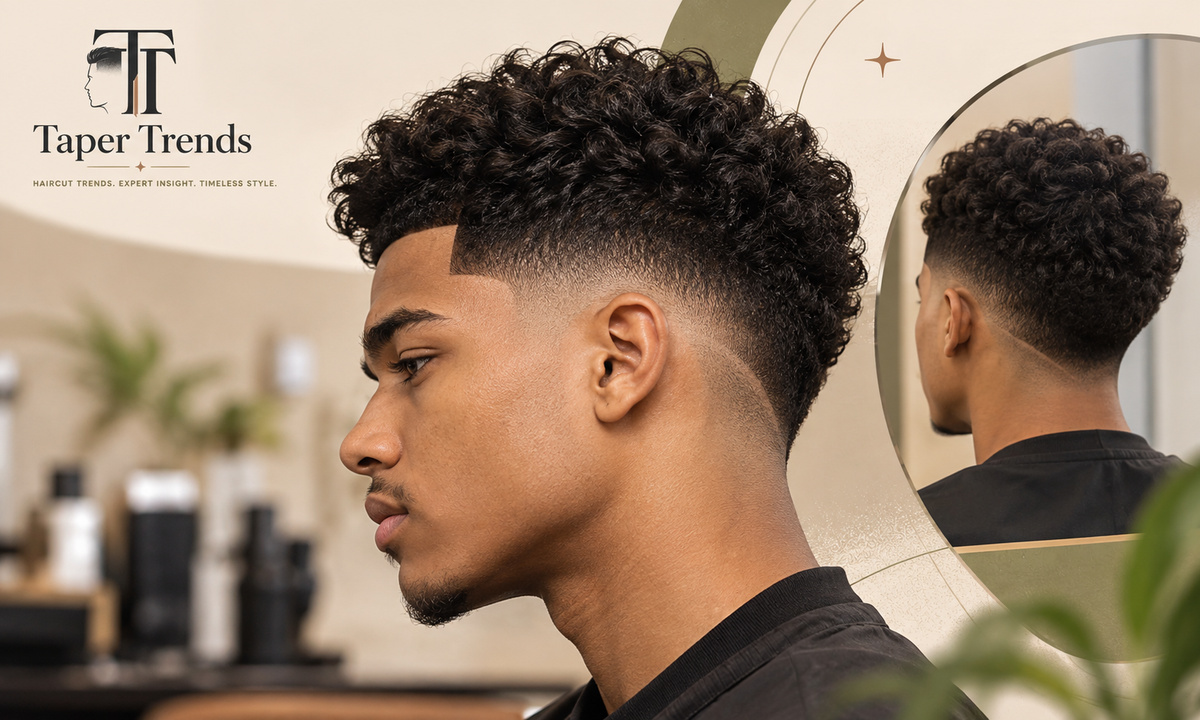
A drop fade for Black men is a fade whose blend line curves down behind the ear toward the nape instead of running level around the head. It works under almost any top, from 360 waves and short coils to a full Afro or locs. The word “drop” only describes that curve. How high the fade starts, how short it goes at the bottom, and what stays on top are separate choices, and most bad drop fades come from leaving one of them to chance. For the shape on every hair type, our complete drop fade guide covers the basics, and the low taper fade haircuts guide is the hub for every taper and fade style on the site.
What is a drop fade for Black men?
A drop fade for Black men is a fade in which the transition line arcs downward behind the ear and continues toward the nape, rather than circling the head at one height. “Drop” names that curved path. It says nothing about how high the fade starts or how close it cuts, so a drop fade can be low or high, skin-close or guarded.
Because the line falls as it moves back, the lower back of the head usually keeps more hair than it would under a level fade started at the same height on the sides. That contour is the signature of the cut. You see it from the side and the rear, which is why a front-facing photo can't tell you whether a haircut is a drop fade at all. Our guide to the different kinds of fade haircuts shows that contour next to the straight and burst lines.
What sits on top is a separate decision. The same curved perimeter works under short natural coils, waves, sponge twists, an Afro, or twists and locs on their way to full length.
The four choices inside every drop fade
Every drop fade comes from four independent choices: the shape of the line, the height where the fade starts, the shortest length at the bottom, and the style on top. Changing one doesn't force a change in the others. A low skin drop with waves and a mid drop with a #1 base under an Afro are both drop fades; they simply answer the other three questions differently.
| Choice | Question it answers | Examples |
|---|---|---|
| Shape | Which path does the blend line follow? | Drop (curves toward the nape) |
| Height | Where does the fade start on the sides? | Low, mid, high |
| Finish | How short is the shortest section? | Skin, #½, #1 |
| Top | What stays above the fade? | Waves, coils, Afro, twists, locs |
Low, mid, high, skin or shadow: choosing the fade base
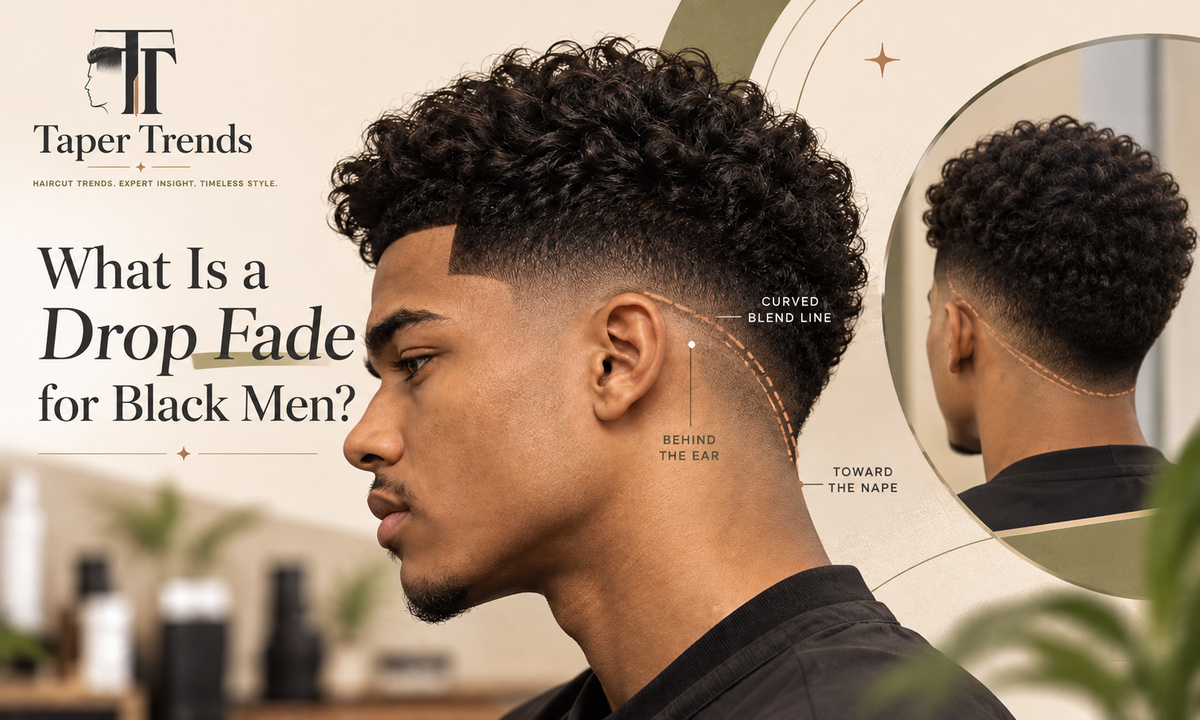
Height and finish do different jobs in a drop fade. Height decides how much hair comes off the sides and back, while the finish decides how much scalp shows at the bottom of the fade. A low fade keeps the most hair and a high fade removes the most; a skin or guarded base then sets how sharp the result looks. Any height can pair with any finish.
1. Low drop fade
A low drop fade starts the blend near the bottom of the sides, just above the ear, and curves down behind it. Most of the side and back hair stays, so the contrast is the softest of the three heights.
It pairs easily with waves, short coils and fuller tops, and it grows out quietly because little scalp was exposed in the first place. If you've never had a drop fade, this is the low-risk version to start with. Our low taper drop fade guide goes deeper on this height, and if you'd rather keep the line level, the low taper fade for Black men is the closest straight-line alternative.
2. Mid drop fade
A mid drop fade begins the blend around the middle of the sides. It removes more weight than a low version while keeping the same downward arc behind the ear.
The result reads as clear contrast without showing as much scalp as a high fade. It suits short natural texture, coils and Afro tops, where you want the shape on top to stand out against a cleaner perimeter. The same height with a level line is covered in our mid taper fade guide for Black men.
3. High drop fade
A high drop fade pushes the blend well up the sides, toward the temple, while the line still falls behind the ear. It gives the strongest contrast and shows the most scalp.
It's also the hardest height to walk back. Hair removed from high on the sides takes weeks to regrow, so choose it on purpose, not by accident, and think twice if you plan to grow your hair into twists, locs or a bigger Afro. Our high drop fade guide covers the base and top choices at this height, and our high taper fade black male guide shows what that much contrast looks like on waves, coils and twists.
4. Skin or bald drop fade
“Skin” or “bald” describes how short the base is, not the drop itself. The barber takes the shortest section down to bare skin, often finishing with a foil shaver or razor, and that can sit at low, mid or high placement.
A skin drop looks sharpest on day one and shows regrowth soonest, because the contrast between bare skin and hair is what catches the eye. If close cuts usually leave you with bumps or itching on the back of the neck, a guarded base keeps the same shape without taking the hair down to the skin.
5. Shadow or guarded drop fade
A shadow or guarded drop fade stops short of bare skin and leaves a visible layer of stubble at the bottom. The curve behind the ear stays exactly the same; only the base changes, which softens the contrast and covers more scalp.
Name the guard instead of saying “not too short.” Wahl lists these attachment guard lengths for its standard guard set:
| Guard | Length left |
|---|---|
| #½ | 1/16" (1.5 mm) |
| #1 | 1/8" (3 mm) |
| #2 | 1/4" (6 mm) |
A #½ base looks nearly skin-close at a glance, while #1 and #2 read as a clear shadow. Other brands and some adjustable clippers number their guards differently, so ask your barber to confirm the actual length rather than relying on the number alone. Our clipper guard size chart converts every guard number to inches and millimeters.
7 drop fade styles for Black men by top hairstyle
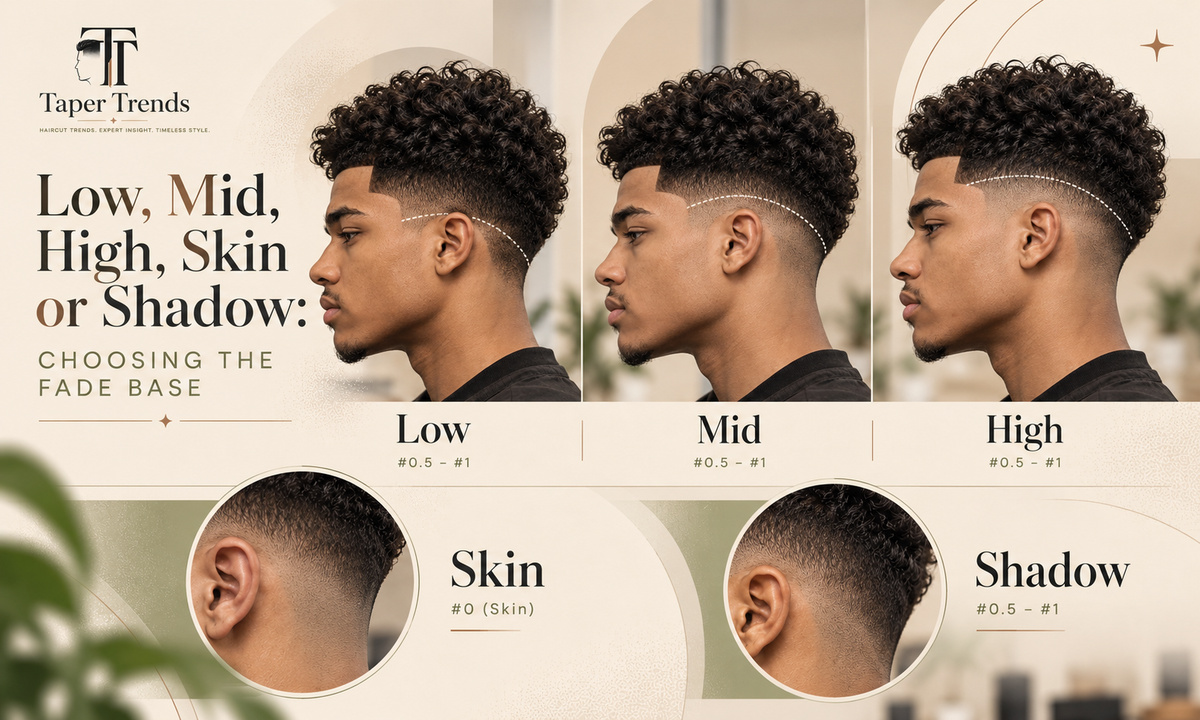
Once the height and base are settled, the biggest visual difference comes from what stays on top. Each style below pairs a drop fade with a different top. Describe the top to your barber separately from the fade, and look at side and rear photos before you commit.
6. Drop fade with 360 waves
A drop fade with 360 waves leaves enough patterned hair above the curve for the waves to stay the focal point, while the close sides and back add contrast. The fade frames a pattern you've already trained. It doesn't create waves.
Choose reference photos with a wave depth and crown pattern close to yours. A low or mid height usually keeps more of the surrounding hair, which helps the pattern carry around the sides instead of stopping abruptly where the fade begins. Our low taper fade with waves guide covers guard lengths and wolfing, and the mid taper fade with waves and high taper fade with waves guides show how much pattern each higher start leaves you.
7. Drop fade with short curls or coils
Short curls or coils pair naturally with a drop fade, because the clean perimeter makes the texture on top easier to see. How it looks in the end depends on how much length and density you keep up there, so leave enough for the texture to show.
Natural coils and sponge-defined twists look different, so say which one you want. A barber who regularly cuts Afro-textured hair can tell you how much length your density needs before the texture reads clearly. Shrinkage is the other half of that judgment, and our drop fade curly hair guide explains how to brief a barber around it, while our drop fade for straight hair covers the opposite end of the texture range, where nothing hides the blend.
8. Afro drop fade
An Afro drop fade sets a full, rounded or squared top against a shorter, curved perimeter. The size of the Afro is its own request: a mini Afro and a fuller shape need very different amounts of hair left above the fade.
Ask the barber to shape the top separately, and keep enough weight there that the fade doesn't make the top look thin. A rear-view photo helps, because the barber needs to see how the Afro sits against the curve at the back. For Afro shaping at each height, see our low taper fade Afro, mid taper fade Afro and high taper fade Afro guides.
9. Drop fade with sponge twists
Sponge twists change the texture of the top, while the drop fade controls the perimeter, so specify them independently. The twist size you want and the length it needs decide how much hair the barber should leave.
Products matter less than length here. If the top is too short, no sponge or product will twist it. If you plan to grow into longer twists later, tell your barber now so the fade doesn't start higher than your plan allows.
10. Drop fade with twists, locs or braids
Twists, locs and braids can all sit above a drop fade, but decide first how much perimeter hair you want to keep for the long term. A high cut on the sides and back removes length that would otherwise become part of the longer style. Share the plan with both your barber and your loctician or braider before either one starts. Our low taper fade dreads guide and mid taper fade with locs walk through keeping locs full while the perimeter stays clean.
For braids, the American Academy of Dermatology says braids, cornrows and weaves should not be too tight, and that if styling hurts you should ask the stylist to stop and redo it.
11. Short hair or buzz cut drop fade
A short or buzz-cut top makes the drop's geometry the main feature, because there's little volume on top to distract from the curve behind the ear.
Name the top length by guard number, using the same system as the base, so the barber knows how far apart the two lengths should be. If the top and the base are too close in length, the fade can look flat from a few feet away. Our low taper fade buzz cut and high taper fade buzz cut guides list the top-and-base guard pairings that keep that gap visible.
12. Drop fade with beard
The beard connection is its own decision. The fade can blend gradually through the sideburn into the beard, or the two can stay deliberately separate. Tell your barber which you want before the clippers start.
Cheek line, beard length and neckline are further separate choices. Side-profile photos matter most for this style, because the connection happens at the sideburn and is invisible from the front. Our low taper fade with beard guide covers the sideburn blend step by step, and the burst fade with beard guide shows the same join under a curved outline. For this exact curve, our drop fade with beard guide covers the connected blend, a deliberate break, and bump-safe shadow finishes, and our skin fade with beard guide covers the same join with the sides taken to bare skin.
Which drop fade should you choose?
Choose a drop fade by four things: how much side and back hair you want to keep, your top length and density, the shape of your head in profile, and whether you plan to grow your hair out. Photos of similar hair on similar head shapes will tell you more than any face-shape rule.
Start with how much hair you want to keep
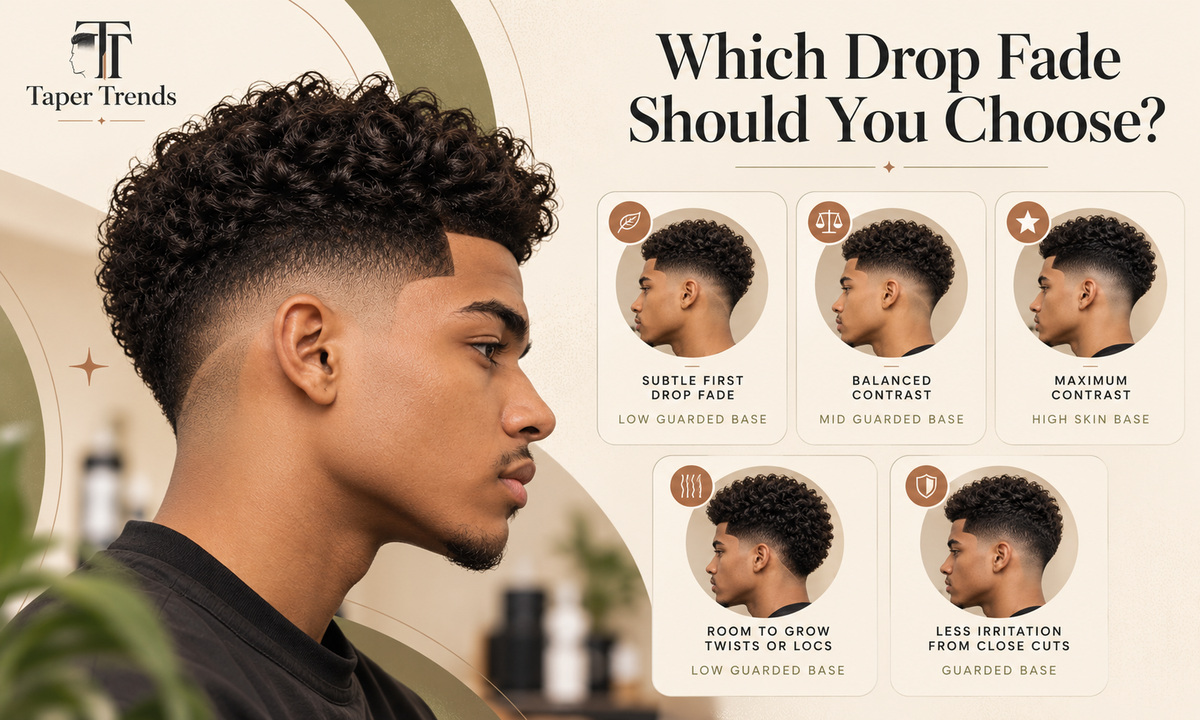
Height is the clearest lever, and the finish fine-tunes it. This table turns the common goals into a starting request you can adjust with your barber.
| If you want | Start by asking for | Trade-off |
|---|---|---|
| A subtle, easy first drop fade | Low drop, #½ or #1 base | Least contrast |
| Clear contrast without much scalp | Mid drop, guarded base | Needs more regular cleanups to stay crisp |
| Maximum contrast | High drop, skin base | Most scalp exposure, slowest to undo |
| Room to grow twists or locs | Low drop, guarded base | Contrast stays modest while you grow |
| Less irritation from close cuts | Any height, #½ or longer base | Never fully bare at the bottom |
Match the cut to your top length and density
How clearly the fade frames your top depends on length and density, not on curl-type labels alone. With waves, keep enough coverage above the drop for the pattern to carry. With an Afro, coils or twists, keep enough length and weight for the shape you want. With a short or buzzed top, the curve is the whole show, so symmetry matters more. If your hair runs fine or very dense, our taper fade guide for thin and thick hair explains how density changes the blend.
Judge silhouette, not face-shape rules
Online face-shape advice for fades contradicts itself often enough that it's a weak guide. Judge your own proportions instead. In side and rear photos, look at how tall the top sits, how wide the sides look, and how the back of your head curves, then compare cuts on heads with a similar profile. If a reference shows a cut only from the front, treat it as incomplete.
Plan around your hairline and growth goals
A drop fade shapes the sides and back, so an overly high cut can remove hair you meant to keep for a fuller Afro, twists or locs. Tell your barber your growth plan up front, and ask them to keep your natural front hairline unless you want it changed.
When in doubt, start lower. You can always go higher at the next visit; going lower means waiting for hair to grow back. Our low taper vs high taper fade comparison puts the two ends of that range side by side.
What should you ask your barber for?
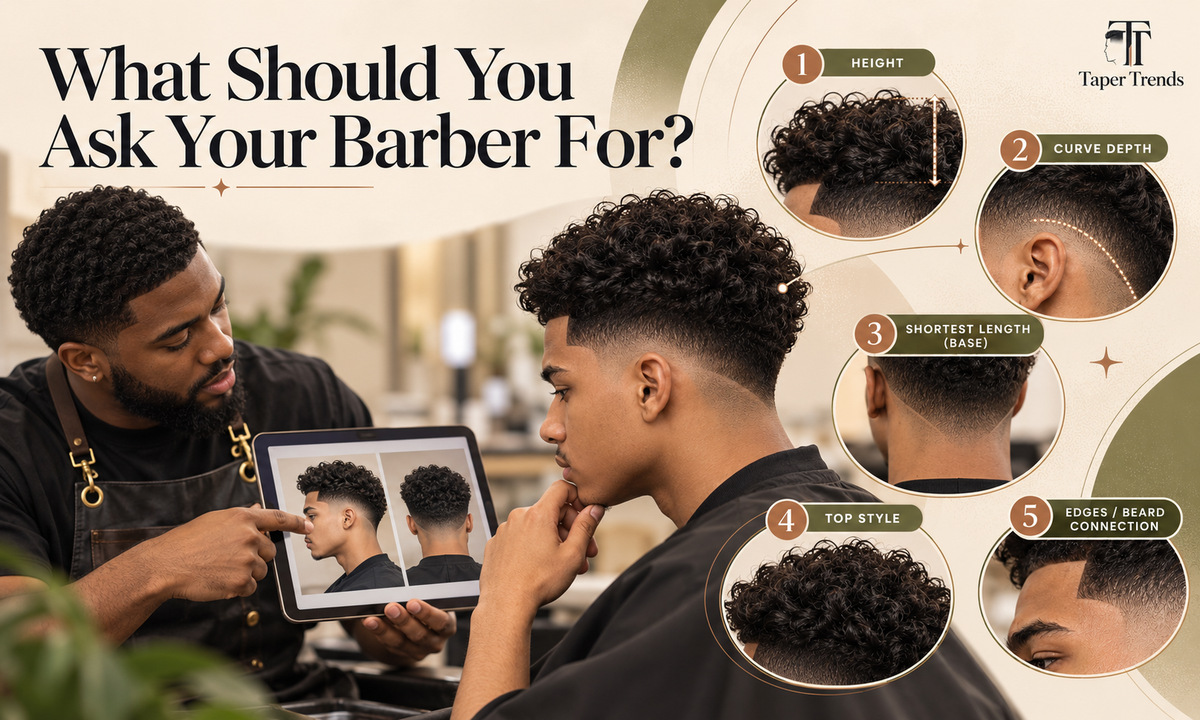
Tell your barber five things: how high the fade starts, how deep the curve drops behind the ear, how short the base goes, what stays on top, and how to handle the edges and beard. Then show a photo that includes the side and back. “Drop fade” on its own leaves too much to interpretation.
Give these five details before the clippers start
- 1. HeightLow, mid or high.
- 2. Curve depthHow far the line should fall behind the ear toward the nape.
- 3. Shortest lengthSkin, or a named guard such as #½ or #1.
- 4. TopWaves, coils, Afro, twists, locs or a short crop, and how much length to keep.
- 5. Edges and beardA natural or sharper line-up, and whether the beard blends into the sideburn.
Bring a side and rear reference photo
The defining part of a drop fade sits behind the ear, so a front-only selfie of someone else's cut won't help much. Pick photos of real haircuts on hair like yours, with similar texture, top length and density, and skip heavily edited or filtered images. If you can find one, a photo of the same cut a week or two later shows how it will actually live on your head between visits.
Barber script examples
Fill in the brackets and adjust the wording with your barber. If you'd rather build it step by step, our barber brief generator turns the same five details into a script you can show on your phone.
Script for waves
“I'd like a [low/mid] drop fade with a [skin/guard number] base. Keep enough length on top to preserve my wave pattern, and give me a [natural/sharper] line-up without pushing my hairline back.”
Script for an Afro or coils
“I'd like a [low/mid] drop fade with plenty of side weight left. I want a [mini/full] Afro on top, shaped separately, and a [guard number] at the bottom.”
Script for twists or locs
“I'm growing out [twists/locs]. Keep the fade low and leave enough perimeter hair for the long-term style. Please check with me before taking the sides any higher.”
Drop fade vs taper, burst, regular fade and skin fade
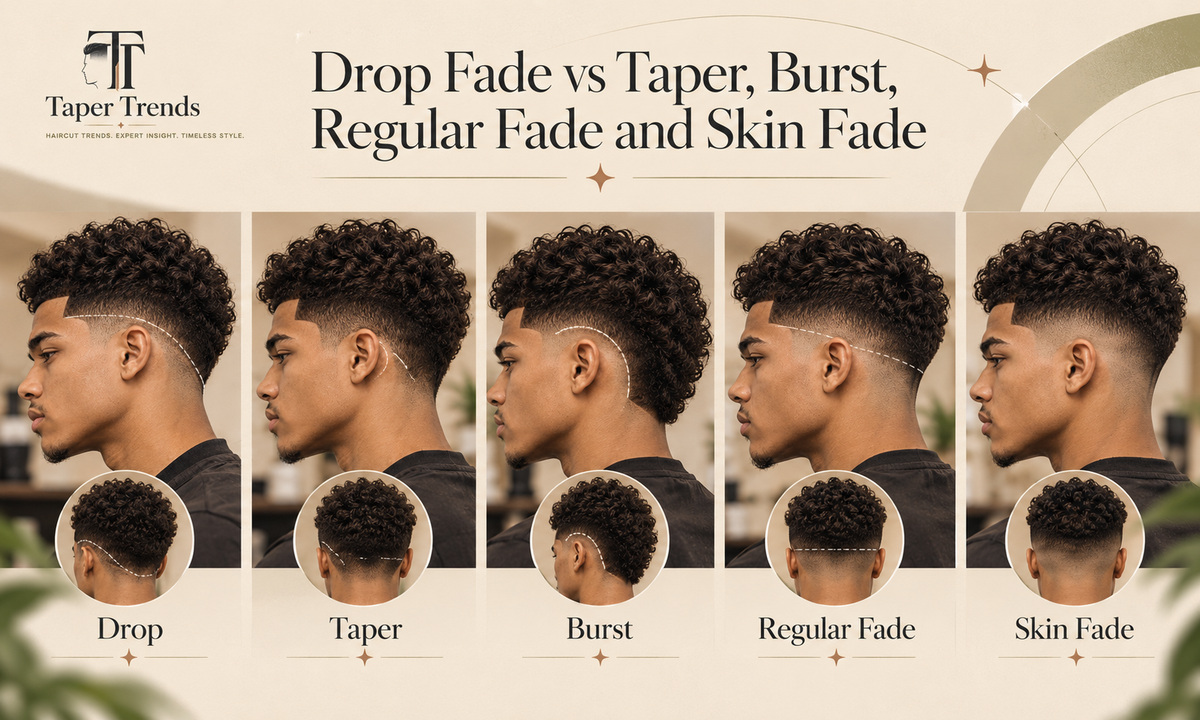
These labels don't all describe the same property, which is why comparing them head to head causes so much confusion. Drop and burst describe the shape of the blend line, low, mid and high describe where it starts, and skin describes how close the base goes. One haircut can carry several of these labels at once.
| Term | What it describes | Can it combine with a drop? |
|---|---|---|
| Drop | Shape: line curves down behind the ear toward the nape | It is the drop |
| Burst | Shape: semicircle around the ear, more length left at the back | No, it’s an alternative shape |
| Low, mid, high | Height where the fade starts | Yes |
| Skin or bald | Shortest length at the base | Yes |
| Taper | Varies by shop; often a smaller faded area | Often, depending on the shop |
Drop fade vs taper fade
Shops use “taper” differently. In some it means a fade limited to the sideburns and neckline; in others it's close to a synonym for fade. Instead of relying on the label, describe the area you want faded and the shortest guard, and you'll get the same result in either kind of shop. Our taper vs fade explainer untangles the two words, and the taper fade guide covers the taper on its own terms.
Drop fade vs burst fade
A burst fade is usually described as a semicircular blend around the ear that leaves more length at the back, while a drop continues down toward the nape. The two can look alike from the side, so confirm which one you're asking for with a rear-view photo; our drop fade vs burst fade guide shows what to check. Our burst fade guide for Black men shows that arc on coils, waves, twists and locs, and the full burst fade guide compares it with every other shape. If you want a drop that leaves the back long, our drop fade mullet guide shows where to stop the curve.
Drop fade vs regular low, mid or high fade
You don't have to pick between them. A low fade with a line that curves down behind the ear is a low drop fade; the terms answer different questions. A “regular” fade in this sense is simply one whose line stays level around the head. Our low taper vs low fade comparison shows how that level line changes with the depth of the cut.
A skin fade is a finish, not the opposite of a drop fade
Low skin drop, mid skin drop and high skin drop are all real haircuts. “Skin” tells the barber how short the base goes, not which path the line takes.
How to maintain a drop fade and protect your scalp
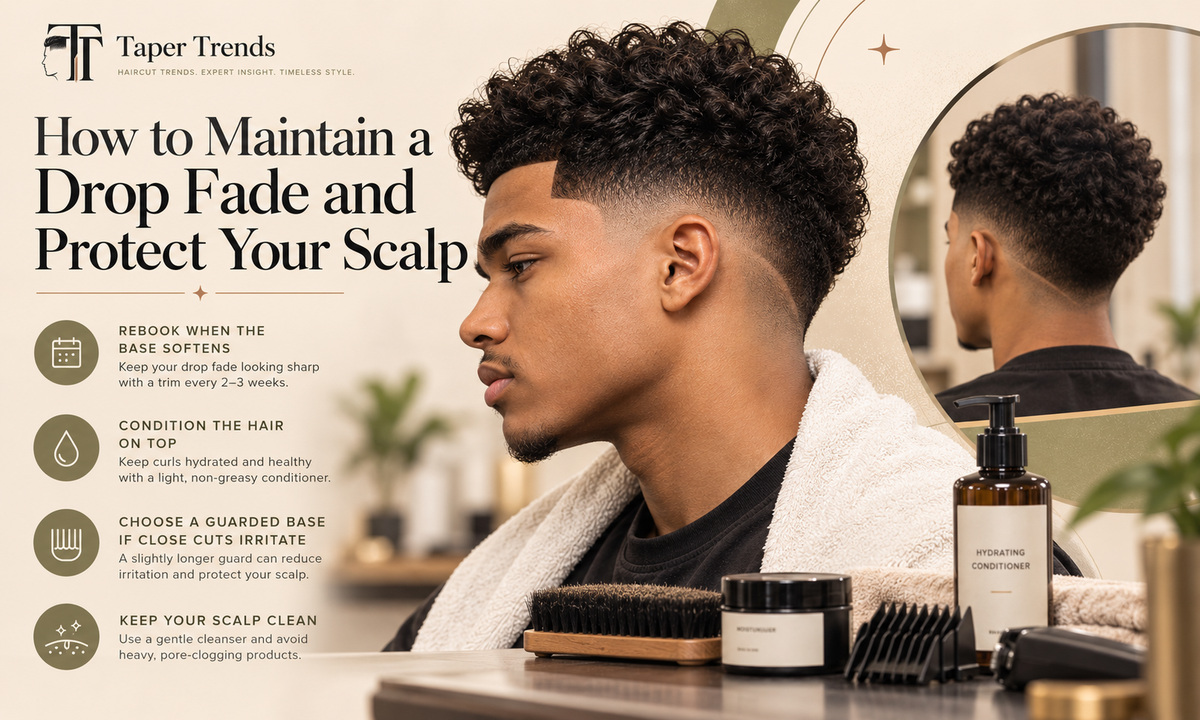
How often a drop fade needs work depends more on how short the base is and how crisp you want the cut than on the word “drop.” Skin-close bases show regrowth soonest, while guarded bases soften more gradually. Recurring bumps on the neck or scalp are a skin issue, not just a haircut problem.
Rebook based on how sharp you like it
There's no single interval that suits everyone. Rebook when the base looks softer than you like. People who wear a skin finish tend to come back sooner, because a few days of growth already changes the look, while a #1 base can go longer before it reads as grown out.
Shorter isn't free, though. The American Academy of Dermatology lists frequent close-shave haircuts among the things that can irritate the skin on the back of the scalp and neck, so if you're prone to bumps, a guarded base and a slightly longer gap between cuts may be the better trade.
Conditioning matters more than “fade products”
The fade itself needs very little product. The hair on top is where care pays off. The American Academy of Dermatology recommends using conditioner every time you wash and coating the ends, since the ends are the oldest and most fragile part of the hair. If you press or straighten, it advises a device with a temperature dial set as low as gets the job done.
Beyond that, style for your top: brushing and a durag for waves, a sponge or twisting routine for twists, moisture and gentle detangling for coils and Afros. Our guide to styling a taper fade breaks those routines down by top.
If close cuts cause razor or neck bumps
Coarse, curly hair can curl back into the skin when it's cut very short. In its razor bump guidance, the American Academy of Dermatology explains that shortened coarse, curly hairs can curve into the skin and cause bumps, and it advises against shaving closely. That page is written about the beard, but the same mechanism is why a guarded base often helps people who react to skin fades. To choose between the three skin heights, read our low, mid and high skin fade comparison before you book.
Bumps on the back of the neck or scalp can also be something more persistent. The AAD notes that with acne keloidalis nuchae, itching may start hours or days after a close-shave haircut, and the bumps that follow are often mistaken for pimples or razor bumps. The same source says the condition isn't caught from dirty clippers, and that untreated it can scar and cause permanent hair loss in that area. If bumps keep coming back, hurt, or start to harden or scar, see a dermatologist rather than trying to cut around them.
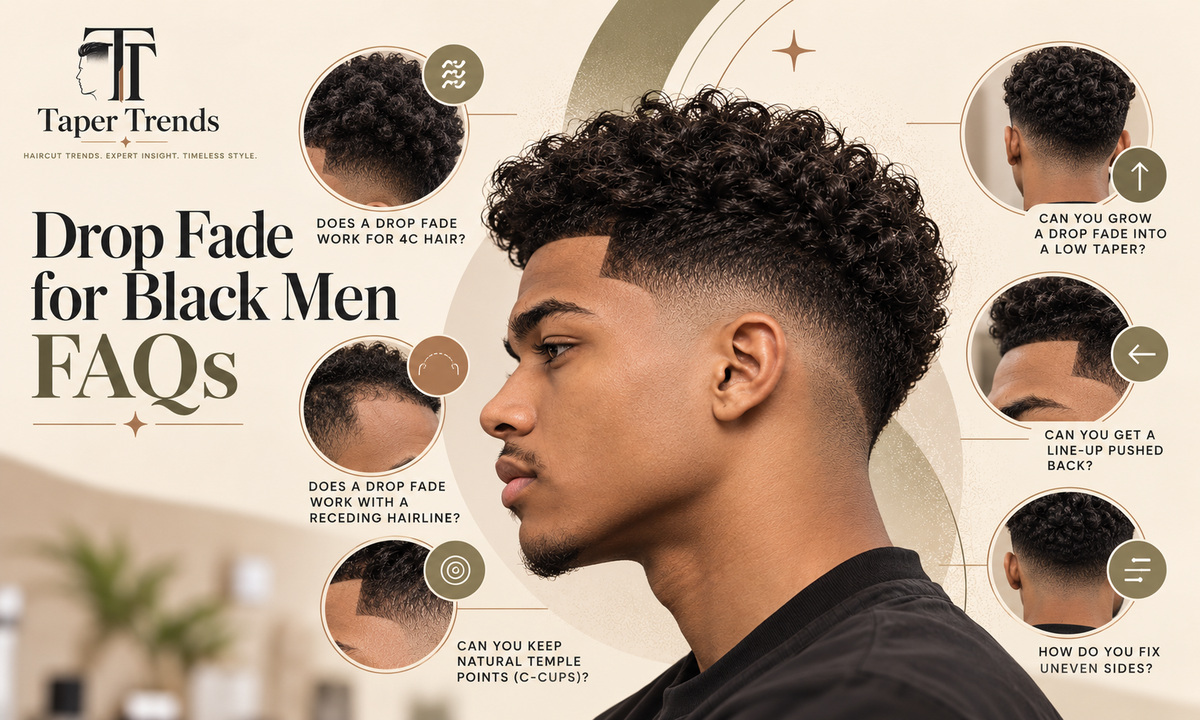
Drop fade for Black men FAQs
Does a drop fade work on 4C hair?
Yes. Tightly coiled 4C hair pairs well with a drop fade. Retained length, density and the top style you want matter more than the curl label, so describe the shape you’re after and let your barber judge how much length your hair needs to hold it.
Does a drop fade work with a receding hairline?
Often, yes. The drop shapes the sides and back, not the front, so it doesn’t make a receding hairline worse. A low or mid height usually keeps more weight around the temples, and asking for a natural line-up rather than a sharp, squared one keeps attention off the hairline itself.
Can you keep C-cups or natural temple points with a drop fade?
Yes, if you say so before the cut starts. Temple detailing is controlled separately from the drop. Tell your barber you want your natural temple points (often called C-cups) kept, and show a front photo of the hairline you mean.
Can you grow a drop fade into a low taper?
Usually, with patience. The removed hair has to regrow, so how long the transition takes depends on how high the fade was cut. Tell your barber your goal so they blend the sides as they grow in instead of resetting the line every visit.
Should the line-up be pushed back for a sharper look?
No. A sharp result doesn’t require moving your natural hairline back. Ask for the edges to be cleaned along your existing hairline, and say clearly if you don’t want the front or temples pushed back.
What if the two sides of the drop look uneven?
Check the rear view with a hand mirror before the barber blends further, and speak up early. A side that has already been cut too high can’t be fixed on the spot, because the hair has to regrow; the barber can only bring the other side up to match or leave it for the next visit.
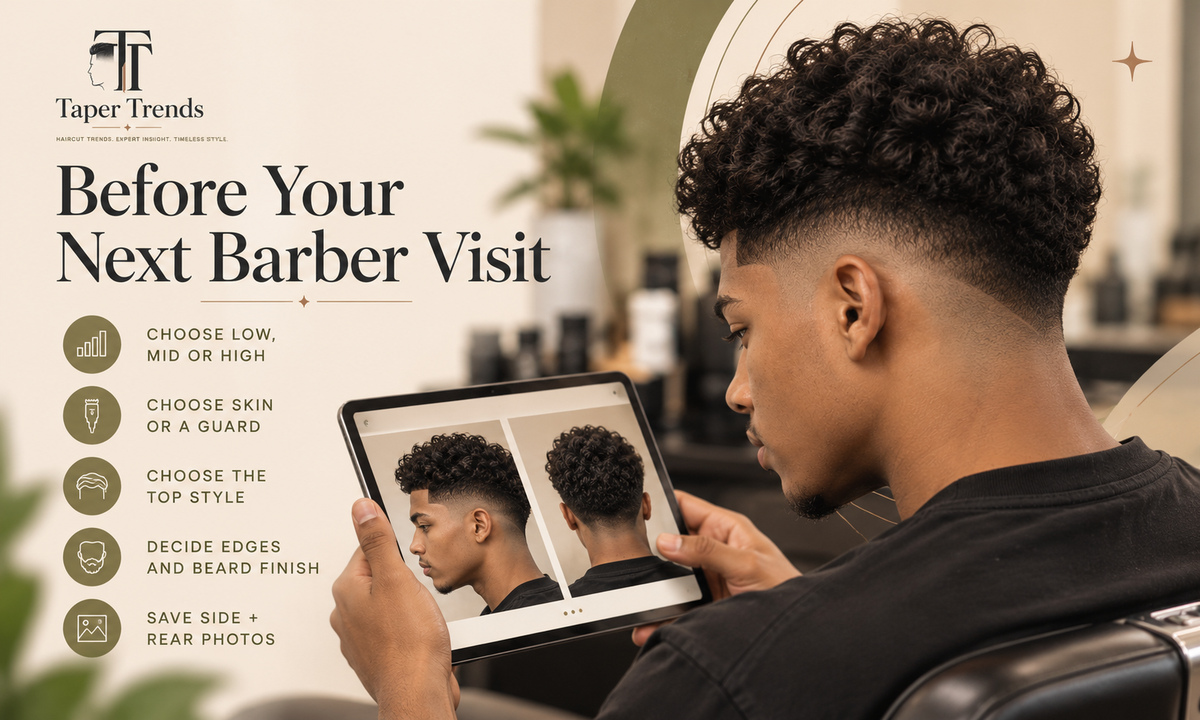
Before your next barber visit
Decide your four choices before you sit down: low, mid or high; skin or a named guard; the top you want; and how the edges and beard should finish. Save one side photo and one rear photo of a real haircut on hair like yours. If you're unsure about height, go lower first, and if close cuts irritate your neck, choose a guarded base and keep the same curve.
The bottom line
A drop fade for Black men is one shape, the curve behind the ear toward the nape, sitting under four separate choices: height, base, top and edges. Waves, coils, an Afro, twists or locs all work above it.
Name all four in the chair, back them with side and rear photos, and start lower if you're unsure. If close cuts leave bumps, keep the curve and raise the base.
Want more taper fade guides?
Browse clean, barber-ready breakdowns for every hair type.