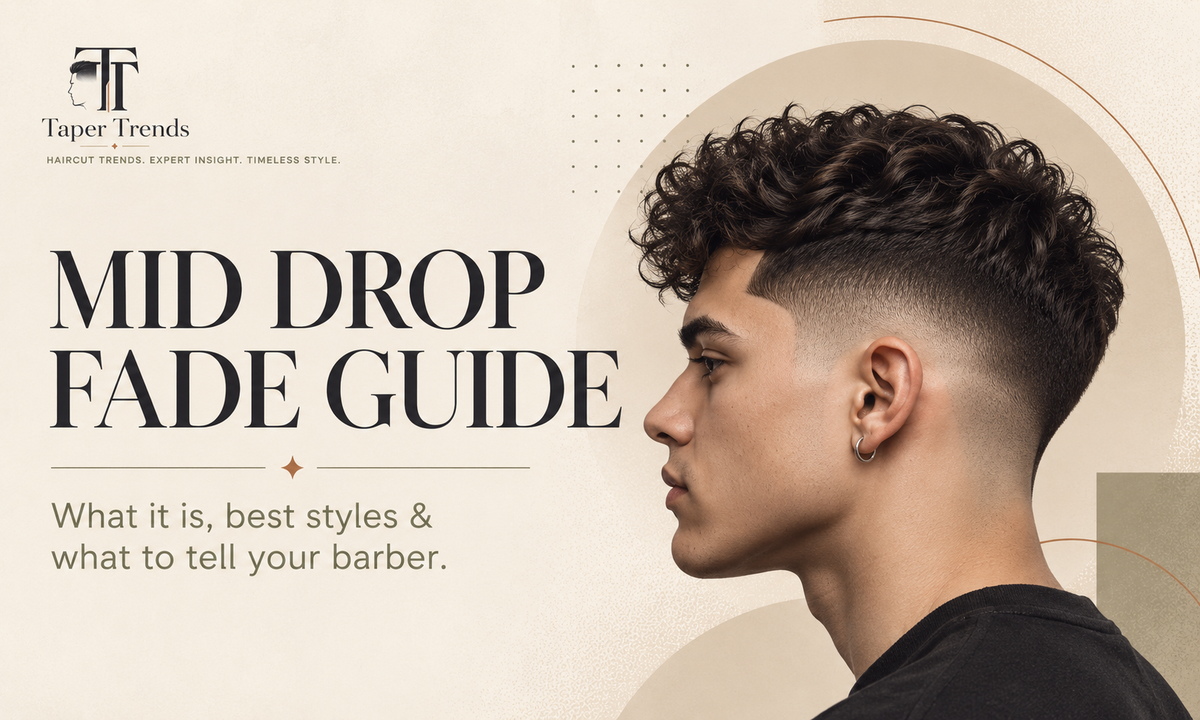
A mid drop fadeis a fade that starts around the middle of the side of the head, near the temple, then curves lower behind the ear on its way to the neckline. “Mid” sets where the fade begins. “Drop” describes the curve. The guard number and the length on top are separate choices. For the curve at every height, see our complete drop fade guide, and for every taper and fade style on the site, start at the low taper fade haircuts guide.
That separation is where most disappointing haircuts start, because barbers don't all use these words the same way. This guide turns the cut into decisions you can say out loud in the chair.
What is a mid drop fade?
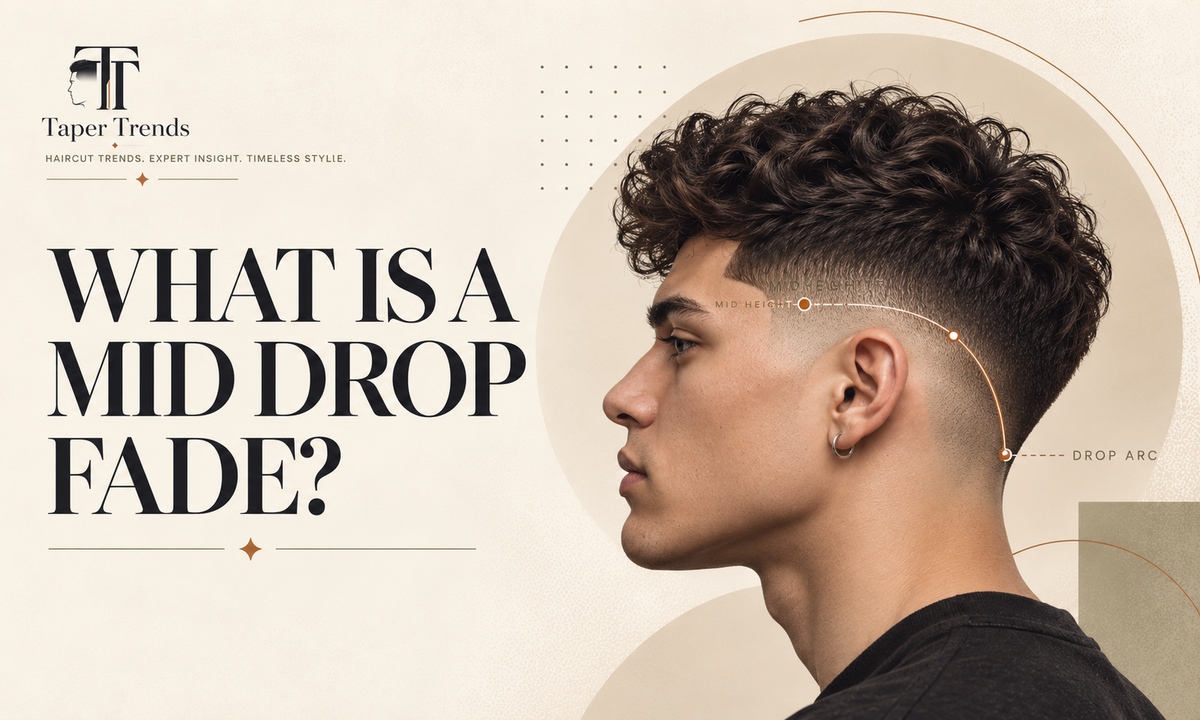
A mid drop fade is a fade haircut in which hair graduates from very short at the bottom to longer above, with the fade line beginning at mid-height on the sides and arcing downward behind the ear toward the nape. From the front, the arc is nearly invisible. From the side and back, it is the whole point.
CADMEN Barber Academy explains the mechanics. A standard fade holds its line at a consistent height around the head, while a drop fade sits higher above the ear and lower behind it. Because the line falls at the back, more hair stays above it, so the crown and upper sides look rounder and fuller than under a level fade started at the same height. Our guide to the different kinds of fade haircuts lays out height, shape and finish side by side.
What does “mid” mean and what does “drop” mean?
“Mid” tells your barber roughly where the fade begins: around the midpoint of the side, near the temple, so about the lower half of the side is faded. “Drop” tells them what the line does behind the ear. The settings are independent, so a mid drop fade can finish at bare skin or at a #1.
| Term | What it controls | What it doesn’t control |
|---|---|---|
| Mid | Where the fade starts on the side | How short the base goes, or top length |
| Drop | The path of the line behind the ear | Starting height or guard number |
Treat “mid” as a zone, not a fixed point. As our drop fade haircut guide notes, its position drifts from shop to shop, and head shape moves the visual midpoint too. Pointing to the spot settles it faster than words. The same height without the curve is covered in our mid taper fade guide, and if you sit between the two heights, the low-mid taper fade shows what that in-between start looks like.
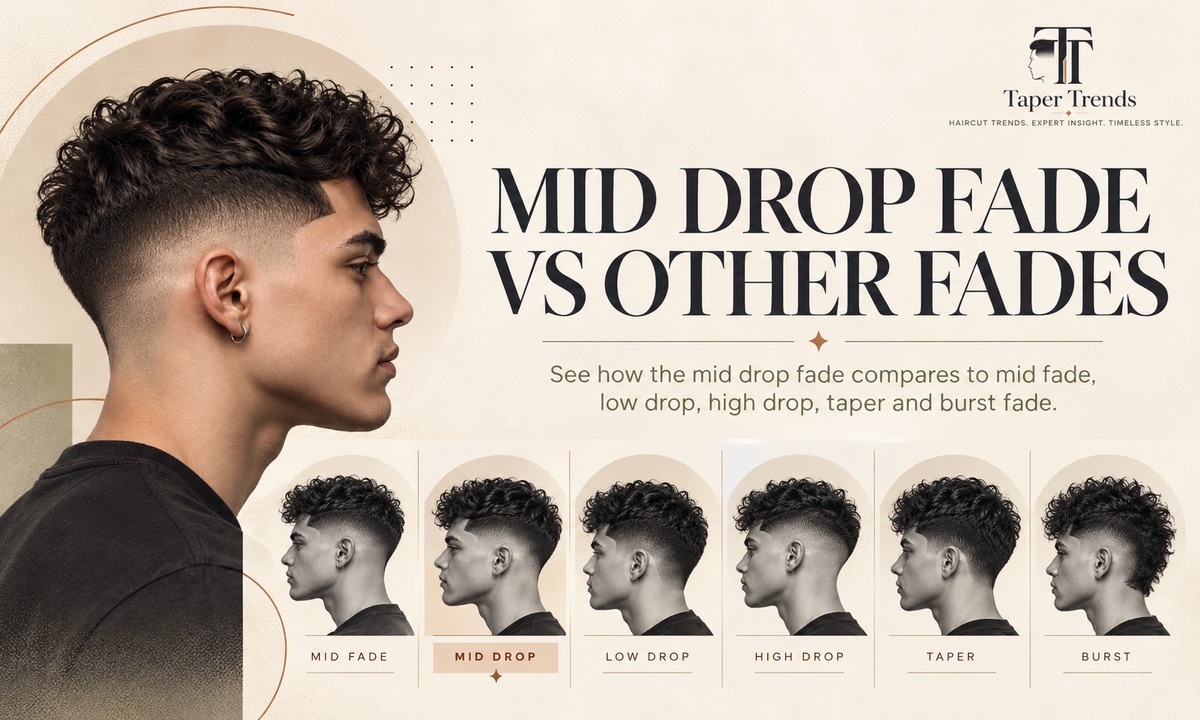
Mid drop fade vs mid fade, low and high drop, taper and burst fade
These names are not rival haircuts. Most describe a single setting: height (low, mid, high), shape (level, drop or burst) or finish (skin, shadow, taper). A mid drop fade combines a mid height with a dropping shape, and it can take any finish.
| Cut | What the name describes | What you’ll see |
|---|---|---|
| Mid fade | Height | Same starting point, but the line stays roughly level |
| Mid drop fade | Height + shape | Line starts mid-side and dips behind the ear toward the nape |
| Low drop fade | Height + shape | Subtle curve close to the ear; keeps the most side weight |
| High drop fade | Height + shape | Most of the side exposed, still dipping behind the ear |
| Skin drop fade | Finish | Any drop height taken to a bare-looking base |
| Taper | Finish or area, by shop | Often limited to the sideburns and neckline |
| Burst fade | Shape | Semicircle around the ear; the back stays longer |
The height and finish rows follow Barber.Style. The taper and burst rows follow our burst fade vs taper fade breakdown, which also flags the real trap. “Taper” means a less-than-skin finish in some shops and a smaller cutting area in others, and some barbers blur drop and burst. Our taper vs fade explainer untangles that vocabulary. If a term still feels fuzzy, ask your barber to point to where the short hair will stop.
Mid drop fade vs regular mid fade
A regular mid fade holds roughly one height around the head. A mid drop fade starts at the same height, then curves down behind the ear. Face on, they look almost identical, so compare them in profile and from behind. For where a mid fade sits against low and high ones, see low vs mid vs high fade.
The difference matters if you change your mind. Flattening a drop into a level fade means cutting higher at the back, which takes one visit. Turning a level mid fade into a drop needs hair that's already been removed, so you'd have to grow the back out first. If you're torn, the drop is easier to walk back.
Mid drop vs low drop and high drop
The curve is the same at every height; what changes is how much side it clears. A low drop fade starts just above the ear and keeps the most side weight, and the low taper drop fade softens it further by shortening mainly the edges. Going the other way, a high drop fade starts the same curve well above the ear, and our high taper fade guide shows how much scalp a higher start exposes. For the level versions of the same jump, compare the low vs mid taper fade and mid vs high taper fade side by side.
Mid drop fade vs mid burst fade
A burst also curves, but as a semicircle around the ear that leaves the back longer, where a drop keeps falling toward the neckline. Our mid burst fade guide shows that arc at the same starting height, and the full burst fade guide covers it from low to high burst. A rear photo settles which outline you want, and our drop fade vs burst fade comparison walks through the ear-and-nape check.
Is a mid drop fade right for you?
A mid drop fade usually suits people who want clear contrast through the middle of the side, a rounded silhouette from behind, and some length or texture on top for the curve to frame. It is less forgiving on fine or thinning sides, and it depends on a barber who cuts curved lines well.
Choose it if
- You wear curls, waves, coils or a textured top. CADMEN calls the drop a natural fit for high-volume and Afro-textured tops, because the lower back line accommodates fuller shapes without abrupt contrast.
- You want more contrast than a low drop, without the exposed scalp of a high fade.
- Your barber's portfolio shows side and rear views of curved fades. CADMEN notes the arc takes more planning than a straight line, since it has to balance on both sides.
Adjust it or reconsider if
- You want subtle contrast. A low drop is the gentler version.
- Your sides are fine or thinning. A skin finish exposes more scalp, so talk through base length before the clippers start.
- You want a buzz cut that hides imperfections. With nothing on top, the drop is more exposed, and an uneven curve has nowhere to hide.
On fine or thinning hair, our taper fade guide for thin and thick hair explains why a guarded base keeps the sides from reading sparse.
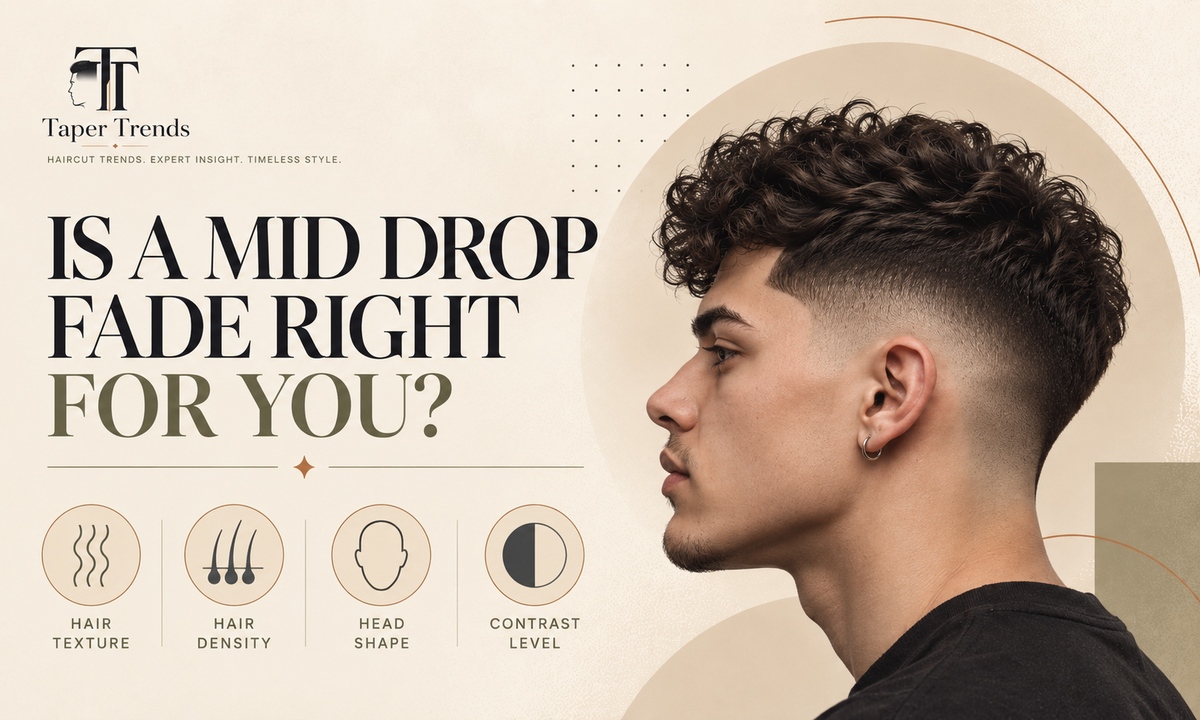
Hair texture, density and head shape matter more than a generic face-shape rule
The same reference photo can look very different on two heads, because density, curl pattern, growth direction and skull shape all change how the curve reads. Those factors predict your result better than face-shape charts, which disagree with one another.
When we compared face-shape advice across guides for our drop fade overview, it was inconsistent, and no face shape or hair texture rules a drop fade out. Even CADMEN, which offers its own face-shape view, says the top's shape affects face balance more than the fade does. If you still want a starting point, our face shape detector gives you one in a few seconds.
Hairstylist Cindy Marcus, editor-in-chief of Latest-Hairstyles with more than 15 years of experience, says many clients ask for this cut after seeing it on someone whose hair is nothing like theirs.
- Density and head shapeChange how the cut has to be done, not just how it looks.
- Curly or coarse hairMay need tighter clipper work and a different lever setting around the curve.
- Neckline growthCan override the plan. One of her clients had thick hair growing in four directions at the nape, so they chose a skin taper there to stop it puffing out within about a week and a half.
For texture-specific detail, see our drop fade on curly hair and drop fade for Black men guides, which cover the mid height on curls, coils, waves and locs.
How to ask your barber for a mid drop fade
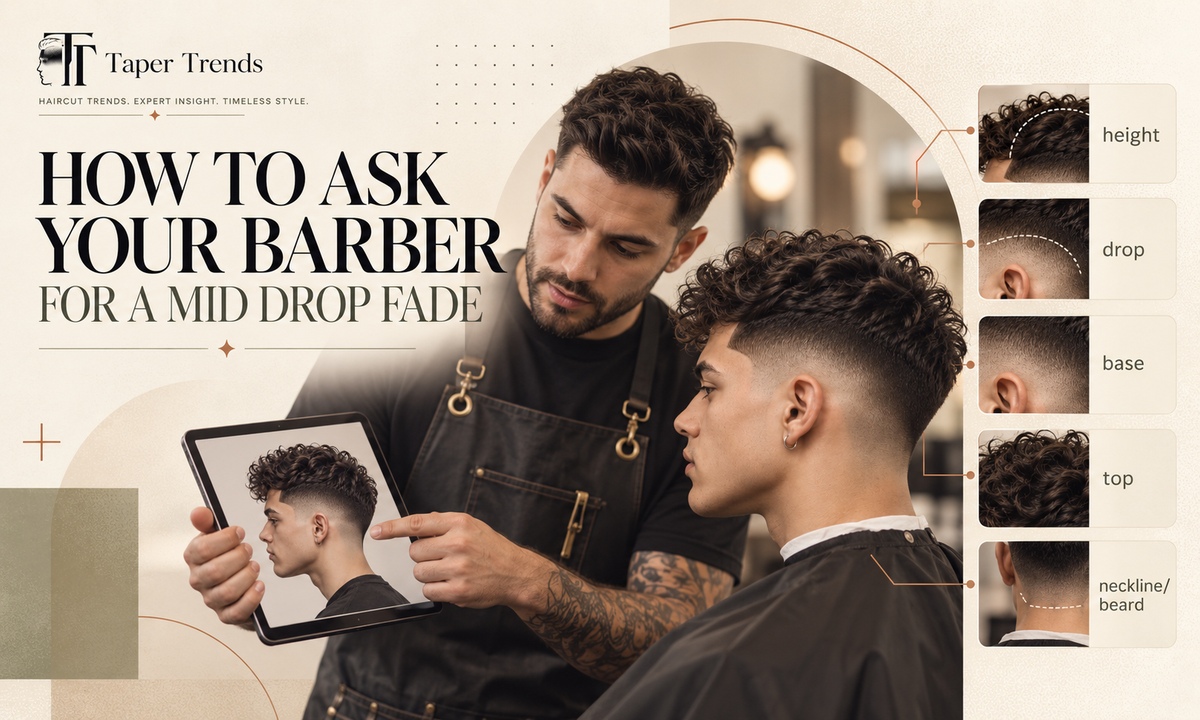
To ask for a mid drop fade, give your barber five decisions: where the fade starts, how far it drops behind the ear, how short the base goes, what stays on top and how the edges finish. Back those words with side and rear photos, because the defining curve can't be seen from the front.
Use this five-part barber brief
Mention your hairline, any cowlick at the crown and how much styling time you'll realistically give the top. Then cover:
- 1. Height“Mid,” plus a finger pointing to where the fade should begin.
- 2. CurveA subtle drop behind the ear or a pronounced one.
- 3. BaseSkin, #0.5, #1 or another shortest length.
- 4. TopLength, texture, and whether it blends into the fade or meets it at a hard line.
- 5. EdgesNeckline shape, line-up or not, and beard connection.
Sample request
“I'd like a mid drop fade starting about here and curving down behind the ear. Take the base to a #1, leave about three inches on top with texture, and blend it in. Natural neckline, no line-up. Could you mark the guideline first so I can check it?”
That last question earns its place. Barber.Style recommends a conservative first guideline, especially if you're switching from a regular fade, because a curve taken too high can't be restored in the same visit. A barber can always go higher. Nobody can go lower. If you'd rather build the brief step by step, our barber brief generator turns the same five decisions into a script you can show on your phone.
Bring a side and back photo, not just a front view
A front-facing photo hides the arc. Bring three references:
- Side viewHow far the line falls behind the ear.
- Rear viewSymmetry and how the fade meets the nape.
- Matching hairSimilar texture, density and top length to yours.
Use photos of real haircuts. As we warn in our drop fade styles guide, some drop fade galleries online are AI-generated, and a render can show a blend no real hair will produce. Treat any photo as a starting point your barber adapts to your head; our guide to what a low taper fade looks like from every angle shows the kind of side and rear shots worth saving.
Guard numbers, skin finishes and top length
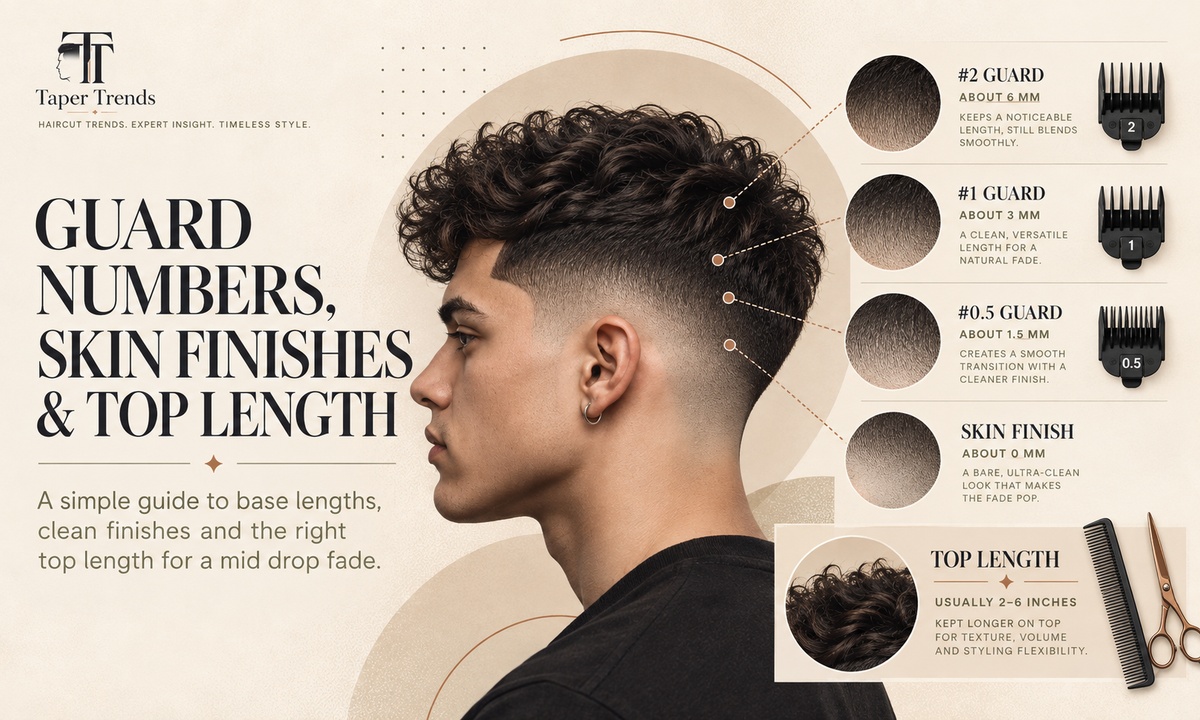
Guard numbers set cutting length, not fade height or shape. On Wahl guide combs, #1/2 leaves about 1/16 inch, #1 about 1/8 inch and #2 about 1/4 inch. Use a number to describe your base, then let the barber decide how to blend upward from it.
| Wahl guard | Cutting length | Common role (convention) |
|---|---|---|
| #1/2 | 1/16 in (1.5 mm) | Closest guarded base |
| #1 | 1/8 in (3 mm) | Close shadow base |
| #2 | 1/4 in (6 mm) | Softer base or early step up |
| #3 | 3/8 in (10 mm) | Upper part of a short blend |
| #4 | 1/2 in (13 mm) | Upper part of a longer blend |
Lengths come from Wahl USA's 10-piece guide comb set and #1/2 guide comb listings. Other brands size guards differently, so the numbers describe a look, not a universal standard. Our clipper guard size chart converts every guard number to inches and millimeters.
For a professional example, the Andis drop skin fade sequence, published by Modern Salon in partnership with Andis, sets the first weight line with a #2 guard, drops it gradually toward the back, then works down through #1.5, #1, #0.5 and #0 before switching the clipper lever between settings to smooth the blend, the same lever move our how to cut a fade guide uses.
Skin is a finish, not a guard. In that sequence, a trimmer then sets a zero line and a foil shaver takes the base to skin. “No guard” and “skin” are different requests. For contrast without bare skin, ask for #0.5 or #1.
Top length is its own number. Give it in inches or show it in a photo.
Best mid drop fade styles by hair type and top style
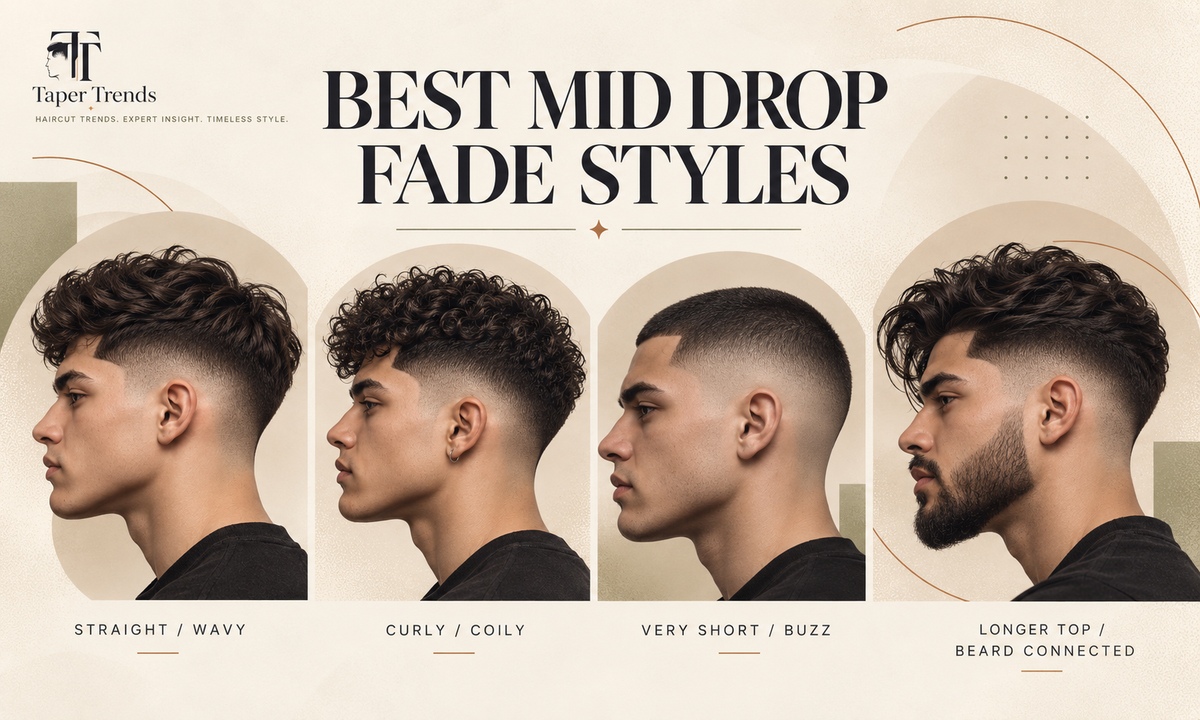
Choose by how your hair behaves first, then by top length. Treat these eight combinations as conversation starters with your barber, not recipes.
Straight and wavy hair
Textured crop
Short, choppy layers suit hair that holds movement on its own. Marcus describes a layered top over a soft fade as a five-minutes-at-most morning: matte paste pushed through with the fingers. Our drop fade for straight hair, mid taper fade for straight hair and mid taper fade for wavy hair guides go deeper on tops at this height.
Quiff or side-swept top
A quiff asks for volume and a routine, roughly 10 to 15 minutes of combing and blow-drying a day by our estimate. A piecey fringe needs real density, and Marcus says fringes suit straight to wavy hair rather than heavy curl. See our drop fade textured fringe guide or the mid taper fade with a textured fringe for the forward-styled version.
Curly and coily hair
Defined curls
Leave enough length for curls to form a shape. Marcus warns against thinning a curly top too much, and our curly drop fade guide notes that removing too much weight above the fade erases the contrast. Curls shrink as they dry, so judge length dry. The mid taper fade on curly hair shows the same height with a level line.
Waves or sponge texture
Patterned wave styles look best with clean sides and back, and both our Black men's drop fade guide and CADMEN describe the skin drop as one of the most common pairings for textured, natural styles. A #0.5 or #1 base softens the contrast, and our mid taper fade for Black men covers the level version at this height. For 360s, see the mid taper fade with waves, and for a fuller shape, the mid taper fade Afro.
Very short tops
Buzz cut
With almost nothing on top, the curve becomes the design. Check its depth and symmetry from the side and back before the blend is finished. Our mid taper fade buzz cut guide covers top guard lengths for this look.
Short textured crop
A textured or French crop pairs clippered sides with a point-cut or razor-cut top. It needs little daily effort but has enough shape that the fade isn't carrying the whole look. Our French crop taper fade guide covers how to ask for the fringe line.
Longer tops and facial hair
Middle part or longer textured top
Marcus lists pushing it back, wearing it forward or leaving it messy as options. For a part or slick-back, ask for the fade to blend into the full top length so the hair lies flat when brushed back. Our mid taper fade middle part and taper fade slick back guides show both tops. If you want length at the back as well as on top, our drop fade mullet guide covers the mid drop under a long crown and back.
Mid drop fade with beard
Treat the beard as a separate decision. A typical beard fade is a half-inch to one-inch blend at the sideburn, with the rest of the beard kept at length; the alternative is a disconnected sideburn with a crisp line-up. Marcus favors connecting them, saying it makes the cut read as intentional. Our mid taper fade with beard guide walks through that sideburn blend step by step.
What should a good mid drop fade look like from the side and back?
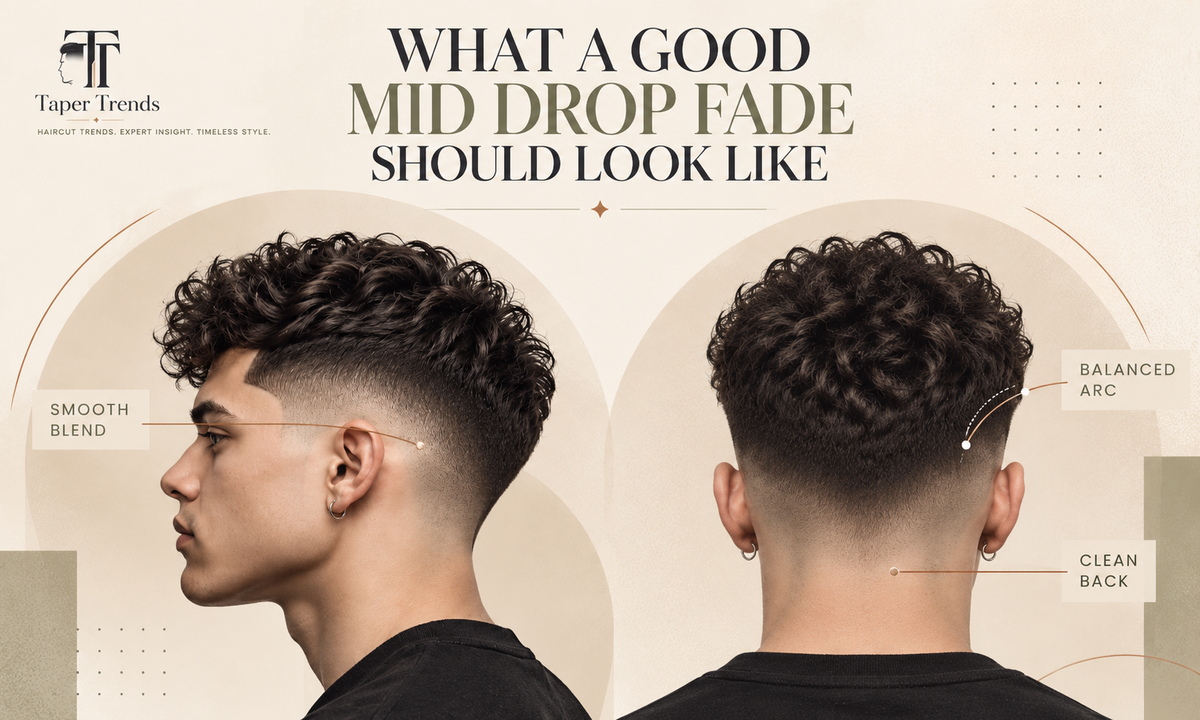
A good mid drop fade shows one smooth, deliberate arc from the temple area down behind the ear to the nape, with no hard stripes between lengths. Check the side, then the back with a hand mirror, then your reference photo, and ask for changes while the clippers are still out.
- SideThe line starts where you agreed and falls gradually, following the shape of the head as in the Andis sequence.
- BlendTone shifts smoothly with no accidental dark band. On skin fades, Andis teaches lightly tapping a foil shaver just above the skin line to soften any visible edge.
- BackBoth sides closely mirror each other, allowing for natural asymmetry. If one side sits noticeably higher, ask for it to be evened out.
- NecklineNatural, rounded or squared as you chose, ending cleanly.
- TopIt meets the fade at the length and blend you asked for.
How often does a mid drop fade need maintenance?
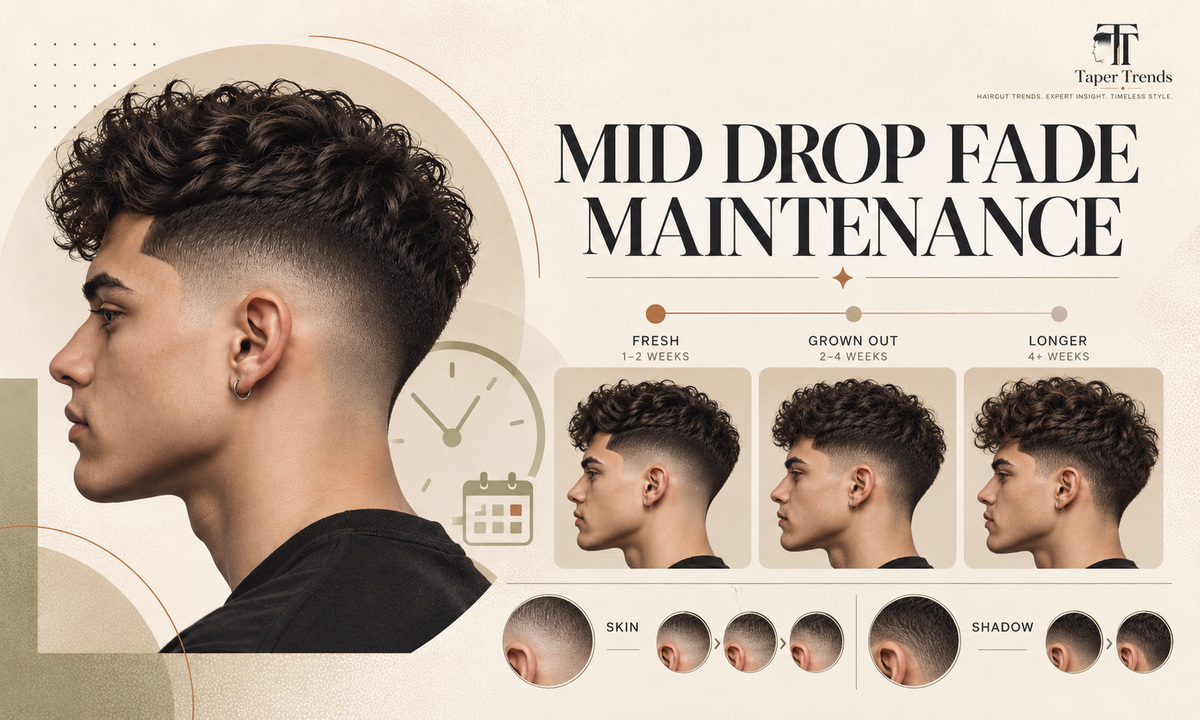
Most people refresh a mid drop fade every two to four weeks, with skin finishes at the shorter end, per the refresh table in our drop fade guide. There's no fixed expiry date. Scalp hair grows about 0.35 mm a day, roughly 1 cm a month, per StatPearls, and what matters is how fast that regrowth softens your chosen contrast.
The math explains the rush. Two weeks at the average rate adds about 5 mm, more than the 3 mm a Wahl #1 leaves, so the base blurs long before the top looks overgrown. Growth varies between people, so build your own schedule: note when the cut starts to look grown in, and book a few days earlier next time. Marcus adds that layered tops fall flat as they grow out, so the top can't wait forever either. When you're working out what to leave at the chair, our barber tip calculator does the math.
Skin fade vs shadow fade grow-out
A skin fade base shows regrowth first, as fuzz along the bottom of the fade. A #0.5 or #1 base shows the same growth more gradually.
| Base | How regrowth shows | Typical refresh window |
|---|---|---|
| Skin | Early, as fuzz at the base | 1 to 2 weeks to stay crisp; 2 to 4 with some softening |
| #0.5 or #1 shadow | Later, as a gradual tone shift | 2 to 4 weeks |
Barber.Style lands in a similar place: skin bases look softest after roughly two to three weeks, while a #0.5 or #1 can stretch longer.
Common mid drop fade mistakes and what can be fixed
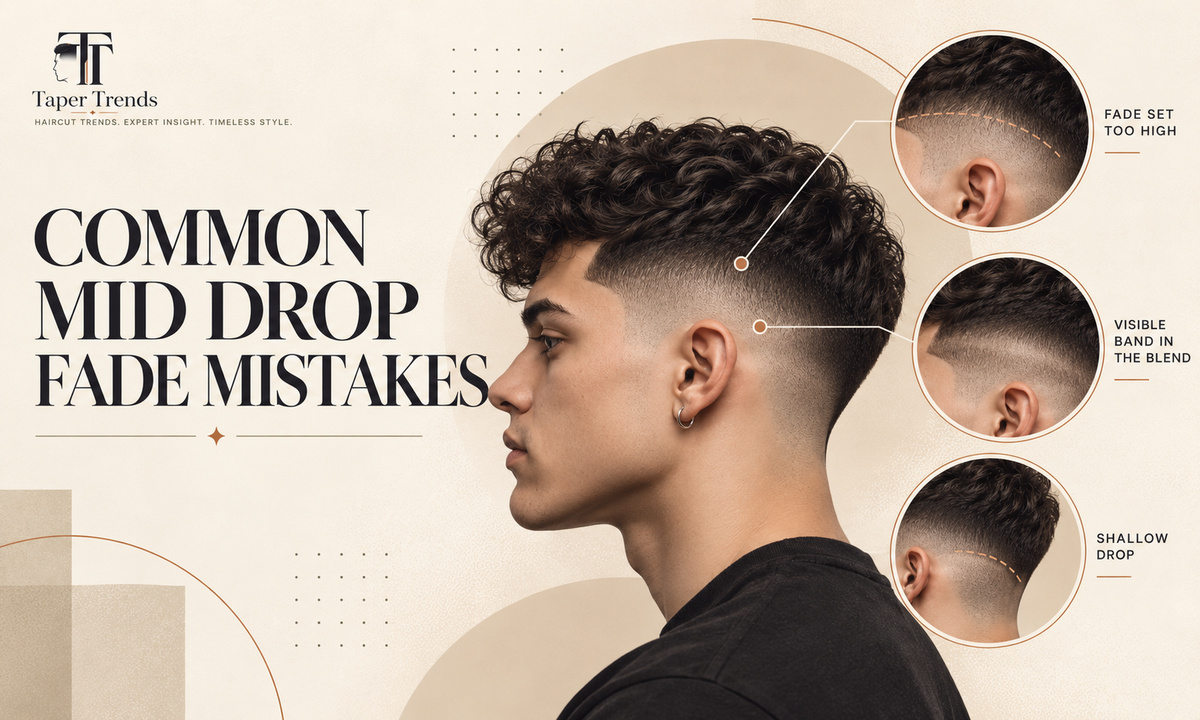
Most mid drop fade mistakes can only be fixed during the appointment, because removed hair won't come back until it grows. Speak up mid-cut, when, as our drop fade guide puts it, a fix takes minutes.
| Problem | Fixable now? | What to do |
|---|---|---|
| Line set too high | No | Let it grow; ask for a lower, marked guideline next time |
| Visible band between lengths | Usually | Ask for another blending pass with lever changes |
| Drop too shallow, reads as level | Only if the back isn’t cut short yet | Ask to deepen the curve now, or regrow and bring a rear photo |
| Choppy join into the top | Yes | Ask for the connection to be reblended |
| Back of the head taken too short | No | Regrow; next time ask how the barber will blend around the occipital bone |
| Top shorter than your reference | No | Regrow; give top length in inches next time |
If you're second-guessing the height after a cut, our low taper vs low fade comparison shows what a lower, softer next cut would look like.
How to style a mid drop fade day to day
The fade itself needs almost no daily styling; the top decides the effort. These suggestions come from Marcus and our own guides, not product testing, so adjust them to your hair.
| Top | Approach |
|---|---|
| Very short crop or buzz | Little or nothing |
| Textured, straight or wavy | Matte paste or clay worked in with the fingers |
| Fine hair that needs lift | Volumizing powder at the roots, or thickening spray before blow-drying |
| Natural waves | Light product on damp hair, then air-dry |
| Curls and coils | Lightweight curl cream on damp hair instead of gel; keep curls moisturized to limit frizz |
| Slick back or side part | High-shine pomade |
Leave the fade to your barber. At home, a trimmer pass along the natural neckline is enough. Our guide to styling a taper fade breaks each of those routines down step by step.
Mid drop fade FAQs
Is a mid drop fade harder to cut than a regular fade?
Somewhat. CADMEN explains that the barber is drawing a curve rather than a straight line, and the arc has to balance on both sides of the head. Experienced barbers handle it routinely, but check a portfolio for side and rear photos of their drop fades before booking.
Can a mid drop fade be a skin fade?
Yes. Skin sets the shortest base, while “mid drop” sets height and shape, so the two combine freely. The trade-off is comfort: the American Academy of Dermatology explains that razor bumps form when very short hairs curve back into the skin, so bump-prone skin may do better with a guarded base.
Can you get a mid drop fade without showing skin?
Yes. A #0.5 or #1 base leaves a thin layer of visible hair under the same curve. If bumps keep returning on the back of your neck or scalp, the AAD says it may be acne keloidalis nuchae, which tends to worsen without treatment, and recommends seeing a board-certified dermatologist.
Does a mid drop fade work with a receding hairline?
Usually. The fade shapes the sides and back, so it doesn’t change your front hairline, and the top style matters more. A mid fade starts near the temples, though, and StatPearls notes pattern hair loss typically begins at both temples, so show your barber your hairline before settling height and base.
Can a mid drop fade connect into a beard?
Yes. A beard connection is a short blend through the sideburn, typically half an inch to an inch, with the rest of the beard kept at length. Mention it before the cut starts so the barber shapes the sideburn to match.
Can you cut a mid drop fade at home?
It’s possible, but hard on yourself. The Andis drop skin fade sequence runs twelve steps across a clipper, several guards, two trimmers and a foil shaver, and the curve has to match on both sides, including the one you can’t see. Limit home work to tidying the neckline.
Sources for these answers: CADMEN, the AAD on razor bumps and acne keloidalis nuchae, StatPearls and the Andis sequence. For the beard blend on this exact curve, see our drop fade with beard guide, which pairs a mid drop with a short boxed beard; at other heights, see our low taper fade with beard guide or our skin fade with beard guide, which covers low, mid and high skin fades. To choose between the three skin heights, read our low, mid and high skin fade comparison before you book.
Your mid drop fade barber checklist
Before you sit down, settle these decisions:
- Mid starting height, shown with a point
- Shallow or pronounced drop
- Skin, #0.5 or #1 base
- Top length in inches, plus the style
- Neckline shape
- Line-up or no line-up
- Beard connected or separate
- Side and rear photos of a real haircut on hair like yours
In the chair, ask for the guideline to be marked first, check the back in a hand mirror before the blend is finished, and speak up while the clippers are still out. Then book your next visit a few days before the fade usually starts to look grown in.
The bottom line
A mid drop fade is two decisions, a start near the temple and a curve down behind the ear, sitting under three more: base, top and edges. Curls, waves, coils and straight hair all work above it.
Name all five in the chair, back them with side and rear photos, and have the guideline marked before the blend. If close cuts irritate your skin, keep the curve and raise the base.
Want more taper fade guides?
Browse clean, barber-ready breakdowns for every hair type.