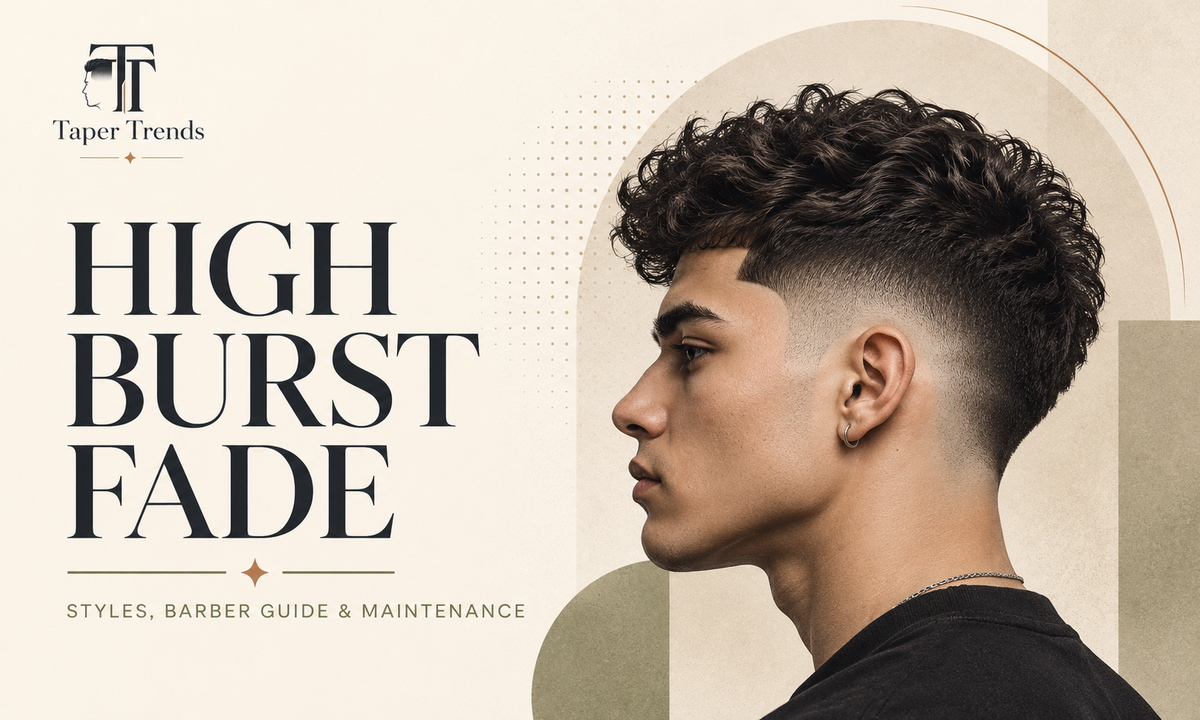
A high burst fade is a fade that curves in a rounded arc around the ear and is carried higher up the side of the head than a low or mid burst. The higher arc removes more hair above the ear, so the contrast with the top and back is stronger. The top and back can stay long, short or anywhere in between.
That flexibility is exactly why the name alone rarely gets you the cut you pictured. Below you'll find how the high version differs from similar fades, which hair it suits, five style directions worth considering, the details to agree with your barber, and what upkeep looks like once you leave the chair. If you want the whole family first, the burst fade haircut guide covers low, mid and high side by side, and the low taper fade haircuts guide is the hub for every fade on the site. Want the halfway-up height instead? Read the mid burst fade guide.
What is a high burst fade?
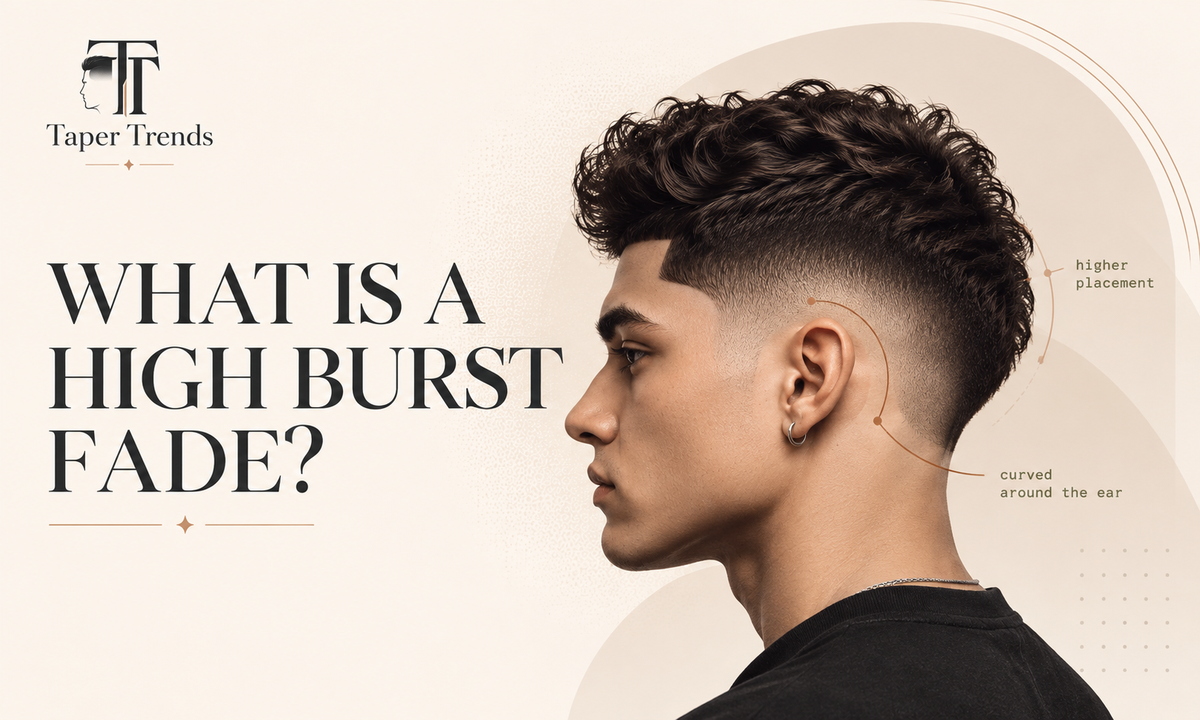
A high burst fade is a burst fade with its curved blend placed high on the side of the head. “Burst” describes the shape: the fade follows the round of the ear instead of running in a straight line around the head. “High” describes placement, taking that arc further up than a low or mid version so more of the side is faded and the contrast increases.
Hector's, a salon in Mortlake, London, defines the burst fade by that ear-following path and points out that the curve gives a strong shape to mullets, crops, faux hawks and textured tops. Those pairings work because hair above and behind the arc, at the crown and nape, is usually left longer. That retained length is what makes the curve readable from the side. Our burst fade mullet, burst fade mohawk and burst fade textured fringe guides show each pairing in full.
Because the shape defines the cut, the shortest length is a separate choice. A barber can take the tightest part of the arc down to skin or stop at a short clipper guard, and both still count as a burst fade as long as the curve is there. The gentlest version of the shape is the taper low burst fade, and the different kinds of fades guide lays out every level, depth and shape side by side.
Where the “high” placement sits
“High” is a relative term with no agreed measurement. The arc climbs further above the ear than on a mid or low burst, so more of the side is faded and less hair sits between the blend and the top. Barber Stake's burst fade guide frames the low, mid and high choice as a question of how much contrast you want, with the higher versions giving the most aggressive transition, the same trade-off covered in low vs mid vs high fade and our mid fade haircut guide.
On a high burst, the curve usually peaks well above the ear, closer to where the side of the head starts turning towards the top, then sweeps back down behind the ear towards the nape. Head shape, hair density and the individual barber all shift where that peak lands. Two barbers can cut a “high burst fade” a couple of centimetres apart and both be right, which is why a side-view reference photo beats the word “high” every time. The same height debate plays out on straight-line blends in mid taper vs high taper and low taper vs high taper.
High burst fade vs low, mid, drop, taper and high fades
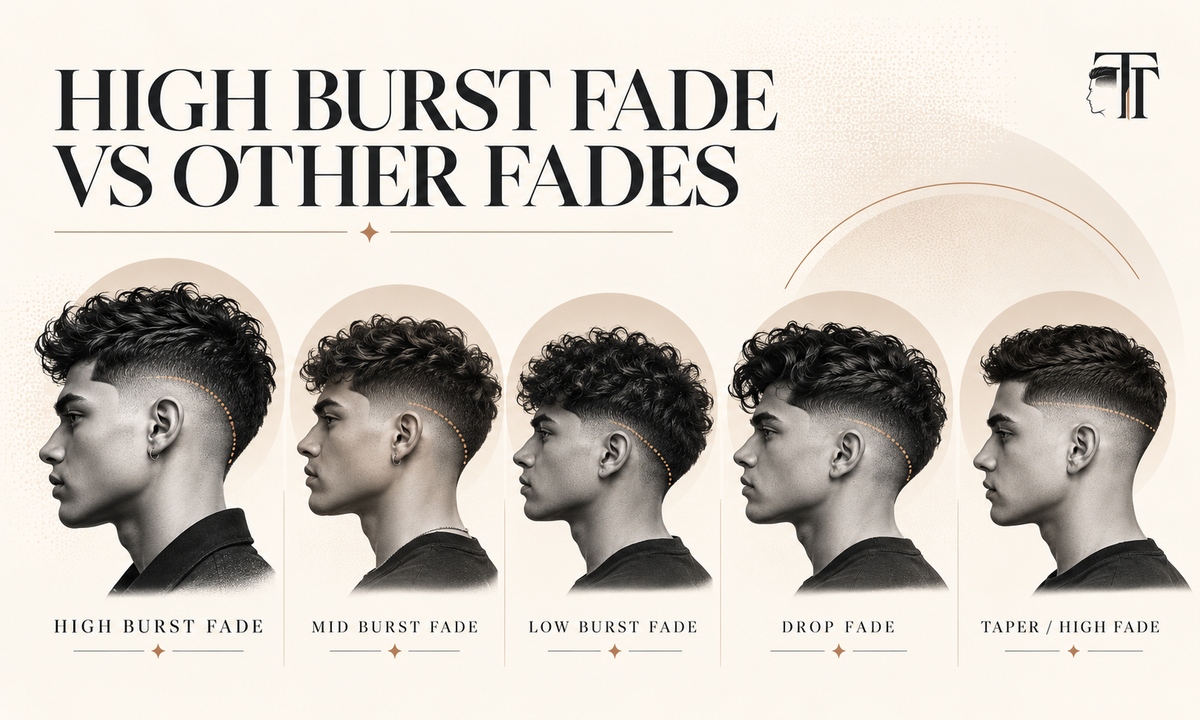
Fade names mix up two separate ideas. “Burst” describes the path of the fade, a curve around the ear. “High”, “mid” and “low” describe how far up that curve travels. Drop, taper and a conventional high fade describe different paths altogether, not just different heights.
| Fade | Path of the blend | Where it sits | Contrast | Back and nape | Consider it if you want |
|---|---|---|---|---|---|
| High burst fade | Curved arc around the ear | Peaks well above the ear | High | Usually kept longer | A bold side profile with length on top or at the back |
| Mid burst fade | Curved arc around the ear | Peaks a little above the ear | Medium | Usually kept longer | A visible curve without emptying the side |
| Low burst fade | Curved arc around the ear | Stays close to the top of the ear | Lower | Usually kept longer | A subtle curve that grows out softly |
| Conventional high fade | Runs around the whole head | High on the sides and back | High | Faded short | Short sides and back with no curve |
| Drop fade | Arcs from the temple and dips behind the ear | Varies by height | Medium to high | Faded, lower at the back | A curved line with a faded back |
| Taper fade | Short blend at the sideburns and neckline only | Hairline edges | Low | Tidied, not faded out | The most conservative option |
High burst vs conventional high fade
The mix-up that causes the most trouble at the chair is high burst versus conventional high fade. Both use the word “high”, but a high fade takes the sides and back short all the way round, while a high burst keeps the arc around the ear and leaves the back longer. Ask for one when you mean the other and you can lose the back length you meant to keep. Our high taper fade guide covers the level-band version in full, and taper vs fade untangles the rest of the vocabulary.
High burst vs drop fade and taper
A drop fade also curves, which causes the second most common mix-up. FashionBeans describes the drop fade as a rounded arc running from the temple to the nape. The burst fade circles the ear and stops, whereas the drop fade keeps travelling down and fades out the back. The low taper drop fade and mid drop fade guides show the dropped line on its own, and the high drop fade guide starts it at the same height as a high burst, so you can compare the two outlines directly. Our drop fade vs burst fade guide puts the two head to head.
The taper is simpler again: Hector's describes it as a gradual, natural blend kept to the neckline, rather than a shape carved around the ear. If a high burst feels like too much, the taper fade guide and the mid burst fade guide are the two calmer places to look next.
Does a high burst fade suit you?
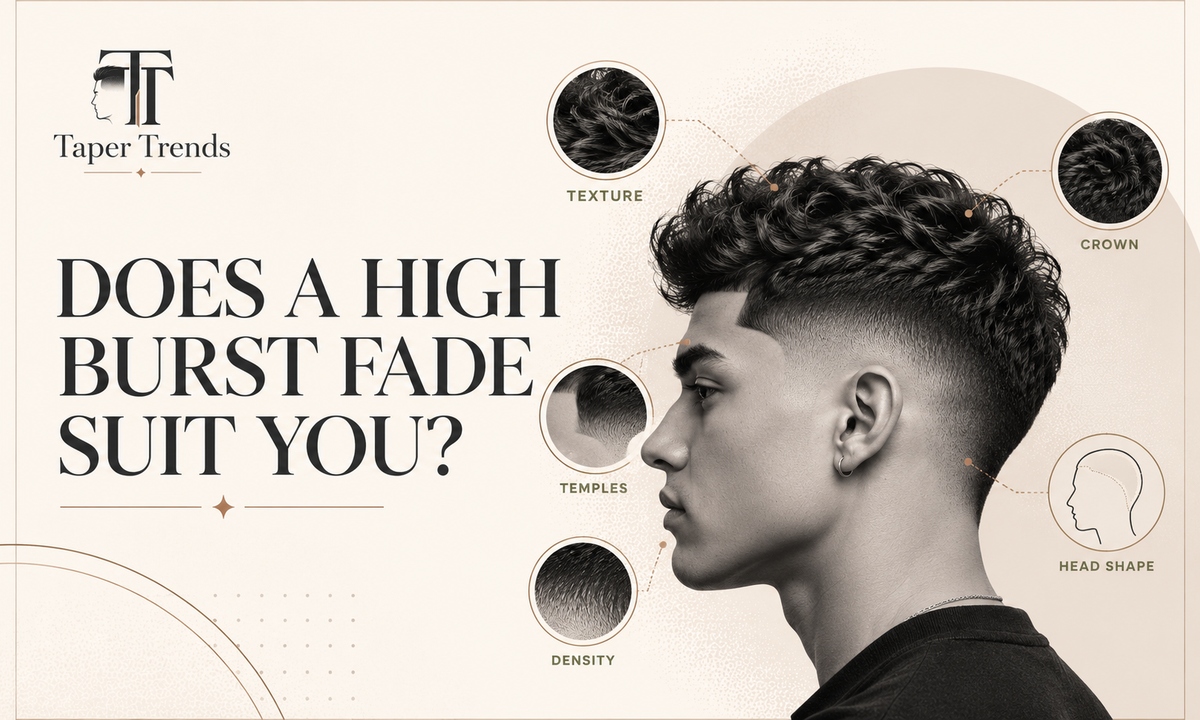
A high burst fade can work on straight, wavy, curly and coily hair, but it asks more of the hair on top than a lower burst does. Because the high arc empties more of the side, the top and crown need enough density and length to balance it. Hair density, crown growth and your appetite for contrast matter more than face shape.
Beard Beasts' 2026 burst fade guide is blunt about this: when the fade climbs too high on hair without a strong top, the sides start to look hollow, and a mid burst usually looks better. Hector's says its stylists choose low, mid or high placement based on the client's hair density and face shape, which is the right order of priorities.
Hair texture and density
- Curly and coilyThe high burst is most forgiving here. Tight sides contrast with natural volume, and dense curls fill the space the high arc creates. Plan for shrinkage when deciding how much to take off at the crown. See burst fade for curly hair, burst fade for Black men and the high taper fade for an Afro.
- WavyWorks well if the top is long enough to show movement. A short wavy top can leave the fade looking stronger than the hair above it. The high taper fade with waves guide covers the same height on wave patterns.
- StraightStraight hair shows every transition. Any hard weight line where the fade meets longer hair is more visible, so the blend at the top of the arc has to be clean. Our burst fade for straight hair, drop fade for straight hair and high taper fade for straight hair guides go deeper.
- Fine or thinningNeeds caution. A high placement exposes more scalp and can make the top look thinner, so a mid burst, or a guard rather than skin at the shortest point, is the safer place to start. The low taper fade on thin and thick hair guide explains how barbers keep or remove weight.
Head shape, hairline and crown
Face-shape advice for burst fades is everywhere, but it is opinion rather than a rule. Rush, a UK salon group, suggests a high burst adds height and structure for rounder faces, while a mid or low burst softens square jawlines. Treat that as a starting point for the consultation, not a verdict.
Two physical factors deserve more of your attention. The first is the crown. If hair there grows in a strong whorl, or too much is removed, the join between the faded side and the longer top or back looks abrupt rather than deliberate. The second is the temples. A receding hairline sits close to where a high burst begins, so a higher arc can draw the eye straight to it. Ask the barber to look at your head from the side and back before settling on a height.
High burst fade styles to show your barber
The fade is only the base. The hair you leave on top and at the back decides what the finished cut looks like, and each of the five directions below asks for something different at the crown, top and nape. Pick one before the appointment rather than showing your barber a mix.
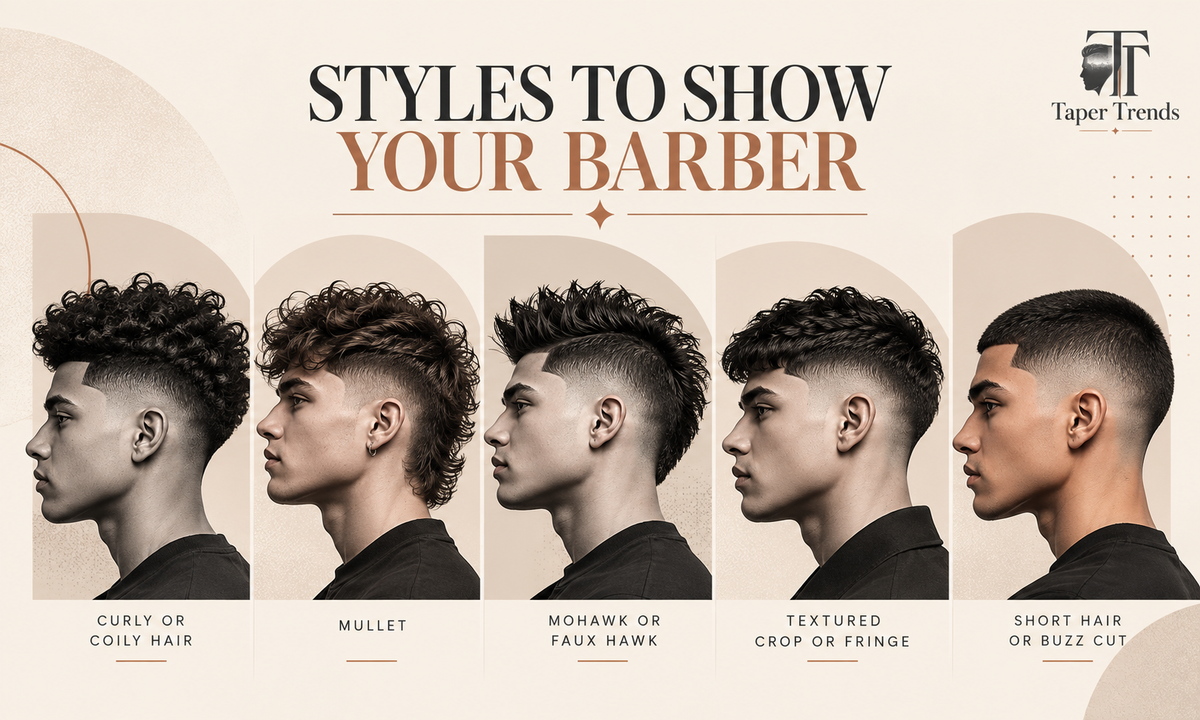
High burst fade with curly or coily hair
The high arc strips bulk from the sides, so the curls or coils on top become the whole silhouette. Hector's notes that burst fades work on Afro and mixed-texture hair when the fade is mapped carefully around the ear and the curl pattern.
Ask the barber to shape the curls rather than cut them flat, and to go easy at the crown. Curly hair shrinks as it dries, so length taken off wet can look far shorter afterwards. Whether the arc goes to skin is a separate decision from how the curls are treated, so agree both. The burst fade curly hair and high taper fade curly hair guides break down silhouettes, and high taper fade for Black men covers coils, twists and waves.
High burst fade mullet
This version pairs the high arc with deliberate length through the back. Hector's lists the burst fade as a common choice for modern mullet shapes, and the part that makes it work is a continuous bridge of hair running from the crown down to the nape.
The high placement raises the stakes. With more of the side faded, any thinning at the crown shows immediately, and a longer back can look as though it was forgotten rather than planned. Say plainly that the back length is intentional and that the crown should stay connected to it. The full burst fade mullet guide covers the settings, the high taper fade mullet shows the same idea with a straight-line blend, and the drop fade mullet curves the line down behind the ear instead.
High burst fade mohawk or faux hawk
Removing bulk from both sides pushes all the attention onto the strip of hair running down the centre of the head. A true mohawk keeps that strip narrow with very short sides. A faux hawk is softer, with a wider centre section that is styled up and inwards.
Decide which one you want before you sit down, because they need different top widths. Also confirm whether the strip should run into the back or stop at the crown. The burst fade mohawk guide walks through both.
High burst fade with a textured crop or fringe
If you want texture on top without a mullet's length at the nape, a textured crop or fringe is the wearable choice. The top carries choppy texture and the fringe falls forward or to one side.
Fringe direction affects how the crown blends into the arc, so mention it alongside the fade height. With no long back section to keep in shape, this is also the easiest of the five to live with between cuts. See the burst fade textured fringe, drop fade textured fringe, high taper fade textured fringe and burst fade Edgar guides for the front end, or the French crop low taper fade for a shorter, blunter finish.
High burst fade with short hair or a buzz cut
A burst shape still shows with a very short top, but with so little length above it, the fade geometry carries the whole cut. Any wobble in the arc is on display. Beard Beasts warns that short hair, bare sides and a high burst together can make the whole haircut look thin, so keep some strength on top.
Daily styling drops to almost nothing. The fade still grows out at the same rate as any other, though, so this version saves you styling time, not barber visits. The high taper fade buzz cut and high taper fade for short hair guides cover the guard choices.
How to ask your barber for a high burst fade
Asking for a “high burst fade” by name leaves too much open. Barbers read height, shortest length and back treatment differently, so agree five details before the clippers start and back them up with side and rear reference photos. That combination removes most of the guesswork.
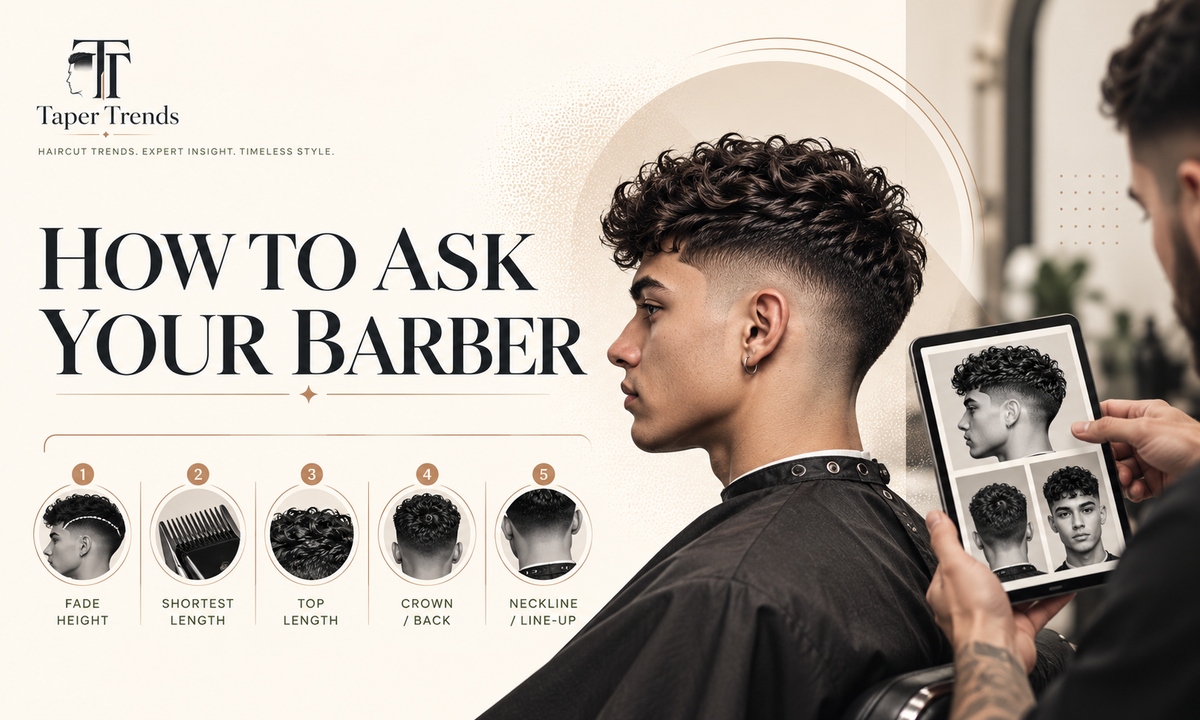
Five decisions to agree before the cut starts
- 1. Fade height and arcWhere the curve should peak on the side of the head, and confirmation that it wraps around the ear rather than running straight round the head.
- 2. Shortest lengthSkin, or a guard number at the tightest point of the arc. This is independent of height and changes both the contrast and how quickly the cut looks grown out.
- 3. Top length and textureHow much to keep, and whether it should be textured, layered or left natural.
- 4. Crown and backWhether the crown and back blend into the fade or stay longer. This matters most for mullet and mohawk versions.
- 5. Neckline and line-upNatural, tapered or squared at the nape, and whether you want a sharp line-up along the front hairline. If you wear a beard, the burst fade with beard guide shows how the arc carries into it, and the high taper fade with beard guide walks through the sideburn-to-beard blend. For a curve that runs behind the ear instead, see the drop fade with beard guide, and for a high fade taken to bare skin, the skin fade with beard guide.
If you'd rather not explain it all from memory, save a short brief on your phone and fill in the brackets:
“High burst fade. Arc peaks [well above the ear / a bit lower, see side photo]. Shortest point [skin / guard number]. Keep [length] on top, [textured / natural]. Crown and back [stay long / blend in]. Neckline [natural / tapered / squared]. Line-up [yes / no].”
The reference photos your barber needs
A single front-facing photo misses the defining part of this cut, because the arc sits beside and behind the ear. Bring three angles:
- Side viewShows the height and curve of the arc. A front photo cannot show this at all.
- Back viewShows how the crown joins the back and what the neckline looks like.
- Front viewShows top length, texture and the hairline.
Choose references with hair similar to yours. A high burst on thick coils will not translate directly to fine, straight hair, however good the photo looks. If you want a model for the angles worth saving, the guide on what a low taper fade looks like shows a finished fade from every side.
How to style and maintain a high burst fade
Your barber looks after the fade; you look after everything above it. “Burst” only describes the sides, so your routine depends on the length and texture you kept on top.
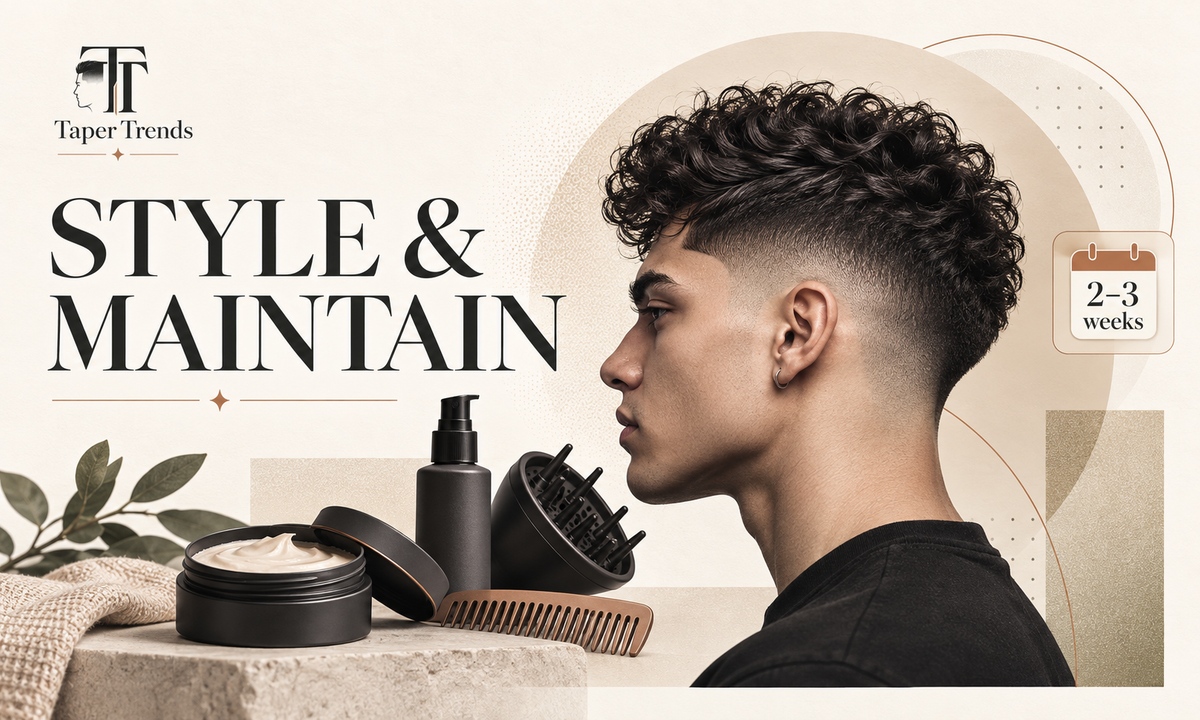
Styling the top by hair texture
Curly and coily hair responds best to moisture and definition. Work a leave-in conditioner or curl cream through damp hair, then air-dry or use a diffuser on low heat so the pattern holds its shape.
Straight and wavy hair usually looks better with a matte clay or paste than with a high-shine pomade. A matte product adds texture and separation without flattening a short top against the head. For added lift, the low taper fade blowout and blowout for curly hair guides show how a dryer builds volume, and our step-by-step guide to styling a low taper fade walks the wider routine.
Short textured tops need very little product. A small amount of paste or texture powder worked through dry hair is plenty, and anything more tends to weigh short hair down.
Touch-up timing and how the fade grows out
Expect a touch-up roughly every two to three weeks if you want the arc to stay crisp. Hector's gives that interval for skin-led burst fades. Some barbers go tighter: Beard Beasts suggests 10 to 14 days for a skin burst, because the area around the ear loses its fresh look faster than anywhere else on the head.
Your own interval depends on how fast your hair grows and how much softness you're happy to live with. A skin-close arc shows regrowth within days, while a guarded one blurs more gradually. The top and back need reshaping less often than the sides, so it is worth asking whether your barber offers a quicker fade touch-up between full cuts.
Drawbacks, common mistakes and scalp considerations
The trade-off is simple. The higher the arc, the stronger the contrast, but the less room there is to fix an uneven line and the more scalp you show. None of that rules the cut out. It just means precision and a clear brief matter more than they would with a low burst.
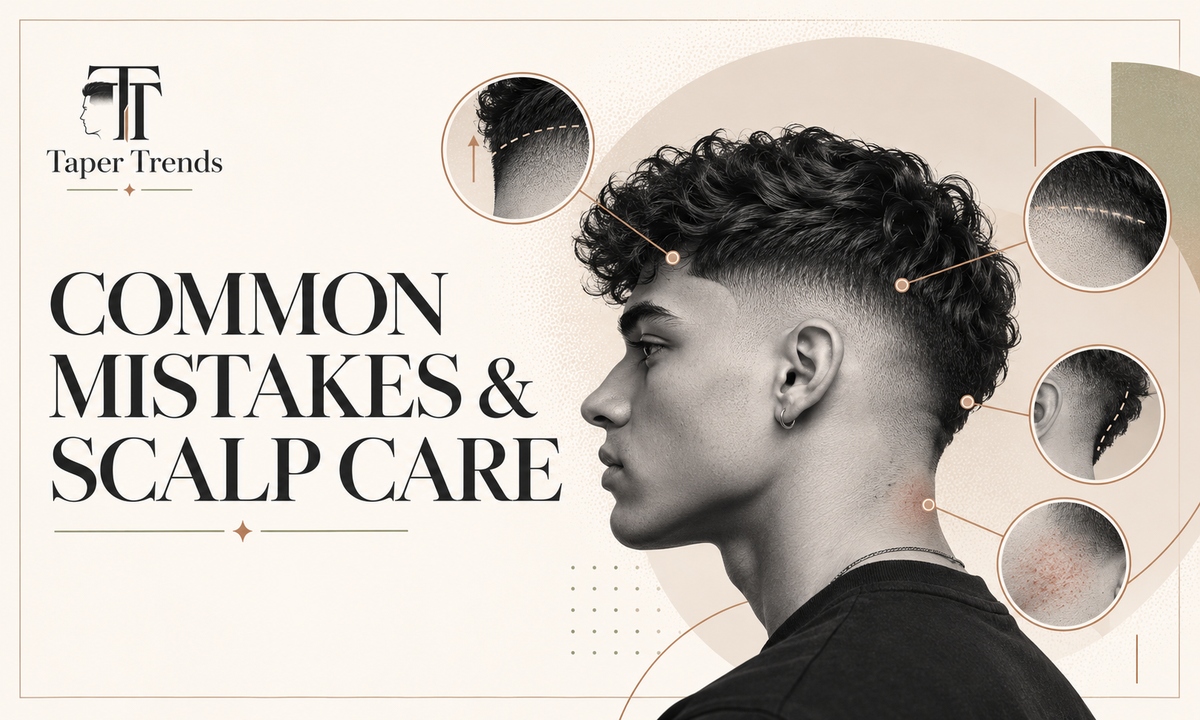
Common high burst fade mistakes
- The curve disappearsThe result reads as an ordinary high fade.
- The arc goes too highIt is taken higher than intended, leaving the sides hollow.
- The back is cut shortA mullet or mohawk request loses its crown connection.
- A hard weight lineIt appears where the fade meets the longer hair.
- The wrong referenceThe photo shows a different hair texture, so the result never matches it.
Most of these trace back to the brief rather than the clippers. If the arc lands too high, the mid burst fade is the natural correction.
Close cutting, irritation and razor bumps
Cutting right down to the skin can trigger ingrown hairs and bumps in some people, particularly those with tightly curled or coarse hair. DermNet describes pseudofolliculitis barbae, better known as razor bumps, as an inflammatory reaction of the hair follicle most often linked to close shaving of the face, though it can occur wherever hair is shaved. Most of that evidence concerns beards rather than scalp fades, so it shouldn't be read as the same risk.
The back of the head has its own concern. The American Academy of Dermatology notes that acne keloidalis nuchae, which affects the back of the neck and scalp, can begin with itching hours or days after a close-shave haircut. If skin fades have irritated you before, ask for a guard at the shortest point instead of skin. Bumps that keep coming back are worth showing to a doctor or dermatologist rather than cutting over. Our burst fade for Black men guide also covers bump-safe finishes. Our skin fade height comparison sets low, mid and high skin fades side by side when the finish is bare scalp.
High burst fade FAQs
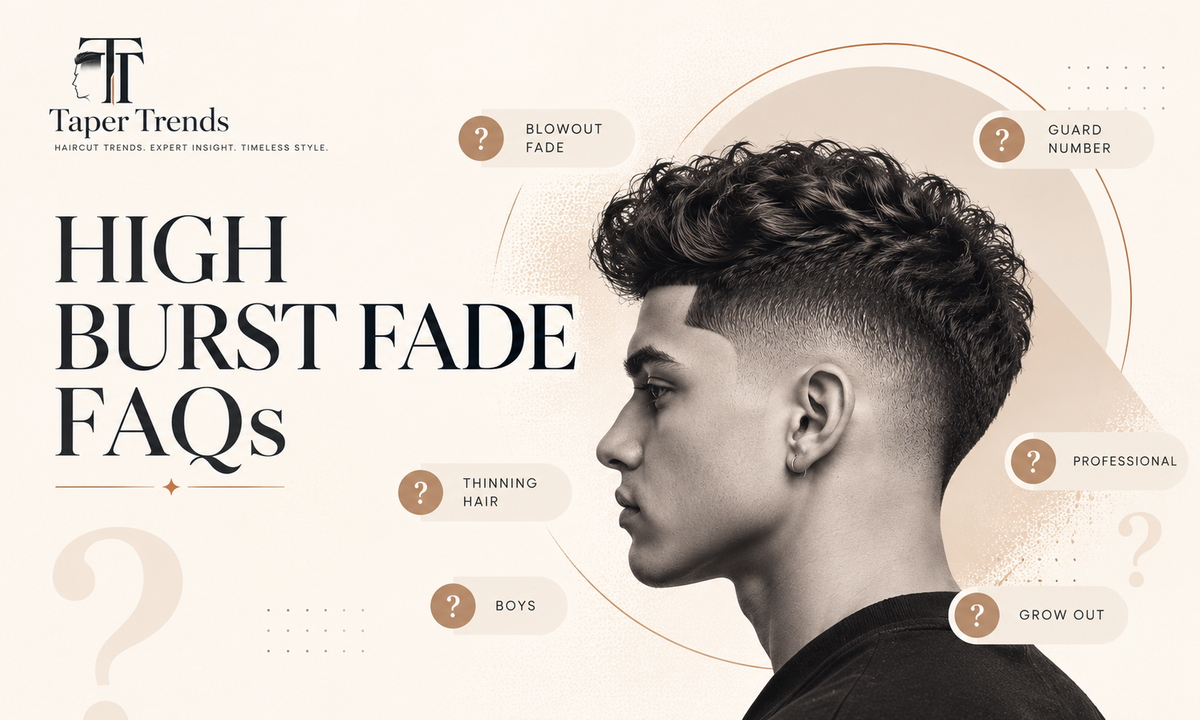
Is a burst fade the same as a blowout fade?
Often, but not always. Hector's notes that many barbers use "burst fade" and "blowout" interchangeably for a fade that curves around the ear. Other barbers use "blowout" for different, temple-focused fades. Terminology varies between shops and regions, so show a photo rather than relying on either name.
What guard number should I ask for with a high burst fade?
There is no single correct guard number for a high burst fade, because "high burst" describes the shape and placement of the fade, not its shortest length. The tightest point can go to skin or stop at a short guard. Choose based on how much contrast you want and how your skin reacts to close cutting, then state it separately from the height.
Can a high burst fade look professional?
Yes, in many workplaces, although the high placement is bolder than a low or mid burst by default. Hector's suggests a controlled burst with a cleaner top for professional settings. A guard instead of skin, a tidy top and a neater back soften the effect further. Check your employer's appearance policy if it is strict.
Does a high burst fade work with a receding hairline or thinning hair?
It can, but the high version is the least forgiving burst for thinning hair. The high arc sits close to the temples and removes hair that would otherwise frame a receding hairline, and the extra contrast can make a thin top look thinner. A mid burst with a guard at the shortest point is usually the better option to discuss with your barber.
Is a high burst fade suitable for boys?
A high burst fade can be cut on boys' hair in the same way as adults', and barbershops such as Barber Industries in Hornsby, Australia offer burst fades for men, teens and young boys. The practical questions are school appearance rules and skin sensitivity. A guard rather than skin at the shortest point is gentler and grows out less harshly between visits.
How do you grow out a high burst fade?
Let the sides grow while keeping up regular trims on the top and back so the overall shape stays balanced. Because the high arc removes so much hair above the ear, the sides take longest to catch up. A practical route is to ask your barber to lower the arc slightly at each visit, passing through a mid and then a low burst on the way.
Looking for something related? The burst fade for boys guide covers that same question in full, with height and finish options sized for a kid rather than an adult. The high taper fade for boys guide covers a straight-line, school-friendly alternative, the high taper fade for white guys guide covers finer straight textures, and the low taper fade blowoutguide explains the blowout vocabulary from the barber's side.
The short version
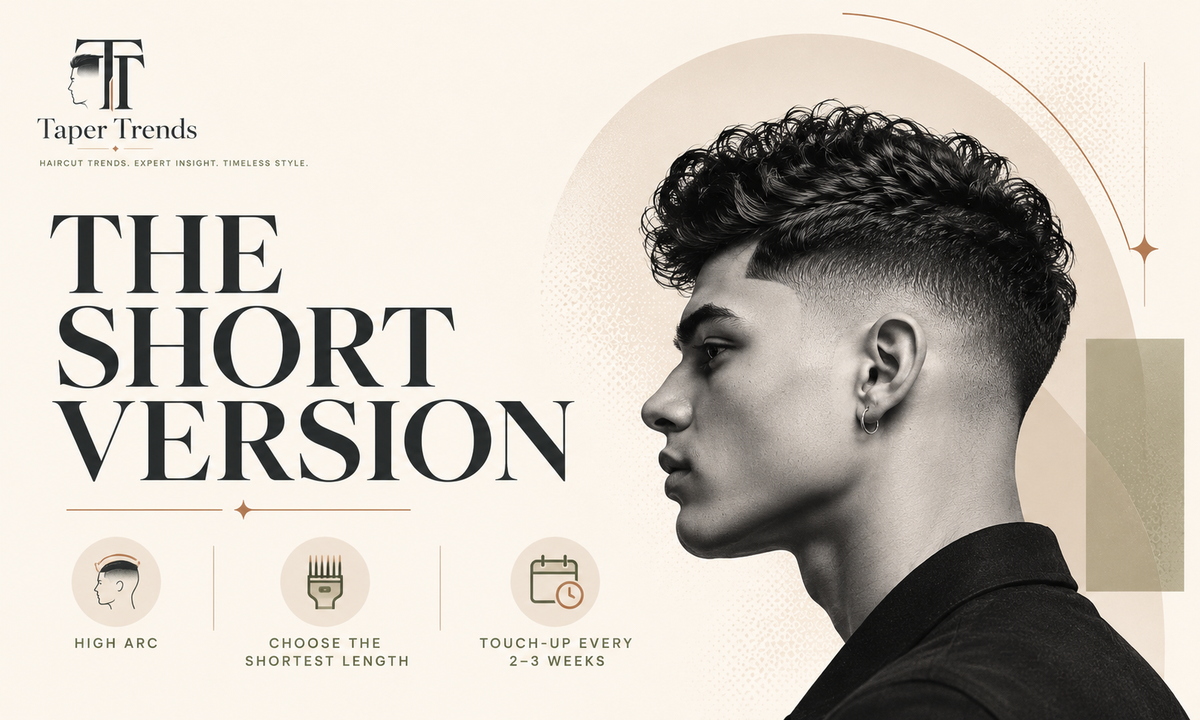
A high burst fade is a set of decisions rather than one fixed look: how high the arc peaks, whether the shortest point goes to skin, how much stays on top and how the crown meets the back. Settle those and the style above the fade, whether curly, mullet, mohawk, crop or buzz, follows naturally.
Bring side, back and front photos of hair like yours, budget for a touch-up every two to three weeks, and if close cutting irritates your skin, change the shortest length rather than putting up with it.
Still comparing? The burst fade haircut guide covers the arc on its own, the full taper fade guide places low, mid and high side by side, and the low taper fade haircuts guide is the hub for every variation. For the closest burst neighbours, read the mid burst fade, burst fade curly hair, burst fade straight hair, burst fade mullet and burst fade mohawk guides, or the taper low burst fade for the gentlest version. Weighing the arc against a straight-line taper specifically? The burst fade vs taper fade comparison puts the geometry, hair-type fit, and upkeep of each side by side.
The bottom line
“High burst fade” settles the shape and the height and leaves the rest open. How short the shortest point goes, how much stays on top and at the back, and how the crown connects are still yours to decide.
Bring side, back and front photos, agree the five details before the clippers start, and choose a guard over skin if close cutting irritates you.
Want more fade guides?
Browse clean, barber-ready breakdowns for every fade shape and hair type.