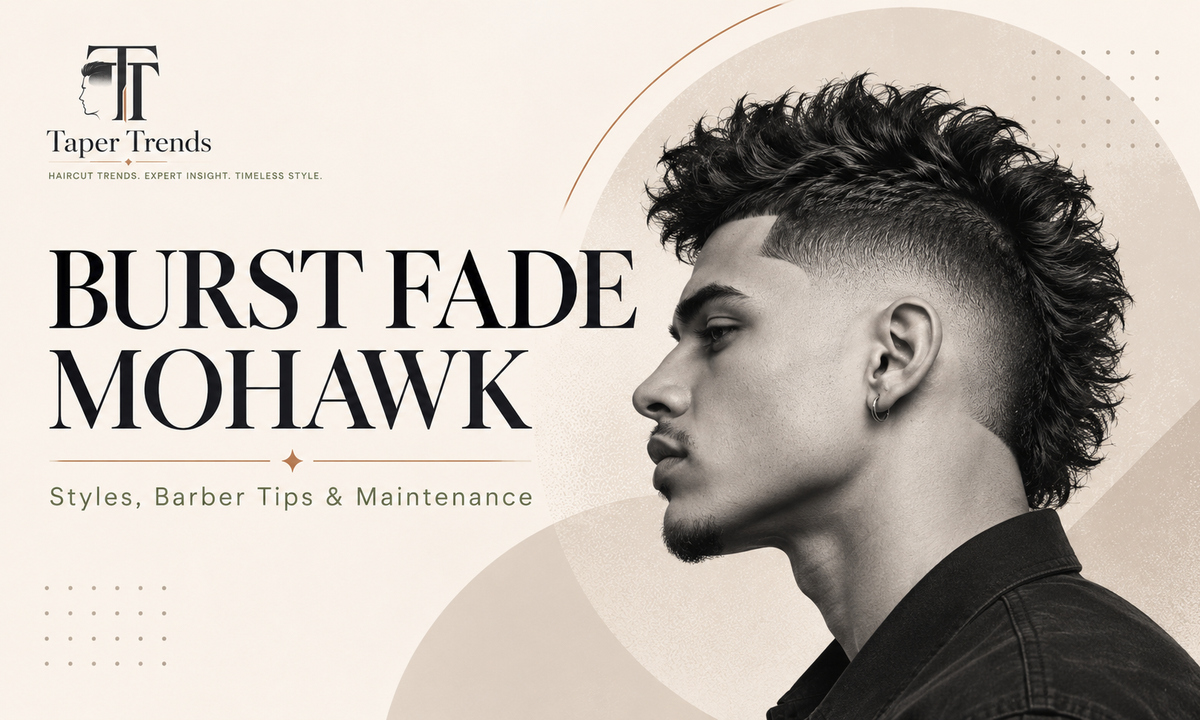
A burst fade mohawk keeps a strip of longer hair down the center of the head and fades the sides in a curve around each ear. The name sounds specific, but it leaves a lot unsaid, which is how people walk out with a cut they didn't picture. This guide covers how to recognize the cut, whether your hair can carry it, which version to request, what to say in the chair, and how much upkeep to expect.
If you want either half of the name explained on its own first, our complete burst fade haircut guide covers the arc, the high burst fade guide covers the tallest version of it, and the low taper fade mohawk covers the same strip over a quieter side. The complete low taper fade haircuts guide is the hub for every softer variation, and the rundown of every kind of fade haircut sets the burst beside its relatives.
What is a burst fade mohawk?
A burst fade mohawk is a haircut that combines a mohawk-style strip of longer hair on top with a burst fade on the sides. The burst fade curves in a half-circle around each ear, so the short hair follows the shape of the head instead of stopping at a level line. The strip sets the silhouette. The fade shapes the sides.
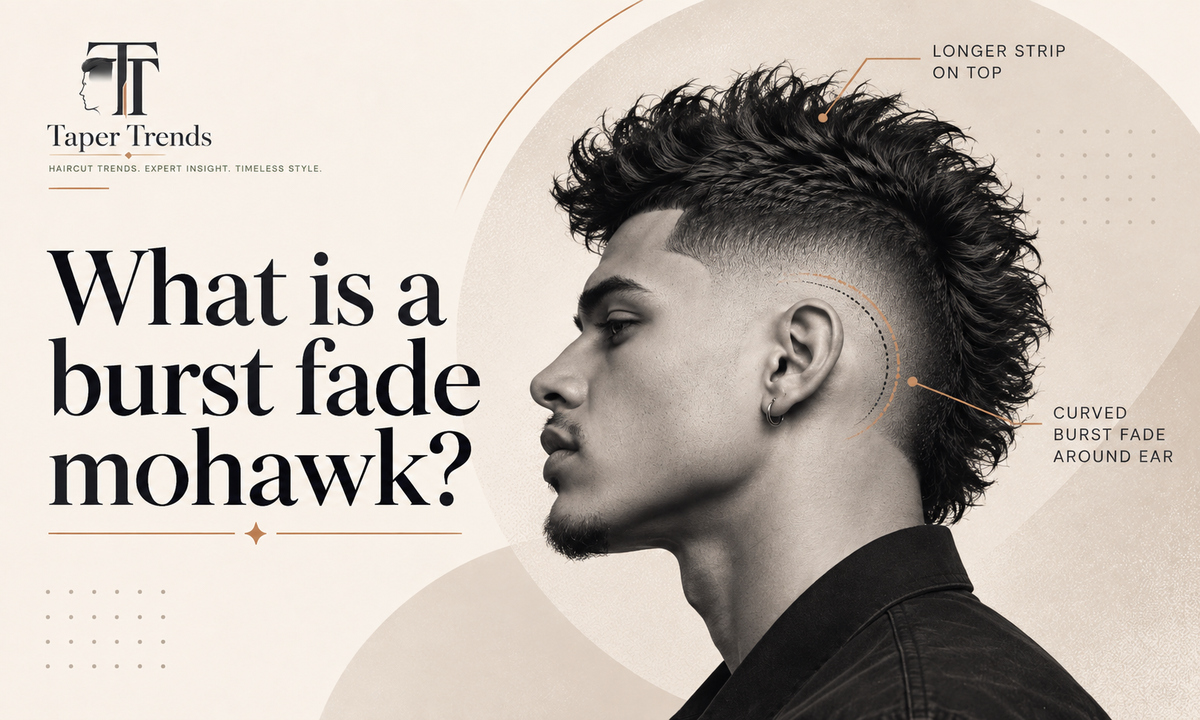
Each half of the name covers a different part of the cut. Barber Style Directory defines a mohawk as a strip of longer hair running from the forehead to the nape, with the sides removed or faded short. The burst fade describes only the side transition. In CADMEN Barber Academy's explanation, the shortest point sits directly behind the ear, and the hair gets longer as the fade moves up and outward in an arc.
Fade height and finish are separate decisions. A burst can sit low, mid, or high, and taking it down to bare skin is optional. The quietest version of the arc is a taper low burst fade, while the low taper vs high taper comparison shows what raising the height does to the contrast. The mid burst fade guide covers the middle setting on its own, and the mid fade haircut guide covers the level version.
To recognize the cut:
- From the side, the short hair arcs around the ear rather than running level.
- From behind, the shortest hair sits just behind each ear and lengthens as it rises.
- From above, a defined strip runs from the front hairline toward the nape.
How does a burst fade mohawk compare with similar haircuts?
Three details separate a burst fade mohawk from its neighbors: the shape of the side fade, the outline on top, and how much length stays at the back. The burst fade mohawk pairs a curved side fade with a center strip. A classic mohawk, faux hawk, burst fade mullet, and drop-fade mohawk each change at least one of those details.
| Haircut | Side fade | Top and back | Consider it if |
|---|---|---|---|
| Burst fade mohawk | Half-circle arc around the ear | Center strip; back length by request | You want a mohawk with a softer, rounded side |
| Classic mohawk | Sides taken to skin | Narrow, pronounced strip | You want maximum contrast |
| Faux hawk | Clipper-cut short, not shaved | Longer top styled toward the center | You want the shape with less commitment |
| Burst fade mullet | Curved arc around the ear | Short sides, noticeably longer back | You want length at the nape |
| Mohawk with drop fade | Follows the hairline down toward the neckline | Center strip; lower contour at the back | You want the fade to dip behind the ear |
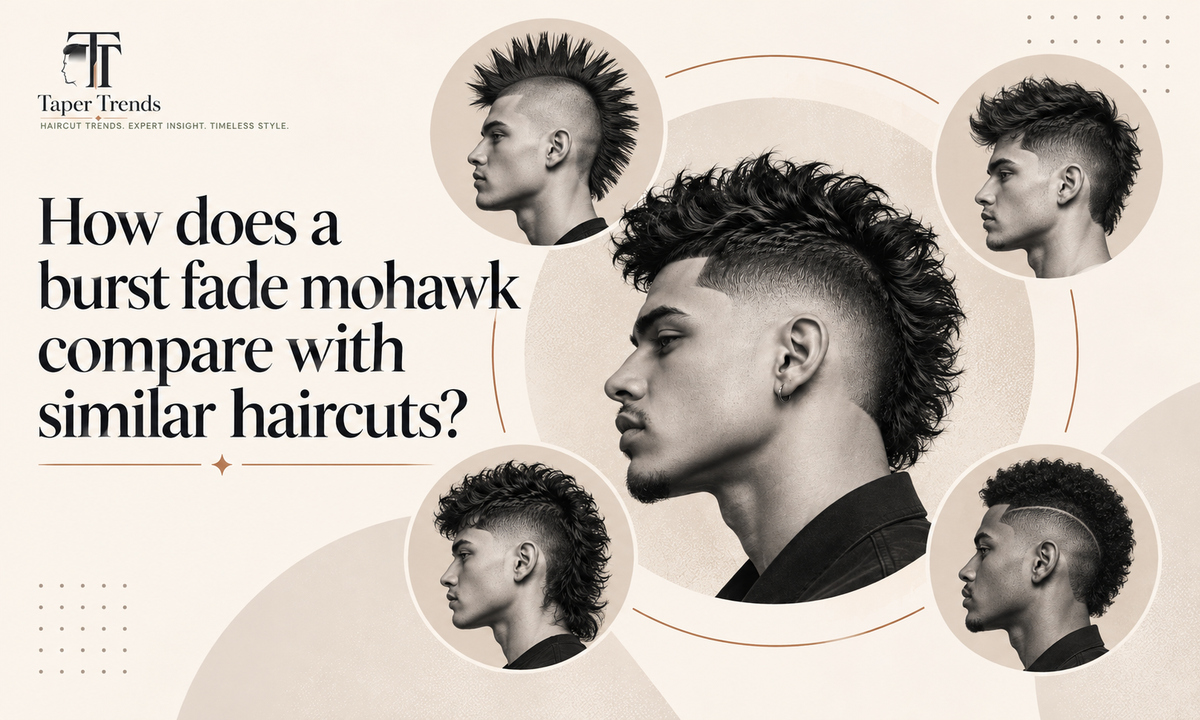
The classic mohawk and faux hawk rows follow Barber Style Directory's mohawk guide. The mullet and drop-fade rows follow CADMEN's burst fade guide, which also notes that some barbers use “burst fade” and “drop fade” interchangeably. Mohawk and mullet hybrids overlap too. Bring front, side, and back photos so your barber isn't guessing from a label; our drop fade vs burst fade comparison shows what each angle should reveal.
Each of those neighbors has its own guide here. The burst fade mullet keeps the same arc but trades the strip for length at the nape, the drop fade mullet keeps that length under a curve that dips behind the ear, the low taper drop fade carries the curve down toward the neckline, and the taper vs fade explainer plus the low taper vs low fade comparison untangle the words barbers use loosely. If you like the strip but not the contrast, the low taper fade mohawk is the gentler sibling of this page.
Will a burst fade mohawk suit your hair and head shape?
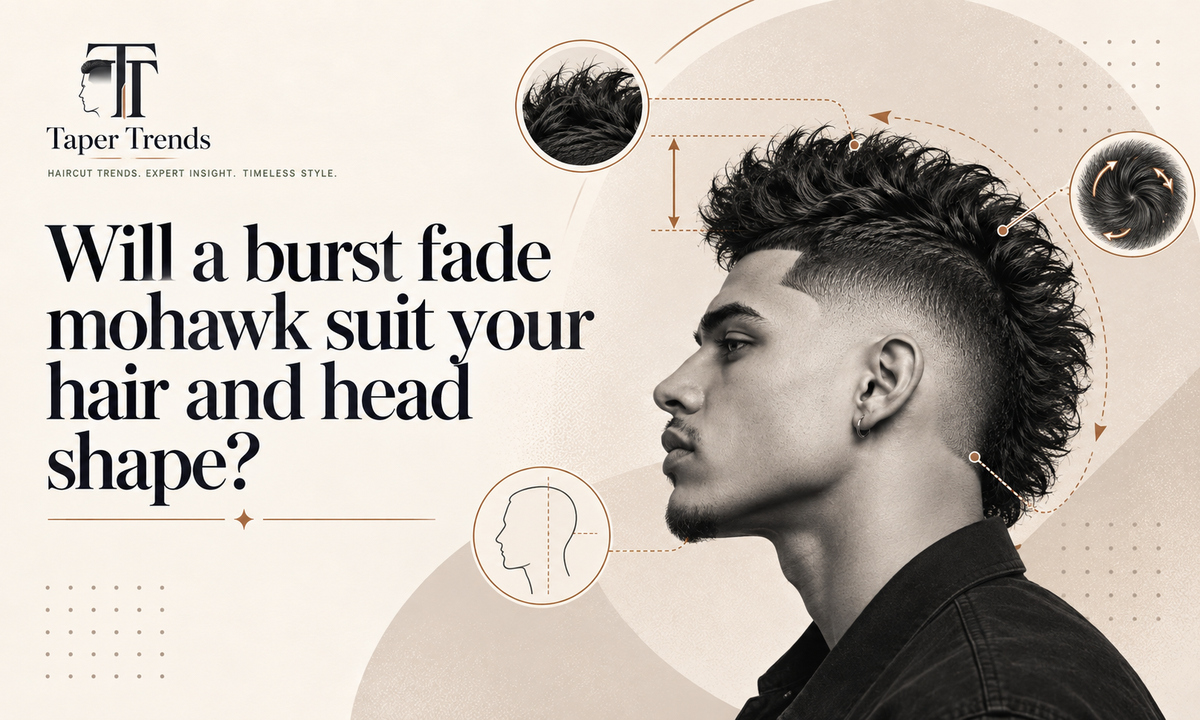
Whether a burst fade mohawk suits you depends on the version you want and the hair you start with, not on a face-shape rule. A barber can judge your length, density, growth pattern, and preferred proportions in a single consultation. Use the two checks below as questions for that conversation, not as a pass-or-fail test.
How much length and density do you need?
There's no universal minimum. A short, tight strip needs far less length than a tall strip or a mullet-style back, and the sides need enough hair to blend into the strip. Length and density are also different things. Hair can be thick per strand and still sparse overall — a distinction our guide to the low taper fade on thin and thick hair works through in detail.
Density matters most for height. Barber Style Directory says thick, dense hair holds height naturally, while thinner hair suits shorter, more relaxed mohawk shapes that don't fight gravity. Before booking:
- Measure your top length dry. For curly or coily hair, note both the dry length and the stretched length.
- Compare it with the strip in your reference photo.
- Ask whether you can get the look now or need to grow into it.
How should the cut adapt to your head shape and growth pattern?
A good barber adjusts the strip width, the curve of the fade, and the back length to your head rather than copying a photo exactly. Growth direction matters most. The same strip can stand up on one person and lie flat on another because the hair leaves the scalp at different angles.
CADMEN's cowlick guide describes cowlicks as permanent growth patterns, most common at the crown, front hairline, and nape. A haircut can't remove one. A barber can cut with the growth direction, leave a little more length at a crown swirl, or choose a rounded or tapered neckline when nape hair grows upward.
Point out your cowlicks before the clippers start. Also ask whether any asymmetry in your reference photo comes from the cut or from the model's own growth pattern. If you want to see how a fade reads from every angle before you commit, our look at what a low taper fade actually looks like is a useful reference point.
Which burst fade mohawk style should you choose?
Choose a burst fade mohawk by three factors: top length, texture, and the contrast between the strip and the sides. Shorter tops read subtler. Higher or skin-level fades raise the contrast. A longer back changes the silhouette from behind. Treat the four versions below as starting points, then adjust each detail with your barber.
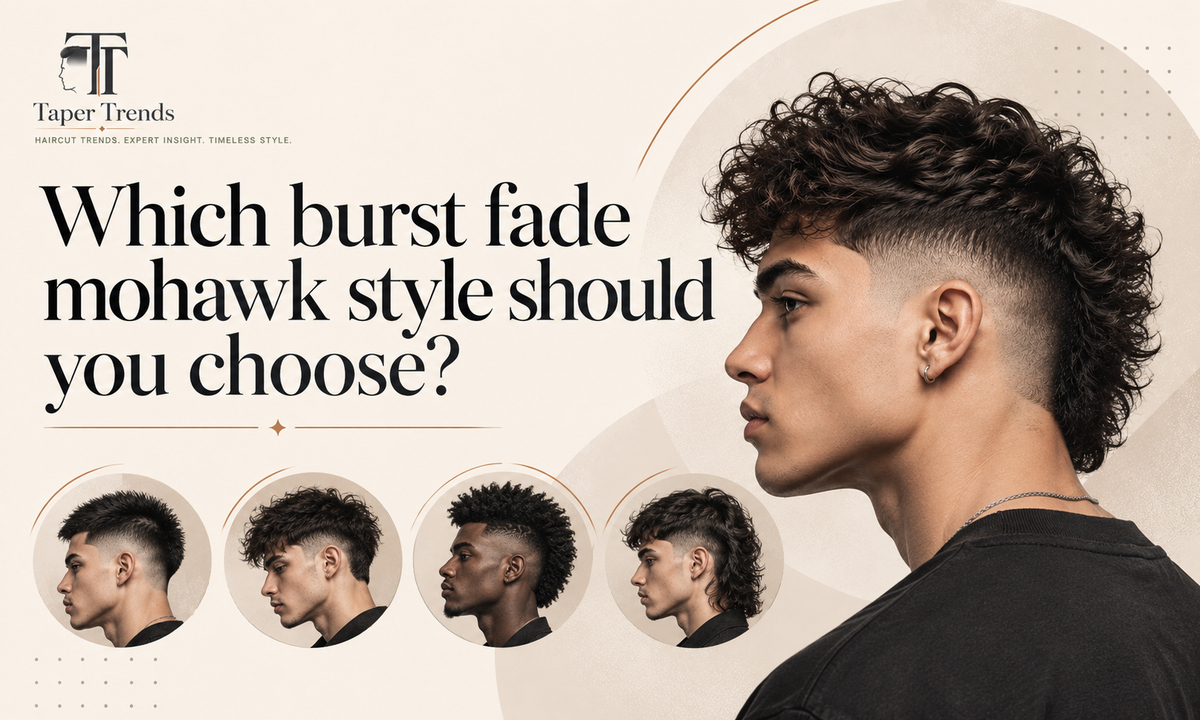
Short, low burst mohawk
This version keeps the top short and the fade low, so the step from sides to strip stays gentle. CADMEN notes that a shorter top makes the burst read as subtle rather than as the statement of the cut. It sits close to the territory covered by our low taper fade for short hair and low taper fade buzz cut guides.
The tradeoff is height. Barber Style Directory describes a tight one-inch strip as crisp, while a four-inch strip needs styling to stand up. Ask for:
- a strip width in inches or centimeters
- a low fade height
- your top length
- your shortest side length
Textured straight or wavy mohawk
Straight and wavy hair can be worn messy, spiky, slicked back, brushed forward, or textured, all from the same basic cut. Most of that range comes from styling. The barber sets strip width and length, while product and drying set direction — the same division our low taper fade for straight hair and low taper fade on wavy hair guides describe. For the burst arc on that texture specifically, our burst fade for straight hair guide runs through nine tops and the six details to agree, and our drop fade for straight hair covers the line that dips behind the ear instead.
Bring a reference photo with hair similar to yours. Ask which parts of the look come from the cut and which come from styling. Then confirm the fade height and shortest side length before the clippers go on. If you train a wave pattern, the low taper fade with waves guide explains how much the clippers can take before the pattern breaks.
Curly or coily frohawk
A frohawk is the natural-hair version of the mohawk, where curl or coil texture supplies the volume. In a reference photo, look closely at the visible curl pattern, the strip width, and the outline from the front and back. Our burst fade for curly hair guide goes deeper on how the arc behaves in curls, and the burst fade for Black men covers coils, waves, locs, and braids. If you like the arc but want a blunt fringe at the front instead of a strip on top, read the burst fade Edgar, or the burst fade textured fringe for a softer, piecey one.
Describe the hair you see, such as loose curls or tight coils, rather than guessing texture from the person pictured. Finishes range from sponged curls to full afros and tight coils, so name the one you want. Tell your barber how long your hair is both dry and stretched. For more on the afro end of that range, see the low taper fade afro and the high taper fade afro; for tighter blends on curls, the curly low taper fade covers the low end.
Longer mohawk with a mullet-inspired back
This version keeps extra length at the nape. On a burst fade mullet, the sides fade while the back length stays. CADMEN says the curved arc moves from short sides to a longer back more naturally than a straight fade.
Add a center strip, and the view from behind changes completely. Hybrid names overlap, so describe the back rather than just saying “mullet.” Our low taper fade mullet, mid taper fade mullet, and high taper fade mullet guides show how fade height changes that back view. Ask for:
- a back length in inches or centimeters
- how the strip connects to that length
- how the fade meets the longer hair
How do you ask your barber for a burst fade mohawk?
To ask for a burst fade mohawk, describe the shape and finish, not just the name. Bring front, side, and back photos. Then state your strip width, top and back length, fade height, and shortest side length. The name alone leaves every one of those choices open, while photos and measurements let the barber match what you picture.
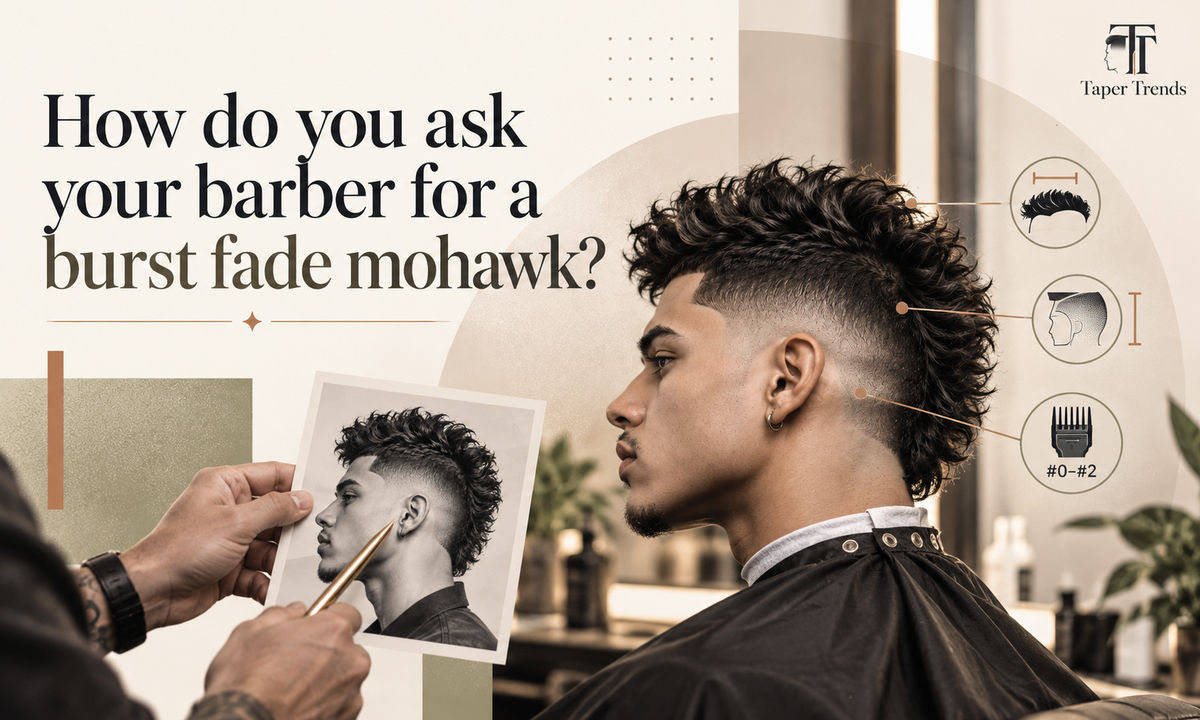
- Show three angles. Mark the one detail you won't compromise on, such as keeping the back long.
- Describe the strip. Barber Style Directory puts standard strip widths at about one to three inches (roughly 2.5 to 7.5 cm). Wider strips look more relaxed, and narrower ones look more aggressive. Showing the width with your fingers works too.
- Agree on fade height. Decide how high the burst should rise around the ear.
- Choose the shortest length. Ask for skin or a guard number. A guard sets one cutting length, not the whole haircut. Wahl lists its No. 1 guard at 1/8 inch (3 mm) and No. 4 at 1/2 inch (13 mm), and notes that guard sizes differ between brands.
- Confirm what's realistic. Ask what your current hair allows today and what a refresh visit would involve.
Fill in this brief and bring it with your photos:
[Low / mid / high] burst fade to [skin / guard No. __]; strip [__ in / cm] wide; [__] on top; back [length and shape]; neckline [natural / outlined].
If you want a beard tied into that outline, the burst fade with beard guide covers the arc-to-beard blend, and the low taper fade with a beard and high taper fade with a beard guides cover the sideburn-to-beard blend, and our drop fade with beard guide covers it under a curve behind the ear, and our skin fade and beard guide covers it with a skin finish. For a carved line beside the strip, read the fade design ideas and low taper fade with a design.
How do you style a burst fade mohawk at home?
Styling a burst fade mohawk depends on your texture and the finish you want. Straight and wavy hair usually build lift with drying and product. Curly and coily hair depend more on moisture, detangling, and gentle shaping. Either way, start with less product than you think you need and follow the label's directions. Our step-by-step guide to styling a taper fade at home covers the same routine in more depth.
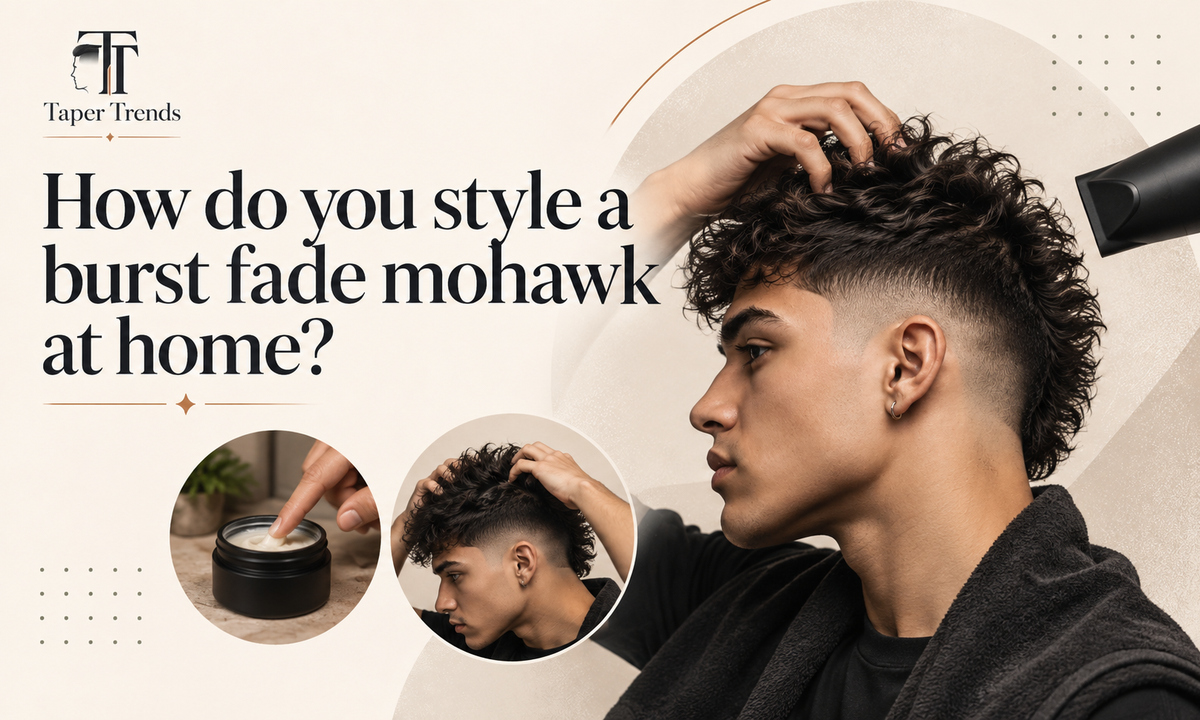
How do you style straight or wavy hair?
Start with clean, fully dry hair, build lift at the roots, then work product from the base of the strip upward. A lighter matte product gives a textured finish. A stronger, shinier one holds a tall, structured strip.
The steps below adapt a June 2026 Uppercut Deluxe feature in which barber Evan Marshall styles a classic mohawk. It is a brand demonstration using the brand's own products, not an independent test.
- Towel-dry and let your hair partly air-dry, then finish with a blow dryer until it's completely dry. The American Academy of Dermatology suggests letting hair partly air-dry before styling and blow-drying less often.
- Shake a volumizing powder into the roots of the strip, front to back, lifting with your fingertips as you go.
- Warm a small amount of pomade between your palms and press it into the base of the strip, working upward with both hands. Add more only if the strip won't hold.
- Pinch and lift the top sections to set the final shape.
If the strip won't stand no matter what you use, the top may be too short for the height you want. That's a question for your barber, not your product shelf.
How do you style curly or coily hair?
Prioritize moisture and gentle handling over stiff hold. The American Academy of Dermatology notes that thick, curly hair is more prone to breakage and dryness. It recommends detangling wet hair in sections with a leave-in conditioner, using fingers or a wide-tooth comb, and avoiding brushing when dry. Decide whether you want defined curls or volume before choosing a routine.
Define loose curls
Detangle wet hair in sections with leave-in conditioner, apply your curl product to the strip, and let it partly air-dry before touching it. Skip combing once the product is in, since the AAD says combing after applying long-hold styling products can break hair. Follow the product's own directions. For a rounder, blown-out shape instead, see the blowout low taper fade for curly hair.
Shape a coily frohawk
Detangle in sections while the hair is wet and moisturize the strip. Then lift and shape it with your fingers, or with a wide-tooth comb or brush made for coily hair. Go easy on heavy butters, which Barber Style Directory says can make the strip lie down rather than stand. Ask your barber or stylist which tools suit your texture. If you wear locs, the low taper fade with dreads and locs guide covers keeping length on top over a faded side.
What can go wrong with a burst fade mohawk?
Problems with a burst fade mohawk usually fall into two groups: a cut that doesn't match what you agreed, or a skin issue at the back of the head. Fix shape problems by returning with your reference photo and asking your barber to reshape around the current length. Take persistent bumps, pain, or irritation to a dermatologist rather than styling around them.
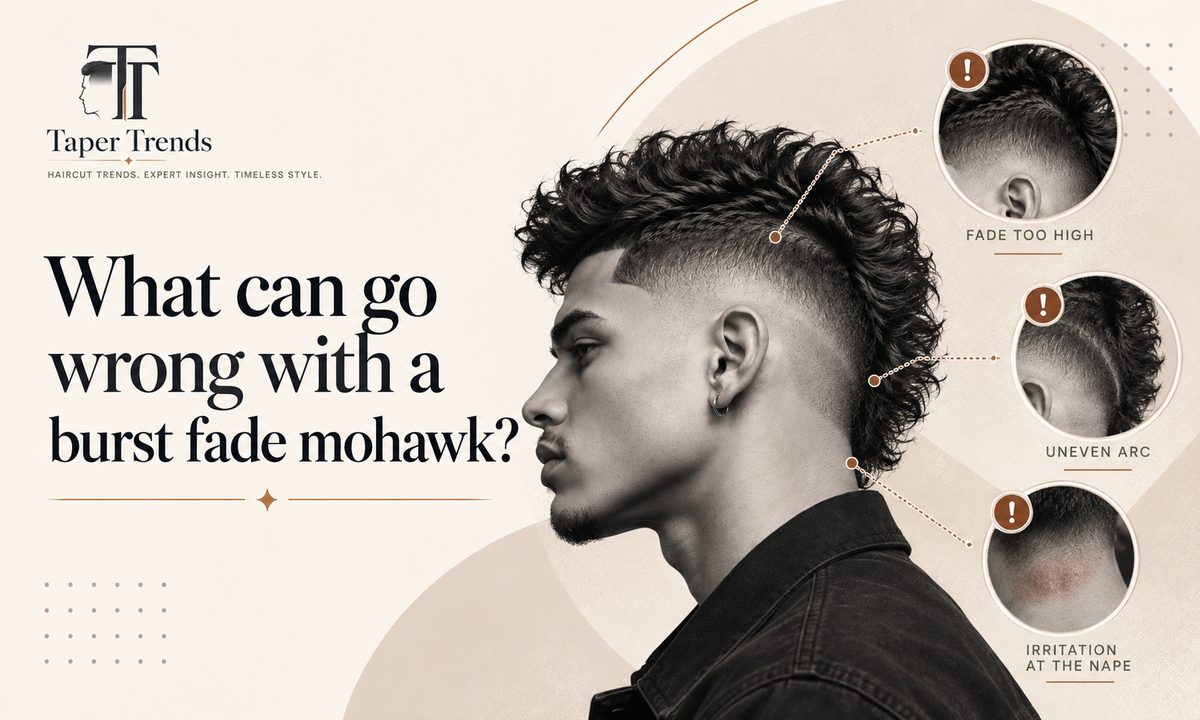
- Fade too high or in the wrong place: removed hair can't be put back, so ask whether to reshape now or plan a grow-out.
- Uneven strip or arc: check both sides and the back in a hand mirror before you leave the chair.
- Result doesn't match the reference: compare it with the agreed photo and ask whether texture or growth pattern explains the gap.
A note on skin. The AAD says bumps on the back of the neck or scalp that look like razor bumps or acne may be acne keloidalis nuchae (AKN). It also says shaving the back of the neck and head can make AKN flare. AKN isn't contagious, and you can't catch it from clippers.
None of this means burst fades cause AKN. If bumps keep returning at the nape, see a board-certified dermatologist and ask your barber not to shave that area. A guarded, shadow-style finish is the usual compromise, and the low taper fade for Black men and high taper fade for Black men guides cover bump-safe finishes in more detail.
How often does a burst fade mohawk need a touch-up?
How often a burst fade mohawk needs a touch-up depends on how sharp you want the fade and how fast your hair grows. Barber education sources suggest anywhere from about 10 days to three weeks for a crisp burst, with skin fades needing attention soonest. Treat any interval as a starting point, not a rule. For the three skin heights side by side, our low vs mid vs high skin fade comparison shows where each bare section stops.
| What you're keeping sharp | Rough interval | Source |
|---|---|---|
| Burst fade, kept crisp | About 10 to 14 days | Barber Style Directory |
| Mohawk with skin sides | Every 7 to 10 days | Barber Style Directory |
| Mohawk with faded sides | About every 2 weeks | Barber Style Directory |
| Arc behind the ear | Reshape around every 3 weeks | CADMEN Barber Academy |
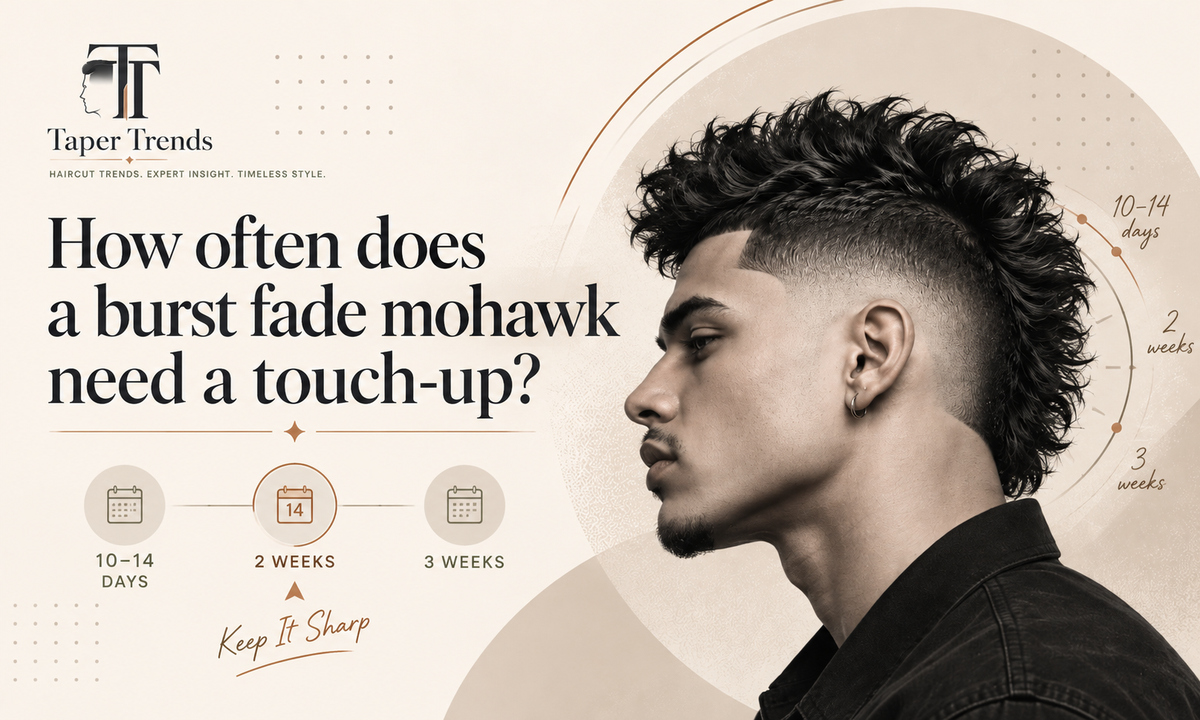
The sources differ in useful ways:
- Barber Style Directory says a burst fade holds its shape for about 10 to 14 days.
- For mohawks in general, the same site says skin sides often need a touch-up every 7 to 10 days, and faded sides every two weeks.
- CADMEN says growth shows first behind the ear, usually around the two-week mark, and that a touch-up every three weeks keeps the arc defined.
Keeping the fade razor-sharp and keeping the overall shape are different goals. A side refresh may come sooner than a reshape of the strip and back, so ask your barber which visits need only the sides. If that cadence sounds like too much, a taper fade or a low-to-mid taper hides regrowth for longer than a skin-level burst does.
Barber Julius Arriola, cofounder of the hair-care brand STMNT, put it simply in a GQ interview republished by GQ Middle East: “Hair doesn't know what day it is.” His clients return anywhere from one to six weeks apart. Judge by the mirror as much as the calendar, and book again when:
- the arc behind the ear looks fuzzy or has lost its curve
- the neckline looks blurred
- the strip has lost its outline or proportion
How much should you budget for a burst fade mohawk?
The cost of a burst fade mohawk varies by city, shop, and barber, so no single price is reliable. Ask for a written quote that lists what's included, and compare quotes from the same area. Any price you find online should state its city, currency, date, and inclusions, or it tells you very little.
Before you book, ask whether the quote covers:
- The initial cut
- Refresh visits, and whether they're priced separately
- Washing and styling
- Design work, such as shaved lines
- Beard shaping
- A booking deposit or other local charges
Refreshes recur, so a cheaper first cut can cost more over a few months if every side refresh is billed as a full cut. Compare like with like, and ask how long the quote stays valid.
How do you grow out a burst fade mohawk?
To grow out a burst fade mohawk, choose the haircut you want to end up with. Then have your barber reshape toward it over several visits, instead of recreating the fade each time. There's no fixed timeline. MedlinePlus says healthy hair takes about a month to grow half an inch, but your starting length and target decide the wait.
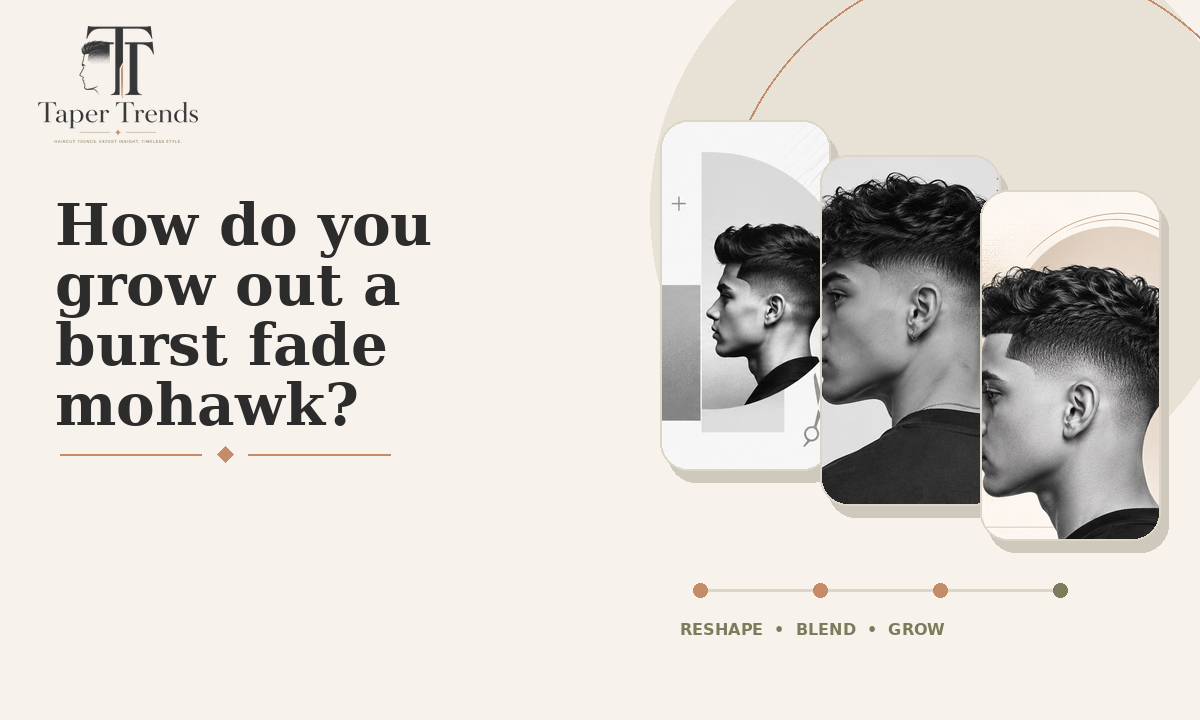
- Document and decide. Photograph the cut from the front, side, and back. Pick a target, such as a taper, a longer textured top, or even length all over.
- Agree on what stays. Ask which areas your barber will leave alone and which they'll blend, so the sides and back catch up evenly.
- Reshape, don't repeat. Book trims that move the outline toward the target rather than sharpening the burst again. A dated photo every few weeks makes progress easier to judge.
Useful landing points as the sides catch up: a low taper fade on medium length hair, a long hair low taper fade if you keep going, or a middle part low taper fade once the strip has filled out across the top.
Burst fade mohawk FAQs
Does the back of a burst fade mohawk have to end in a V?
No. The shape at the nape is a separate choice from the strip. Men's Hairstyles Today shows burst fade mohawks with both V-shaped and rounded backs, and Barber Style Directory notes that a burst fade usually tapers gradually at the nape rather than going to skin. If your nape hair grows upward, a rounded or tapered neckline tends to stay neater, so ask your barber which suits your growth.
Can a burst fade mohawk connect to a beard?
Yes. Ask your barber to blend the sideburns into the beard so the fade and facial hair read as one outline. Men's Hairstyles Today suggests a low or mid fade to avoid too much contrast with a full beard. Check whether beard shaping is included in your quote, since some shops price it separately.
Do you need a sharp line-up with a burst fade mohawk?
No, a line-up is optional. Decide between a natural hairline and a defined outline before the cut, because the front shape changes the look. Barber Style Directory notes that a slightly rounded front hairline reads less aggressive than a square one. Agree on the boundaries first and check them against your reference photo.
Can you cut a burst fade mohawk at home?
You can tidy a basic fade at home, but a burst is much harder. Wahl advises starting with a larger guard and working down gradually. Barber Style Directory warns that the curved pattern is difficult to recreate without training and that DIY touch-ups often flatten it into a straight fade. You also can't see the back of your own head easily, and hair you remove stays removed.
Can children get a burst fade mohawk?
Yes, if the child wants it and the family is ready for the upkeep. Check the current school handbook first, since dress codes vary between schools and districts and some restrict certain hairstyles. Choose a barber who is comfortable cutting children's hair, and agree in advance on a version the child can realistically style and maintain.
Can you switch from a high fade to a burst fade mohawk?
Sometimes, depending on how much hair is left around the ears and at the back. A burst arc is blended from existing length, and a high fade may already have removed the length the barber needs. Your barber can check what's there. If very little remains, expect a staged transition over more than one visit rather than an instant switch.
Two of those answers point elsewhere on the site: for the school-age question, our burst fade for boys guide covers that same curved shape sized for a kid, and our low taper fade for boys, mid taper fade for boys, and high taper fade for boys guides cover straight-line school-friendly versions, and for the switch from a high fade, the high taper fade guide and mid taper fade guide explain how much length a barber needs to work with.
Before your next appointment
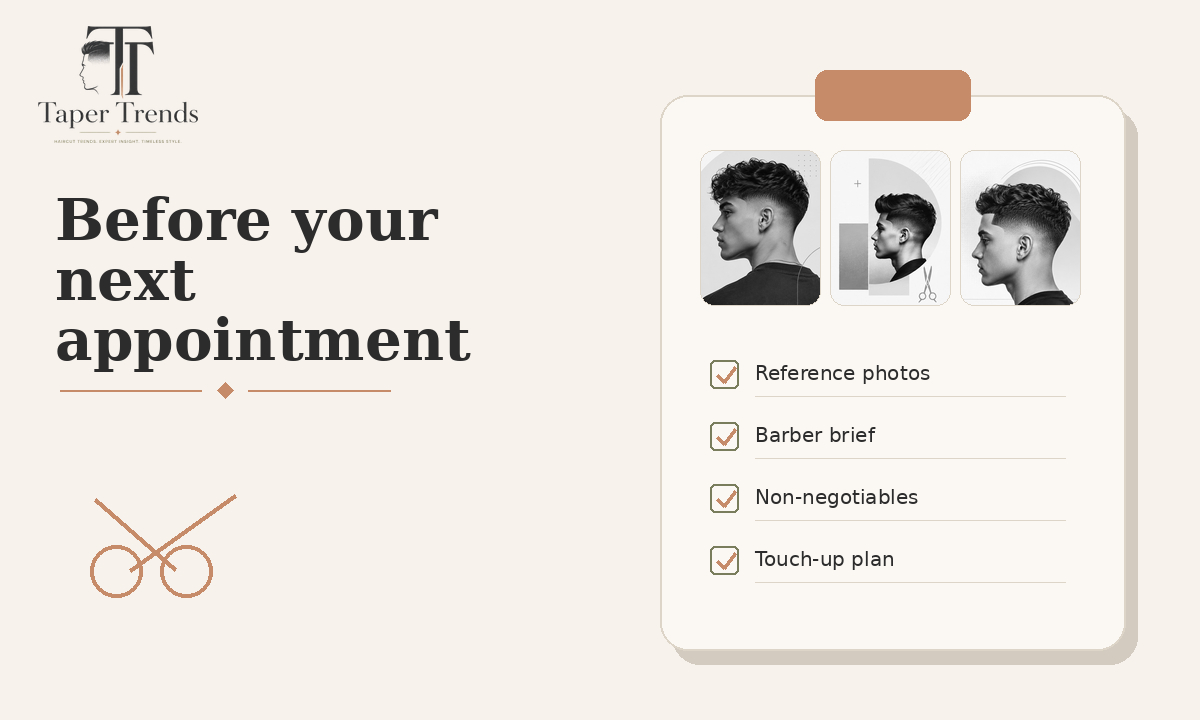
A burst fade mohawk is really four decisions: the strip, the arc, the back, and the finish. Each one is easier to get right when you say it out loud. You don't need a barber's vocabulary. You need a clear reference, a sense of which details matter most to you, and an honest idea of the upkeep you'll accept.
Take with you:
- one reference photo from the front, side, and back
- your filled-in barber brief
- your non-negotiables and acceptable compromises
- questions about touch-up timing and a written quote
Still comparing shapes? The burst fade haircut guide covers the arc on its own, the full rundown of fade types places it beside everything else on the menu, and the low taper fade haircuts guide is the hub for every quieter variation. For the nearest neighbors to this cut, read the low taper fade mohawk, the burst fade mullet, the burst fade for curly hair, or the taper low burst fade.
The bottom line
“Burst fade mohawk” names two things and settles neither. The strip width, the height of the arc, the length at the back, and whether the finish is skin or guarded are all still yours to decide.
Bring photos from three angles, name your measurements out loud, and start lower and longer than you think. You can always go shorter next visit.
Want more fade guides?
Browse clean, barber-ready breakdowns for every fade shape and hair type.