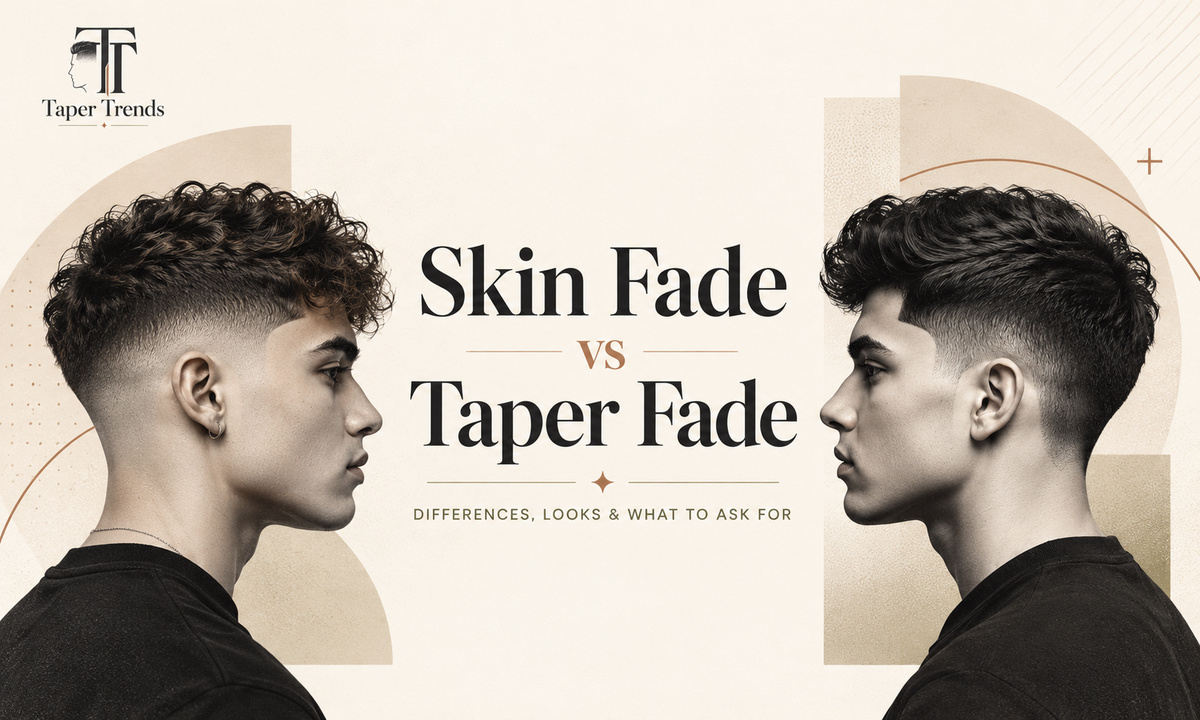
In skin fade vs taper fade, two things separate the cuts: how short the hair gets and where the short part sits. A skin fade blends hair down to bare skin, usually across a band that wraps around the sides and back. A taper fade keeps its shortest blending to the edges: the sideburns and the nape, with most of the side hair left at a visible length.
The names overlap, though. A taper can also finish at skin, and barbers don't all use the words the same way.
For each cut on its own, see our complete skin fade guide and taper fade haircut guide. The taper vs fade explainer covers the broader difference, and the low taper fade haircuts guide is the hub for every taper and fade on the site.
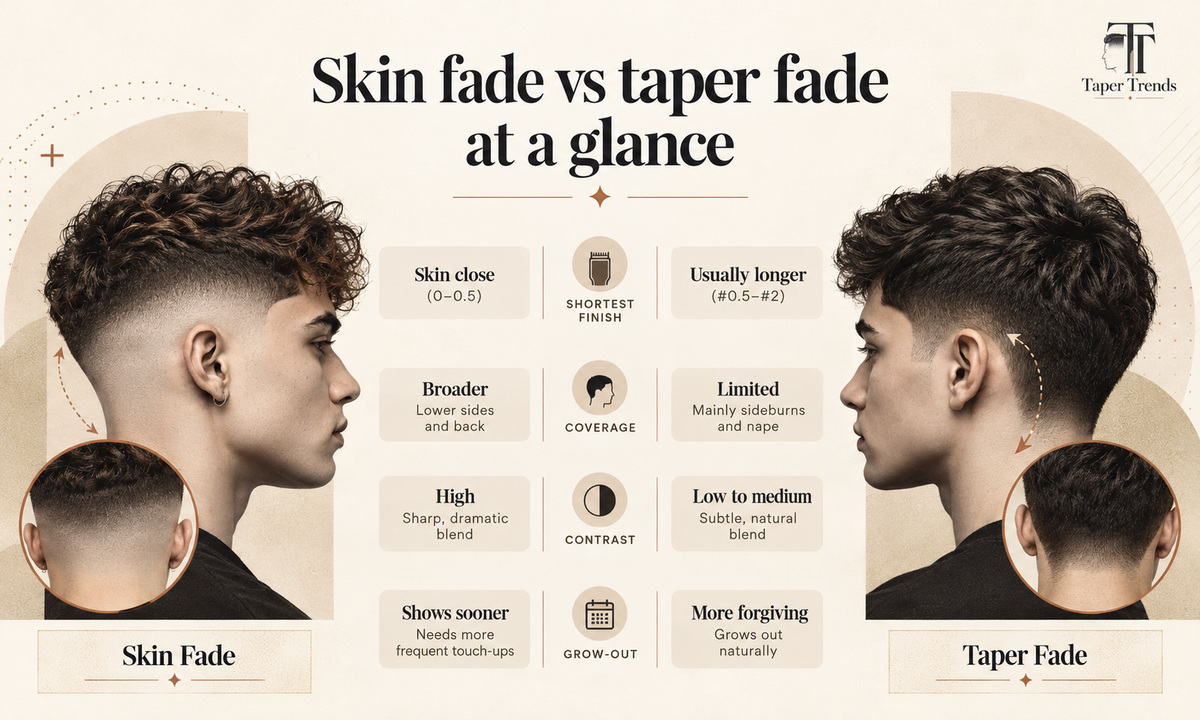
Skin fade vs taper fade at a glance
Two questions keep these cuts apart: how short does the hair get, and where does the short part sit? “Skin” answers the first. “Taper” usually answers the second.
| Skin fade | Taper fade | |
|---|---|---|
| Shortest finish | Bare skin | A close clipper length, or skin at the very edges |
| Where hair is cut short | A band around the sides and back | Mainly the sideburns and nape |
| Side length kept | Depends on fade height | Most of it |
| Visible scalp | Yes, at the bottom of the blend | Little or none |
| Contrast | Strong | Soft |
| Grow-out | Bare section turns to stubble quickly | Changes gradually |
| What to tell the barber | Fade height and “to skin” | Taper zones and shortest length |
Want obvious contrast and don't mind frequent visits? Get the skin fade. Want clean edges most people won't register as a fade? Get the taper.
The same two questions sort every other fade name. Our guide to every type of fade haircut lines them all up, and the burst fade vs taper fade and drop fade vs burst fade comparisons apply them to the curved shapes.
What is a skin fade?
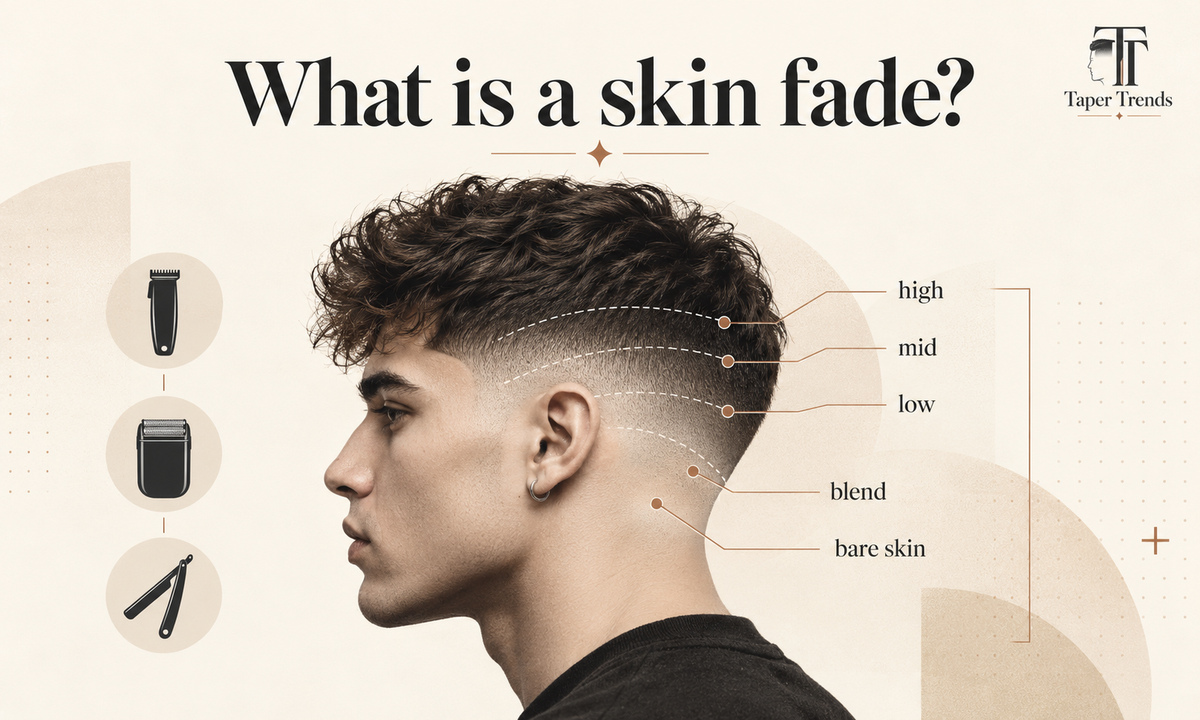
A skin fade, also called a bald fade or zero fade, is a graduated haircut that blends the sides and back from longer hair down to bare skin at the lowest point. The blend can start low, mid, or high on the head, as low vs mid vs high fade explains. The skin-level finish is what makes it a skin fade, not the height.
Because scalp shows at the bottom, a skin fade has the strongest contrast of the two, and it loses that edge fast. Moustache Barbers, a shop in Leeds, notes the bare section becomes visible stubble quickly.
In Wahl's taper lever guide, a skin fade starts at the neckline with no guard, then a #½ guard about an inch higher, with the taper lever used to blend each join, the method our how to cut a fade guide uses on a guarded fade. Uppercuts Barbershop says the very bottom is usually finished with a foil shaver or straight razor. Our skin fade haircut guide walks through low, mid, and high skin fades and how a barber builds each one.
What counts as a skin-close finish?
“Skin,” “zero,” and “bald” get used loosely, and they don't always produce the same result. An unguarded clipper with the blades closed still leaves roughly 0.5 to 1 mm of stubble, according to Haircut.info, depending on the blade (our best clippers for fades guide compares fade and zero-gap blades), while a #0.5 guard leaves about 1.5 mm. A foil shaver or razor goes closer than either.
Ask for “a zero” and you may get a shadow of stubble. Ask for “shaved to skin” and you'll get bare scalp. Our clipper guard size chart converts every guard number to inches and millimeters, our haircut numbers guide explains why the same number can differ by brand, and the low taper fade buzz cut guide shows how those close lengths look under a buzzed top.
What is a taper fade?
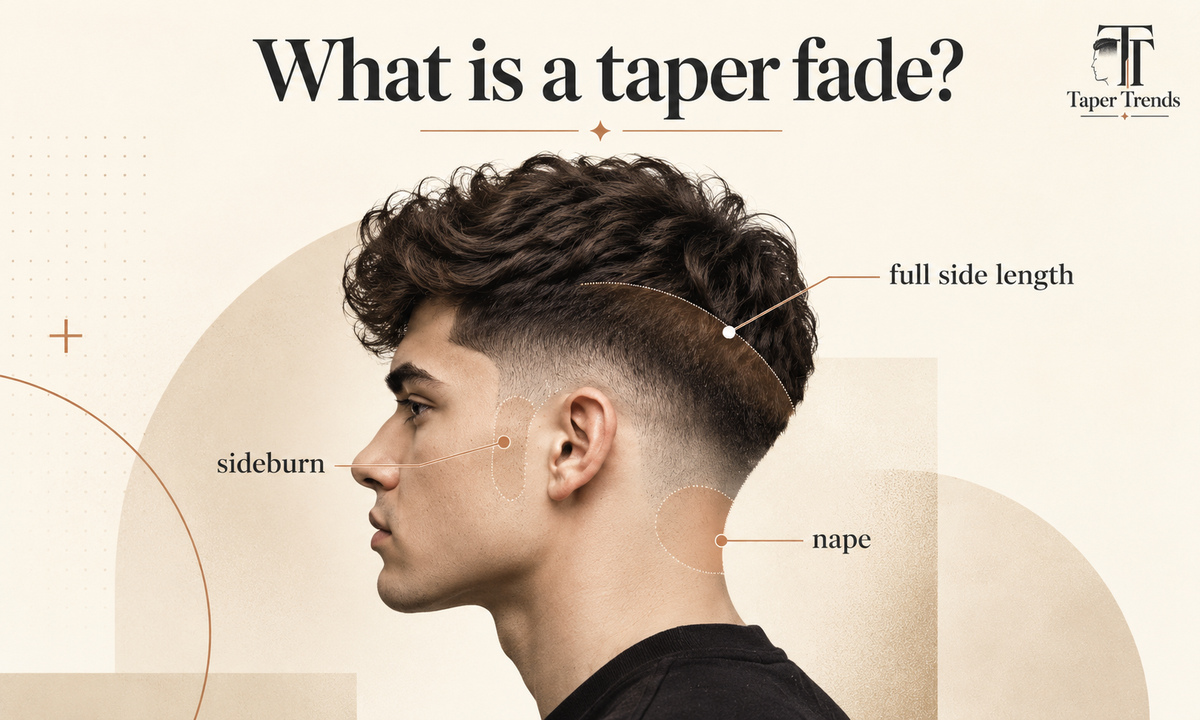
A taper fade shortens the hair gradually at the sideburns and the nape, then blends those edges into sides that keep visible length. Haircut.info describes most of the hair above and behind the ear staying at a #2 to #4 guard or scissor length.
It helps to separate it from the classic taper. David Yagudayev, owner and New York-licensed master barber at Eddie's Haircut & Shave in Manhattan, describes classic tapers as ending in a clean line at the neckline and sideburns with no fade at all. A taper fade sits between that and a full fade. Our taper haircut guide covers the classic taper in full.
Our taper fade guide covers every type, and the low taper fade from every angle shows exactly where those two short zones sit.
Where does a taper fade sit on the head?
The short hair in a taper fade sits in two places: the sideburn in front of the ear and the nape behind it. Haircut.info places a low taper fade's blend below the top of the ear at the sideburn and just above the natural neckline at the back.
The hair directly above the ear is the giveaway. If it stays at full side length, you're looking at a taper fade. If the barber fades that area too, the cut has become a regular low fade, which is the exact line our low taper vs low fade comparison draws.
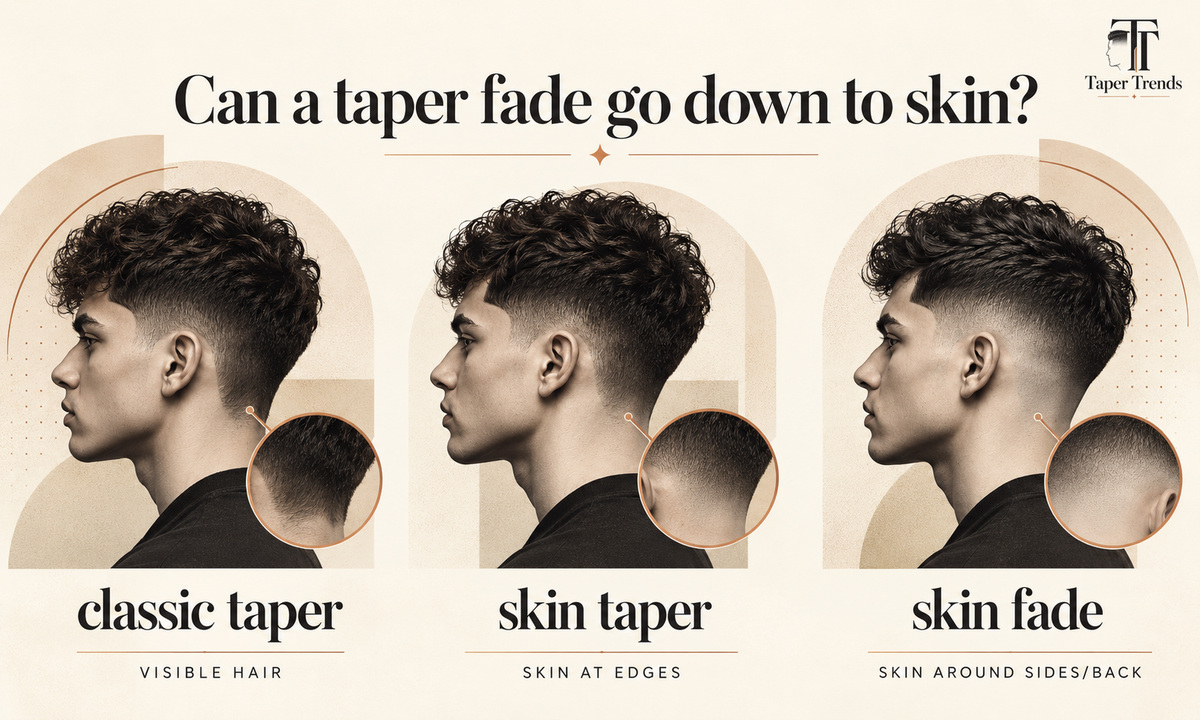
Can a taper fade go down to skin?
Yes, a taper fade can finish at skin, but not every barber assumes you want it. Coverage and shortest length are separate choices, so the sideburns and nape can go to bare skin while the sides stay long. Some shops, though, hear “taper fade” and stop at a close guard.
The professional sources split on this. CADMEN Barber Academy in Ontario says most barbers read “taper fade” as a fade that doesn't reach skin, and Eddie's describes its taper fade as ending at a #1 or half guard. Haircut.info and Uppercuts describe a taper fade that goes to skin, or a #0.5, at the edges only. Andis, the clipper manufacturer, even teaches a Low Tapered Afro that starts with a low skin fade, the same idea behind our low taper fade afro guide.
So say the finish out loud. CADMEN suggests “taper, not to skin” or “skin fade”; “taper fade to skin” is just as clear. Three terms are worth keeping straight:
- Classic taperEdges shortened to a clean line, visible hair, no fade.
- Skin taper (taper fade to skin)Bare skin only at the sideburns and nape.
- Skin fadeBare skin across a band of the sides and back.
Skin taper vs full skin fade
Both cuts can show skin, but the amount differs a lot. A skin taper exposes skin in two small zones and leaves the hair above the ear at length. A full skin fade carries skin around the entire lower head, so it shows more scalp, creates more contrast, and turns to stubble over a larger area.
That's why “low skin fade” and “low skin taper” are different requests: one clears a band all the way around, the other cleans up the edges. The high taper fade for Black men and low taper fade for Black men guides show both skin tapers and full skin fades on tight textures, where the difference is easiest to see.
How do low, mid, and high fades change the result?
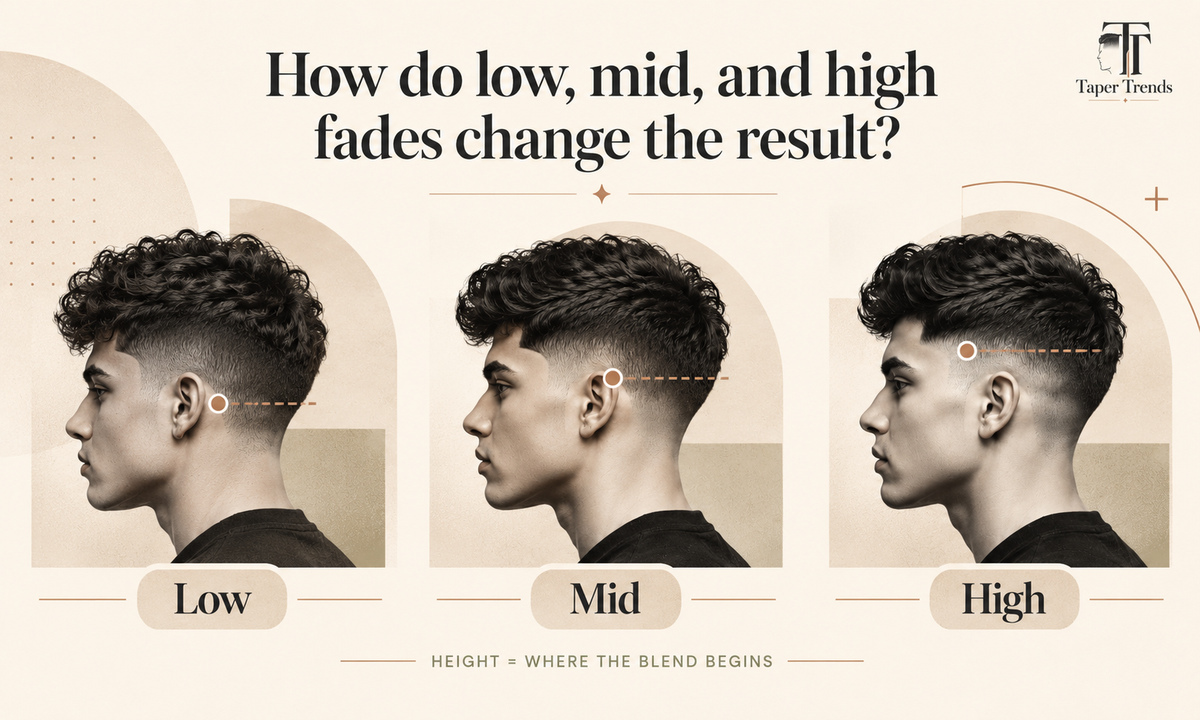
Fade height describes where the blend begins, not how short it ends. CADMEN puts a low fade starting just above the ears, a mid fade around the temples, and a high fade near the top of the sides. Any of the three can finish at skin or at a close guard.
| Height | Blend begins | Contrast | Usually pairs with |
|---|---|---|---|
| Low | Just above the ears and neckline | Subtle | Longer tops, conservative settings |
| Mid | Around the temples | Moderate | Most top lengths |
| High | Near the top of the sides | Bold | Shorter or tighter tops |
Shops draw these lines a little differently, so confirm where the blend will stop. If you're unsure, Uppercuts suggests starting with a mid fade and going higher next time, while Moustache Barbers calls the low taper the lower-commitment choice for a first fade.
Height works the same way on every taper, which our low vs mid taper fade, low vs high taper fade and mid vs high taper fade comparisons lay out side by side. For each height on its own, see the mid taper fade, the high taper fade and the in-between low-mid taper fade.
Low skin fade vs low taper fade
A low skin fade runs the blend all the way around the head just above the ears and neckline, finishing at skin. A low taper fade blends only the sideburn and nape, leaving the hair above and behind the ear at full side length, as Haircut.info describes. In a photo, check whether the short hair circles the ear or stops at the sideburn and nape.
Curved shapes follow the same rule. A low drop fade or high drop fade can end at skin or on a guard, and so can a mid burst fade or high burst fade.
Which cut suits your hair and style?
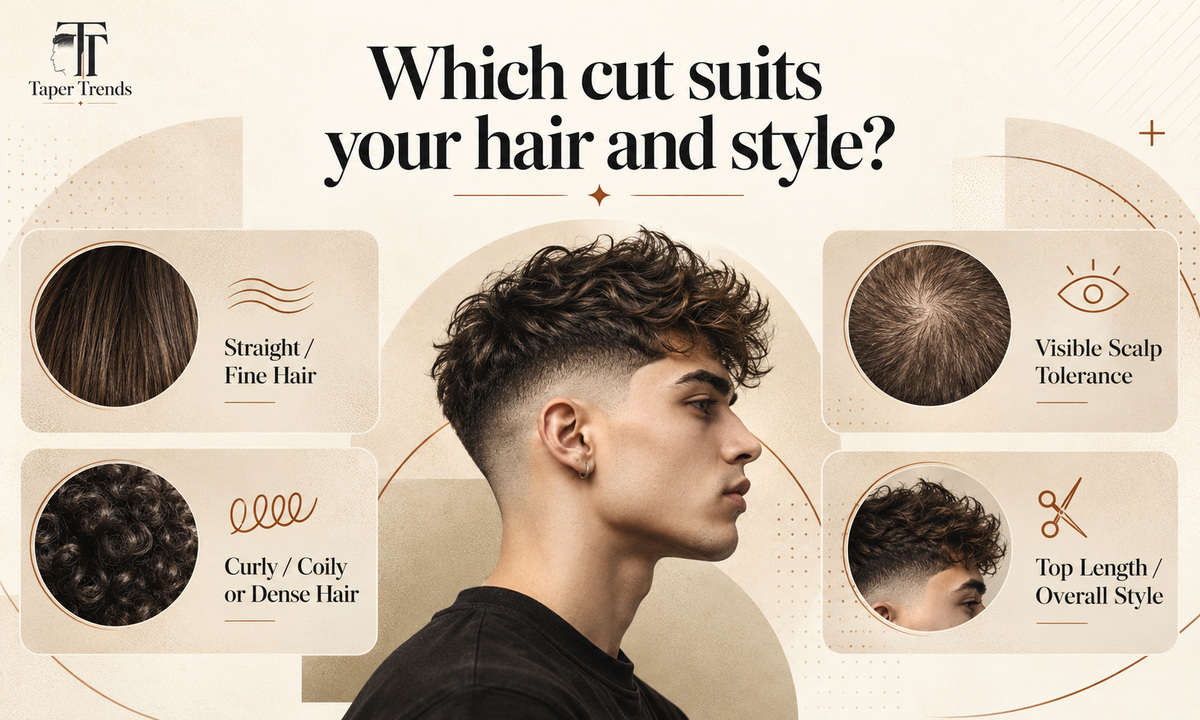
Neither cut belongs to one hair type. Density, texture, growth direction, the shape you want on top, and how much scalp you're comfortable showing matter far more than the name or your face shape.
Straight and fine hair
Fine, straight hair lies flatter, so CADMEN notes that even a skin-level finish produces a softer-looking gradient than it would on coarse hair. Eddie's adds that finer hair may show less volume at the top of the fade.
Density is the bigger question. If your hair is thinning or receding (our receding hairline haircut guide goes deeper), Uppercuts recommends a taper or low fade, because a high skin fade strips a lot of hair from the sides and can draw the eye to a thin top. Our taper fade guide for thin and thick hair explains how density changes any fade, and the low taper fade for straight hair, mid taper fade for straight hair and high taper fade for straight hair guides cover flat strands at each height. The low taper fade for white guys adds tips for early recession.
Curly, coily, and dense hair
On coarse, tightly curled hair, CADMEN says a skin finish creates high contrast, because the line between bare skin and the first length above it is easy to see.
Uppercuts notes that dense sides tend to puff out as they grow, and taking the lower sides to skin keeps the shape tight for longer. A taper fade works too: Haircut.info says its gradual blend suits wavy and curly hair and suggests asking for a comb-and-clipper technique in the transition zone. The deciding factor is the shape you want on top.
For curls, compare our low taper fade for curly hair, mid taper fade for curly hair and high taper fade for curly hair. For a skin finish on curls, see our skin fade curly hair guide before choosing between the two. For a fuller shape, see the mid taper fade afro and high taper fade afro. Waves need a close but even side, which our low taper fade with waves guide covers, and the low taper fade for wavy hair shows the looser pattern.
Head shape, hairline, and top length
Higher fades reveal more of the head's outline. Uppercuts argues head shape matters more than face shape here: a high skin fade suits a round, even head and is less forgiving of flat spots. CADMEN adds that a pronounced bump at the back of the skull may show more under a skin fade, though it doesn't rule the cut out.
Top length changes the look as well. Moustache Barbers notes that a high fade removes more weight and makes the top look more disconnected from the sides. Short tops like a French crop or textured fringe take a higher skin fade well, while a side part, comb over or slick back usually sits better on a low taper. Our face shape detector suggests a starting point for the top.
Which is easier to maintain and grow out?
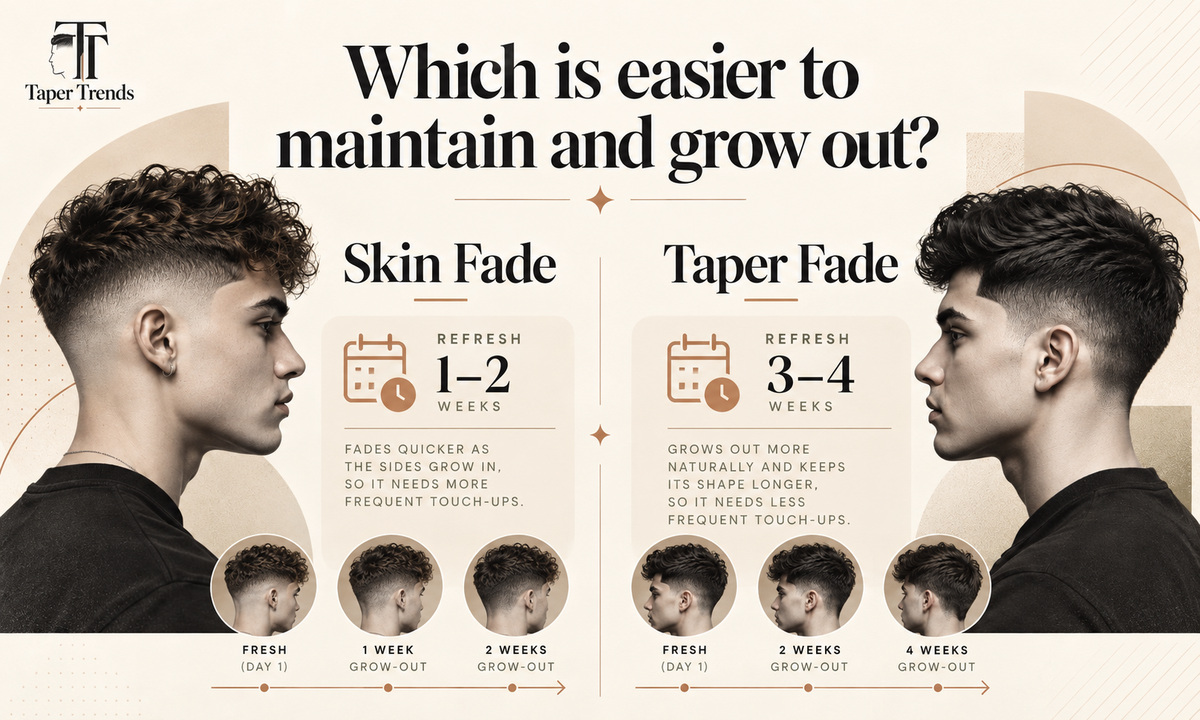
A taper fade is easier to maintain. Hair grows at the same rate under either cut, roughly half an inch a month, but the bare section of a skin fade turns to stubble within a week, while a taper starts from a longer length and changes more gradually. How soon either one needs a refresh depends on how much regrowth you're willing to wear.
Working barbers don't agree on exact intervals:
| Source | Skin fade stays sharp | Taper fade stays tidy |
|---|---|---|
| Eddie’s Haircut & Shave (New York) | 1 to 2 weeks | Often 3 to 4 weeks |
| CADMEN Barber Academy | 2 to 3 weeks | 3 to 4 weeks (taper not to skin) |
| Uppercuts Barbershop | 2 to 3 weeks | 4 to 6 weeks |
| Haircut.info | Not stated | 3 to 4 weeks for crisp edges, 5 to 6 for overall shape |
How often should you refresh each cut?
A haircut loses its just-finished look well before it needs replacing, so the right interval is partly your call. Our guide to how often you should get a haircut gives a starting window for each cut. Moustache Barbers frames it around habits rather than rules. Someone who can visit every two or three weeks and likes a crisp outline may prefer a skin fade. Someone who visits every four weeks, works in a conservative setting, or dislikes visible scalp may be happier with a low taper.
If you love the skin fade but can't book often, Uppercuts suggests a quick line-up between full cuts to keep the hairline and neckline crisp (a temp fade is the temple-only version of that idea), and leaving the top slightly longer so the proportions hold up as the sides grow. Between visits, our five-step guide to styling a faded cut keeps the top in shape.
What does each cut cost over a year?
Annual cost depends on your local menu and how often you go back, not on a fixed price gap between the two cuts. Uppercuts, a barbershop chain in British Columbia, Canada, listed its skin fade at CAD $32 and its taper fade at CAD $36 on its September 2026 page. At that shop, the bolder cut is the cheaper one per visit.
As an illustration, a skin fade every three weeks works out to about 17 visits, or roughly CAD $544 a year. A taper fade every five weeks is about 10 visits, or CAD $360. For your own estimate, multiply your shop's price by 52 and divide by the number of weeks between visits. Our barber tip calculator works out what to add at the chair.
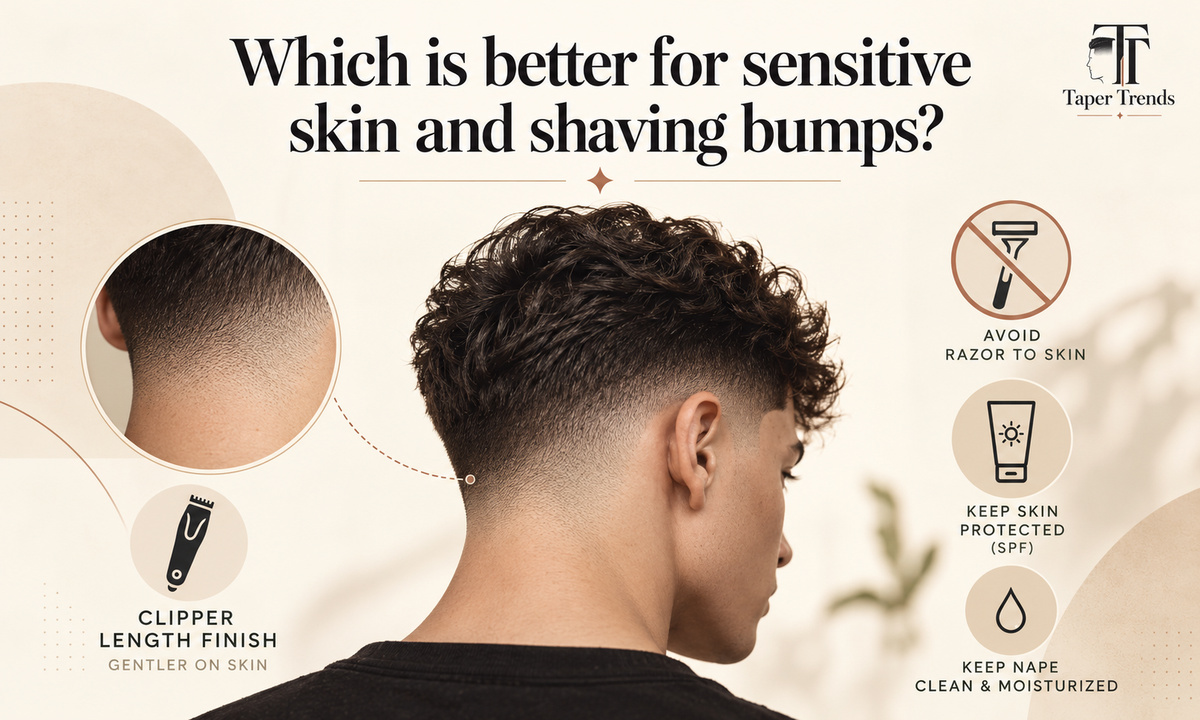
Which is better for sensitive skin and shaving bumps?
If close shaves leave you with bumps, a fade that stops at a clipper length, rather than one shaved to skin, is the gentler option. The American Academy of Dermatology (AAD) lists frequent close-shave haircuts among the things that can irritate the back of the neck and scalp in acne keloidalis nuchae, a condition that causes bumps and, without treatment, scarring.
The AAD says it most often affects men of African ancestry, isn't caught from dirty clippers, and responds better to early treatment.
Shaving is also a common cause of folliculitis, which usually looks like a sudden acne-like breakout. When shaving is the cause, the AAD advises stopping for 30 days.
Exposed scalp needs sun protection too. The AAD recommends a broad-spectrum, water-resistant sunscreen with SPF 30 or higher on all skin not covered by clothing, which includes a freshly faded scalp.
What to tell your barber before any shaving
Mention these before the clippers come out:
- Any current bumps or sore spots, especially at the nape
- Irritation you’ve had after previous close cuts or shaves
- Whether you’d rather keep a clipper finish instead of a foil shaver or razor
- The shortest length you’re comfortable with, as a guard number or simply “not shaved to skin”
Mention scars too. Bumps that are persistent, painful, or scarring deserve a board-certified dermatologist, not just a different haircut. If you wear a beard, the same caution applies along the jaw; our drop fade with beard and burst fade with beard guides cover bump-safe lines at the sideburn, and our skin fade with a beard guide weighs a clipper-close finish against a razor-close one. To choose between the three skin heights, read our low, mid and high skin fade comparison before you book.
How to ask your barber for the right fade
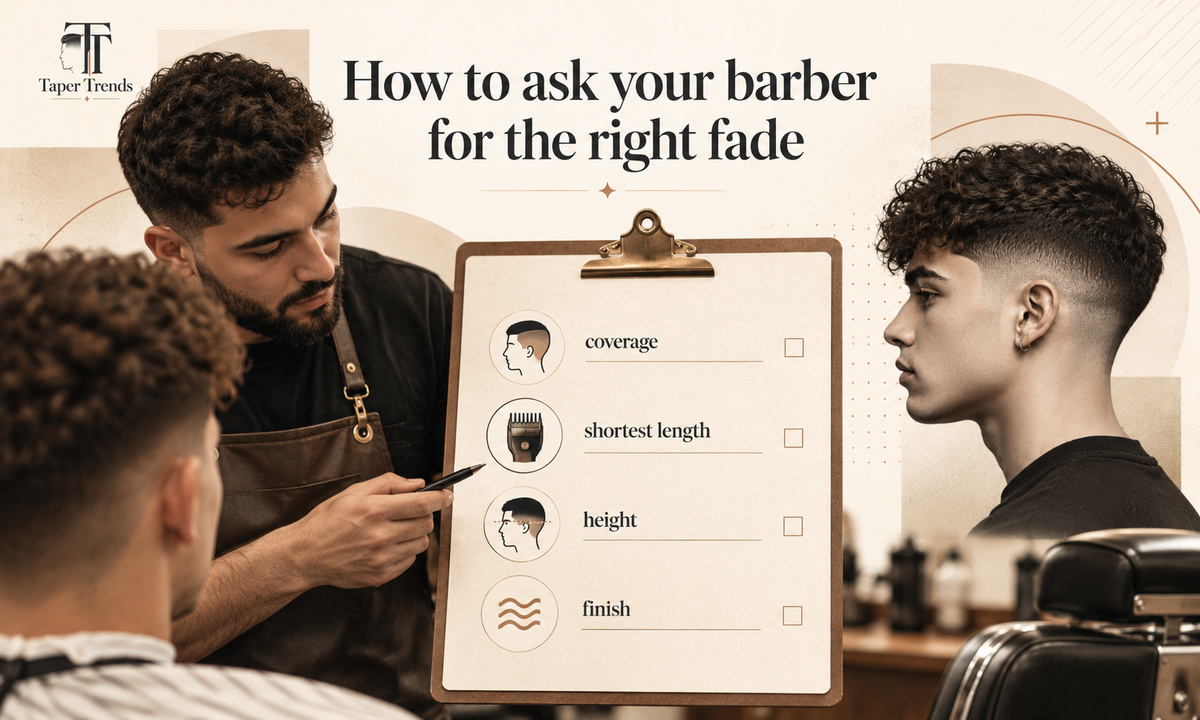
Describe the haircut as four separate choices (coverage, shortest length, height, and finish) rather than relying on a name. Moustache Barbers recommends giving the barber decisions they can confirm instead of a trend name they have to interpret, and bringing two or three photos that show the sides, not just the front.
Two example requests, written for this guide rather than quoted from any shop:
Localized taper“Keep most of the sides full, taper just the sideburns and nape, and leave a little visible hair at the edges.”
Broader skin fade“I'd like a low skin fade on the sides and back, blended into the top. Can you show me how high it will go before you start?”
Haircut.info adds one instruction worth borrowing for any taper request: “don't fade above the ear.” It stops a taper from turning into a low fade.
Four details to confirm before the cut
Before any hair comes off, confirm these four points and ask the barber to repeat the plan back to you (our guide on what to tell your barber for a fade covers the full conversation):
- 1. CoverageOnly the sideburns and nape, or a band around the whole lower head?
- 2. Shortest lengthVisible hair, a close clipper cut, or bare skin? Name the finish, such as “taper to skin” or “down to a #0.5,” not just a guard number.
- 3. HeightLow, mid, or high, and the exact spot on your head where the blend should stop.
- 4. FinishTop length, side weight, sideburns, and whether the neckline stays natural or gets squared off.
If any answer doesn't match the photo you brought, settle it before the clippers start. Our barber brief generator turns those four details into a note you can show on your phone, and the Taper Trends gallery has side and rear reference shots worth saving.
What if your fade was cut too high or too short?
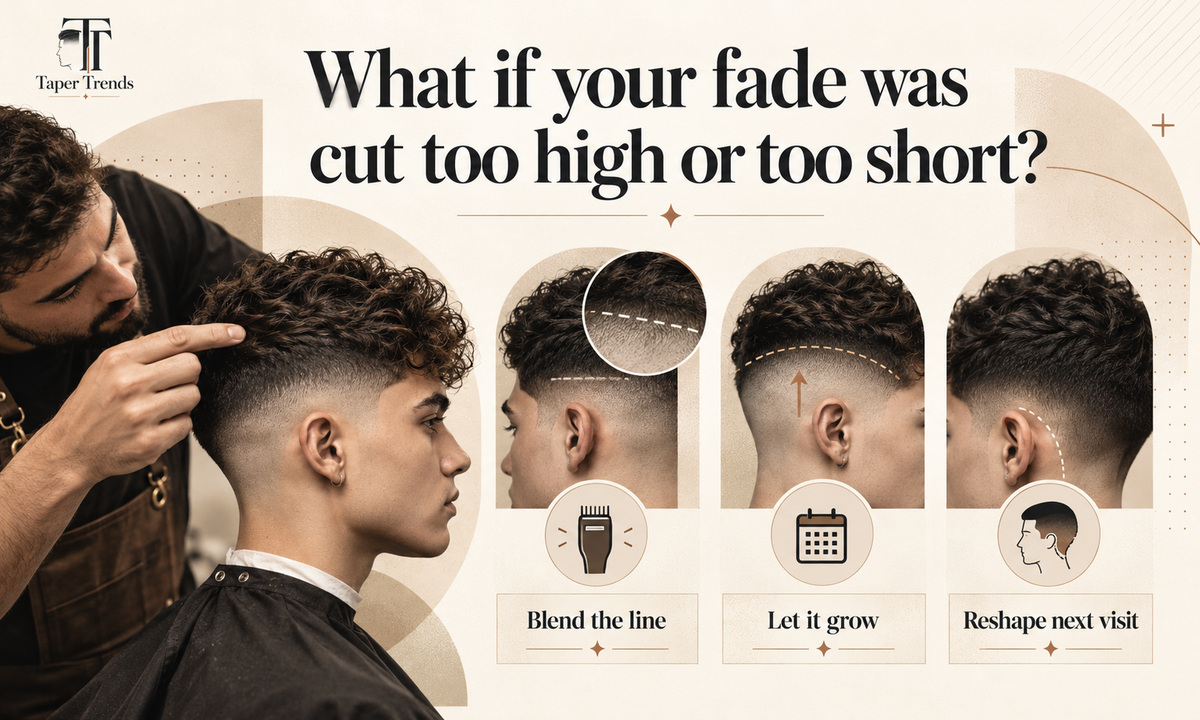
A barber can often soften a harsh blend or tidy an outline right away, but hair taken off too high has to grow back. Wahl's own fade guide puts it simply: you can always go shorter, “but you can't add more hair.”
Moustache Barbers advises describing the problem in observable terms rather than asking someone to “fix the fade.” Say “too much scalp above the temple” or “the blend starts higher than we agreed.” It also warns against removing more hair to chase symmetry. Our full guide on how to fix a bad fade walks through each case.
| What you see | Realistic next step | Limit |
|---|---|---|
| A visible line at the top of the blend | Ask the barber to blend the transition | Needs enough length left above the line |
| Blend sits higher than agreed | Let it grow, then reshape at the next visit | Can’t be lowered on the spot |
| Too little weight at the corners | Let the sides grow out | Takes weeks, not a single visit |
Haircut.info lists that visible line, along with a taper that creeps up over the ear, as the two most common faults on a taper fade. If a high fade needs time to grow back, the low taper fade for medium-length hair shows the shape the sides can settle into.
Skin fade vs taper fade FAQs
Does a skin fade have to be cut with a razor?
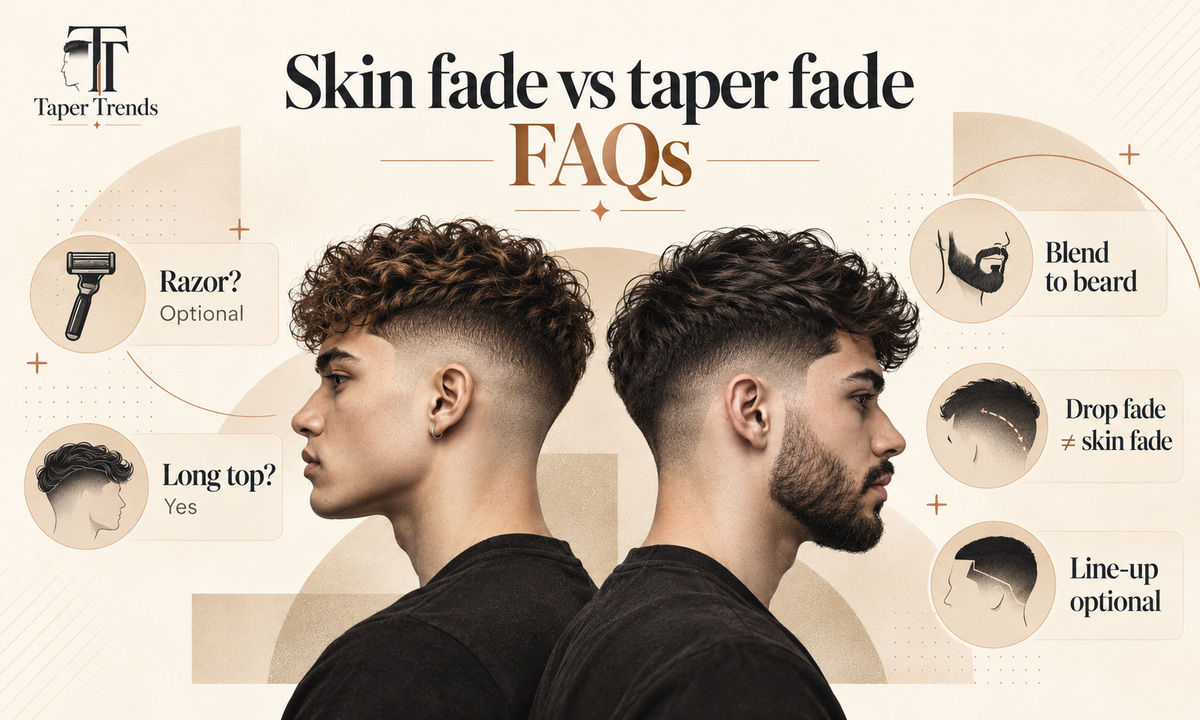
No. Eddie’s says the final edge pass is often a straight razor or a trimmer, and Uppercuts mentions foil shavers alongside razors. If razors irritate your skin, ask for a foil shaver or a clipper finish instead.
Can you get a skin fade with long hair on top?
Yes. The skin finish and the top length are separate choices. Andis teaches a classic side part on a skin fade in its education library, and Uppercuts lists quiffs, pompadours, and textured crops as common pairings. A low or mid height usually suits longer tops, since a high fade makes them look disconnected. Our low taper fade for long hair and mid taper fade for long hair guides show how much length the top can carry.
Can a taper fade blend into a beard?
Yes. The sideburn is one of the two taper zones, so a barber can connect it to your beard without a full skin fade. Wahl's beard-fading guide treats the sideburn as the bridge, keeping it intact and fading upward through the cheekbones. See our low taper fade with beard, mid taper fade with beard and high taper fade with beard guides for the sideburn join at each height.
Is a drop fade the same as a skin fade?
Not exactly. “Drop” describes the shape of the fade line, which arcs downward behind the ear instead of running level around the head. “Skin” describes the shortest finish. CADMEN describes the drop fade as both a standard fade with a modified line and a skin fade variation, so ask for the shape and the finish separately. Our drop fade haircut guide covers the curve in full, and the drop fade vs burst fade comparison sets it against the other curved shape.
Do you need a line-up with either haircut?
No. A line-up is an optional step that sharpens the hairline and edges with a trimmer or razor. Uppercuts tells clients to add “with a line-up” to the request if they want one. If you’d rather skip it, ask for a natural hairline and neckline.
Which is better for a first fade, or a child’s first fade?
A taper fade is usually the safer first step, because it can always be taken shorter at the next visit. Uppercuts offers both cuts on its kids' menu but usually suggests a taper for a child's first or second fade, partly because fades take longer in the chair. Our low taper fade for boys, mid taper fade for boys, high taper fade for boys and burst fade for boys guides keep each cut school-friendly.
The final choice: skin fade or taper fade?
Choose a skin fade if you want strong contrast, are comfortable with visible scalp, and can return every two or three weeks. Choose a taper fade if you want clean edges, more length on the sides, and a softer grow-out.
Whichever you pick, specify where the blend sits, how short it ends, and how high it goes. Bring side and back photos, and if you're unsure, start longer: hair can be cut shorter next visit, but it can't be put back.
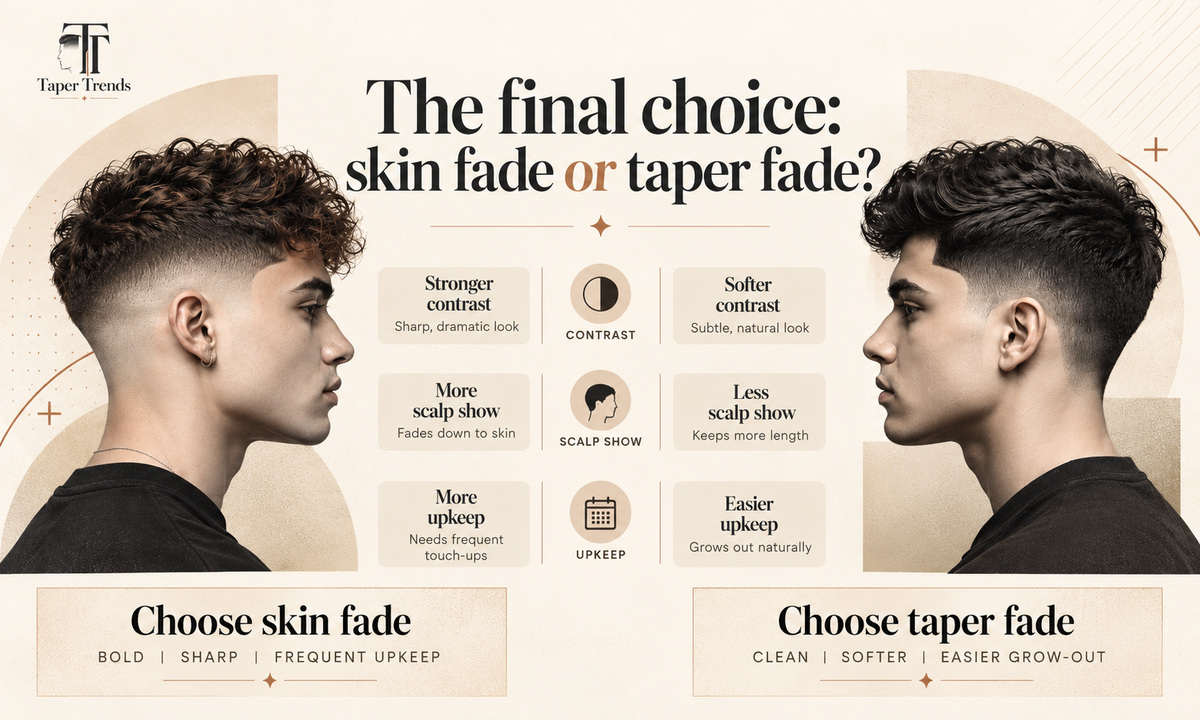
The bottom line
Skin or taper comes down to two questions: should a whole band go to bare scalp, or only the sideburns and nape?
Name the coverage, the shortest length, the height, and the finish, bring side and back photos, and start longer if you're unsure.
Want more fade comparisons?
Browse clean, barber-ready breakdowns for every fade and hair type.