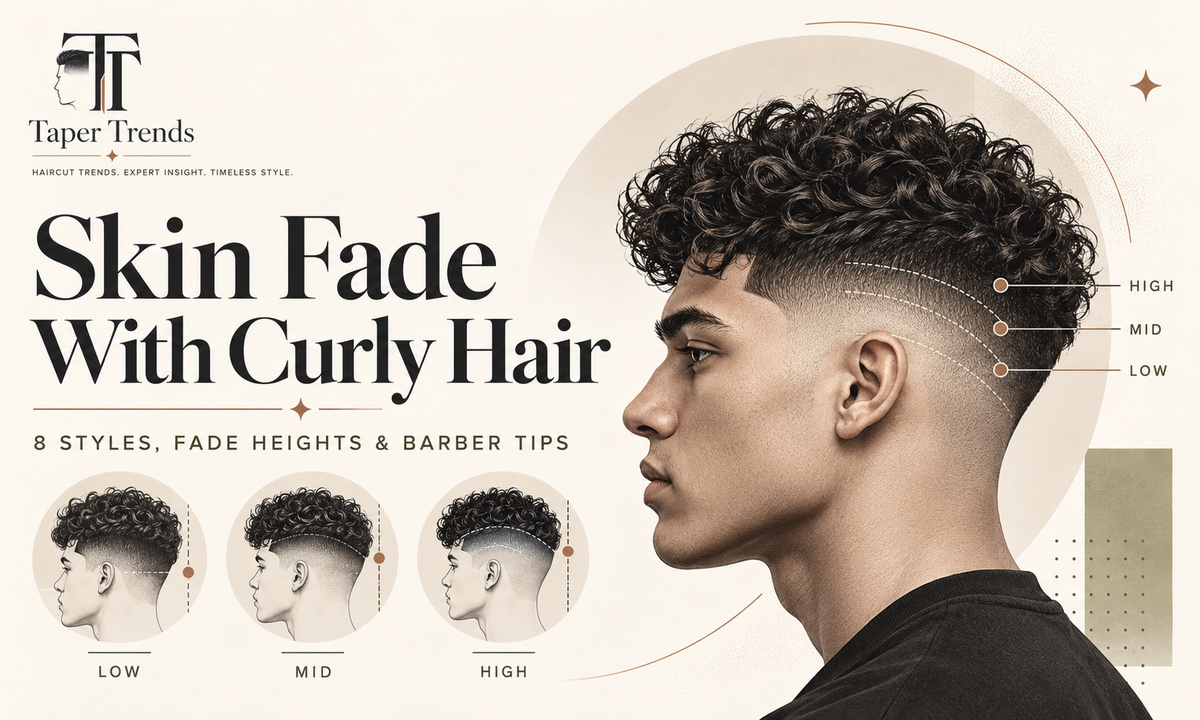
A skin fade on curly hair takes the lower sides and back down to bare skin, then blends upward into a longer curly top. The result is a clean, sharp outline under natural texture. How it turns out depends on three choices you make before the clippers start: how high the fade climbs, how close the base is cut, and how much curl stays on top.
This guide covers each of those decisions, then eight distinct styles and a script you can read to your barber.
For the cut on any hair type, start with our complete skin fade guide. The skin fade vs taper fade comparison helps if you're still choosing between the two, and the low taper fade haircuts guide is the hub for every taper and fade on the site.
What is a skin fade on curly hair?
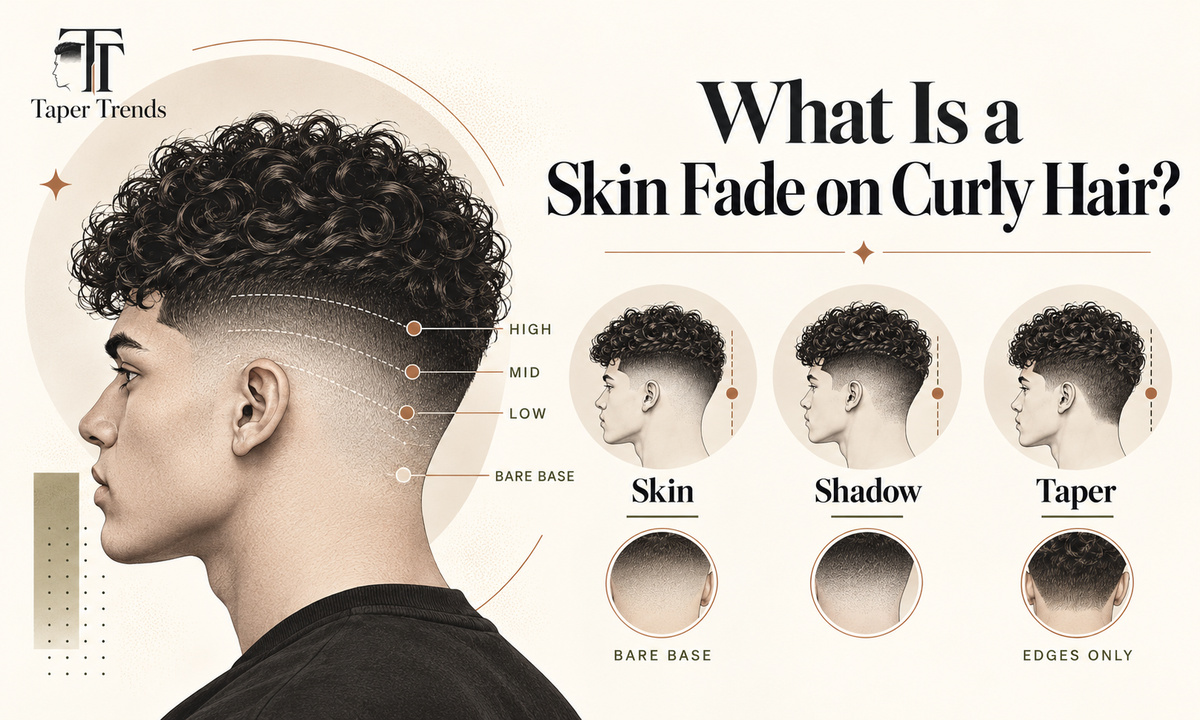
A skin fade on curly hair is a haircut where the sides and back graduate down to bare skin at their lowest point and lengthen gradually into a curly top. Only the bottom edge of the fade reaches skin. The curls above keep their natural shape and length, and the fade itself can sit low, mid, or high on the head.
The vocabulary is where most bad haircuts start. Many barbers use “skin fade” and “bald fade” for the same finish, but how close “skin” actually gets depends on the tool. Hair care brand John Frieda describes a skin fade as being blended to roughly a grade 0, while clipper maker Wahl links its #½ guard, which still leaves about 1/16 inch of hair, to the skin-fade look. A foil shaver gets closer than either. Our clipper guard size chart converts every guard number to inches and millimeters.
Two neighboring terms matter too. A shadow fade stops at very short visible stubble instead of skin. A taper shortens only the sideburns and neckline, whereas a full fade carries the short section all the way around the head. Because shops use these words loosely, ask your barber to point to the shortest spot and say what will be left there.
That taper-or-fade line is the one our taper vs fade explainer and low taper vs low fade comparison draw in detail, and our guide to every type of fade haircut lines up the rest of the names. If a taper is what you actually want, the taper fade haircut guide covers it from the ground up.
Which skin fade height looks best with curly hair?
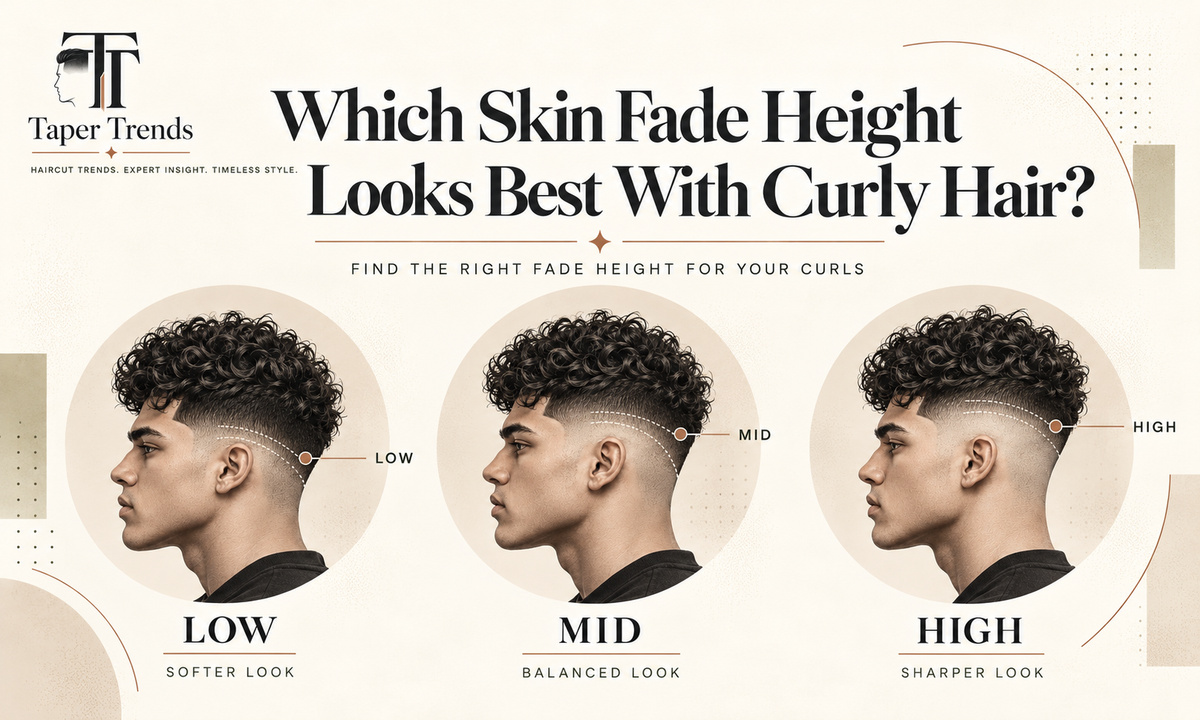
No skin fade height suits everyone. Height decides how much hair stays on the upper sides and how strongly the curls are framed: a low skin fade keeps the most side hair, a mid skin fade balances the two, and a high skin fade shows the most skin and the sharpest contrast. Choose by the silhouette you want and the upkeep you'll accept.
Low, mid, and high fades are the same idea at different heights, so any of them can finish at skin. “Low” describes where the fade sits. “Skin” describes how short the bottom is cut. They are two separate instructions.
| Fade height | Upper-side hair kept | Visual effect |
|---|---|---|
| Low skin fade | Most | Softest contrast, fuller sides |
| Mid skin fade | Moderate | Balanced contrast, curls clearly framed |
| High skin fade | Least | Strongest contrast, narrow outline |
The table compares geometry, not quality. Even barbers disagree on a default: one curly-hair studio in Ontario says a low drop fade or mid taper usually suits curls better than a high skin fade, while John Frieda notes that a low fade can make very coarse curls look heavy. Your own density and curl shape settle the argument.
Height works the same way on tapers, which our low vs mid taper fade, low vs high taper fade and mid vs high taper fade comparisons lay out side by side.
Low skin fade with curly hair
A low skin fade keeps the bare section close to the ears and the lower back of the head, leaving plenty of hair on the upper sides. Side fullness stays intact, and the contrast is the softest of the three heights. It works well when you want the curls framed rather than isolated on top.
Make sure it wraps around the whole head. A low cut that only cleans up the temples and neckline is a taper, and plenty of people walk out with one when they asked for a fade. Our low taper fade for curly hair shows that softer version, and the blowout low taper fade on curly hair adds volume on top.
Mid skin fade with curly hair
A mid skin fade places the transition around the temple line, roughly halfway up the side of the head, with bare skin below it. That leaves room for a smooth blend while keeping the curls above the temple fully visible. Exact placement shifts with head shape, so confirm the line before the barber commits.
One documented mid skin fade from that same studio shows bare skin from the nape to above the ear, with darker hair starting near the temple under long, loose curls. The curls still cover the upper corner of the head, which is what separates it from a high fade. For the taper version at the same height, see our mid taper fade for curly hair; the mid taper fade guide and the in-between low-mid taper fade show where the temple line can sit.
High skin fade with curly hair
A high skin fade carries the transition up toward the point where the side of the head turns into the top. More skin shows, and the curls sit in a narrower, more concentrated shape. Contrast is strongest here and side fullness is lowest.
If your curls are fine or your temples are sparse, a high fade can draw attention to thin areas, so raise that with your barber first. Leaving enough length on top helps balance the exposed sides. Our high taper fade for curly hair keeps a little more hair at that height, and the high taper fade guide covers the height on every texture.
How should curl pattern, density, and dry length shape the cut?
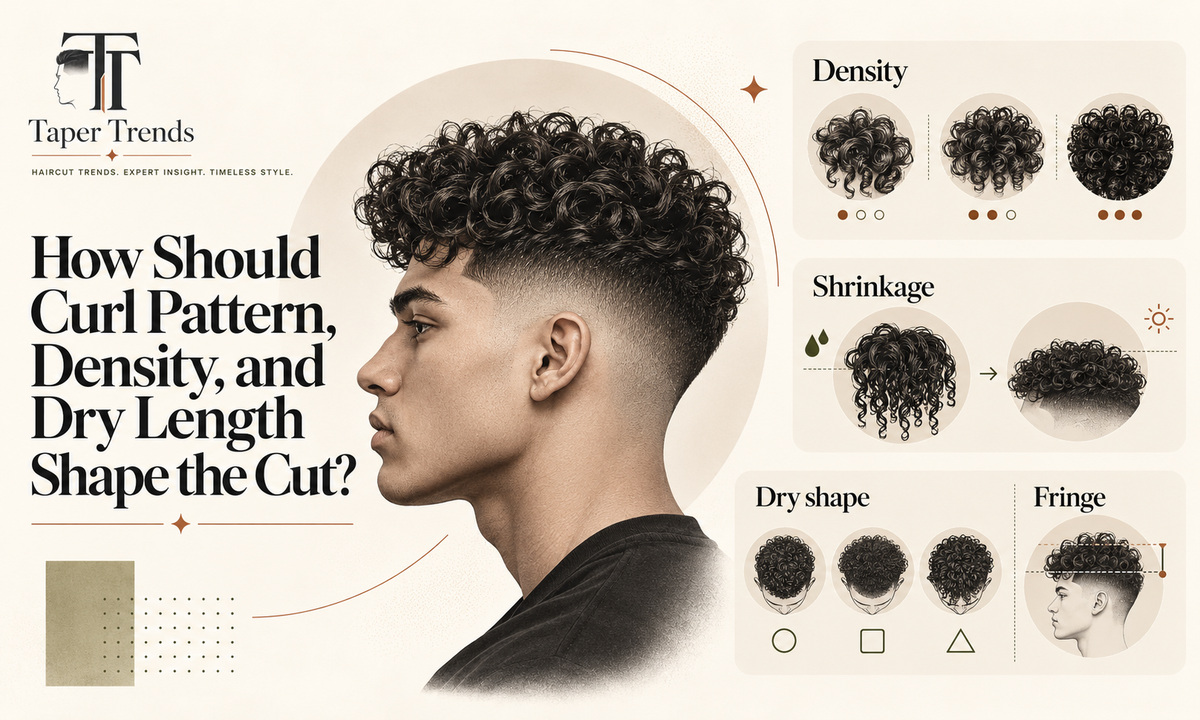
Curl pattern, density, shrinkage, and the dry shape you want decide how much hair your barber should leave on top. Judge the cut by how your curls sit when dry, not by how far they stretch when wet, and agree on that visible shape before any length comes off.
Choose the top shape for your curl pattern and density
A good skin fade leaves enough texture on top to hold the shape you want, whether that's loose ringlets, springy curls, or tight coils. Look at how your curls sit on a normal day, how dense the crown and temples are, and whether you want a wide outline or a narrow one.
Density matters as much as curl pattern. Sparse sides or temples become more visible once the hair around them is taken to skin. Two people with the same curl-type label can also have very different results, so use the label as a starting point and let your actual hair make the call.
Our fade guide for thin and thick hair explains how density changes any fade. Looser S-shaped patterns behave closer to waves, which our low taper fade for wavy hair and mid taper fade for wavy hair cover, and permed curls follow the same dry-length rules as natural ones, as our low taper fade perm guide shows.
Account for curl shrinkage before cutting the top
Curly hair sits shorter when dry than when wet or stretched, so settle on the visible dry length before anything is removed. Arrive with your hair styled the way you usually wear it.
Barbers at that Ontario studio say they read the curl pattern dry first, because a length that looks right wet can spring up much shorter. They suggest coming in a day after washing, without heavy gel, and they start most curly tops at roughly 2 to 3 inches so the curls have room to form. Treat that as one shop's starting point, since shrinkage varies a lot between people. Ask your barber to test a representative curl, show you where the fringe will land, and check the dry shape in the mirror before the final trim.
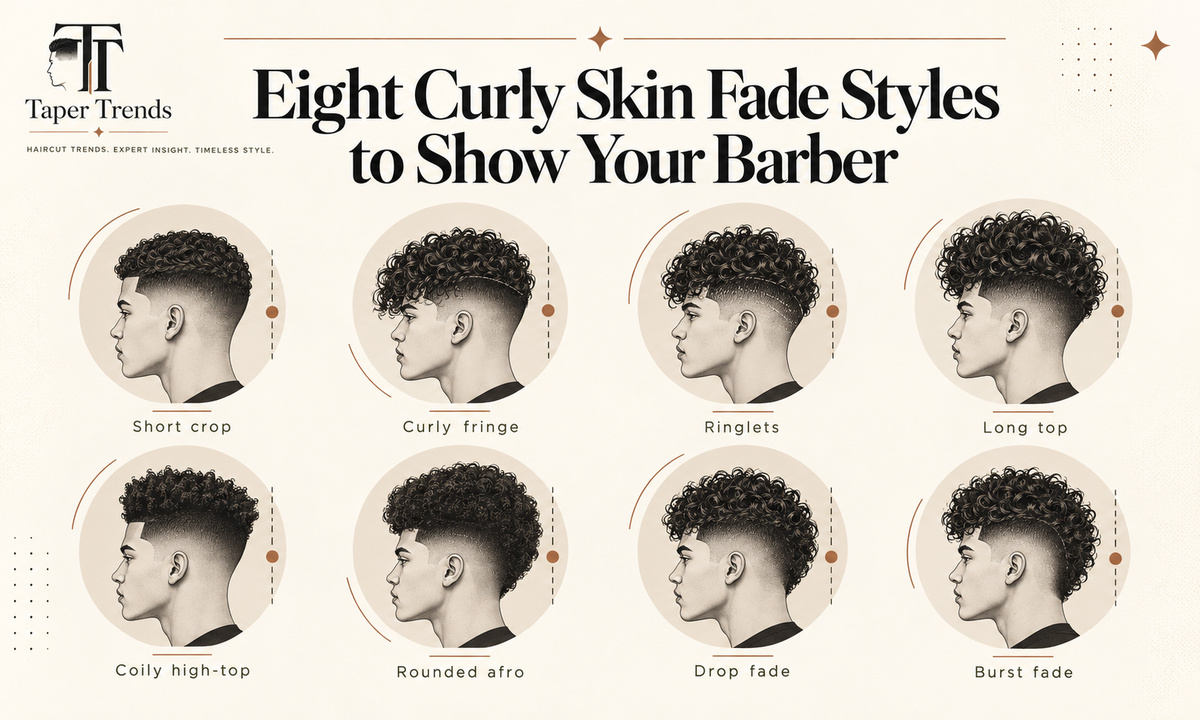
Eight curly skin fade styles to show your barber
The skin fade defines the sides. The length, shape, and texture of the top decide what the haircut actually looks like. Each of the eight styles below pairs a different top with a fade height or fade shape, so no two are the same cut with a new name. Use them as starting points and match the top to your own dry curl length.
Short curly crop and curly fringe skin fades
Both keep the sides tight, but a crop holds a compact shape on top while a fringe lets more hair fall forward.
Short curly crop with skin fade
Short, compact curls sit above sides taken to skin, with a tidy outline all round. It suits dense hair and anyone who wants very little styling time. Ask for enough length at the front that the curls still read as curls rather than texture.
Curly fringe with skin fade
A deliberate forward fringe set against faded temples and sides. Tell your barber exactly where the fringe should end when dry, because shrinkage can pull it well above where it sat wet.
For the crop, our French crop low taper fade and low taper fade for short hair show compact tops, with the mid taper and high taper short-hair guides at the higher heights. For the fringe, see the textured fringe with a low taper fade, the mid taper textured fringe, the high taper textured fringe and the softer, airier low taper fade fluffy hair look. A blunter, straight-across front is closer to an Edgar, which our burst fade Edgar guide covers.
Defined ringlets and longer curly tops
A skin fade can frame defined ringlets or longer curls without taking away upper length. The aim is clumped, visible curls with a blend that keeps their width.
Defined ringlets with mid skin fade
A mid fade leaves space above the temple for ringlets to clump and show definition. Ask the barber to remove bulk where the sides meet the top, not curl length.
Long curly top with low skin fade
A low fade keeps more hair on the upper sides, so longer curls settle into a softer, fuller outline. Pick this when length and width should stay the main feature.
For more length ideas, our low taper fade for long hair, mid taper fade for long hair and low taper fade for medium-length hair show how far a top can grow over short sides. Curls kept long at the back turn the cut into a mullet, which the low taper fade mullet guide covers.
Coily high-tops and rounded afro-shaped tops
Tightly coiled hair can be shaped taller or rounder over a skin finish on the lower sides. Even density on top and a clean side-to-top transition matter most.
Coily high-top with skin fade
A taller, structured silhouette over faded sides. It needs evenly dense hair through the crown and a transition with no ledge where the top begins.
Rounded afro-shaped top with skin fade
A rounded curly top over faded sides. Ask the barber to follow the natural curve of your head so the outline looks even from the front, sides, and back.
Our low taper fade afro, mid taper fade afro and high taper fade afro guides show the rounded shape at each height. For a taller strip of coils, the low taper fade mohawk and burst fade mohawk are close cousins of the high-top. The low taper fade for Black men, mid taper fade for Black men and high taper fade for Black men guides show skin finishes on tight textures, and the low taper fade for Black women covers natural hair from TWAs to rounded afros.
Drop and burst skin fades with curly hair
These two change the path of the fade rather than its height. A drop fade arcs down behind the ear toward the nape, following the curve of the lower skull. A burst fade curves in a half circle around the ear and leaves the hair at the back longer. Either can finish at skin, but they produce different backs, so name the one you want.
Curly drop skin fade
The fade line travels down behind the ear toward the nape, giving the back a curved base beneath the curls.
Curly burst skin fade
A semicircle of short hair around each ear, with more length kept behind it. Confirm how much hair should stay at the nape so it isn't tidied away.
Our drop fade for curly hair and burst fade for curly hair guides go deeper on each shape on curls, and the drop fade vs burst fade comparison shows how to tell the backs apart. For each shape on its own, see the drop fade haircut guide and burst fade haircut guide, plus the mid drop fade, high drop fade, mid burst fade and high burst fade at each height. The drop fade for Black men and burst fade for Black men guides show both curves taken to skin on coily hair, and the burst fade mullet and drop fade mullet keep the curls long at the back.
What should you tell your barber for a curly skin fade?
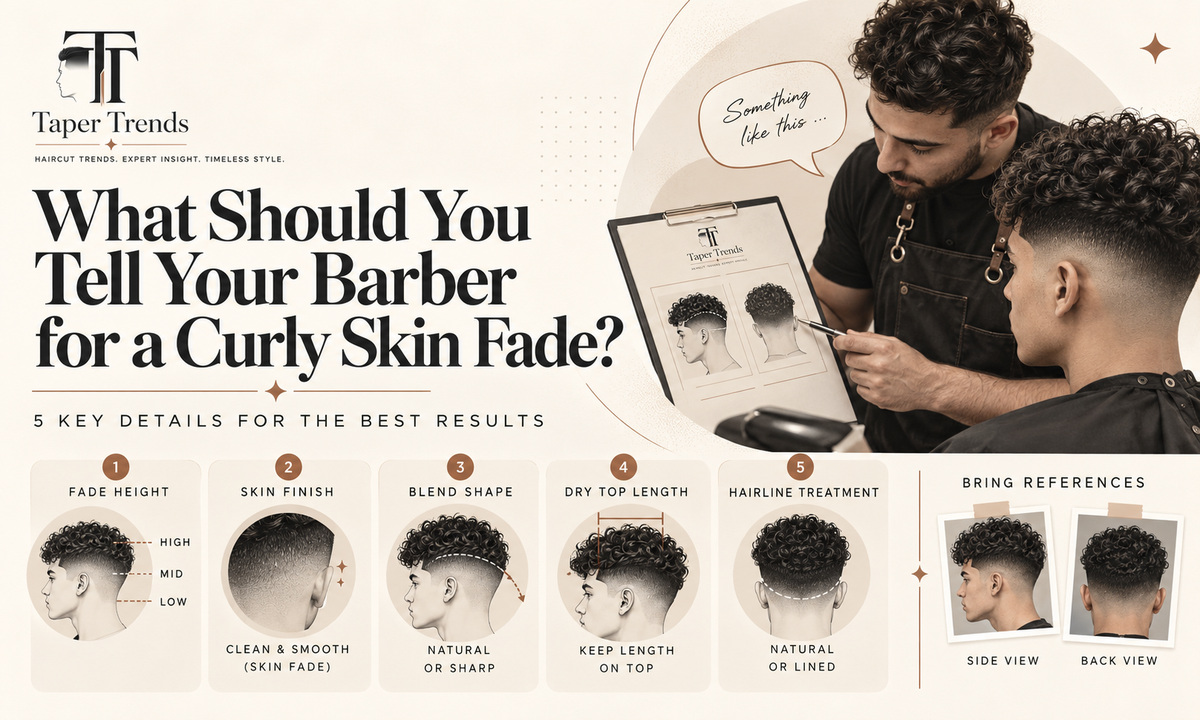
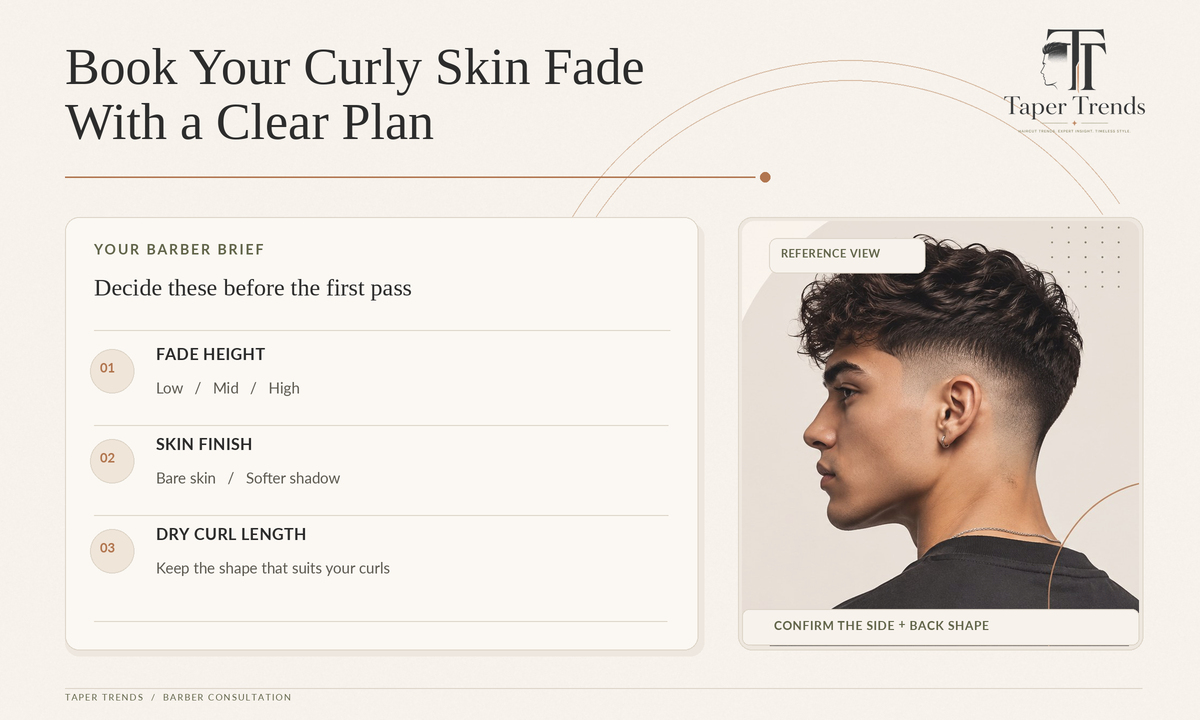
Give your barber five details: fade height, skin finish, blend shape, dry top length, and hairline treatment. Bring photos of the side and back, not just the front, and ask to confirm the plan before cutting starts, as our guide on how to ask for a fade explains. Here's a script to adapt, swapping in your own height:
“I'd like a low skin fade around the sides and back, blended into my curls without a heavy shelf. Please keep my current dry length on top and check how the curls sit before taking more off. Follow my natural front hairline, and show me the fade height before cutting.”
Our barber brief generator turns those five details into a note you can show on your phone, and the Taper Trends gallery has side and back reference shots worth saving.
Specify fade height, skin finish, and blend shape
Say how high the fade should rise, whether the base should reach skin, and whether the line runs straight, drops behind the ear, or bursts around it.
Point to landmarks such as the temple or the top of the ear instead of relying on “low” or “high” alone, because those words shift from shop to shop. If you're unsure about a fully bare base, ask whether a shadow fade would suit you better. Then ask for a blend with no visible band between skin and curls. Our low taper fade from every angle shows those landmarks on a real head, and the low taper drop fade and taper low burst fade guides show how the curved lines start low.
Set the dry top length and hairline details
Describe how the curls should fall when dry, where the fringe should end, how much fullness to keep on the upper sides, and whether the front hairline should look natural or lined up.
A photo of your own dry hair on a normal day helps more than any description. A lineup sharpens the perimeter but removes some of the natural edge, so choose it on purpose. If you wear a beard, say how the sideburns should connect to it. Our skin fade with beard, low taper fade with beard, mid taper fade with beard, high taper fade with beard, drop fade with beard and burst fade with beard guides cover that sideburn join at each height and shape.
How does a barber blend a skin fade into curly hair?
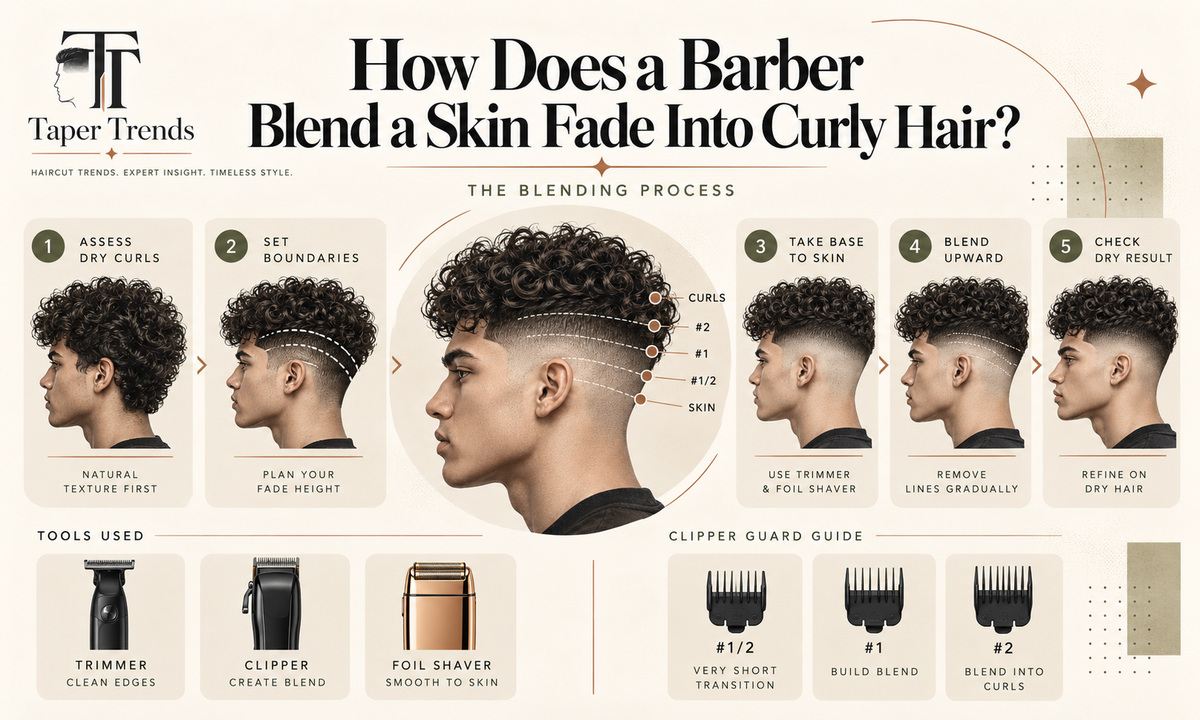
A barber blends a skin fade into curly hair by setting the fade boundaries, taking the lowest section to skin, then graduating upward in small steps until the short hair meets the curls with no visible shelf. The result is checked from both sides and the back with the hair dry. This is what to expect in the chair, not a guide to cutting your own.
- 1.Assess the dry curls, density, growth direction, and scalp.
- 2.Agree on where the fade starts and where the skin section ends.
- 3.Take the lowest section to skin with a close trimmer or a foil shaver built for skin fades.
- 4.Build the graduation upward in small length changes, using an upward rocking motionso each pass doesn't cut into the section above.
- 5.Blend into the curls. Because curls sit away from the scalp, a blend that looks smooth on straight hair can leave a step under a curly top, so curly-hair barbers often carry the blend slightly higher.
- 6.Inspect the dry result and ask for adjustments before you leave the chair.
That step under a curly top is why the same fade looks different on flatter textures. Compare our low taper fade for straight hair and drop fade on straight hair, and see the high taper fade for white guys and mid taper fade for white guys for how barbers handle looser curls on finer hair. The Hispanic and Mexican low taper fade covers thick, wavy-to-curly textures.
What do clipper guards and finishing tools mean?
Clipper guard numbers tell you how much hair remains after the clipper passes, while a trimmer or foil shaver can cut closer than any guard. The finish you get depends on the tool (our best clippers for fades guide compares close-cutting blades), so agree on the closeness rather than a number.
Wahl's standard guard chart lists these lengths:
| Wahl guard | Hair length left |
|---|---|
| #½ | 1/16 inch |
| #1 | 1/8 inch |
| #2 | 1/4 inch |
| #3 | 3/8 inch |
| #4 | 1/2 inch |
Its taper lever adjusts closeness between guard sizes, which is how barbers make half steps, as our beginner fade-cutting guide shows. Even #½ leaves visible hair, and numbering can vary between clipper systems, so these figures aren't a recipe every curly skin fade follows. Our clipper guard size chart lists the millimeter equivalents, and the low taper fade buzz cut and high taper fade buzz cut show how those close lengths look across a whole head.
How do you style curly hair after a skin fade?
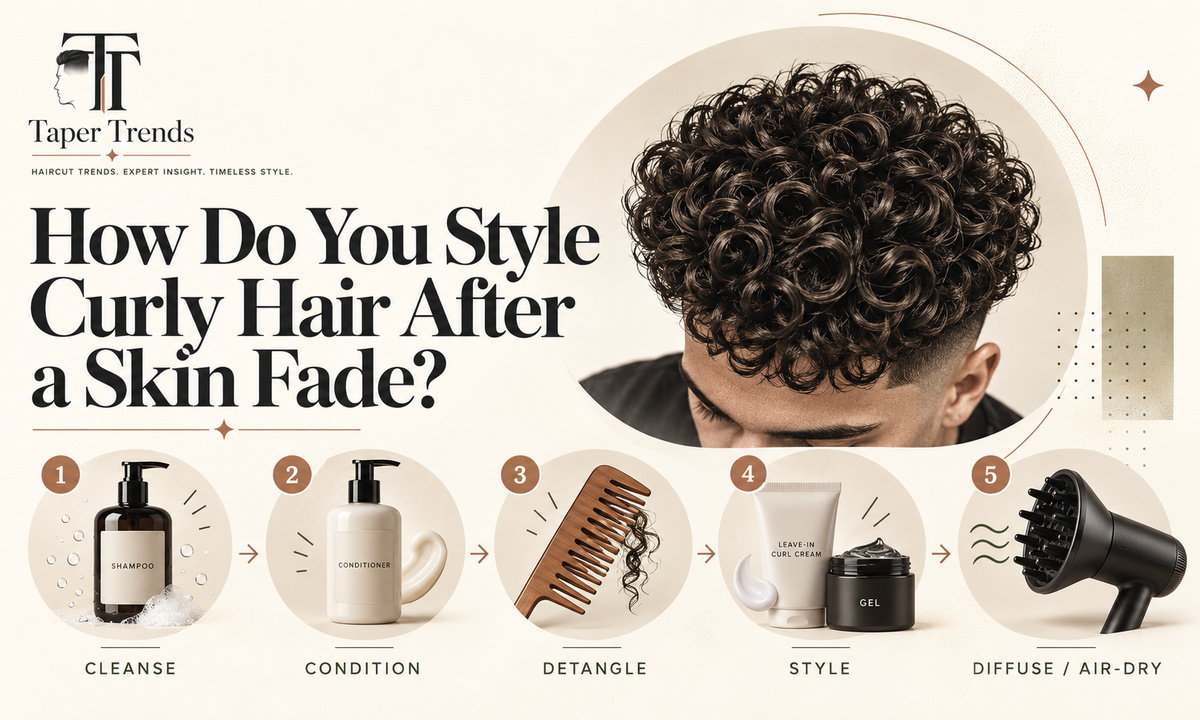
Style the curly top for its natural pattern and treat the faded sides as skin rather than hair. Condition and moisturize the curls, add a styling product while they're damp, then air-dry or diffuse on low heat. The short sides don't need product piled onto them, and the best hair products for fades guide covers curl cream and gel.
The American Academy of Dermatology notes that curly hair is drier than other hair typesand doesn't need washing daily or even weekly, but it recommends washing at least every two to three weeks for scalp and hair health. It also advises conditioning all of your hair, not only the ends.
A simple wash-day and next-day curl routine
Wash only when your hair and scalp need it, then moisturize and detangle gently while the curls are wet.
- 1.Shampoo with a moisturizing formula, cleansing the scalp and rinsing the short sides gently.
- 2.Condition all of the curls, roots to ends.
- 3.Detangle wet hair with your fingers or a wide-toothed comb. Dermatologists advise against brushing curly hair dry, which causes breakage and frizz.
- 4.Add leave-in conditioner or curl cream while damp, and layer a gel on top only if you want more hold.
- 5.Air-dry or diffuse on low heat. The next day, lightly dampen and reshape instead of stacking more product.
Our five-step guide to styling a faded cut matches products to curly and coily textures. If you'd rather stretch the curls into a rounded, lifted shape, the low taper fade blowout and mid taper fade blowout guides walk through the blow-dry, and the mid taper fade fluffy hair shows a softer, diffused finish.
How do you maintain a curly skin fade as it grows?
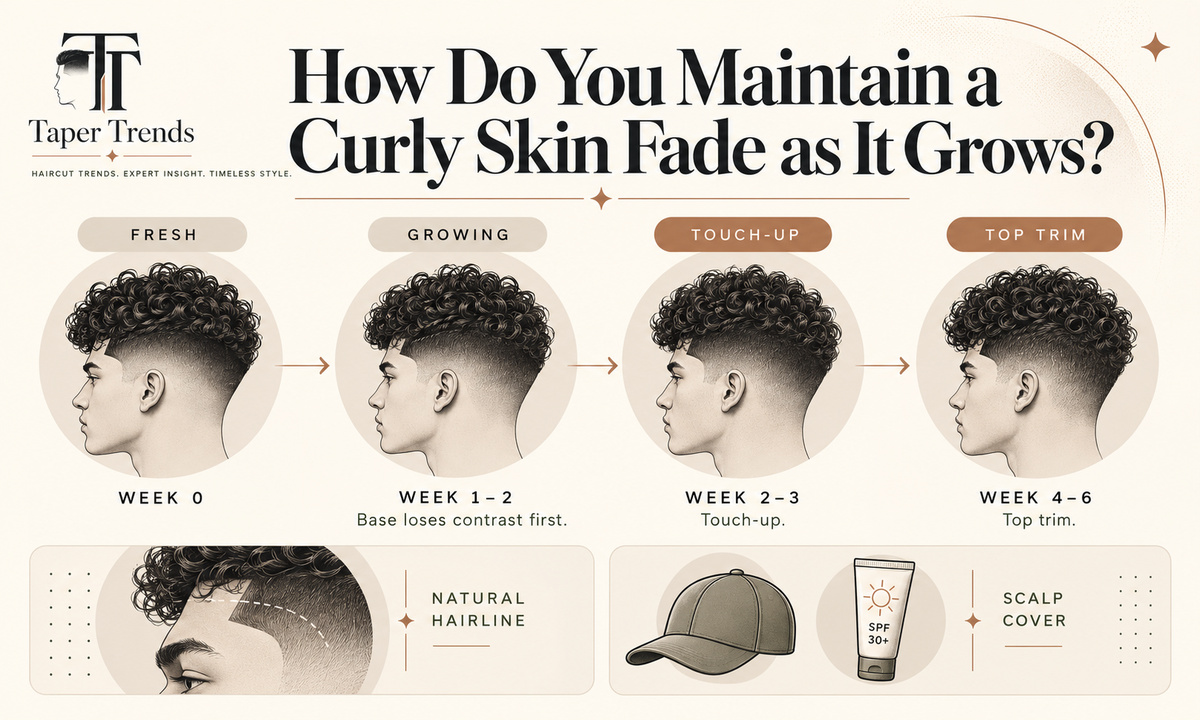
A curly skin fade loses its contrast first at the base, where stubble returns, while the curly top changes shape much more slowly. Book touch-ups according to how sharp you want the transition and hairline to stay, not by a fixed calendar.
Ask your barber to keep any lineup on your natural hairline so repeated edge-ups don't gradually push it back or widen it. Freshly exposed scalp also burns. The Skin Cancer Foundation's expert advice is that a hat, ideally one rated UPF 50+, is probably the best scalp protection, with sunscreen on exposed areas when a hat isn't practical.
When should you book a skin fade touch-up?
Book a touch-up when the base no longer looks smooth, the blend has blurred, or the hairline has grown out of shape.
One barbershop reports that by about two weeks the bare band is covered in stubble, and most of its clients rebook every two to three weeks while the curly top goes four to six weeks between trims (our guide to how often you should get a haircut explains why texture changes the clock). Some people book a fade-only clean-up between full cuts. Treat those intervals as one shop's experience, since growth speed and how crisp you like the fade both vary. Our barber tip calculator works out what to add at the chair on those frequent visits.
When might a shadow fade or taper be better for curly hair?
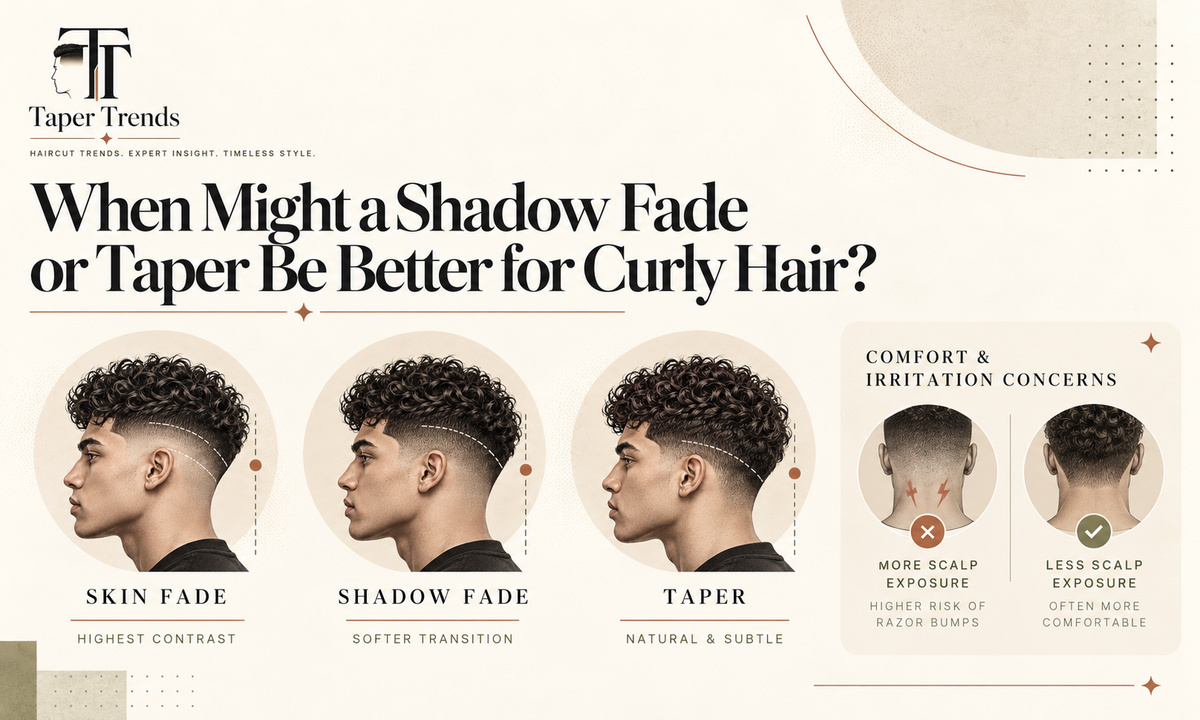
A shadow fade or taper can be the better choice if you want a softer grow-out, less exposed scalp, or fewer irritation problems after close cuts. A shadow fade keeps very short hair at the base, and a taper shortens mainly the edges. Neither is better overall; each trades some contrast for comfort.
| Option | Shortest finish | Main trade-off |
|---|---|---|
| Skin fade | Bare skin at the base | Sharpest contrast, most scalp exposure |
| Shadow fade | Very short hair kept at the base | Softer finish, visible stubble |
| Taper | Short only at sideburns and neckline | Most side hair kept, least contrast |
Our skin fade vs taper fade comparison weighs those trade-offs in full, and the burst fade vs taper fade guide does the same for the curved shape. On curls, the curly low taper fade is the gentlest version to try first. Our skin fade height comparison sets low, mid and high skin fades side by side when the finish is bare scalp.
When do razor bumps or scalp irritation change the recommendation?
If close haircuts keep causing painful bumps or irritation, ask for a less-close finish, and see a dermatologist if the problem continues.
Dermatologists explain that razor bumps form when hair is cut very short and coarse, curly hairs curve back into the skin. Bumps on the back of the neck or scalp that feel like razor bumps can instead be acne keloidalis nuchae (AKN), and for people with AKN the American Academy of Dermatology recommends haircuts that avoid shaving the back of the neck and head, since shaving can trigger flares. Don't try to diagnose yourself from photos. Painful, persistent, or scarring bumps deserve a visit to a board-certified dermatologist.
Locs and twists are another way to keep the scalp covered; our low taper fade with dreads and mid taper fade with dreads guides cover hairline-safe finishes.
Frequently asked questions about curly skin fades
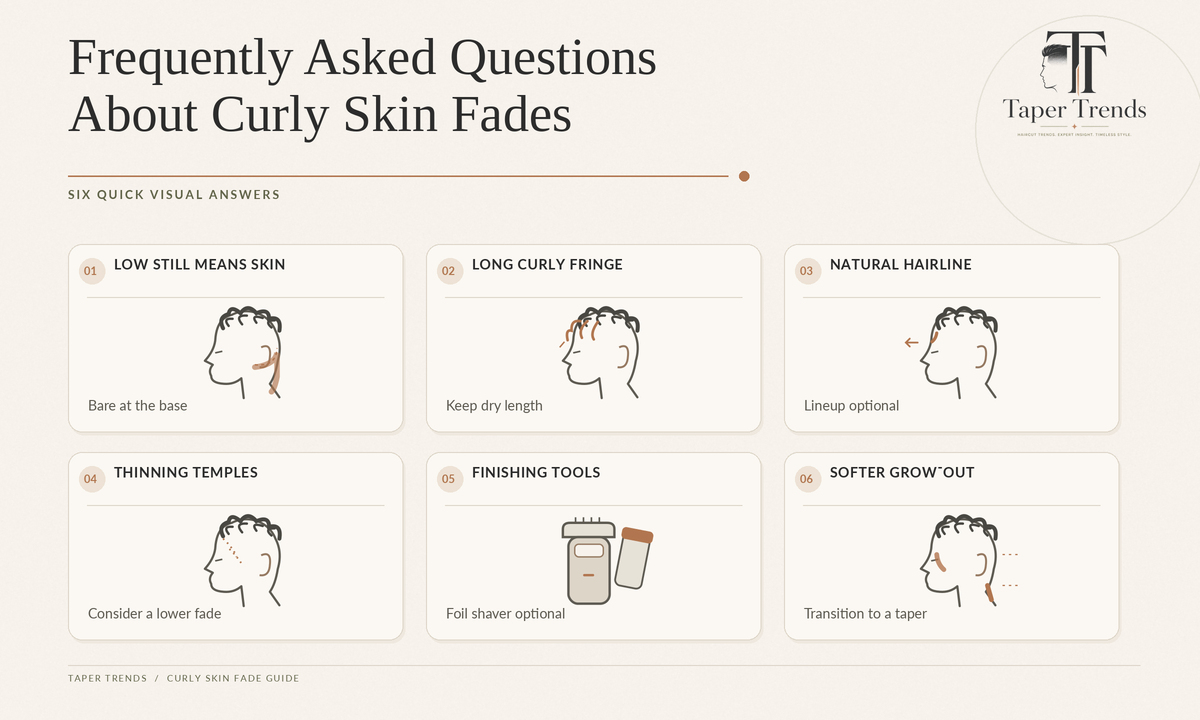
Can a low skin fade still go down to bare skin?
Yes. “Low” describes how high the fade rises, and “skin” describes how short the bottom is cut. A low skin fade keeps the bare section near the ears and lower back of the head. Use both words when you book so the barber hears two separate instructions. The low drop fade works the same way: a low height that can still finish at skin.
Can you keep a long curly fringe with a skin fade?
Yes. The sides can go to skin while the front stays long. Name the dry length you want the fringe to reach, and ask for the upper sides to be blended so the top doesn't sit heavy or square over the fade. Our burst fade textured fringe and drop fade textured fringe guides show longer fringes over skin-finished sides.
Does a curly skin fade need a sharp lineup?
No. A lineup is optional. Ask your barber to follow your natural hairline for a softer look, or to limit edging to the temples and neckline if you want some definition without a hard front edge.
Can you get a skin fade with thinning temples?
Often, yes, but a skin finish can make sparse areas more visible. A lower fade, a shadow fade, or a softer blend at the temples usually looks more even. If the thinning is new or happening quickly, a dermatologist can look into the cause. Our fade guide for thin and thick hair explains how density changes the right height.
Is a foil shaver necessary for every skin fade?
No. Barbers reach a very close base with trimmers, zeroed clippers, or foil shavers, and the method varies by shop. Agree on how smooth you want the base rather than which tool gets you there, and mention it if close finishes irritate your skin.
Can you grow a skin fade into a softer taper?
Yes. At each visit, ask your barber to leave the sides slightly longer and soften the transition until the shape becomes a taper. Expect an in-between stage of a few weeks while the shortest areas catch up. The curly low taper fade is a good shape to aim for on the way out.
Book your curly skin fade with a clear plan
A good curly skin fade comes down to three decisions made before cutting: how high the fade rises, how close the base goes, and how much curl stays on top. Bring side and back photos, describe your curls as they sit dry, and have your barber confirm the fade line before the first pass.
After the cut, keep the curls moisturized, cover exposed scalp in strong sun, and rebook when the contrast starts to blur. If close finishes irritate your skin, a shadow fade or taper gets you most of the look with less scalp exposure.
Not sure which top suits your face? Our face shape detector suggests a starting point, and the low taper fade haircuts guide links every cut and hair-type guide on the site.
The bottom line
A curly skin fade is three decisions: how high the fade rises, how close the base goes, and how much curl stays on top.
Judge the top dry, bring side and back photos, confirm the line before the first pass, and pick a shadow fade or taper if close cuts irritate your skin.
Want more curly fade ideas?
Browse clean, barber-ready breakdowns for every fade and hair type.