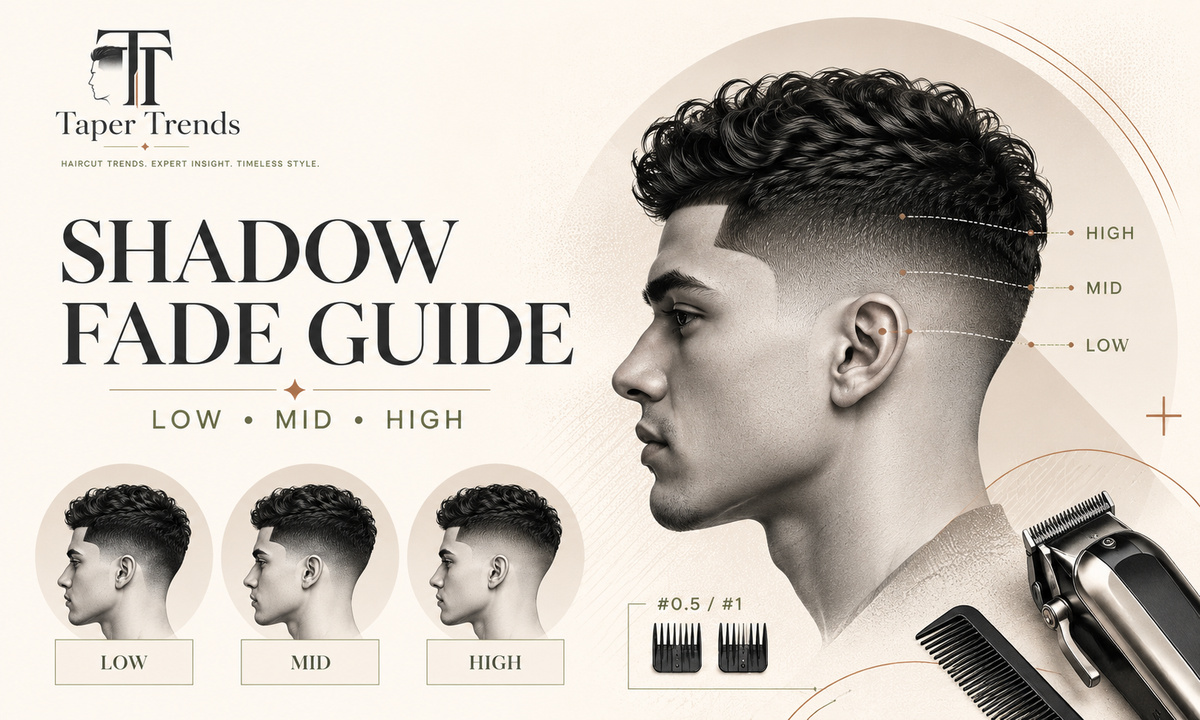
A shadow fade is a fade haircut that blends the sides and back down to very short hair instead of bare skin. A thin layer of stubble stays at the bottom, so the finish looks softer than a skin fade and grows out without a sudden jump from scalp to hair. It is also an easier fade to leave behind; how to grow out a fade shows how.
Two decisions shape the result: how short the base goes and how high the fade climbs. Settle both before you sit down.
If you are still sorting out the vocabulary, start with the guide to every type of fade haircut, the taper vs fade explainer, and the types of fade haircuts comparison. The low taper fade haircuts guide is the hub for every taper and fade on the site, and the barber brief generator turns your choices into a message you can show in the chair.
What is a shadow fade haircut?
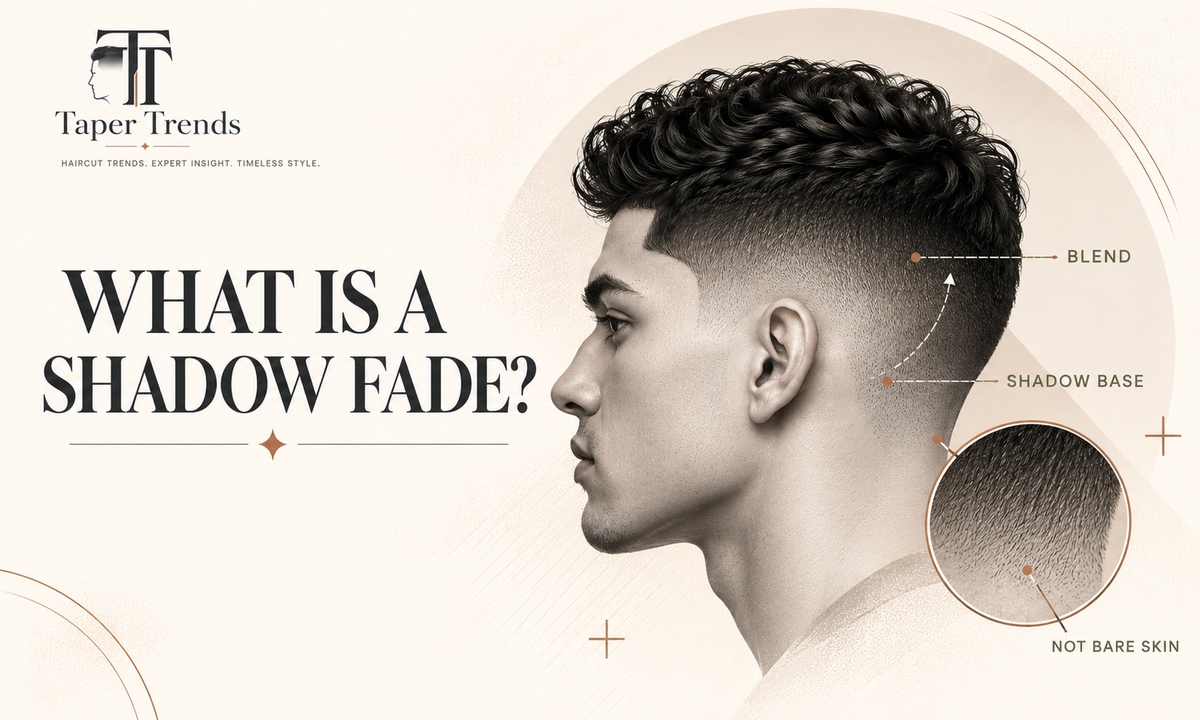
A shadow fade is a fade whose shortest section keeps visible hair rather than exposed scalp. The hair above it gets gradually longer, with no hard line where one length meets the next. “Shadow” names the finish at the base. Where the fade starts, whether low, mid, or high, is a separate choice, which is why the same vocabulary runs through our taper fade guide and low vs mid vs high skin fade comparison.
The same cut can look different from one head to the next, because hair color and density change how dark the base reads. The barbers at Markcutit, a shop in Mississauga, Ontario, note that a half guard on very dark, dense hair can look almost solid from a distance, closer to a short back and sides than a fade.
Why is it called a shadow fade?
The name describes the look. When the base is cut to a half or #1 guard, the scalp shows through the short hair as a darker haze around the lower head, a bit like a shadow, instead of disappearing into bare skin. Dark hair produces a deeper shade. Blond, gray, or fine hair produces a lighter, more see-through one.
Where does the shortest hair stop?
A shadow fade ends in short, visible hair along the lower sides and the nape. A skin fade, by contrast, takes the baseline all the way down to bare skin, as Prime Barbershop in Manhattan explains. Scalp can show through the stubble of a shadow fade, but it is never shaved clean. A sharp lineup at the hairline is a separate finishing step and does not change the fade, as our temp fade guide explains for the front corners.
What clipper guard makes a shadow fade?
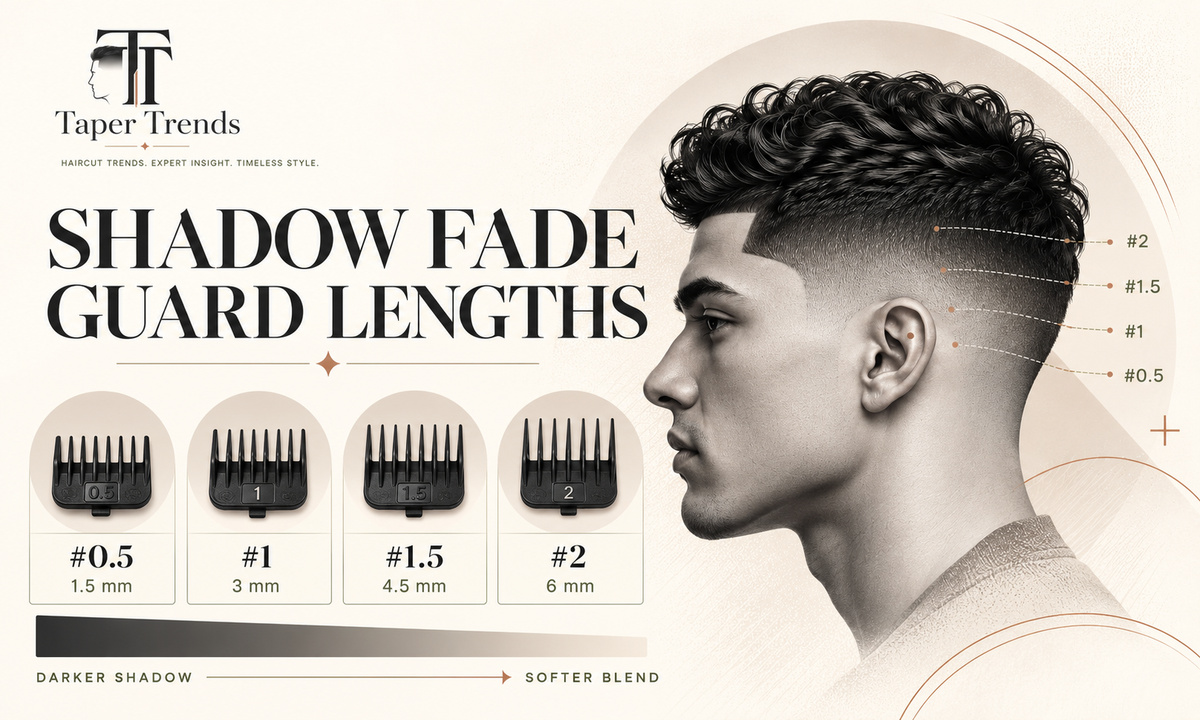
Most shadow fades bottom out at a #0.5 (half) or #1 guard, according to both Markcutit and the fade guide from CADMEN Barber Academy. Treat those numbers as a starting point for the conversation, not a definition. The finished look depends on your hair, the clipper and its blade lever (our best clippers for fades guide compares both), and how much scalp you are comfortable seeing.
| Wahl guard | Nominal cutting length | How it tends to read |
|---|---|---|
| #½ | 1/16 in (1.5 mm) | Darkest shadow, scalp clearly visible |
| #1 | 1/8 in (3 mm) | Softer haze, scalp partly visible |
| #1½ | 3/16 in (4.5 mm) | Short, mostly solid color |
| #2 | 1/4 in (6 mm) | Usually used higher in the blend |
Cutting lengths are from Wahl's Secure-Fit attachment guard set, checked October 2026. Other brands and lever positions can cut slightly differently. Our clipper guard size chart converts every guard number to inches and millimeters, and the haircut numbers guide explains how those labels differ between brands.
Does a shadow fade require a #0.5 or #1 guard?
No single guard is required, because the visible finish matters more than the number. Markcutit's barbers say a base longer than about a #1½ usually reads as short sides rather than a fade, so the shortest section should stay very short.
Be careful with the word “zero.” Markcutit measures a bare clipper with the lever closed at roughly 0.5 to 1 mm, which is still stubble, while a bald fade is finished with a foil shaver or razor. Instead of naming a number, describe what you want to see: short hair visible at the bottom, no skin. The skin fade guide covers what the bare-scalp finish involves, and our temp fade guide shows a shadow finish applied to the temples.
Shadow fade vs skin fade vs taper fade: what's different?
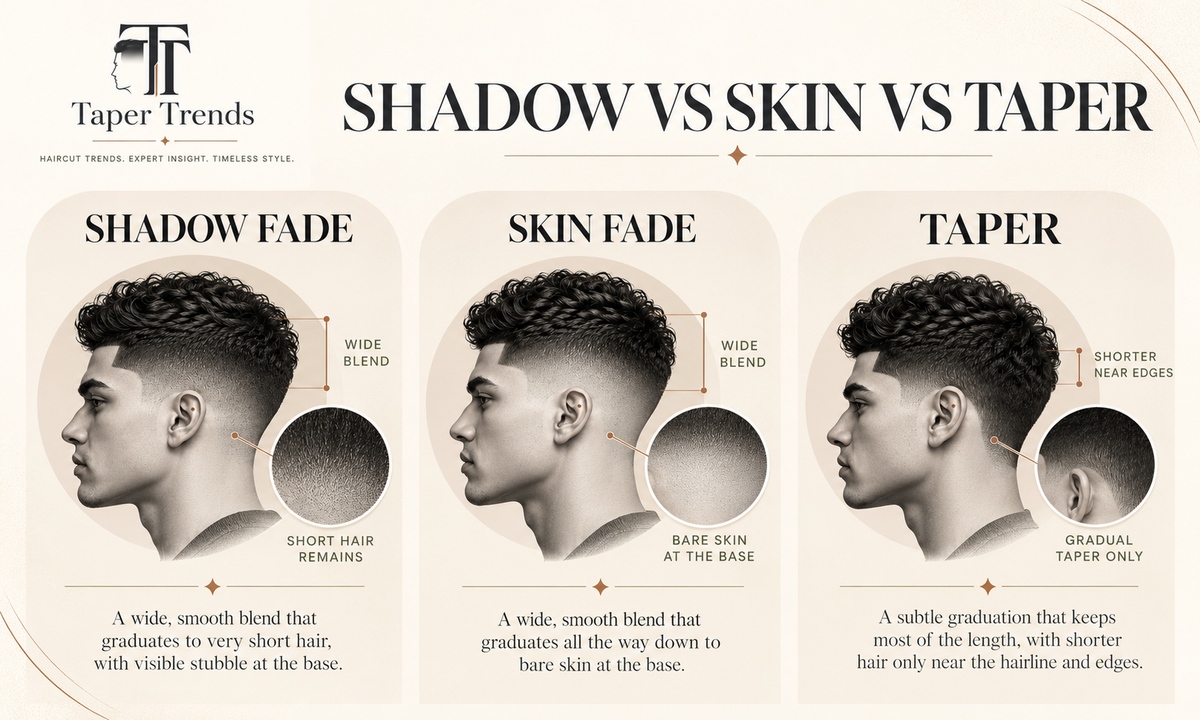
A shadow fade keeps short hair at the base, a skin fade reaches bare scalp, and a taper haircut shortens hair over a much smaller area near the hairline. Shadow and skin fades both blend across a wide band of the sides and back; they differ only in how close the bottom gets. Prime Barbershop and CADMEN both note that clients often use “fade” and “taper” interchangeably, so describe length and coverage rather than relying on the label.
| Shadow fade | Skin fade | Taper | |
|---|---|---|---|
| Shortest length | Short visible hair | Bare skin | Varies by shop and request |
| Area covered | Wide band of sides and back | Wide band of sides and back | Roughly the last 1 to 2 inches above the hairline |
| Contrast | Softer | Strongest | Subtle |
| Grow-out | Gentle | Shows fastest | Most gradual |
Taper coverage follows Prime Barbershop's definition; grow-out reflects Markcutit's and Prime's upkeep guidance. For the full side-by-side, read skin fade vs taper fade, low taper vs low fade, taper vs fade and burst fade vs taper fade.
Is a shadow fade the same as a taper fade?
Not exactly, though the two overlap. “Shadow” describes how short the base gets, while “taper” describes how much of the head the shortening covers. Markcutit explains that a shadow fade still blends the whole side and back, whereas a taper only shortens the sideburns and neckline, and both can avoid skin.
The “taper fade” on many menus combines the two: CADMEN describes it as a taper's length graduation done with a fade's smooth blending. Ask for a fade if you want the blend across the full sides, a taper if you only want the edges cleaned up, and bring a photo to settle any doubt. The low taper fade haircuts guide and the types of fade guide map the rest of the names.
Who should choose a shadow fade, and who should skip it?
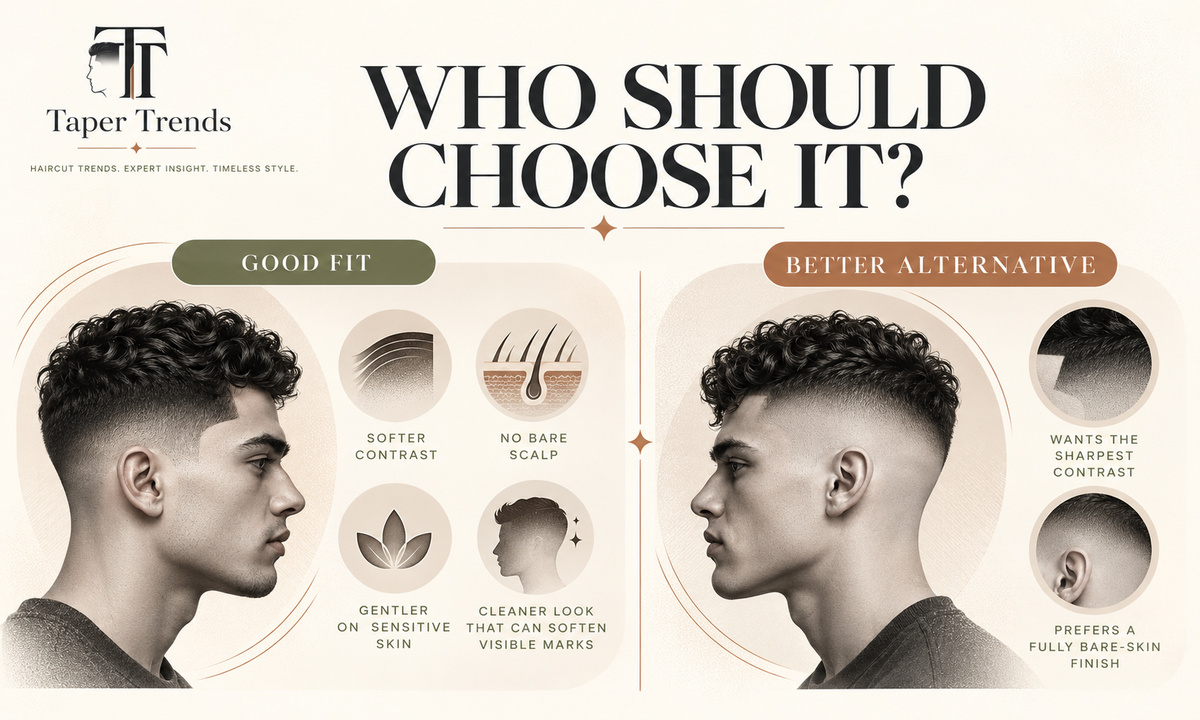
A shadow fade suits people who want a clean, blended fade with softer contrast and no bare scalp. Barbers at In The Cut in Vancouver recommend it for thinner or lighter-colored hair and sensitive scalps. Markcutit adds scars, birthmarks, and workplaces or schools that frown on visible skin. It is a weaker choice if you want razor-sharp contrast. Our thin and thick hair guide explains how density changes any fade, and the face shape detector can give you a starting point for choosing height.
There is a skin-comfort angle too, with limits. A shadow fade is finished with clipper guards rather than a razor or foil. The American Academy of Dermatology says shaving irritates the skin and causes razor bumps, and its page on acne keloidalis nuchae lists frequent close-shave haircuts among things that can irritate the back of the neck and scalp. Keeping some length may be gentler, but a shadow fade is not a treatment. Persistent bumps on the nape are worth showing a board-certified dermatologist. The skin fade for curly hair guide covers bump-safe habits for tight textures.
When is another fade a better choice?
Choose a skin fade for the strongest contrast and a crisp, high-impact finish; In The Cut notes that thicker, darker hair shows that contrast best. Choose a taper if you want to keep most of your side length and stretch the time between visits, as in the taper fade guide or the low taper fade for short hair. A shadow fade sits between the two, and it makes a forgiving first fade because regrowth starts from short hair rather than bare skin.
Low vs mid vs high shadow fades: which placement should you choose?
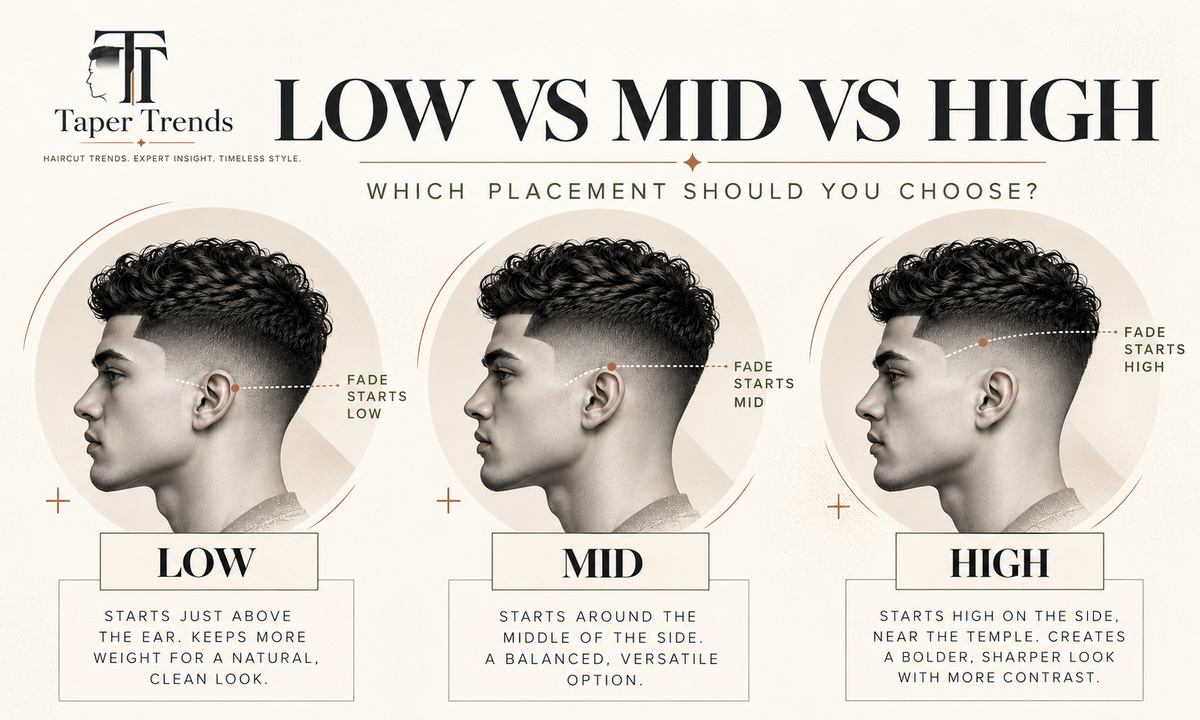
Low, mid, and high describe where the fade starts, while “shadow” describes how short its base stays. CADMEN places the starting line just above the ear and neckline for a low fade, at temple level for a mid fade, and above the temple for a high fade. The higher it starts, the more side length comes off and the stronger the contrast with the top. The low vs mid taper fade, mid vs high taper fade and low vs high taper fade comparisons show the same three heights side by side, and low vs mid vs high fade compares them for full fades.
Low shadow fade
A low shadow fade keeps the blend just above the ears and low on the nape, so most of your side length stays intact. Haircut Inspiration recommends it for an understated look and for anyone trying a shadow fade for the first time. Choose it if you want a visible tidy-up without changing your overall shape. Our low taper fade haircuts guide and low-mid taper fade guide cover the softest heights in depth.
Mid shadow fade
A mid shadow fade starts around the temples, separating the sides from the top more clearly while keeping some weight on the upper sides. Haircut Inspiration calls it a balanced option for a neat, natural cut with a medium-length top. Prime Barbershop says the mid fade is its most requested height and the one a barber will likely suggest if you ask for “a fade” without more detail. See the mid taper fade guide for how that height reads on the side of the head.
High shadow fade
A high shadow fade starts above the temples and removes the most side length, yet still ends in short visible hair rather than skin. Haircut Inspiration describes it as a bold choice for people comfortable with an edgier cut. Because so much of the head ends up short, it shows more of your head shape, so study a side-view reference photo before committing. The high taper fade guide shows what that height does to the silhouette.
Can the placement follow a curve instead of a straight line?
Yes. A drop fade curves down behind the ear and a burst fade circles the ear, and either can end in a shadow base. Browse the low drop fade, mid drop fade, high drop fade, mid burst fade and high burst fade pages, or the taper low burst fade for a softer take.
Which hairstyles and hair textures suit a shadow fade?
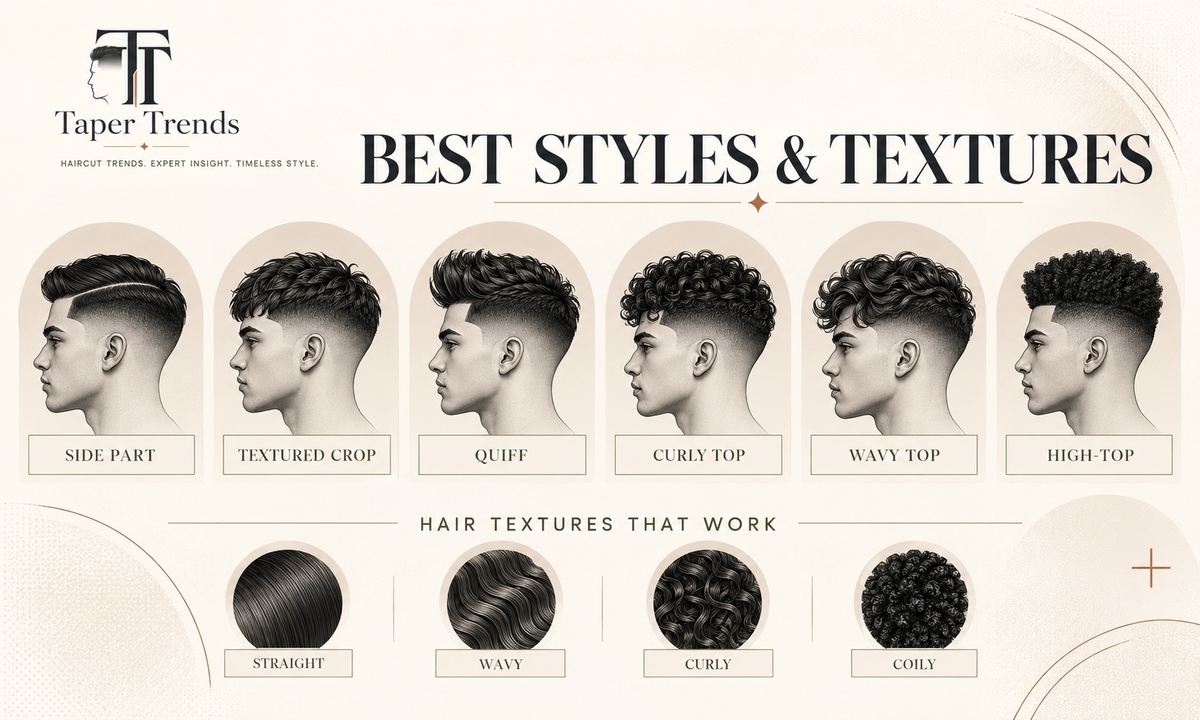
A shadow fade works with most top styles because it only shapes the sides and back. Choose your top first, then tell your barber how much side weight to keep. Texture, density, and growth direction all affect how the blend looks.
| Top style | Why it pairs well |
|---|---|
| Side part or comb-over | Long enough to part, with a neat, conservative blend |
| Crew cut or Ivy League | Compact shape that looks tidy rather than dramatic |
| Textured crop | Messy top that contrasts with clean sides |
| Quiff | Front volume over controlled sides |
| Curly top | Curl length stays on top while the sides tighten |
| Short afro or high top | Defined outline over a softer base |
Pairings drawn from Markcutit's advice and the Haircut Inspiration gallery. Our side part with a low taper fade, low taper fade comb over, French crop with a low taper fade, textured fringe with a low taper fade, low taper fade slick back, low taper fade middle part, low taper fade fringe and low taper fade blowout guides go deeper on each top, and the styling guide covers the products.
Shadow fade with straight or wavy hair
Straight hair shows every step in the blend. CADMEN notes that on straight, fine hair the gradient reads very sharply, so a skilled blend looks obvious and a weak one does too. Haircut Inspiration suggests comb-overs, textured crops, quiffs, and slick backs. Wavy hair already carries volume, so you can let the barber handle the fade and style the top yourself with a little product. Mention any cowlick at the crown or nape, because growth direction changes how the blend lies.
For full guides, see the low taper fade for straight hair, mid taper fade for straight hair, high taper fade for straight hair, drop fade for straight hair and burst fade for straight hair pages, plus the low taper fade for wavy hair, mid taper fade for wavy hair, low taper fade with waves, mid taper fade with waves and high taper fade with waves guides.
Shadow fade with curly or coily hair
Curls and coils can stay full on top while the sides are shortened, with no need to go down to skin. CADMEN says that on coily textures such as 4a and 4b hair, the same guard looks softer than it would on straight hair, so barbers often go lower to get the same visual tightness. A #1 on coily hair may look looser than you expect, so agree on how short the base should look on your texture and how much volume to keep on top.
The low taper fade for curly hair, mid taper fade for curly hair, high taper fade for curly hair, skin fade for curly hair, drop fade for curly hair and burst fade for curly hair guides show each height on a curl pattern. For tighter textures, add the low, mid and high taper fade Afro guides, the low taper fade for Black men, mid taper fade for Black men, high taper fade for Black men, drop fade for Black men and burst fade for Black men pages, and the low taper fade with dreads and locs and mid taper fade with dreads and locs guides.
Shadow fade with a mullet, mohawk or other bold top
Bolder tops keep their length and let the fade frame them. The low taper fade mullet, mid taper fade mullet, high taper fade mullet, drop fade mullet, burst fade mullet, low taper fade mohawk and burst fade mohawk guides show how a short base changes each silhouette.
How should you ask your barber for a shadow fade?
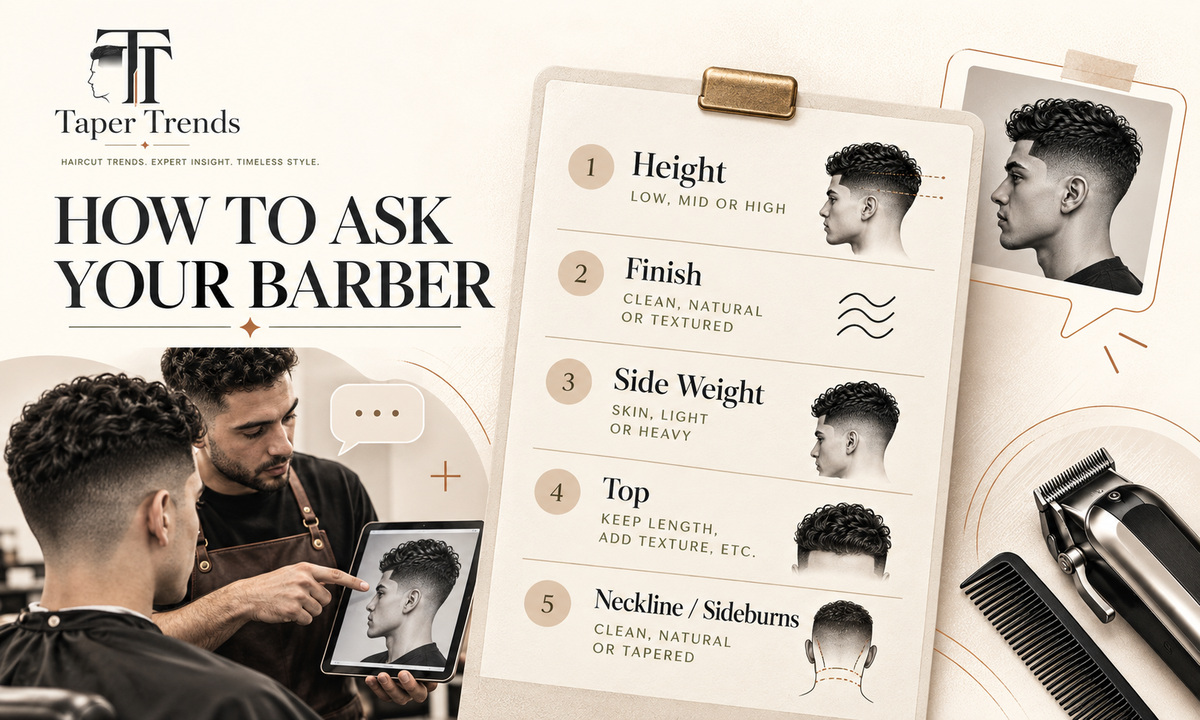
Give your barber the fade height, the finish, and the top length in one request, then show a photo, as our guide on how to ask for a fade sets out. “Shadow fade” on its own can be heard as a skin fade or a taper, and if you skip the height you may get the shop's default. Confirm everything before cutting, because CADMEN warns that a fade line can be moved up after the first pass but never moved down. The barber brief generator can help you organize the details.
What five details must you specify?
Save a side photo and a back photo, then cover these five points:
- Height: low, mid, or high.
- Finish: short visible hair at the base, not bare skin. A half guard or #1 is a fair starting point, not a requirement.
- Side weight: how much length stays above the fade.
- Top: the length and shape, for example long enough to part.
- Neckline and sideburns: natural, rounded, squared, or tapered, and whether the sideburns blend into a beard.
Leave one out and the barber has to guess, usually on height or finish, the two hardest things to undo.
What should you say and show your barber?
Say the request plainly, then ask your barber to repeat it back. Two examples you can adapt:
“I'd like a low shadow fade: short hair at the bottom, not skin, starting just above my ears. Keep the sides fuller and the top long enough to part. Natural neckline, please.”
“I'd like a mid shadow fade starting at my temples, with short hair at the base instead of skin, a textured top, and a rounded neckline.”
Use photos of hair like yours, skip vague phrases like “not too short,” and ask the barber to start conservatively and check with you in the mirror before taking the blend higher. For more wording, see the taper fade guide and the skin fade with beard guide, which covers the sideburn conversation.
How does a barber create a clean shadow fade?
Barbers vary their working order, but most follow a sequence like this one, adapted from CADMEN's step-by-step guide. Knowing it helps you speak up right after the base is set.
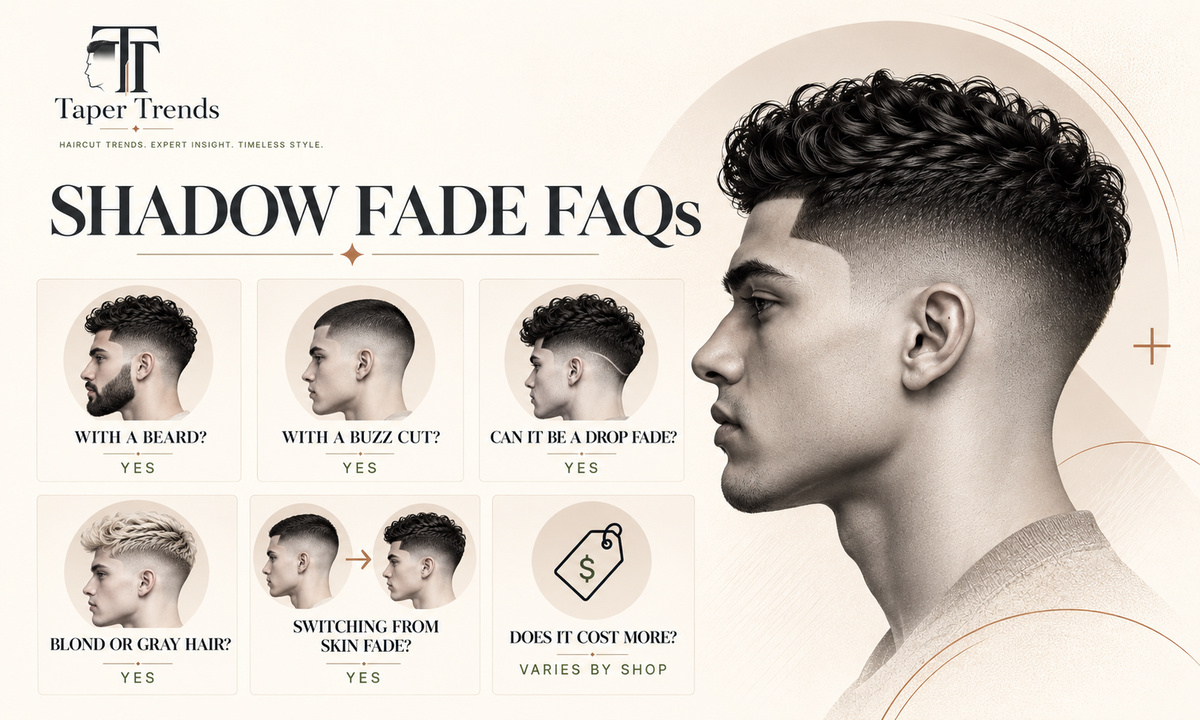
- Mark the guidelines. The barber locates the neckline, the temple, and where the top begins, then clips the top out of the way.
- Cut the base. For a shadow fade, CADMEN says this is a very low guard, a 0.5 or 1, set low and conservative at first.
- Work upward. Progressively longer guards follow, each flicked outward at its upper edge so it leaves no hard stop.
- Blend the transitions. Half guards or clipper-over-comb passes remove the bands between lengths, the step our how to cut a fade guide covers in detail.
- Check and detail. Both sides are compared, then the ear line and neckline are cleaned with a trimmer.
The same blending logic runs through our taper fade guide, and the clipper guard size chart shows what each guard leaves behind.
What does good shadow-fade blending look like?
Good blending reads as one smooth gradient from base to top, with no bands where one guard meets the next. Both sides should match, the base should stay short but not bare, and the ear line and neckline should look clean. CADMEN lists skipped intermediate guards, too few blending passes, and uneven clipper pressure as the usual causes of visible lines. Check the back in a hand mirror before you leave.
How long does a shadow fade last, and how do you maintain it?
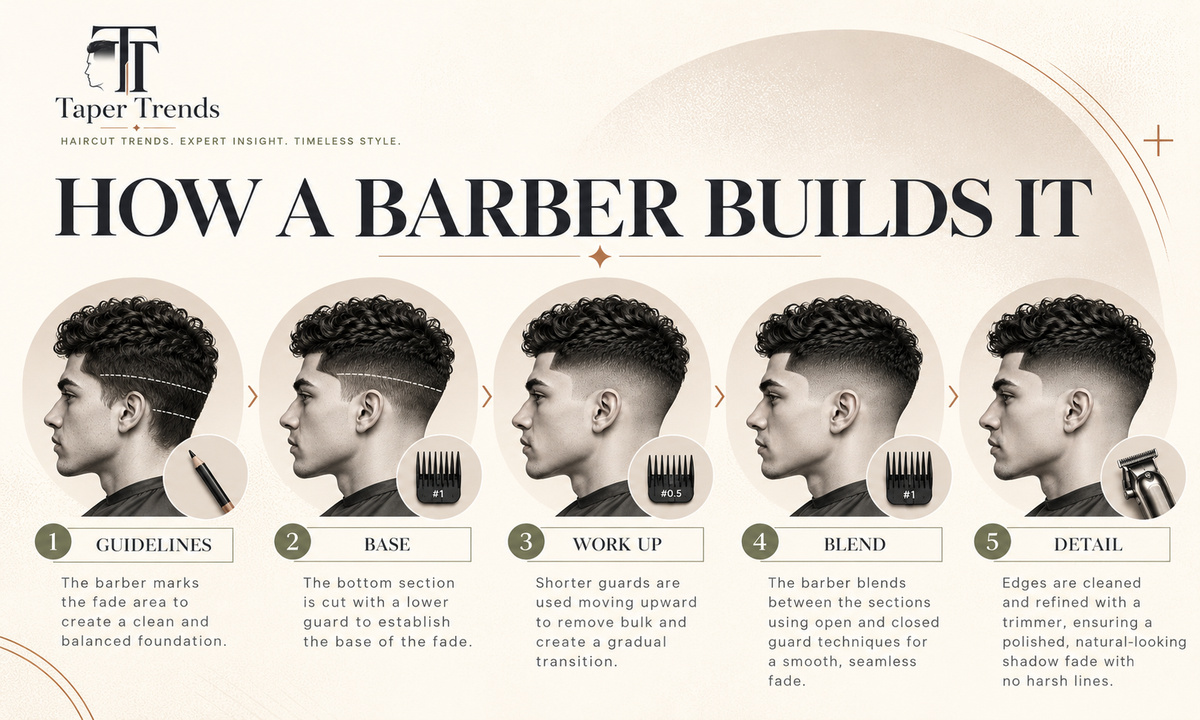
A shadow fade usually looks fresh for about two to three weeks, then softens as the base grows out. Markcutit's barbers say it typically passes as fresh until around day 18 to 21, compared with 10 to 14 days for a skin fade. Treat those figures as shop experience, not a measured standard.
MedlinePlus, from the U.S. National Library of Medicine, says healthy hair takes about a month to grow half an inch. That averages roughly 1/8 inch a week, the length of a #1 guard, so the base can double within a week or so. Growth varies by person, but a shadow fade starts with less contrast to lose than a skin fade.
When should you book a shadow-fade touch-up?
Book when the blend or outline stops looking the way you want, which for most people lands around every three to four weeks, the range Markcutit lists. Prime Barbershop says a high fade's sharp contrast can blur within two to three weeks, while a taper can still look acceptable at five or six. Neckline fuzz and bulk above the ears are the usual signs, and our guide to how often you should get a haircut compares this window with skin fades and tapers. The barber tip calculator helps you plan the cost of regular visits.
How should you maintain the cut between visits?
Leave the blend to your barber and keep the home routine simple:
- Wash your hair and scalp regularly, and style the top the way your texture needs. The styling guide has routines by hair type.
- Resist evening out the sides with clippers. Uneven pressure and skipped lengths are the mistakes CADMEN says create visible lines.
- Rebook when the blend or neckline shifts, not on a fixed date.
What mistakes should you avoid with a shadow fade?
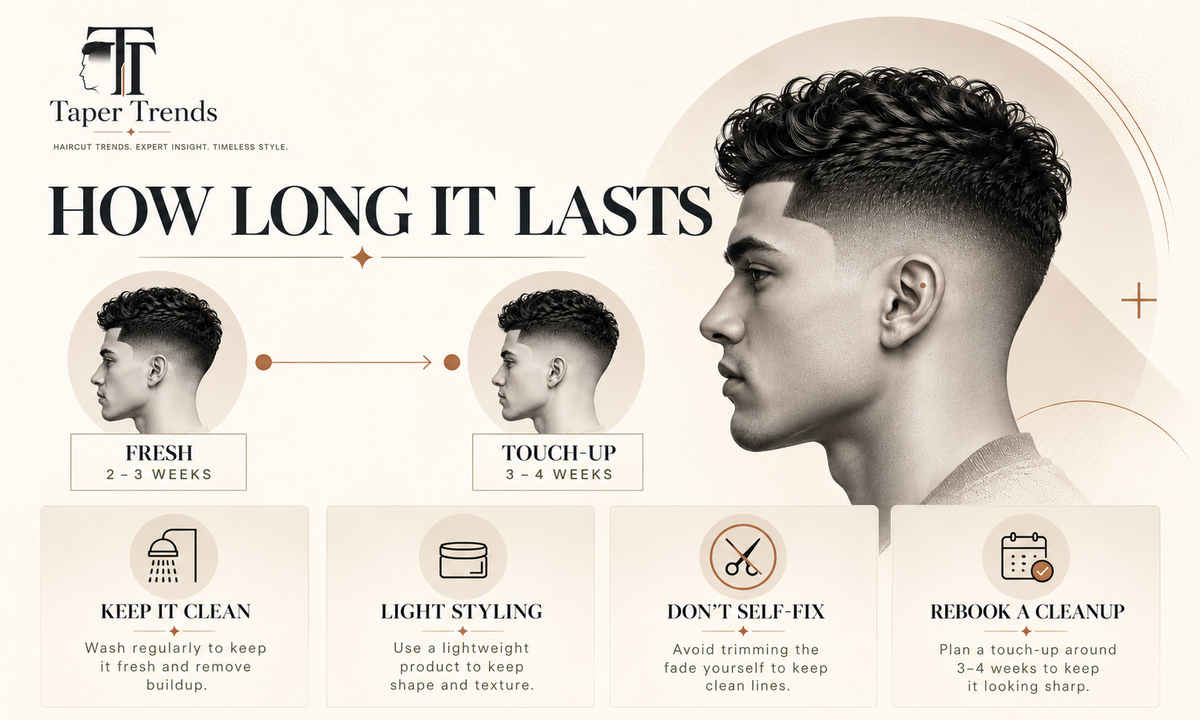
Most shadow-fade problems start with a vague request or a quick fix at home (our guide on how to fix a bad fade explains why the home fix usually backfires). Watch for these:
- Naming the finish but not the height. Say low, mid, or high every time.
- Assuming every barber reads “shadow” the same way. Confirm out loud that the base stays as short hair.
- Letting the base be set high on the first pass. CADMEN flags this as a common error, and a line set too high cannot be lowered.
- Choosing reference photos with different lighting or a very different hair type from yours.
- Correcting the fade yourself. A quick fix at the shop beats repairing a home attempt.
If your photos show a bare-scalp finish, compare them against the skin fade guide so you both agree on which one you mean, and check the skin fade vs taper fade comparison if the word “zero” comes up.
Shadow fade FAQs
Shorter answers to the narrower questions people ask before booking.
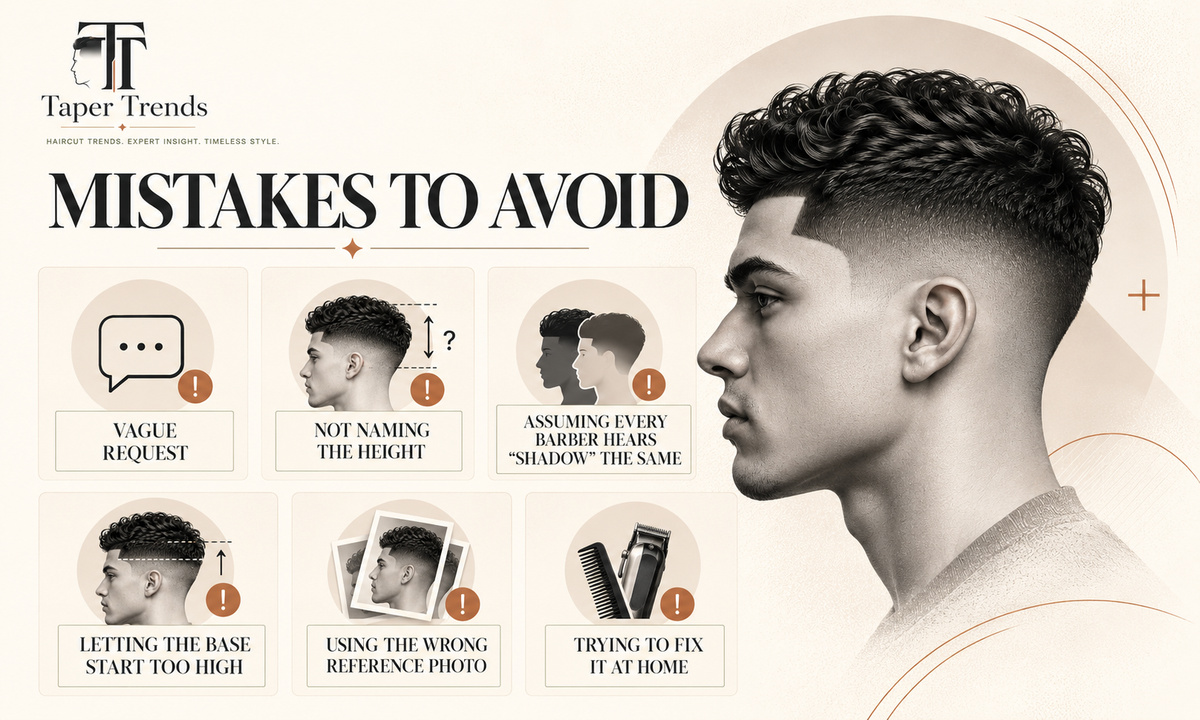
Can you combine a shadow fade with a beard?
Yes. The sideburn can blend from the short base straight into beard length without a gap of bare skin. Markcutit says a sideburn can step from a #1 directly into the beard, and the Haircut Inspiration gallery shows shadow fades flowing into groomed beards. Tell your barber where the beard should start and how long it should stay. The low taper fade with beard, mid taper fade with beard, high taper fade with beard, skin fade with beard, drop fade with beard and burst fade with beard guides show how the sideburn join changes at each height and shape.
Does a shadow fade work with a buzz cut?
Yes, as long as the top stays noticeably longer than the base. Prime Barbershop describes a mid fade with a buzz on top as a high-contrast look. When the top and sides are nearly the same length, there is no room for a visible gradient, and the cut reads as one even buzz. Our low taper fade buzz cut, mid taper fade buzz cut and high taper fade buzz cut guides show how much top length each height needs.
Can a shadow fade also be a drop fade?
Yes. “Drop” describes the path of the fade, which curves down behind the ear toward the nape, while “shadow” describes the finish at the base. Haircut Inspiration shows a shadow drop fade and notes that drop fades are usually cut at low or medium height. Start with the drop fade guide, then see the low drop fade, mid drop fade and high drop fade pages, or compare it with a burst fade in the drop fade vs burst fade breakdown.
Will a shadow fade look different on blond or gray hair?
Yes, because the shadow effect comes from hair color against the scalp. Markcutit says gray and white hair can look patchy against bare skin, while a short guard keeps the color even, and In The Cut recommends shadow fades for lighter hair that needs coverage. Expect a subtler haze than on dark hair. The low taper fade for blonde hair and thin and thick hair guide explain how color and density change any fade.
Can you switch from a skin fade to a shadow fade?
Yes, at any visit. Markcutit says the barber simply starts the base at a half or #1 guard, with nothing to grow out first. The base cannot end up longer than the hair already there, though, so if your last skin fade was very recent, wait a week or two. The skin fade guide and the low vs mid vs high skin fade comparison show what you are moving away from.
Does a shadow fade cost more than a regular fade?
Not by default. Price depends on the shop, the city, and any add-ons, not the name of the cut. Markcutit books a shadow fade as a standard haircut. Prime Barbershop in Manhattan listed its fade service at $45 in July 2026, with shape-ups and line-ups at $18. Check your own shop's current menu, and use the barber tip calculator to budget the whole visit.
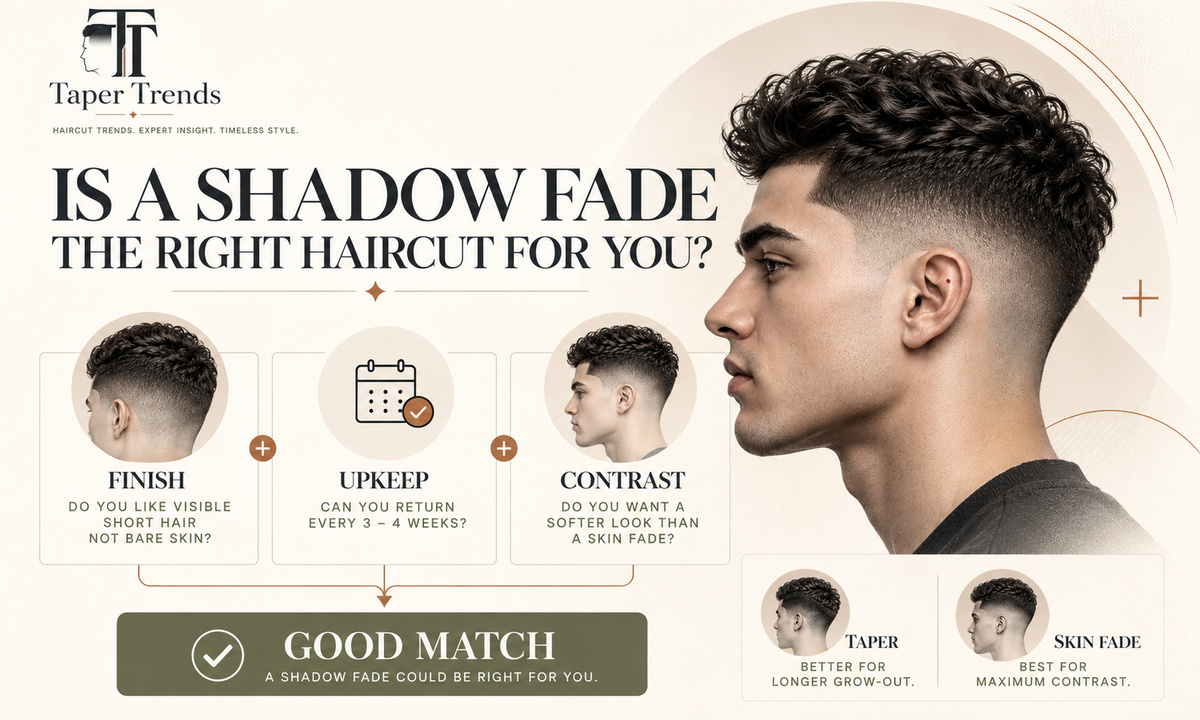
Is a shadow fade the right haircut for you?
Run through three quick questions:
- Finish: Are you happy with scalp showing through short hair rather than bare skin? If yes, a shadow fade fits.
- Upkeep: Can you get back to the barber every three to four weeks? If not, a taper will hold its shape longer.
- Contrast: Do you want the sharpest possible edge? If so, a skin fade will serve you better.
If you are torn between two base lengths, pick the longer one. You can go shorter next visit, but you cannot add length back. Then choose your height, save a side and back photo, and book the appointment. To keep exploring, browse the full set of low taper fade guides, compare a burst fade or drop fade, or see how the same finish works at the temples in the temp fade guide.
The bottom line
A shadow fade blends the sides and back down to short visible hair, never bare skin, and the height you pick decides how much side length stays.
Name the height, the finish, the side weight, the top and the neckline, bring side and back photos, and start with the longer base if you are unsure.
Want more fade guides?
Browse clean, barber-ready breakdowns for every fade and hair type.