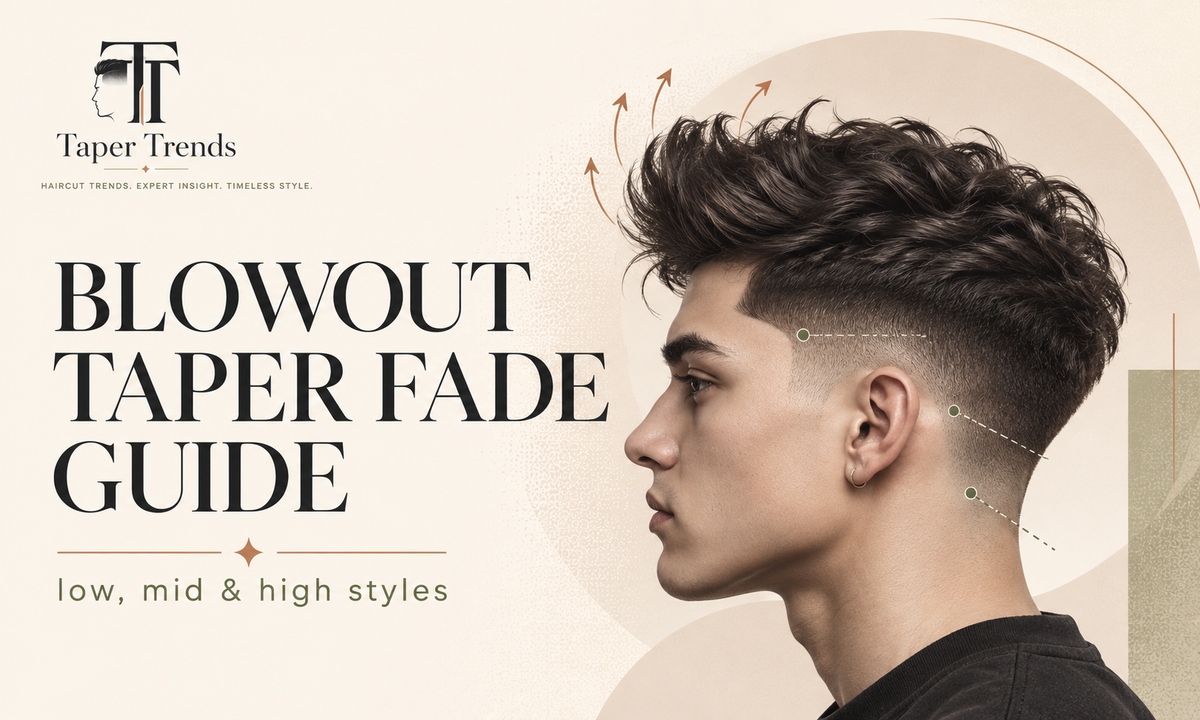
A blowout taper fadepairs a full, lifted top with hair that gets gradually shorter at the temples, sideburns, and neckline. The sides stay mostly intact, so the top keeps its volume. Barbers use “taper” and “fade” loosely, though, so the finished cut depends on two things you should spell out: where the shortening starts and how much side hair stays.
If you already know the basics, skip to choosing a taper height, what to tell your barber, or styling at home. For the wider picture, our complete low taper fade haircuts guide and the full taper fade guide cover every height and texture, while the low taper fade blowout and mid taper fade blowout guides go deep on each placement.
What Is a Blowout Taper Fade?
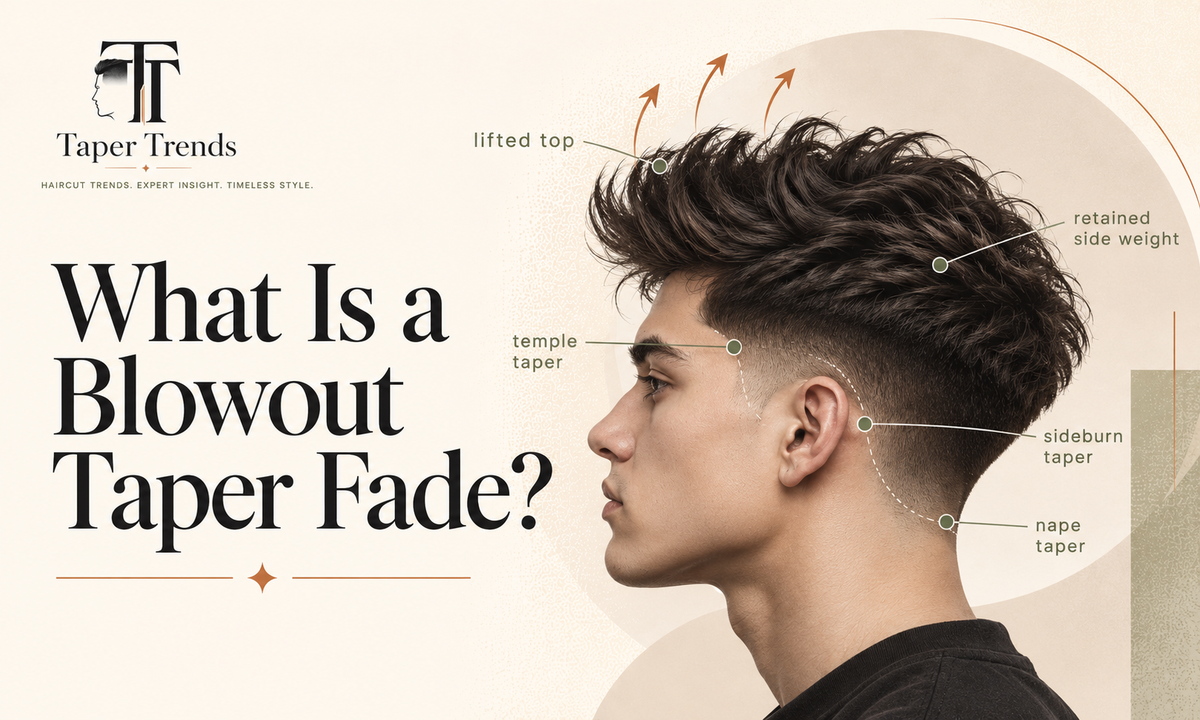
A blowout taper fade is a men's haircut built from two separate ideas. The blowout is the full, lifted or rounded shape on top. The taper is the gradual shortening toward the edges, concentrated at the temples, sideburns, and nape, while the hair above that zone stays long enough to hold its shape. If the base cut is new to you, our taper haircut basics explain the classic taper before any fade is added.
The neckline deserves more attention than it usually gets. Nick Hall, a former barber who now edits Man of Many, argues that tapering the nape instead of squaring it off lets the hair at the back and sideburns grow out more naturally, so the cut stays neat for longer.
What Creates the Blowout Shape?
Four things build the volume: top length, hair density, styling direction, and the weight left on the upper sides. The crown and fringe need enough length to lift, and natural texture adds body on its own. Straight hair usually needs a dryer to finish the shape. GATSBY's blowout taper guide, published by the styling-product brand, recommends blow-drying damp hair while brushing upward with a round brush. The soft, airy finish is the same idea behind our low taper fade with fluffy hair and mid taper fade with fluffy hair guides.
Where Does the Taper Fade Actually Sit?
The short hair sits at the perimeter: temples, sideburns, around the ears, and the nape. Everything above stays fuller. Andis shows the principle in its low taper fade lesson for barbers, which keeps longer length through the sides and top and connects the transition through the parietal ridge, the widest part of the head above the temples. A broader fade climbs higher and removes far more hair. To picture the soft version, see what a low taper fade looks like from every angle.
How Is a Blowout Taper Different From a Regular Fade?
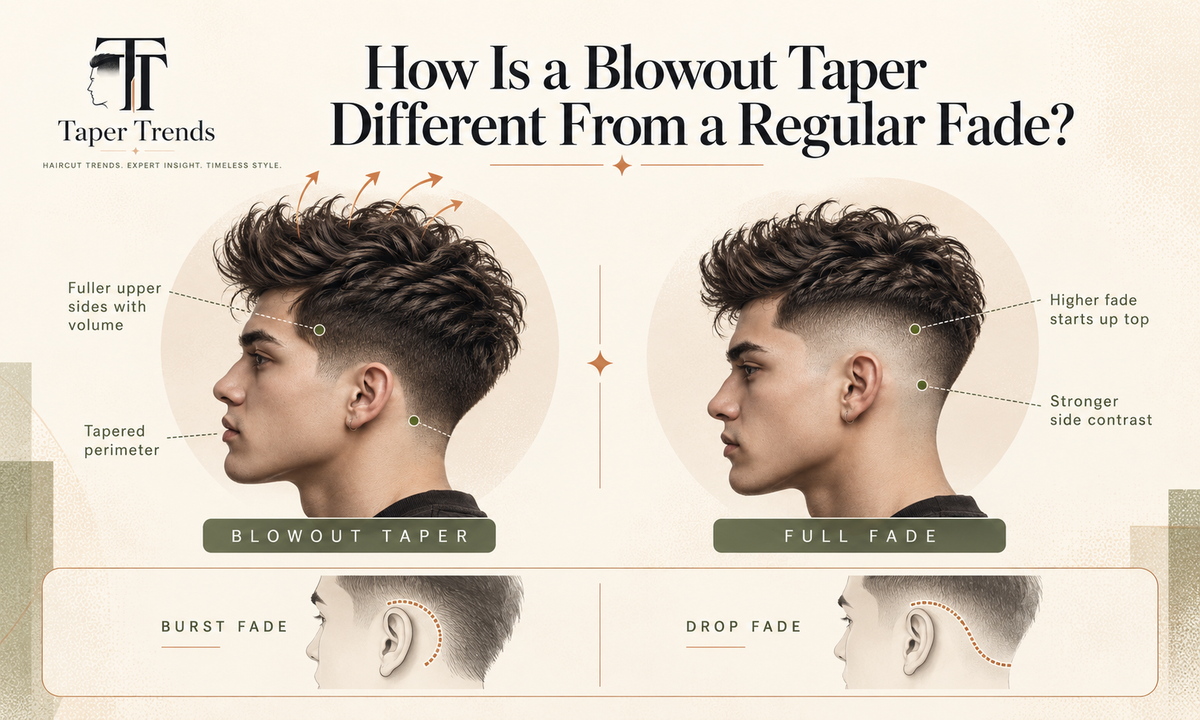
The blowout describes upper volume. Taper and fade describe where the shorter hair sits and how far it climbs. Because these are separate choices, a blowout can sit on a light perimeter taper or on a high skin fade. What changes is how much side hair survives, and that decides the overall silhouette.
The vocabulary is messy. The Art of Manliness defines a fade as a taper taken down to skin, so every fade is a taper but not every taper is a fade. The Modest Manadds that most barbers who hear “taper fade” will give you a taper, or perhaps a very low fade. Describe the result you want instead of trusting the label. Our taper vs fade explainer and the low taper vs low fade breakdown sort out the wording in full.
| Feature | Blowout taper | Blowout with full fade |
|---|---|---|
| Main effect | Full top, restrained edges | Full top, strong side contrast |
| Shortest area | Temples, sideburns, nape | Much more of the sides and back |
| Upper-side weight | Usually kept | Often reduced substantially |
| Skin exposure | Optional | Yes, in a skin-fade version |
| Key decision | Where to keep fullness | How far up to fade |
Blowout Taper vs. Full Skin Fade
A localized taper keeps more of the upper sides, while a full skin fade can expose much of the side panel. Regrowth also shows sooner on a skin fade. Hall says low tapers usually last the longest because the blend sits close to the natural hairline. If you still want a skin fade, The Right Hairstyles shows versions that grow extra weight at the top of the sides so the blowout still reads as full. Our skin fade guide, skin fade vs taper fade comparison, and low, mid and high skin fade breakdown show what each one removes. If you want the lightest touch, the shadow fade and temp fade guides cover blends that stop short of bare skin or stay at the temples.
Blowout Taper vs. Burst Fade or Drop Fade
Fade names describe the path of the blend. A burst fade follows a semicircle around the ear and leaves the back longer. A drop fade usually dips lower behind the ear toward the nape, although some guides use “drop” to mean an abrupt change in length. Either can carry a voluminous top, but the outline differs from a simple perimeter taper, so bring a reference photo that shows the side and back. Read the burst fade guide, drop fade guide, burst fade vs taper fade, and drop fade vs burst fade to tell the outlines apart.
Which Blowout Taper Height Should You Choose?
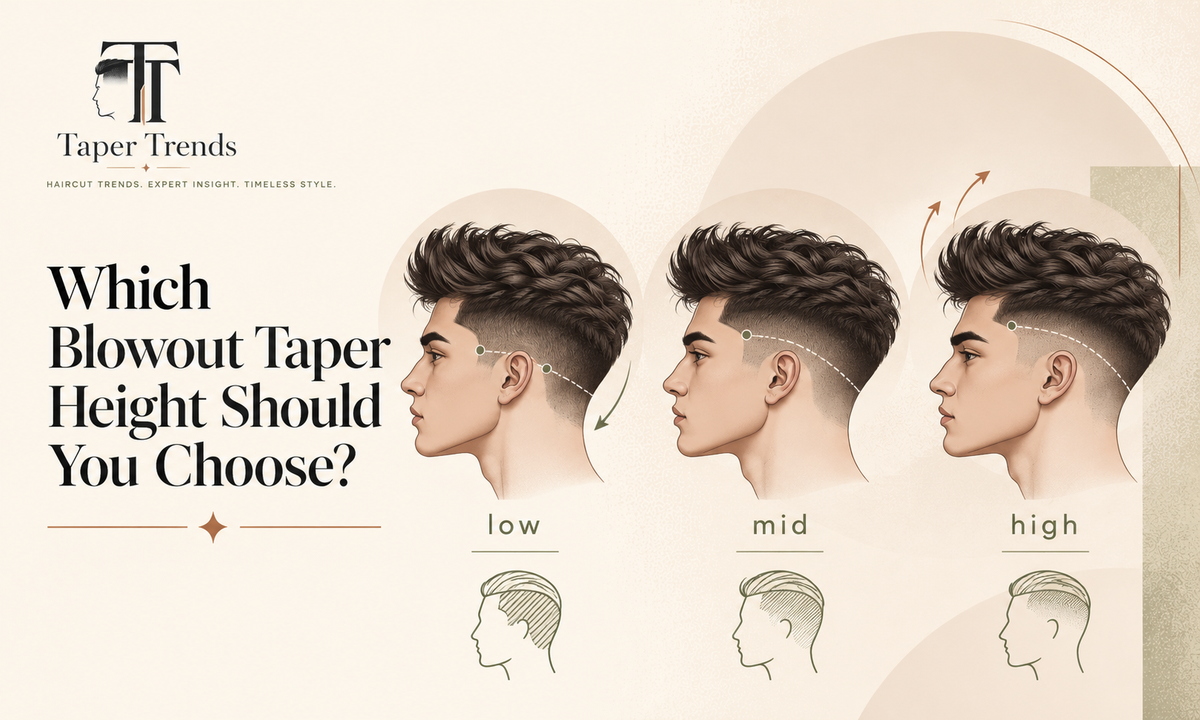
Taper height controls contrast. A low blowout taper keeps the most side fullness and looks softest. A higher taper shortens more of the sides, so the top looks more separated from them. Height labels vary from shop to shop, so ask the barber to show you the starting line in the mirror before the clippers come out.
As a rough guide, GATSBY places a low taper near the neckline and ears, a mid taper around the temples, and a high taper near the upper sides. Treat those positions as a starting point for the conversation, not a measurement. For a side-by-side look, our low taper vs mid taper fade, mid taper vs high taper fade, and low taper vs high taper fade comparisons weigh contrast, scalp exposure, and upkeep.
Low Blowout Taper Fade
Short hair stays near the ears and neckline, and the sides keep most of their weight. Writing about taper fades in general, Hall calls the low version the safest and most versatile option. It also grows out the most gracefully. Look for references with a soft temple and a gradual nape, and see our low taper fade blowout guide for the full version.
Mid Blowout Taper Fade
A mid taper starts higher, around the temples, which adds definition while leaving the upper sides alone. How far it reaches is a judgment call. Ask the barber to point to where the shortest hair stops and the full side begins. The mid taper fade blowout and mid taper fade guides walk through it, and the low mid taper fade sits between the two.
High Blowout Taper Fade
A high taper takes hair farther up the perimeter. Contrast gets sharper, but you can lose the side weight that makes a blowout look like a blowout. Choose it only if you want a clearly separated top, and make sure the barber knows you mean a high taper at the edges, not a high fade around the whole head. Our high taper fade guide covers what to ask for.
Whatever height you pick, Hall's advice is to start lower. A barber can always raise the taper on a second pass. Hair that's already gone stays gone until it grows back.
How Long Should Your Hair Be for a Blowout Taper?
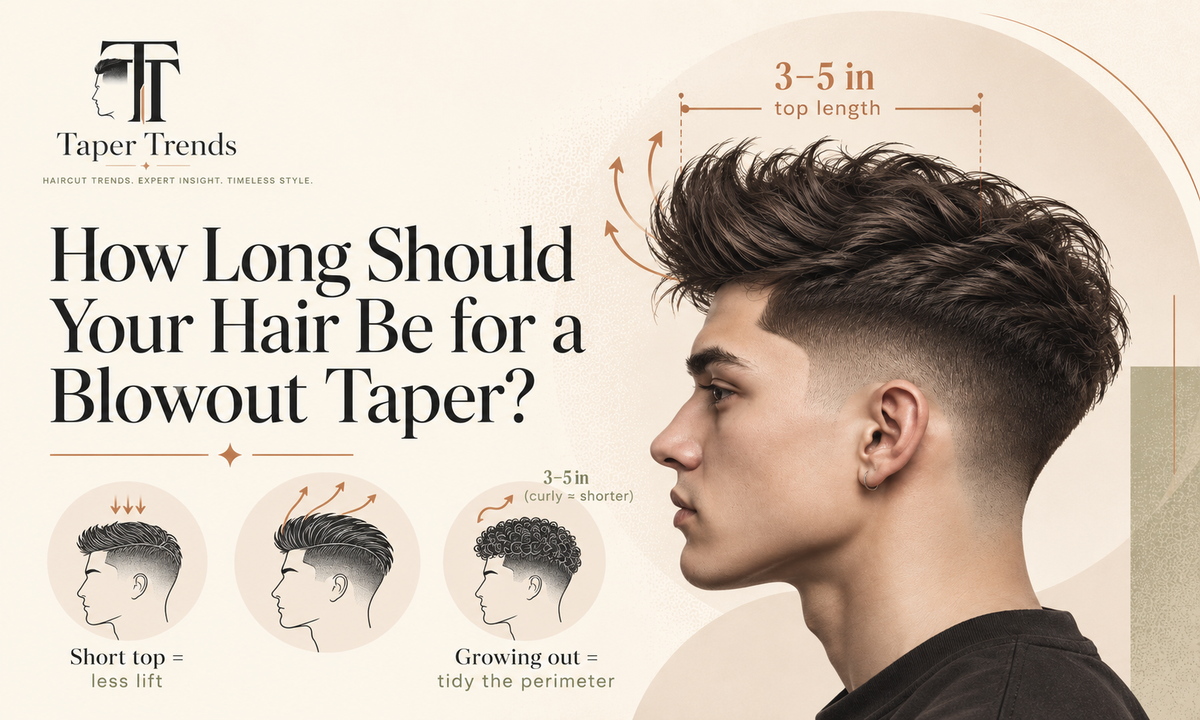
There's no universal minimum. The top needs enough length to lift or round out, and how much length you actually see depends on curl pattern, density, and styling direction. GATSBY suggests keeping about 3 to 5 inches on top. Read that as one brand's example, not a requirement. Our low taper fade for medium length hair and long hair low taper fade guides show how much top different lengths give you to work with.
Curly hair shrinks as it dries, so a stretched measurement overstates the length you'll see in the mirror. Judge your top dry and unstyled, and show the barber a reference with similar texture.
What If Your Hair Is Short or Growing Out?
A short top can still take a textured version, but it won't lift as much. For a full blowout, let the top grow while the barber tidies only the perimeter at each visit. Bring photos that match your current length as well as your goal, so the barber can tell you how far off you are. The low taper fade for short hair and mid taper fade for short hair guides are useful holding patterns while the top fills in.
Does a Blowout Taper Fade Work With Your Hair Type?
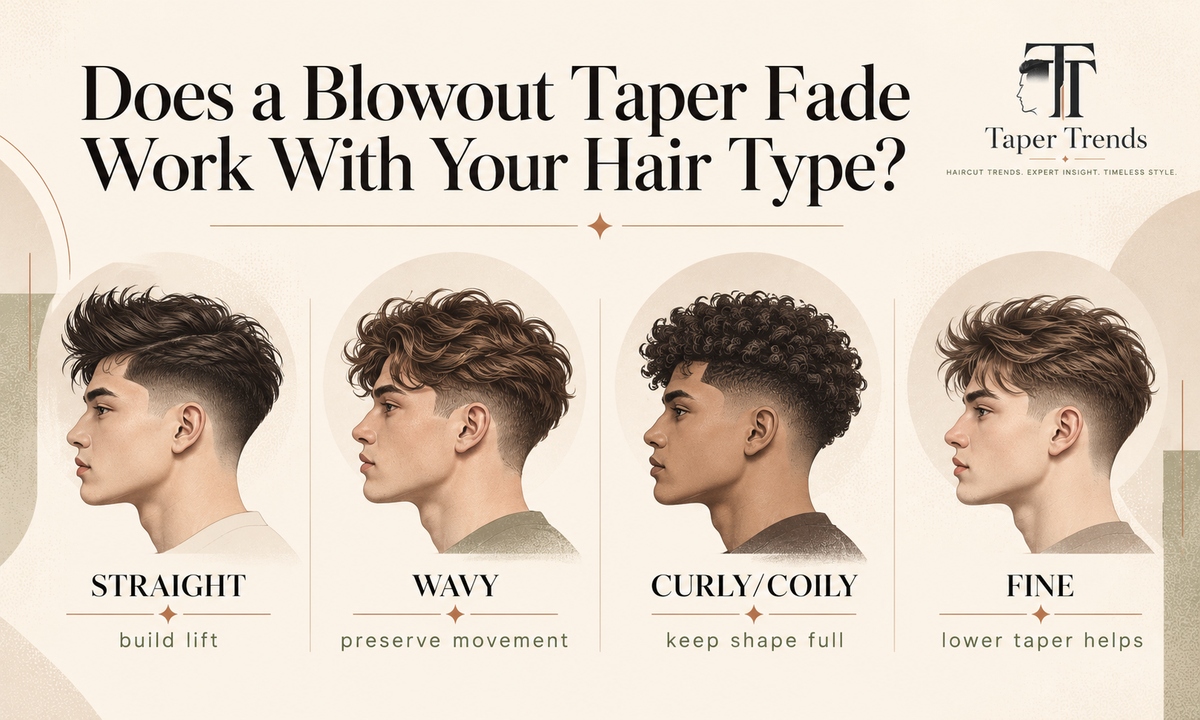
Yes, with adjustments. The cut adapts to straight, wavy, curly, and coily hair, but natural volume, styling effort, and the final shape all differ. Texture and density matter more than any label, so judge by how your hair behaves once it dries without product.
Straight Hair: Building Lift
Straight hair often needs help to stand up, especially when it's fine or very heavy. Ask for enough top length, then dry the roots upward. The Right Hairstyles notes that straight hair usually needs a product to keep it from falling flat, and that some men get a perm for extra lift. Our guides to the low taper fade for straight hair, mid taper fade for straight hair, and high taper fade for straight hair show how each height behaves on flat strands, and the low taper fade perm guide covers the chemical route.
Wavy Hair: Preserving Natural Movement
Waves give you volume without forcing every strand into place. The same gallery suggests curl cream on wet hair, then a diffuser, for a messy top that plays against the clean taper. Air-drying works too if you want a looser finish. See the low taper fade wavy hair and mid taper fade wavy hair guides for more.
Curly and Coily Hair: Keeping the Shape Full
Curly and coily hair can build a full silhouette on its own, while the perimeter taper sharpens the outline. Decide early whether you want defined curls or an expanded, rounded shape, and allow for shrinkage. The American Academy of Dermatology (AAD) recommends coating the ends with conditioner and applying a heat protectant to wet hair before heat styling. The blowout low taper fade for curly hair guide breaks this down by curl type, and the curly low taper fade, mid taper fade curly hair, and high taper fade curly hair guides cover the other heights. For fuller, coily volume, see the low taper fade afro, mid taper fade afro, and high taper fade afro guides, plus our low taper fade for Black men guide.
Fine or Thinning Hair: Managing Expectations
A good cut can make hair look fuller, but it can't add density. If your scalp shows easily, a lower taper that keeps side hair usually helps, and so do lightweight products in place of heavy clays. The AAD advises seeing a board-certified dermatologist if your hair's texture or appearance changes, because even slight noticeable thinning can be the start of hair loss. Our low taper fade for thin and thick hair guide shows how the cut changes with density, and the low taper fade for Asian hair and low taper fade for white guys guides cover the texture differences in more detail.
Which Blowout Taper Fade Styles Are Worth Showing Your Barber?
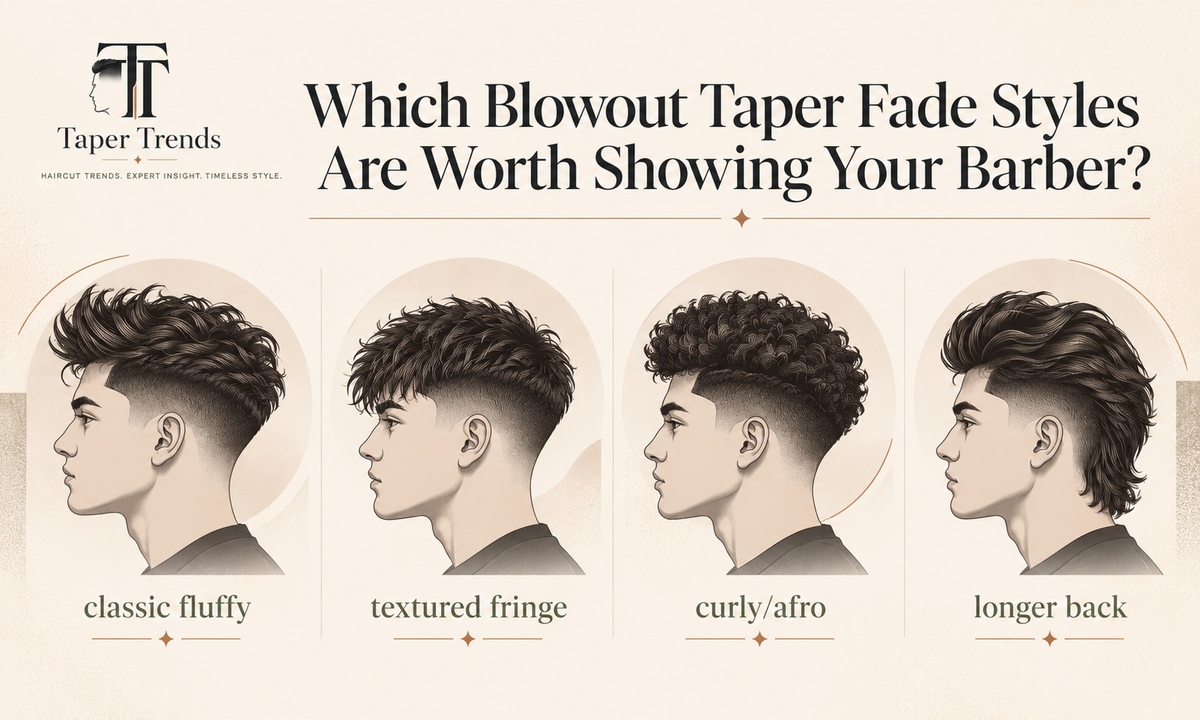
Four versions are different enough to matter. Each changes texture, direction, or back length instead of renaming the same cut. Whichever you choose, bring photos of the side and back, because those angles show where the taper stops.
Classic Fluffy Blowout Taper
This is the baseline: a soft, lifted top, full upper sides, and a short perimeter. Ask for a taper at the temples and nape, full sides, and enough top length to dry upward. The fluffy hair low taper fade guide has more variations on this shape.
Blowout Taper With Textured Fringe
Here the fringe stays prominent and tousled. GATSBY's barber cue is tapered sides with extra weight left in the fringe area, so the top can be cut choppy and blow-dried forward. Compare it with the textured fringe with a low taper fade, low taper fade fringe, mid taper fade textured fringe, and French crop low taper fade guides.
Curly or Afro Blowout Taper
Tightly curled hair holds its shape well, so a barber can leave plenty of weight on top while still showing a blurry taper and a sharp line-up. A low or mid taper with a shaped top is a sensible place to start, and the curly blowout taper and low taper fade afro guides show the shapes.
Blowout Taper With a Longer Back
This version tapers the sides but keeps layered length on top and through the back, close to the wolf-cut pairing in GATSBY's guide. Agree on exactly where the taper ends so the rear stays full instead of turning into a short fade. The low taper fade mullet and mid taper fade mullet guides cover the same idea of a tidy perimeter under length.
What Should You Tell Your Barber for a Blowout Taper Fade?
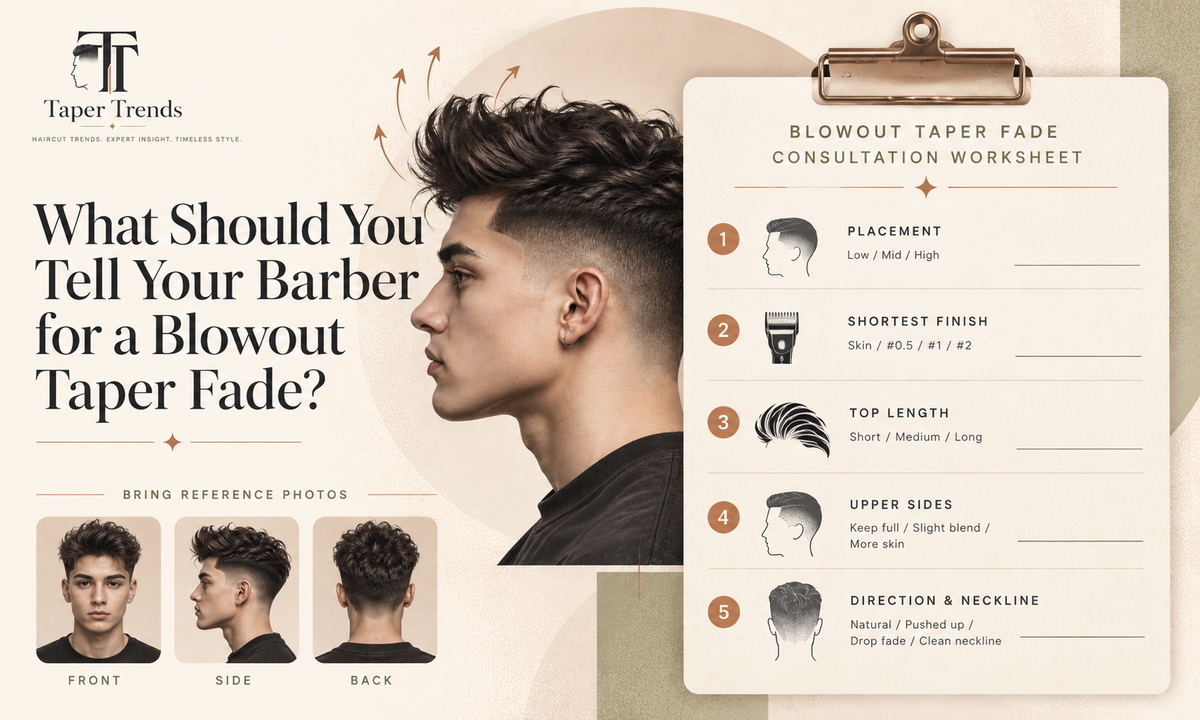
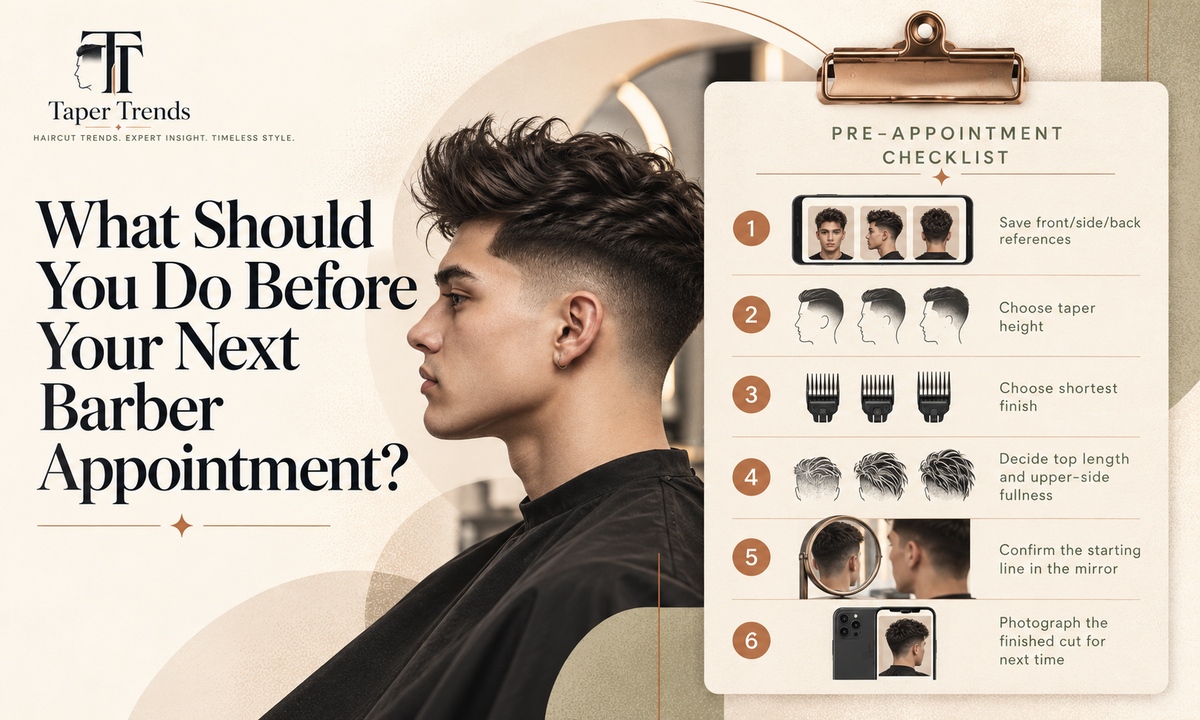
Describe the result, not just the name. Tell the barber where the taper sits, how short the edge goes, how much top length to keep, how full the upper sides stay, and which way the hair will be styled. Then confirm the starting line in the mirror before the first pass.
The Five Details Your Barber Needs
| Decision | Your options |
|---|---|
| 1. Taper placement | Low, mid, or high, shown with a finger in the mirror |
| 2. Shortest finish | Soft, very close, or skin |
| 3. Top length | How much to keep, measured against your current hair |
| 4. Upper sides | Keep them full, or remove some weight |
| 5. Direction and neckline | Up, back, forward, or natural curls; natural or defined neckline |
A request might sound like this:
“Low taper at the temples and nape, soft finish, keep the top and upper sides full, styled upward, natural neckline.”
If the barber reads it differently, settle that before any hair comes off. Hall also recommends bringing side and back photos, not just one front shot, since the difference between a good taper and a regrettable one tends to hide around the ears and neckline. If you want a carved line or pattern at the edge, our low taper fade design guide covers lineups and placement.
How to Use Reference Photos Without Confusing the Cut
- Pick front, side, and back shots of the same haircut.
- Match texture and density. A photo of much thicker hair sets expectations your hair can't meet.
- Separate the cut from the styling, since many photos show product and a dryer at work.
- Point to where the taper ends and how much side hair remains.
- Ask what the barber would change for your hair.
How Do You Style a Blowout Taper Fade at Home?
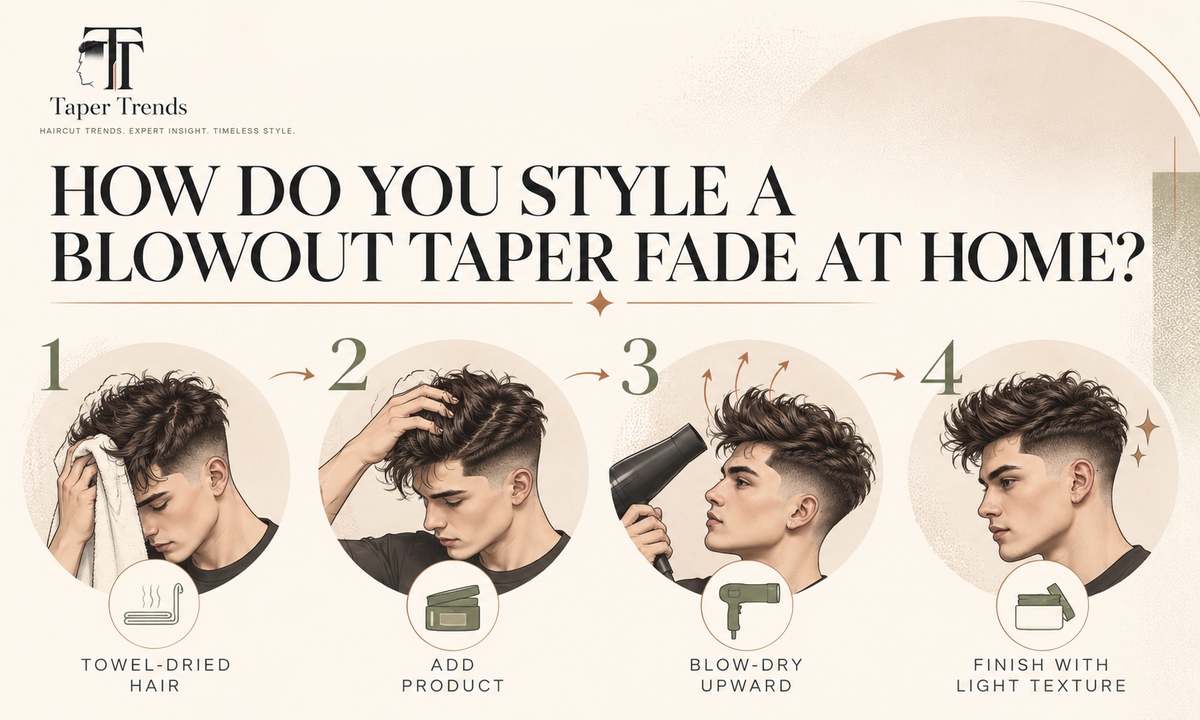
Start with towel-dried hair that has partly air-dried, add a product suited to your texture, build the shape with airflow or your fingers, and finish with a light hold. Not every texture needs high heat. The AAD recommends letting hair partially air-dry before you style it and blow-drying fewer times a week. Our step-by-step guide to styling a low taper fade covers the same routine across textures.
If the shape still collapses after a few honest attempts, the cut may be the problem. Tell your barber at the next visit whether you need more top length or less side contrast.
Styling Straight or Wavy Hair
Prepare and Lift
- Work a light mousse (straight hair) or curl cream (wavy hair) through damp hair, plus a heat protectant if you'll use the dryer.
- Dry the roots upward on low to medium heat, brushing up with a round brush.
Shape and Finish
- Set the shape with a burst of cool air.
- Rub a small amount of matte paste or texture powder through the top, then stop. Extra product weighs the volume down.
Styling Curly or Coily Hair
Prepare the Natural Texture
- Start with damp hair. Condition dry ends, then add a moisturizing curl product. The AAD says people with tightly curled or textured hair should brush while the hair is wet to reduce breakage, which is the reverse of its advice for other hair types.
Dry and Shape the Volume
- Diffuse on low heat or air-dry, and leave the curls alone while they set.
- For a rounded, expanded shape, lift gently at the roots once dry. For defined curls, shape with your fingers.
Setting and Refreshing the Finished Style
- Lightly dampen flattened areas and reshape them with your fingers.
- Add product sparingly, because buildup flattens volume.
- Skip repeated high-heat drying between washes.
Which Tools and Products Do You Need for a Blowout Taper?
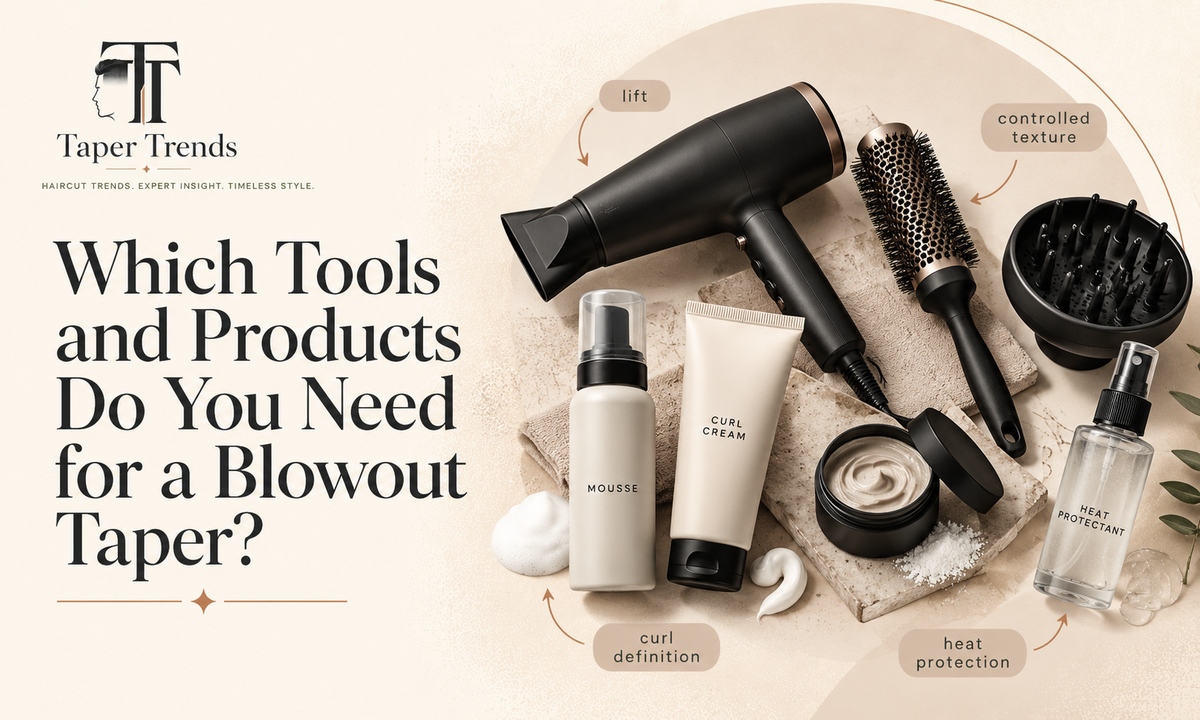
A blow dryer and round brush create lift on straight or wavy hair. A diffuser, a curl product, or just your fingers suit natural curls. Start with the fewest tools that give you the shape, and use a heat protectant whenever heat is involved.
Choose Products by Hair Texture and Desired Finish
Pick the product for the finish you want, and use less than you think you need. The AAD suggests reducing “long-lasting hold” styling products, because combing through them can break hair and, over time, contribute to hair loss.
| Goal | Product type | How to use it |
|---|---|---|
| Lift | Lightweight mousse | Damp roots, before drying |
| Controlled texture | Matte paste or texture powder | Small amount on dry hair |
| Curl definition | Curl cream | Wet hair |
| Heat protection | Heat protectant | Before any hot tool |
Follow each product's label, since formulas and directions change. For more routines built around specific products, see our low taper fade styling guide.
How Often Does a Blowout Taper Fade Need Maintenance?
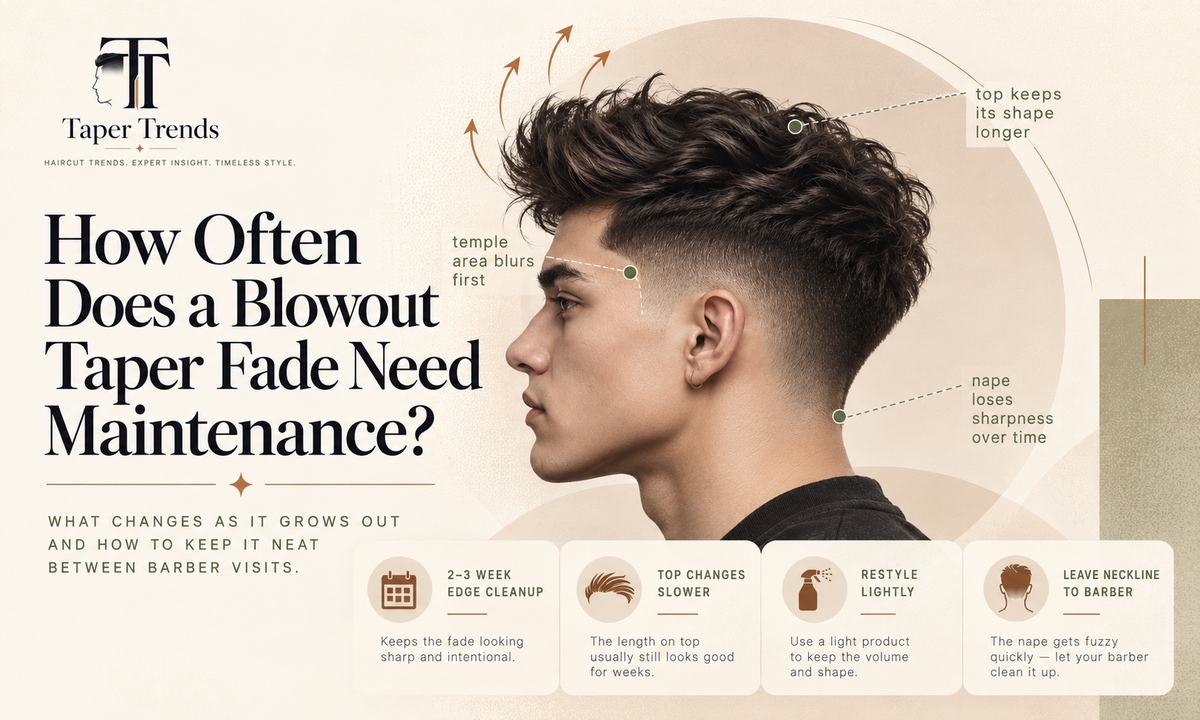
The tapered edges lose definition first, and the top changes more slowly. How often you need a trim depends on the taper height, how fast your hair grows, and how crisp you want the edges. Both GATSBY and Hall suggest a clean-up every two to three weeks if you want sharp edges, and Hall notes that mid and high tapers show regrowth faster than low ones. That's a target for crisp lines, not a rule. Plenty of people let it go longer.
A perimeter touch-up resets the edges. A full reshape also rebalances the top and sides. If you want the longest gap between visits, the low versions in our low taper fade guide grow out the most gracefully.
What Changes as a Blowout Taper Grows Out?
The temples and nape blur first. Then the sides fill in, the contrast between top and sides softens, and the fringe may start to fall differently. Photograph your side and back at each visit and you'll learn your own timeline within a couple of cuts.
How Can You Keep It Neat Between Barber Visits?
- Reshape the top with a quick restyle instead of piling on product.
- Keep hair clean and conditioned so the volume stays soft.
- Leave the neckline to your barber. Self-fading usually removes more than you meant to.
What Mistakes Should You Avoid With a Blowout Taper Fade?
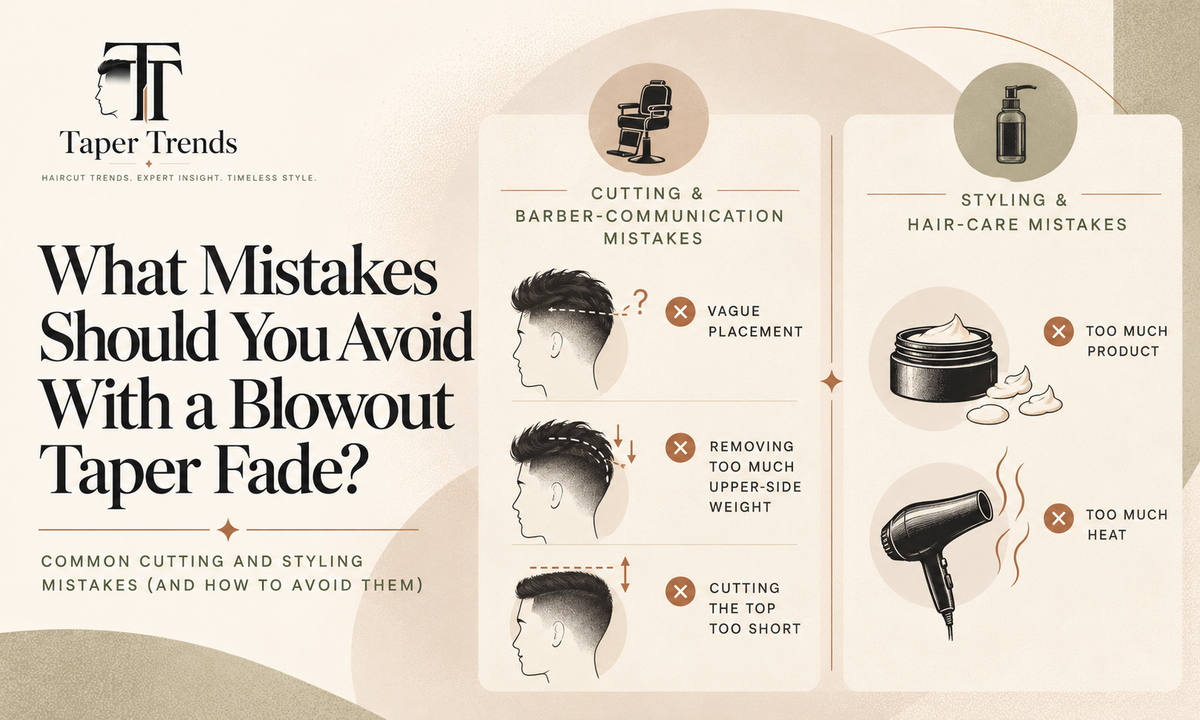
The costliest mistakes are losing too much upper-side weight, cutting the top shorter than the shape needs, relying on a vague photo, and styling with too much heat. The first three happen in the chair and the last happens at home, so the fixes differ.
Cutting and Barber-Communication Mistakes
Vague placement causes the most damage, because “low” can turn into high without a mirror check. Over-thinning and over-shortening come next, since both strip away lift, so ask for texture without removing crown weight. Finally, check the fringe length against your forehead and growth direction before the barber commits to it. If the label itself is the problem, our taper vs fade and low taper vs low fade guides give you the words to use.
Styling and Hair-Care Mistakes
Too much product flattens the shape, so add a little at a time. Heat is the other problem. The AAD warns that excessive heat can damage hair no matter your hair type, so keep the dryer on low or medium and style less often when you can.
Is a Blowout Taper Fade the Right Haircut for You?
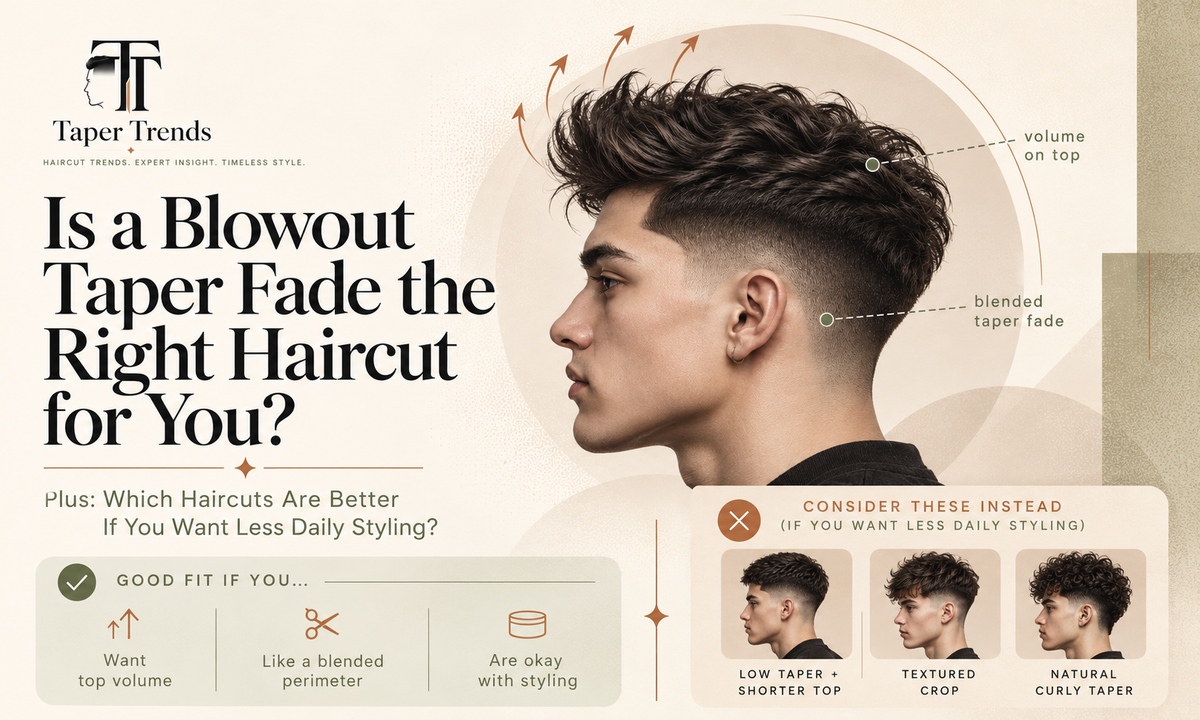
A blowout taper fade suits you if you want visible top volume and a blended perimeter and you don't mind styling most mornings. It's a weaker fit if you prefer wash-and-go hair, have very little top length right now, or can't get regular trims. Weigh your styling time, hair density and texture, and how much contrast you want.
Which Haircuts Are Better If You Want Less Daily Styling?
| Alternative | Best when | Trade-off |
|---|---|---|
| Low taper with a shorter top | You want a clean blend with little effort | Less lift |
| Textured crop | You want almost no drying | Less volume |
| Natural curly taper | Your curls supply the shape | Needs regular moisture |
If you lean toward the low-effort end, the low taper fade buzz cut, low taper fade for short hair, and curly low taper fade guides show the versions that ask for less from you each morning.
Blowout Taper Fade FAQs
Can you get a blowout taper fade with a beard?
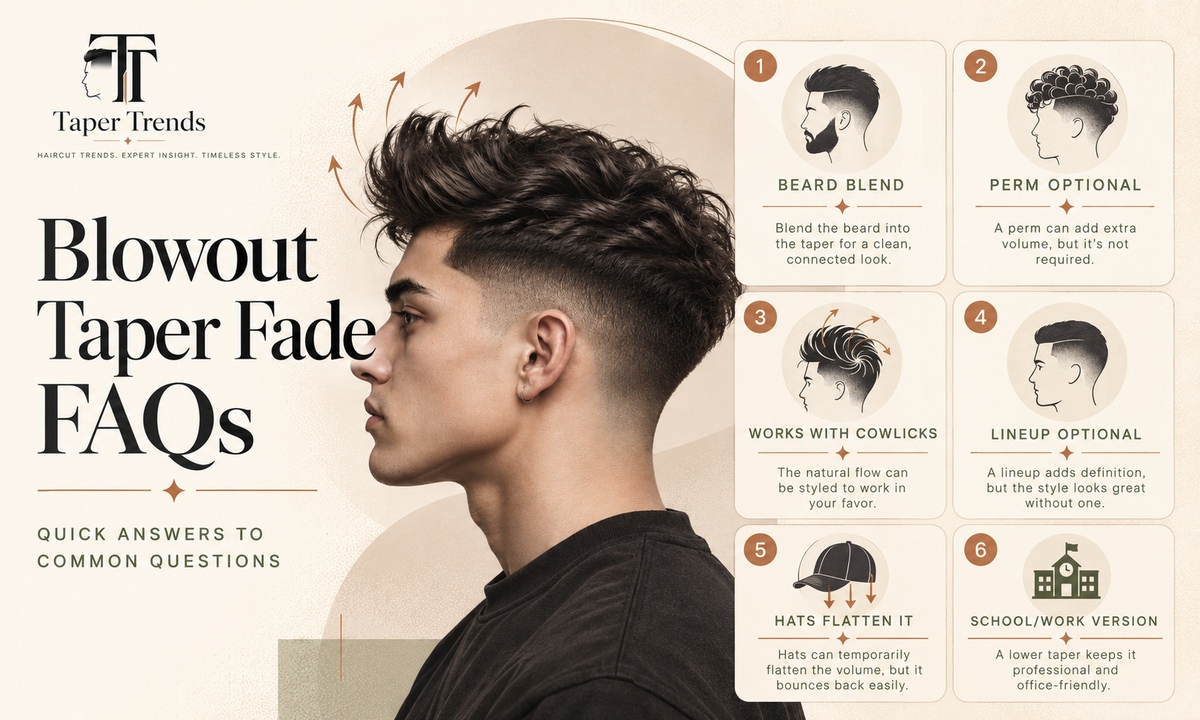
Yes. A temple or sideburn taper can blend into facial hair. A low taper usually connects more naturally into a beard because the transition stays near the natural hairline. Discuss beard density and whether you want a soft or defined transition before the barber starts.
Do you need a perm for a blowout taper fade?
No. Natural texture, the cut, and styling can create the shape on their own. If you do get a perm, follow the package instructions, time the solution carefully to prevent long-lasting damage, and wash it off immediately if it causes excessive stinging or burning.
Can a blowout taper work with a cowlick?
Usually, yes. Ask the barber to look at your hair in its natural growth direction before cutting. A crown or fringe cowlick changes how the top lies, and styling with the growth tends to work better than fighting it.
Is a sharp lineup necessary for a blowout taper?
No. A crisp lineup is a finishing choice, not part of the cut's definition. A natural hairline gives a softer look, while a defined edge shows the temple detail more clearly. Tell your barber which you prefer before the trimmer comes out.
Will wearing a hat or helmet flatten a blowout taper?
Temporarily, yes. Pressure flattens styled volume. Afterward, lift the roots with your fingers or give the top a short low-heat dry, using little or no extra product.
Is a blowout taper fade appropriate for school or work?
Often, but rules vary, so check the dress code first. A high taper may not suit conservative workplaces or schools. A lower taper and a more manageable top give you a subtler version.
What Should You Do Before Your Next Barber Appointment?
Save one front, side, and back reference that matches your hair texture. Decide where the taper should sit, how short the edge should go, how much top length to keep, and how full the upper sides should stay. Bring those details, confirm the starting line in the mirror, and photograph the finished cut so your next appointment starts from a picture instead of a memory.
More blowout and taper guides
Pick the guide that matches your next decision, whether that is the placement, the texture, or the vocabulary:
- Low taper fade haircuts guideThe pillar overview of the low taper fade across every texture and style
- Low taper fade blowoutThe blowout on the softest, lowest taper
- Mid taper fade blowoutThe blow-dried top over a temple-height taper
- Blowout low taper fade, curly hairThe rounded blowout on curls and coils, by curl type
- Taper fade (the full guide)Types, heights and what to ask for
- Taper haircut (the basics)The classic taper before any fade is added
- Taper vs fadeThe core difference and how to choose
- Skin fade vs taper fadeBare scalp against short hair at the edges
- Low taper vs mid taper fadeWhich height to pick, angle by angle
- Mid taper vs high taper fadeContrast, scalp exposure and grow-out compared
- Low taper fade, fluffy hairLoose, textured volume on top
- How to style a low taper fadeThe at-home routine and products
The bottom line
A blowout taper fade is two decisions made together: a full, lifted top and a perimeter that shortens gradually. Pick the taper height for the contrast you want, keep enough length and upper-side weight for the shape to hold, and say all of it out loud before the clippers start.
Start low if you are unsure, bring side and back photos that match your texture, and keep styling light. Done that way, it is a cut that looks full on day one and grows out without drama.
Want more taper fade guides?
Browse clean, barber-ready breakdowns for every hair type.